Tag Archives: oceania

Ancient tooth could help solve human evolution's biggest mystery

A tooth unearthed from a remote cave in Laos is helping to sketch an unknown chapter in the human story.

Researchers believe the tooth belonged to a young female who lived at least 130,000 years ago and was likely a Denisovan – an enigmatic group of early humans first identified in 2010.

The lower molar is the first fossil evidence placing Denisovans in Southeast Asia and may help untangle a puzzle that had long vexed experts in human evolution.

LIVE NEWS UPDATES: New poll suggests voter shift
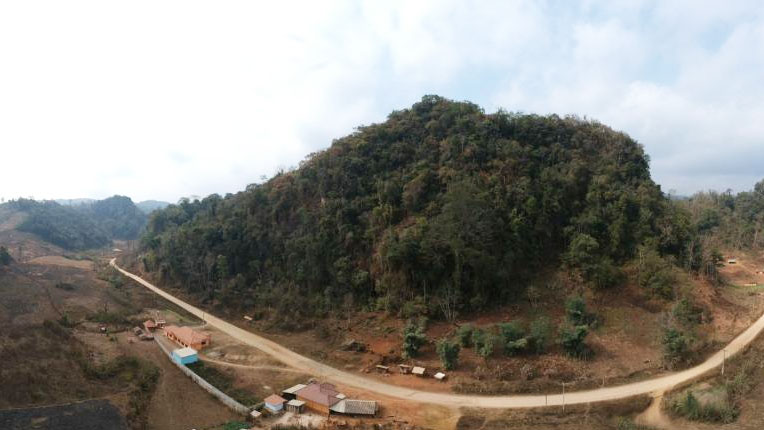
The researchers began excavating Cobra Cave in northern Laos in 2018.

The only definitive Denisovan fossils have been found in North Asia – in the eponymous Denisova cave in Siberia's Altai Mountains in Russia.

Genetic evidence, however, has tied the archaic humans most closely to places much further south – in what's now the Philippines, Papua New Guinea and Australia.

"This demonstrates that the Denisovans were likely present also in southern Asia," said study author Clément Zanolli, a researcher in palaeoanthropology at CNRS, the French National Centre for Scientific Research and the University of Bordeaux.

"And it supports the results of geneticists who say that modern humans and the Denisovans might have met in Southeast Asia."

READ MORE: Seized jewellery going under the hammer from just $1

Archaeologists uncovered the tooth in a place known as Cobra Cave, 260km north of Laos' capital, Vientiane, where excavations began in 2018.

The study, which published in the journal Nature Communications on Tuesday, estimated the molar was between 131,000 and 164,000 years old, based on analysis of cave sediment, the dating of three animal bones found in the same layer, and the age of rock overlying the fossil.

"Teeth are like the black box of an individual. They preserve a lot of information on their life and biology. They have been always used by paleoanthropologists, you know, to describe species or to distinguish between species. So for us paleoanthropologists (teeth) are very useful fossils," Zanolli said.

Comparison with archaic human teeth

The researchers compared the ridges and dips on the tooth with other fossilised teeth belonging to archaic humans and found it didn't resemble teeth belonging to Homo sapiens or Homo erectus – an archaic human that was the first to walk with an upright gait whose remains have been found across Asia.

The cave find most closely resembled a tooth found in a Denisovan jawbone found on the Tibetan plateau in Xiahe county, in Gansu province, China. The authors said it was possible, though less likely, it could belong to a Neanderthal.

"Think about about it (the tooth) as if you are traveling into (a) valley between mountains. And the organisation of these mountains and valleys is very typical of a species," Zanolli explained.
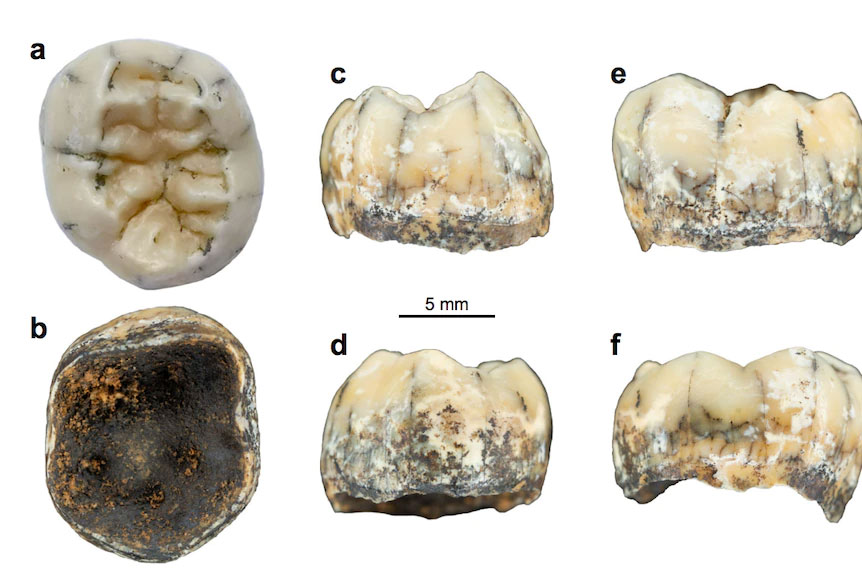
The tooth shown from top, bottom and side angles.

Analysis of some protein in enamel from the tooth suggested that it belonged to a female.

Denisovan DNA lives on in some humans today because, once our Homo sapiens ancestors encountered the Denisovans, they had sex with them and gave birth to babies – something geneticists call admixture.

This means we can look back into human history by analysing current-day genetic data.

The "admixing" happened was thought to have happened more than 50,000 years ago, as modern humans moved out of Africa and likely crossed paths with both Neanderthals and Denisovans.

But pinning down exactly where it happened has proven difficult – particularly in the case of Denisovans.

Definitively Denisovan?

Any addition to the meagre hominin fossil record of Asia is exciting news, said Katerina Douka, an assistant professor of archaeological science at the department of evolutionary anthropology at the University of Vienna.

She wasn't involved in the research.

She said she would have liked to see "more and extensive evidence" that the tooth was definitively Denisovan.

"There is a chain of assumptions the authors accept in order to confirm that this is a Denisovan fossil," she said.

"The reality is that we cannot know whether this single and badly preserved molar belonged indeed to a Denisovan, a hybrid or even an unknown hominin group. It might well be a Denisovan, and I would love it to be a Denisovan, because how cool would that be? But more confident evidence is needed," she said.

In deeming the Laos tooth Denisovan, the researchers in this study relied heavily on a comparison with the Xiahe jawbone, Douka said.

However, the jawbone, while thought by many to be Denisovan, was not an open-and-shut case. No DNA had been retrieved from the fossilized jawbone, only "thin" protein evidence, she added.

"Anyone working on this hominin group, where many major questions still remain, wants to add new dots on the map. The difficulty is in reliably identifying any fossils as that of a Denisovan," she said.

"This lack of robust biomolecular data, however, reduces significantly the impact of this new find and it is a reminder of how difficult it is to work in the tropics.

"The study authors said they planned to try and extract ancient DNA from the tooth, which, if possible, would provide a more definitive answer but the warm climate means that could be a long shot.

The research team also plans to continue excavating the site after a pandemic-induced hiatus in the hope of more discoveries of ancient humans that lived in area.

"In this kind of environment, DNA doesn't preserve well at all but we'll do our best," said study co-author Fabrice Demeter, an assistant professor at the Lundbeck Foundation GeoGenetics Centre in Denmark.

How TikTok is changing the campaign game of Australian politics

As the 2022 federal election heats up and May 21 edges closer, politicians are exhausting all avenues to claim every last vote that counts with debates, photo opportunities and endless posters hung on neighbourhood fences.

Amidst all the strange campaign moments, however, there's one avenue changing the way young voters are viewing Australian politics: the video sharing app TikTok. 

With more than one billion monthly active users, the social media platform has evolved from a viral video factory into a campaigning playground for Australian politics.

FULL COVERAGE: Federal Election 2022

Featuring comedy groups such as Mates Rates and content creators such as Left Right Out, federal election content on the social media app is endless, from satirical campaign spoofs to bite-size explainers on how the election and parties work.

Dr Francesco Bailo, lecturer in digital media and political studies at the University of Technology Sydney, believes TikTok will play a key role in shaping the voting attitude of young voters and ignite their interest in politics.

"The content shared on social media probably won't affect people who are already highly invested in politics," Bailo told 9news.com.au.

"But for those who are not politically active or interested, consuming such content will have a positive effect, especially since TikTok's main demographic is young adults aged 18 to 25 who have to start getting involved in politics."

READ MORE: Sweden ends 200 years of neutrality with move to infuriate Putin

Elfy Scott, co-creator of political podcast series Left Right Out, agrees TikTok's many politically related videos are necessary and helpful in engaging young voters.

"Some people may think that using comedy for raising political awareness is reductive," Scott told 9news.com.au.

"But at least the message is getting out there even if it's just funny spoofs and memes."

With the average TikTok user in Australia spending about 17 hours a month on the app and 44 per cent of them in the 18-24 age bracket, it comes as no surprise many major politicians and parties have also jumped onto the social media bandwagon.

Not all politicians, however, have found success on the video sharing app.

Unlike other social media sites, TikTok doesn't allow paid political advertising on its platform, leaving all parties to their own devices to produce their own original content to find their niche audience.

READ MORE: Scientists predict three COVID-19 scenarios over next five years

"The app has many fascinating uses to reach a wider audience," Scott said.

"But the two major parties aren't doing a fantastic job at communicating to the younger audience, which doesn't help their popularity at all."

Politicians such as Jacqui Lambie and Bob Katter, however, have become favourites for their outlandish videos partaking in viral TikTok trends.

Such videos include Lambie lip syncing to Kath and Kim while decked out in her own merchandise and Greens leader Adam Bandt placing a filter of "sexy Shrek in the sky" gyrating on Parliament House as the "newest Greens candidate".

In Victoria, Wannon's independent candidate Alex Dyson went viral when he teamed up with TikTok star Millie Ford to encourage young voters to cast their own vote and not copy their parents.

Although TikTok has exposed young viewers to the Australian political scene, the app's effectiveness in boosting approval ratings of the politicians who use the app is still to be determined.

"It's a bit early to find some robust results whether TikTok is an effective campaign platform," Bailo said.

"But what we have observed so far is that not every party has the same footing on the app.

"When you're moving onto a different campaigning background anything can backfire so with apps like TikTok you really have to give it your all or know who your target audience is."

READ MORE: Ukrainian forces reach Russian border near Kharkiv

While the popular videos on Tiktok by politicians and content creators are engaging and informative, Bailo notes the app shouldn't be used as a primary source to be informed about politics.

"A lot of important issues can't be mediated through social media in general as they're very complicated," Bailo explained.

"[TikTok] users should keep in mind that social media has the power to also distort information or neglect certain political issues which seem 'boring' in order to get more views or likes."

Woman attacked by kangaroo at Gold Coast golf club

A woman has been hospitalised after being targeted by a kangaroo at a popular Gold Coast golf club, where other golfers have reported ongoing attacks.

Mary Kohler, 64, was playing golf with a group of friends when a kangaroo attacked her at the Arundel Hills Country Club two weeks ago, leaving her with bleeding gashes along her neck and back.

"I could feel the pounding and the scratching," Kohler said.

READ MORE: Mask mandates back on the cards as COVID-19, flu surges

Mary Kohler, 64, was playing golf with a group of friends when a kangaroo attacked her.Members say nothing has been done about the kangaroos.

"I was screaming for help… my playing partners heard my cries and rushed to help.

"One of my girlfriends jumped out of the cart with a golf club and pounded the kangaroo off my back.

"It was quite terrifying. At this stage I didn't realise the extent of my injuries."

Staff at the golf club confirmed the kangaroos were getting out of hand, with more golfers forced to fend the animals off with their clubs.

EXPLAINER: Everything you need to know about voting early in the Federal Election

Staff at the golf club confirmed the kangaroos were getting out of hand.

In a video posted to Facebook, a club member is heard telling staff about the ongoing attacks.

"A roo has attacked 15 people now," he is heard saying.

"It's still out there.

"What are you going to do, let a roo keep attacking people? What if it attacks a kid and kills it?"

Members said despite ongoing complaints to the club over the last few years, nothing has been done about the kangaroos.

 other golfers have reported ongoing attacks.

While the club has signs warnings golfers not to approach the kangaroos, they appear in large numbers throughout the course.

9News reached out to the Arundel Hills Country Club for comment but they did not respond.

Queensland Parks and Wildlife say the club is private property, however they've notified the club they must call animal specialists to relocate any dangerous kangaroos.

Teen becomes youngest Aussie to climb Mt Everest

Gabby Kanizay, 19, has become the youngest Australian woman to climb the summit of Mount Everest.

Venturing from Melbourne's eastern suburbs, the Brighton teen has conquered the highest mountain in the world.

Kanizay said it was the most amazing feeling.

READ MORE: 'Very high chance' grandfather missing in Victoria's freezing alpine region could be alive

"Just to know that you're literally on top of the world and there is nobody higher than you at this point," she said.

The 19-year-old tackled the peak with her mum Jane by her side.

Along with their Sherpas, they were able to spend an hour at the summit and watch the sun rise from the top, something Kanizay said she would never forget.

"We definitely helped each other stay strong and helped each other get to the summit," she said.

"Now it's this experience, we will be able to share together for the rest of our lives which is awesome."

Kanizay said she set herself the goal to climb to the top of Everest when she was just 14.

Back home in Brighton, her father, Jarrod, said he was incredibly proud and overjoyed.

He said he never doubted his daughter's determination.

"She's very courageous and she's very sporty," he said.

"She has an energy about her that does allow her to stick to her guns and follow through."

READ MORE: Ryanair CEO unleashes scathing attack on Boeing management

Jarrod said the pair have been training for the climb for years.

"It's very special because Gabby and Jane have done it together over four years now," he said.

"To have had these incremental efforts over the four years come to fruition now is just mind blowing.

"Gabby brings a spirit of happiness and complete joy to any room that she enters so for her to achieve this, it is amazing."

While Gabby has now conquered Mount Everest along with her mum, the teen says she won't stop now.

She has her sights now set on completing all 14 peaks across the world.

Jury sees photos of Amber Heard's swollen face after fight with Depp

Jurors in Johnny Depp’s libel trial against his ex-wife, Amber Heard, saw photos on Monday of her with alleged red marks and swelling on her face after their final fight before their divorce, and heard testimony about her expertise in covering up bruises with makeup.

Heard concluded her direct testimony in a Virginia courtroom with a third day that was centred on the final months of her marriage to Depp.

His lawyers began their cross-examination later in the afternoon.

READ MORE: Federal Court overturns decision that a refugee advocate pay Peter Dutton damages over defamation case

Actor Amber Heard testifies in the courtroom at the Fairfax County Circuit Courthouse in Fairfax, Virginia on Monday, May 16, 2022.

The trial is now in its fifth week, and jurors have seen multiple photos of Heard throughout the trial that purport to document the abuse she said she received during her relationship with Depp.

Several of the photos shown on Monday, though, had not previously been seen by the jury and showed redness and swelling much more clearly than earlier photos.

Heard said the marks came when Depp threw a phone at her face.

The confrontation in May 2016 prompted Heard to file for divorce two days later. A few days after that, she obtained a temporary restraining order after a courthouse hearing, and was widely photographed leaving the courthouse with a clear red mark on her right cheek.

The final fight has been a key point in the couple’s ongoing dispute.

Depp is suing Heard in Fairfax County Circuit Court for libel over a December 2018 op-ed she wrote in The Washington Post describing herself as “a public figure representing domestic abuse".

His lawyers say he was defamed by the article even though it never mentioned his name.

READ MORE: NSW plastic bag ban coming next month

Amber Heard displayed a makeup kit in the courtroom, saying she used makeup to cover up bruises.

Depp says he never struck Heard and that she’s concocting claims she was abused.

Earlier in the trial, jurors heard from police officers who responded to emergency calls during that final fight who said Heard’s face looked red from crying but that they saw no visible bruises. Witnesses also testified that they didn’t see bruises on Heard’s face in the immediate days after the fight.

Heard, in her testimony on Monday, said she didn’t cooperate with officers who responded to the couple’s penthouse, and said her face-to-face interactions with officers were very limited.

She also discussed her makeup routine, using a colour correction wheel that she called her “bruise kit” to cover up marks on her face. She said she learned over the years to use green shades in the first day of a bruise to cover up redness, and switch more to orange shades as the bruise turned blue and purple.

“I’m not going to walk around LA with bruises on my face,” she said.

On cross-examination, Depp's lawyer Camille Vasquez questioned Heard about multiple photos of her that appeared not to show bruises even though they were taken within days of alleged abuse incidents. Heard said she used makeup to cover bruises and ice to reduce swelling.

Federal election 2022: How do I vote if I have COVID-19?

Johnny Depp is suing Amber Heard over a December 2018 op-ed she wrote describing herself as "a public figure representing domestic abuse."

“You should see what it looked like under the makeup,” she said.

Vasquez also questioned Heard about her $US7 million divorce settlement from Depp.

Heard pledged to donate the full amount to charity but has so far only donated a portion of it. She testified she’s been unable to fulfil her pledge yet because Depp sued her for $50 million. But on cross-examination she acknowledged that she had received the full $US7 million from Depp months before he filed the lawsuit.

In her direct testimony, Heard testified she did not want to publicly expose Depp as an abuser in her court proceedings, but had to go to the courthouse to provide testimony to obtain the restraining order, and she was taken aback when she left the courthouse surrounded by paparazzi.

“I just wanted to change my locks,” she said about why she went to court to get the restraining order.

“I just wanted to get a good night’s sleep.”

During Monday’s testimony, Heard also strongly denied an accusation from Depp that she left human fecal matter in the couple’s bed after a fight. Heard said it was the couple’s teacup Yorkshire terrier that messed the bed and that it had a history of bowel problems ever since it had accidentally ingested Depp’s marijuana.

“Absolutely not,” she said about the alleged poop prank.

“I don’t think that’s funny. I don’t know what grown woman does. I was not in a pranking mood.”

Heard said, though, that Depp became obsessed with the idea that someone had pooped in his bed. She said it was all he wanted to talk about during that final fight on May 21, 2016, even though Depp’s mother had just died and the couple hadn’t spoken in a month.

READ MORE: These toxic mushrooms are no fairytale, expert warns

Amber Heard said in her testimony that accusations she receives on a daily basis from Depp supporters that she's lying about the abuse are "torture."

The poop allegation is one of several that Depp’s online fans have particularly latched onto in their social media critiques of Heard.

Heard also talked about the op-ed piece itself, saying staffers with the American Civil Liberties Union — for whom she had started work as an ambassador — wrote the first draft. She said she was happy to lend her voice to the debate over domestic violence, and wasn’t intending to reference Depp.

“It’s not about Johnny,” she said.

“The only one who thought it was about Johnny was Johnny. It was about me, and my life after Johnny.”

Heard concluded her testimony by saying that accusations she receives on a daily basis from Depp supporters that she’s lying about the abuse are “torture.”

“I want to move on with my life,” she said.

“I want Johnny to move on. I want him to leave me alone.”

Porsche driver charged after wild police pursuit in Sydney's west

A man has been charged after taking police on a wild chase through Sydney's south-west last night.

NSW Police stopped a Porsche on Reginald Avenue, Belmore, at around 6.10pm yesterday, for a random breath test.

However, as the officers spoke to the 29-year-old driver, he allegedly drove off, sparking a lengthy pursuit through two suburbs in Sydney's south-west.

READ MORE: Scientists predict three COVID-19 scenarios over next five years

A Porsche driver has been charged after a police pursuit through Sydney's south-west.A Porsche driver has been charged after a police pursuit through Sydney's south-west.

At the intersection of Wirega Avenue and Moorefields Road, Kingsgrove, the Porsche collided with a parked car.

"There was a loud bang and we heard the sirens, the police sirens," a witness said.

The man and a 40-year-old female passenger ran from the crashed Porsche but were caught by police and arrested a short time later.

The woman has since been released.

READ MORE: Ukrainian forces reach Russian border near Kharkiv

A Porsche driver has been charged after a police pursuit through Sydney's south-west.A Porsche driver has been charged after a police pursuit through Sydney's south-west.

Police discovered the 29-year-old driver's licence had been disqualified in 2013, until 2057.

"It will be further alleged the man was involved in multiple fraudulent online transactions committed earlier this year," NSW Police said in a statement.

The man has been charged with 18 fraud offences and three offences over the police pursuit.

He appeared before a magistrate at Bankstown Court today where he was denied bail and kept behind bars.