By Hamish Cardwell of RNZ “Let me put it this way …. this is a big deal” – that’s the Climate Change Minister on the suite of climate policies about to drop.The next 10 days may see a historic shift in climate policy in Aotearoa.We…
Tag Archives: oceania
Major mental health, addiction treatment shift proposals would extend 'young adult' treatments to age 25
A focus on the first thousand days of life and extending young adult treatment options until people turn 25 are among proposed mental health and addiction service reforms.And people with personal experience of mental health distress…
What North Korea learned from Ukraine on nuclear weapons
If North Korea was looking for another excuse to forge ahead with its nuclear weapons program, it just found one in Russia's invasion of Ukraine.
That one of the very few countries to have voluntarily given up a nuclear arsenal is now under attack from the same country it gave its warheads to will not be lost on Pyongyang.
In fact, analysts say, Moscow's actions have gifted the reclusive Asian nation a "perfect storm" of conditions under which to ramp its program up.
READ MORE: Putin risks escalating Ukraine war on Victory Day

Not only will North Korea use Ukraine's plight to bolster its narrative that it needs nukes to guarantee its survival, but leader Kim Jong-un may find that, with all eyes on the war in Europe, he can get away with more than ever.
Divided over Ukraine, the international community will likely have little appetite for sanctions on the hermit kingdom; indeed, even unified condemnation of a recent North Korean ICBM test remains elusive.
What's more, the boycott of Russian oil and gas could even open the door to cut-price energy deals between Pyongyang and Moscow – ideological allies whose friendship harks back to the Korean war of the 1950s.

In the worst-case scenario, experts even wonder whether this is the start of a once unthinkable chain of events that could end with a return to inter-Korean conflict, perhaps even with the North invading the South, though most see this as highly unlikely.
As professor Andrei Lankov of Kookmin University puts it, the lesson North Korea has learned from Russia's war in Ukraine, is simple: "Never, ever surrender your nuclear weapons."
A nuclear lesson, from Ukraine to Saddam and Gaddafi
Moscow's invasion of its neighbour has reinforced a message that has been playing on Pyongyang's mind for decades, Lankov said.
When Ukraine was part of the USSR, it hosted thousands of nuclear warheads.
It voluntarily handed these over to Russia after the Soviet Union collapsed in 1991, as part of a 1994 deal with the United States, United Kingdom and Russia which would guarantee Ukraine's security, a deal known as the Budapest Memorandum.
Ukraine now finds itself under brutal attack from the very same country that signed the deal to protect its sovereignty, one that now repeatedly refers to its nuclear arsenal to warn the West off intervention.
READ MORE: Putin's reputed girlfriend Alina Kabaeva included in proposed EU sanctions list, sources say
Would Moscow have invaded if Ukraine had kept its warheads?
Most experts, and most likely Pyongyang too, think not.
"Now (the North Koreans) have got yet another confirmation (of this lesson) after Iraq, after Libya," Lankov said.
Pyongyang regularly uses the experiences of Saddam Hussein and Moammar Gaddafi, the former leaders of Iraq and Libya, to justify its nuclear program, both to its own people and the world.
Both strongmen leaders lost their grips on power and, ultimately their own lives, after their own nuclear ambitions came grinding to a halt.
The Russian invasion will bolster that narrative, but in doing so it could also have a "very negative impact" on the mind of North Korea's own strongman leader, according to Lee Sang-hyun, president and senior research fellow of the Sejong Institute.
He says Kim is likely to respond in only one way: by becoming "even more obsessed with his nuclear weapons and missile capabilities."
Pyongyang's carte blanche
Even before the invasion, North Korea had shown signs of ramping up its nuclear ambitions.
On Saturday, it held its 14th missile launch of the year, up from just four tests in 2020 and eight in 2021.
One of the missiles tested this year was believed to be an ICBM (intercontinental ballistic missile) that is assumed capable of hitting the mainland US.
That was the first ICBM test since 2017 and was widely seen as a harbinger of tests to come.
READ MORE: Afghanistan's Taliban order women to cover up head-to-toe
Kim made clear his intention to go full speed ahead with his nuclear program at a military parade on April 25.
And commercial satellite images suggest Pyongyang is trying to restore access to its Punggye-ri underground testing site, according to South Korean officials and think-tanks.
US officials tell CNN North Korea could be ready to resume nuclear testing later this month.

Against this background the Russian invasion, and the international sanctions that followed, have created a "perfect storm" of conditions for Pyongyang to operate in, analysts say.
"There are some interesting, perhaps unintended consequences for the Western response against Russia in particular, which is that a Russia that has been completely isolated from the global economy and put under tremendous sanctions pressure. I think it has very few incentives to enforce sanctions against North Korea," said Ankit Panda, a senior fellow in the Nuclear Policy Program at the Carnegie Endowment for International Peace.
A clear split among United Nations Security Council permanent members, Russia and China on one side, the UK, US and France on the other, means any unified decision to punish North Korea is impossible.
READ MORE: Massive 450kg beast recorded swimming off US coast
"It's quite clear that China and Russia will block additional sanctions and frankly it's not quite clear, what else can you possibly sanction," Lankov said.
Even a seventh nuclear test may not provoke the usual negative response from Beijing, "China is not going to be happy enough about nuclear tests, but they will swallow it," Lankov said.
Cashing in with an old friend
If anything, North Korea may even benefit financially as other countries boycott Russian oil and gas.
The cash-strapped country would be more than happy to take up some of the slack, potentially at a discount, and deal with a Russia no longer constrained by US-led sanctions against the North.
"I think that Russia is going to provide more economic support and energy support to North Korea," said Ramon Pacheco Pardo, the KF-VUB Korea chair at the Institute for European Studies of Vrije Universiteit Brussel.
"Oil and gas, certainly but it could also include food… fertilisers, it could be all sorts of economic aid North Korea wants."

That Pyongyang would side with Moscow in a new world order is not a surprise.
Relations between the two countries were forged by the Korean War of 1950-1953, and they shared a communist ideology for decades.
The former Soviet Union was a major benefactor to North Korea, financially propping the Kim regime up.
While that task has now transferred to China, the return of Russia to strongman rule under President Vladimir Putin has put a new shine on the relationship.
"(Pyongyang) were sort of disgusted about the democratic and liberal or semi-democratic, semi-liberal Russia which used to exist, and they basically greeted Vladimir Putin as a leader who was driving the country into the right direction," Lankov said.
FULL COVERAGE: Federal Election 2022
Kim's fleeting dance with the US, holding three meetings with former President Donald Trump that ultimately yielded little, only reminded him his more natural and lucrative allegiances remain with China and Russia.
Pyongyang for its part has made clear where it places the blame for the war in Ukraine.
"The root cause of the Ukraine crisis lies totally in the hegemonic policy of the US and the West which indulge themselves in high-handedness and arbitrariness towards other countries," its Foreign Ministry said.
Would North Korea invade the South?
Since Russia's invasion, North Korea's rhetoric towards South Korea has changed.
Last month Kim's sister, Kim Yo Jong, warned that if South Korea was to confront the North militarily its army would "face a miserable fate little short of total destruction and ruin."

Threatening language from Pyongyang is nothing new, a US official once described being insulted publicly by North Korea as like a "badge of honour."
What is new is that since the invasion, experts like Lankov have been asking whether North Korea would consider an invasion of the South again, more than seven decades after its invasion in 1950 sparked the Korean War.
That question has for years been dismissed out of hand.
Most experts still see the changes as negligible, but the fact it is even being discussed is noteworthy.
READ MORE: How $10,000 in stolen goods were recovered with a simple $45 gadget
"North Koreans are probably dreaming again about something that (they) used to take seriously, but in recent decades nearly forgot. That is conquest of the South," Lankov said.
For now, the idea seems fanciful. But the future is another matter.
"Maybe, just maybe, the American President of the year 2045 or 2055 will not risk San Francisco in order to save Seoul," Lankov said.
"(By then) North Koreans could use ICBMs, maybe nuclear armed submarines to (terrify) Americans, to blackmail Americans out of the conflict."
China 'interference and intrusion' a challenge for Pacific leaders: PM
Prime Minister Scott Morrison said today Australia is "very aware" of Chinese ambitions in the Pacific after reports Beijing is planning to build port infrastructure on the Solomon Islands.
Morrison was asked by reporters during a campaign event on the NSW South Coast about a leaked draft maritime cooperation deal between the Solomon Islands and China obtained by The Australian newspaper.
"We are very aware of what's happening in our region and of the pressures there that the Chinese government is seeking to put on countries across our region," the prime minister said.
READ MORE: How $10,000 in stolen goods were recovered with a simple $45 gadget
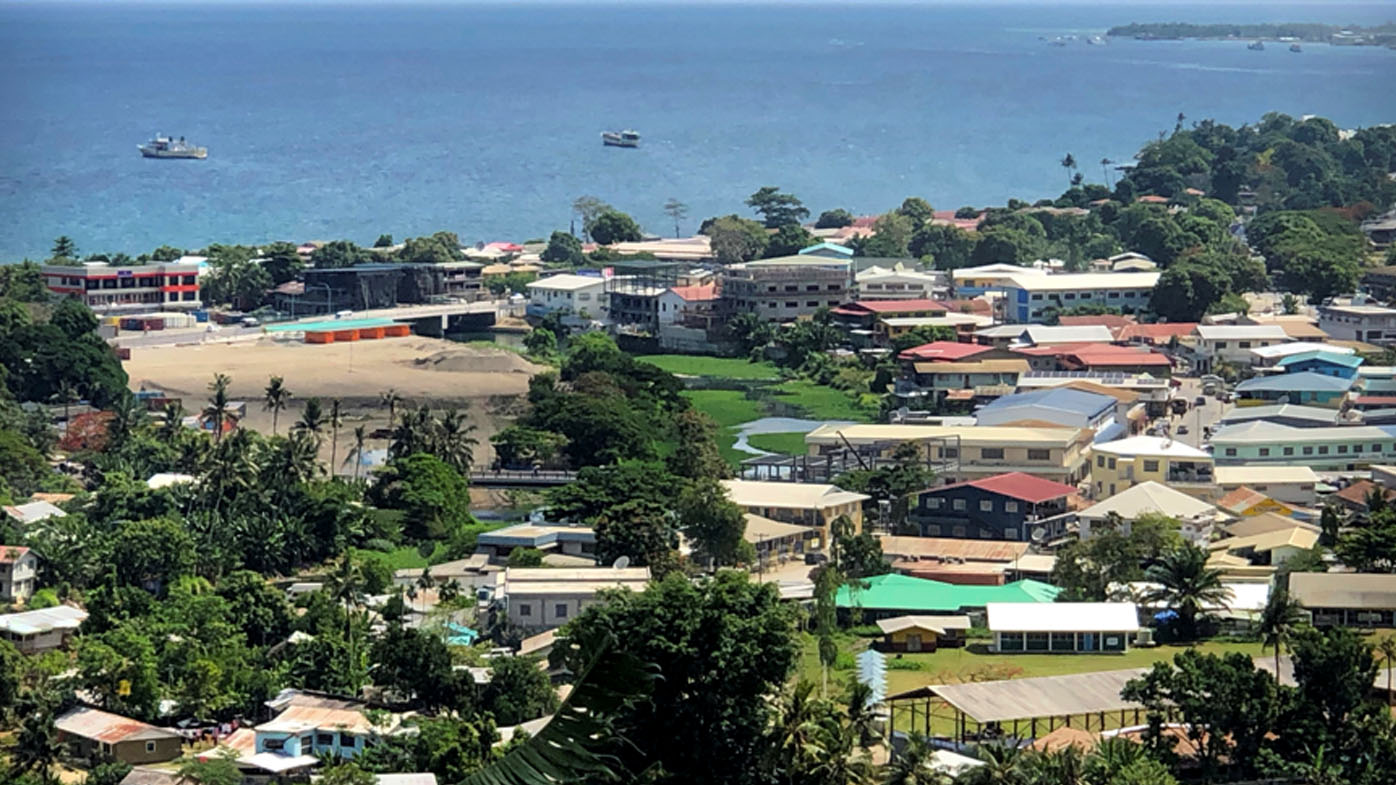
Beijing is aiming to cement closer economic and security ties with the Solomon Islands – which is 1700km from the Queensland coast – by pledging to build shipyards, wharves and submarine cables in the Pacific, the report said.
The leaked document also said China wants to set up deep-sea fishing facilities and explore underwater mining in the Pacific.
Morrison repeated his assertion that the security deal between the two countries was not in the interests of the Solomon Islands.
"I don't believe it's in the Solomon Islands' national interest. That is ultimately a matter for the people of the Solomon Islands.
"I am very concerned, as many other Pacific leaders are, about the interference and intrusion of the Chinese government into these types of arrangements and what that can mean for the peace, stability and security of the south-west Pacific."
READ MORE: US inmate and ex corrections officer still on the run after a week

During his visit to the NSW South Coast, Morrison launched the Coalition's 'safe and secure Australia' policy at the HMAS Albatross naval base.
The blueprint flagged the biggest expansion of Australia's armed forces since World War II, including 54 new naval vessels and $8 billion for a new fleet of helicopters for the ADF.
Morrison said the Coalition planned to continue building the defence budget towards a target of 2 per cent of GDP.
"Our policy continues to set out the significant investments that we are making to ensure our defence capabilities, our intelligence capabilities, our border protection capabilities, are strong and secure."
Cooking the Books podcast: Can rising wages be a bad thing?
Each week BusinessDesk and the NZ Herald’s Cooking the Books podcast tackles a different money problem. Today, it’s why you might not feel richer despite rising wages, and how to change that. Hosted by Frances Cook. Wages have…
Napier charity fundraiser fatality: Witness tells of motorcycle 'flying across road'
A witness has described a large motorcycle “flying across the road” immediately after a crash which killed a woman on a charity ride. Another has said there was an “implosion” as two motorcycles collided in front of her car as she…
How Aussie inventions changed the world
From healthcare, to travel, to technology and food, Australian inventions have changed the world we live in.
Meat and vege prices predicted to keep soaring
Already strained Aussie households must brace for steadily rising fresh meat and vegetable prices this year, an analyst has warned.
The cost of beef, lamb, chicken and pork have all jumped from this time last year, according to latest Consumer Price Index (CPI) data.
Coffee lovers have also seen sharp rises to their favourite drink, while alcohol prices are on their way up too, underlining why the cost of living is proving such a crunch battleground on the federal election campaign trail.

READ MORE: Morrison and Albanese clash in heated second leaders' debate
Beef prices have increased 9 per cent from 2021 levels, largely because of strong demand from China, with lamb lifting almost 7 per cent.
Chicken and pork have so far been least affected, however that could be about to change with global feed grain shortages caused by Russia's invasion of Ukraine.
Matt Dalgleish, manager of commodity markets insights at Thomas Elder Markets, warned Aussie chicken and pig farmers are probably on the brink of passing on rising production costs to shoppers and supermarkets.
"I think for the next year there's going to be price pressures for consumers across a whole range of products," Dalgleish told 9news.com.au.
READ MORE: Massive 450kg beast recorded swimming off US coast

ANALYSIS: What did we learn during The Great Debate?
Australia's COVID-19 restrictions had seriously curtailed backpacker labour on livestock and horticultural farms, he said, and that issue is now manifesting in fresh food prices.
"There has been quite a few stories getting around about farmers with the inability to harvest at the right time who are forced to leave product to rot in the ground, or they're turning it back into the ground because they've just not got access to the labour force.
"That lack of supply of product has been flowing through into higher prices at the supermarket for a whole range of vegetables."
The cost of vegetables and coffee are up 8 per cent, compared to 2021, with milk closing in on 4 per cent.
Alcohol prices had lifted by about 15 per cent in the past five years, Dalgleish said, after being relatively stable through the first half of the last decade.
Meat and seafood had increased by more than a third from levels seen in 2013.
FULL COVERAGE: Federal Election 2022

Combined with recent and anticipated interest rate rises, Dalgleish said Aussie household budgets would inevitably come under pressure this year.
Last month inflation soared to a 21-year high, rising 5.1 per cent annually.
The jump in inflation surprised many analysts, who had expected an increase to no more than match the 2008 Global Financial Crisis, when annual CPI hit 5 per cent.
House prices, mortgage repayments, and the cost of food, schooling and fuel have been front of centre of federal election debates.
Man allegedly kidnapped and assaulted in regional Victoria
Police are appealing for information after a man was allegedly kidnapped and assaulted in regional Victoria last week.
Police say a man was picked up by a woman driving a blue Holden Commodore sedan from a Hamilton address about 11.30pm on Friday.
Once inside the vehicle, police believe the man was allegedly assaulted by a man hiding inside the car.
READ MORE: WWII medals found hidden in garage sale furniture

The offenders then drove to a petrol station on Cox Street in Hamilton where the victim managed to escape and raise the alarm.
The 38-year-old Hamilton man was taken to hospital with facial injuries.
The investigation remains ongoing, and investigators are keen to speak to any witnesses.
Record high number of little penguins gather on Victorian beach
Victoria's Phillip Island beach has hosted the highest number of little penguins in 54 years in what one scientist called a "penguin party".
Some 5219 little penguins swum into shore at Phillip Island and waddled up the beach to their burrows in just one hour on Tuesday, May 3, marking the highest number recorded there since 1968.
The record-breaking event came as a surprise, with the largest numbers of penguin crossings usually occurring during the peak of breeding season in November and December.
READ MORE: Thousands of unnecessary calls to triple zero every month in Victoria

"We couldn't believe our eyes when more than 5000 penguins came out of the water in less than an hour," Phillip Island Nature Parks' scientist Paula Wasiak said.
"It's been a penguin party night after night, which is unusual for this time of year, let alone in record numbers like we are seeing now."
Between 3000 and 5000 penguins came in every other night last week, with as many as 4500 counted on one week the night prior.

The average number of penguins who burrowed at the beach each night last year ranged from around 700 in July to 2300 in November.
Wasiak said it seemed that an abundance of food close to shore was allowing the penguins to gear up for the biggest Autumn breeding attempt ever seen.
"While penguins usually breed during spring and summer, older, more experienced birds are known to take advantage of a secondary peak in marine productivity in autumn, which can result in an increase in colony attendance and breeding behaviour."
READ MORE: Trio of baby lions born at regional Australian zoo

She said work to improve the dune structure and restore the habitat following erosion at the beach had also likely contributed to the increase in penguins visiting.
Phillip Island's colony of about 40,000 little penguins is the largest in the world.
Visitors pack stands by the beach to watch the penguins arrive each night, with the parades have been booked out every night during the Easter school holidays.