Originally published by The Spinoff America is trying to end daylight saving once and for all. Here’s how New Zealand can do it too. This weekend is shaping up nicely. On Saturday, you’ll probably have a blast. In Auckland,…
Tag Archives: oceania
Ardmore vegetation blaze: Fire and Emergency trying to contact property owner
Fire and Emergency are trying to track down the owner of a southeast Auckland rural property where a vegetation fire is burning for a second day.Crews have worked overnight to contain the blaze on Papakura-Clevedon Rd in Ardmore….
Jack Tame: Better games than Wordle are Worldle and Tradle, geography and trade
OPINION: I’m always late to digital trends. I’ve never recorded a TikTok. I haven’t invested in Bitcoin. It was only last year that I finally stopped using an old-school paper-and-pen diary to organise my schedule. So when at…
New anti-COVID-19 drug eliminated virus in three days, study shows
A new anti-COVID-19 drug has shown promising signs of eliminating the virus in three days, a study has revealed.
Clinical trials of the American made drug Molnupiravir have shown the pill can "eliminate" a mild to moderate COVID-19 infection by day three of the treatment.
However, a COVID-19 patient needs to start the drug within five days of developing symptoms.
READ MORE: Chinese military set to be based on Australia's doorstep

Molnupiravir is an "oral antiviral prodrug" that has been used to fight coronaviruses, including COVID-19.
The drug has been provisionally approved by the Therapeutic Goods Administration in Australia
The study carried out by Merck & Co, the manufacturer of the drug, found that zero of the 92 participants with COVID-19 still had the virus by day three of taking Molnupiravir whereas 21 per cent of participants who had a placebo still had the virus at that time.
Dr Julie Strizki, the scientist heading the study, concluded a five-day course of Molnupiravir is effective in rapidly eliminating COVID-19.
"This study provides additional evidence that molnupiravir helps those infected clear SARS-CoV-2 (COVID-1) faster than placebo," she said.
"Molnupiravir can lower the risk of progression to serious illness in this high-risk cohort."
READ MORE: Asian countries once COVID-19 success stories see massive outbreaks

It also appears to clear the virus equally well in immunocompromised patients.
The study also revealed the drug can improve symptoms quicker, especially loss of smell and fatigue
The results of the studies will be presented at the European Congress of Clinical Microbiology & Infectious Diseases with hopes the pill will be approved for emergency use in Europe.
READ MORE: NSW, Victoria record drop in COVID-19 cases
Covid-19 – Health leader Rawiri Jansen says Māori dying because of misinformation
A Māori health leader says a new international misinformation study confirms the alarm many were desperately trying to raise last year about the impact on Māori during the initial vaccine rollout.The article in the Journal…
iPhone saves life: NZ snowboarder defies death after Swiss Alps mountain crevasse fall
A New Zealander who plummeted almost 5m down a hidden crevasse while snowboarding off-piste and alone has revealed how his iPhone – with just 3 per cent battery power – saved his life. Tim Blakey, 41, was snowboarding in the Swiss…
Speeding motorcyclist in Dunedin loses licence after police pursuit, dangerous 'lunatic' ride
A young motorcyclist who drove at more than 150kmh through suburban Dunedin acted like a “lunatic”, a judge says.When Kenneth Michael Cowie (20) saw the flashing lights of a police car on January 27 this year, he panicked.Police…
How lockdown triggered Jade's late autism diagnosis
It was during Victoria's first lockdown in mid-2020 that Jade Mekon was forced to confront issues she had been dealing with her whole life.
The 31-year-old from Bendigo had always had what she calls "meltdowns", where her struggles to cope with daily life would come to a head.
But when the pandemic hit, Ms Mekon said they started happening more frequently.
"I've always needed routine and structure to be able to function on a daily basis and when that was taken away during lockdown I experienced more frequent and intense meltdowns than I had ever before," Ms Mekon said.
READ MORE: Aussie scientists create screening test to diagnose autism in babies

"I knew that working from home was obviously having a negative effect on my mental health, but I had no idea what was going on."
It wasn't until a friend suggested that her experiences sounded a lot like autism that the lightbulb moment happened.
"I hadn't really considered it before but I went online and did some research about how autism presents itself in women," she said.
Ms Mekon could relate to many of the signs she was reading about.
Growing up, Ms Mekon said she was "always really, really bad with change" and needed everything to be organised properly.
"If anything changed I would just freak out."
Ms Mekon said she also used a lot of repetitive, self-soothing behaviours as a child to cope in the classroom – known as stimming.
"One of the big ones was I used to always have Blu Tak in my hands and I was used to just play with that to help me concentrate."
There were also sensory issues with noises, lights and food, she added.
"I have massive sensory issues with food and I have always been like that. I struggle to eat new foods. Chicken nuggets and schnitty always get me through.
"The signs were always there, it was just I don't think anyone kind of knew how to put a name to it."
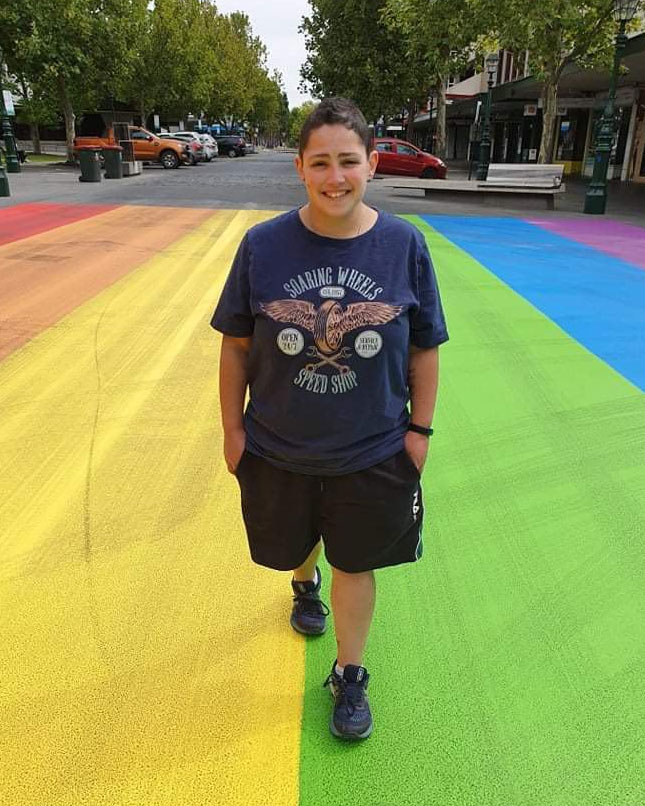
Despite all these behaviours pointing to autism, Ms Mekon said her GP wasn't convinced and was initially reluctant to refer her to a psychologist for assessment.
"He didn't want to write the referral, and I said to him it makes no difference to you whether you write it but it could make a massive difference to my mental health," she said.
"I basically sat there and refused to leave his office until he gave me a referral."
After a series of assessments, her psychologist diagnosed Ms Mekon with mid-level autism.
"She basically took one look at me and was like, how have you not been diagnosed already?" Ms Mekon said.
It was a relief to finally have the diagnosis, Ms Mekon said.
"Even though I'd expected it, I was like, holy s**t, there's an actual explanation for why I am the way that I am," she said.
But it soon came with an underlying resentment too.
"It did kind of mess with my head a little bit," she said.
"I was a little bit angry that no one noticed it earlier because if I had gotten the support that I get now, when I was younger, it probably would have helped me a lot."
Ms Mekon said while her diagnosis made sense to her family and those closest to her, many expressed surprise when she broke the news.
"A lot of people that I told, were like, 'Oh, no, you're fine, you're absolutely fine'.
"But they don't see what happens at home and the struggles that I have with just daily stuff."
Ms Mekon said she had become an expert at masking over the years, adapting her behaviours to suit society's expectations.
"Masking is when autistic people basically pretend that everything's okay. I got very good at masking."
Elizabeth Sarian, from Autism Awareness Australia, said it was now well known that females were better at masking the signs of autism than males.
"Girls are much better at adapting socially and learning how to adjust their behaviours," Ms Sarian said.
"They call it masking but it's a means of protecting themselves and trying to fit in.
"It is absolutely emotionally exhausting for them, and hence why we find that in their teenage years, or in their early adult years, it's a lot more obvious that it really is autism."
Another reason both girls and women tend to be diagnosed later was because the diagnostic criteria for autism was developed around a male profile.
It was not uncommon for women with autism to be misdiagnosed with another mental health condition, such as bipolar or anxiety, first, Ms Sarian said.
A common trigger for both women and men to seek out an autism diagnosis later in life was becoming a parent themselves, she added.
"At the moment we are seeing parents getting diagnosed after their children get diagnosed," she said.
"They are recognising the signs they're seeing in their children are actually really common in themselves."
Ms Mekon, who is sharing her story as part of World Autism Awareness day today, said getting a diagnosis had helped her tremendously and she wanted to encourage anyone who might suspect they are autistic to seek out an assessment.
"If you think that you could be autistic then go and talk to your GP," she said.
"If they're not receptive to it, but you know deep down that you fit every criteria, then find a new doctor.
"Just advocate for yourself would be probably my main advice, especially for women, because women do find it so much harder to get diagnosed."
April 2 is World Autism Awareness Day. For more information on navigating through an autism diagnosis, visit Autism: What Next?
Contact reporter Emily McPherson at em********@******om.au
Milford Track death: Experienced tramper worked as a lodge attendant
The man found dead in Fiordland this week was carrying safety equipment — for what was meant to be a one-day hike — and was an experienced tramper who worked for Queenstown company Ultimate Hikes.He was reported missing shortly…
Vegetation fire in Ardmore, southeast Auckland
A vegetation fire in south-east Auckland has grown to 16 hectares, but is contained.Fire crews were called to the fire on Papakura-Clevedon Road in Ardmore around 4pm.The fire is now contained to the gully where it originated….