Tag Archives: oceania

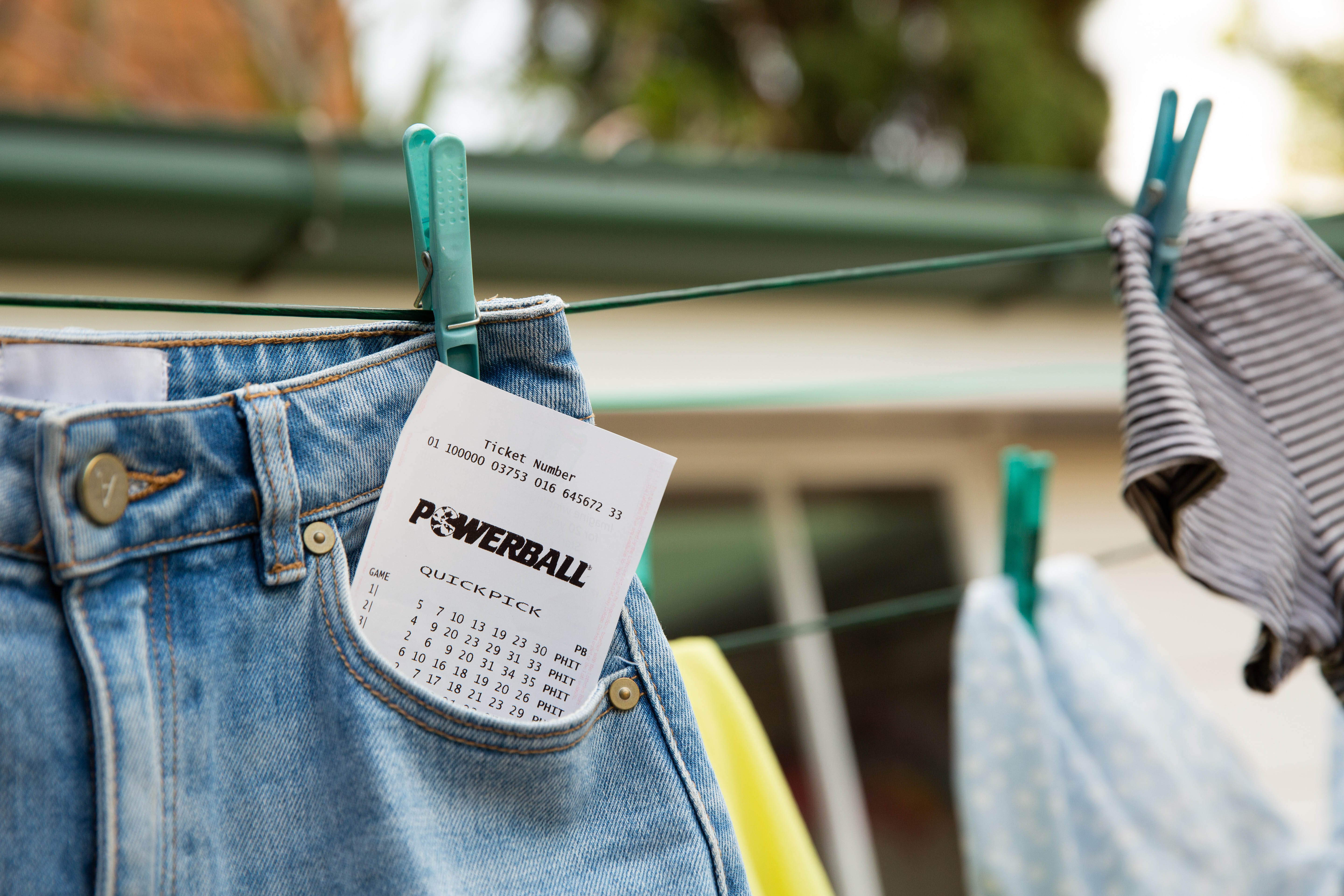
$60m Powerball winner plans to buy 'red sports car'

A Coffs Harbour man is one of two winners splitting last night's $120 million Powerball jackpot and he hasn't shied away from sharing how he's going to spend his winnings.

The "middle-aged family man" checked his ticket this morning and couldn't believe his luck, scoring a whopping $60 million.

"I just checked my ticket earlier this morning. I scanned it on the app. I just couldn't believe it. It came up as division one. Oh mate, it's huge," he said.

"It's like a dream come true."

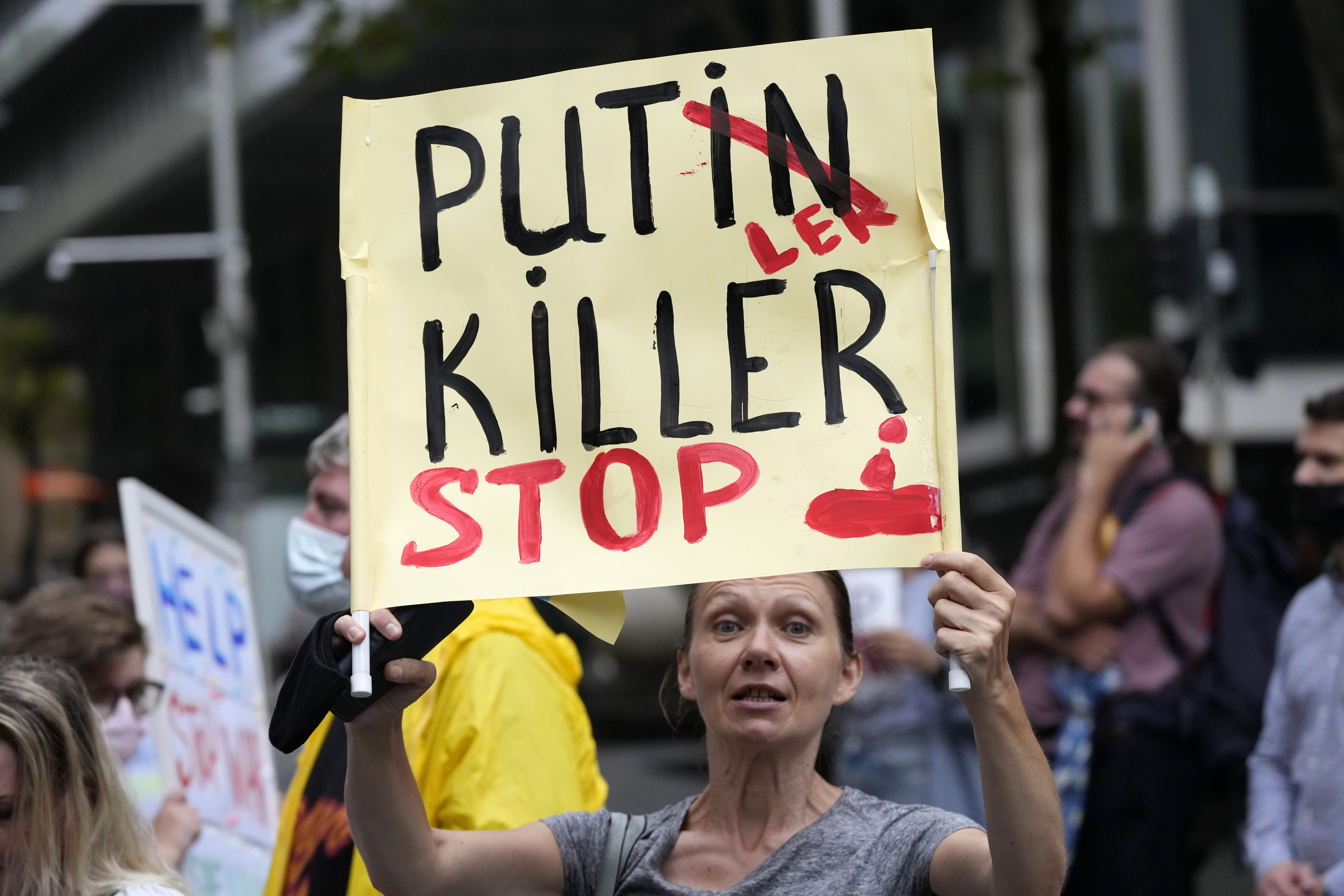
LIVE UPDATES: Russia-Ukraine invasion 'Our worst fears have come true'

Powerball jackpot new car and ticket

The man has shared how he planned to spend his $60 million – with some luxury purchases.

"I've started a wish list already," he said.

"Straight up – a red sports car, a new house, holidays, you name it."

"I also really want to look after my family."

Despite being one of Australia's newest millionaires, the man said he would still show up at work today.

His winning entry was purchased at Coffs News in Coffs Harbour.

The winning numbers in Powerball draw 1345 were 6, 15, 9, 27, 32, 28 and 33. The Powerball is 8.

It comes after officials from The Lott said early this morning the NSW multi-million-dollar winning entry was not registered to a player card, leaving officials with no way of contacting them.

Now the man finally checked his ticket and became an overnight millionaire.

READ MORE: How Russia's invasion of Ukraine unfolded in pictures

Lotterywest operates lotteries in Western Australia and will be getting in contact with the WA winner.

According to The Lott, there were 36 winners in division two.

The jackpot rolled over to $120 million, the second-largest in Australian history, when no winners were declared in the previous week's draw.

Three people shared in a $150 million jackpot in 2019 but the $120 million figure is the largest prize Powerball has offered for more than two and a half years.

What does Putin want in Ukraine? The conflict explained

After months of military build-up and brinkmanship on its border with Ukraine, Russia invaded its ex-Soviet neighbour with a multi-pronged attack, threatening to destabilise Europe and draw in the US.

A whirlwind of diplomatic efforts to stave off a Russian invasion in recent weeks failed to defuse tensions that had mounted over months.

Russia had been tightening its military grip around Ukraine since last year, amassing tens of thousands of soldiers, as well as equipment and artillery, on the country's doorstep.

LIVE UPDATES: Ukraine declares full military mobilisation
The escalation in the years-long conflict between Russia and Ukraine has triggered the greatest security crisis in Europe since the Cold War.

Russia's attacks on several parts of Ukraine raise the spectre of a dangerous showdown between Western powers and Moscow.

So how did we get here? The picture on the ground is shifting rapidly, but here's a breakdown of what we know.

What's the situation on the border?

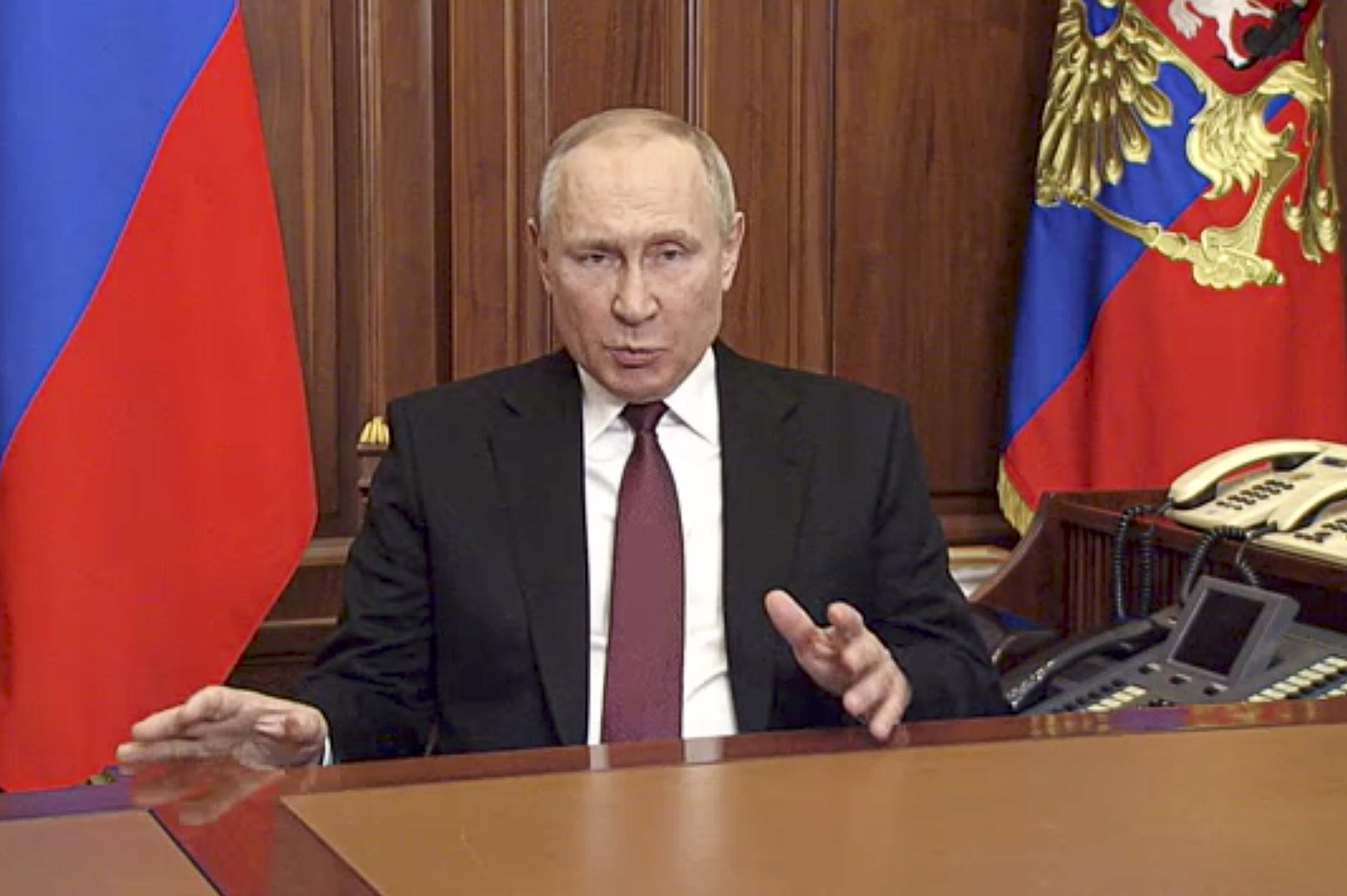
Several areas across Ukraine came under attack on Thursday morning (local time) after Russian President Vladimir Putin declared the start of a "special military operation" and warned of bloodshed unless Ukrainian forces lay down their arms.

The move came after months of speculation about what Moscow's intentions were with the troops it had massed on the Ukrainian border. More than 150,000 Russian troops encircled the country on three sides, like a sickle, according to estimates from US and Ukrainian intelligence officials.

Some of those forces began pouring across the border, crossing into Ukraine from the north in Belarus and to the south from Crimea, according to the Ukrainian State Border Service. Elsewhere, explosions rang out in multiple cities, including the capital Kyiv.

READ MORE: Biden reveals more sanctions
The coordinated assault came days after Mr Putin announced that Moscow would officially recognise the self-declared Donetsk and Luhansk People's Republics (DNR and LNR), in eastern Ukraine's Donbas region, ordering the deployment of Russian troops there in what was widely believed to be the opening salvo to a broader military confrontation.

The territory recognised by Mr Putin extended beyond the areas controlled by pro-Russian separatists, raising red flags about Russia's intended creep into Ukraine.

Russia repeatedly denied it was planning an assault, but an escalation in shelling in eastern Ukraine heightened fears that it could be stoking the violence to justify a wider conflict.

As the situation on Ukraine's border has intensified, NATO has raised the readiness of its rapid response force, while member countries put troops on standby and deployed battalions, planes and ships to the region.

US President Joe Biden said the US would deploy additional troops to Germany and redeploy some forces already in Europe to NATO eastern flank allies. In recent weeks, the US has sent several thousand soldiers into NATO countries in Eastern Europe.

READ MORE: Reporter comes to face to face with Russian troops

The US says it has no intention of sending troops into Ukraine, which is not a NATO member. On Thursday, NATO's Secretary General, Jens Stoltenberg condemned the Russian attack as a "grave breach of international law, and a serious threat to Euro-Atlantic security".

Also on Thursday, the US unveiled new sanctions that will cut off certain strategic imports to Russia, adding to a "first tranche" of measures targeting two large financial institutions, the country's sovereign debt, and Russian elites and their family members.

Mr Biden has vowed the world will "hold Russia accountable" for the invasion, and is expected to spell out a set of additional sanctions, which were once meant to deter such an assault.

Mr Biden and European leaders have previously warned that Russia would suffer serious consequences should Putin move ahead with a wider invasion. But that has not stopped Russia from continuing to bolster its military positions.

In late 2021 and early 2022, satellite images revealed new Russian deployments of troops, tanks, artillery and other equipment cropping up in multiple locations, including near eastern Ukraine, Crimea and Belarus, where its forces were participating in joint drills with Moscow's closest international ally.

Despite receiving funding, training and equipment from the US and other NATO member countries, experts say Ukraine would be significantly outmatched by Russia's military, which has been modernised under Mr Putin's leadership. If an all-out war broke out between the two countries, tens of thousands of civilians could die and up to five million could be made refugees, according to some estimates.

READ MORE: How Ukraine invasion could impact China and Taiwan
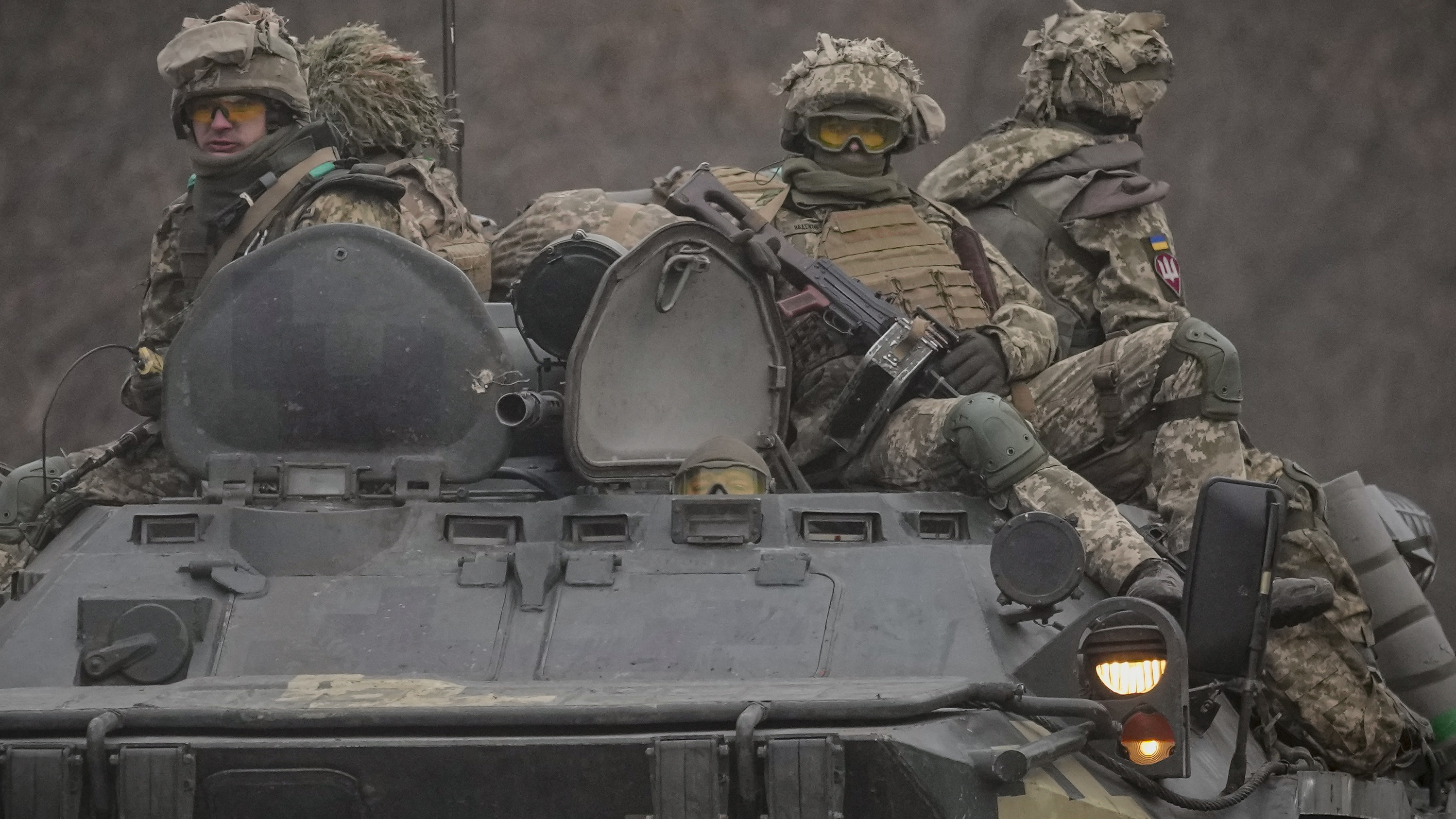
Ukrainian servicemen sit atop armored personnel carriers driving on a road in the Donetsk region, eastern Ukraine.

What has set the stage for the conflict?

Ukraine was a cornerstone of the Soviet Union until it voted overwhelmingly for independence in a democratic referendum in 1991, a milestone that turned out to be a death knell for the failing superpower.

After the collapse of the Soviet Union, NATO pushed eastward, bringing into the fold most of the Eastern European nations that had been in the Communist orbit. In 2004, NATO added the former Soviet Baltic republics Estonia, Latvia and Lithuania. Four years later, it declared its intention to offer membership to Ukraine some day in the distant future – crossing a red line for Russia.

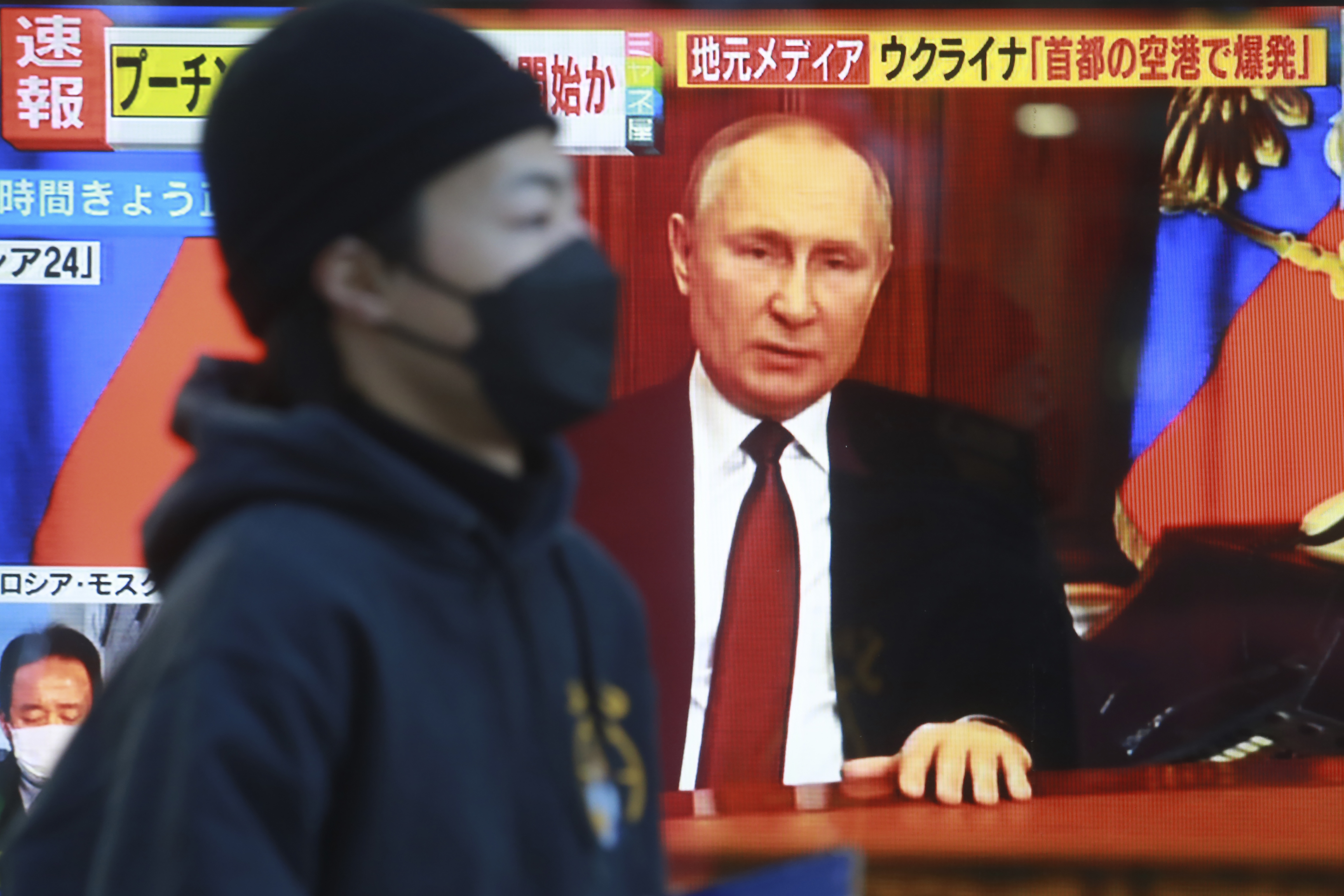
Mr Putin sees NATO's expansion as an existential threat, and the prospect of Ukraine joining the Western military alliance a "hostile act" – a view he invoked in a televised speech on Thursday, saying that Ukraine's aspiration to join the military alliance was a dire threat to Russia.

READ MORE: Ukraine reports fatalities as hospitals and health workers hit by Russia
In interviews and speeches, Mr Putin has previously emphasised his view that Ukraine is part of Russia, culturally, linguistically and politically. While some of the mostly Russian-speaking population in Ukraine's east feel the same, a more nationalist, Ukrainian-speaking population in the west has historically supported greater integration with Europe.

In early 2014, mass protests in the capital Kyiv known as Euromaidan forced out a Russia-friendly president after he refused to sign an EU association agreement. Russia responded by annexing the Ukrainian peninsula of Crimea and fomenting a separatist rebellion in Ukraine's east, which seized control of part of the Donbas region.

Despite a ceasefire agreement in 2015, the two sides have not seen a stable peace, and the front line has barely moved since. Nearly 14,000 people have died in the conflict, and there are 1.5 million people internally displaced in Ukraine, according to the Ukrainian government.

In the eight years since, Moscow has been accused of engaging in hybrid warfare against Ukraine, using cyberattacks, economic pressure and propaganda to whip up discord. Those tactics have escalated in recent months, and in early February the US State Department claimed Mr Putin was preparing a false-flag operation to create "a pretext for an invasion."

READ MORE: Crypto makes it easier than ever for Russia to evade financial sanctions
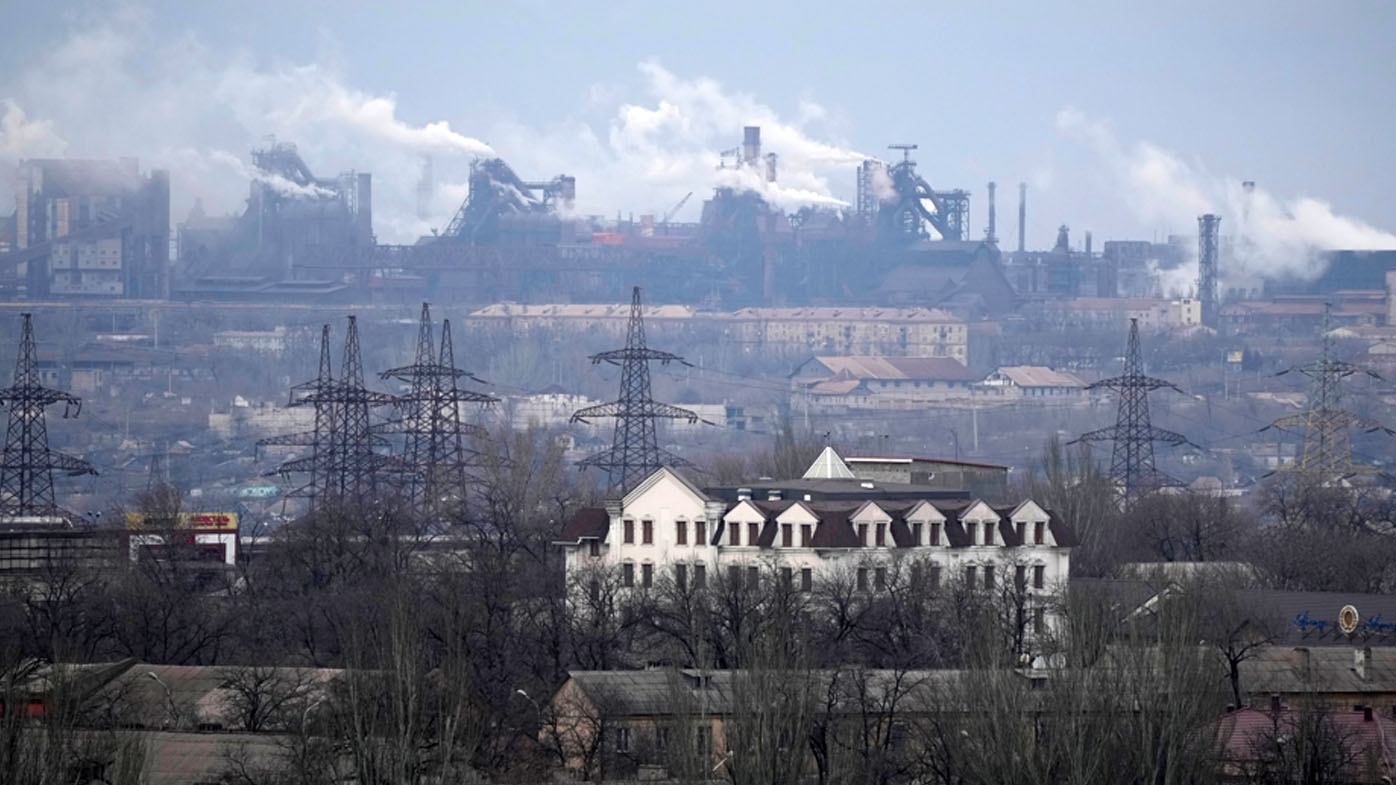
What does Putin want?

In a lengthy essay penned in July 2021, Mr Putin referred to Russians and Ukrainians as "one people," and suggested the West had corrupted Ukraine and yanked it out of Russia's orbit through a "forced change of identity".

That type of historical revisionism was on full display in Mr Putin's emotional and grievance-packed address to the nation on Monday announcing his decision to recognise the Donetsk and Luhansk People's Republics, while casting doubt on Ukraine's own sovereignty.

But Ukrainians, who in the last three decades have sought to align more closely with Western institutions like the European Union and NATO, have pushed back against the notion that they are little more than the West's "puppet".

In fact, Mr Putin's efforts to bring Ukraine back into Russia's sphere have been met with a backlash, with several recent polls showing that a majority of Ukrainians now favour membership of the US-led transatlantic military alliance.

In December, Putin presented the US and NATO with a list of security demands. Chief among them was a guarantee that Ukraine will never enter NATO and that the alliance rolls back its military footprint in Eastern and Central Europe – proposals that the US and its allies have repeatedly said are non-starters.
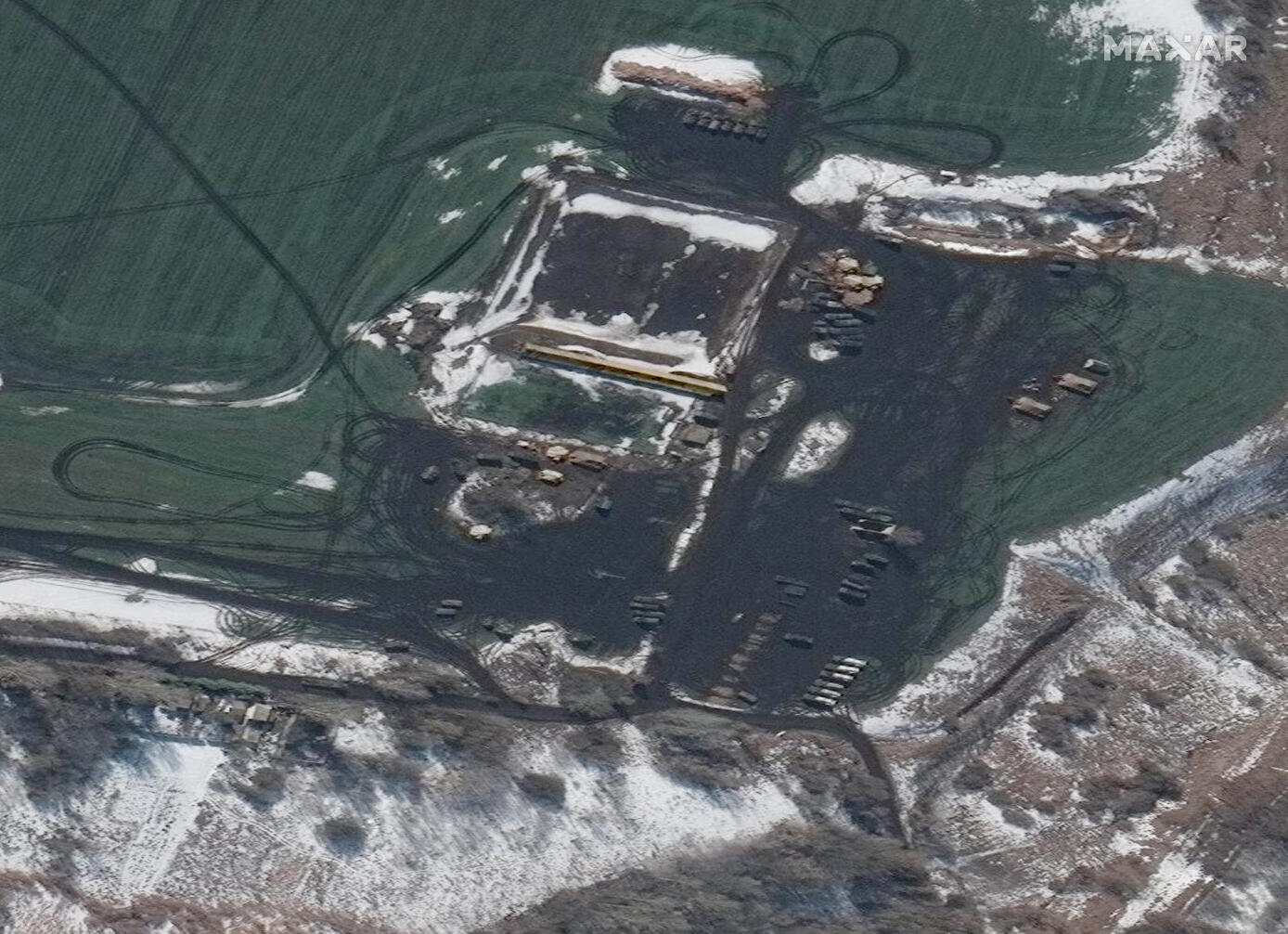
This Thursday, Feb. 24, 2022, satellite image provided by Maxar Technologies shows Russian forces remain deployed in and around the western outskirts of Belgorod, Russia, with artillery and multiple rocket launchers deployed in the area, approximately 10 miles north of the border with Ukraine. (Satellite image ©2022 Maxar Technologies via AP)

Mr Putin indicated he was not interested in lengthy negotiations on the topic. "It is you who must give us guarantees, and you must do it immediately, right now," he said at his annual news conference late last year.

"Are we deploying missiles near the US border? No, we are not. It is the United States that has come to our home with its missiles and is already standing at our doorstep."

High-level talks between the West and Russia wrapped in January without any breakthroughs. The standoff left Europe's leaders to engage in a frenzy of shuttle diplomacy, exploring whether a negotiating channel established between France, Germany, Russia and Ukraine to resolve the conflict in Ukraine's east – known as the Normandy Format talks – could provide an avenue for calming the current crisis.

In a news conference with the new German Chancellor Olaf Scholz on February 16, Mr Putin repeated unsubstantiated claims that Ukraine is carrying out a "genocide" against Russian speakers in the Donbas region and called for the conflict to be resolved through the Minsk peace progress – echoing similar rhetoric that was used as a pretext for annexing Crimea.

But less than a week later, after Russia's upper house of parliament approved the deployment of military forces outside the country on February 22, Mr Putin told reporters that the Minsk agreements "no longer exist," adding:

"What is there to implement if we have recognised these two entities?"

The agreements, known as Minsk 1 and Minsk 2 – which were hammered out in the Belarusian capital in a bid to end a bloody in eastern Ukraine – have never been fully implemented, with key issues remaining unresolved.

Moscow and Kyiv have long been at odds over key elements of the peace deal, the second of which was inked in 2015 and lays out a plan for reintegrating the two breakaway republics into Ukraine.

Ukrainian President Volodymyr Zelensky recently stated that he did not like a single point of the Minsk accords, which require dialogue on local elections in the Russian-backed separatist regions and – although unclear in what sequence – would also restore the Ukrainian government's control over its eastern borders.

Critics say the agreement could give Moscow undue sway over Ukrainian politics.

Mr Putin previously responded in blunt terms by saying that regardless of whether Mr Zelensky likes the plan, it must be implemented.

"Like it or don't like it, it's your duty, my beauty," Mr Putin said in a news conference alongside French President Emmanuel Macron.

Mr Zelensky, a former comedian and TV star, won a 2019 election in a landslide on promises to end the war in Donbas, but little has changed.

Responding to a question about Mr Putin's stark, undiplomatic language, Mr Zelensky responded in Russian, saying bluntly: "We are not his."

What is Ukraine's view?

Mr Zelensky previously downplayed the danger of all-out war with Russia, noting that the threat has existed for years and that Ukraine is prepared for military aggression.

But on Thursday, as Russia launched an assault on his country, Mr Zelensky made an emotional address directly to the Ukrainian people, declaring martial law in the country.
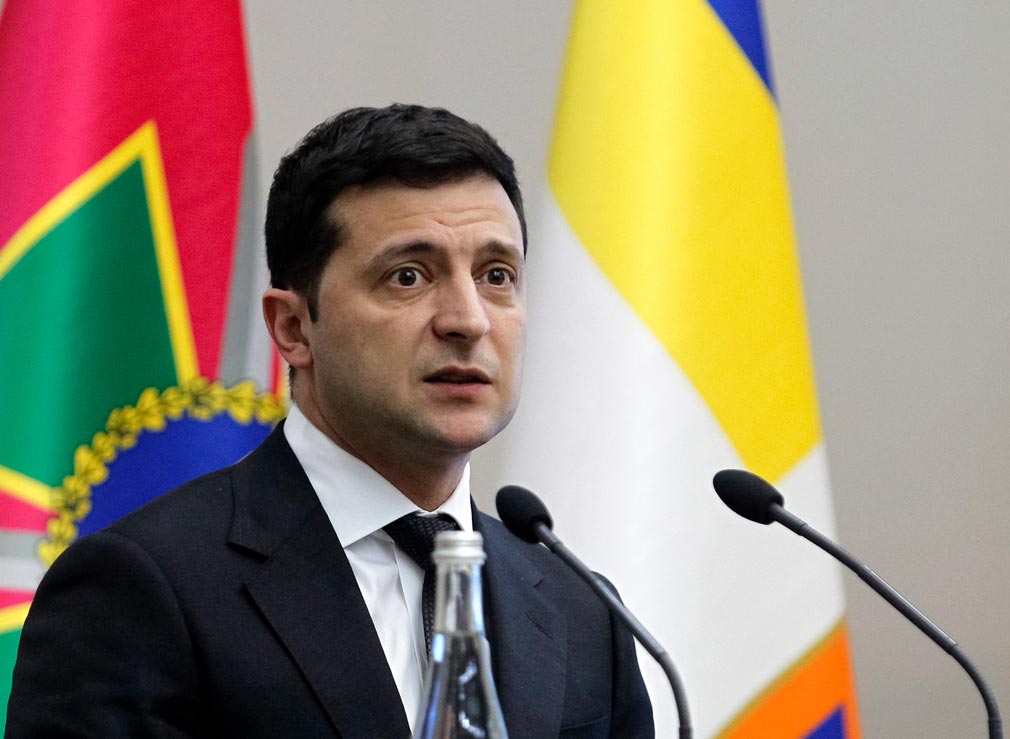
"Russia began an attack on Ukraine today. Putin began war against Ukraine, against the entire democratic world. He wants to destroy my country, our country, everything we've been building, everything we are living for," Mr Zelensky said in a video message posted on his official Facebook page.

Ukraine's government insists that Moscow cannot prevent Kyiv from building closer ties with NATO, or otherwise interfere in its domestic or foreign politics.

"Russia cannot stop Ukraine from getting closer with NATO and has no right to have any say in relevant discussions," the Foreign Ministry said in a statement to CNN.

Tensions between the two countries have been exacerbated by a deepening Ukrainian energy crisis that Kyiv believes Moscow has purposefully provoked. Ukraine views the controversial Nord Stream 2 pipeline – connecting Russian gas supplies directly to Germany – as a threat to its own security.

Nord Stream 2 is one of two pipelines that Russia has laid underwater in the Baltic Sea – in addition to its traditional land-based pipeline network that runs through eastern Europe, including Ukraine. Kyiv views the pipelines across Ukraine as an element of protection against invasion by Russia, since any military action could potentially disrupt the vital flow of gas to Europe.
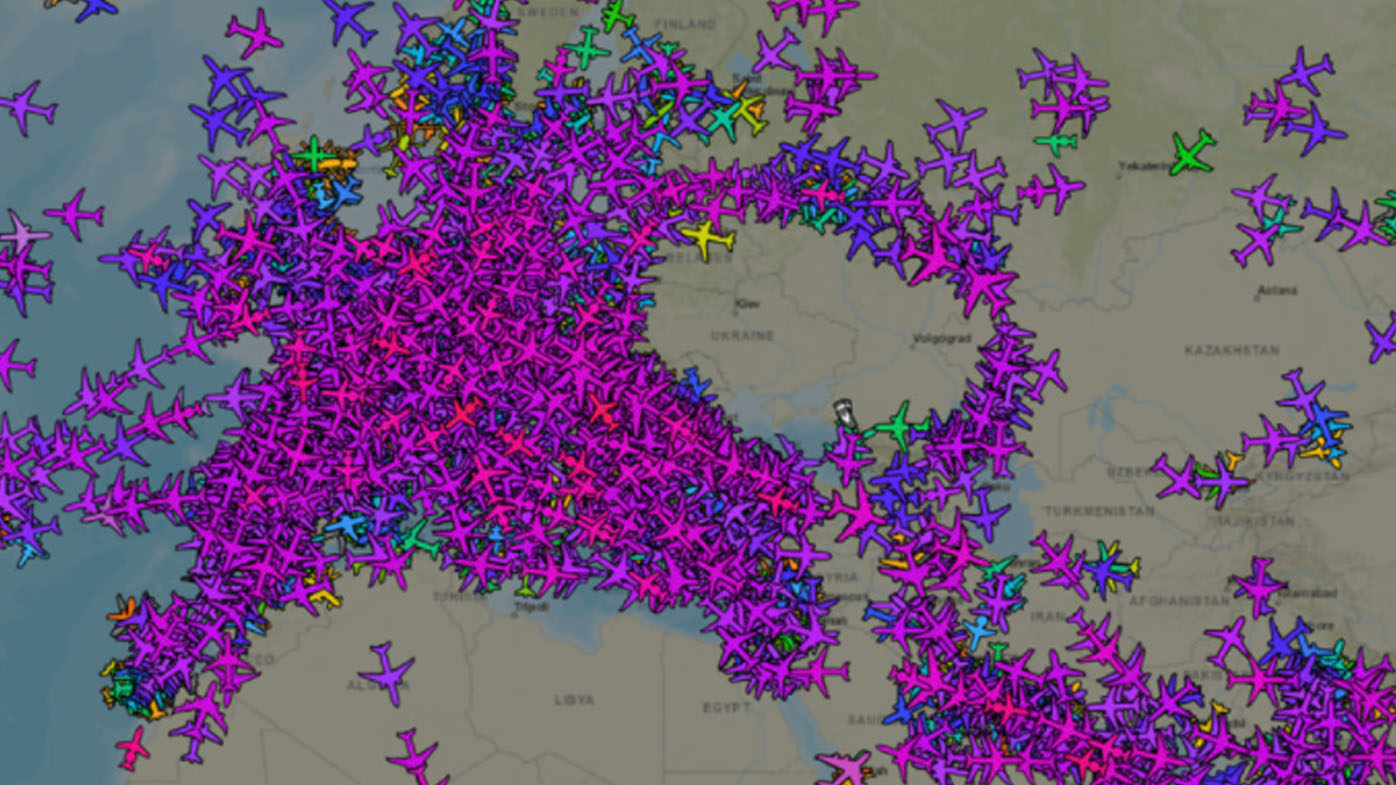
After requests from Mr Zelensky and the US administration, German Chancellor Olaf Scholz said on Tuesday that he would halt the certification of the pipeline following Mr Putin's decision to order troops into parts of eastern Ukraine.

Nord Stream 2 is just one of myriad challenges facing Mr Zelensky's government. The former actor, who played a president on Ukrainian television, has had a brutal baptism of fire into real-world politics since assuming office in 2019.

His government's popularity has stagnated amid multiple domestic political challenges, including a recent third wave of COVID-19 infections and a struggling economy.

Many Ukrainians are unhappy that the government has not delivered on the promises that brought it into power, including cracking down on corruption in the country's judicial system. But the more pressing concern is Mr Zelensky's failure so far to bring peace to the country.

Reporter comes to face to face with Russian troops north of Kyiv

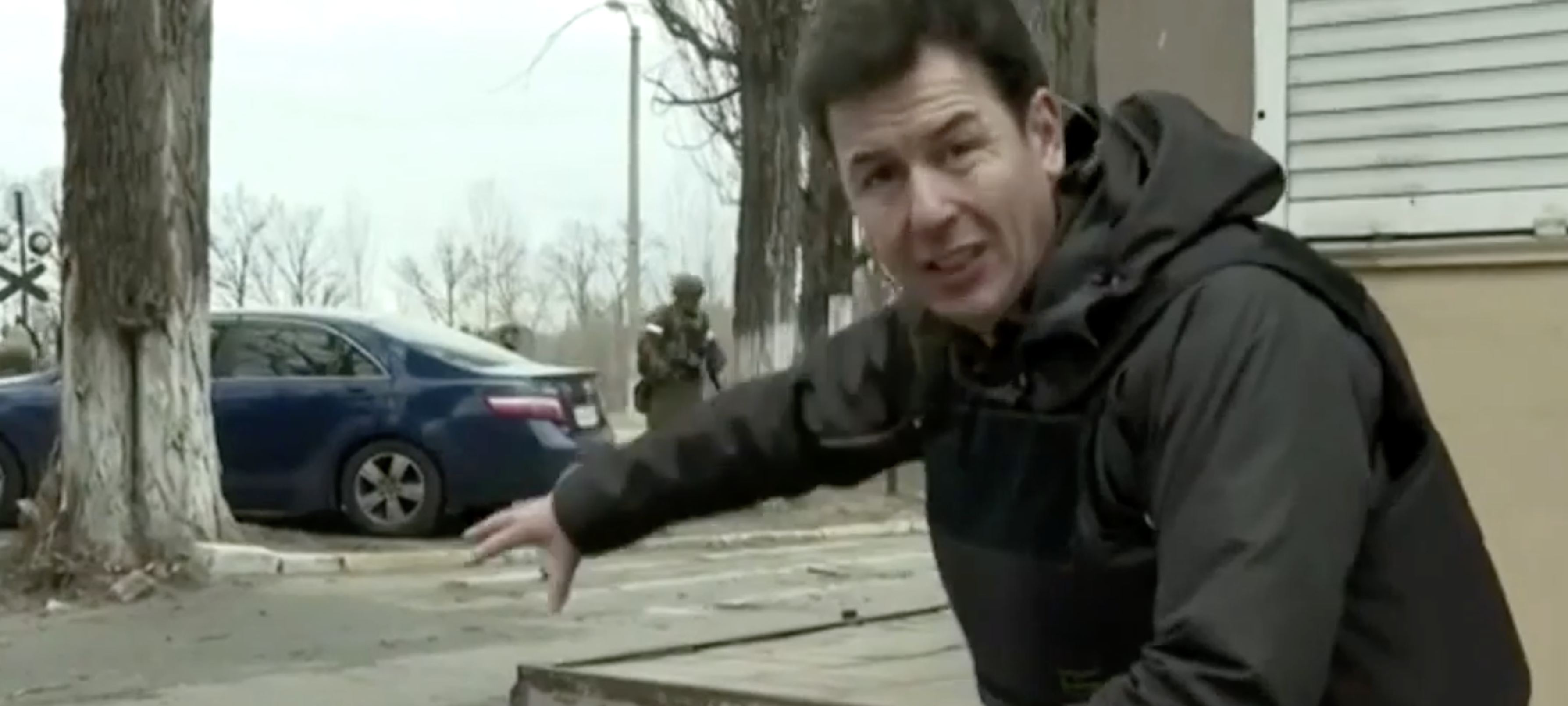
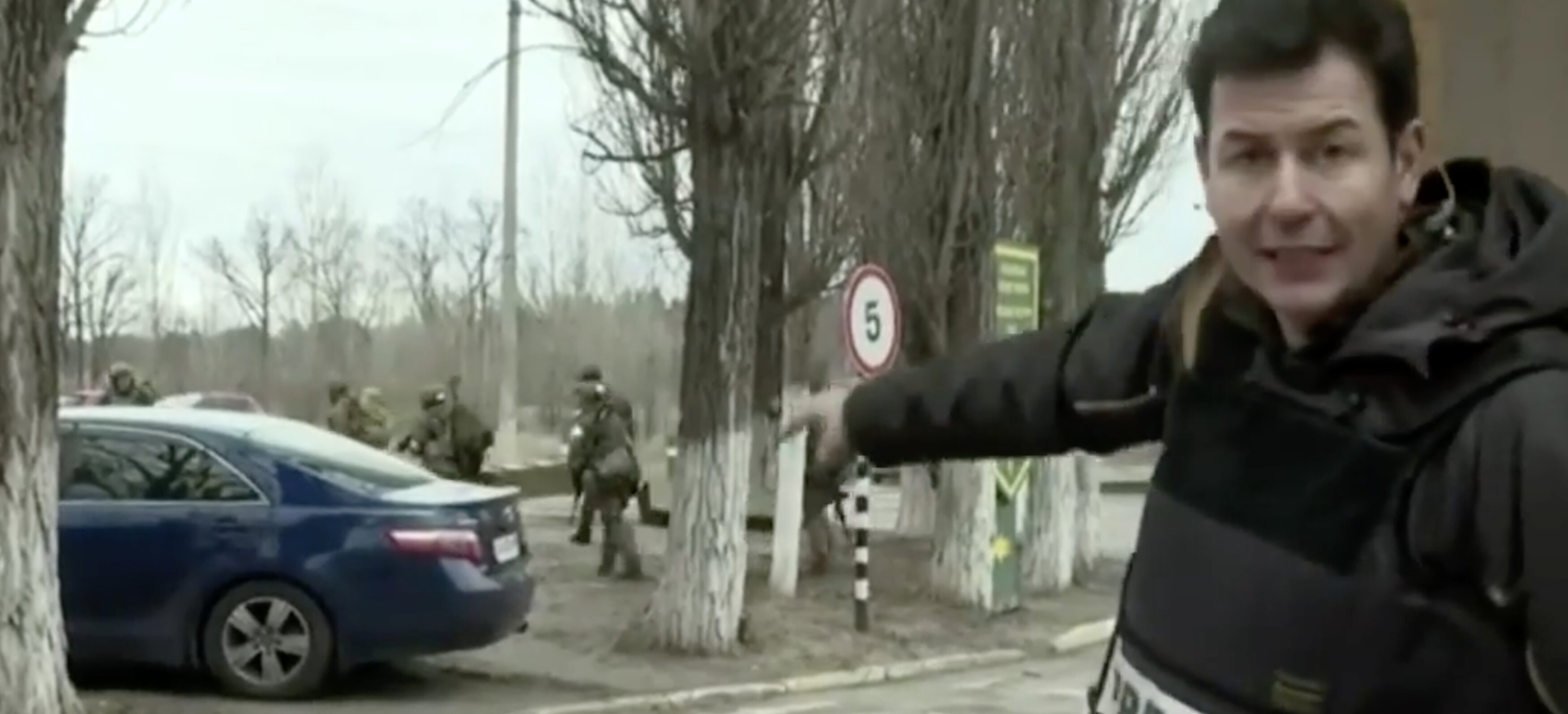
Startling vision has captured the moment a reporter came face to face with Russian forces shortly after troops seized a key airport on the outskirts of Kyiv.

CNN journalist Matthew Chance spoke to viewers while reporting from the front line, saying he had held talks with "the commander on the ground" who had confirmed Russian troops had captured Antonov Airport, on the north-western outskirts of the Ukrainian capital.

LIVE UPDATES: Russia-Ukraine crisis

READ MORE: 'President Xi has a lot of power he can exert over Putin'

"We are here at the Antonov Airport which is about 25 kilometres – 15 miles or so – out of the centre," Mr Chance said.

"These troops you can see over here…they are Russian airborne forces. They have taken this airport.

"They have allowed us to come in and be with them as they defend the perimeter of this air base here.

READ MORE: Ukraine reports fatalities as hospitals and health workers hit by Russia

"These troops were landed in the early hours of this morning to take and form an air bridge to allow for more troops to come."

Mr Chance said that Russian forces are identifiable due to an orange and black band present on their uniforms.

READ MORE: Biden reveals more sanctions

He said that, according to Ukrainian officials, Russian's plan "isn't just to surround" the capital, they fear now it's Russian President Vladimir Putin's plan to completely capture Kyiv.

"To decapitate the leadership of Ukraine," he said.

"And replace that leadership with a pro-Russian government.

"That's what Ukrainian officials are telling us now."

READ MORE: Why control of Ukraine international airport crucial

Overnight, Ukraine lost control of the Chernobyl nuclear site, where Ukranian forces had waged a fierce battle with Russian troops.

Adviser Myhailo Podolyak told The Associated Press that Ukrainian authorities did not know the current condition of the facilities at Chernobyl, the site of the world's worst nuclear disaster.

"After the absolutely senseless attack of the Russians in this direction, it is impossible to say that the Chernobyl nuclear power plant is safe," he said.

Cyclone watch issued for Northern Territory

A tropical cyclone watch has been issued for the Northern Territory, with warnings Darwin could be in the firing line.

The watch comes as a large part of Queensland from the north of Bundaberg to the south of Brisbane is bracing for more torrential rain.

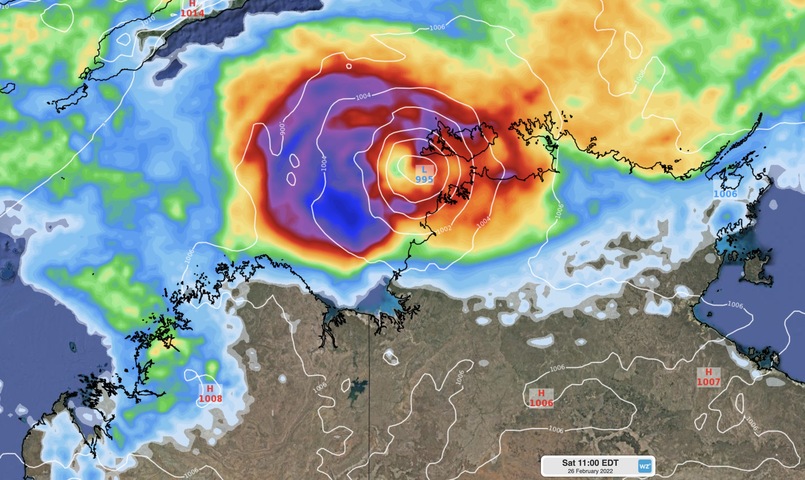
Weatherzone said a low pressure system is currently gaining strength in the Timor Sea and could move towards the Top End by Friday afternoon.

READ MORE: Officials say Ukraine no longer in control of Chernobyl site

A tropical cyclone watch has been issued for Darwin as a low pressure system gains strength in the Timor Sea.

"At this stage, the low is expected to develop into a category one tropical cyclone on Friday and may become a category two cyclone over the weekend," it said.

"The initial track map issued by the Bureau of Meteorology suggests that tropical cyclone could move towards Darwin as it gains strength over the weekend.

"However, there is a high amount of uncertainty regarding the future movement of this system and it may track further south, towards WA's Kimberley coast."

READ MORE: Dozens of deaths reported as Russia attacks Ukraine

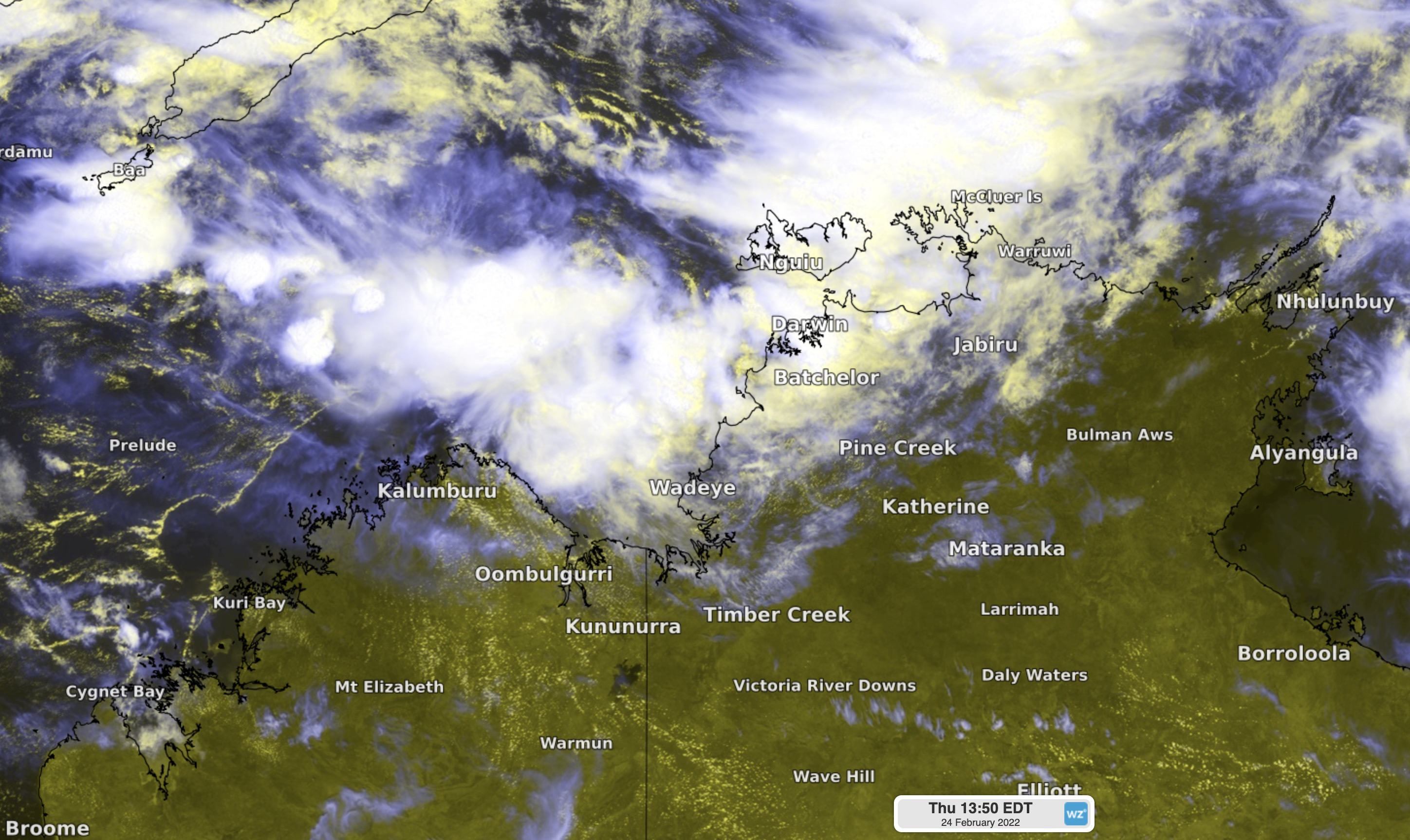
Enhanced visible/infrared satellite image showing cloud building around a developing tropical low to the west of Darwin on Thursday.

On Monday the weather service warned two cyclones could potentially form, with modelling suggesting the other would hit Far North Queensland.

The warning comes as the east coast is inundated with heavy rain, causing deadly flash-flooding and forcing a number of swiftwater rescues across northern NSW and south-east Queensland.

https://twitter.com/JessMillward9/status/1496916236210704387

More heavy rain expected for Queensland

The Bureau of Meterology (BoM) has issued yet another severe weather warning for Queensland, as a storm sweeps through the Wide Bay–Burnett regions.

The BoM said very dangerous conditions with intense rainfall may lead to more life-threatening flash flooding.

READ MORE: 'The worst sunrise in my life': Ukrainians wake to attack

https://twitter.com/BOM_Qld/status/1496910096240197635

"Locations which may be affected include Childers, Biggenden and Gin Gin," the BoM said.

A number of flood watches are in place with Eyre Creek, Georgina River the lower Burnett River, Stuart and Boyne Rivers, Mary River, Tinana and Six Mile creeks, the Paroo River and the Stanley River of the most concern.

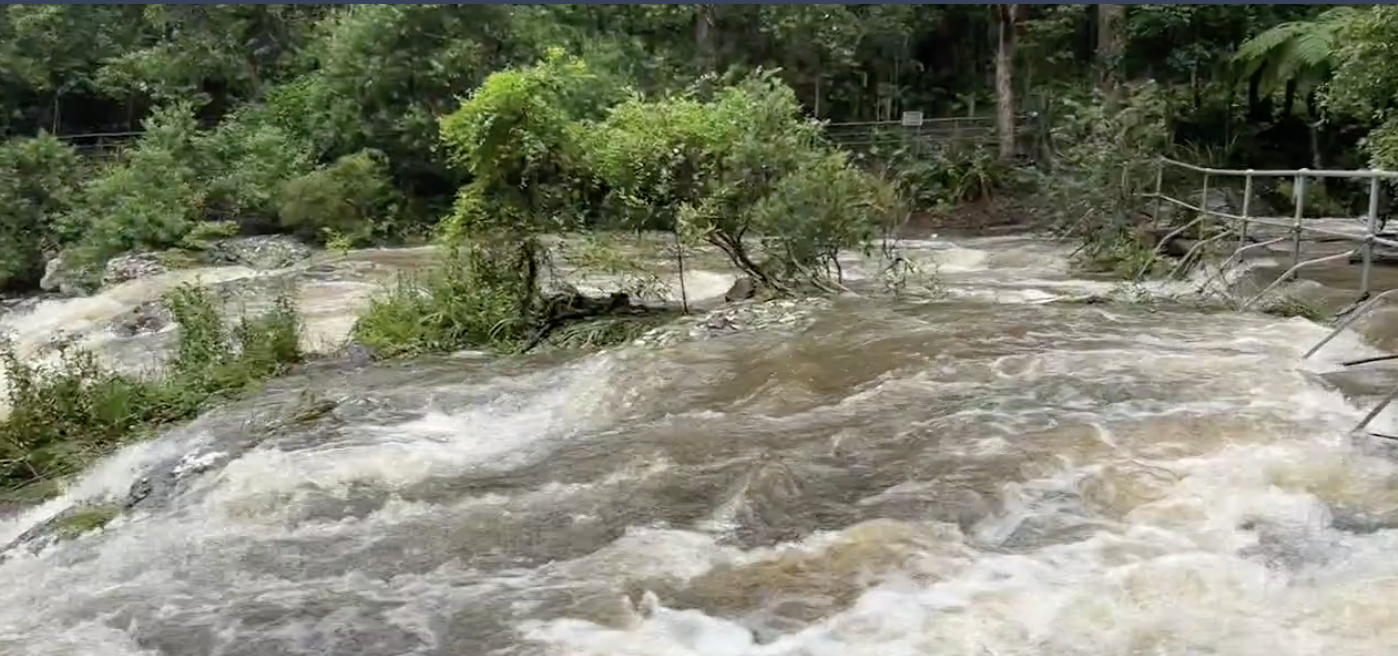
Amid the threat of heavy rain there are fears the city of Gympie could split in two.

Cascading water is seen in the Gympie region, amid fears the city could be split in two if more rain falls.

The area has been hard hit with rain, receiving the state's highest rainfall total – Mt Wolvi, near Gympie, recorded 425mm of rain in the 24 hours to 9am on Wednesday.

The second death of the flood emergency was also recorded.

The body of missing motor cyclist Phil Lambert, 54, was discovered at Cedar Pocket, in the Gympie Region.

It's believed the father of three hadn't seen the rising floods when driving through the area on Wednesday morning and was hit by a torrent of rushing water.

It comes after the body of woman was found in her submerged vehicle at Belli Park, Sunshine Coast.

Read on, to find out what the weather is doing across the nation's capitals today.

Brisbane

It will be a wet day in Brisbane, with a maximum temperature of 25C forecast.

Theres a chance of a thunderstorm, with possible heavy falls during the morning and afternoon.

Gusty winds will be felt late this afternoon and evening.

Sydney

Sydney will today reach a maximum temperature of 27C with more showers expected.

There's also the chance of a thunderstorm.

Melbourne

It will be a cloudy 23C day in Melbourne, which has a slight chance of a shower on the cards.

Canberra

It will be a cloudy and wet day for the nation's capital, which has a very high chance of showers and a high 23C forecast.

These are most likely in the afternoon and evening.

There's also a chance of a thunderstorm during this afternoon and evening with possible heavy falls.

Hobart

The mercury will climb to 19C in Hobart. It will be cloudy, with a medium chance of drizzle this morning.

Adelaide

It will reach a maximum temperature of 29C in Adelaide today. It will be mostly sunny.

Winds will tend southeasterly 30 to 45 km/h, gusty about the hills and southern suburbs early morning, then decreasing to 25 to 40 km/h during the morning.

Darwin

It will reach a maximum temperature of 30C in Darwin today.

It will be cloudy with a very high chance of showers.

There's also a chance of a thunderstorm. Winds will tend north to northeasterly at 25 to 35 km/h before becoming northeasterly 30 to 45 km/h in the evening.

Perth

It will be hot and sunny in Perth with the mercury hitting a maximum temperature of 33C.

Winds will tend east to southeasterly 25 to 35 km/h becoming light in the morning, then becoming west to southwesterly 15 to 25 km/h in the middle of the day.

Gusts up to 65 km/h will be felt about the hills and foothills early morning.

'Putin is the aggressor. Putin chose this war': Biden extends sanctions

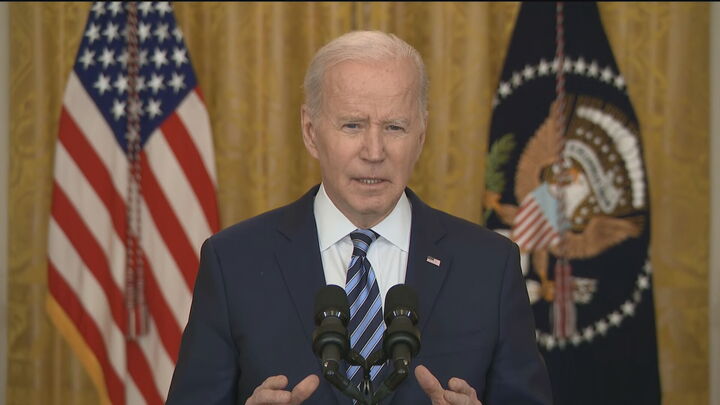
US President Joe Biden has unveiled new, "devastating" sanctions on Russia designed to punish the country for its full-scale invasion of Ukraine, calling out Russian President Vladimir Putin for his aggression.

"Putin is the aggressor. Putin chose this war. And now he and his country will bear the consequences," Mr Biden said, laying out a set of sanctions including export controls that will "impose severe cost on the Russian economy, both immediately and over time".

Mr Biden said the new sanctions also include four Russian banks and "corrupt billionaires" and their families who are close to the Kremlin.

READ MORE: Officials say Ukraine no longer in control of Chernobyl site

US President Joe Biden on Thursday unveiled new, 'devastating' sanctions on Russia after its invasion of Ukraine.

And he announced a new deployment of ground and air forces to NATO's eastern flank, even as he reiterated US troops would not engage in direct conflict in Ukraine.

"Our forces are not and will not be engaged in the conflict," he said.

"Our forces are not going to Europe to fight in Ukraine but defend our NATO allies and reassure those allies in the east."

Mr Biden addressed the nation from the White House East Room, his first appearance in public since the Russian attack commenced late Wednesday.

READ MORE: Crypto makes it easier than ever for Russia to evade financial sanctions

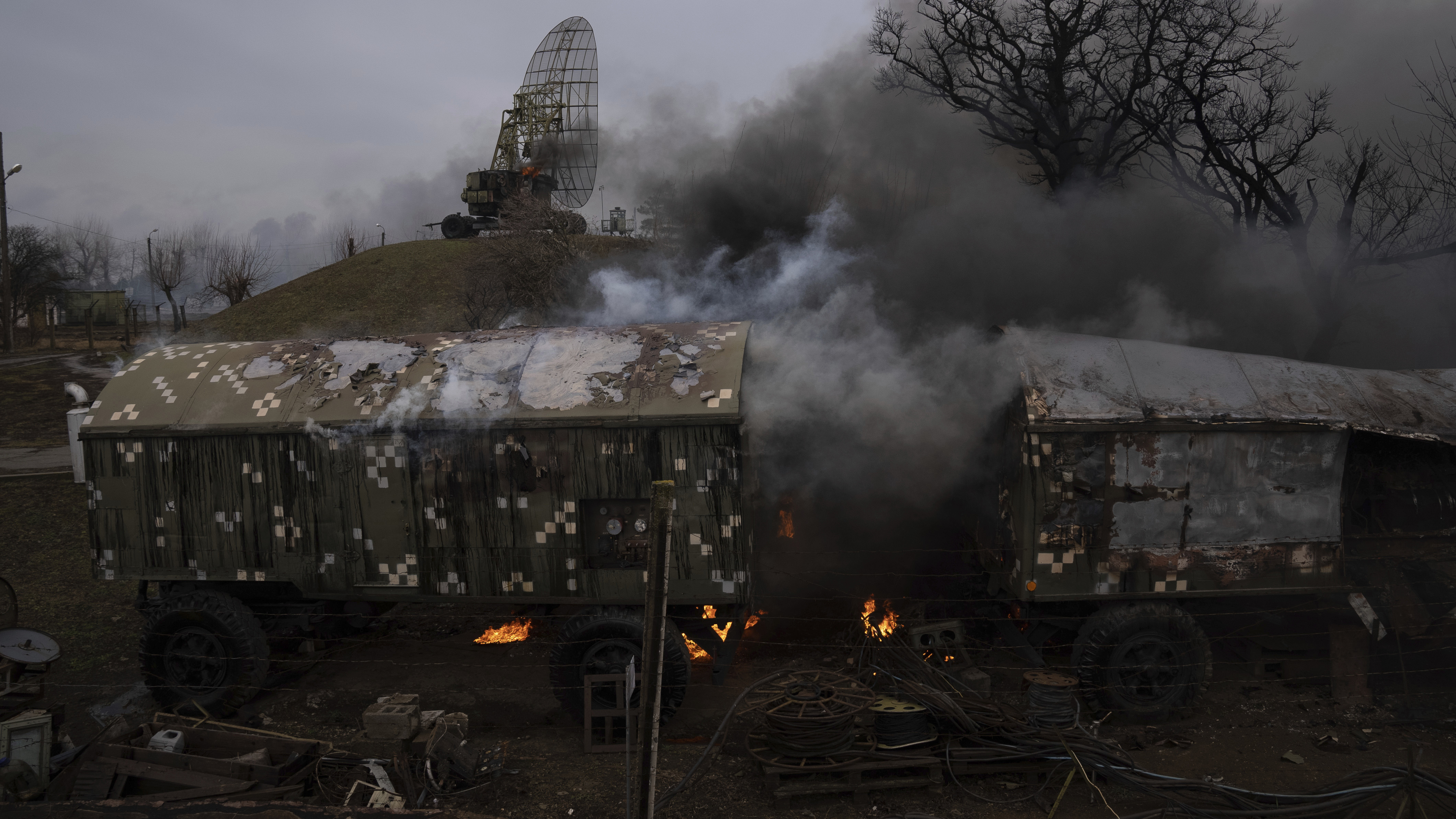
Ukrainian military track burns at an air defence base in the aftermath of an apparent Russian strike in Mariupol, Ukraine.

World leaders condemn invasion

World leaders have expressed raw outrage shrouded by an impotence to immediately come to the aid of Ukraine to avoid a major war in Europe.

They condemned Russia's attack on its neighbour as the European Union, United Kingdom and others promised unprecedented sanctions to hit the Kremlin.

NATO moved to beef up its eastern flank facing Russia and planned a virtual leaders' summit for Friday after President Putin warned anyone listening that any interference would "lead to consequences you have never seen in history."

LIVE UPDATES: 'Our worst fears have come true': UK PM

EU and NATO member Lithuania declared a state of emergency since the Baltic nation borders Russia's Kaliningrad region to the south-west and Russia's ally Belarus to the east.

NATO nations have 100 jets and 120 ships on high alert as deterrence.

"Make no mistake: we will defend every ally against any attack on every inch of NATO territory," said NATO chief Jens Stoltenberg.

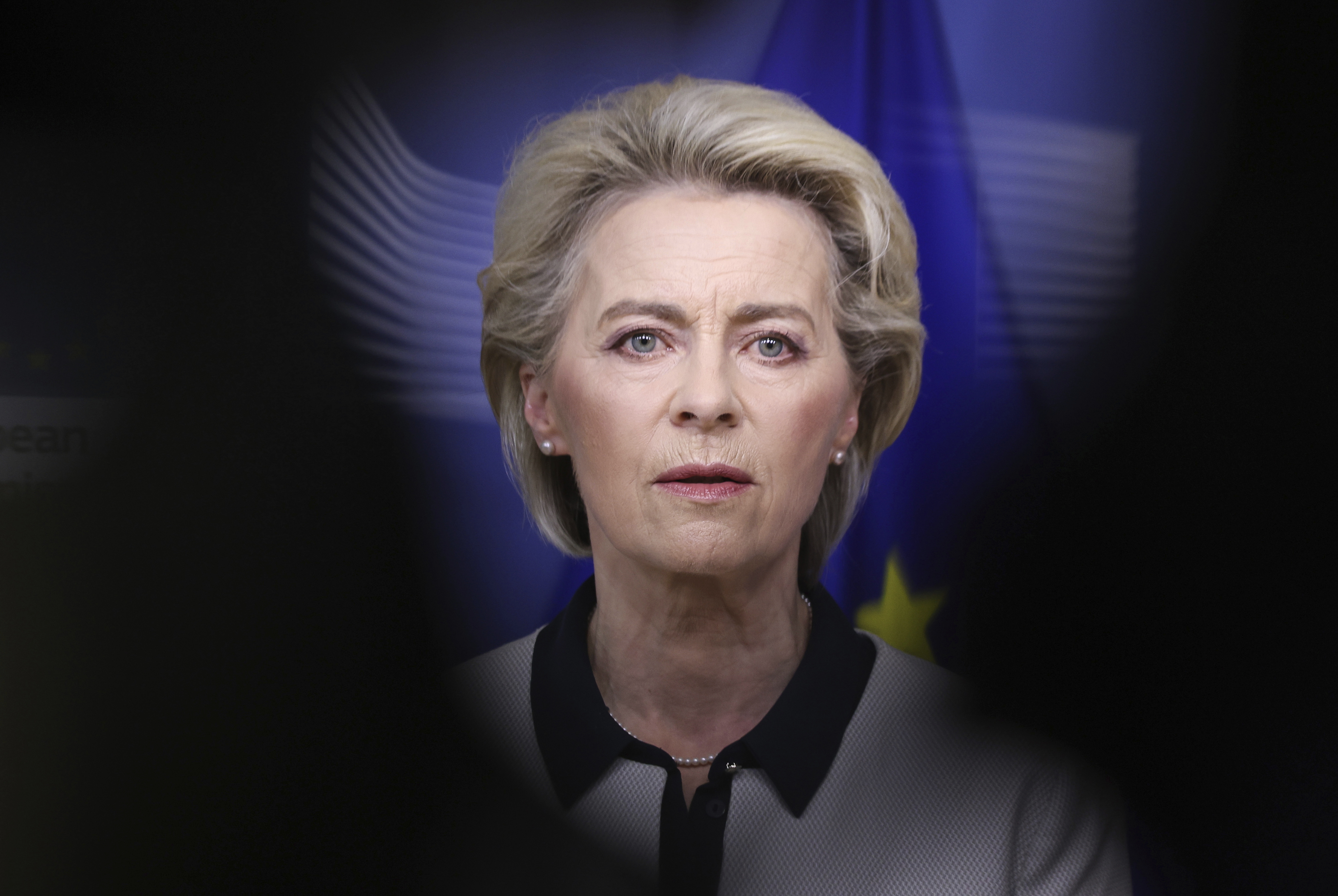
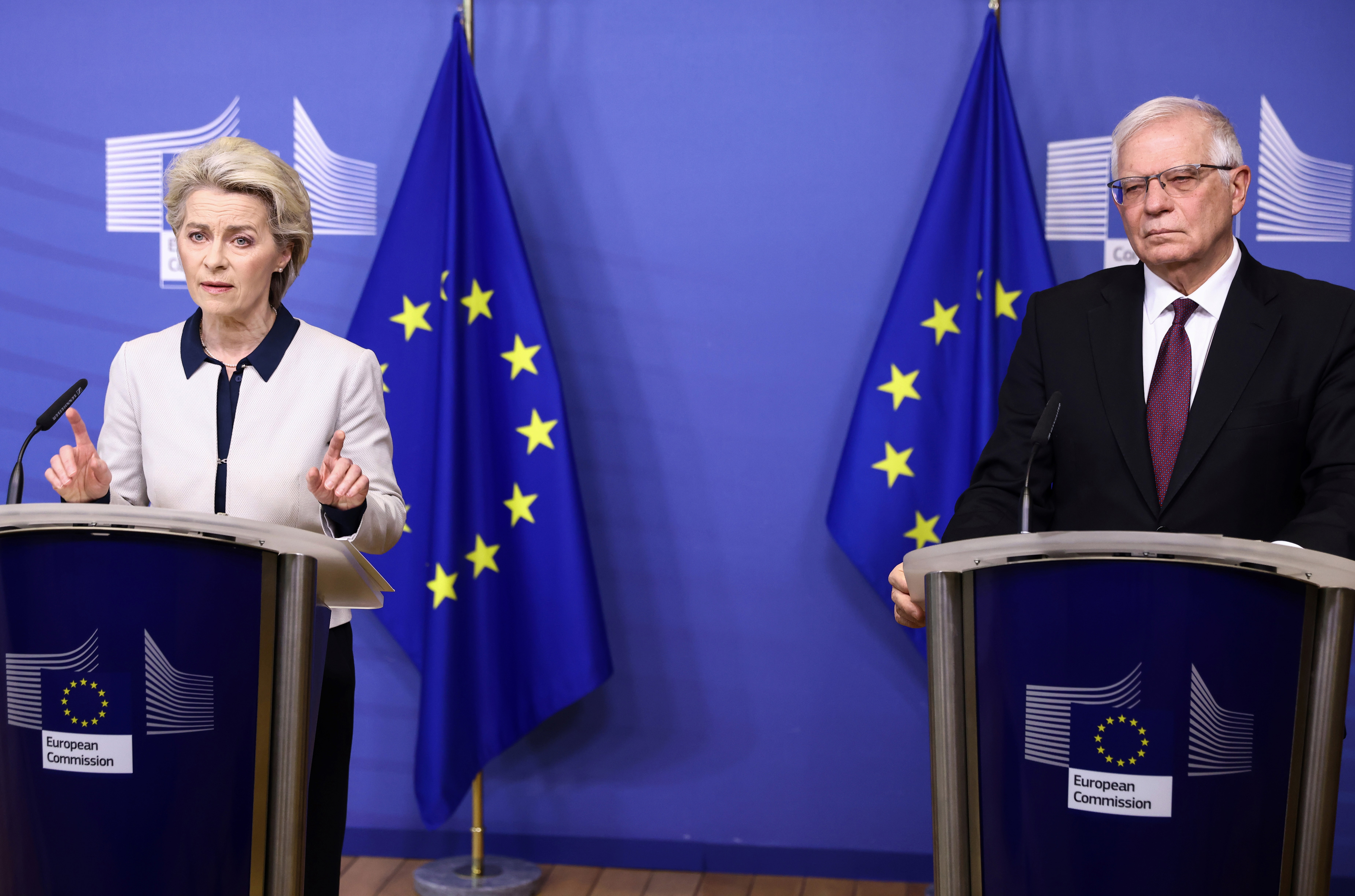
European Commission President Ursula von der Leyen called it a "barbaric attack" on an independent nation that also targeted "the stability in Europe and the whole of the international peace order." The EU will hold an emergency summit in Brussels.

READ MORE: Aussie share market wipes more than $70 billion after Russia announces formal invasion

UK Prime Minister Boris Johnson said the invasion "hideous and barbaric", while pledging "a massive package of economic sanctions to be agreed today" that would "hobble" the Russian economy.

"Our mission is clear, diplomatically, politically, economically, and eventually, militarily, this hideous, barbaric venture of Vladimir Putin must end in failure," he said.

But no one promised to move in militarily and defend Ukraine as it could touch off a major European war.

https://twitter.com/BorisJohnson/status/1496928461717327906

So instead, most of the world — including Australia but notably but not China — condemned and threatened to hit the Russian elites with, in the words of Ms von der Leyen, "massive and targeted sanctions."

She will put to EU leaders late Thursday a proposal that "will target strategic sectors of the Russian economy by blocking the access to technologies and markets that are key for Russia."

READ MORE: First explosions and air raid sirens heard in Ukraine after Russia declares 'military action'

She said the sanctions, if approved, "will weaken Russia's economic base and its capacity to modernise."

"In addition, we will freeze Russian assets in the European Union and stop the access of Russian banks to European financial markets," She said.

Like the first package of sanctions that were imposed when Russia recognised the two breakaway eastern Ukrainian republics, Ms von der Leyen said all Western powers were walking in lockstep.

"We are closely aligned with our partners and allies the United States, the United Kingdom, Canada, but also, for example, Japan and Australia," she said.

READ MORE: Prime Minister Scott Morrison condemns actions of Russia

Highlighting a widening rift in superpower relations, China stood alone in failing to condemn the attack and instead accused the United States and its allies of worsening the crisis.

And it put its friendship in practice Thursday by approving imports of wheat from Russia, a move that could help to reduce the impact of possible increased Western sanctions.

Russia is one of the biggest wheat producers but would be vulnerable if foreign markets block shipments.

In a clear defence of Moscow, China "called on parties to respect others' legitimate security concerns."

READ MORE: Doctor and mother prepares to join defence against Russia

Smoke rise from an air defence base in the aftermath of an apparent Russian strike.

Foreign Ministry spokesperson Hua Chunying said "all parties should work for peace instead of escalating the tension or hyping up the possibility of war", in language China has consistently used to criticise the West in the crisis.

"Those parties who were busy condemning others, what have they done? Have they persuaded others?" Ms Hua said.

One thing was clear — weeks of diplomatic cajoling, global crisscrossing of leaders and foreign ministers, and the threat of sanctions against Putin's inner circle had failed to dissuade the Kremlin from taking one of the most significant measures in Europe since the end of the Cold War.

Overall, more sanctions appear the only option for the foreseeable future. And from South Korea to Australia to Europe, governments were lining up to oppose Putin.

French President Emmanuel Macron, who had laboured until the last minute for a diplomatic solution, said "France firmly condemns Russia's decision to wage war," and promised support for Ukraine.

The turmoil from the beginning of a long-feared act of aggression rippled from Europe to Asia.

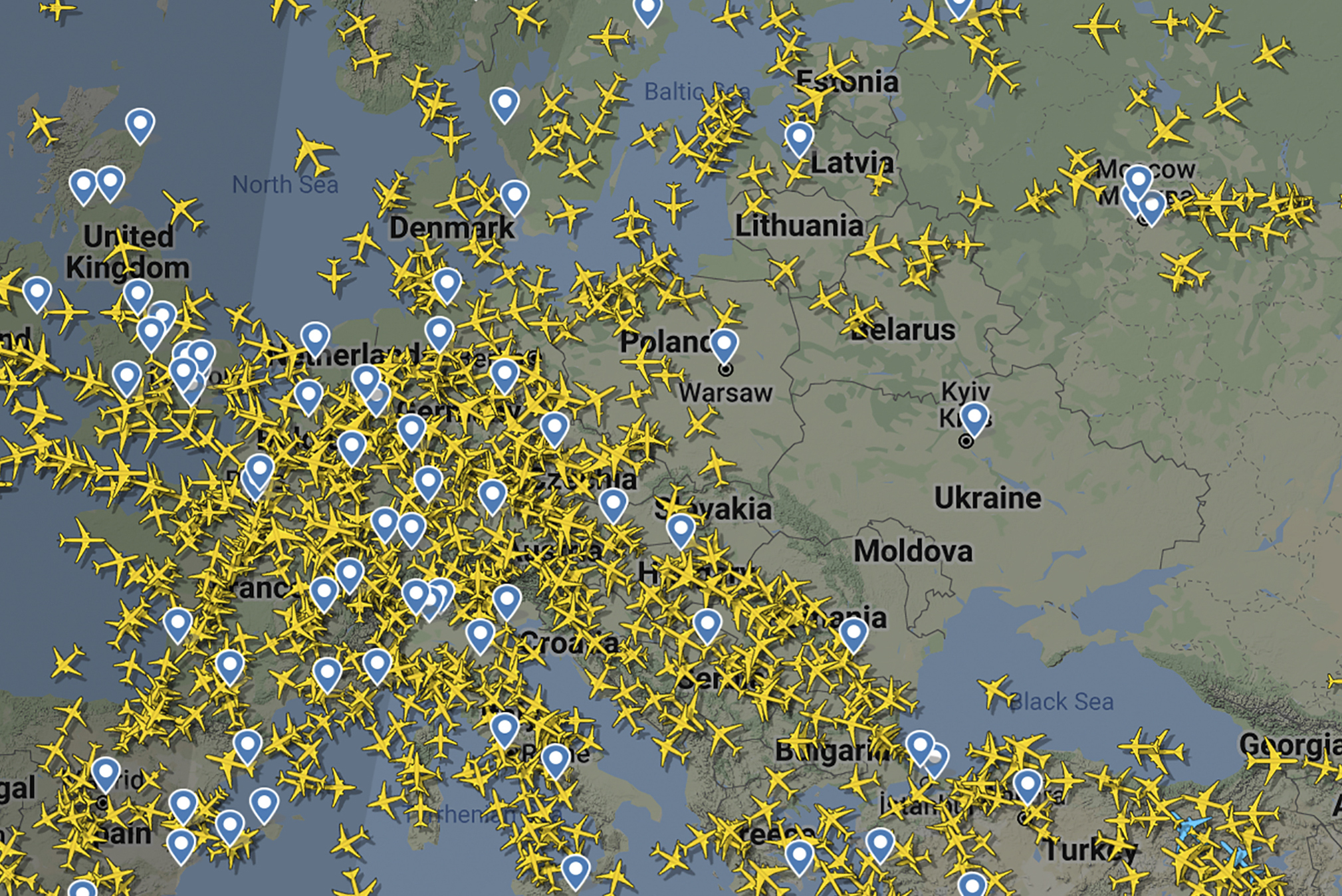
Stock markets plunged, oil prices surged, and European aviation officials warned of a high risk to civilian aircraft over Ukraine, reminding air operators that "this is now an active conflict zone."

Russia's attack and uncertainty about the intensity of the Western response sent stocks tumbling and oil prices surging by more than US$5 ($7.98) per barrel.

Market benchmarks in Europe and Asia fell by as much as 4 per cent, while Brent crude oil briefly jumped above US$100 ($139.70) per barrel in London for the first time since 2014 on unease about possible disruption of supplies from Russia, the No. 3 producer.

In New York, the UN Security Council held an extraordinary emergency meeting meant to dissuade Russia from sending troops into Ukraine.

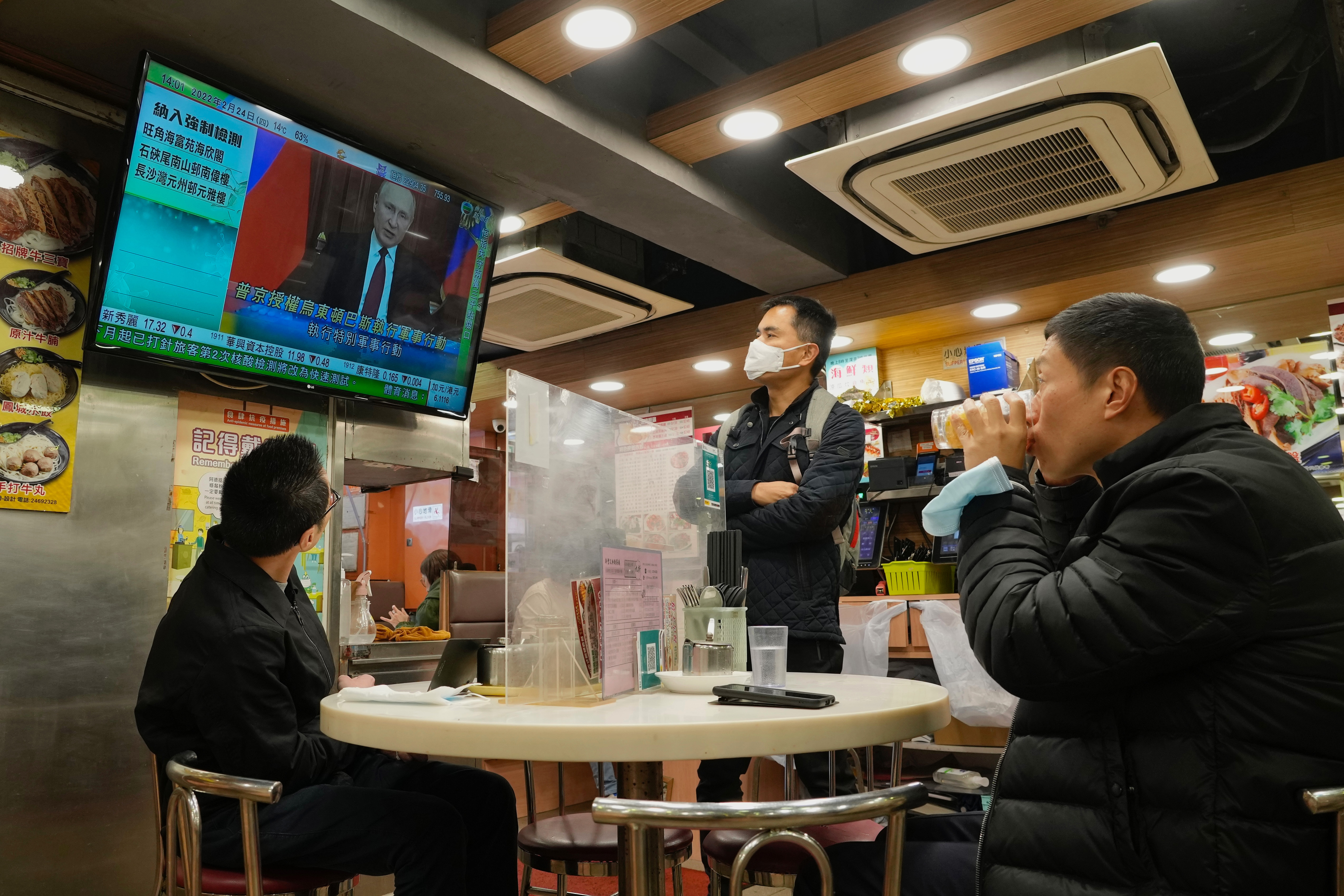
Secretary-General Antonio Guterres' plea to "give peace a chance" came just as Russian President Vladimir Putin appeared on Russian TV to announce the military operation.

Explosions were heard in Kyiv and other cities in Ukraine. Moscow had massed more than 150,000 troops on Ukraine's borders. On Monday, Mr Putin recognised the independence of two separatist regions in eastern Ukraine and ordered Russian forces there for what he called "peacekeeping".

To avoid international civilian casualties, the European Union Aviation Safety Agency said "there is a risk of both intentional targeting and misidentification of civil aircraft" and that "the presence and possible use of a wide range of ground and airborne warfare systems poses a HIGH risk for civil flights operating at all altitudes."

The attack touched all sectors of society across the globe. The director of the Africa Centres for Disease Control and Prevention openly worried that global attention will now shift even further from helping the world's least vaccinated continent respond to COVID-19.

"The conflict in Ukraine definitely will draw attention, political attention, towards that crisis," John Nkengasong said.

'The worst sunrise in my life': Ukrainians wake to attack

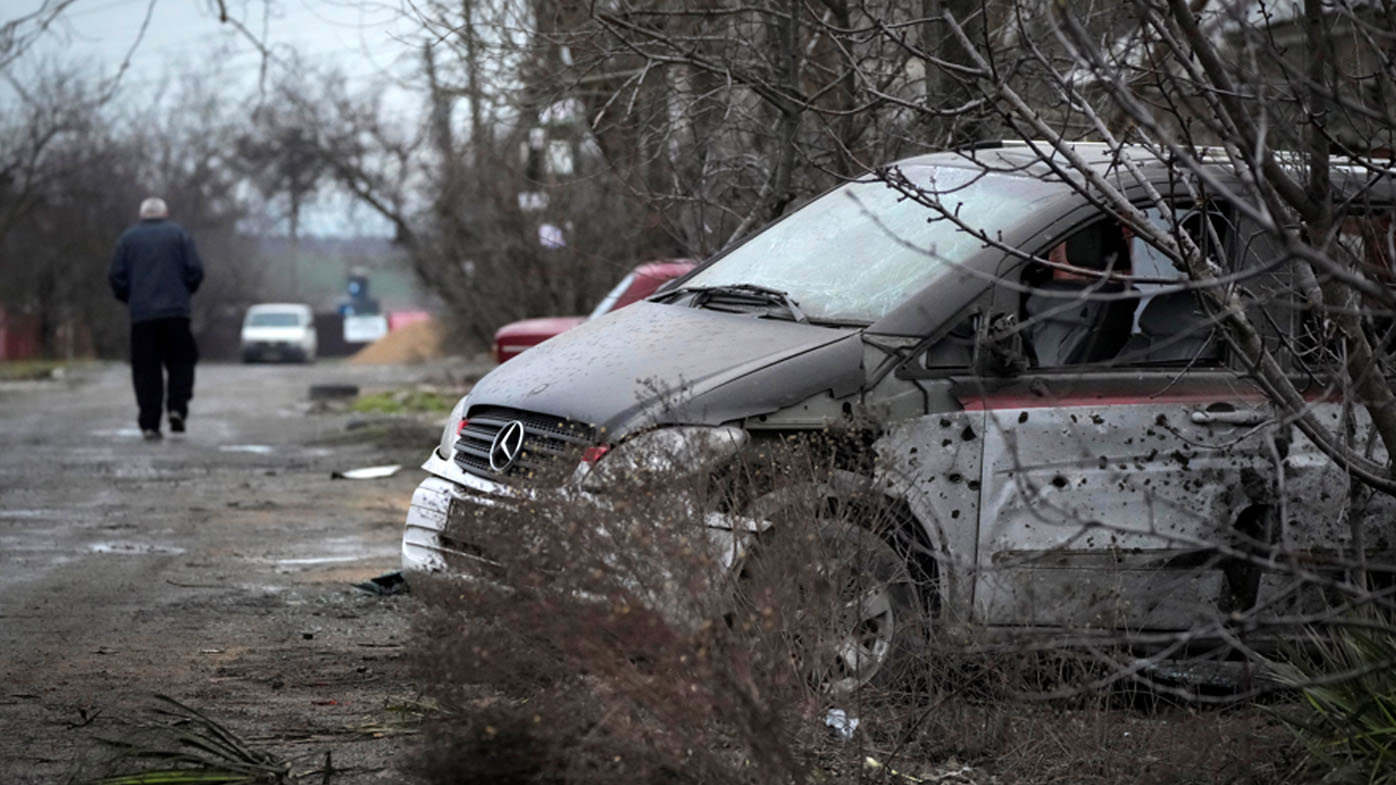
The missile fragment pierced the ceiling of Mikhail Shcherbakov's apartment in Kharkiv, Ukraine's second largest city. A Russian attack, after weeks of warnings, had hit home.

"I heard noise and woke up. I realised it sounded like artillery," Mr Shcherbakov said.

He jumped from the couch and ran to wake his mother, and something exploded behind him.

READ MORE: First explosions and air raid sirens heard in Ukraine after Russia declares 'military action'

The missile left a nearby computer and teacup shrouded with dust, instant artefacts of Europe's latest crisis.

At dawn on Thursday (Thursday afternoon AEDT), Ukrainians' uneasy efforts at normality were shattered. Smoke rose from cities, even well away from the country's disputed eastern border.

"Today I had the worst sunrise in my life," said another Kharkiv resident, who gave her name only as Sasha.

She rushed to her balcony and realised the sounds that had woken her weren't fireworks.

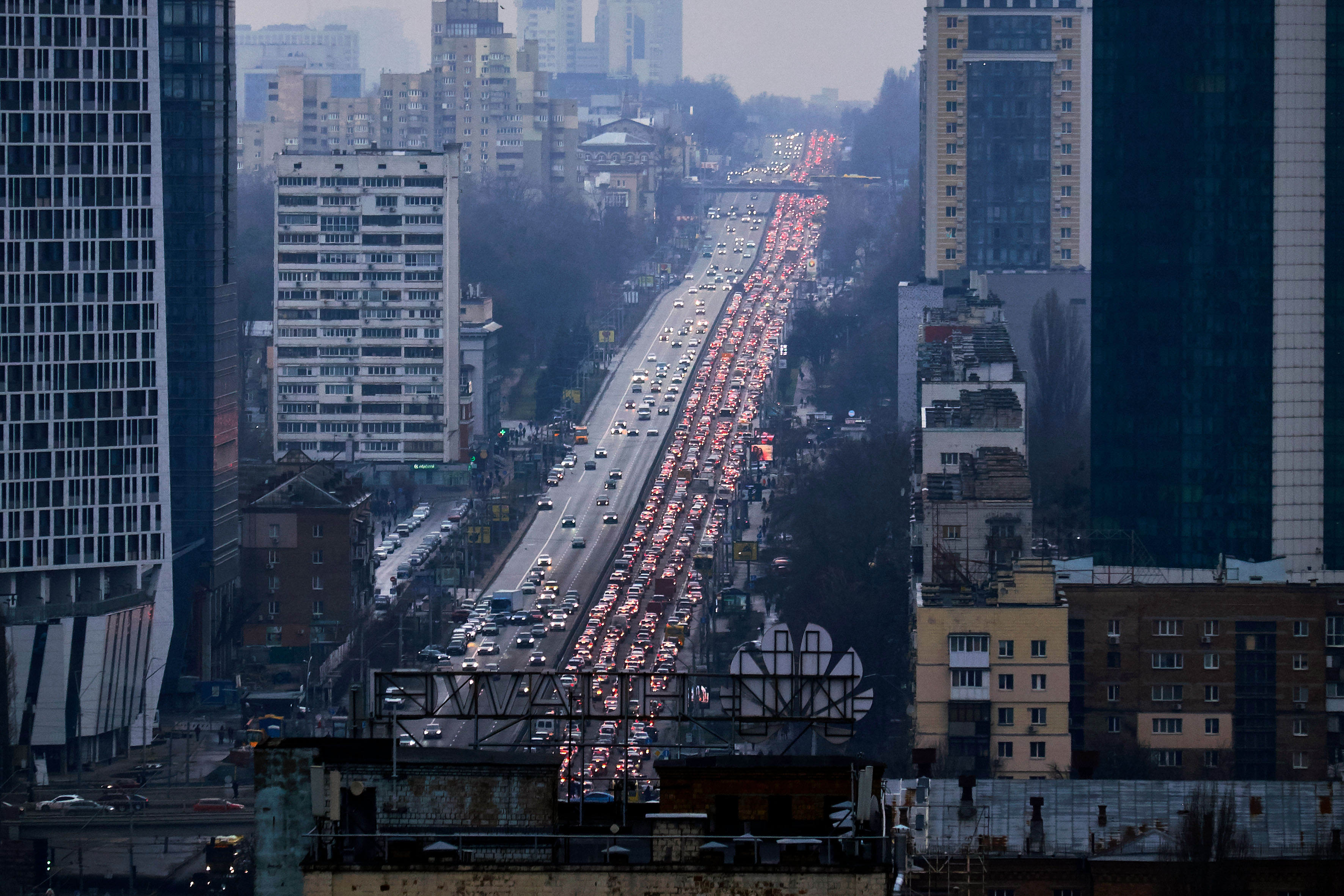
Farther from the border, a morning commute transformed into chaos, with lines of cars waiting at fuel stations or fleeing from the grey and drizzly capital, Kyiv.

Traffic in Kyiv following Russian invasion

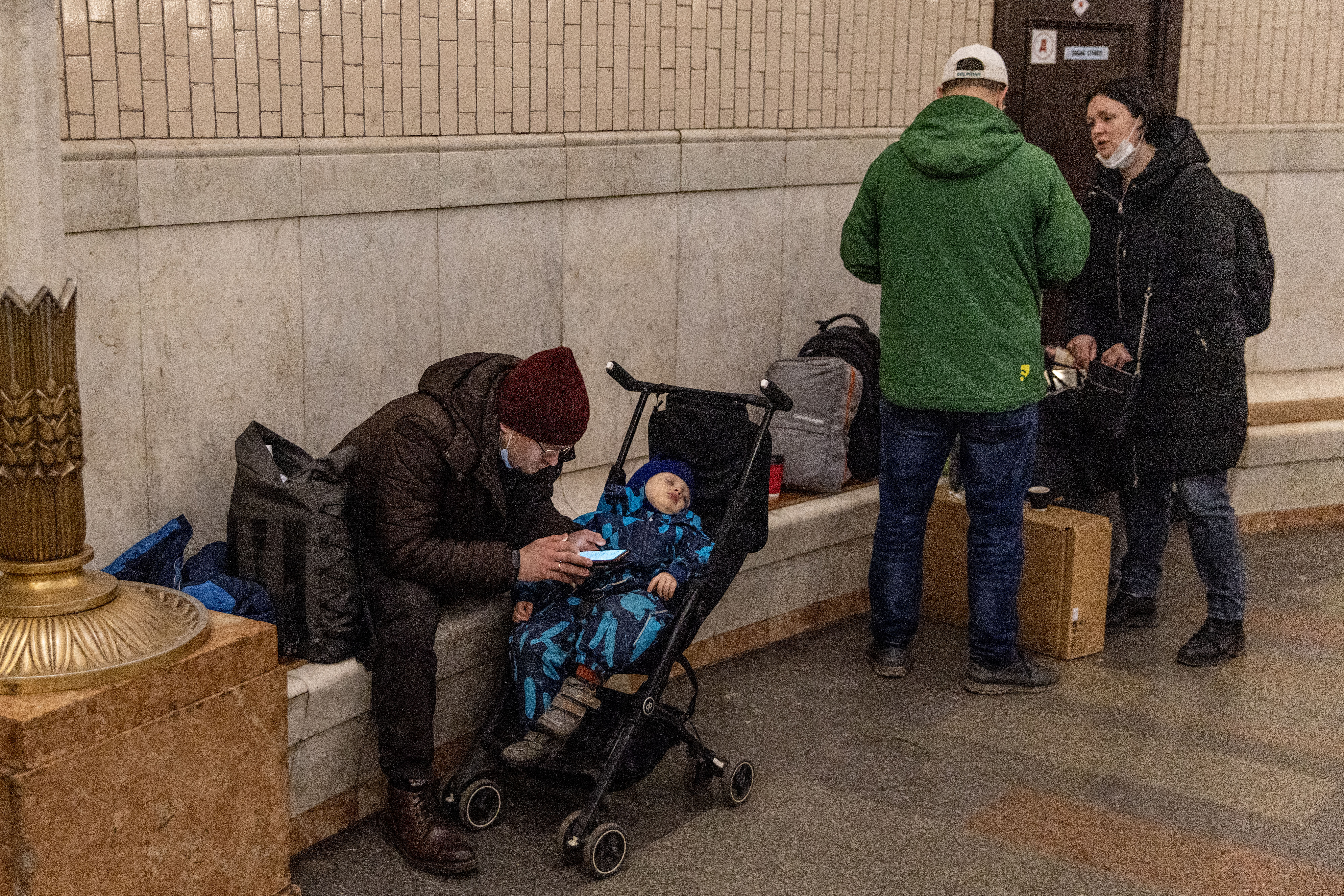
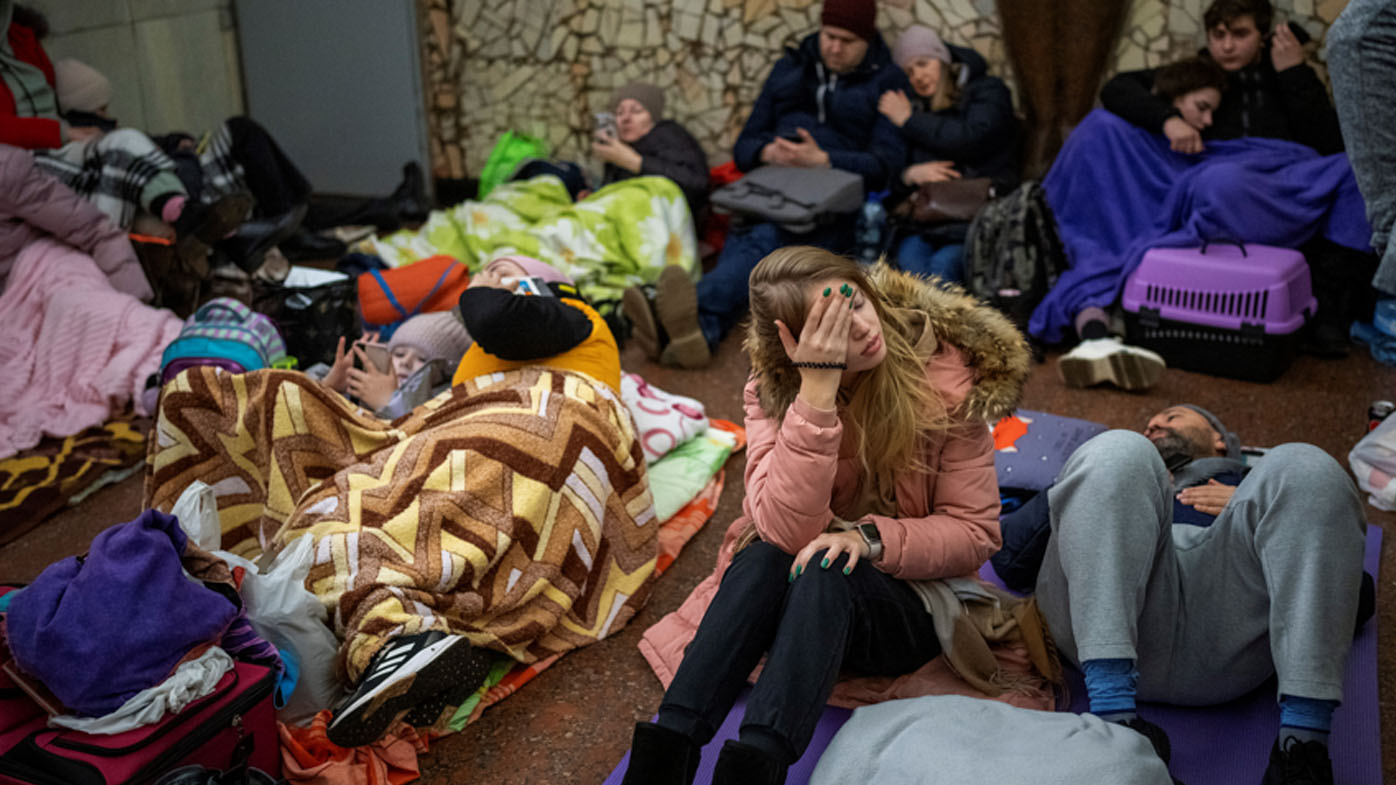
People carrying luggage took shelter in the subway, unsure of where to go.

Some panicked. Others clung to routine, with irritation.

"I'm not afraid. I'm going to work. The only unusual thing is that you can't find a taxi in Kyiv," one resident complained, as air raid sirens wailed.

Many seemed unsure how to react. Kyiv's main street, Khreshchatyk, rippled with anxiety as people checked their phones. Some walked their dogs or waved at friends.

"I'm not scared at the moment. Maybe I'll be scared later," resident Maxim Prudskoi said.

READ MORE: Prime Minister Scott Morrison condemns actions of Russia

People shelter in a subway in Kyiv

But elsewhere in the capital, Anna Dovnya watched soldiers and police remove shrapnel from an exploded shell and was terrified.

"We have lost all faith," she said.

"Until the very last moment, I didn't believe it would happen. I just pushed away these thoughts."

In Mariupol, the Azov Sea port city that many feared would be the first major target because of its strategic importance, AP journalists saw similar scenes of mixed routine and fear.

Some residents waited at bus stops, seemingly on their way to work, while others rushed to leave the city that is only about 15km from the front line with the Donetsk People's Republic, one of two separatist-held areas recognized by Russian President Vladimir Putin as independent this week in a prelude to the attack.

READ MORE: Doctor and mother prepares to join defence against Russia

Ukrainian military track burns at an air defence base in the aftermath of an apparent Russian strike in Mariupol, Ukraine.

As the day progressed, alarm across Ukraine rose. People crowded at grocery stores and cash machines.

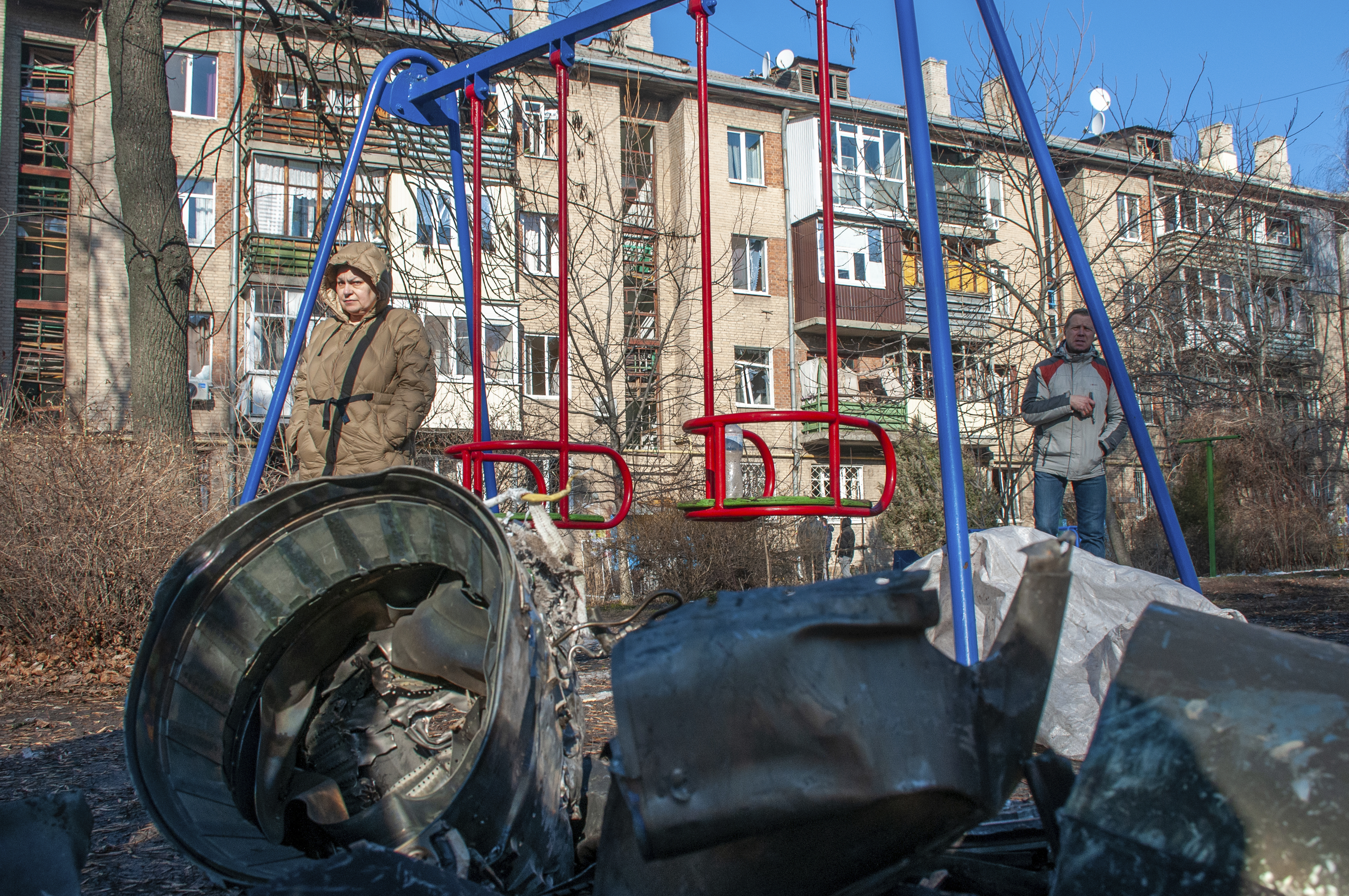
In Kharkiv, worried residents inspected fragments of military hardware strewn across a children's playground.

Kyiv mayor Vitaly Klitschko called on the city's three million people to stay indoors unless they worked in critical sectors and said everyone should prepare go-bags with necessities such as medicine and documents.

For weeks, President Volodymyr Zelenskyy had tried to moderate expectations of aggression by Russia, even as warnings by the United States became more urgent.

Mr Zelenskyy argued that panic would lead to societal destabilisation that could be as much of a tactical advantage for Russia as the estimated 150,000 troops that had massed on Ukraine's borders.

On Thursday, as the President imposed martial law, Ukrainians realised with a jolt that everything was changing.

"I feel panic, scared and excited. I don't know who I should ask for help," said Kyiv resident Elizaveta Melnik.

"We didn't believe this situation would come."