Tag Archives: oceania

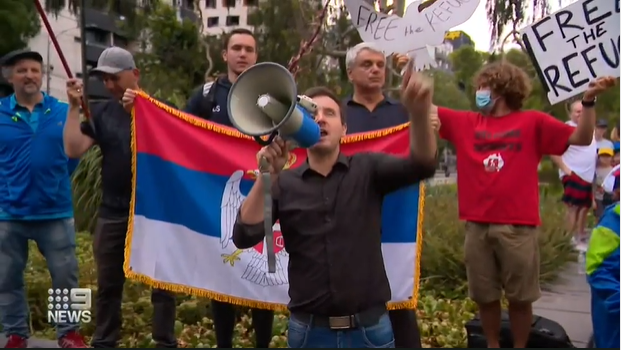
Djokovic fans, refugee supporters and anti-vaxxers protest in Melbourne

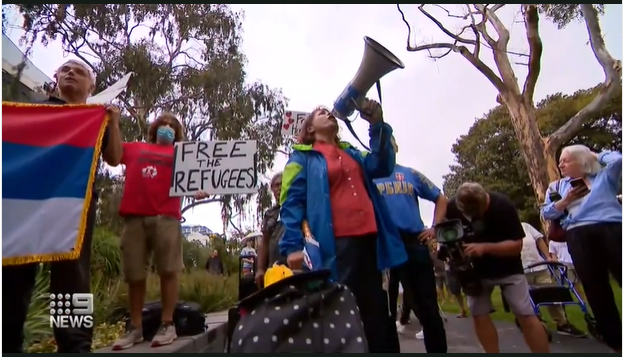
Both Novak Djokovic supporters and refugee advocates have taken to Melbourne streets to protest after the tennis star was placed in a Melbourne detention facility yesterday.

Djokovic fans have marched down Swanston Street in Melbourne CBD draped in Serbia's national colours and chanting, "Novak, we love you."

The world number one is being held at the Park Hotel in Carlton for four days as he awaits his day in court to appeal against the Australian Government's decision to cancel his visa.

READ MORE: Self-reporting system for COVID-19 cases goes live as Victoria records 21,728 new cases

The hotel is guarded by police and his room is beside where two dozen asylum seekers – some who have been imprisoned for nine years – are staying.

The asylum seeker's supporters also convened in Melbourne today, chanting, "Free the refugees".

Supporters of the anti vax and freedom movement also gathered in the city from midday.

Small groups of police officers monitored the groups of protesters.

Most of the protesters cleared out when heavy rain hit Melbourne early afternoon.

No singing, dancing in NSW venues

Some COVID-19 restrictions will be reintroduced in New South Wales in response to the skyrocketing number of cases.

Elective surgery has been postponed, and there is no singing or dancing allowed in hospitality venues – not including performers or at weddings.

It comes as the state reported a record high of 38,625 cases, but health experts say the real number of people infected is probably much higher.

LIVE UPDATES: Supermarket shortages as COVID-10 cases skyrocket

Ambulances at RPA Hospital Emergency in Sydney.

NSW Premier Dominic Perrottet said restrictions were coming into effect in NSW from tomorrow until January 27 to manage the surging Omicron cases.

Most major events across New South Wales will proceed with COVID-safe plans.

"So if you have a major event planned, throughout January, continue as planned, there are no changes to any of those events," Mr Perrotet said.

The premier has also encouraged people to "minimise mingling where possible" as well as minimise household visits and indoor gatherings.

Mr Perrottet said elective surgery for non-urgent surgeries will be suspended until mid-February.

READ MORE: Talented Sydney sportsman, just 23, dies from COVID-19

Positive rapid tests to be reported

Going forward, people in the state will also be required to report a positive rapid test result through the Service NSW app. An online registration system is set to be available by mid-next week.

Chief Health Officer Dr Kerry Chant said positive rapid antigen test results were now being treated as the same as positive PCR results.

"In this current setting of such high case numbers, if you've got symptoms, and you've got a positive RAT test, then you're a case," she said.

"We're also saying that if you're a household contact or you have had those high-risk exposures, then also you're positive, you're a case.

"If you have had no exposures to anyone, it's really unusual that you have got a positive test, under those circumstances, you might get a PCR to validate it," Dr Chant said.

Peak of Omicron surge yet to come

NSW Health Deputy Secretary Susan Pearce said the state would be "well past" the peak of the Omicron case surge by mid-February.

"We expect that peak to occur in around the third to the last week of January," she said.

"We have got some challenging weeks ahead of us. But we have been planning for this pandemic and continuing to reinvent ourselves for two years now."

Half of all cases in people in their 20s and 30s

New modelling shows nearly 50 per cent of all COVID-19 cases in NSW in the last week are in people aged 20-39.

"So there's 29 per cent between 20 and 29, and 30 and 39 account for 19 per cent of the cases," Dr Kerry Chant said.

"The transmission is happening in a variety of settings. Obviously in those household and social gatherings that people are having, and also in places like pubs, clubs, nightclubs, and the concern around the behaviour of dancing and singing," she added.

Dr Chant said when people sing and dance they mingle with groups they wouldn't otherwise interact with, which can spread the virus further.

"But when you're actually dancing on a dance floor, when you're energised and singing in a group and moving around, then you actually risking exposing people that you would normally day-to-day not come into contact with.

"So with this time, we really just trying to slow the spread, reduce the introduction to new social networks as a mechanism of slowing the spread to remove that peak, blunt that peak in the projections … in order to reduce the impact we're seeing on our hospital and those other critical services in the community."

Boosters mandatory for some healthcare workers

Today it was also announced that a third dose of a COVID-19 vaccine will become mandatory for some frontline health workers.

"So there are a number of workers here in New South Wales that we have deemed to be in high-risk settings," Mr Perrottet said.

"In those circumstances, we have mandated vaccinations. We will be moving to those mandates including a booster shot.

"So the Health Minister is working through that at the moment, but that announcement today will ensure that whether it's our teachers, nurses, our front-line health and disability workers, where NSW Health has previously required mandatory vaccination for certain front-line staff – we will move to boosters being included as part of that fully vaccinated determination."
Scientists explore Thwaites, Antarctica's 'doomsday' glacier

A team of scientists is sailing to “the place in the world that’s the hardest to get to” so they can better figure out how much and how fast seas will rise because of global warming eating away at Antarctica’s ice.

Thirty-two scientists are starting a more than two-month mission aboard an American research ship to investigate the crucial area where the massive but melting Thwaites glacier faces the Amundsen Sea and may eventually lose large amounts of ice because of warm water.

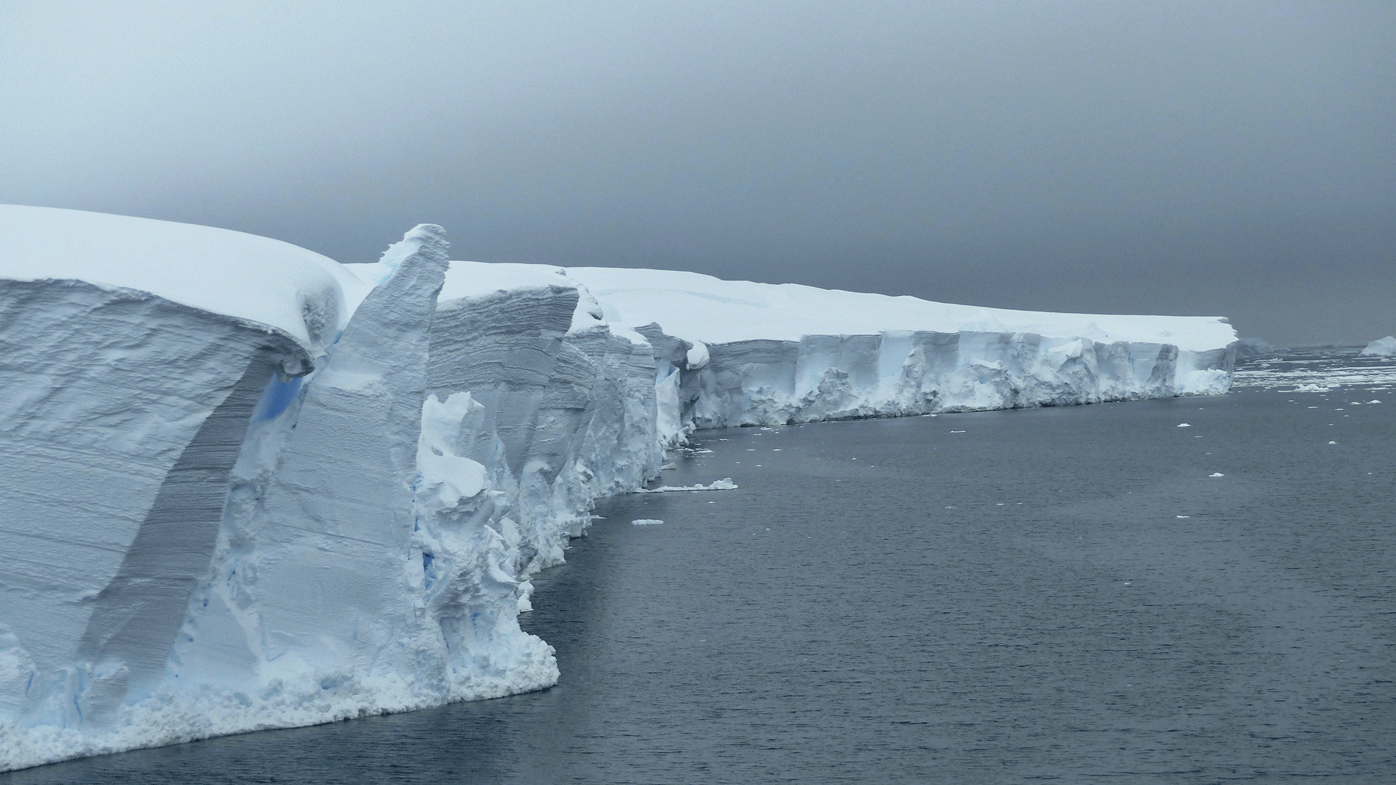
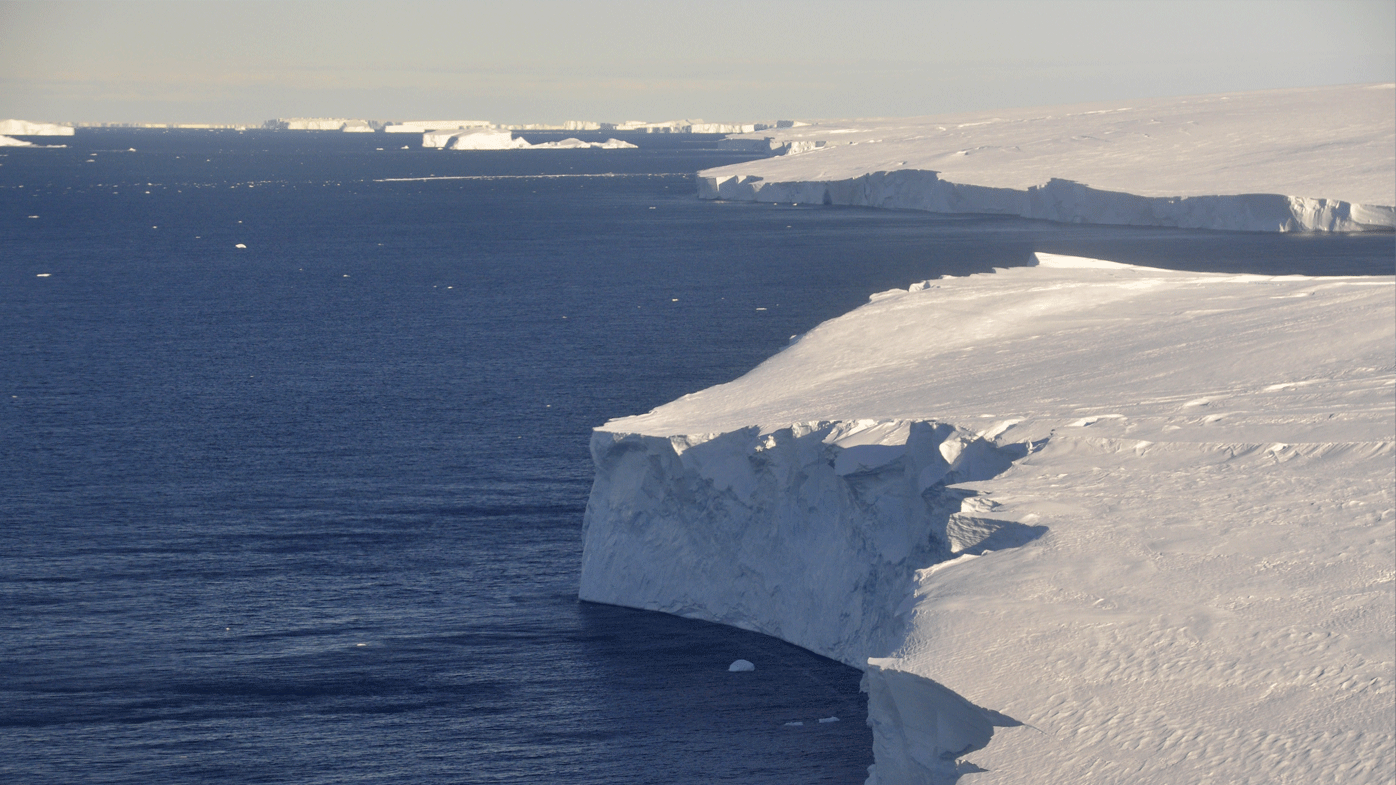
The Florida-sized glacier has gotten the nickname the “doomsday glacier” because of how much ice it has and how much seas could rise if it all melts – more than two feet (65 centimetres) over hundreds of years.

LIVE UPDATES: Supermarket shortages as COVID-10 cases skyrocket

Thwaites glacier Antartica

Because of its importance, the United States and the United Kingdom are in the midst of a joint $69 million mission to study Thwaites, the widest glacier in the world by land and sea.

Not near any of the continent's research stations, Thwaites is on Antarctica's western half, east of the jutting Antarctic Peninsula, which used to be the area scientists worried most about.

“Thwaites is the main reason I would say that we have so large an uncertainty in the projections of future sea level rise and that is because it’s a very remote area, difficult to reach,” Anna Wahlin, an oceanographer from the University of Gothenburg in Sweden, said Wednesday in an interview from the Research Vessel Nathaniel B. Palmer, which was scheduled to leave its port in Chile hours later.

READ MORE: Talented Sydney sportsman, just 23, dies from COVID-19

Thwaites glacier Antartica

“It is configured in a way so that it’s potentially unstable. And that is why we are worried about this.”

Thwaites is putting about 50 billion tons of ice into the water a year. The British Antarctic Survey says the glacier is responsible for 4 per cent of global sea rise, and the conditions leading to it to lose more ice are accelerating, University of Colorado ice scientist Ted Scambos said from the McMurdo land station last month.

Oregon State University ice scientist Erin Pettit said Thwaites appears to be collapsing in three ways:

  • Melting from below by ocean water
  • The land part of the glacier “is losing its grip” to the place it attaches to the seabed, so a large chunk can come off into the ocean and later melt
  • The glacier’s ice shelf is breaking into hundreds of fractures like a damaged car windshield. This is what Pettit said she fears will be the most troublesome with 10 kilometre long cracks forming in just a year

READ MORE: Cyclone risk as monsoon trough slams into state

Thwaites glacier Antartica

No one has stepped foot on the key ice-water interface at Thwaites before. In 2019, Wahlin was on a team that explored the area from a ship using a robotic ship but never went ashore.

Wahlin’s team will use two robot ships – her own large one called Ran which she used in 2019 and the more agile Boaty McBoatface, the crowdsource named drone that could go further under the area of Thwaites that protrudes over the ocean – to get under Thwaites.

The ship-bound scientists will be measuring water temperature, the sea floor and ice thickness. They'll look at cracks in the ice, how the ice is structured and tag seals on islands off the glacier.

Thwaites “looks different from other ice shelves,” Wahlin said.

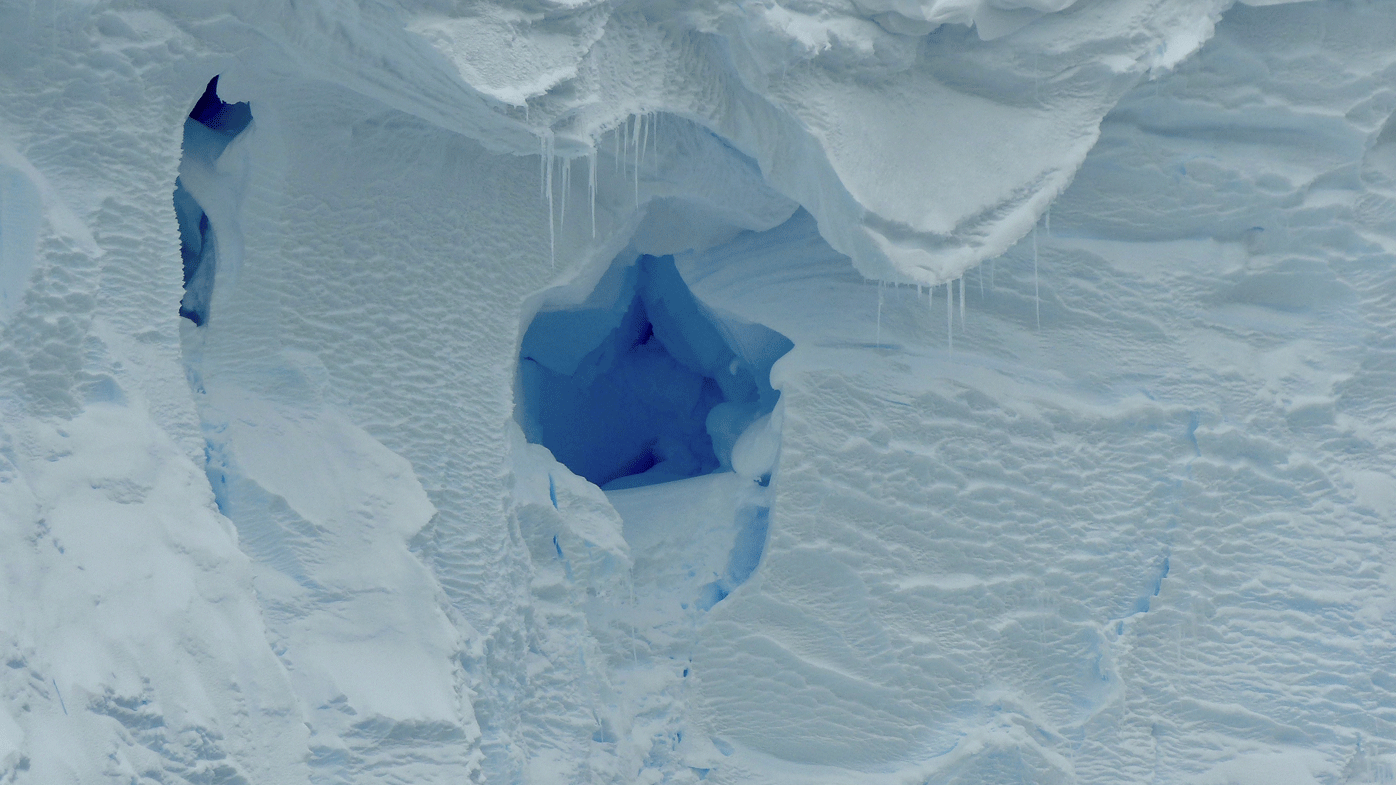
“It almost looks like a jumble of icebergs that have been pressed together. So it’s increasingly clear that this is not a solid piece of ice like the other ice shelves are, nice smooth solid ice. This was much more jagged and scarred.”

SA Chief Public Health Officer denies resignation rumours

South Australia's Chief Public Health Officer, Professor Nicola Spurrier has staunchly denied rumours she threatened to resign, after it was pointed out she has been absent from public health updates in recent weeks.

"Now why would I threaten to resign from this sort of job. I'm here to handle a pandemic, not mess around," Ms Spurrier said at today's press conference.

"I am here to do a good job and I am leading a pandemic response. Absolutely no to that sort of question."

LIVE UPDATES: Supermarket shortages as COVID-10 cases skyrocket

Ms Spurrier shut down the rumours, adding there were no tensions between herself and Premier Steven Marshall.

"I get on extremely well with the premier. We spend a lot of time talking, we need to be on the same wavelength. We've worked extremely well in South Australia as a team."

READ MORE: Talented Sydney sportsman, just 23, dies from COVID-19

READ MORE: Cyclone risk as monsoon trough slams into state

She said despite rumours she had resigned, or had been sick with COVID-19, she was still working as the CPHO.

"I'm always available to come and do a press conference as part of my job and address the public and I look forward to any opportunity I am given."

South Australia recorded 3707 cases of COVID-19 today and two further deaths.

Bitcoin hits lowest price in months

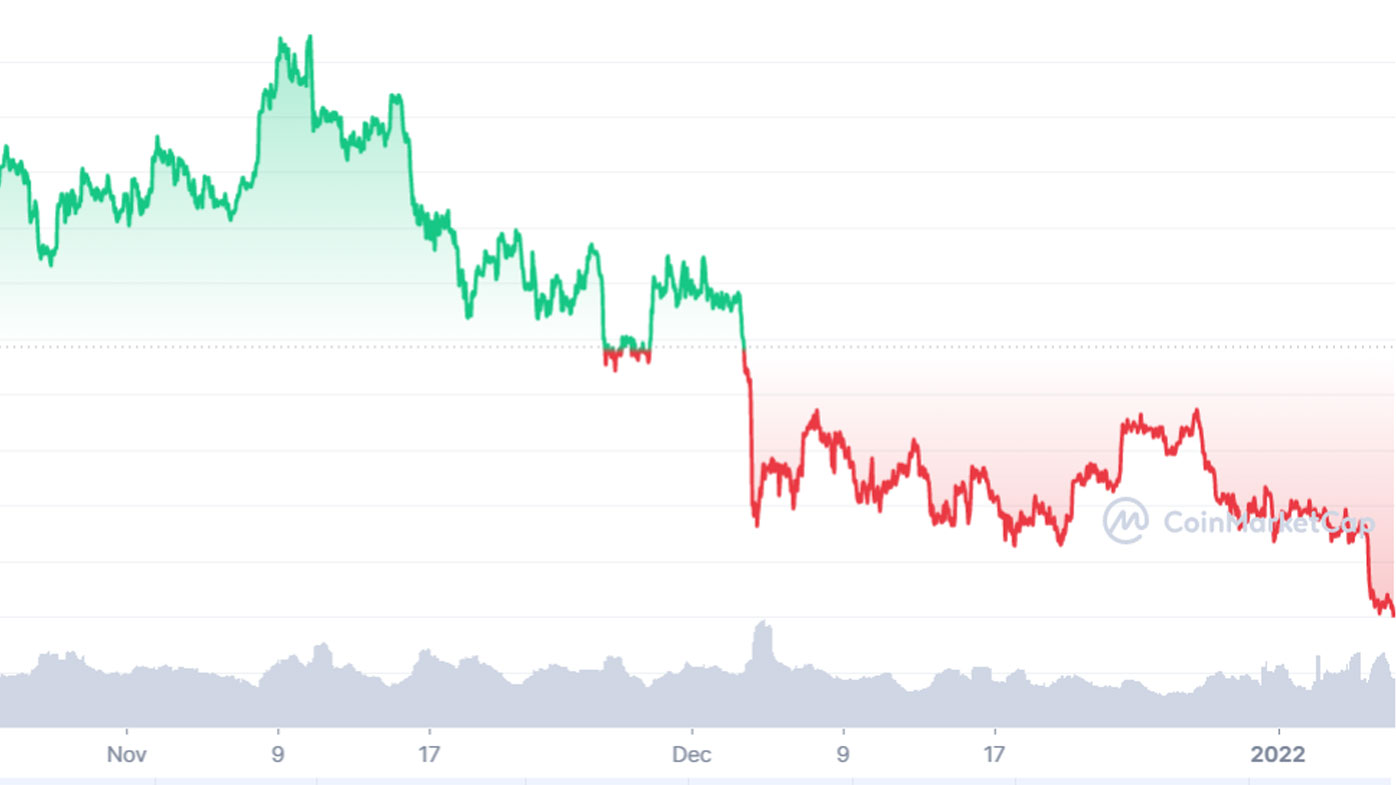
Bitcoin has continued to shed value in January, reaching its lowest point in months, trading at just over US$42,250 at 2.30pm AEST.

Since reaching a $69,000 high in November, the cryptocurrency has rapidly lost over a third of its price.

Over the past week, deadly protests in Kazakhstan have caused more jitters in the Bitcoin market, with the second-biggest country for Bitcoin mining losing internet access and taking as much as 15 per cent of the network offline.

LIVE UPDATES: Supermarket shortages as COVID-10 cases skyrocket

A graph from CoinMarketCap showing the price of Bitcoin over the past three months.

READ MORE: Talented Sydney sportsman, just 23, dies from COVID-19

Bitcoin today fell below $43,000 for the first time since September.

Many investors rushed into Bitcoin in 2017 and watched prices surge from about $1000 per coin to a little below $20,000 by December of that year.

More large gains were made last year, despite China clamping down on Bitcoin and banning mining and all crypto-related activity.

But investors are used to a bumpy ride.

Earlier this week investment bank Goldman Sachs predicted Bitcoin could more than double, to a little over $100,000 per coin, within the next five years.

An increasing number of top fund managers including George Soros, Stanley Druckenmiller, Paul Tudor Jones and have invested in Bitcoin.

NEWS QUIZ: Test your knowledge with trivia from this week's big news events