New Zealand actor Sam Neill is putting his original vineyard on the block.The A-lister and founder of the Two Paddocks wine company said he was selling the “beautiful” 8.3-hectare Gibbston Back Rd property reluctantly.”Two Paddocks…
Tag Archives: oceania
Covid 19 Delta outbreak: Taranaki midwives threaten to quit over vaccine mandate
Healthcare workers who treat vulnerable people are required to get a Covid vaccine because they have a responsibility to others, the Government says.Responding to news that 10 of Taranaki District Health Board’s 63 registered midwives…
Man charged with murder after body found at Ōmāpere address
A man has been charged with murder after the discovery of a body at Ōmāpere in Northland. The 73-year-old man was found dead at an Ōmāpere address on Friday.This morning police confirmed a 48-year-old man is…
Life saved: Auckland fisherman plucked from surf in dramatic rescue by Eagle helicopter crew, off-duty officer
The quick actions of an off-duty police officer out for a surf and an Eagle helicopter crewman saved a man’s life when he was swept off rocks at a wild west coast beach out of Auckland. Emergency services were called after a man…
Giant planet found orbiting a dead star shows what may happen when our sun dies
The discovery of a distant Jupiter-like planet orbiting a dead star reveals what may happen in our solar system when the sun dies in about 5 billion years, according to new research.
This unusual duo was discovered 6500 light-years away, near the center of our Milky Way galaxy. The pairing is unexpected because this gas giant exoplanet with a mass similar to Jupiter's is orbiting a white dwarf.
A white dwarf is what remains after a sun-like star swells up to a red giant during the star's evolution. Red giants burn through their hydrogen fuel and expand, consuming any planets near their path. After the star loses its atmosphere, all that remains is the collapsed core — the white dwarf. This remnant, usually about the size of Earth, continues to cool for billions of years.
READ MORE: Strange signals coming from heart of Milky Way stump scientists
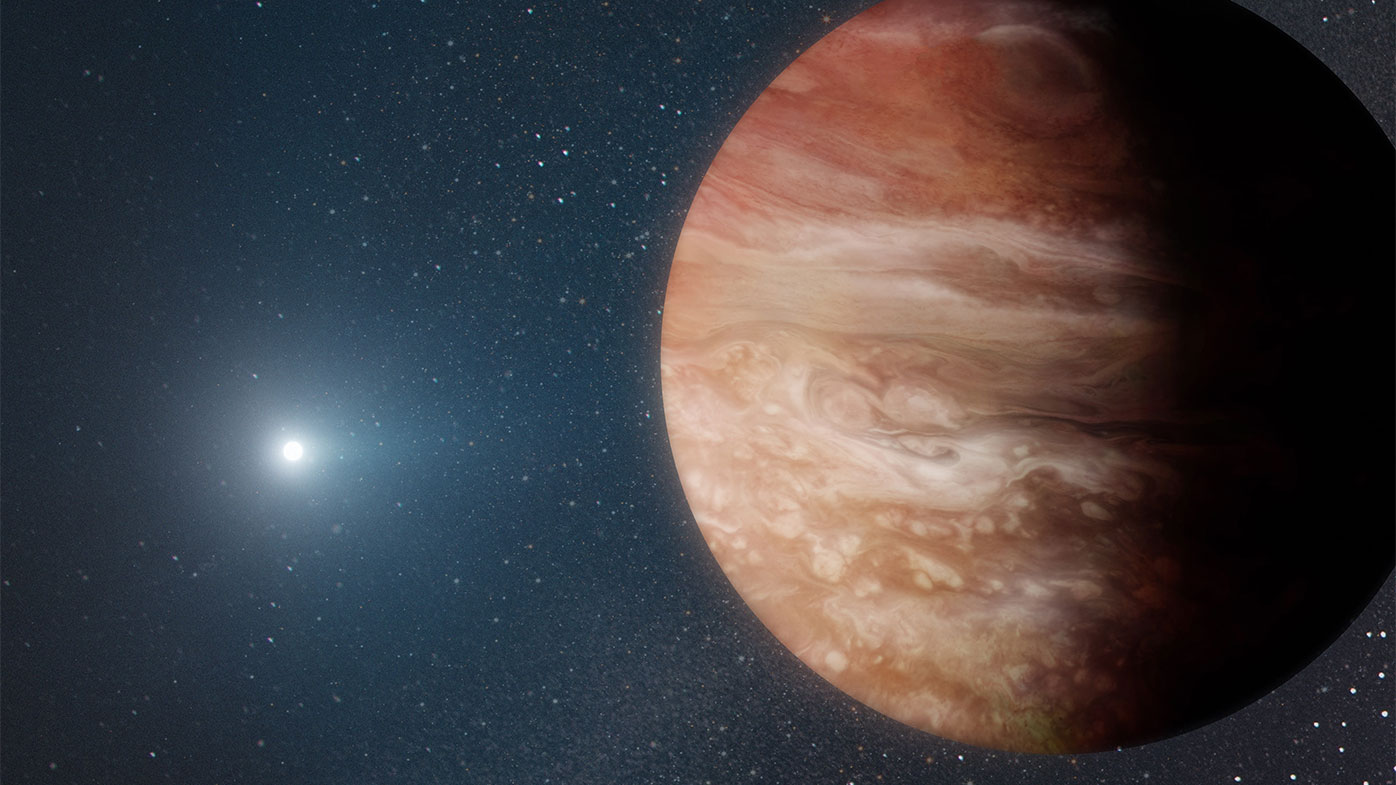
Finding an intact planet orbiting a white dwarf raises questions about how it survived the star's evolution into a white dwarf.
By observing the system, researchers were able to determine that the planet and star formed around the same time and the planet survived the star's death. The planet is about 2.8 AU from the star. An AU, or astronomical unit, is the distance between Earth and the sun, or 148 million km.
Previously, scientists believed gas giant planets needed to be much further away to survive a sun-like star's death.
The findings of a new study, published Wednesday in the journal Nature, show that planets can survive this incredibly violent phase of stellar evolution and support the theory that more than half of white dwarfs likely have similar planets orbiting them.
"This evidence confirms that planets orbiting at a large enough distance can continue to exist after their star's death," said Joshua Blackman, lead study author and astronomy postdoctoral researcher at the University of Tasmania, in a statement. "Given that this system is an analogue to our own solar system, it suggests that Jupiter and Saturn might survive the Sun's red giant phase, when it runs out of nuclear fuel and self-destructs."
READ MORE: Australia to build lunar rover for NASA mission to the Moon
White dwarfs and Earth's future
When our sun becomes a red giant billions of years from now, it will likely engulf Mercury and Venus — and perhaps Earth.
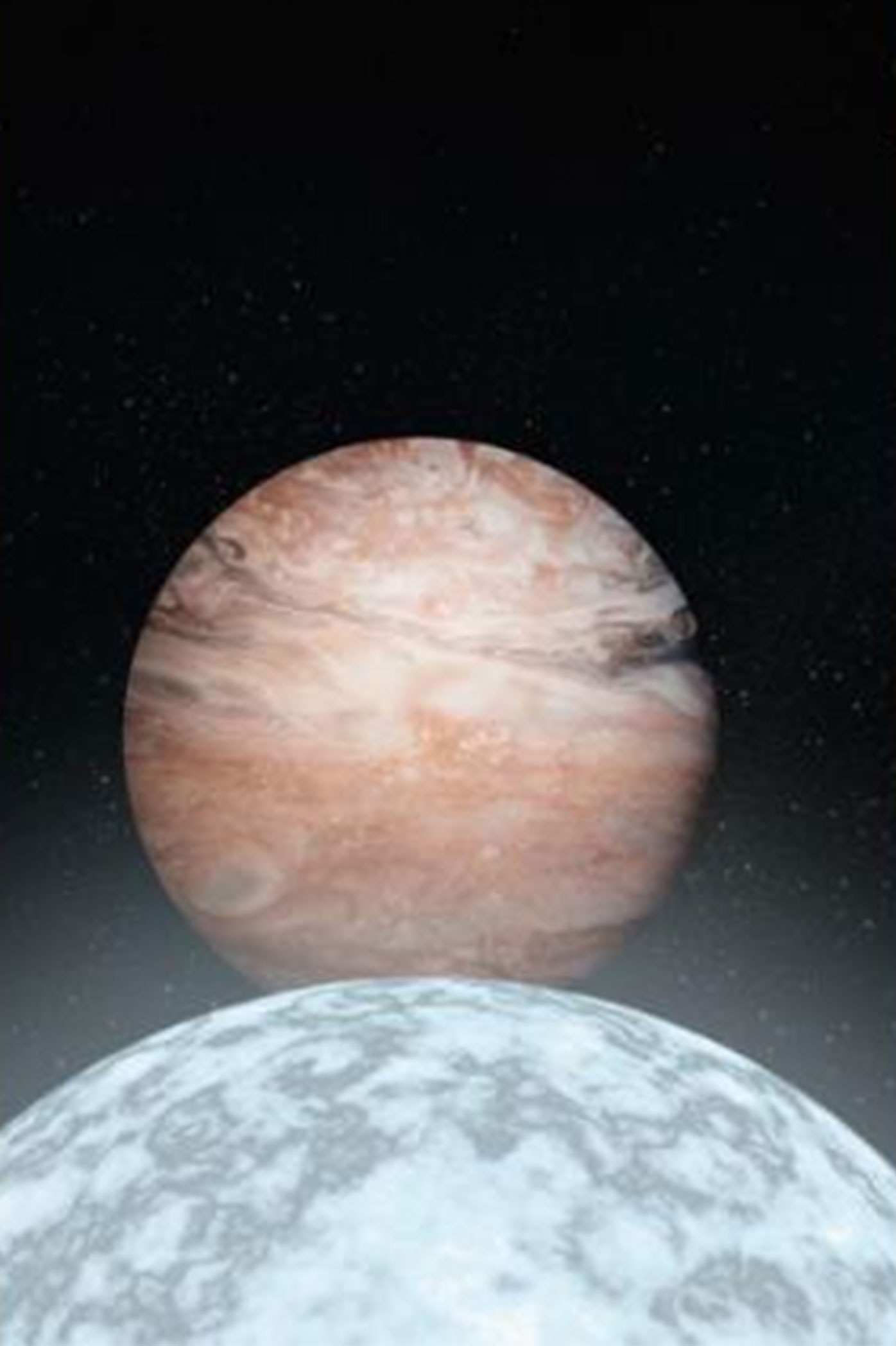
"Earth's future may not be so rosy because it is much closer to the Sun," said David Bennett, study coauthor and senior research scientist at the University of Maryland and NASA's Goddard Space Flight Centre, in a statement.
"If humankind wanted to move to a moon of Jupiter or Saturn before the Sun fried the Earth during its red supergiant phase, we'd still remain in orbit around the Sun, although we would not be able to rely on heat from the Sun as a white dwarf for very long."
The Jupiter-like planet was previously discovered through a technique called microlensing, which is used to detect cold planets that are distant from their stars. This same technique can be used to find small, faint white dwarfs. Microlensing happens when a star in close proximity to Earth briefly aligns with a more distant star. The closer star's gravity acts like a magnifying lens and increases the light from the more distant star.
The researchers used the W. M. Keck Observatory in Hawaii, as well as its Near-Infrared Camera, to observe the white dwarf and planet. The white dwarf is 60 percent the mass of our sun, and the planet is about 40 percent more massive than Jupiter.
The high-resolution near-infrared images allowed the researchers to rule out the possibility that what the exoplanet is orbiting is a normal star or another type of evolved star.
"We have also been able to rule out the possibility of a neutron star or a black hole host. This means that the planet is orbiting a dead star, a white dwarf," said study coauthor Jean-Philippe Beaulieu, Warren chair of Astrophysics at the University of Tasmania and director of research for the French National Centre for Scientific Research's Institut d'Astrophysique de Paris, in a statement. "It offers a glimpse into what our solar system will look like after the disappearance of the Earth, wiped out in the cataclysmic demise of our Sun."
READ MORE: Researchers find our planet isn't as bright as it once was
More surviving planets around white dwarfs
So far, only giant planets have been detected around white dwarfs, but that doesn't mean they are the only planets in existence around these dead stars.
"There should also be smaller mass planets orbiting white dwarfs," Bennett wrote in an email. "Our microlensing surveys detect similar numbers of Jupiters and Neptunes, but we are more sensitive to Jupiters. So, we've found that Neptune mass planets are about 10 times more common than Jupiters in these wider orbits that will survive the end stages of stellar evolution. We expect that we will find planets of a range of masses orbiting white dwarfs."

"We do expect to find planets with a range of masses orbiting white dwarfs, but smaller rocky planets in close orbits are more likely to have been ripped apart during the red giant phase of its host star's evolution," Blackman added.
The researchers will continue the search for exoplanet survivors orbiting dead stars in the future. The Nancy Grace Roman Space Telescope, slated to launch in 2026, "will conduct a much more sensitive microlensing survey that should find many more planets orbiting white dwarfs," Bennett said.
The telescope will directly image giant planets and survey the planets orbiting white dwarfs across our galaxy, providing scientists with a better ratio of how many are destroyed by stellar evolution and how many survive.
In the last few years, other giant planets have been found orbiting dead stars, including one that is slowly being eaten alive by its zombie star, as well as a giant planet that closely orbits a white dwarf.
"The news of another planet found circling a white dwarf is exciting, offering additional proof that planets exist around dead stars after our paper last year reported on the first one ever found," said Lisa Kaltenegger, director of Cornell University's Carl Sagan Institute. Kaltenegger was not involved in the new study.
While this particular planet is unlikely to be potentially habitable for life, there has been a lot of research focused around the idea of searching for life on planets that could orbit white dwarfs.
"If planets can survive their star's demise, could life as well? The James Webb Space Telescope, launching soon, could very well answer the question," Kaltenegger said. "If life could survive even on planets circling stellar corpses, that would make for an amazing future of our cosmos."
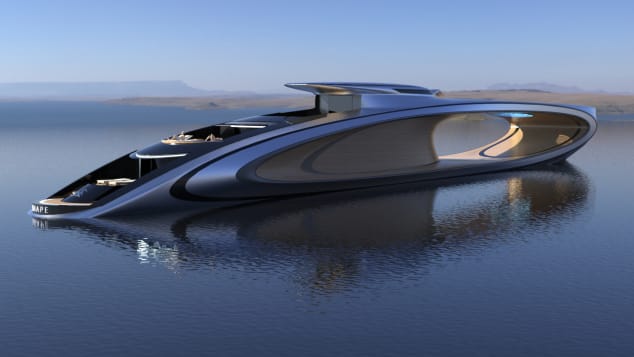
The futuristic super yacht with an intentional hole in the middle
Previous offerings include a yacht in the form of a swan and another devised to resemble a shark, but Lazzarini Design Studio's latest superyacht concept may be one of its most daring yet.
The Rome-based design team has just unveiled renderings of a brand new 69-metre yacht design with a "gaping hole" right in the middle.
The aptly named Shape concept, which is to run entirely on clean energy, features a huge empty opening in its superstructure, resulting in a wonderfully distinctive silhouette.
READ MORE: UK politician Sir David Amess dies after being stabbed at constituency meeting
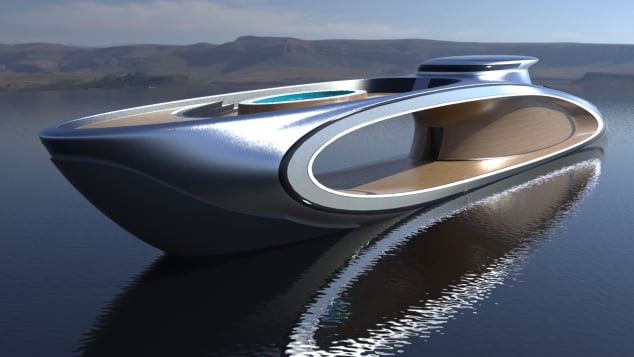
Referred to as the "hole deck," the space is accessible via an entrance on the bow and has steps leading down to the sea level, making it an ideal sun lounging area, and can be customised to suit the owner's requirements.
Meanwhile, the upper deck of the yacht is fitted with a glass-bottomed infinity pool, offering swimmers a fabulous view of the open space below.
The living area, located at the rear of the superstructure, consists of six suites, with room for up to 12 guests.
READ MORE: How to get your COVID-19 Vaccine Certificate
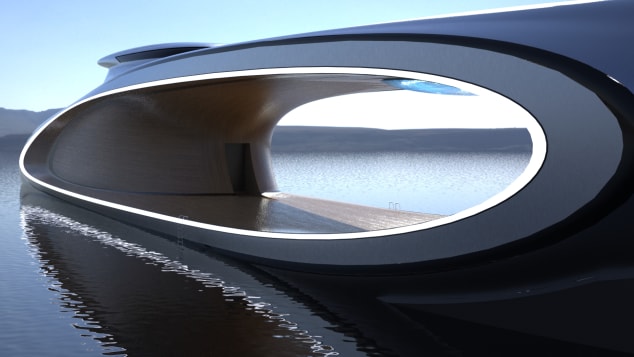
"Because of the stylistic choice of placing a void inside the superstructure, space on The Shape is the real luxury," say the designers.
There's also a beach club with a diving platform onboard, a helipad, a garage full of toys and all of the typical amenities you'd find on a yacht of this stature.
Shape, which has an estimated price around US$80 million, will be equipped with a propulsion system powered by hydrogen, and will run entirely on clean energy, with max speed of around 24 knots, or 12 knots when in full electric mode.
The solar panels on its sundeck are to be used to charge all onboard systems.
READ MORE: Man finds message in a bottle between his walls during renovations

Although it's still just a concept, the team at Lazzarini say the unconventional design has been getting a lot of attention from brokers since it was unveiled.
If Shape were to be picked up, it would take around 20 months to build and execute, according to the designers.
The distinctive concept is one of a number of new innovative superyacht designs to be unveiled over the past few weeks.
In September, German shipyard Lurssen debuted a new emission-free superyacht concept inspired by Lewis Carroll's "Alice's Adventure in Wonderland" at the Monaco Yacht Show, while Italian shipyard Tankoa chose the same event to debut its striking steel and aluminum Apache concept.
Covid 19 Delta outbreak: Waitākere Hospital Emergency Department a location of interest
A West Auckland supermarket and a South Auckland pharmacy are among the latest locations of interest to be released by the Ministry of Health.Anyone who visited FreshChoice in Ranui on Tuesday 12 October between 11:00 am and 12:30…
Covid 19 Delta outbreak: Investigation ongoing into Auckland police inspector at centre of alleged border 'favour' breach
No decision has been made on whether a high-ranking Auckland police officer will be charged after allegedly breaching the city’s southern border without an exemption.The investigation into the actions of Counties Manukau Māori…
Bus tips into sinkhole as deadly storms lash Greece
A bus transporting oil refinery workers fell into a sinkhole in the centre of Greece's second-largest city on Friday as storms continued to batter the country, damaging roads, closing schools and causing the deaths of at least two people.
Authorities said all 15 people on the bus in Thessaloniki were unharmed.
The incident occurred early on Friday as the refinery employees were heading to work.
READ MORE: UK politician Sir David Amess dies after being stabbed at constituency meeting

The front of the bus initially partially tipped into the hole, allowing people on board to escape through the rear door.
The empty vehicle later fell deeper into the hole before a crane removed it.
READ MORE: How to get your COVID-19 Vaccine Certificate

Hundreds of homes in Athens, Greece's capital, were flooded, and major roads remained closed as the storm crossed the country, heading east.
READ MORE: Man finds message in a bottle between his walls during renovations
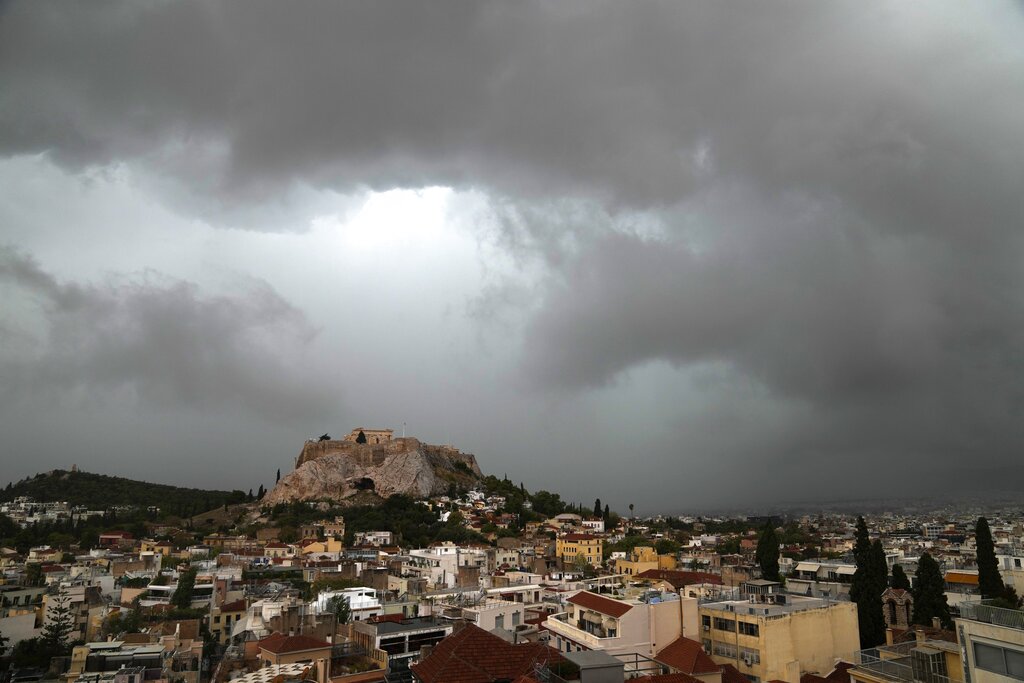
Flooding killed one person on the Greek island of Evia, where the severe weather compounded damage from a massive August wildfire.
READ MORE: Major storm cleanup after wild weather leaves path of destruction

Torrential rain was also blamed for a traffic accident in Greece's southern Peloponnese region which left one woman dead and several people injured.
Schools were closed in Athens and many flood-hit parts of the country including on Corfu and other islands along Greece's western coast. Rescue helicopters on Corfu were used to lift stranded residents off the rooftops of flooded buildings.
Covid 19 Delta outbreak: Royal New Zealand Navy crew member tests positive
By RNZ A crew member on the Royal New Zealand Navy frigate HMNZS Te Kaha has tested positive for Covid-19.The positive test result was returned during routine testing of the ship’s crew after a port visit to Guam, the Defence…