Epidemiologists say there’s no cause for alarm over two “weak” positive coronavirus cases picked up in Wellington wastewater, with similar traces from past infections having been found before through sewage sampling.But they’re…
Tag Archives: oceania
Bryce Edwards: Political Roundup – Will the Government take the poverty crisis seriously?
This week’s Budget is a chance for the Labour Government to take the crisis of poverty and inequality seriously. They can do this by delivering something serious or even transformational for those suffering at the bottom of the heap…
Disabled protesters demand reprieve for Laura Fergusson Trust in Auckland
Tetraplegic Sophia Malthus was among disabled protesters clutching placards who rallied in Greenlane today calling on authorities to save the Laura Fergusson Trust.The Trust supports young disabled people with physical and neurological…
Two arrested after loaded military-style assault rifle recovered in Auckland
Two men in their twenties have been arrested after a loaded military-style assaultrifle was confiscated on Sunday morning.Police attended a report of disorder at the Manukau Sports Bowl in Clover Park just after 9am, but police…
Four boaties safe on land after boat capsizes near Cape Palliser
Four people on board a fishing boat that capsized near Wellington have made it to shore safe and well.Rescue helicopters, police and three nearby fishing boats joined the search for the boat off Cape Palliser. A broken mayday…
Volcanoes could still be active on Mars
The barren landscape of Mars makes the planet seem like a quiet, frozen desert where nothing has happened for billions of years except for the occasional dust storm.
New research, however, suggests that the red planet has a more recent history of activity – and it could still be volcanically active.
Scientists still are trying to understand the history of Mars, and NASA rovers like Curiosity and Perseverance can help uncover evidence to piece together the planet's time line.
READ MORE: Masks no longer mandatory on public transport from tonight in Sydney

Mars was once much wetter and warmer than it is today about four billion years ago. Something happened to cause the planet to lose its atmosphere and send its water beneath the surface about four billion years ago – but the cause remains a mystery.
Scientists had believed much of the planet's volcanic activity occurred between three and four billion years ago, along with some isolated eruptions happening about three million years ago.
Now, orbiters circling Mars have provided imagery and data of a previously unknown area of interest. This latest information shows evidence of volcanic activity that happened within the last 50,000 years – which is fairly young, astronomically speaking.
The smooth, dark area stretches for 12.8 km. It's surrounded by a 32km volcanic fissure in the Cerberus Fossae system of faults where the Martian crust has pulled apart.
READ MORE: Bloody night as five people stabbed in separate attacks across Sydney's west

This intriguing feature is located in the Elysium Planitia region, a plain spread across the planet's equator and second largest volcanic region.
The study published Monday in the journal Icarus.
"This may be the youngest volcanic deposit yet documented on Mars," said lead study author David Horvath, a research scientist at the Planetary Science Institute, in a statement. "If we were to compress Mars' geologic history into a single day, this would have occurred in the very last second."
The researchers believe the evidence, including how the material was distributed on the surface, matches a pyroclastic eruption. This type of volcanic eruption occurs when magma explodes due to expanding gases.
In other words, think about what happens when you shake up a soda.
"When we first noticed this deposit, we knew it was something special," said study coauthor Jeff Andrews-Hanna, an associate professor at the University of Arizona Lunar and Planetary Laboratory, in a statement.
"The deposit was unlike anything else found in the region, or indeed on all of Mars, and more closely resembled features created by older volcanic eruptions on the Moon and Mercury."
Most of the evidence of previous volcanic activity is similar to lava flows that we might see on Earth. But this one is different.
"This feature overlies the surrounding lava flows and appears to be a relatively fresh and thin deposit of ash and rock, representing a different style of eruption than previously identified pyroclastic features," Mr Horvath said.
"This eruption could have spewed ash as high as 9.6km into Mars' atmosphere. It is possible that these sorts of deposits were more common but have been eroded or buried."
READ MORE: Police treating death of woman found Melbourne apartment complex as 'suspicious'

The potential for life on Mars
While neither of the rovers are close enough to investigate this feature, NASA's InSight Lander is about 1609 km away. The stationary craft has been studying seismic activity on Mars since it landed in November 2018.
While tracking seismic activity, InSight detected two Marsquakes – like earthquakes but not caused by tectonic plates since Mars doesn't have any – that originated from the region around Cerberus Fossae.
Since tectonic activity isn't the cause, scientists think magma could be moving deep within the planet's interior to cause these quakes.
"The young age of this deposit absolutely raises the possibility that there could still be volcanic activity on Mars, and it is intriguing that recent Marsquakes detected by the InSight mission are sourced from the Cerberus Fossae," Mr Horvath said.
Fissures in Cerberus Fossae likely occurred 20 million years ago when groundwater spewed up and onto the surface, although the cause for this eruption is unknown.
And these volcanic deposits could suggest something many scientists have speculated: Mars could have been habitable below the surface more recently than the surface itself.
"The interaction of ascending magma and the icy substrate of this region could have provided favourable conditions for microbial life fairly recently and raises the possibility of extant life in this region," Mr Horvath said.
Eruptions could have occurred when Martian magma made contact with permafrost beneath the surface.
"The ice melts to water, mixes with the magma and vaporises, forcing a violent explosion of the mixture," said study coauthor Pranabendu Moitra, a research scientist in the University of Arizona's department of geosciences, in a statement. "When water mixes with magma, it's like pouring gasoline on a fire."
High activity just 9.6 km away from this volcanic eruption, considered to be the youngest on the planet, is also the youngest impact crater on Mars. The crater is 6 miles wide.
"The ages of the eruption and the impact are indistinguishable, which raises the possibility, however speculative, that the impact actually triggered the volcanic eruption," Mr Moitra said.
Large impacts to Mars may have shaken up the subsurface magma, much like large earthquakes have been linked to volcanic eruptions.
Elysium may seem flat and boring, but it's no coincidence that this area is home to active Marsquakes, the planet's most recent water floods and lava flows — and now, the most recent volcanic eruption.
"This may be the most recent volcanic eruption on Mars, but I think we can rest assured that it won't be the last," Mr Andrews-Hanna said. "All these data seem to be telling the same story: Mars isn't dead."
Six weeks of work will be done in four days to replace 100-year-old Wellington pipe
All six lanes of Wellington’s Jervois Quay will be closed over Queen’s Birthday weekend in a mammoth effort to replace a broken 100-year-old stormwater pipe. In February a sinkhole opened up in the road after the pipe collapsed,…
Herald afternoon quiz: May 16
Test your brains with the Herald’s afternoon quiz. Be sure to check back on nzherald.co.nz for the morning quiz tomorrow. To challenge yourself with more quizzes, CLICK HERE.
MBIE to provide payment range for contractors after new way of measuring
By Phil Pennington of RNZ A new way of measuring what contractors are charging the Government will set out the range of what is paid for each type of job.The public sector is under orders to rein in contractor spending, and also…
Melbourne man's shock cancer diagnosis: 'It looked like a pimple'
*Graphic warning: images may disturb some readers*
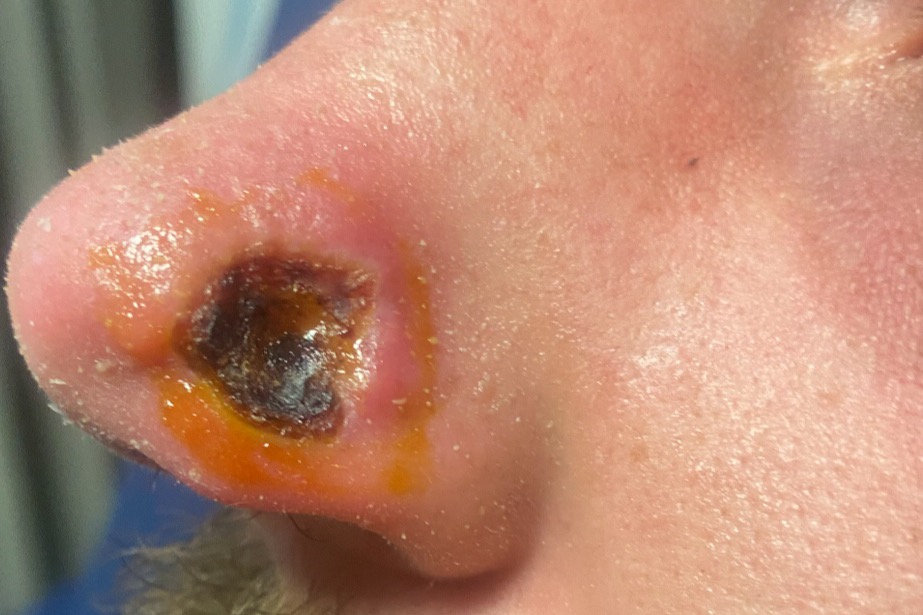
When a young Melbourne man spotted a dot on his nose, a pimple seemed to be the most obvious diagnosis.
However, in a matter of weeks, the dot ballooned in size – and it turned out to be cancer.
Josh Maschewski, 24, and his partner Ayshe Nazifovski, 30, are now warning people to remain vigilant if they see an obscure spot on their face.
Speaking to 9news.com.au, Ms Nazifovski said her partner developed the spot on his left nostril at the end of February, which looked just like a pimple – but was far from it.
"It just looked like a pimple that was about to get a head on it," she said.
"I tried to squeeze it, but nothing happened."
READ MORE: Condition 'that doesn't exist' affecting almost half world's population

After two weeks, the spot had not disappeared, instead growing about 10 times in size, until it was as large as his nostril.
"It went from a dot to 10mm long in two weeks," Ms Nazifovski said.
"It grew even more – it appeared on the whole left side of his nostril."
Concerned, the 24-year-old sought advice from his local GP, who told him the dot was an infected boil and gave him antibiotics – but they were wrong.
When the antibiotics did not work, they rushed to a hospital in Melbourne's west to seek another opinion.
They waited more than 10 hours in the emergency department to be seen, only to be again told it was an infected boil.
At no point was his skin checked for cancer, Ms Nazifovski said.
READ MORE: New immunotherapy drug could be used to treat melanoma of the eye
"Everyone said it's an infected boil, you have to get it drained.
"It was an unpleasant experience – Josh just kept getting sent away with no answer, only this unknown lump growing bigger and bigger."
By this stage, Mr Maschewski was struggling to stay awake, constantly feeling lethargic, while complaining about a buzzing sensation in his nose.
"He was trying to work, and he kept saying: 'I want to sleep.' He started getting a buzzing sensation in his nose, he kept saying: 'it's buzzing, it's buzzing.'"

It was only when the pair went to a dermatologist when they finally got answers.
The dermatologist took one look at the 24-year-old's nose and was instantly concerned.
"He thought it was cancer and reacted quite quickly and cut it off," Ms Nazifovski said.
"[Josh] never imagined this would happen in his wildest dreams."
Test results returned a diagnosis for squamous cell carcinom (SCC), a common type of skin cancer.
The form of cancer can develop in parts of the body that get a lot of sun, including the head, neck, face, hands and arms.
According to Spot Check Skin Cancer Clinic, there are more than 2500 treatments provided for non-melanoma skin cancers in Australia, such as SCC, every day.
The rate of non-melanoma skin cancer increases significantly with age, Ms Nazifovski telling 9news.com.au her partner may be one of the youngest cases of SCC.
READ MORE: New hope for women with pregnancy-associated breast cancer

However, the 24-year-old was not out of the woods, as despite the doctor being confident the cancer had been removed, it grew back.
Mr Maschewski has since been referred to the Peter MacCallum Cancer Centre, where he underwent his first operation to remove his left nostril.
He is now undergoing radiation therapy five days a week for six weeks.
Ms Nazifovski said doctors would not start reconstructing his nose until they were certain all of the cancer had been removed, which will likely be in two years' time.
"It's a big pill to swallow for a 24-year-old to hear you're not going to have a nose for the next two years," she said.
She set up a fundraiser to cover his medical expenses and bills, with Mr Maschewski unable to work for the next six months.
READ MORE: Expensive migraine drug added to PBS
Since its launch, nearly $3000 has been raised to support the young man.
The 24-year-old's cancer battle has not come without a message, the pair urging others in similar positions to continue seeking different opinions if medical advice did not sit right.
"Josh's message would be – always just go with your gut," Ms Nazifovski said.
"If you feel like that professional advice is not sitting well with you, go somewhere else.
"We went to four different places with this 'infected boil'. So know your own body."