The decision follows a mayoral rebuke and a major backlash from businesses and residents.
Tag Archives: oceania
Superbug outbreak in Auckland, Christchurch hospitals – Health NZ
One of the strains detected in Christchurch has been linked to an Auckland cluster.
AGB opens first zero‑silica stone factory in Nelson in fight against silicosis
The site removes silica entirely, eliminating the risks of dust exposure.
Fugitive from Hungary corruption case set up new life in Auckland to avoid prison overseas
He boasted: ‘Everyone will fall for it … One day we’ll write about it in a book.’
Trump’s bitter attack after being called ‘most unpopular president of all time’
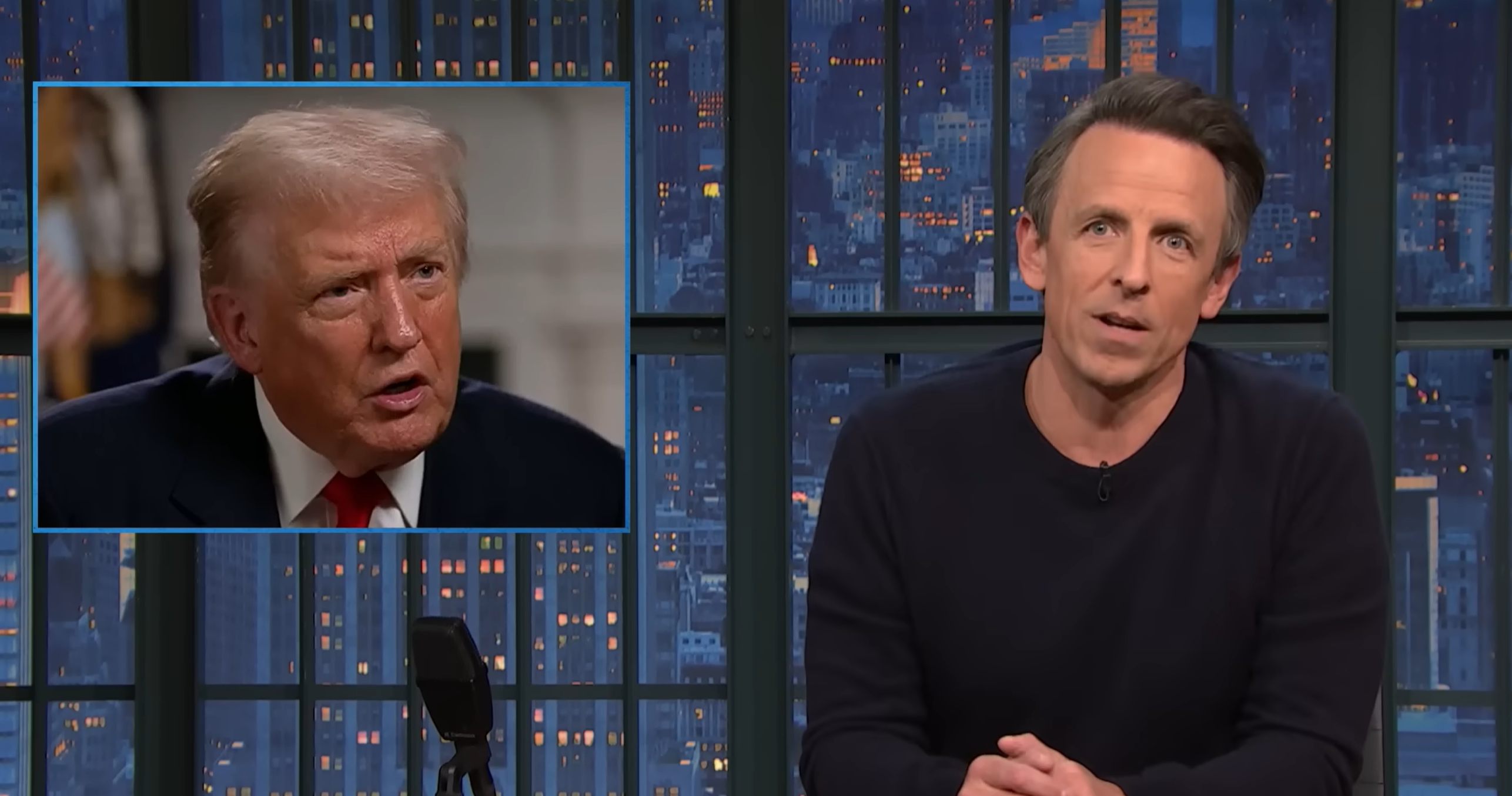
Donald Trump has resumed his social media siege against the late night television industry – and comedian Seth Meyers is his latest target.
The US president took to his platform Truth Social to call for Meyers to be fired after the Late Night host described Trump as the "most unpopular president of all time" while discussing the Republican Party's declining support.
"Trump is losing support among Republicans. Not all or even most of them, but enough to make a difference," Meyers said during his November 14 show.
READ MORE: Huge threat prompting multiple countries to bring back the military draft
READ MORE: Trump hints at decision on Venezuela – is the US about to go to war?
"Republicans losing faith in Trump is a meaningful and real development, and it's not coming out of thin air.
"He's done a bunch of very specific things to pi– off MAGA lately."
Recent poll numbers found Trump's approval rating among Republicans has dropped by 13 points since March 2025, according to the Associated Press-NORC Center for Public Affairs Research.
Meyers also took aim at Trump's support for the H1B visa program in the US to bring skilled foreign workers into America to boost manufacturing, after the president claimed US citizens in the "unemployment line" can't be trusted to work in factories.
He joked that Trump would also be in the "unemployment line" if he didn't come from wealth.
"If you didn't have a rich dad, that's where you'd be, my man," Meyers continued.
"I mean, without a million bucks you inherited from your father, you'd be a guy in Queens who lost his job selling vacuums door to door."
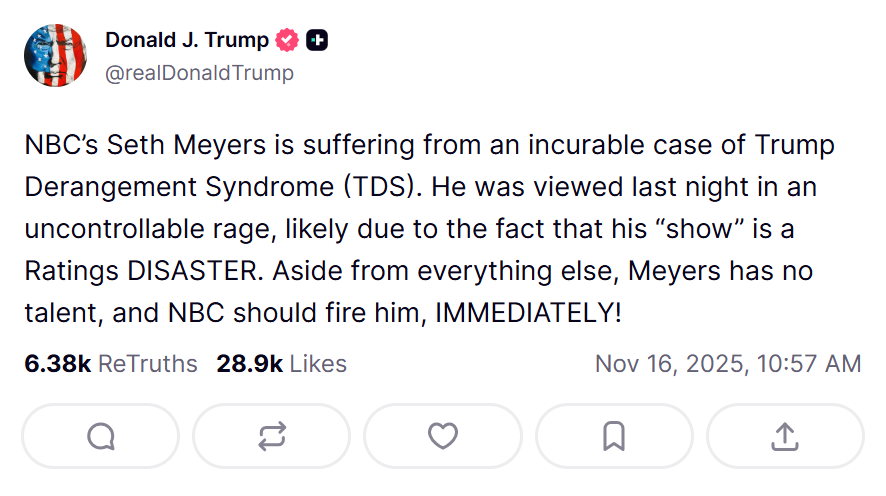
In a fiery response on Truth Social, Trump accused Meyers of suffering from "an incurable case of Trump Derangement Syndrome (TDS)".
READ MORE: Boy, 14, on bail allegedly stabs 19-year-old on quiet Melbourne street
The president also called on NBC to fire Meyers.
"He was viewed last night in an uncontrollable rage, likely due to the fact that his 'show' is a Ratings DISASTER," he said.
"Aside from everything else, Meyers has no talent, and NBC should fire him, IMMEDIATELY!"
Trump's Federal Communications Commission (FCC) chairman Brendan Carr reposted the message onto his X account.
Meyers has not publicly responded to Trump's fiery social media post.
He is not the first host to become ensnared in the president's retaliation against anti-Trump messaging on late night TV.
Fellow comedian Jimmy Kimmel was pulled off the air in September following comments he made about Charlie Kirk's assassination.
Jimmy Kimmel Live! was temporarily suspended by ABC's parent company Disney for criticising the MAGA movement's reaction to conservative activist Kirk's death.
Trump celebrated the decison and said Kimmel is "not a talented person", adding he "was fired because he had bad ratings more than anything else".
Kimmel returned to the air after a week.
DOWNLOAD THE 9NEWS APP: Stay across all the latest in breaking news, sport, politics and the weather via our news app and get notifications sent straight to your smartphone. Available on the Apple App Store and Google Play.
Huge threat prompting multiple countries to bring back military conscription
It is a debate many hoped would never be revived after the fog of war lifted: compulsory military conscription.
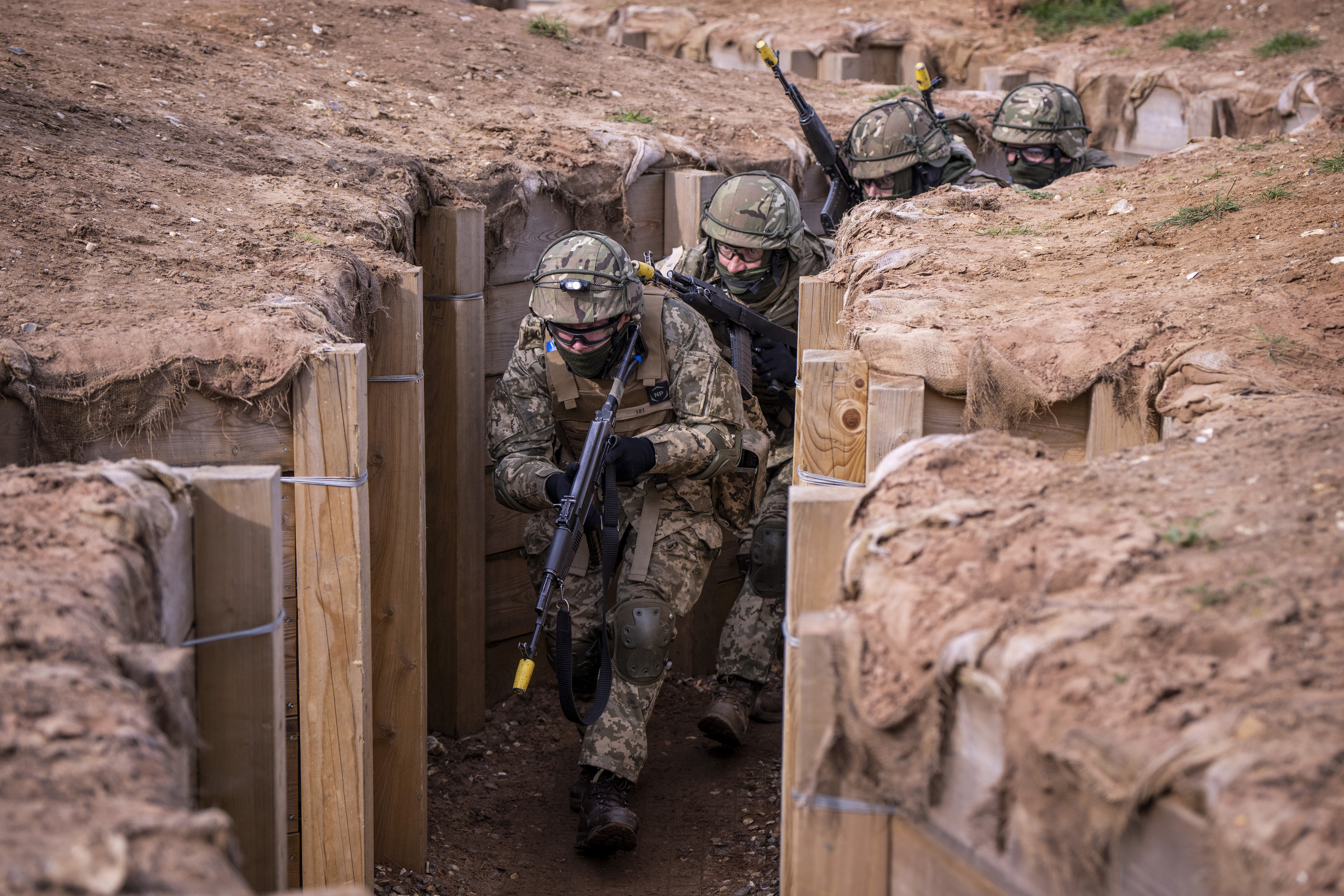
The Russia-Ukraine conflict has triggered several European governments to discuss or reinstate mandatory military service for the first time in decades.
NATO countries are now expected to meet the target of spending 5 per cent of annual GDPs on defence by 2035 as "profound security threats and challenges" threaten the EU.
READ MORE: Trump hints at decision on Venezuela – is the US about to go to war?
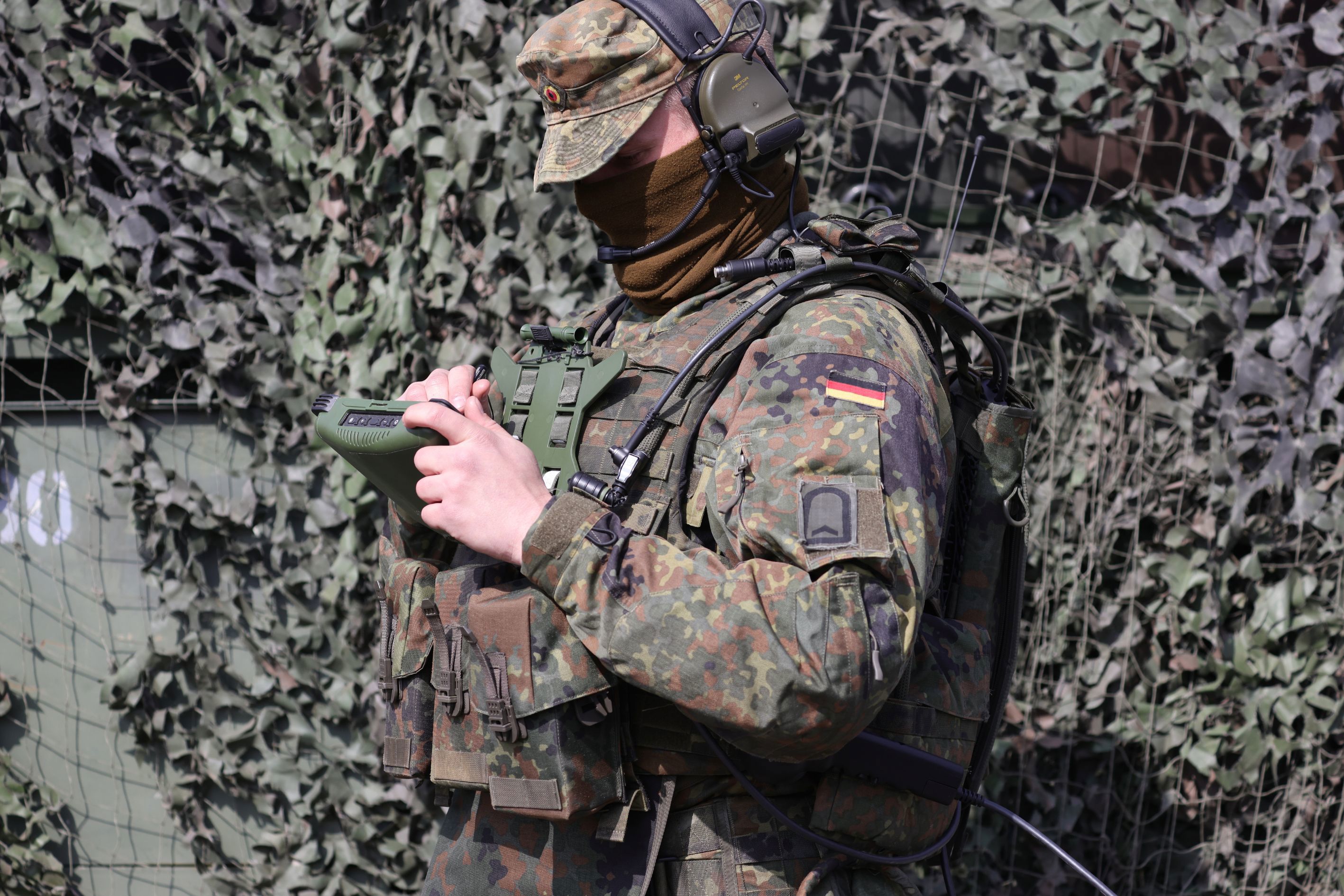
This ambitious target has generated an EU-wide drive to increase and fortify militaries.
Germany's government this past week torpedoed a plan to bring back its formerly-abolished system of mandatory conscription following a government stoush over the issue.
Chancellor Friedrich Merz had advocated for bringing back compulsory service because he wanted to build the strongest conventional army in Europe in the face of Russian threats.
But his grand plan was reduced to a new system of voluntary service.
If this does not help strengthen the country's dwindling military numbers, a nationwide conscription, known in German as "bedarfswehrpflicht", may be reconsidered.
https://x.com/NATO/status/1937861780576838025
Compulsory conscription has successfully been reestablished in other EU countries.
Latvia reinstated mandatory service for men in 2024 after 18 years, which forces conscripts to serve 11 months minimum.
And conscription was also brought back in Ukraine in 2014 following the war in Donbas.
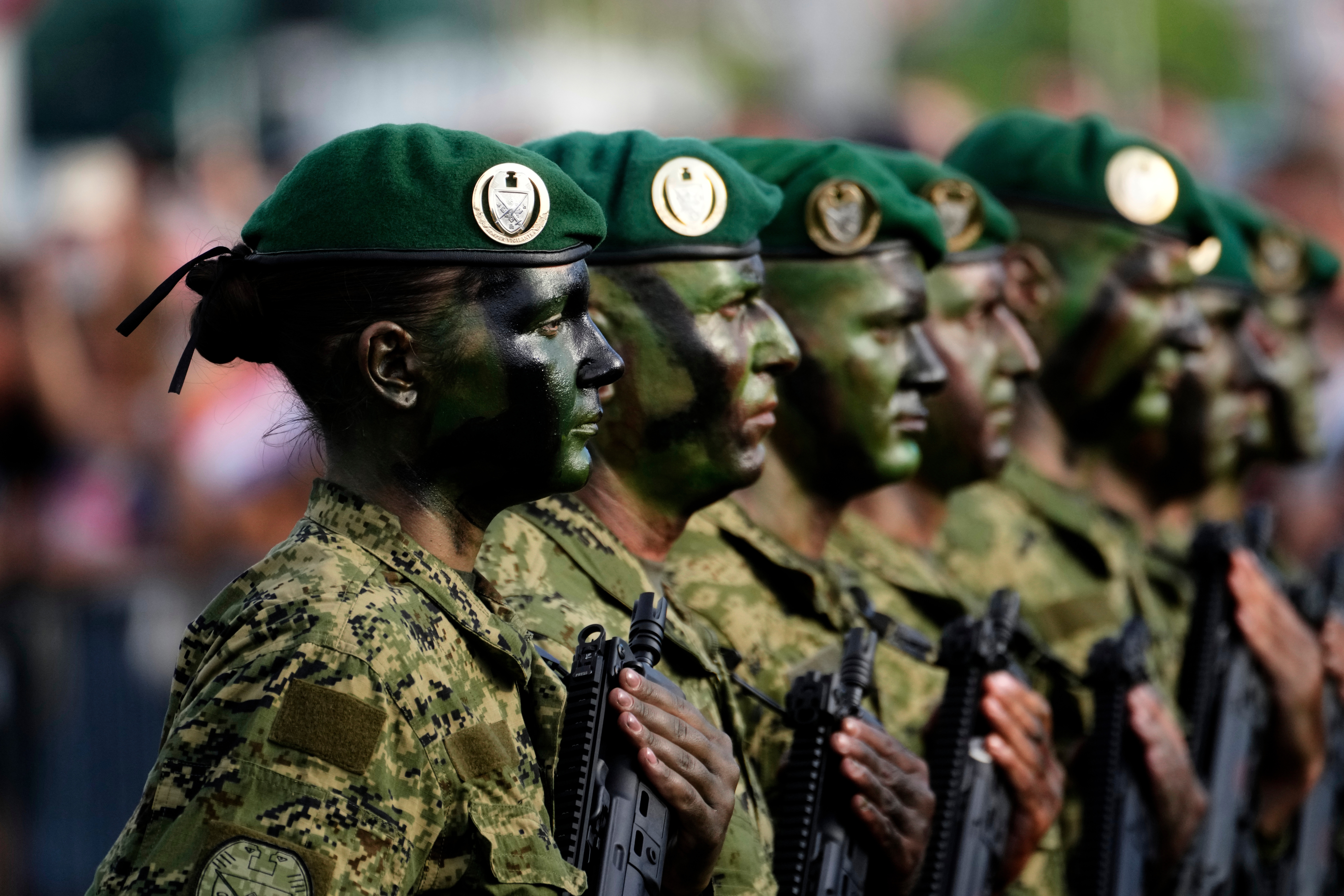
Croatian lawmakers recently voted to re-introduce compulsory military service from January 1, 2026.
Despite the country previously abolishing conscription in 2008, the new law sailed through parliament as a response to the Russian war on Ukraine and rising tensions in the Middle East.
"We are seeing a rise in various types of threats … that demand swift and effective action from the broader community," Defence Minister Ivan Anusic said.
Male Australian-Croatian nationals will need to report to the defence authorities of Croatia under the change which will come into effect on January 1 in 2026.
It will see 18,000 men enlisted each year for two months of training as they turn 18.
Failure to report to defence authorities is an offence.
Women are exempt from Croatia's conscription.
Nearby Serbia moved to bring back compulsory military service this year after abolishing it 14 years earlier.
READ MORE: Giant US warship arrives in Caribbean as part of Trump military build-up
Serbian men will be made to take part in 60 days of training and 15 days of exercises, the government said in 2024.
Women are exempt from Croatia and Serbia's conscription.
However gender exemption has been scrapped in some EU nations, such as Denmark.
Danish women can be called for up to 11 months of mandatory military service when they turn 18 after new rules were passed in parliament.
Before now, women could join the military on a voluntary basis.
Denmark has a lottery system that decides who gets drafted, which is used after volunteers are recruited.
Neighbouring nations Sweden and Norway also both enshrined mandatory conscription for women.
Sweden introduced it in 2017, while the Norwegian parliament brought in universal conscription for men and women in 2015.
Switzerland, meanwhile, also has a compulsory system for military service, which only applies to men.
Swiss citizens voted overwhelmingly to keep conscription during a referendum in 2013.
However the country appears to be slowly moving towards a gender-neutral model too.
A proposal for changing the military penal codes in Switzerland is under consultation.
The push comes as the Swiss army aims to rebuild ranks.
READ MORE: Boy, 14, on bail allegedly stabs 19-year-old on quiet Melbourne street
Does Australia have compulsory military service?
Conscription during peacetime was abolished in Australia in 1972 as the end of the Vietnam War neared.
However the question of mandatory national service in Australia does arise now and again.
Former Prime Minister Tony Abbott called on school leavers to serve a period of national service while speaking on a podcast in 2022.
"It's about giving as well as receiving and I think we do have to talk more about what we can give back to our country," Abbott said at the time.
Ex-SAS soldier Harry Moffitt also recently began a campaign to convince the government to provide a form of national service for every student finishing year 10.
He claimed it would be nation-building and help to save "the anxious generation".
In 2022, Defence Minister Richard Marles urged young Australians to enlist in the Defence Force amid a worrying shortage.
DOWNLOAD THE 9NEWS APP: Stay across all the latest in breaking news, sport, politics and the weather via our news app and get notifications sent straight to your smartphone. Available on the Apple App Store and Google Play.
Horror New Zealand house fire that killed three young kids a suspected triple murder
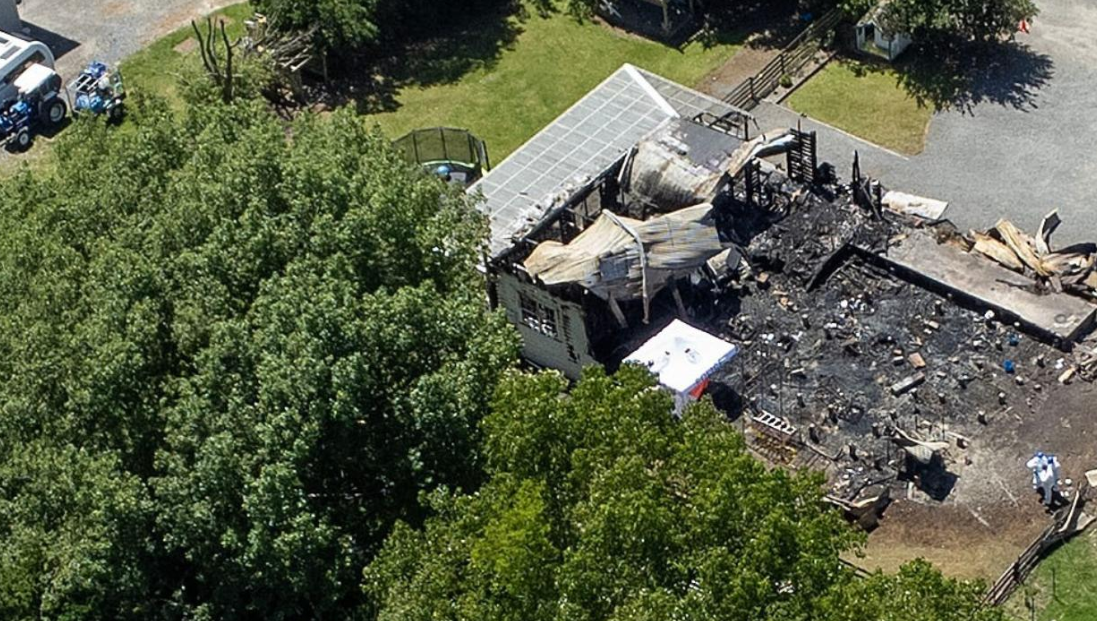
The deaths of three children and their father at the scene of a Manawatu house fire in New Zealand are being investigated as a suspected triple murder-suicide, Stuff understands.
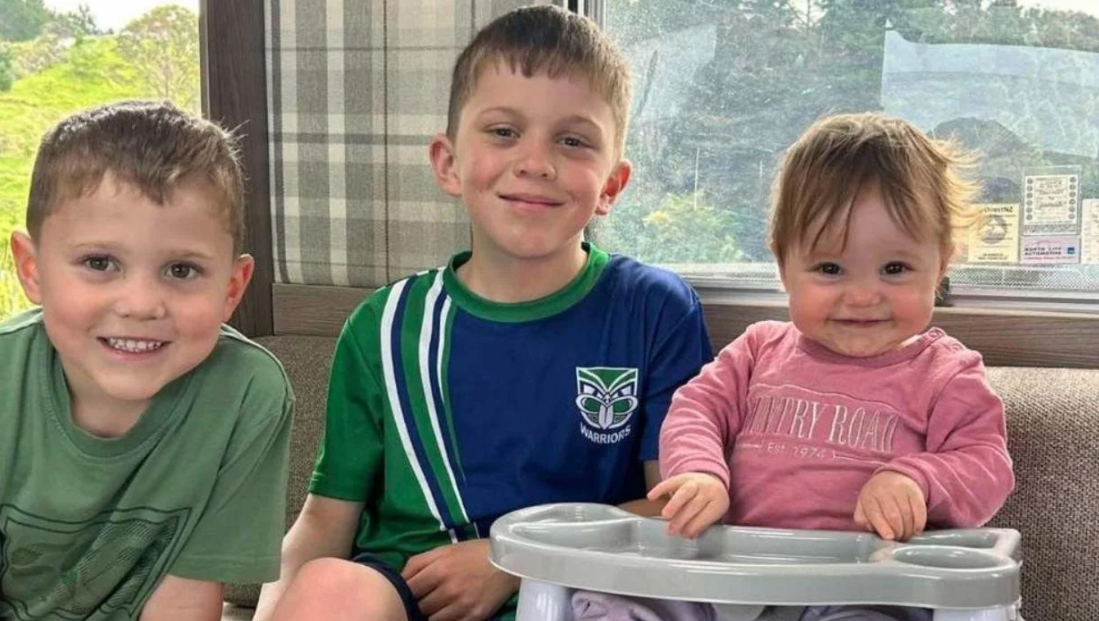
Dean Field died at a property on SH1 in Sanson that was consumed by fire on Saturday afternoon, and it's understood police believe he killed his three children – August, Hugo, and Goldie, aged 7, 5, and 1 – and then took his own life.
The bodies of two of the children were removed from the scene yesterday evening and police said today that efforts were ongoing to locate the body of the third.
READ MORE: Trump hints at decision on Venezuela – is the US about to go to war?
Police declined to comment about the circumstances of the deaths when approached by Stuff today.
A New Zealand Ministry of Justice spokesperson said three deaths had been referred to the coroner, and a fourth was expected to be notified.
The investigation was in its early stages, they said, and formal identification of the deceased had yet to be completed.
Stuff previously reported that it was believed police were investigating whether the fire was deliberately lit. They've said they're not seeking anyone else in relation to it.
It's understood Field and the mother of the children, both of whom had lived at the property, were separating.
Manawatu area commander Inspector Ross Grantham family were present to bless the two children's bodies with karakia when they were removed from the scene on Sunday evening.
He said police were completing a "meticulous and "thorough" scene examination at the property.
"This tragedy has shocked not only the local community, but also many people across the country," he said.
"Our investigators remain determined to find answers to as many questions as we can."
READ MORE: Looming vote in the US marks crucial moment for Epstein files
An online fundraiser, titled "A mother's worst nightmare", set up to support the mother of the children, said they "were the light and love of her life, and her entire world has been shattered".
"In the midst of this unimaginable grief, she also lost her home and everything she owned," friends of the woman wrote.
The appeal had raised more than NZ$160,000 ($139,028) by early this afternoon local time, and the friends offered their "deepest gratitude" for the outpouring of support.
They thanked the nation for "the beautiful messages of love, thoughts and prayers, and the community spirit that you all have created for our friend".
"No amount of money will ever be enough to heal the wounds left in her heart and soul, but to have this safety net to rebuild her life, knowing what feels like the whole of Aotearoa is with her, and how you have all contributed to this outpouring of love in so many ways is more than we could've ever hoped for," they wrote.
Police 'ran towards house'
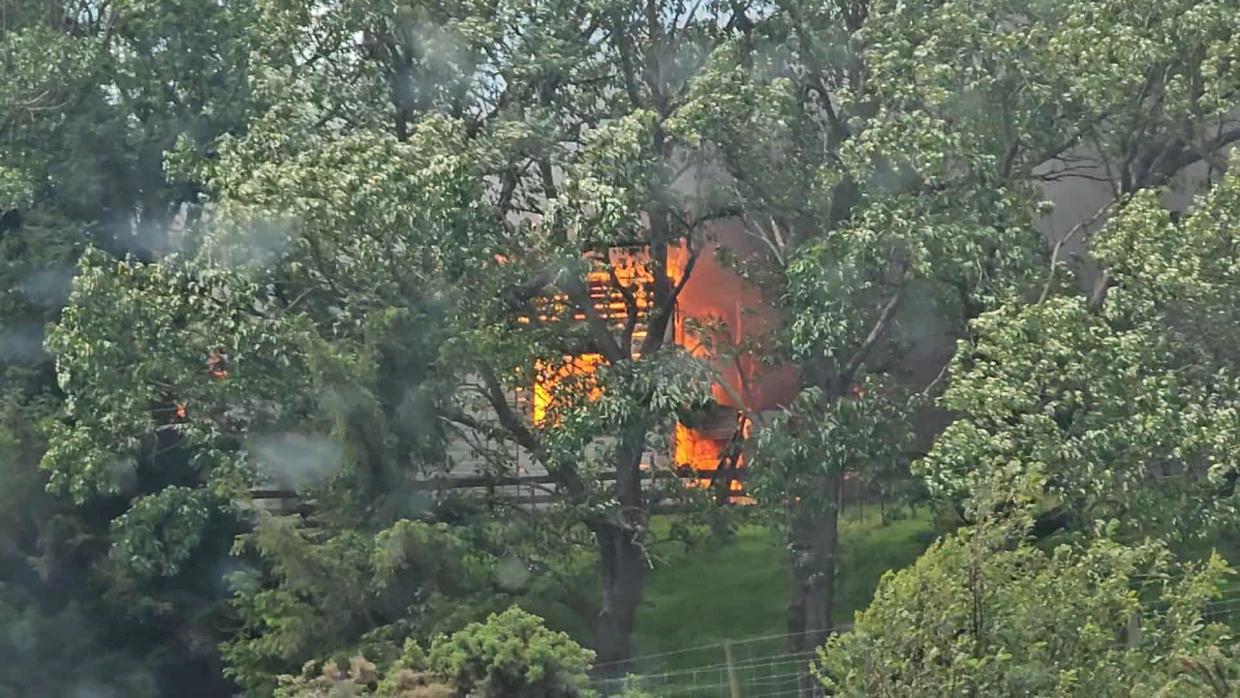
A Sanson man who Stuff has chosen not to name said he drove past the fire at about 2.45pm on Saturday. The house was well ablaze with thick, billowing smoke.
The man said he saw two police officers with "big guns" running towards the house. There were fire engines present.
The police officers were dressed in black with masks on.
'I don't think it gets much worse'
Neighbour Alan Parker spoke of the tragedy that occurred close to his house.
"I don't think it gets much worse. It's really, really bad for the people who are left behind to deal with it," he said.
Parker knew Field as a neighbour and said while they weren't quite friends, the man would help fix up his truck and other mechanical bits and pieces.
Parker did not know the mother or the children, but he had seen them playing on bikes and scooters on the property. Field would take them fishing and into the outdoors.
"Things seemed to be going well for them. They spent a heap of money renovating, he's been painting for the last six months," Parker said.
On Saturday he saw the flames and smoke and thought it was his own house that was alight. Then he realised it was theirs.
"The smoke was so bad I thought my house was on fire," he said.
He didn't know anyone was home until later. The police came to his house looking for the children.
Finding out each new detail was a "ratcheting up" of tragedy, he said.
"There's a hole that's not going to be filled very easily."
Support is available from the National Sexual Assault, Domestic and Family Violence Counselling Service at 1800RESPECT (1800 737 732).
Readers seeking support can contact Lifeline on 13 11 14 or beyond blue on 1300 22 4636.
This article initally appeared on Stuff and is republished here with permission.
School shutdown in ACT, SA over asbestos sand fears today
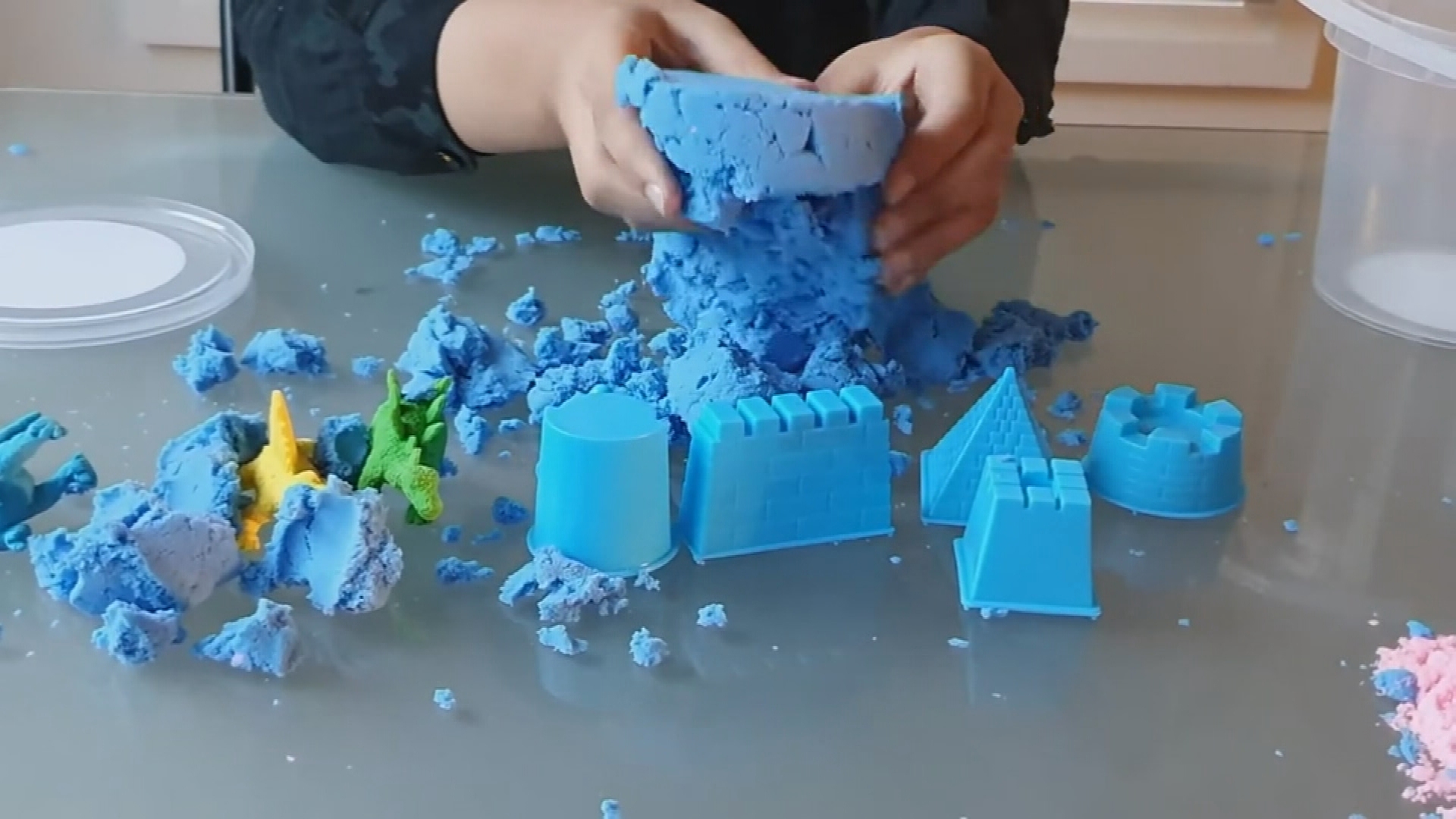
Schools will stay shut in the ACT and South Australia today amid the ongoing fallout to recalls of popular play sand that may contain asbestos products last week.
The sand has been found in dozens of schools in both jurisdictions.
After the recalls widened to include products sold at Kmart and Target, ACT Education Minister Yvette Berry announced yesterday afternoon that most of the territory's schools would be closed today.
READ MORE: Boy, 14, on bail allegedly stabs 19-year-old on quiet Melbourne street
Last night, the government said it had started auditing all public schools for the affected products, listing 71 that would be closed, with just 23 opening.
The announcement followed more closures on Friday.
Berry said "unfortunately, this could take days" for asbestos contractors to "test, remediate and clear the spaces for use again".
In South Australia, 130 schools were reported to have the sand but it was still sealed in 88 of the education facilities, meaning loose sand was found at 20 schools.
The SA government said some classrooms would be closed today for cleaning but a list was not freely available. Parents were urged to watch for communication from their schools.
No schools were listed as closed in NSW, Victoria or Queensland.
The Australian Competition and Consumer Commission has issued three separate recalls for play and decorative sand in the past week, including a 14-piece sand castle building set and magic sand in blue, green and pink – all sold at Kmart and Target – at the weekend.
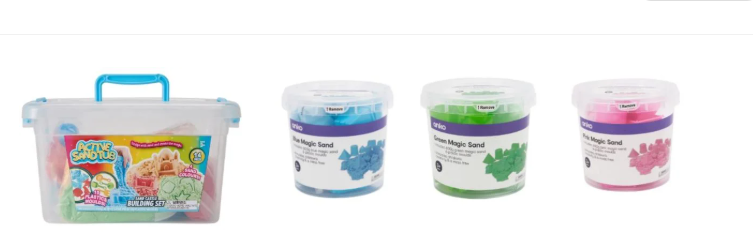
"The products may cause a risk to health as asbestos has been detected in some samples after laboratory testing," ACCC Product Safety said.
"Importantly, respirable asbestos has not been detected in any of the tested samples.
"The release of respirable asbestos fibres is unlikely to occur in its current state, unless the sand is processed by mechanical means such as crushing or pulverising.
"The risk that any asbestos found, that is likely to be airborne or fine enough for inhalation, is low."
The Kadink Decorative Sand 10g six-pack was pulled from Officeworks shelves on Friday, two days after Educational Colours issued a recall for a range of its products sold across Officeworks and other retailers over the past five years.
Customers have been told to stop using the products immediately and safely dispose of them.
"Wear disposable gloves and a mask and either return in the original tub or place the sand in a heavy-duty plastic bag and double tape it securely and keep it out of reach of children," the recall notice said.
"Do not dispose of the products in general waste."
Information on the disposal of asbestos waste, including disposal facilities in your state or territory can be found on The Asbestos and Silica Safety and Eradication Agency website.
DOWNLOAD THE 9NEWS APP: Stay across all the latest in breaking news, sport, politics and the weather via our news app and get notifications sent straight to your smartphone. Available on the Apple App Store and Google Play.
Rachel helps breast cancer survivors, but she’s not allowed to show her work
A Queensland cosmetic tattoo artist who helps breast cancer survivors says it is almost impossible to share photos and videos of her work on social media.
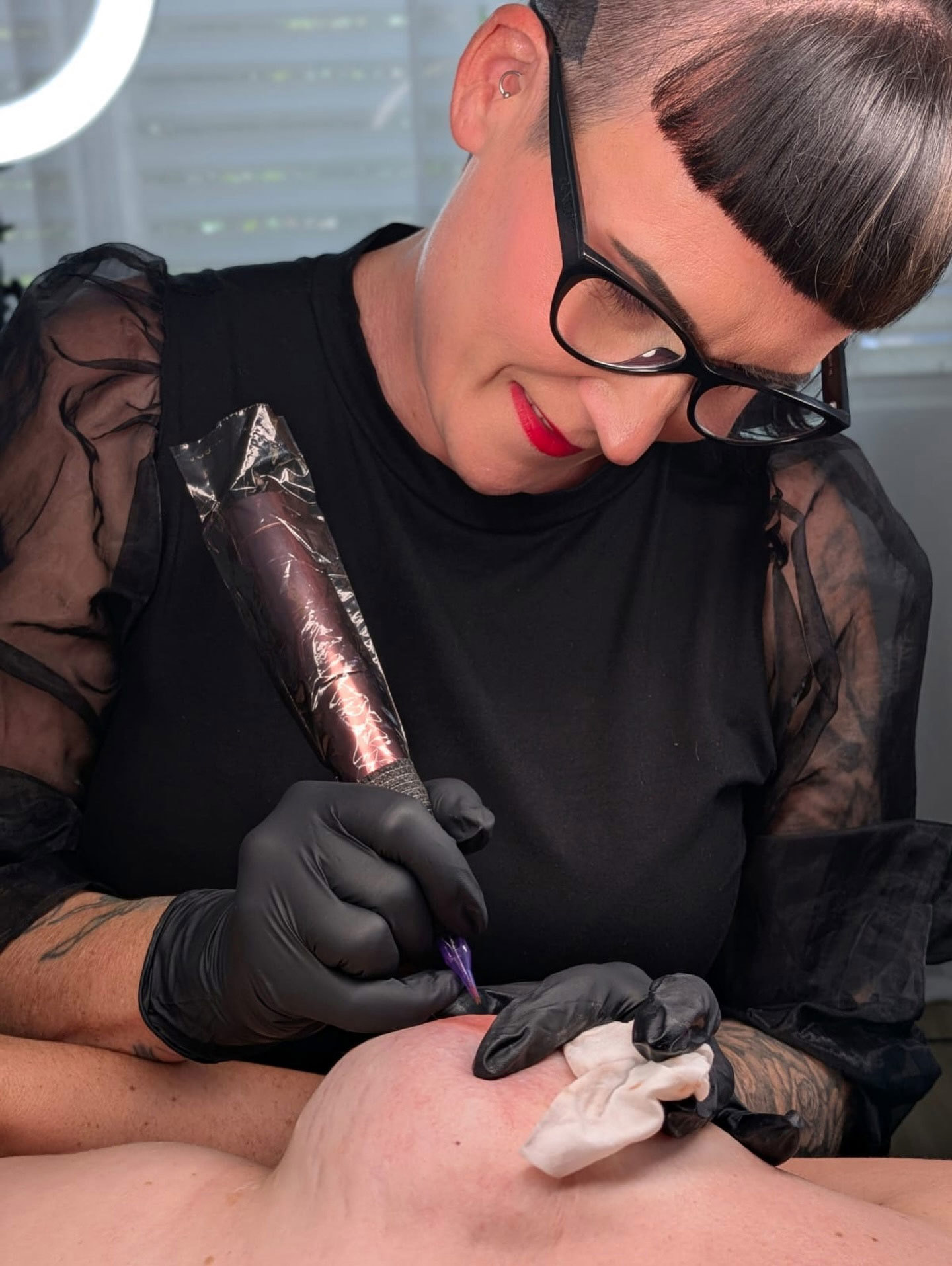
Rachel Cahn, who runs Tinted Love in Noosa, specialises in creating tattoo areolas for clients who have undergone mastectomies and no longer have nipples.
Being able to provide realistic-looking, 3D areola tattoos for cancer survivors was deeply meaningful, Cahn said.
READ MORE: Dozens of schools to close over asbestos play sand fears

"This art is not just about aesthetics; it's often the final step in helping survivors to reclaim their bodies and restore their sense of hope and dignity," she said.
Areola tattooing is a relatively new procedure available for breast cancer survivors and Cahn said she was therefore keen to let as many women as possible know about it.
However, social media platforms such as Facebook, Instagram and TikTok were constantly banning her photos and videos due to them being flagged as showing nudity, Cahn said.
"Social media platforms can't distinguish the difference between nudity and art," she said.
"I can't post anything on TikTok, they don't really allow any of my work."
Likewise, Cahn said photos she posted to Facebook showing areola tattoos were often banned, after which she needed to go through a time-consuming process to have them reinstated.
Cahn said other restrictions had been placed on her accounts, such as Instagram banning her from posting live videos for 12 months and Facebook blocking her from inviting people to join her page.
The cosmetic tattooist said she also suspected her accounts had been "shadow banned".
"Shadow banning is where you don't come up in people's feeds," she explained.
"You're not on the 'explore' page. People try and type in your name, and it doesn't come up."
The actions of the social media giants appear to directly contradict their policies on allowing photos and videos of breast mastectomies for education and advocacy purposes.
"We agree that undergoing life-changing experience and that sharing photos can help raise awareness about breast cancer and support the men and women facing a diagnosis, undergoing treatment or living with the scars of cancer," Facebook says on its website.
"The vast majority of these kinds of photos are compliant with our policies."
It is understood that the automated processes used by social media platforms to detect nudity, including nipples, is unable to distinguish between real and tattoo areolas.
Nine.com.au reached out to Meta, the owner of Facebook and Instagram, for comment but did not receive a response before publication.
A spokesperson for TikTok said the platform had worked with Cahl to reinstate two videos which were "incorrectly moderated by our automated systems".
"TikTok's Community Guidelines do not allow nudity or body exposure, but we do allow some content that falls within our limited exception categories," the spokesperson said.
Cahn said she was exhausted by the process of trying to fight the social media companies simply to show her work.
"It is tiring, and I'm wanting women to know that I'm here and what I do, but it doesn't get seen by anyone, and I get all these bans and restrictions and flags," Cahn said.
"And it is so hypocritical because then you see all the hate speech and the violence on social media.
"Even Instagram says they don't allow photos of buttocks, and I'm just like, come on, that's an absolute joke, every second woman is in a string bikini."
Frustrated, Cahn has started a Change.org petition calling for social media companies to reform the rules for cosmetic tattooists who work with cancer survivors.
"The guidelines need to be changed so that cosmetic tattooers can post these images, so that breast cancer survivors are aware that this service is available.
"I have a lot of women that actually come in here and they say that they didn't even know the service was available until I posted something in one of the Facebook groups."
Do you have a story? Contact reporter Emily McPherson at EM********@******om.au
Teen who climbed 20-storey crane arrested after eight-hour standoff
A teenager who climbed a crane 20 storeys high in the middle of Adelaide has been dramatically arrested after more than eight hours of negotiation.
Police were notified that a man was sitting on the edge of the machinery on a commercial building site on the corner of King William and Gilbert streets about 8pm yesterday.
The scene drew crowds of anxious people underneath.
READ MORE: New horned 'devil' bee discovered by scientist in WA
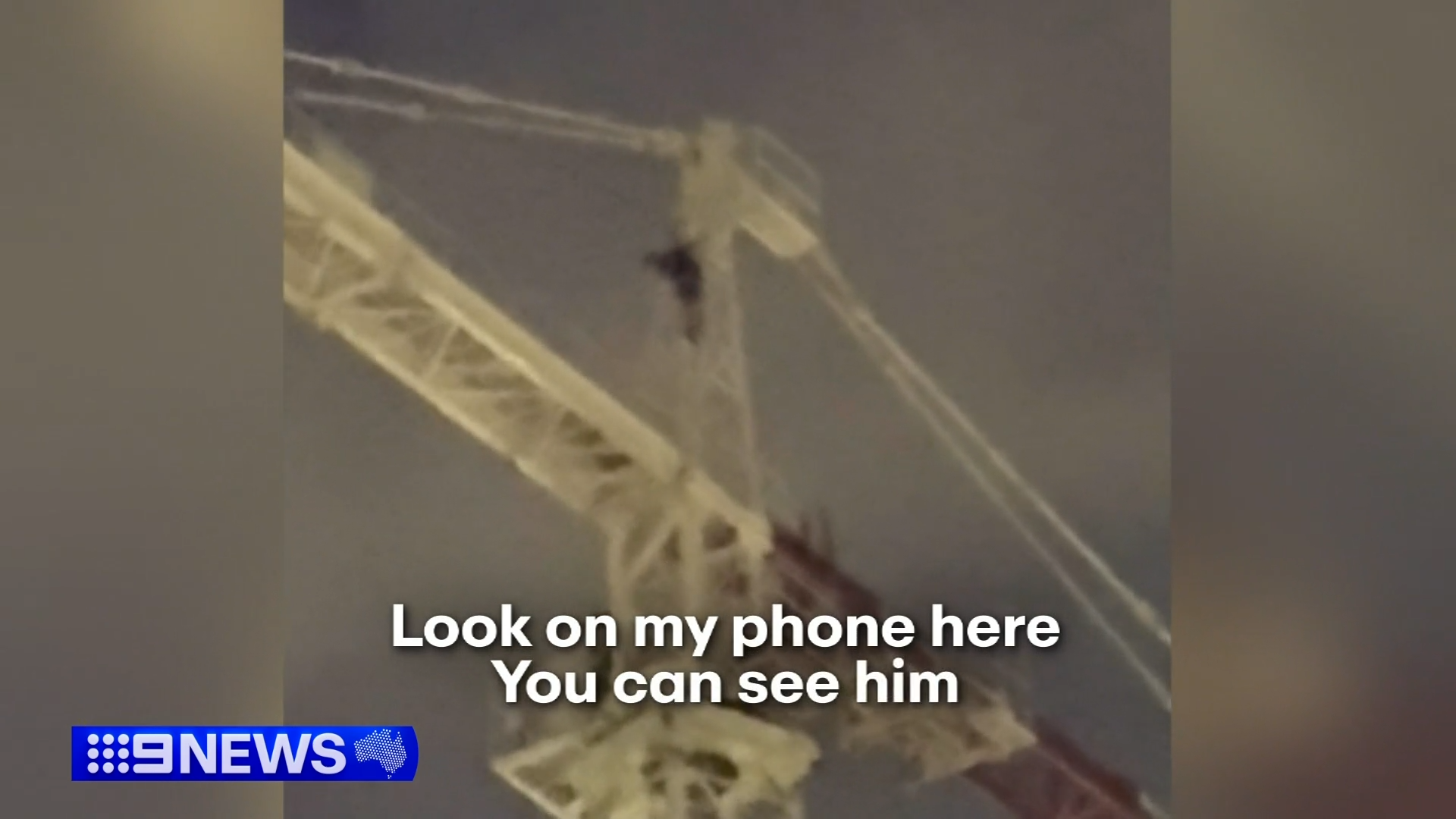
"At one point, he went from the inside of the crane to the outside of the crane and was looking down," witness Mikaela Mudie told 9News.
"So that was when we were all really concerned for his safety. And we kept watching, and he kept going higher and higher."
Police officers called in the Special Tasks and Rescue Group and specialist negotiators to persuade the man to safely climb back down.
They tried to reach him from multiple angles, with police climbing up themselves and firefighters flying in from above.
READ MORE: 'Their own policy': PM addresses Victorian Premier's new 'adult time' youth crime laws
About 4.30am today, the man finally climbed down.
The 19-year-old from Hackham West was arrested and taken to hospital for assessment.
Police expect to interview him and charge him with trespass and obstructing a public place.
The crane itself will now need to be checked and calibrated, but it is unlikely to cause any delays to the building project.
DOWNLOAD THE 9NEWS APP: Stay across all the latest in breaking news, sport, politics and the weather via our news app and get notifications sent straight to your smartphone. Available on the Apple App Store and Google Play.