Tag Archives: oceania

How the ‘laser-focused’ One Nation has quietly gained support as the Coalition flounders

While the Coalition's very public internal fractures have caused it to flounder in the polls, one often overlooked party has quietly gained a surge in support, bolstered by a "laser-focused" agenda and unimpressed voters. 

The latest Resolve poll for Nine's newspapers showed the Coalition scraped a two per cent increase of the primary vote after bottoming out at 27 per cent in September.

Meanwhile, One Nation has remained steady at 12 per cent after seeing its numbers rise to their highest point since the federal election.

READ MORE: Grim fears after supply plane crashes into neighbourhood
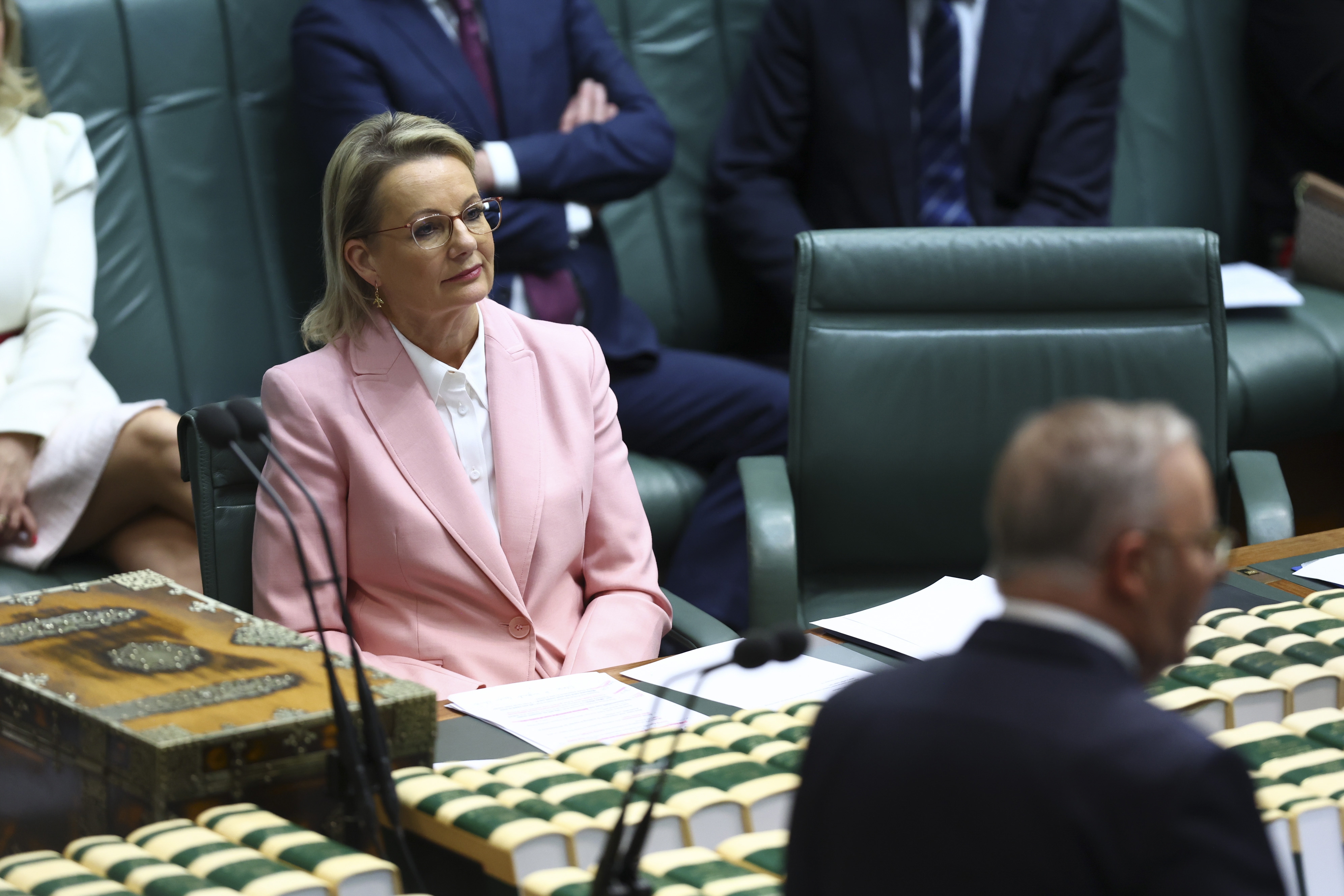
Leader of the Opposition Sussan Ley and Prime Minister Anthony Albanese during the first Question Time of the 48th parliament in the House of Representatives at Parliament House in Canberra

Resolve's Jim Reed said voters are abandoning the Coalition for One Nation due to Opposition Leader Sussan Ley's inability to address the root cause following weeks of infighting over net-zero and Nationals MP Barnaby Joyce openly flirting with the idea of defecting to One Nation.

"The Coalition are viewed as disunited and focused on themselves, so they've got to get their house in order in terms of leadership and unity, competence in prosecuting a case against Labor and having an alternative policy suite," he told 9news.com.au.

"One Nation's vote is at its highest point now, and it's mostly come from the Coalition, mainly because they're acting like an opposition.

"They're highlighting government weaknesses that are relevant to people in immigration and energy policy, and prosecuting the case for a different path."

The Coalition's failure to reach an agreement has brought Ley's leadership into question from her own party members, forcing Angus Taylor to deny growing speculation that he would challenge her position. 

Joyce is considering leaving the Nationals for One Nation, after citing policy differences and his strong opposition to net-zero, threatening to take some voters with him.

Hanson has invited him over, saying he is more aligned with her right-wing party than the Nationals.

READ MORE: 'Time for talk is over': Eight illegal tobacco and vape stores shut down in statewide blitz
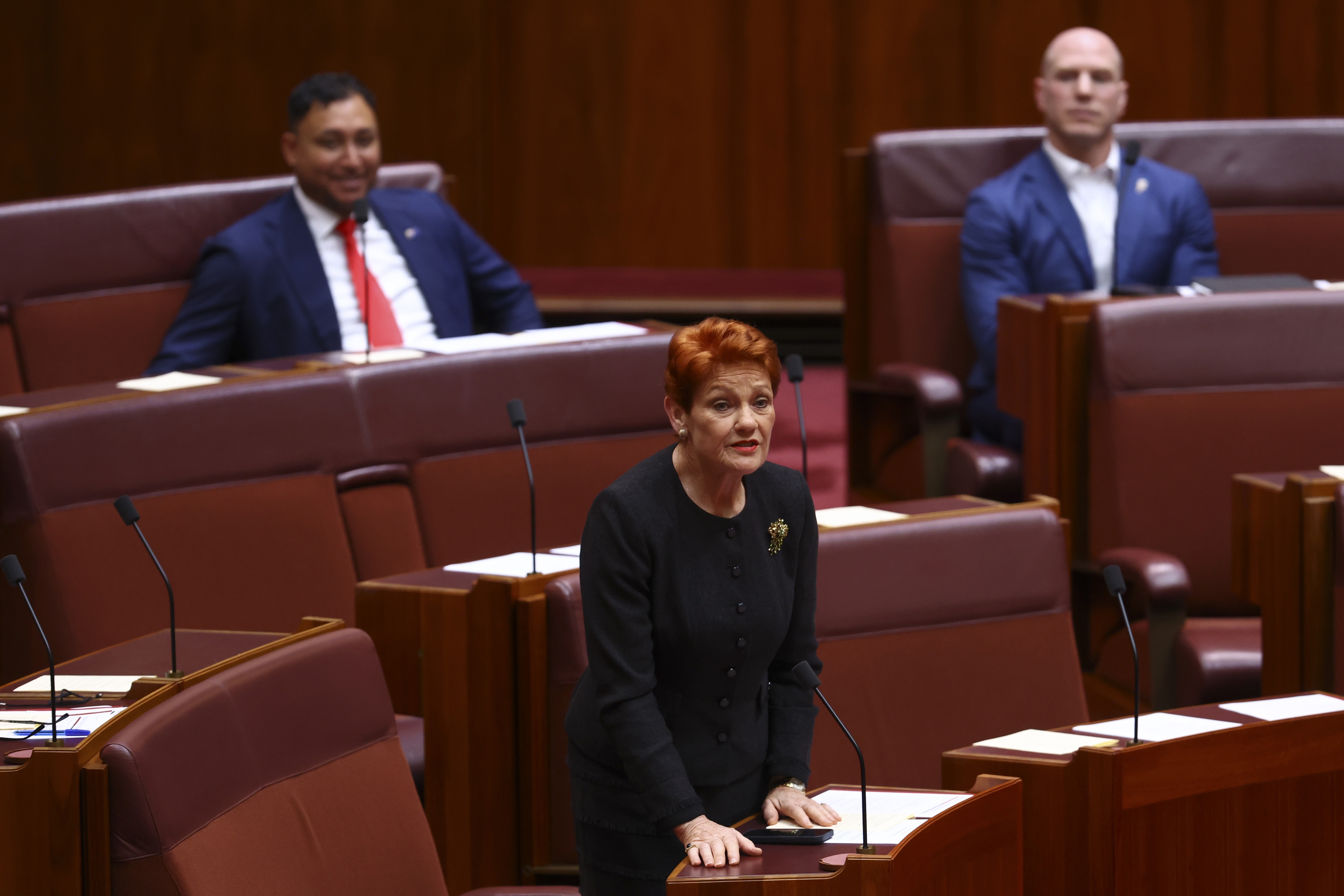
Senator Pauline Hanson nominates Senator David Pocock for Senate President during the opening of the 48th Parliament in the Senate at Parliament House in Canberra on July 22, 2025. FEDPOL. Photo: Dominic Lorrimer

Monash University's head of politics, Associate Professor Zareh Ghazarian, said voters are no longer apprehensive about supporting non-major party candidates if they sense division and disunity.

"The Liberal Party seems to be really struggling with what it wants to be in Australian politics," he said. 

"You've got other parties, for example, like One Nation, which I think has become more prominent because they've got a very laser-focused policy agenda, and people know what that party is seeking to achieve in a policy sense."

Analysts and politicians alike have long recognised a shift in voter sentiment away from the major parties towards minor parties like the Greens and One Nation, and independents.

Together, the minor parties and independents have 20 seats in the Senate, not far behind the Coalition at 27 and Labor at 29.

The story is a little different in the House of Representatives, where Labor has a commanding majority.

But 10 independents retained their seats in the House in this year's federal election, continuing to solidify themselves as legitimate alternatives.

They played a significant role in the 2022 federal election, snatching several once-safe Liberal seats and helping create the largest crossbench in Australian history.

READ MORE: Surge in deadly virus results in alarming scenario
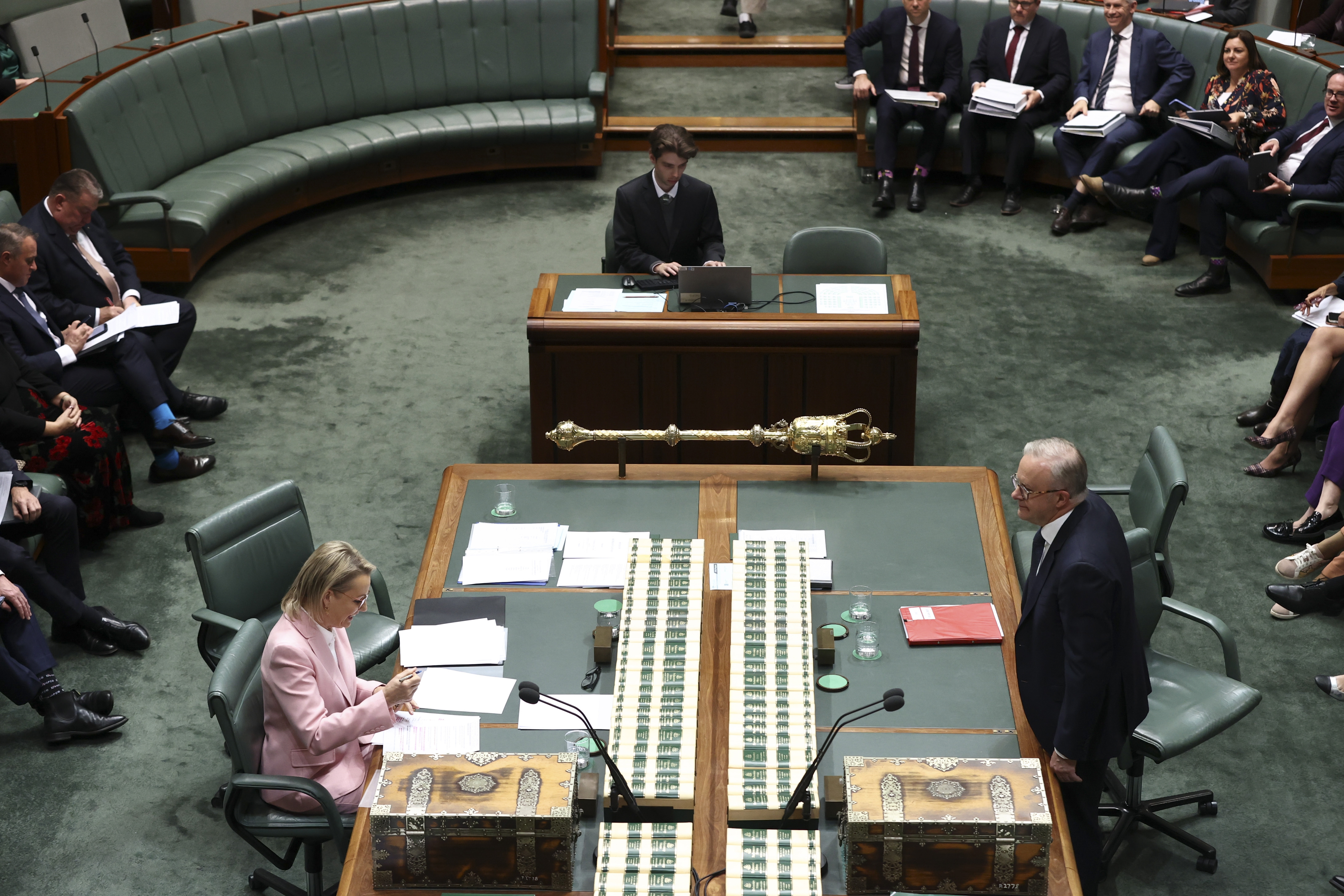
Leader of the Opposition Sussan Ley and Prime Minister Anthony Albanese during the first Question Time of the 48th parliament in the House of Representatives at Parliament House in Canberra

Ghazarian said some voters believe minor parties and independents can be more effective at representing clear policy concerns rather than Labor and the Coalition.

"There is fragility. There is a bit of brittleness within the party system and within the electoral system, as in voter preferences," he said.

"And it is a warning to the major parties that they must work very hard to maintain the support that they have and to potentially build on it.

"Otherwise, we're seeing that voters are very happy to support non-major party candidates."

But Reed warned that major parties still take the lion's share of the primary vote, with Labor at 33 per cent and the Coalition at 29 per cent, leaving the centre as the place where elections are won and lost. 

"We've got to remember that One Nation is still very much a minor party and that the likes of Hanson and Joyce are still not well-liked, but they are effectively appealing to a minority and making gains because of that," he said.

DOWNLOAD THE 9NEWS APP: Stay across all the latest in breaking news, sport, politics and the weather via our news app and get notifications sent straight to your smartphone. Available on the Apple App Store and Google Play.
Future PM told Whitlam to arrest the governor-general

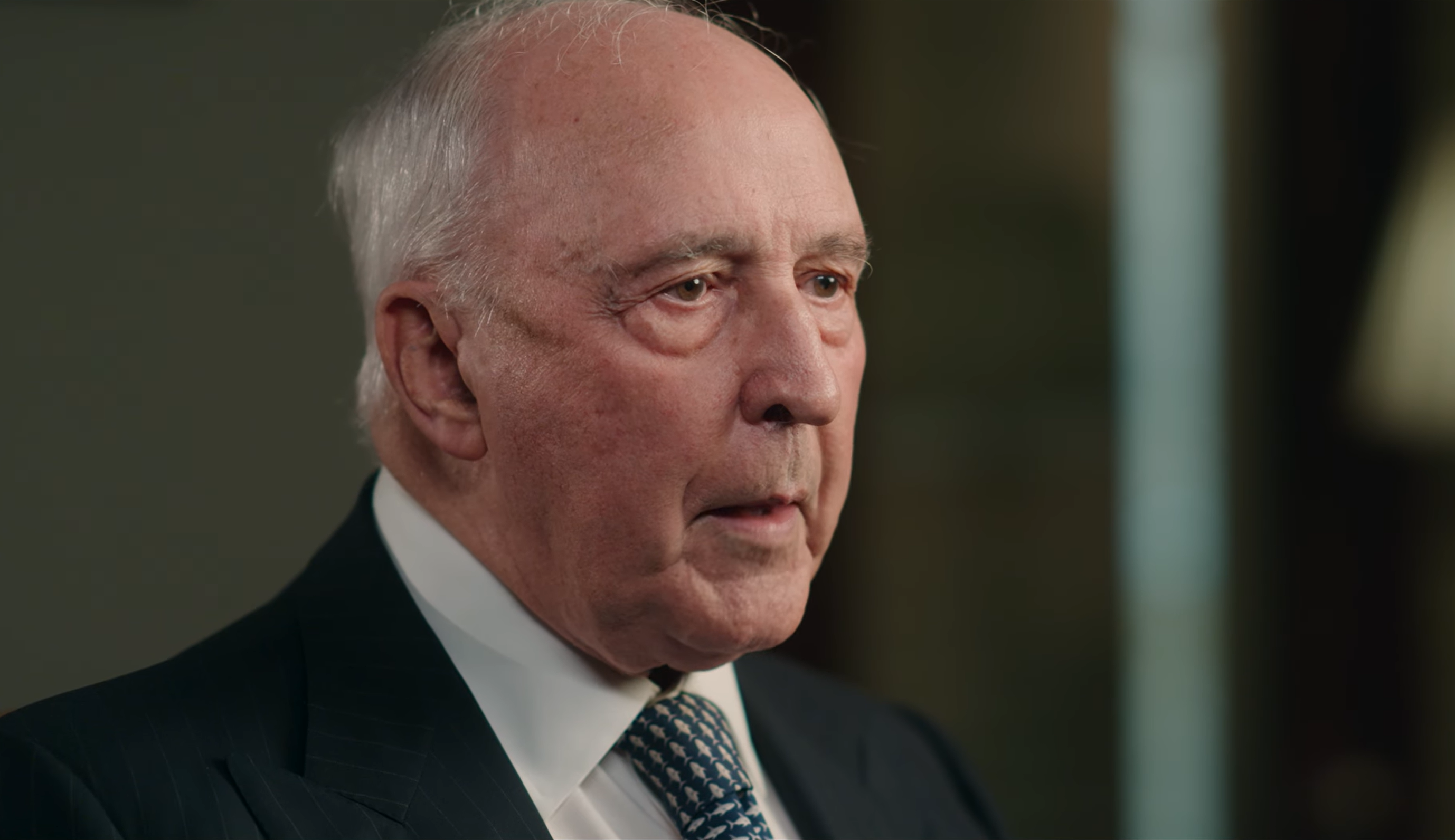
Former prime minister Paul Keating has revealed he told Gough Whitlam to either sack Sir John Kerr or have the governor-general arrested during the dismissal, a move he admitted could have escalated the crisis into a conflict between the police and armed forces.

In an interview released by the Museum of Australian Democracy today to mark the 50th anniversary of Whitlam's dismissal in 1975, Keating said he put the advice to the then-prime minister in the immediate aftermath of being sacked by Kerr.

"I said, 'Kerr has expropriated the… queenly powers of the monarch'," Keating said.

READ MORE: Aussies warned to avoid tourist destination where they risk being 'shot, killed'

Former prime minister Paul Keating.

"'He may have done it with the monarch's knowledge, but he may not have done it.

"'I think you're entitled to say to the Queen that you recommend the appointment of a different governor-general' … while this problem was not of the Queen's making, it was of the Queen's need to resolve it.

"So my proposition was that Gough should ask the Queen to accept his advice about the appointment of a new governor-general, and in the event that Kerr resisted, I said to Gough I thought he should be put under police arrest."

Keating, who went on to serve as prime minister from 1991-1996, conceded that course of action could have put the police at odds with the Australian Defence Force.

"I said, 'The only thing you'd have to be sure about, Gough is, of course, Kerr is technically the commander-in-chief of the soldiers'," he said.

"'Do not end up in a fight with the police.'

"In other words, you'd have to have the soldiers with you for this to happen…

"That's what I certainly would have done if I'd have been prime minister."

READ MORE: 'Deeply troubling': Author's dogged pursuit of the truth 50 years after Whitlam dismissal

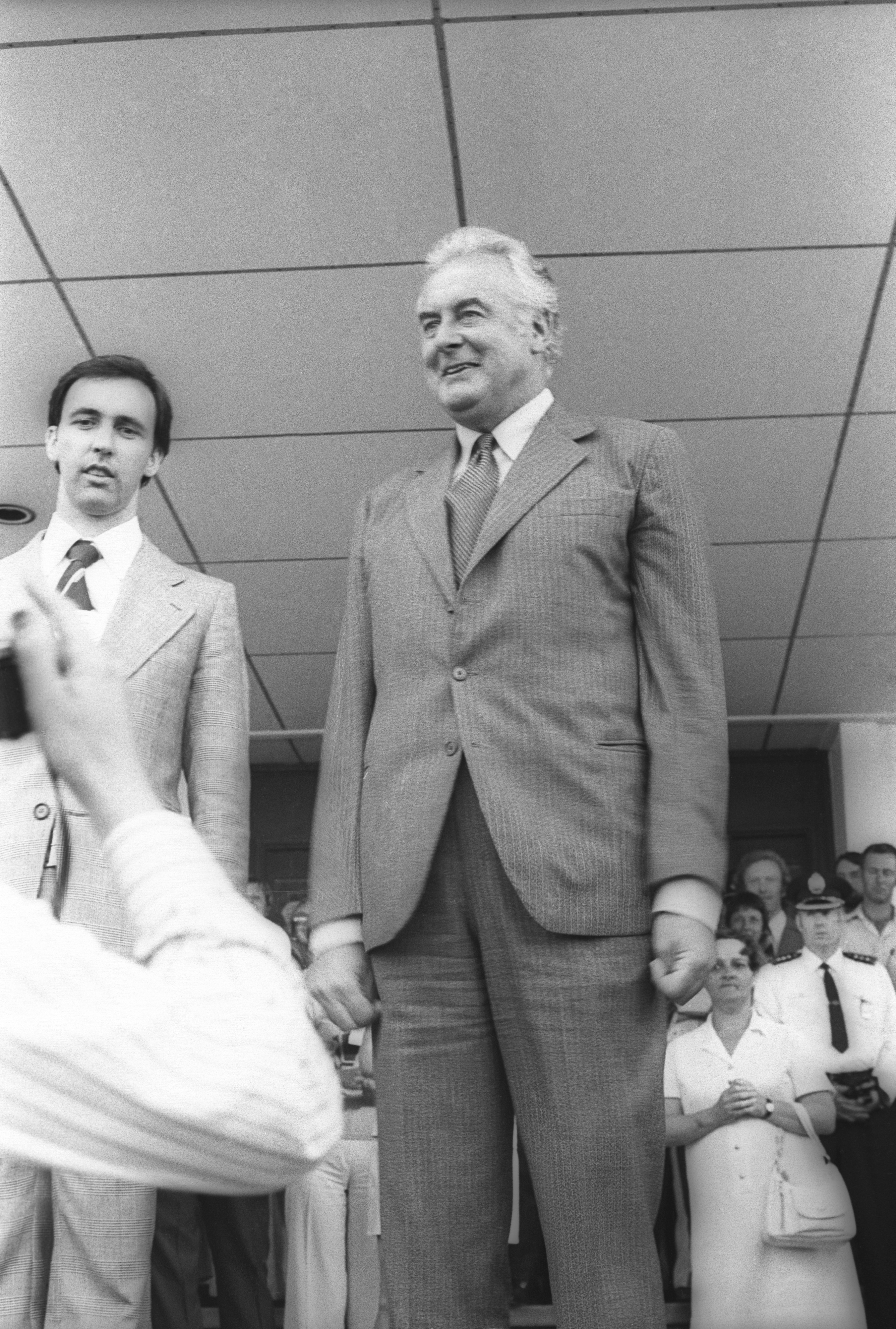
Gough Whitlam addresses the crowd on the steps of Parliament House, Canberra, November 11, 1975, with then-minister for northern Australia Paul Keating next to him.

He added that Whitlam would then have to call an election.

The future treasurer and prime minister was the most junior member of Whitlam's front bench at the time, having been appointed minister for northern Australia just three weeks earlier.

He said Whitlam was "a bit shocked" by his advice, and didn't give it much consideration.

"He said, 'Thank you, you know-all, for that advice'," Keating recalled.

"He wasn't of a mind to take the advice. He was a constitutionalist, Gough, he wasn't into blood and gore."

READ MORE: Unlikeliest figure appears during Australia's gravest political crisis

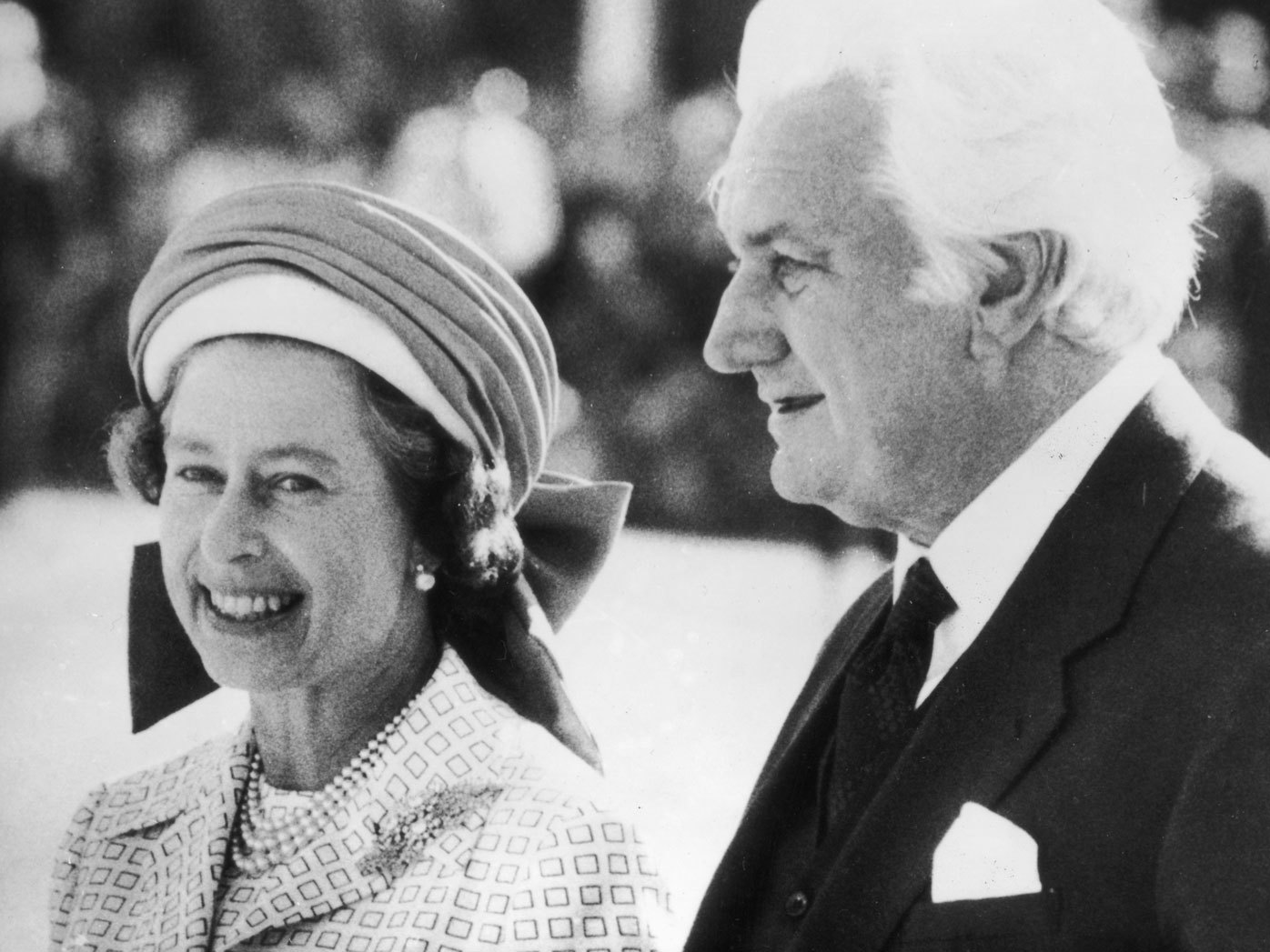
Queen Elizabeth and Sir John Kerr

Half a century after the controversial dismissal, debate continues over Kerr's decision to sack the Whitlam government, after the Coalition, led by then-opposition leader Malcolm Fraser, blocked supply in the Senate for weeks and demanded a fresh election.

It remains the first and only time an Australian government has been dismissed.

Speaking to ABC radio this morning, Keating's successor as prime minister, John Howard – who was given his first cabinet position by Fraser following the dismissal – said Kerr had been left with no choice but to sack Whitlam.

"Kerr… was the meat in the sandwich between two very powerful, determined men who each behaved in their own way in a very ruthless pack," he said.

"I felt that the action Kerr took was the only one that could have resolved the situation, absent either Fraser backing down in blocking supply or Whitlam advising a general election for both houses of parliament."

READ MORE: Jury still out on deposit scheme stoking rise in property prices

Prime Minister Anthony Albanese during a press conference at Parliament House in Canberra on Monday 10 November 2025.

However, current Prime Minister Anthony Albanese – who announced the government will commission a new statue of Whitlam to mark 50 years since the dismissal – gave a scathing appraisal of Kerr in a speech last night.

"Make no mistake: November 11th, 1975, was not a 'constitutional crisis' – it was a partisan political ambush," he said.

"There was no real precedent – and no legitimate pretext.

"The opposition orchestrated a parliamentary gridlock over the budget and then secretly prevailed upon the governor-general to break it by sacking the prime minister…

"But in truth, the opposition had preyed upon Sir John Kerr's desire to be at the centre of events."

Keating, for his part, was even blunter.

"In every respect, it was a coup. A coup by an individual," he said.

DOWNLOAD THE 9NEWS APP: Stay across all the latest in breaking news, sport, politics and the weather via our news app and get notifications sent straight to your smartphone. Available on the Apple App Store and Google Play.
Aussies warned to avoid tourist destination where they risk being ‘shot, killed’

Australians have been warned not to travel to Afghanistan despite a recent spike in tourism to the Taliban-controlled country.

Updated advice from Smartraveller listed terror attacks, kidnappings, and arbitrary detention among the risks Western tourists face in the Central Asian nation.

"Do not book a tourist trip to Afghanistan, even if offered by reputable operators," it read.

READ MORE: Great White Shark knocks rider off foilboard at WA beach

Mazar-i-Sharif, Balkh province, Afghanistan: Shrine of Ali (Hazrat Ali Mazar) - also known as the Blue Mosque or Rauza, considered (mainly by the Afghans) as the burial place of Ali ibn Abi Talib, the son-in-law of Muhammad and one of the most important personalities of Islam. Mazar-e Sharif is Persian and means "shrine of the noble". The imposing mausoleum is one of the most beautiful mosques in the world and is the most important pilgrimage site in Afghanistan. However, it is highly controvers

"Westerners, including Australians, have recently been shot, injured or killed while on a guided tour in Afghanistan."

Tourism in Afghanistan has risen significantly in the four years since the Taliban takeover.

The Taliban took control on August 15, 2021 and declared an 'interim government' that has remained in power ever since.

Fewer than 700 tourists visited in 2021.

That figure rose to more than 9000 in 2024, according to local officials.

Australian and international influencers have faced criticism for promoting Afghanistan as a tourist destination.

Even some everyday Australian tourists, like Jess Davis from Melbourne, have risked visiting the Taliban-controlled nation themselves.

READ MORE: The Wiggles company admits 'likely' law breach over Emma headband

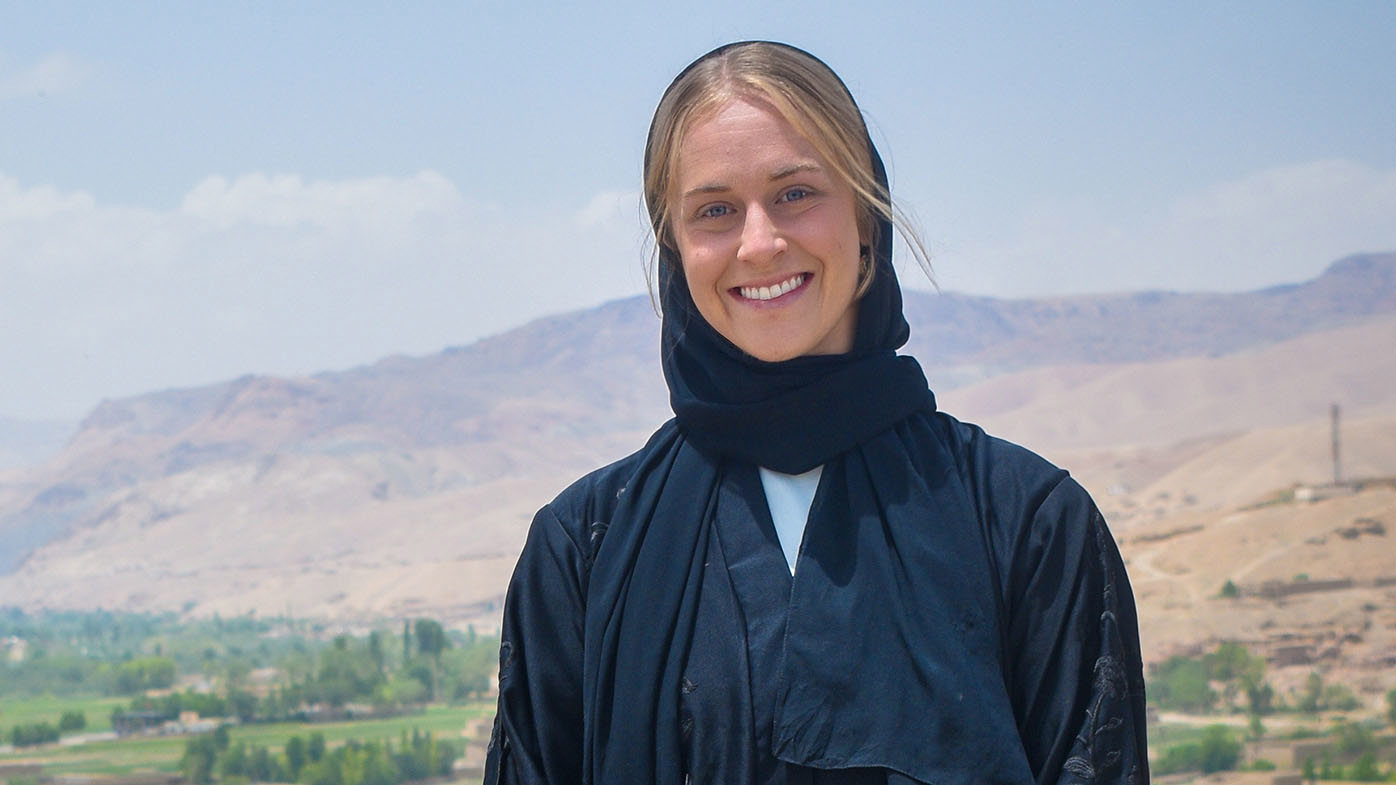
Jess Davis during her visit to Afghanistan in 2025.

Davis previously told 9news.com.au that she never felt unsafe during her two visits to Afghanistan.

But the official advice is that she never should have gone in the first place.

Smartraveller has long warned that nowhere in Afghanistan is safe – even the capital, Kabul.

"Australians have been kidnapped, arbitrarily detained and targeted by terrorist attacks in Afghanistan," the latest advice read.

"The security situation is extremely dangerous and volatile."

Armed conflict in Afghanistan may escalate without warning, and airports and borders can close suddenly, trapping tourists.

READ MORE: Trump orders air traffic controllers back to work amid mounting flight chaos

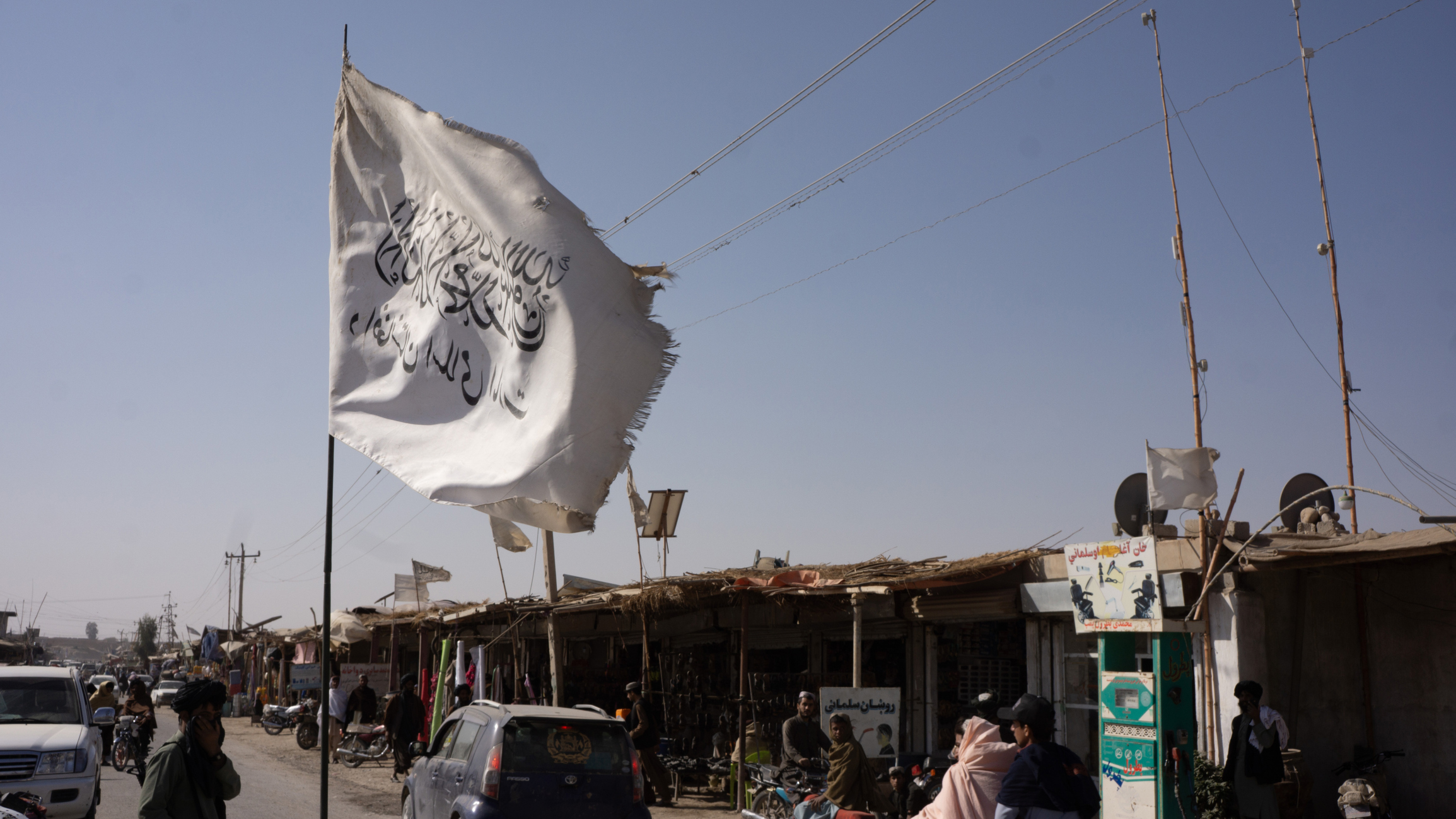
Sangin District Helmand Afghanistan December 20 2021 Taliban flag in Sangin District main market.

Australians who choose to ignore warnings and travel to Afghanistan against government advice are responsible for their own safety.

And those who encounter any issues on their travels may struggle to get help.

Australia has no Embassy in Kabul and the government's ability to provide consular or passport assistance is "severely limited".

Have you got a story? Contact reporter Maddison Leach at Google Play.

Surge in deadly virus results in alarming scenario

International health experts have declared Canada is no longer "measles-free" amid ongoing outbreaks, as childhood vaccination rates fall and the highly contagious virus spreads across North and South America.

The loss of the country's measles elimination status comes more than a year after the highly contagious virus started spreading.

Canada has logged 5138 measles cases this year and two deaths. Both were babies who were exposed to the measles virus in the womb and born prematurely.

READ MORE: President let out of prison after 20 days

Measles elimination is a symbolic designation, but it represents a hard-won battle against the infectious disease. It is earned when a country shows it has stopped continuous spread of the virus within local communities, though occasional cases might still pop up from travel.

Measles typically begins with a high fever followed by a telltale rash that starts on the face and neck. Most people recover, but it's one of the leading causes of death among young children, according to the World Health Organisation (WHO). Serious complications, including blindness and swelling of the brain, are more common in young children and adults over age 30.

It is prevented by a vaccine administered routinely and safely to children around the world.

READ MORE: US Supreme Court rejects bid to overturn marriage equality

Measles morbillivirus structure - 3d rendered image. Abstract background.

"It's a deeply disheartening development. It's a deeply worrisome development. And, frankly, it's an embarrassing development," said Jennifer Nuzzo, a Brown University infectious disease expert.

"No country with the amount of resources of Canada – or other countries in North America even – should lose their measles elimination status."

The WHO declared Australia measles-free in 2014.

Since then, cases have remained mostly isolated, but concerns are rising as vaccination rates dip.

Earlier this year, the Australian Health Protection Committee expressed its concern about the "recent increase" in measles cases, after outbreaks in several states and territories.

"Between 1 January and 27 May 2025, 77 people were diagnosed with measles in Australia," the organisation said.

"Most were young people aged 20 to 49 years who are either unvaccinated or unsure of their vaccination status, and associated with overseas travel."

The Western Australian government issued a measles alert several days ago after an outbreak in the south of the state.

Vaccination campaigns led to elimination

Canada eliminated measles in 1998, followed by the US two years later. After hugely successful vaccination campaigns, the Americas became the first region in the world to be free of measles in 2016. Health officials estimate the measles vaccine prevented 6.2 millions deaths in the Americas between 2000 and 2023.

But vaccination rates have since slipped below the 95 per cent coverage rate needed to stop outbreaks. Large outbreaks in Venezuela and Brazil in 2018 and 2019 cost the region its elimination status. It was reclaimed in 2024, but ends again with Canada's loss.

Experts from the Pan American Health Organisation, an independent health agency, made the determination after analysing data on Canada's outbreaks that showed the virus has spread continuously for a year.

READ MORE: Trump threatens to sue BBC for $1 billion over speech edit

It has never been easy to stop measles from circulating in local communities, Dr Jarbas Barbosa, director of the Pan American Health Organisation, said in a briefing Monday.

"As a region, we have eliminated measles twice," Barbosa said. "We can do it a third time."

In a statement, Canadian health officials said they were working with government and community partners to improve vaccination coverage, share data and provide evidence-based guidance.

The virus is one of the most contagious known to medicine. One infected person can spread it to up to nine out of 10 unprotected people they come into close contact with. Health experts say, by far, the best prevention against measles is the vaccine, which provides 97 per cent protection after two doses.

Barbosa's organisation has confirmed nearly 12,600 cases this year across 10 countries, a 30-fold increase from 2024. The vast majority are in Canada, the US and Mexico, but Bolivia, Brazil, Paraguay and Belize also have active outbreaks.

In 2024, the region had a 79 per cent vaccination rate, an increase from years past but still too low, he said.

United States could be next to lose status

The US eliminated measles in 2000. That status is at risk even though the large outbreak that killed three and sickened nearly 900 across Texas, New Mexico and Oklahoma earlier this year is over.

Current outbreaks in the US include 34 cases in South Carolina and one hitting towns on the Arizona-Utah border that has sickened more than 150 since mid-August.

A major question now is if either are linked to the Texas outbreak. To lose elimination status, health data must show a continuous chain of measles spread for one year.

International health officials have recommended the US "enhance case investigation protocols," because closing data gaps is key to stopping the virus from taking hold again, said Dr Daniel Salas, who leads immunisation efforts at the Pan American Health Organisation.

The US Centres for Disease Control and Prevention has confirmed 1681 cases and 44 outbreaks this year, making it the worst year for measles in the US in more than three decades. Only nine states haven't confirmed cases, according to the CDC.

A large outbreak also continues in Chihuahua, Mexico, where health officials have confirmed 4430 cases as of last week and 21 deaths, according to state health data.

Mexican and US officials have said the genetic strains of measles spreading in Canada match those in the Texas and Chihuahua outbreaks. All those outbreaks affected certain Mennonite Christian communities who trace their migration over generations from Canada to Mexico to Seminole, Texas.

In August, officials said Mennonite communities in Belize, Argentina, Bolivia, Brazil, and Paraguay had outbreaks of the same type of measles virus.

Mennonite churches do not formally discourage vaccination, though more conservative Mennonite communities historically have low vaccination rates and a distrust of government.

It was tempting to look at the outbreaks in a vacuum, Nuzzo said. But many were likely linked, she said, not just by sick people traveling but also by anti-vaccine disinformation.

"It's not a religious prohibition in most of these cases," she said. "It is just people being, perhaps, distrustful of authorities, but also preyed upon by these anti-vaccine influencers who profit off of the fears that some people may have."

DOWNLOAD THE 9NEWS APP: Stay across all the latest in breaking news, sport, politics and the weather via our news app and get notifications sent straight to your smartphone. Available on the Apple App Store and Google Play.
Bus returning from church camp overturns on winding California road

A bus carrying teens and young adults returning from a church camp in the Southern California mountains has lost control and tipped onto its side while driving down a winding mountain road, sending 20 people to the hospital.

The bus began to shake and swerve then rocked side to side before toppling over, said Cyntia Ramirez, a 21-year-old community college student who was on board.

She recalled the accident while picking up her stray luggage from the Orange County church that organised the weekend retreat at a camp in the San Bernardino Mountains.

READ MORE: US Supreme Court rejects bid to overturn marriage equality

A youth leader from the trip pulled her out of a hatch on the roof, she said.

“It’s just a freak accident,” Ramirez said.

The bus with 36 people on board crashed at a curve on two-lane highway near Running Springs, about 113 kilometres north-east of Los Angeles, the San Bernardino County Fire Department said.

The winding route curves along cliffsides and through forest areas at an elevation of about 1860 metres.

“A total of 26 patients, including three with major injuries, were treated. Of those, 20 were transported to area hospitals, all by ground ambulances,” the fire department said.

The others declined to be transported.

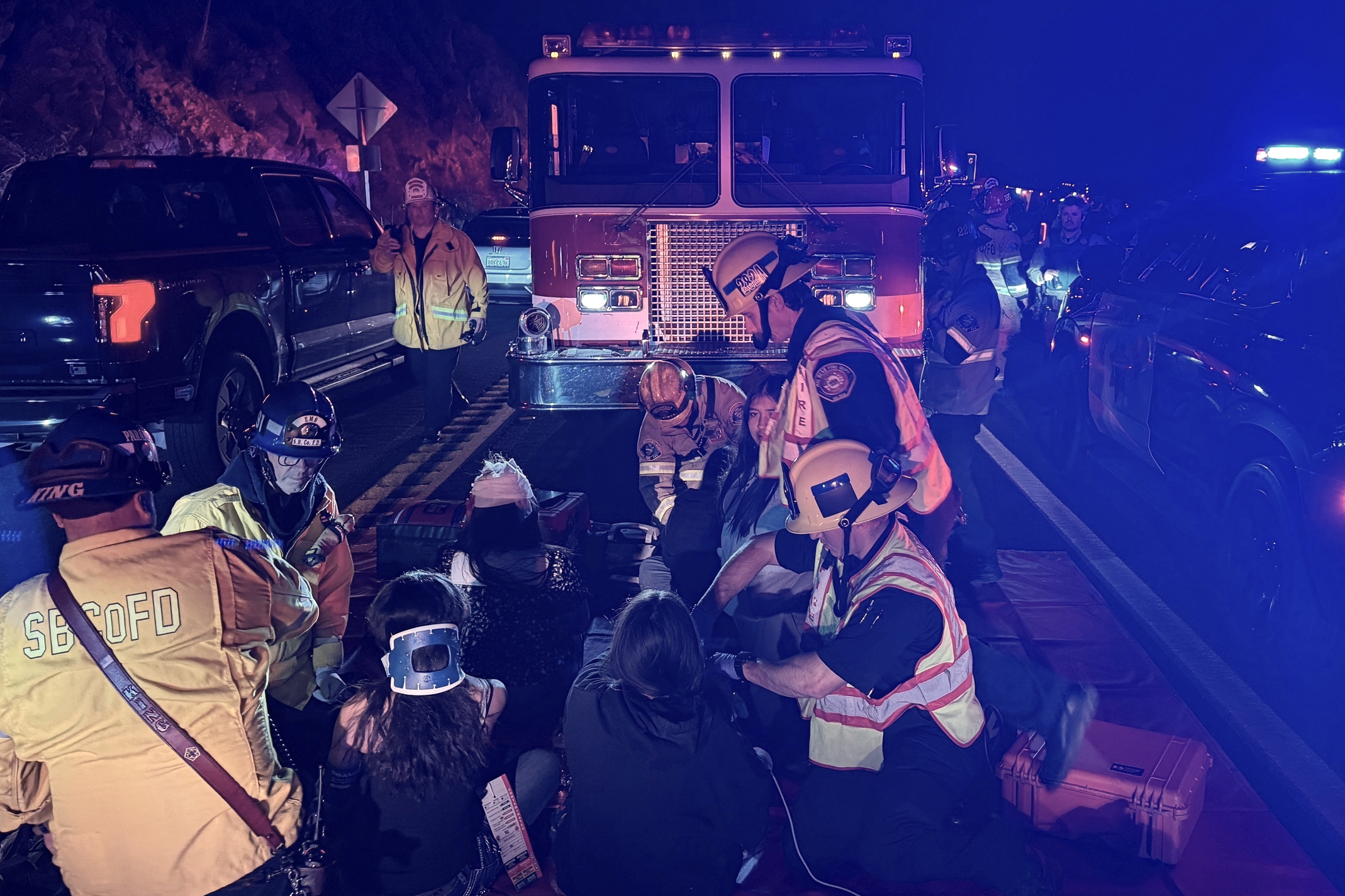
Fire department photos showed paramedics tending to patients, some wearing neck braces, seated in a triage area set up on the highway.

There was no fire or hazardous material exposure.

Authorities have not said what caused the crash.

READ MORE: Warren Buffett says he is 'going quiet' in final letter to shareholders

The bus, carrying adults and teens, was traveling downhill back to Orange County after a three-day youth retreat at Camp Nawakwa near the tiny community of Angelus Oaks in the San Bernardino Mountains, said Jarryd Gonzales, a spokesperson for the Diocese of Orange.

About 125 people including teens, staff and volunteers from Our Lady of Guadalupe Catholic Church in Santa Ana participated in the event, he said.

They were heading home in several vans and the bus that was involved in the accident.

“We extend our deepest gratitude to the first-responder agencies for their prompt and professional response in safely evacuating passengers and ensuring they received proper medical attention,” Gonzales said in a statement.

Youth leader Prisilla Mendoza, 20, said she had dozed off in the moments before the crash.

“I was asleep and I just woke up and I heard everybody screaming,” she said.

Mendoza said she blacked out after the crash and doesn't remember how she got out of the bus.

Father José Félix Troncoso said a half-dozen patients remained at the hospital for treatment for fractured fingers and at least one head injury.

The route was closed in both directions during the investigation, which was led by the California Highway Patrol.

Troncoso said he made the trek up the scenic mountain road to lead Mass for the group on Sunday. He left at 4pm and got word about the accident around 10pm.

“It’s very beautiful, but getting up there is a process,” Troncoso told reporters in Spanish.