Tag Archives: oceania

Earth is spinning faster – here’s why it could be a problem

Earth is spinning faster this winter, making the days marginally shorter and attracting the attention of scientists and timekeepers.

July 10 was the shortest day of the year so far, lasting 1.36 milliseconds less than 24 hours, according to data from the International Earth Rotation and Reference Systems Service and the US Naval Observatory, compiled by timeanddate.com.

More exceptionally short days are coming on July 22 and August 5, currently predicted to be 1.34 and 1.25 milliseconds shorter than 24 hours, respectively.

READ MORE: Luciano said his daughter was abducted. She was dead in a pond

The length of a day is the time it takes for the planet to complete one full rotation on its axis – 24 hours or 86,400 seconds on average.

But in reality, each rotation is slightly irregular due to a variety of factors, such as the gravitational pull of the moon, seasonal changes in the atmosphere and the influence of Earth's liquid core.

As a result, a full rotation usually takes slightly less or slightly more than 86,400 seconds – a discrepancy of just milliseconds that doesn't have any obvious effect on everyday life.

However, these discrepancies can, in the long run, affect computers, satellites and telecommunications, which is why even the smallest time deviations are tracked using atomic clocks, which were introduced in 1955.

Some experts believe this could lead to a scenario similar to the Y2K problem, which threatened to bring modern civilisation to a halt.

Atomic clocks count the oscillations of atoms held in a vacuum chamber within the clock itself to calculate 24 hours to the utmost degree of precision.

We call the resulting time UTC, or Coordinated Universal Time, which is based on around 450 atomic clocks and is the global standard for timekeeping, as well as the time to which all our phones and computers are set.

READ MORE: The eight-hour change making workers happier, healthier, better

Astronomers also keep track of Earth's rotation – using satellites that check the position of the planet relative to fixed stars, for example – and can detect minute differences between the atomic clocks' time and the amount of time it actually takes Earth to complete a full rotation.

Last year, on July 5, 2024, Earth experienced the shortest day ever recorded since the advent of the atomic clock 65 years ago, at 1.66 milliseconds less than 24 hours.

"We've been on a trend toward slightly faster days since 1972," Duncan Agnew, a professor emeritus of geophysics at the Scripps Institution of Oceanography and a research geophysicist at the University of California, San Diego, said.

"But there are fluctuations. It's like watching the stock market, really.

"There are long-term trends, and then there are peaks and falls."

In 1972, after decades of rotating relatively slowly, Earth's spin had accumulated such a delay relative to atomic time that the International Earth Rotation and Reference Systems Service mandated the addition of a "leap second" to the UTC.

This is similar to the leap year, which adds an extra day to February every four years to account for the discrepancy between the Gregorian calendar and the time it takes Earth to complete one orbit around the sun.

READ MORE: Police officer dies suddenly on the beach while playing with his kids

Glaciers in Antarctica on February 07, 2022. A new study suggests even if the world meets its climate targets it may not be enough to save the planet's ice sheets.

Since 1972, a total of 27 leap seconds have been added to the UTC, but the rate of addition has increasingly slowed, due to Earth speeding up; nine leap seconds were added throughout the 1970s while no new leap seconds have been added since 2016.

In 2022, the General Conference on Weights and Measures (CGPM) voted to retire the leap second by 2035, meaning we may never see another one added to the clocks.

But if Earth keeps spinning faster for several more years, according to Agnew, eventually one second might need to be removed from the UTC. "There's never been a negative leap second," he said, "but the probability of having one between now and 2035 is about 40 per cent".

What is causing Earth to spin faster?

The shortest-term changes in Earth's rotation, Agnew said, come from the moon and the tides, which make it spin slower when the satellite is over the equator and faster when it's at higher or lower altitudes.

This effect compounds with the fact that during the summer Earth naturally spins faster – the result of the atmosphere itself slowing down due to seasonal changes, such as the jet stream moving north or south; the laws of physics dictate that the overall angular momentum of Earth and its atmosphere must remain constant, so the rotation speed lost by the atmosphere is picked up by the planet itself.

Similarly, for the past 50 years Earth's liquid core has also been slowing down, with the solid Earth around it speeding up.

READ MORE: Cold fronts to bring Australia-wide soaking this week

By looking at the combination of these effects, scientists can predict if an upcoming day could be particularly short.

"These fluctuations have short-period correlations, which means that if Earth is speeding up on one day, it tends to be speeding up the next day, too," Judah Levine, a physicist and a fellow of the National Institute of Standards and Technology in the time and frequency division, said.

"But that correlation disappears as you go to longer and longer intervals. And when you get to a year, the prediction becomes quite uncertain.

"In fact, the International Earth Rotation and Reference Systems Service doesn't predict further in advance than a year."

While one short day doesn't make any difference, Levine said, the recent trend of shorter days is increasing the possibility of a negative leap second.

"When the leap second system was defined in 1972, nobody ever really thought that the negative second would ever happen," he noted.

"It was just something that was put into the standard because you had to do it for completeness.

"Everybody assumed that only positive leap seconds would ever be needed, but now the shortening of the days makes (negative leap seconds) in danger of happening, so to speak."

The prospect of a negative leap second raises concerns because there are still ongoing problems with positive leap seconds after 50 years, explained Levine.

"There are still places that do it wrong or do it at the wrong time, or do it (with) the wrong number, and so on.

"And that's with a positive leap second, which has been done over and over.

"There's a much greater concern about the negative leap second, because it's never been tested, never been tried."

Because so many fundamental technologies systems rely on clocks and time to function, such as telecommunications, financial transactions, electric grids and GPS satellites just to name a few, the advent of the negative leap second is, according to Levine, somewhat akin to the Y2K problem – the moment at the turn of the last century when the world thought a kind of doomsday would ensue because computers might have been unable to negotiate the new date format, going from '99' to '00.'

The role of melting ice

Climate change is also a contributing factor to the issue of the leap second, but in a surprising way.

While global warming has had considerable negative impacts on Earth, when it comes to our timekeeping, it has served to counteract the forces that are speeding up Earth's spin.

A study published last year by Agnew in the journal Nature details how ice melting in Antarctica and Greenland is spreading over the oceans, slowing down Earth's rotation – much like a skater spinning with their arms over their head, but spinning slower if the arms are tucked along the body.

"If that ice had not melted, if we had not had global warming, then we would already be having a leap negative leap second, or we would be very close to having it," Agnew said.

Meltwater from Greenland and Antarctica ice sheets has is responsible for a third of the global sea level rise since 1993, according to NASA.

The mass shift of this melting ice is not only causing changes in Earth's rotation speed, but also in its rotation axis, according to research led by Benedikt Soja, an assistant professor at the department of civil, environmental and geomatic engineering of The Swiss Federal Institute of Technology in Zurich, Switzerland.

If warming continues, its effect might become dominant.

"By the end of this century, in a pessimistic scenario (in which humans continue to emit more greenhouse gases) the effect of climate change could surpass the effect of the moon, which has been really driving Earth's rotation for the past few billions of years," Soja said.

At the moment, potentially having more time to prepare for action is helpful, given the uncertainty of long-term predictions on Earth's spinning behaviour.

"I think the (faster spinning) is still within reasonable boundaries, so it could be natural variability," Soja said.

"Maybe in a few years, we could see again a different situation, and long term, we could see the planet slowing down again.

"That would be my intuition, but you never know."

DOWNLOAD THE 9NEWS APP: Stay across all the latest in breaking news, sport, politics and the weather via our news app and get notifications sent straight to your smartphone. Available on the Apple App Store and Google Play.

Joe Biden’s son makes profane attack on George Clooney

Joe Biden's son Hunter has said the former president's poor debate performance last year was due to a sleeping pill he had been given.

In a long-ranging and profanity-laced three-hour interview, the younger Biden revealed his father was "tired as s—" during the debate.

"They give him Ambien to be able to sleep," he told YouTube channel Channel 5. 

READ MORE: Biden says he's 'feeling good' in first remarks after cancer diagnosis

"He gets up on the stage and looks like he's a deer in the headlights, and it feeds into every f—ing story that anybody wants to tell."

The then-president's dire debate performance led to a litany of prominent Democrats to call for him to retire.

But Biden launched a passionate defence of his father and tore into Democratic heavy-hitters who pushed him to drop out of the race.

Much of his invective was directed at actor George Clooney, who wrote an editorial in the New York Times calling for him to not run for re-election.

"F— him and everyone around him," Biden said of Clooney.

"What right do you have to step on a man who's given … his f—ing life to the service of this country and decide that you, George Clooney, are going to take out basically a full page ad in the f—ing New York Times."

Joe Biden with his son Hunter.

Biden took particular issue at Clooney claiming the then-president did not recognise him at a fundraiser.

He also vociferously tore into senior Democratic consultants James Carville, David Axelrod, David Plouffe and the hosts of popular podcast Pod Save America.

"James Carville, who hasn't run a race in 40 f—ing years and David Axelrod, who had one success in his political life," he said.

"And that was because of Barack Obama not because of f—ing David Axelrod."

"And the Pod Save America guys who were junior f—ing speechwriters on Barack Obama's Senate staff who have been dining out on the relationship with him for years."

He also went into detail about his father's cancer battle.

"They can treat it but it's not curable," Biden said.

"But seeing him day-to-day he's doing well."

READ MORE: Trump sues Wall Street Journal over Epstein birthday card report

Hunter Biden has become his father's most vocal defender.

Biden also gave a full-hearted defence of illegal immigrants in America.

"How do you think your hotel gets cleaned? How do you think you got food on your f—ing table? Who do you think washes your dishes?

"Who do you think is here by the f—ing sheer f—ing grit and will that they figured out a way to get here because they thought they could get themselves and their families a better chance?"

The younger Biden became tabloid fodder in the past decade, with much attention drawn to his legal battles and his addiction to crack cocaine and alcohol.

He said he has been sober for more than six years.

DOWNLOAD THE 9NEWS APP: Stay across all the latest in breaking news, sport, politics and the weather via our news app and get notifications sent straight to your smartphone. Available on the Apple App Store and Google Play.
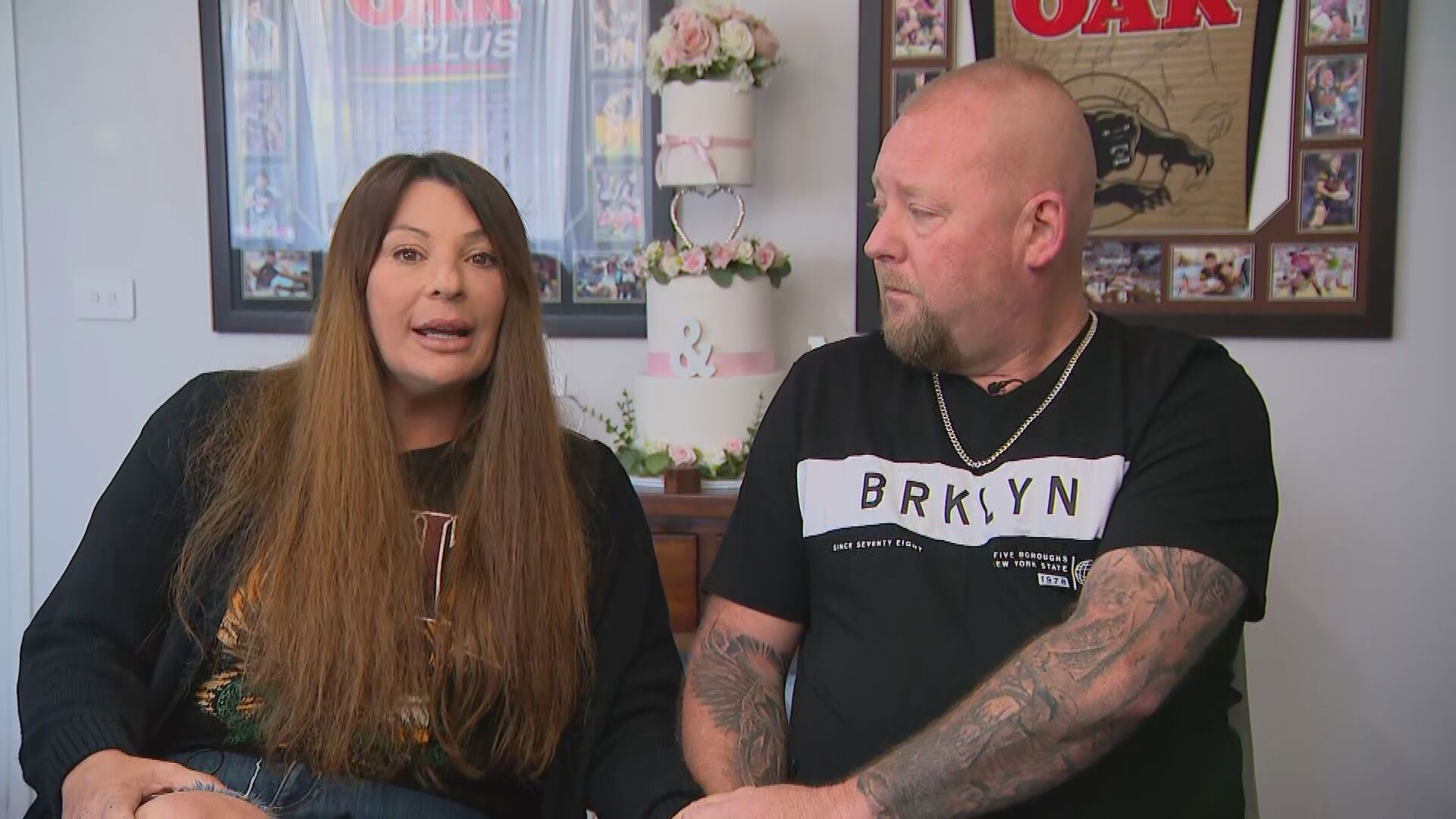
Major bank reveals the time of day you’re most likely to be scammed

Tuesday afternoon at 4pm – it's the time of the day and week when we are at our most hectic, rushing to school pick-up, battling traffic or finishing up at work.

It's no accident that this is also the time scammers are most likely to strike, according to an analysis of Westpac transaction data.

The second and third most popular times for scammers are also in the afternoon, on Thursday and Monday.

READ MORE: Father arrested in New York in death of nine-year-old daughter

Scammer stock photo

Westpac's head of fraud prevention Ben Young said scammers set out to take advantage of people when they were distracted.

"We're seeing a clear pattern where scammers are striking later in the day, most commonly on Tuesday afternoons, when people are multitasking and not paying close attention to the signs that something could be a scam," Young said.

"You might receive a suspicious message in the morning, but it's often in the late afternoon, when your guard is down, that you act on it. 

"That's the window scammers are counting on, and this is why it's so important for people to stay alert and take a moment to think before clicking links, sharing information or sending money."

Data from Westpac shows the most common time of the day scammers strike.

The Westpac data showed 80 per cent of scam cases happen from lunchtime onwards, and 85 per cent occured during weekdays.

The most common type of scam employed by fraudsters on busy weekday afternoons is the remote access scam, making up 30 per cent of the total cases.

"These scams are designed to catch people off-guard," Young said.

"In particular, remote access scams often involve a sense of urgency or technical confusion, perfectly timed for when people are less focused."

Major breakthrough after Australian man gunned down in Bali villa

Indonesian police have found two guns in their investigation into a deadly shooting in Bali last month in which one Australian man was killed and another injured.

Today, more than a month since 32-year-old Melbournian Zivan Radmanovic was gunned down at a villa, officers fronted the media, putting one of the recovered pistols on display in an evidence bag.

Radmanovic's friend Sanar Ghanim was left beaten in the attack.

READ MORE: Call to overhaul contentious tax break as parliament returns

A gun recovered by Indonesian police over a Bali shooting that killed an Australian man.

The gun that police allege is the murder weapon was discovered in an irrigation stream, while the other was found within 50 metres of it.

Police say both weapons have undergone ballistic testing and that the bullets and shell casings are consistent with those used in the June 13 attack.

They also claim DNA has been found on a balaclava and pair of gloves that matches one of the three Australian men currently in custody who are accused of being behind the attack.

READ MORE: Light plane was on annual instrument check before deadly crash

Zivan Radmanovic and Sanar Ghanim.

Police have previously said they have enough evidence to bring those three men – Coskun Mevlut, Tupou Pasa Midolmore, and Darcy Francesco Jenson – to trial on charges of premeditated murder.

The maximum sentence for premeditated murder is the death penalty.

An Australian embassy lawyer has been appointed to represent the trio.

DOWNLOAD THE 9NEWS APP: Stay across all the latest in breaking news, sport, politics and the weather via our news app and get notifications sent straight to your smartphone. Available on the Apple App Store and Google Play.
CCTV captures terrifying crashes and near misses on Sydney light rail line

Impatient motorists, cyclists and pedestrians are dicing with death by taking unnecessary risks around the Parramatta light rail in Sydney's west, leaving tram drivers on high alert.

There have been 11 collisions between trams and vehicles as well as dozens of near misses since the line opened seven months ago, according to Transport for NSW coordinator-general Howard Collins.

CCTV of one incident shows a delivery rider straying onto the light rail tracks and pulling back right before the tram passes.

READ MORE: Tributes flow after Year 12 student at King's School dies in tragic car crash

There have been 11 collisions between trams and vehicles as well as dozens of near misses since the line opened seven months ago.

Footage of another near-miss shows a scooter rider in Parramatta speeding through a crossing, forcing the driver to hit the brakes.

"We've seen a lot of near misses, it catches people out," Collins said.

Transport officials believe pedestrians, cyclists and motorists are simply ignoring the potential dangers.

READ MORE: Worker crushed, two others injured during alleged truck theft in Sydney

Impatient motorists, cyclists and pedestrians are dicing with death by taking unnecessary risks around the Parramatta light rail.

Collins said motorists should heed the warnings as each tram weighs 80 tonnes, the equivalent of two adult humpback whales.

"It takes time to stop," he said.

"While people think 'I can walk in front of the tram, it's going to stop if I trip over', it won't."

Of all the accidents that have happened between vehicles and light rail since the line opened, more than half have been at Westmead.

Transport for NSW is now reviewing each of those collisions and near misses.

"Are there even greater signs, markings, lanes, we could put in to really spoon feed those pedestrians and road users to say please do not do that?" Collins said.

DOWNLOAD THE 9NEWS APP: Stay across all the latest in breaking news, sport, politics and the weather via our news app and get notifications sent straight to your smartphone. Available on the Apple App Store and Google Play.
Man borrows butcher’s knife in wild scenes at Sydney Mitre 10

Four people have been injured in a chaotic string of events that started at a Sydney petrol station and ended by the side of the M4.

In between there was a man armed with a knife borrowed from a butcher, another with a hacksaw, and a police pursuit from Luddenham to Prospect.

It started at a petrol station on Fifteenth Avenue in Austral where a 51-year-old man was being escorted by two men, one who lived nearby and his friend.

READ MORE: Police offer $500K reward after 'completely innocent' woman killed

The 51-year-old, who was accused of having stolen property, appeared cool and calm before he suddenly bolted through a car park.

The chase did not last long and eventually the 51-year-old was ushered into a Mitre 10.

But he again broke free and allegedly armed himself with a hacksaw, injuring two staff members and slicing the ear of the man who had been ushering him.

The local man then rushed to a nearby butcher and asked for a knife, being shown two options before he grabbed one and raced back.

But by the time he had returned the 51-year-old had taken off again.

A bizarre sequence of events has unfolded across Sydney's western suburbs. Four people have been injured and one man is in custody after a police pursuit from Luddenham to Penrith however the real drama unfolded in an Austral car park.

He allegedly stole a truck from Mitre 10 and rammed a staff member as he made his escape.

Unbeknownst to him, the vehicle had a tracker in it and Mitre 10 staff watched his every move.

Police were informed and eventually tracked him from Luddenham to Emu Plains.

The man eventually became trapped in peak-hour traffic on the M4 at Prospect, where he was arrested.

DOWNLOAD THE 9NEWS APP: Stay across all the latest in breaking news, sport, politics and the weather via our news app and get notifications sent straight to your smartphone. Available on the Apple App Store and Google Play.

Man, 20, caught ‘impersonating foreign police’ before guns found at his home

A P-plater was allegedly caught impersonating a foreign police officer by displaying fake Chinese police signs on a Mercedes in Sydney's Inner West.

Traffic officers spotted the unusual sign on the black sedan in Everton Road, Strathfield.

Images show it said POILCE in white on the bonnet next to Chinese characters.

READ MORE: Father and two kids among four killed in horror head-on crash in Queensland

A 20-year-old P-plater allegedly displayed a fake Chinese police signs on a car, which officers spotted in Sydney's Inner West.Traffic officers spotted the unusual sign on the black sedan in Everton Road, Strathfield.

READ MORE: Millions of Aussies just days away from having their debt slashed

The 20-year-old man behind the wheel allegedly showed the officers ID and a disability pass.

Ammunition was also found in the car.

When the man's house in Baulkham Hills was then searched, police allegedly found two guns.

A 20-year-old P-plater allegedly displayed a fake Chinese police signs on a car, which officers spotted in Sydney's Inner West.Traffic officers spotted the unusual sign on the black sedan in Everton Road, Strathfield.

READ MORE: Police offer $500K reward after 'completely innocent' woman killed

He will face court for allegedly impersonating a foreign police officer and possessing firearms.

His charges include use display emergency services organisation insignia, drive motor vehicle with unlawful police insignia, use false document to influence exercise of public duty, holder of Category A or B licence not have approved storage (two counts), provide information known to be false or misleading, possess unauthorised prohibited firearm, and not comply P2 licence condition not display P plates.

He was granted conditional bail to appear at Burwood Local Court tomorrow.

His firearms licence was suspended.

Labor to keep Latham portrait with note condemning his behaviour

The official photo of former federal opposition leader Mark Latham, recognising him as an ex-Labor leader, will have a small note added to it condemning his behaviour following calls to have it removed from Parliament House in Canberra.

The NSW upper house MP has recently faced allegations of domestic abuse from his ex-partner, as well as inappropriate behaviour in NSW parliament.

Latham has strenuously denied any wrongdoing.

READ MORE: Father and two kids among four killed in horror head-on crash in Queensland

Following calls to have his portrait removed from the Labor party room in Canberra, where it sits among all the party's leaders, caucus chair Sharon Claydon confirmed it will not be taken down.

Instead, a plaque will be added with a note which reads: "In 2017 Mark Latham was expelled from the Australian Labor Party and banned for life.

"His actions do not accord with Labor values and failed to meet the standards we expect and demand."

Social Services Minister Tanya Plibersek has previously questioned why Latham's portrait would remain in the caucus room following the allegations levelled against him last week.

READ MORE: Millions of Aussies just days away from having their debt slashed

"I'm sure that there are plenty of people scratching their heads about his portrait being up in the caucus room and giving consideration to whether it's appropriate or not," Plibersek said last week.

NSW state Housing Minister Rose Jackson, who also holds a range of other portfolios including mental health, described Latham on Thursday as a "pig" who would have been sacked from any other workplace.

"I've been on the record about that for a long time...This man has attacked Rosie Batty, told her to grieve in private," Jackson said last week.

"This man is well known, on the record, multiple times, as a bigot.

"He's one of the biggest bigots in the state."

Latham addressed allegations against him in a press conference last week.

"I've broken no law," he said. "This has gone right down the rabbit hole."

House CANBERRA, AUSTRALIA - JULY 21: Former leaders and Prime ministers on the wall in the Labor Caucus room at Parliament House on July 21, 2025 in Canberra, Australia. Following the winter recess, Parliament is set to resume in Canberra this week. (Photo by Hilary Wardhaugh/Getty Images)

READ MORE: Police offer $500K reward after 'completely innocent' woman killed

Latham also addressed his relationship with his former partner Nathalie Matthews, who has accused him of domestic abuse. 

Matthews is seeking a private apprehended violence order against her ex, alleging she faced emotional and physical abuse.

Latham has denied the allegations.

"It's nonsense, complete nonsense," he said.

"The police did not involve themselves in the AVO matter, and now Matthews is attacking them for, in effect, not protecting her from herself."

Matthews' AVO application will be heard in two weeks.

Support is available from the National Sexual Assault, Domestic and Family Violence Counselling Service at 1800RESPECT (1800 737 732).