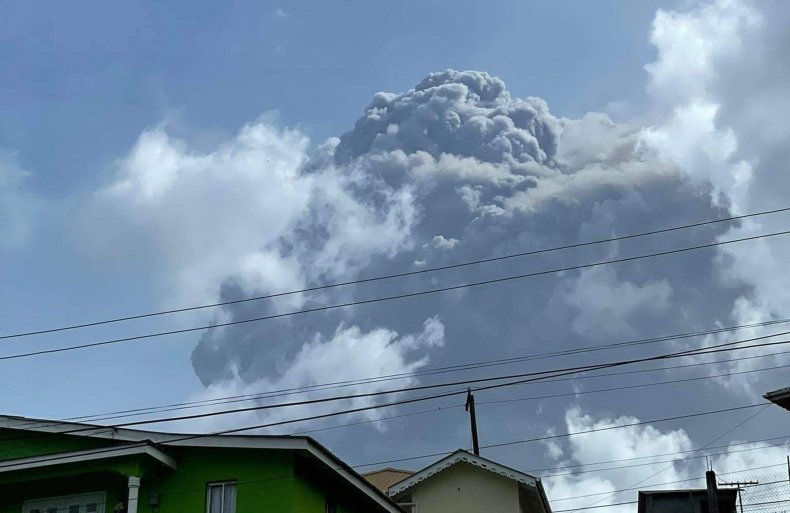
Thick ash continues to spew from the La Soufrière volcano on the Caribbean island of St Vincent this week as it enters its fifth day of erupting.
The region’s National Emergency Management Organization (NEMO) confirmed in a tweet that an “explosive eruption” was recorded from the volcano on Friday last week (April 9), and it has continued to show extensive activity in the days since.
More than 10,000 residents are under evacuation orders as of Tuesday and mass power blackouts have impacted the majority of the island.
Footage released on Monday by the Cooperative Institute for Research in the Atmosphere (CIRA), of Colorado State University, showed satellite video of the large eruption taken the day prior, showing large clouds of ash billowing from the volcano’s crater.
Yesterday’s full daytime view of La Soufrière erupting. pic.twitter.com/FayknJ3Wj3
— CIRA (@CIRA_CSU) April 12, 2021
Thick ashfall has blanketed the island and scientists have warned that pyroclastic flows have now started to occur. While these do not include lava flow, they are a mixture of thick ash, rock and gas produced from an eruption that destroys anything in its path.
The University of the West Indies Seismic Research Centre, which monitors for quakes, volcanoes and tsunamis in the eastern Caribbean, said in its latest update that ashfall and explosions were predicted to “continue to occur over the next few days.”
Erouscilla Joseph, director of the research center, told the Associated Press (AP) this week that the existence of pyroclastic flows means all nearby residents must evacuate. “Anything that was there, man, animal, anything… they are gone,” she said.
Scientists said a “huge explosion” was recorded at 4:15 a.m. local time on Monday, as residents in the neighbouring island of Barbados were also hit by traveling ash.
The seismic research centre said in one of its latest updates that “extensive damage to vegetation was seen in the area extending from Larikai Bay to Turner Bay on the west coast.” Tremors were coinciding with periods of “venting or explosive activity.”
NEMO, which is posting updates and images of the volcano to Facebook and Twitter, said on Sunday roads on St. Vincent, which is home to around 110,000 residents, were treacherous and many homes on the island were left without water and electricity.
It warned: “Ash particles can be breathed into lungs. They can cause runny nose, sore throat, hacking cough, wheezing or shortness of breath.” It remains unclear if there have been any injuries or deaths relating to the eruption. None have been reported.
Authorities in the region have warned residents to stay away from the volcano and said no-one would be allowed nearby without police permission.
The agency NEMO warned on Facebook: “Anyone caught in the Red Zone without the permission of the police will be immediately arrested and prosecuted to the full extent of the law. This will apply whether you are a usual resident of the area or not.” It said water was being distributed to shelters and communities until local service is restored.
St. Vincent Left Without Clean Water and Electricity

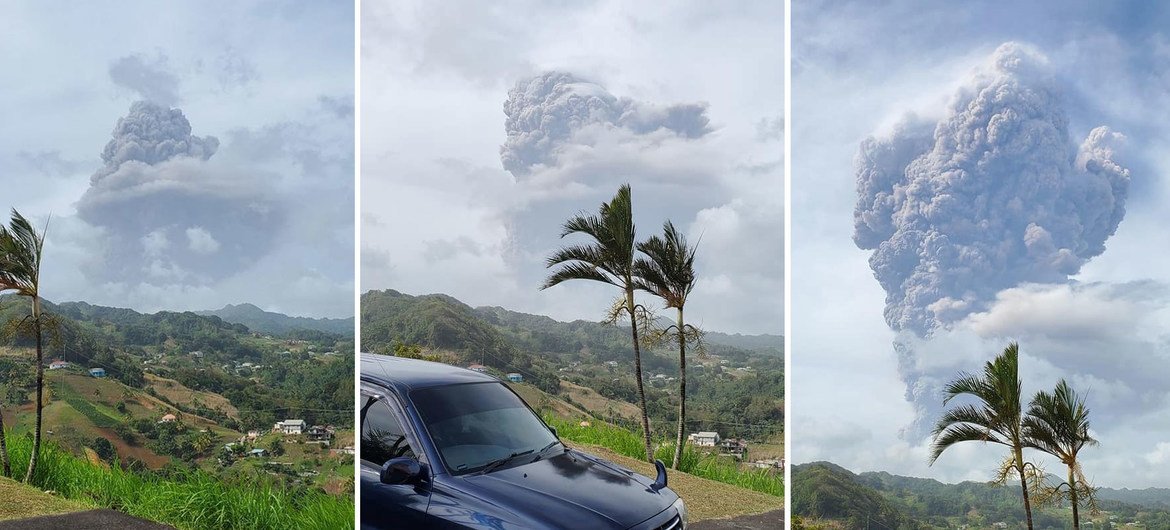
Plumes of ash billow from the La Soufrière volcano on the island of St. Vincent and the Grenadines which started erupting on 9th April.
12 April 2021
Last week’s eruption of La Soufrière volcano in Saint Vincent and the Grenadines, has left the entire population of the main island without clean water and electricity, the UN Spokesperson said on Monday.
Citing reports from the UN Office for the Coordination of Humanitarian Affairs (OCHA), Stéphane Dujarric added that about 20,000 evacuees on the Caribbean island are currently in need of shelter.
“The eruption has affected most livelihoods in the northern part of the island, including banana farming, with ash and lava flows hampering the movement of people and goods”, he told journalists at the daily news briefing.
Although the volcano had been dormant since 1979, it started spewing smoke and actively rumbling in December.
La Soufrière erupted last Friday, blanketing Saint Vincent in a layer of ash and forcing some 16,000 residents to evacuate their homes to cruise ships and safer parts of the island.
Limited humanitarian access
Emphasizing that access to the island is limited, Mr. Dujarric said that along with the Caribbean Disaster Emergency Management Agency, the UN has mobilized pre-positioned water and sanitation hygiene supplies, currently stored in nearby Barbados.
Over the weekend, the Secretary-General spoke to Prime Minister Ralph Gonsalves and the Government officially asked for UN assistance.
The aid includes relief items, food and cash distribution and technical advice while neighbouring countries are contributing emergency supplies and assets to support evacuation, according to the UN spokesperson.
Continuing threat
Meanwhile, OCHA reported that as of yesterday, intervals between tremors have lasted between 1.5 to 3 hours, which, based on visual observations and satellite imagery, are associated with periods of explosive activity or enhanced venting of the volcano.
“Explosions and accompanying ashfall of similar or larger magnitude are likely to continue to occur over the next few days”, according to the UN humanitarian office.
At the request of the Prime Minister, the UN has also mobilized experts through the UN Environmental Programme (UNEP) to develop and implement a debris management plan, including to clean up ash and promote environmental health and safety.
Situation overview
- Airports in Saint Vincent and the Grenadines are closed.
- Maritime assets are limited.
- Approximately 30 villages have been evacuated.
- Between 16,000 and 20,000 people have been affected.
- Some 3,500 people are in 85 shelters.
- The Pan American Health Organization (PAHO) and the World Food Programme (WFP) have deployed to support health and humanitarian efforts.
The post St. Vincenr: La Soufriere Still Spewing Ash & Lava, No Water, Electricity appeared first on The St Kitts Nevis Observer.