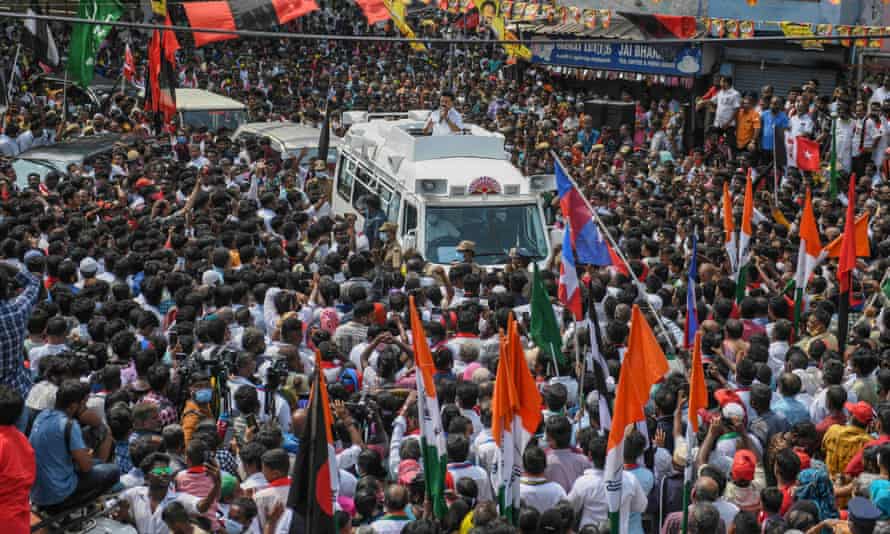
Dr. K Senthil had feared it was coming. He had feared it as he saw the reckless crush of hundreds of people taking part in large wedding parties over the past months, feared it as he saw the maskless faces of shoppers at the market, feared it as he witnessed thousands come together for political rallies in the ongoing elections in the Indian state of Tamil Nadu, where he is the president of the state medical council.
But despite his growing sense of foreboding, the second wave of coronavirus that began to engulf India last month has confounded even Senthil’s worst expectations.
“People became so complacent, acting as if the virus had vanished which was absurd,” said Senthil, who is a urologist in Coimbatore, Tamil Nadu.
“Now we are experiencing a wave of coronavirus infections that is far worse than the first and the magnitude of the spread is getting worse and worse. In Tamil Nadu it has taken just 15 days to reach the same level of cases in hospitals which was the peak last time. In the big cities in the state, the hospitals are already almost full.”
This week has marked a series of grim Covid milestones for India. It was this week the country once again outstripped Brazil to become the second-worst affected globally, with a total of over 13.68m cases. Each day has brought a new record for new infections; on Tuesday, the figure was 161,736. Active cases also hit a new high, while deaths continued to escalate to a total of over 171,000.
Thousands come together for election campaign rallies ahead of the elections, like this one in Chennai on 4 April Photograph: Arun Sankar/AFP/Getty Images
Nightmare scenes of a country struggling to cope have begun to emerge as doctors speak of a new variant of the virus that appears to be spreading faster than ever before, affecting young people and even children this time around and pushing India’s healthcare system to the brink of collapse. States such as Maharashtra have imposed a weekend lockdown in an attempt to curb infections, while Delhi has introduced a night curfew, with a total lockdown still not ruled out.
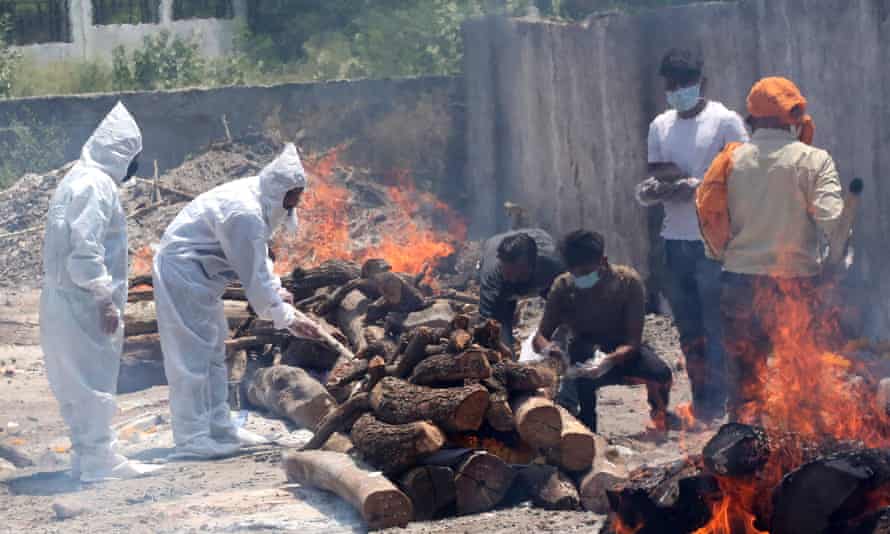
Over the weekend bodies piled up outside the government hospital in Raipur, in the state of Chhattisgarh, because the hospital had “not expected so many people to die at once” from coronavirus and could not cremate them fast enough. In Surat, in the state of Gujarat, crematoriums became so overwhelmed with coronavirus victims that families began burning their dead on open ground.
“This sheer tsunami of cases has already overwhelmed the healthcare infrastructure in the state,” said Dr Shashank Joshi, a member of the Mumbai Covid taskforce. “This time we are seeing younger people between 20 and 40 getting seriously affected and even children are now being hospitalised with severe symptoms. The capacity for the healthcare system to hold on is fast dwindling.”
Kshitij Thakur, a local politician in the Vasai-Virar municipality of Maharashtra, made a desperate public plea for help with an “acute” shortage of oxygen in the local government hospital, which had already led to the loss of three lives.
“The supply can run for only three hours,” said Thakur in a tweet directed at the central government and prime minister Narendra Modi. “There are more than 7,000 active cases in the area and more than 3,000 people require oxygen supply daily.”
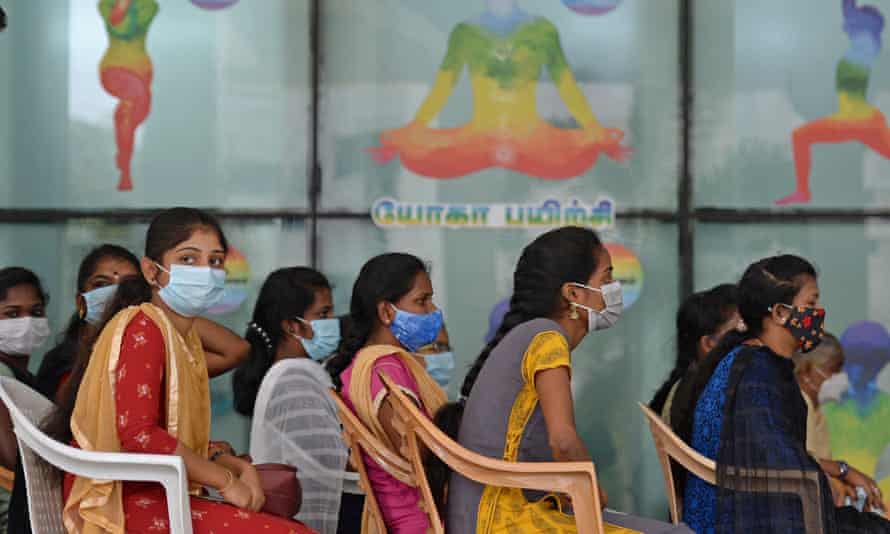
Young frontline workers wait to get vaccinated at a government hospital in Chennai Photograph: Arun Sankar/AFP/Getty Images
Though over 108 million people have been vaccinated so far, in a country of 1.3bn it has not been enough to curb the second wave. On Tuesday, the drugs controller general of India (DCGI), Dr VG Somani, approved the Russian Covid-19 vaccine, Sputnik V, for emergency use in India, with distribution likely to begin next month, and also cleared the way for Pfizer, Moderna and Johnson & Johnson to be given approval.
Just a month ago, while Europe grappled with soaring cases and stringent lockdowns, there was a widespread belief across India that the country had avoided the spectre of a second wave through a combination of herd immunity from the first wave, which eased off around November, and a speculated natural immune resistance among Indians.
In January, health minister Harsh Vardhan proclaimed that India had “successfully contained the pandemic”. Caps were lifted on social and religious gatherings, including the Kumbh Mela, a Hindu festival which on Monday drew crowds of over a million. Several populous states held their elections over the past month, with prime minister Modi and home minister Amit Shah among those holding political rallies where thousands gathered without social distancing or masks enforced. All three states are now experiencing a sharp rise in cases.
Much of the blame for the second wave has been attributed to complacency, but an increasing body of evidence, backed up by first-hand accounts from doctors on the frontline, also points to possible new variants in India which are proving to be drastically more infectious.
“The rate at which cases have increased in this wave far exceeds the rate at which cases grew the first time,” said Gautam Menon, professor of physics and biology at Ashoka University. “There is certainly evidence that it is spreading faster, suggesting that it is likely more infectious.”
Menon believed it was “new variants driving this rapid increase”, in particular an Indian variant known as B.1.617, which contains two mutations which are associated with increased infectivity and “immune escape”. Menon pointed to data from Maharashtra, the Indian state worst affected by Covid-19, where this variant has been found to be responsible for 20% of the cases.
The government has been accused of being slow in genome sequencing of Covid cases in India over the past few months and therefore failing to detect new and possibly more virulent domestic variants, as well as the virulent Brazil and UK variants. In the state of Punjab which is experiencing a severe rise in case, 80% have been found to be the UK variant.
Menon said that it was unlikely that a second wave in India could have been avoided altogether. “However, a more robust sequencing program should have acted as an early warning system, picking up the new variants of concern at an earlier stage,” he said. “This would have helped to slow down, if not actually stop, the spread.”
Here’s more on the latest situation in India from Rafiq Maqbool and Aniruddha Ghosal at the Associated Press.
They report that India’s worst-hit and richest state Maharashtra will impose stricter restrictions for 15 days from today in an effort to stem the surge of coronavirus infections that is threatening to overcome hospitals.
Top state officials stressed that the closure of most industries, businesses, public places and limits on the movement of people didn’t constitute a lockdown.
Last year, a sudden, harsh, nationwide lockdown left millions jobless overnight. Stranded in cities with no income or food, thousands of migrant workers walked on highways to get home. Since then, state leaders have repeatedly stressed that another lockdown wasn’t on the cards.
Maharashtra chief minister Uddhav Thackeray said that most public places, shops and establishments will be shut starting 8pm Wednesday, except for essential services such as grocery shops and banks.
Although the state has announced a relief package of $728m (£527m) that will include assistance for the poor, industry experts say that the new restrictions might prove fatal for businesses that were only just recovering from last year’s economic recession.
“Livelihoods are important, but life is more important,” Thackeray said, echoing a difficult choice faced by other states in India.
The scenes playing out in Maharashtra in the past week mirror those developing in other parts of the country which confirmed a national one-day record of 184,000 new coronavirus cases in 24 hours today: patients gasping for air turned away from hospitals that are running out of oxygen and weeping families waiting their turn to bid farewell to their loved ones at crematoria.
France suspending all flights to and from Brazil over Covid variant fear
Kim Willsher
France is suspending all flights to and from Brazil to contain the spread of a highly contagious new Covid-19 variant picked up in the country.
Prime minister Jean Castex said the so-called Brazilian variant, known as P.1, is extremely virulent and partly to blame for fuelling the third coronavirus wave in France last month.
“We have noted that the situation is becoming worse, which is why we have decided to suspend all flights between Brazil and France until further notice,” Castex told MPs in the Assemblée Nationale.
The P.1 variant was first picked up in travellers from Brazil who were tested when they arrived at a Japanese airport in early January. In Brazil, the official death toll from Covid-19 has risen from 200,000 to more than 35,000 since the start of the year. France reported four cases of P.1 variant in early February.
All travellers embarking in Brazil must already have a negative Covid tests before leaving and upon arrival in France and are required to self-isolate for 10 days.
On Tuesday, health minister Olivier Véran said the Brazilian and South African variants were “less contagious than the English variant”. Véran told MPs more than 80% of new cases in France were what is known in the UK as the “Kent variant”.
The Brazilian president Jair Bolsonaro has been criticised for his handling of the Covid crisis in his country that has one of the highest infection rates in the world after the US and India. The Brazilian Senate has opened an inquiry into what has gone wrong in the South American country.
Romania’s health minister fired over handling of Covid pandemic
Romania’s prime minister Florin Cîtu said this morning he has fired health minister Vlad Voiculescu after weeks of mounting tensions over how to handle the new coronavirus pandemic.Reuters report deputy prime minister Dan Barna has been appointed interim health minister, Citu said in a statement.