Spread of Indian Covid variant has not deterred PM from return of cinemas and indoor hospitality and permitting mixing at home

Friends and family will be able to hug and mix indoors from next week, while cinemas and museums can reopen, Boris Johnson is to confirm on Monday despite growing concerns over the spread of the India coronavirus variant.
Yat, scientists warned this weekend that cases are doubling in some areas where the variant, B1.617.2, has been detected. More deprived areas and those with large ethnic minority communities where vaccination rates may be lower are most affected, they said.
But at a press conference today the prime minister will hail the Covid vaccine rollout, with more than two-thirds of UK adults having had a first dose and a third now fully vaccinated. Just two deaths within 28 days of a positive test were reported on Sunday.
Johnson will confirm that the next stage in the easing of Covid restrictions for England will go ahead from 17 May. Indoor drinks and meals will be allowed for groups of up to six or two households, while cinemas, galleries and the rest of the accommodation sector will reopen.
International leisure travel will be possible, with some destinations given a “green light” enabling return without self-isolation, and ministers indicated that “intimate contact” will once more be permissible.
“The roadmap remains on track, our successful vaccination programme continues – more than two-thirds of adults in the UK have now had the first vaccine – and we can now look forward to unlocking cautiously but irreversibly,” Johnson said in comments released overnight.
Speaking on BBC One’s Andrew Marr Show on Sunday, the Cabinet Office minister, Michael Gove, said that the government wants to see families able to hug again. “As we move into stage three of our roadmap it will be the case that we will see people capable of meeting indoors. And without prejudice to a broader review of social distancing, it is also the case that friendly contact, intimate contact, between friends and family is something we want to see restored,” he said.
Scientists are concerned about the possible spread of variants as the country relaxes. The notification by Public Health England that one of three variants first seen in India is now “of concern”, with increased transmissibility, demonstrates the need for continued caution, they said. There is anxiety about the anticipated ending of mask-wearing in schools, where clusters of cases linked to the variant have been reported.
Prof Susan Michie, director of UCL’s Centre for Behaviour Change, talked of a mixed picture. If people carry on getting vaccinated at the current rate, it should be possible to keep transmission low, she said.
But the spread of the virus was very uneven. “We have pockets of high rates of transmission, especially in more deprived communities, and where you get high rates of transmission, you obviously also get the likelihood of variants that might undermine the vaccine programme,” said Michie.
Cases of the Indian variant are thought to be doubling every week. “There’s definite signs of community transmission in London. Now that’s obviously concerning, because we don’t yet know what effects it’s likely to have on our vaccine programme,” she added.
Paul Hunter, professor in medicine at the University of East Anglia, said it was “the Indian variant that is giving me most unease”. The Kent variant (B.1.1.7) had been collapsing in recent months but the Indian variant had been increasing quite rapidly. “I do worry that we will see cases increasing again soon when and if the Indian variant B.1.617.2 becomes dominant,” he said.
But it was difficult yet to know how serious an issue this was. “The signs are troubling but probably not yet strong enough to delay the next stage of lockdown easing. In particular we don’t know how severe the Indian variant will be in people who have been vaccinated,” he said.
Michael Head, senior research fellow in global health at Southampton University, said his personal view was that we could encourage larger outdoor gatherings but leave the reopening of indoor settings until all adult groups are vaccinated, which is expected by mid-July.
“Meeting friends and relatives outdoors is much lower risk. Personally, I’d be happier to spend two hours sat outdoors in a sports stadium with a few thousand spectators than I would be inside a cinema watching a film with 100 other people,” he said.
Michie said she thought the public should be given more information about the importance of ventilation indoors to prevent aerosol transmission. Hugs, as long as people did not breathe in each other’s faces, were not so risky, she said. “I think the issue about opening up all the indoor spaces, whether it’s pubs, restaurants, cinemas, theatres, etc, is the ventilation. I don’t know how that’s going to be communicated.”
LATEST NEWS
- Taiwan to quarantine all China Airlines pilots for 14 days
- Nepal asks Himalayan climbers to bring back empty oxygen tanks to help Covid fight
- France to reopen outdoor bars and restaurants on 19 May
- Ireland lifting some coronavirus restrictions today
- India reports more than 366,000 daily cases
- China to set up ‘separation’ line on Mount Everest over Covid-19 fears
- Johnson to unveil timetable for lifting England restrictions
====================================================
US ‘turning the corner’ on pandemic but pressure grows to help other nations
Daily new cases plummet in US with advent of vaccines while they rise at alarming rates in south Asia, with India bearing the brunt

The US is approaching a turning point where Covid vaccinations are sharply reducing infection and hospitalization rates, key figures in the fight against the disease said on Sunday, though the Biden administration is facing mounting pressure to do more to help other nations still in the grip of the disease.
“We are turning the corner,” said Jeffrey Zients, the White House Covid response coordinator. With about 58% of adult Americans having received at least one shot of vaccine, and with some 113 million people now fully vaccinated, the country was on track to meet Joe Biden’s goal of 70% of the population at least partially vaccinated by 4 July, he said.
“I think everyone is tired, and wearing a mask can be a pain. But we are getting there, and the light at the end of the tunnel is brighter and brighter,” Zients said, speaking on CNN’s State of the Union show.
Anthony Fauci struck a similar upbeat note on ABC News’s This Week. The nation’s top infectious diseases expert said it was time to start loosening guidelines and allowing Americans to start enjoying the benefits of vaccination.
“Yes we do need to start being more liberal as we get more people vaccinated,” Fauci said. But he added that the battle was still on to get the overwhelming proportion of the population vaccinated, because when that happened “the virus has nowhere else to go”.
The daily load of new Covid cases has plummeted with the advent of vaccines in the US, from a seven-day average of more than 250,000 per day in January to the current average of about 43,000. Hospitalisations and deaths are also dramatically down.
But as the US begins to feel the benefits of widespread vaccination, other parts of the world are still mired in the depths of the pandemic. The World Health Organization (WHO) has called the inequity in access to vaccines “grotesque” and a “moral outrage”.
The WHO has pointed out that across the globe the past two weeks have seen more cases recorded than in the entire first six months of the pandemic, with India bearing the brunt. Daily cases are rising at alarming rates across south Asia, and observers are especially worried about Nepal, Sri Lanka and the Maldives.
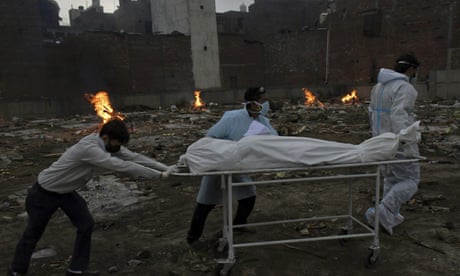
India continues to smash global records for new cases – more than 400,000 – and deaths (3,915). The country is grappling with dire shortages of oxygen and other essential hospital supplies.
Last month Biden promised that the US would send oxygen-related supplies and vaccine materials to India. The US has also indicated it will provide up to 60m doses of AstraZeneca vaccine to other countries struggling to protect their people from the virus, an act of altruism arguably diminished by the fact that the AstraZeneca vaccine is not approved for use in the US.
In addition, the Biden administration has backed the campaign to waive patents on vaccines to allow low-income countries to make their own versions.
Despite these recent concessions, Biden has come under intense pressure to do more to help ailing nations. In the early weeks of his presidency he refused to budge from the position that the US would only send vaccines abroad once all Americans had had the chance of being immunised.
On Sunday, Fauci called on the manufacturers of vaccines in the US to scale up production “in a great way” to allow large quantities of supplies to reach India quickly. He said the ambition would be for “literally hundreds of millions of doses” destined for India and other needy countries.
Asked whether waiving intellectual property rights on the patents would prevent the big US companies from making more vaccines for transport abroad, Fauci said “I don’t think that’s the case. They can scale up. I think the waiving of the patents is not going to necessarily interfere with that right now.”
The contrast between countries in Africa where only 1% of the population is vaccinated and the US where almost 60% of adults have received at least one shot is all the more glaring given that at home in the US the emphasis now is not on accessing supplies of vaccines but on overcoming vaccine hesitancy. Several states are turning away allotted vaccines because demand is so low.
Fauci said the group of those who were “recalcitrant” was relatively small. The Biden administration was seeking to overcome resistance among them by making vaccinations extremely easy to obtain, through walk-in pharmacies and mobile units, he said.
The other method being pursued was to use “trusted messengers” – whether sports or entertainment stars, clergy or family doctors. They would spread the word that vaccines were a safe way of getting back to what Fauci described as “what we used to remember as ‘normal’ before all this happened”.
Latest News
May 10 (GMT)
Updates
- 362 new cases in Uzbekistan [source]
- 254 new cases and 5 new deaths in Kyrgyzstan [source]
- 2,142 new cases and 15 new deaths in Kazakhstan [source]
- 463 new cases and 1 new death in South Korea [source]
- 2 new cases in New Zealand [source]
The post UK To Reopen, US-Cases Down, Vaccinations Down, World Stats appeared first on The St Kitts Nevis Observer.