
Thursday, May 13 marked the deadliest day for COVID-19 in Trinidad and Tobago since the pandemic began, with 21 deaths recorded.
The latest deaths, reported by the county’s Ministry of Health, took the toll to 256. With 87 of those occurring this month, May is now also the month in which the most deaths have been recorded.
The Ministry said the 21 latest deaths include six elderly females – five of them with comorbidities; six middle-aged women – half of them with comorbidities; five elderly men – four of them with comorbidities; three middle-aged males – one with comorbidities; and a young man without comorbidities.
The number of active cases is now 4,814. Since March 2020 when the first case of COVID-19 was recorded in twin-island republic, there have been 14,814 cases.
The Ministry also reported in its update on Thursday that 342 patients currently are hospitalized and being treated for COVID-19, while 103 persons are in step-down facilities, recovering from the virus.
CDC Says Fully Vax People Can Go Maskless
People who are fully vaccinated against COVID-19 can safely resume life without any restrictions, according to long-awaited federal guidance released Thursday.
The Centers for Disease Control and Prevention (CDC) says if you are fully vaccinated — two weeks past the last required COVID-19 vaccine dose — you don’t need to wear masks indoors or outside, and you don’t need to maintain physical distance.
The change is a monumental shift in how the agency has communicated about the risks of the coronavirus and the benefits of vaccines, and is a major step towards reopening America in time for the July 4th holiday.
Essentially, for vaccinated people, life can begin to return to normal.
“Anyone who is fully vaccinated, can participate in indoor and outdoor activities, large or small, without wearing a mask or physical distancing,” CDC Director Rochelle Walensky said during a White House briefing. “If you are fully vaccinated, you can start doing the things that you had stopped doing because of the pandemic. We have all longed for this moment, when we can get back to some sense of normalcy.”
The new guidelines do not apply to health care settings, correctional facilities or homeless shelters, the agency said. People will also need to follow local business and workplace guidances, so masks are likely to continue to be required in private businesses.
In addition, CDC emphasized fully vaccinated people should still wear well-fitted masks where required by laws, rules and regulations, including on airplanes, trains and public transportation.
It also urged those who are immune-compromised to speak with their doctors before giving up their masks.
The update comes as the agency has been criticized for being too slow to react to changing science, overly cautious and even contradictory in its recommendations to the public.
More than 117 million Americans are now fully vaccinated, which is about 35 percent of the population. New cases are down by a third over the last two weeks, and daily deaths have dropped to the lowest point since April 2020.
But the announcement puts even more pressure on businesses and local governments. There is no way to know who is vaccinated and who is not, and the idea of some kind of “vaccine passport” or digital identifier has become a partisan flashpoint vehemently opposed by Republicans.
States across the country have been easing restrictions and reopening businesses as local vaccination rates increase, despite the CDC and federal health officials who continued to urge caution.
Health experts said they feared the agency’s overly conservative approach could result in fewer people getting shots, if they failed to show the benefits of being vaccinated.
The agency relaxed some of its rules for fully vaccinated people last month, but still advised wearing masks indoors in most public settings, and in many outdoor places.
That guidance included an elaborate color-coded chart for various activities that was widely mocked for being confusing and contradictory.
The agency’s recent guidance on summer camps was also panned as being overly restrictive.
The CDC had said masks should be worn at all times, even outdoors, by everyone, including vaccinated adults and children as young as 2 years old.
Walensky denied that the changes were being made because of the criticism, or as an incentive to get more people vaccinated.
“We follow the science here,” Walensky said. “While this may serve as an incentive for some people to get vaccinated, that is not the purpose.”
She said additional data in the past few weeks has shown the effectiveness of the vaccines in the real world, the vaccines work against variants, and vaccinated people are unlikely to transmit the virus.
But as recently as Wednesday evening, the message hadn’t changed.
During an interview with CNBC’s Shepard Smith, Walensky said that masks were still advised for people indoors, even if they were fully vaccinated because the science wasn’t clear if the vaccine worked against COVID-19 variants or whether vaccinated people could be asymptomatic carriers.
=================================================
Delay in giving second jabs of Pfizer vaccine improves immunity
Study finds antibodies against Sars-CoV-2 three-and-a-half times higher in people vaccinated again after 12 weeks rather than three
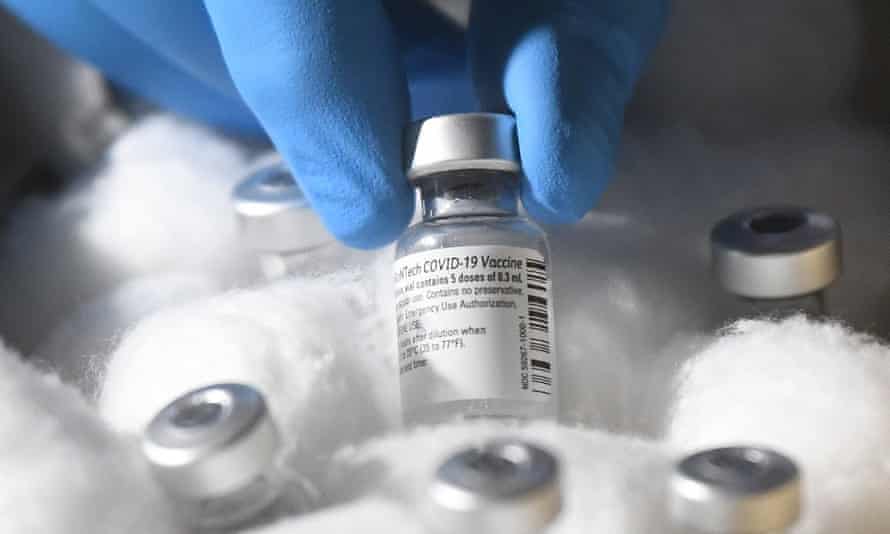
The UK’s decision to delay second doses of coronavirus vaccines has received fresh support from research on the over-80s which found that giving the Pfizer/BioNTech booster after 12 weeks rather than three produced a much stronger antibody response.
A study led by the University of Birmingham in collaboration with Public Health England found that antibodies against the virus were three-and-a-half times higher in those who had the second shot after 12 weeks compared with those who had it after a three-week interval.
Most people who have both shots of the vaccine will be well protected regardless of the timing, but the stronger response from the extra delay might prolong protection because antibody levels naturally wane over time.
Dr Helen Parry, a senior author on the study at Birmingham, said: “We’ve shown that peak antibody responses after the second Pfizer vaccination are really strongly boosted in older people when this is delayed to 11 to 12 weeks. There is a marked difference between these two schedules in terms of antibody responses we see.”
In the first weeks of the vaccine programme the UK took the bold decision to delay administering booster shots so that more elderly and vulnerable people could more quickly receive their first shots.
The move was controversial because medicines regulators approved both the Pfizer/BioNTech and Oxford/AstraZeneca vaccines on the basis of clinical trials that spaced out the doses by only three or four weeks.
Researchers from Oxford University showed in February that antibody responses were more than twice as strong when boosters of their vaccine were delayed for 12 weeks. But the latest study is the first to compare immune responses after different timings with the Pfizer/BioNTech jab.
The scientists analysed blood samples from 175 over-80s after their first vaccine and again two to three weeks after the booster. Among the participants 99 had the second shot after three weeks, while 73 waited 12 weeks. After the second dose, all had antibodies against the virus’s spike protein, but the level was 3.5 times higher in the 12-week group.
The researchers then looked at another arm of the immune system, the T cells that destroy infected cells. They found that T cell responses were weaker when the booster was delayed, but settled down to similar levels when people were tested more than three months after the first shot. Details are published in pre-print form and have yet to be peer reviewed.
“This study further supports the growing body of evidence that the approach taken in the UK of delaying that second dose has really paid off,” said Dr Gayatri Amirthalingam, consultant epidemiologist at Public Health England.
“Individuals need to really complete their second dose when it’s offered to them because it not only provides additional protection but potentially longer lasting protection against Covid-19.”
The findings come as new data from Public Health England suggested that the vaccination programme had prevented 11,700 deaths by the end of April 2021 in those aged 60 and over, and at least 33,000 hospitalisations in those aged 65 and over in the same period.
“Overall, these data add considerable support to the policy of delaying the second dose of Covid-19 vaccine when vaccine availability is limited and the at-risk population is large,” said Eleanor Riley, professor of immunology and infectious disease at the University of Edinburgh.
“Longer term follow-up of this cohort will help us to understand which vaccine interval will be optimal in the future, once the immediate crisis is over.”
==================================================
Taiwan reports another record rise in domestic Covid-19 cases
Almost half the Australians booked on India repatriation flight barred after Covid tests
Updated at 7.37am BST
The post T&T’s Deadliest Day, US CDC: Vaccinated People Can Go Maskless, More appeared first on The St Kitts Nevis Observer.