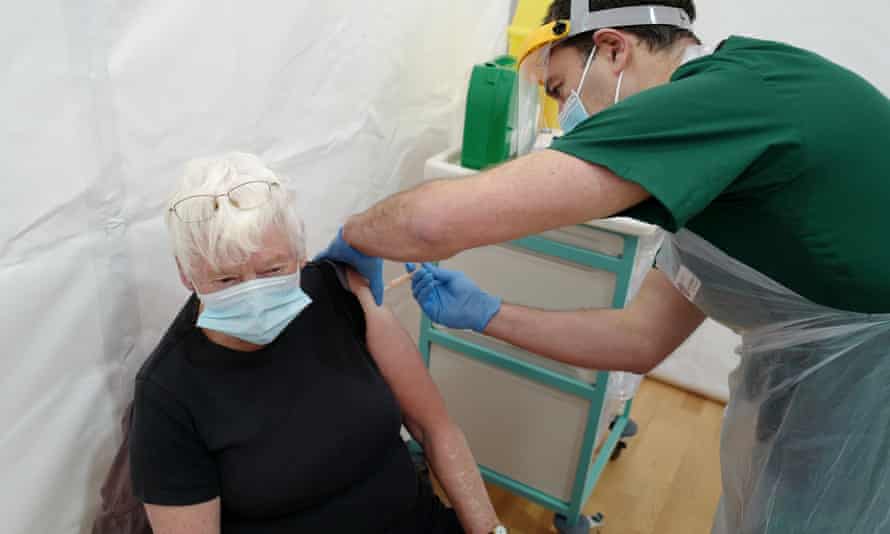
Older people are dying less frequently compared to previous waves due to the effectiveness of the UK’s vaccination programme, which prioritised people by age. Photograph: Hugh Hastings/Getty Images
Official statistics show Covid is claiming 100 lives a day on average across the UK. But the figures tell only a fraction of the story.
Scientists and academics are looking at the profiles of those who are dying to see how they compare to previous waves.
So what do we know?
The age profile of those dying with Covid has changed
At the height of the second wave in January, the under-65s accounted for just 11% of deaths. In recent weeks, they accounted for about 25% of deaths.
The total number of deaths this time round is substantially lower, however. In the week to 13 August, 652 deaths were registered in the UK. In the week ending 22 January, the figure stood at 9,056.
Kevin McConway, Emeritus professor of applied statistics at The Open University, points out that, of 571 Covid deaths registered in England and Wales in the week to 13 August, 7% were people under 50.
He notes that last time the UK exceeded 571 deaths in a week was in late March this year – and then only under 4% were aged under 50. Looking back further to mid-October 2020 – when overall death figures were roughly similar – under 2% of Covid-related deaths were of people aged under 50.
The reason older people are dying less frequently compared to previous waves is the effectiveness of the UK’s vaccination programme, which prioritised population cohorts by age.
If vaccine coverage was equal in all age groups, experts would expect to see the same proportion of almost all deaths from Covid in elderly people. But the younger age groups are not vaccinated at the same rate as older age groups and this is resulting in a relative increase in younger people dying.
“Last October, we had no vaccines, and in late March most people in the older age groups had been vaccinated but not necessarily with both doses. This increasing proportion of younger people among the Covid deaths clearly has a lot to do with vaccination,” he said.
“So, if the people dying weren’t getting younger, that would be really quite alarming.”
Being vaccinated does not mean you cannot die from Covid
Although there is overwhelming evidence that the vaccines are dramatically effective in preventing severe disease and death, they are not perfect.
Of the 1,189 deaths confirmed as Delta cases between 1 February and 15 August, about 57% had received their second jab at least two weeks previously, according to Public Health England.
As most of the adult population is now fully vaccinated, those who die are more likely to be vaccinated, explained Dr Kit Yates, a senior lecturer in mathematical biology at the University of Bath.
Even if everyone were fully vaccinated, some people would still die – that doesn’t mean vaccines aren’t effective at reducing death.
Men are more at risk
Despite catching Covid at a relatively similar rate, men are still dying more than women, likely due to a mixture of biological and behavioural factors. Of the 571 deaths registered in England and Wales in the week up to 13 August, 59% were men.
On Tuesday, 174 deaths were reported within 28 days of a positive test. Scientists expect case rates will jump again with schools and universities set to soon reopen – probably followed by a rise in death rates.
Although early UK data suggests antibody levels fall in the weeks and months after the second jab, it’s unclear what impact that has on the ability of the vaccines to protect against severe disease and death.
As such, says Prof Sheila Bird, formerly of the Medical Research Council’s biostatistics unit at Cambridge University, we must remain “vigilant and cautious”.
Patients who have recovered from Covid in Vietnam will be offered a monthly allowance if they agree to stay on to help health workers struggling to cope with the surge in infections.
The programme, called “patient zero with patient zero”, was launched this week in Ho Chi Minh City, the epicentre of the current outbreak.
In recent weeks, Vietnam’s health ministry has dispatched 14,600 additional doctors and nurses to the city and its neighbouring provinces to support an overwhelmed medical system.
According to a letter seen by Reuters:
Participants will be provided with personal protective equipment, food, accommodation and a monthly allowance of 8 million dong (£255).
New Zealand’s Covid response minister says the country will not “throw in the towel” with its elimination strategy, as cases continue to rise.
New Zealand announced 63 new cases of Covid-19 on Wednesday, bringing the total to 210 cases. It is the largest single-day jump since the outbreak began last week, and 12 people are hospitalised with the virus.
Some commentators and media overseas have questioned whether the country should continue its elimination strategy, but Covid-19 response minister Chris Hipkins said the country would be staying its course.
“To New Zealanders at home who are saying, ‘is this still the right strategy’, it’s too soon to throw in the towel,” he said. “We’ve come this far, it would be an absolute waste for us to give up on this now. We still want to drive this particular outbreak of Covid-19 out of our community and get back to a sense of normality.”
Russia reported 19,536 new Covid cases and 809 further deaths on Wednesday, according to the government’s coronavirus task force.
The latest daily death toll is close to the record-high 815 fatalities reported earlier this month.
The Scottish government has launched a five-year NHS recovery plan, with £1bn targeted investment to deal with the backlog from the pandemic and increase overall capacity by at least 10%.
The key aim in primary care is to restore face-to-face GP consultations as quickly as possible, but the plan will also invest in mental health support for the NHS workforce, new national and international recruitment campaigns and increasing Child and Adolescent Mental Health capacity.
Launching the plan, the first minister, Nicola Sturgeon, said: “As we maintain our resilience against Covid-19 and other pressures, the Scottish government is providing targeted investment to increase capacity, reform the system and ultimately get everyone the treatment they need as quickly as possible.
“Tackling the backlog of care is essential and will be a priority. But we want to go further than that and deliver an NHS that is innovative, sustainable and stronger than ever before.”
========================================
Researchers in Thailand have developed a machine to draw out Covid vaccine doses more efficiently as the country struggles with its worst coronavirus outbreak yet, Reuters reports.
Using a robotic arm, the “AutoVacc” system can draw 12 doses of the AstraZeneca vaccine in four minutes from a vial, according to researchers at Chulalongkorn University.
So far, about 9% of Thailand’s population of more than 66 million have been fully vaccinated, with the rollout hindered by lower-than-anticipated vaccine supplies.
The research team say they should be able to produce 20 more AutoVacc units within three or four months, but that government funds and support would be needed to expand across the country.
======================================
Kazakhstan will ban unvaccinated people from entering shopping malls, restaurants and cafes at weekends in a bid to contain the spread of Covid, the government said on Wednesday.
From Saturday, people wanting to shop or eat out will have to show a “green” status on a mobile app to prove they have been jabbed, or a recent negative test or have recovered from Covid within the past three months.
Kazakhstan has reported 823,189 Covid cases with 8,643 related deaths, Reuters reports.