COVID-19 infections have soared in red states, where many governors have fought mask mandates and anti-vaccine sentiment runs high. The latest political battle is being fought over medicines used to treat the thousands of patients who are crowding emergency rooms and intensive care units.
Florida Governor Ron DeSantis attributes a 60-percent reduction in COVID-19 hospital admissions to the success of monoclonal antibodies, an antiviral treatment for people who are considered high risk for severe illness. People have been flocking to the treatment since states expanded access and significant increases in orders were seen in Alabama, Mississippi, Georgia and other states with low vaccination rates—only seven states account for 70 percent of orders. To stave off a potential shortage, the Department of Health and Human Services (HHS) put a temporary limit on the amount providers could order.
That prompted DeSantis to rip into President Joe Biden for restricting his state’s access to the drugs. The White House says it is merely concerned with distributing the drugs equitably among the states that need them. Biden accused DeSantis of “playing politics” with public safety.
Vaccines remain the best option, by far, to prevent COVID-19. But it’s too late for the vaccine-hesitant now swarming hospitals. For them, antiviral drugs are their best bet to stop COVID-19 in its tracks, particularly among those patients with severe symptoms.
Although millions of Americans are reluctant to get their COVID-19 jabs, they’re apparently eager to try drugs for treatment—even dubious ones like hydroxychloroquine, the malaria drug promoted by President Donald Trump, and unproven drugs like ivermectin, a miracle drug for treating parasites in people and animals but not cleared as a treatment for COVID-19.
Ivermectin has nevertheless proven so popular that veterinarians have had trouble getting hold of the medication for treating horses.The craze started when ivermectin was shown to inhibit the ability of SARS-CoV-2, the virus that causes COVID-19, to reproduce. But the effect was observed in human cells cultured in petri dishes and in concentrations high enough to damage the human body.
Results from clinical trials have shown mixed results and many have been plagued by poor quality data. Since many of the studies were performed outside the U.S. with no oversight by the Food and Drug Administration, “we actually have no way of confirming whether the results reported in those trials are real or not,” said Dr. John Farley, director of the FDA‘s office of infectious diseases in the Center for Drug Evaluation and Research’s Office of New Drugs, in an interview with the American Medical Association.
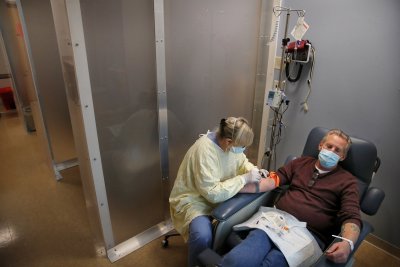
Doctors have some bona fide treatment options for COVID-19 patients, but they’re limited in duration and effectiveness, and they’re expensive and time consuming to administer. Scientists are developing new therapeutics that have great promise—notably an antiviral pill—but they will not be ready in time to help the patients already crowding into hospitals in West Virginia, Alabama, Tennessee and other states with where relatively few people have received vaccinations.
“I think that is important because I’ve had a lot of patients who think there are a lot of drugs and that message may make people be a little risky,” says Dr. Adarsh Bhimraj, a physician at the Cleveland Clinic’s infectious disease department. “Our treatments are not that great.”
The stalwart drug in fighting the worst effects of COVID-19 is dexamethasone, the steroid that Trump took when he was airlifted to Walter Reed National Military Medical Center in October 2020. It is the most important tool doctors have for the severely ill and the only treatment that has been shown to decrease mortality. But dexamethasone is only useful for patients who already have so much trouble breathing that they require supplemental oxygen, at which point the risk of dying of COVID-19 is higher than for those admitted to the hospital with normal blood oxygen levels.
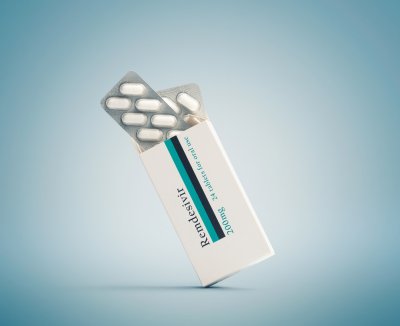

The next most important tool is Remdesivir, the only FDA-approved antiviral for treating COVID-19. It has shown some benefit in slightly reducing the average hospital stay, but it is ineffective if administered too late and can only be given for five or 10 days, depending on the treatment cycle. By then, a person’s viral load has significantly waned, rendering Remdesivir ineffective. After that, doctors are left managing the ramifications of COVID-19, usually with dexamethasone and oxygen.
“After those 10-days, even if the patient is still gravely ill, it is no longer the virus causing that illness, it’s the inability of the patient’s inflammation to turn off,” says Dr. Panagis Galiatsatos, a pulmonary physician and professor at Johns Hopkins. “The match has been put out, but the resulting fires continue.”
Doctors are also turning to monoclonal antibody treatments, which studies have shown to be 70 percent effective at reducing hospitalizations. The antibodies act in the same fashion as those the human body naturally produces after an infection or inoculation, offering protection against the virus. Regeneron’s treatment has become popular in Florida and other states. Although it’s only approved for use in patients who are considered “high risk,” that includes more than 179 million Americans.
Monoclonal antibodies, which were never intended to be used in lieu of a vaccine, have helped reduce the strain on hospitals. But they are time-consuming and expensive to administer. They are given intravenously (or as multiple shots if an intravenous infusion isn’t possible), which requires a health care professional to administer and can take several hours. The treatment is also 52 times more expensive than the FDA-approved Pfizer vaccine and does nothing to reduce the spread of the virus.
Current antiviral and monoclonal antibody treatments have failed to break the logjam of patients overwhelming many ERs and ICUs, where a typical COVID-19 stay can stretch for weeks.
The Holy Grail of COVID-19 antivirals would be a daily pill that could be prescribed on an outpatient basis and administered in the early stages of the disease. Three major companies—Pfizer, Merck and Roche—are conducting clinical trials for oral medications that prevent serious illness by blocking the virus from replicating.
“When we get into crisis mode as hospitals, our ability to care for patients will impact outcomes regardless of what drugs we have,” says Dr. Bhimraj. “That is why I like the idea of a pill you could take early at home so people don’t progress to the point they need hospitalization. That’s a promising area.”
The trouble with an antiviral pill is that they are still in clinical trials and likely won’t be rolled out for many months. The U.S. has agreed to spend $1.2 billion for enough of Merck’s twice-daily pill to treat 1.7 million people, provided it receives clearance from the FDA. But that clearance could take months and come too late to help stem the current wave of cases.
Still, oral antivirals could come in handy in the ongoing battle against COVID-19, which looks like it will rage well into 2022 and perhaps 2023. Researchers are conducting clinical trials to determine if oral antivirals can be used to prevent someone from contracting COVID-19 after being exposed. A prophylactic pill would provide people with immediate protection, which would be important for helping people who can’t get inoculated for medical reasons or don’t develop the necessary antibodies to fight COVID-19 after being vaccinated.
Unlike vaccines, pills are easy to store, transport and administer. They would also be the first treatments that don’t require a health care provider to administer. “Oral antivirals could be a real game changer in terms of how we treat and manage COVID in an outpatient setting,” says Dr. Andrew Bradley, head of the Mayo Clinic’s Coronavirus Task Force. “Hopefully that too would help offset the burden of the need to take care of people in hospital beds.”
Of course, even an antiviral pill is not likely to be as effective in protecting against COVID-19 as the vaccines we already have on hand
================================================
Fake News of New COVID Miracle Drug Causing Major Problems
The Hill
An avalanche of misinformation about the antiparasitic drug ivermectin’s ability to treat COVID-19 has caused a series of national problems, from increased calls to poisoning centers to a shortage of the medicine itself.
Patients have become desperate for a treatment that’s most commonly used for livestock and have taken their disputes over ivermectin with hospitals to court.
Disinformation has flooded the internet, where dozens of Facebook groups centered around ivermectin remain active despite insufficient evidence that the medicine works in treating people for COVID-19.
It’s also gone well beyond the internet to popular podcast hosts like Joe Rogan, who has touted the medicine to his millions of listeners.
The Food and Drug Administration (FDA), other state health departments and even Merck, the drug’s main manufacturer, have all warned against using ivermectin for COVID-19.
Still, online influences supporting the controversial COVID-19 treatment endure.
It’s all raising questions about whether the government needs to do more to step in.
“The promise that there are miracle solutions to an illness is really persuasive,” Jennifer Reich, a professor of sociology at the University of Colorado Denver. “And the idea that individuals can manage their own health, if they read a lot, gather information and make their own decisions is really powerful.”
Media Matters for America found 60 public and private Facebook groups dedicated to ivermectin last month, before the social media giant removed 25 of them after the liberal watchdog’s report. But the other groups still involve more than 70,000 combined users.
Media Matters released a report on Tuesday concluding that Facebook users are getting around the platform’s moderation strategies by posting links and screenshots of misinformation in the comments of posts and by purposely misspelling keywords such as ivermectin and vaccines.
“Unfortunately, due to Facebook’s lax moderation of the content on its platform, these evasion techniques are working, and misinformation is thriving on the social media site,” the report reads.
Kayla Gogarty, the associate research director for Media Matters, criticized Facebook for not adequately responding to such misinformation in groups.
“The fact that Facebook has not taken much action against these groups is definitely problematic,” she said.
A Facebook spokesperson told The Hill that the company has removed 20 million pieces of content from Facebook and Instagram for violating COVID-19 misinformation policies.
“As we enforce our policies against COVID misinformation, we know people will keep trying new tactics to get around our policies and we are constantly evolving to stay ahead of them,” the spokesperson said.
“We will continue to enforce against any account or group that violates our COVID-19 and vaccine policies,” the statement continued.
A spokesperson also told The New York Times that the platform removes “content that attempts to buy, sell or donate for ivermectin” and any claims that the drug is “a guaranteed cure or guaranteed prevention.”
Ivermectin is not the first drug to gain traction online as a possible COVID-19 treatment despite lacking evidence. Several experts compared the dewormer’s popularity to that of antimalarial hydroxychloroquine that former President Trump promoted last year.
Yunkang Yang, a postdoctoral research scientist at the Institute for Data, Democracy and Politics at George Washington University, said that influential figures, including Republican politicians, have contributed to the discourse of ivermectin as a “miracle cure.”
For instance, Rogan declared to his millions of listeners that he was taking ivermectin following his COVID-19 diagnosis.
“It would be hard to imagine this information gaining any traction without [their] participation,” he said.
Misinformation surrounding ivermectin specifically is also not new, as the drug was proposed as a possible treatment earlier in the pandemic, including in some studies retracted due to flawed or fabricated data.
But ivermectin-related calls to poison control centers this year have more than tripled compared to the same period last year, with 1,440 calls through Sept. 20, according to the American Association of Poison Control Centers.
July, in particular, saw a five-fold increase in ivermectin calls compared to the “pre-pandemic baseline,” according to the Centers for Disease Control and Prevention. Some cases have been fatal, with New Mexico reporting this week two deaths from misusing ivermectin as a COVID-19 medication.
The spikes in ivermectin misuse sparked the FDA to issue an advisory against using the drug for the virus earlier this month.
“You are not a horse. You are not a cow. Seriously, y’all. Stop it,” the agency said on Twitter.
While the FDA has approved ivermectin to treat parasitic worms, lice and skin conditions like rosacea among humans, the drug is more often used to treat animals, including cattle and horses.
In addition to taking unprescribed ivermectin, several cases have emerged where people have been using these animal products.
“The issue happens when you have inappropriate use where you have a non-human product, for example, that is meant for cattle that has a different formulation composition,” said Ziad Kazzi, a professor of medical toxicology at Emory University.
“The strength of the formulation is different than what you would use in a human,” said Kazzi, who is also the secretary treasurer of the American College of Medical Toxicology.
The post The Facts About Current Treatments for Coronavirus appeared first on The St Kitts Nevis Observer.