The global death toll from COVID-19 topped 5 million on Monday, less than two years into a crisis that has not only devastated poor countries but also humbled wealthy ones with first-rate health care systems.
Together, the United States, the European Union, Britain and Brazil — all upper-middle- or high-income countries — account for one-eighth of the world’s population but nearly half of all reported deaths. The U.S. alone has recorded over 740,000 lives lost, more than any other nation.
“This is a defining moment in our lifetime,” said Dr. Albert Ko, an infectious disease specialist at the Yale School of Public Health. “What do we have to do to protect ourselves so we don’t get to another 5 million?”
The death toll, as tallied by Johns Hopkins University, is about equal to the populations of Los Angeles and San Francisco combined. It rivals the number of people killed in battles among nations since 1950, according to estimates from the Peace Research Institute Oslo. Globally, COVID-19 is now the third leading cause of death, after heart disease and stroke.
The staggering figure is almost certainly an undercount because of limited testing and people dying at home without medical attention, especially in poor parts of the world, such as India.
Hot spots have shifted over the 22 months since the outbreak began, turning different places on the world map red. Now, the virus is pummeling Russia, Ukraine and other parts of Eastern Europe, especially where rumors, misinformation and distrust in government have hobbled vaccination efforts. In Ukraine, only 17% of the adult population is fully vaccinated; in Armenia, only 7%.
“What’s uniquely different about this pandemic is it hit hardest the high-resource countries,” said Dr. Wafaa El-Sadr, director of ICAP, a global health center at Columbia University. “That’s the irony of COVID-19.”
Wealthier nations with longer life expectancies have larger proportions of older people, cancer survivors and nursing home residents, all of whom are especially vulnerable to COVID-19, El-Sadr noted. Poorer countries tend to have larger shares of children, teens and young adults, who are less likely to fall seriously ill from the coronavirus.
India, despite its terrifying delta surge that peaked in early May, now has a much lower reported daily death rate than wealthier Russia, the U.S. or Britain, though there is uncertainty around its figures.
The seeming disconnect between wealth and health is a paradox that disease experts will be pondering for years. But the pattern that is seen on the grand scale, when nations are compared, is different when examined at closer range. Within each wealthy country, when deaths and infections are mapped, poorer neighborhoods are hit hardest.
In the U.S., for example, COVID-19 has taken an outsize toll on Black and Hispanic people, who are more likely than white people to live in poverty and have less access to health care.
“When we get out our microscopes, we see that within countries, the most vulnerable have suffered most,” Ko said.
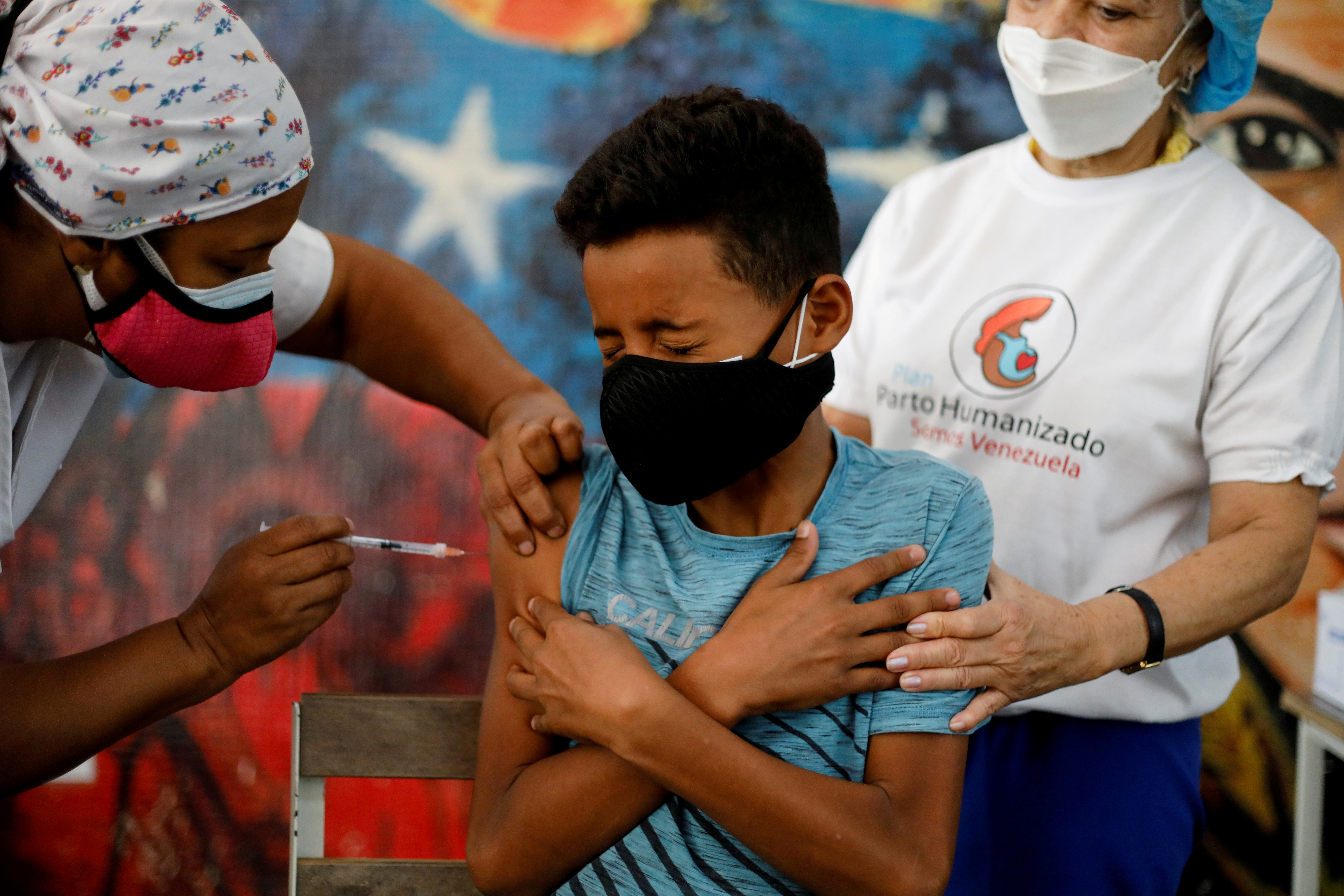
Wealth has also played a role in the global vaccination drive, with rich countries accused of locking up supplies. The U.S. and others are already dispensing booster shots at a time when millions across Africa haven’t received a single dose, though the rich countries are also shipping hundreds of millions of shots to the rest of the world.
Africa remains the world’s least vaccinated region, with just 5% of the population of 1.3 billion people fully covered.
“This devastating milestone reminds us that we are failing much of the world,” U.N. Secretary-General António Guterres said in a written statement. “This is a global shame.”
In Kampala, Uganda, Cissy Kagaba lost her 62-year-old mother on Christmas Day and her 76-year-old father days later.
“Christmas will never be the same for me,” said Kagaba, an anti-corruption activist in the East African country that has been through multiple lockdowns against the virus and where a curfew remains in place.
The pandemic has united the globe in grief and pushed survivors to the breaking point.
“Who else is there now? The responsibility is on me. COVID has changed my life,” said 32-year-old Reena Kesarwani, a mother of two boys, who was left to manage her late husband’s modest hardware store in a village in India.
Her husband, Anand Babu Kesarwani, died at 38 during India’s crushing coronavirus surge earlier this year. It overwhelmed one of the most chronically underfunded public health systems in the world and killed tens of thousands as hospitals ran out of oxygen and medicine.
In Bergamo, Italy, once the site of the West’s first deadly wave, 51-year-old Fabrizio Fidanza was deprived of a final farewell as his 86-year-old father lay dying in the hospital. He is still trying to come to terms with the loss more than a year later.
“For the last month, I never saw him,” Fidanza said during a visit to his father’s grave. “It was the worst moment. But coming here every week, helps me.”
Today, 92% of Bergamo’s eligible population have had at least one shot, the highest vaccination rate in Italy. The chief of medicine at Pope John XXIII Hospital, Dr. Stefano Fagiuoli, said he believes that’s a clear result of the city’s collective trauma, when the wail of ambulances was constant.
In Lake City, Florida, LaTasha Graham, 38, still gets mail almost daily for her 17-year-old daughter, Jo’Keria, who died of COVID-19 in August, days before starting her senior year of high school. The teen, who was buried in her cap and gown, wanted to be a trauma surgeon.
“I know that she would have made it. I know that she would have been where she wanted to go,” her mother said.
In Rio de Janeiro, Erika Machado scanned the list of names engraved on a long, undulating sculpture of oxidized steel that stands in Penitencia cemetery as an homage to some of Brazil’s COVID-19 victims. Then she found him: Wagner Machado, her father.
“My dad was the love of my life, my best friend,” said Machado, 40, a saleswoman who traveled from Sao Paulo to see her father’s name. “He was everything to me.”
___
AP journalists Rajesh Kumar Singh in Chhitpalgarh, India; Cara Anna in Nairobi, Kenya; Rodney Muhumuza in Kampala, Uganda; Kelli Kennedy in Fort Lauderdale, Florida; Colleen Barry in Bergamo, Italy; and Diane Jeantet in Rio de Janeiro contributed.
======================================================
What you need to know about the coronavirus right now
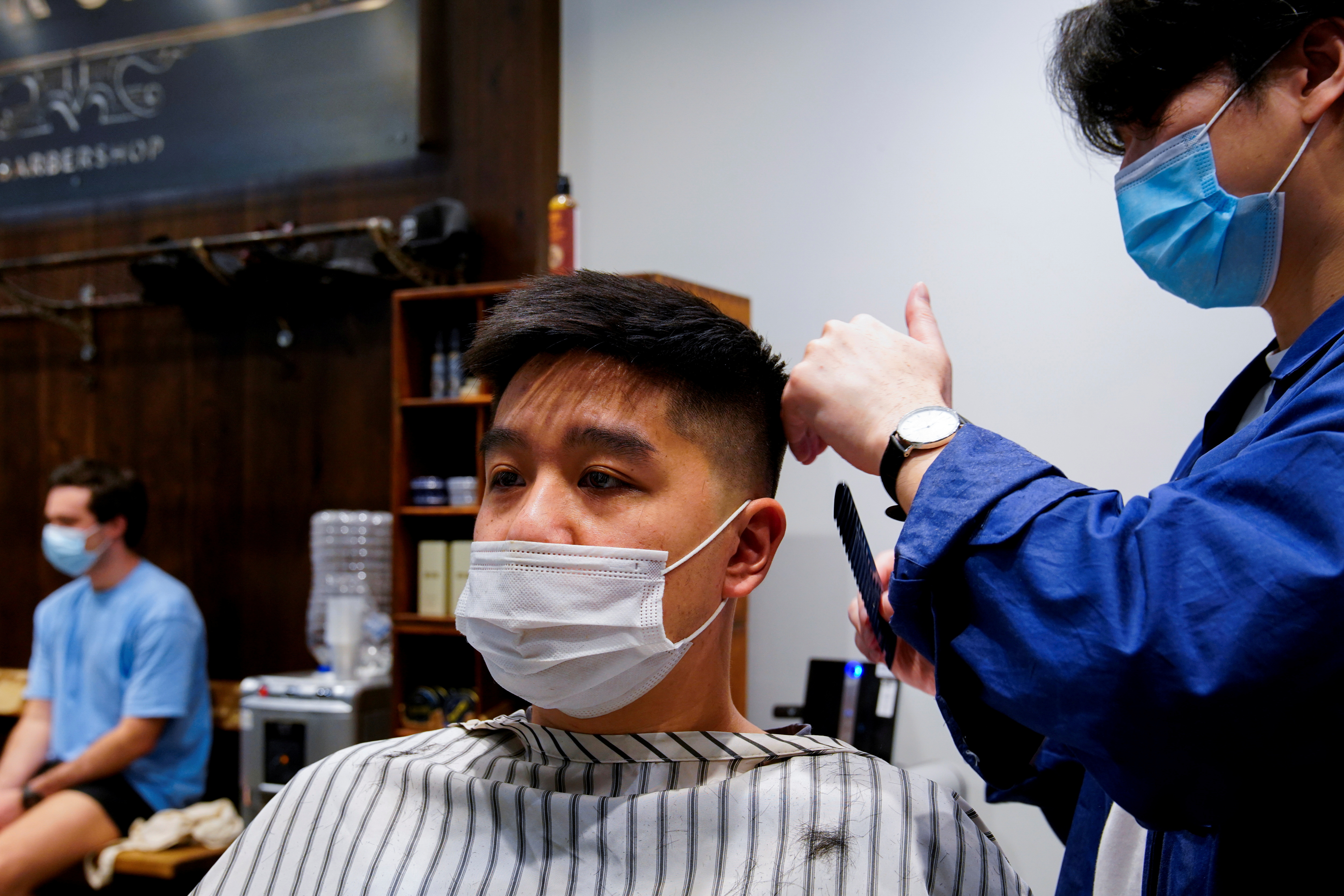
Patrick Vo gets his hair cut on the first day of eased coronavirus disease (COVID-19) regulations, following a lockdown to curb an outbreak, in Melbourne, Australia, October 22, 2021. REUTERS/Sandra Sanders
Nov 1 (Reuters) –
Borders open in Australia, Thailand
Australia eased its international border restrictions on Monday for the first time during the coronavirus pandemic, allowing some of its vaccinated public to travel freely and many families to reunite, sparking emotional embraces at Sydney’s airport. While travel is initially limited to Australian citizens, permanent residents and their immediate families, it sets in motion a plan to reopen the country to international tourists and workers, both much needed to reinvigorate a fatigued nation. read more
Hundreds of vaccinated foreign tourists are scheduled to arrive in Bangkok on Monday, the first wave of visitors to Thailand in 18 months who will not have to undergo quarantine for the coronavirus. Seeking to resurrect its pandemic-ravaged tourism economy, Thailand’s government has given the green light to vaccinated tourists from more than 60 countries, including the United States and China. read more
FDA needs more time to complete review of Moderna teen shot
Moderna Inc said on Sunday it has been told that the U.S. Food and Drug Administration will require additional time to complete its assessment of the company’s COVID-19 vaccine for use in adolescents aged 12 to 17 years.
The FDA informed Moderna that the review may not be completed before January 2022, the company said in a statement, dealing a potential setback to the timing of an emergency use authorization (EUA) for that age group. read more
China outbreak developing rapidly, health official says
China’s latest COVID-19 outbreak is developing rapidly, a health official said, as the authorities demanded high vigilance at ports of entry amid growing infections in northeastern Heihe border city caused by the virus arriving from abroad.
Some 377 domestically transmitted cases with confirmed symptoms were reported from Oct. 17-29, National Health Commission (NHC) data showed. China has tackled a series of outbreaks this year since it largely contained a national spread in early 2020. read more
China says U.S. COVID origins report is without credibility
A declassified U.S. intelligence report saying it was plausible that the COVID-19 pandemic originated in a laboratory is unscientific and has no credibility, Chinese foreign ministry spokesman Wang Wenbin said in a statement on Sunday.
The updated U.S. intelligence briefing, published on Saturday, said that a natural origin and a lab leak were both plausible hypotheses to explain how SARS-CoV-2, the virus responsible for COVID-19, first infected humans, but that the truth may never be known. read more
A joint study by China and the World Health Organization published this year all but ruled out the theory that COVID-19 originated in a laboratory, saying that the most likely hypothesis was that it infected humans naturally, probably via the wildlife trade. read more
Cheap antidepressant shows promise against COVID-19
Fluvoxamine, an inexpensive antidepressant, might help keep patients with COVID-19 from developing severe disease, according to a new study published in The Lancet Global Health on Wednesday.
The researchers suspect the drug is helping by limiting the ability of the virus to cause inflammation. However, more research is needed to determine the impact of fluvoxamine because “composite outcomes” – where a variety of results are lumped together for analysis – are unreliable, according to an editorial by Otavio Berwanger of Hospital Israelita Albert Einstein in Sao Paulo. read more
WORLD STATS
Latest News
November 1 (GMT)
- 17 new cases and 1 new death in New Caledonia [source]
- 14 new cases in Saint Lucia [source]
- 98 new cases in Papua New Guinea [source]
- 9 new deaths in El Salvador [source]
- 1 new case in China, Hong Kong SAR [source]
- 34 new cases and 1 new death in Afghanistan [source]
- 116 new cases and 1 new death in Brunei Darussalam [source]
- 3,117 new cases and 104 new deaths in the Philippines [source]
- 5 new cases in Ta
The post COVID-19′s Gobal Death Toll Tops 5 Million in Under 2 Years, Corona Summary, World Stats appeared first on The St Kitts Nevis Observer.