Faced with rising coronavirus infections, some states are pushing ahead of the federal government and making booster shots available to anyone who wants one, turbocharging the rollout in hopes of blunting a potential winter spike.
This week, Colorado Gov. Jared Polis (D) signed an executive order declaring everyone over the age of 18 eligible for a booster dose. Hospitals in the state are once again full of COVID-19 patients, and officials are scrambling to slow the spread of the virus before winter.
According to the Centers for Disease Control and Prevention (CDC), only about 45 percent of fully vaccinated adults 65 and older in Colorado have received a booster shot.
In California, where cases are also rising, health officials are encouraging boosters for everyone who has been vaccinated for at least six months. Only about 34 percent of people over age 65 have received a booster in the state.
“If you think you will benefit from getting a booster shot, I encourage you to go out and get it,” California Health Secretary Mark Ghaly said during a press conference.
New Mexico also opened boosters to all adults on Friday amid a surge in cases that has overwhelmed hospitals in the state.
“I strongly encourage every New Mexican to register for a booster today — we have appointments available and are ready to get shots in arms,” New Mexico Gov. Michelle Lujan Grisham (D) said in a statement.
The current federal guidance for boosters is fairly broad — the people who should get a booster are those over age 65 and anyone at high risk because of work, where they live or those with an underlying medical condition.
Vaccine providers are not supposed to ask questions or turn anyone away, relying on self-attestation for eligibility. Still, the Food and Drug Administration and the CDC stopped short of recommending boosters for everyone, which puts Colorado and California at odds with federal guidance.
Monica Gandhi, an infectious disease expert and professor of medicine at the University of California, San Francisco, said federal health officials haven’t been clear.
Chaotic and at times disparate messaging from administration health officials over the past two months culminated in a complicated set of recommendations about who should be getting booster shots and why.
“We have the CDC director saying one thing, [Anthony Fauci] saying another thing, the president saying another thing, and that is causing massive confusion, and that’s why public health officers are taking it upon themselves,” Gandhi said.
“In my mind, the data is very clear. Get it if you’re over 65, get it if you’re immunocompromised, and then otherwise I think we don’t have good evidence for it,” she added.
The Biden administration has promised and encouraged booster doses for months, and federal officials are currently evaluating a request by Pfizer to authorize a booster dose for all adults over the age of 18.
When asked during a press briefing if other states should follow California and Colorado, CDC Director Rochelle Walensky demurred, stating they are encouraging everyone eligible for a booster to get one, but the agency’s goal is to make sure everyone gets their primary doses.
White House Press Secretary Jen Psaki on Friday said local officials should continue to follow federal guidelines.
“This isn’t currently the guidance that’s being projected by our health and medical experts, and we would continue to advise leaders across the country to abide by public health guidelines coming from the federal government,” she said.
Celine Gounder, an epidemiologist and infectious diseases specialist at New York University and Bellevue Hospital, said states ought to be following the federal recommendations, but it’s a problem when the administration hasn’t articulated why boosters are necessary.
“This is really only going to have an impact at that population level. It doesn’t make sense to have this individual free for all, which is the situation … the California and Colorado governors are reinforcing,” Gounder said.
Gounder, who advised the Biden transition team on COVID-19, said she thinks health officials are searching for anything to try to improve protection since there are still so many people who aren’t vaccinated.
“I think where this is coming from is this feeling that they’re really frustrated,” Gounder said. “They’ve done everything possible to try to encourage unvaccinated people to get vaccinated, starting with incentives and then incrementally moving towards mandates. … It’s sort of an act of desperation where it’s like, well, what else are we supposed to do?”
Experts and federal officials agree that boosters are not going to end the pandemic.
But when only about 70 percent of people over the age of 18 are fully vaccinated, boosters may be the only thing they can do.
In Colorado, officials argued that because transmission is so widespread, everyone is at risk of infection, and so everyone is eligible for a booster shot.
“Because disease spread is so significant across Colorado, all Coloradans who are 18 years of age and older are at high risk and qualify for a booster shot,” Polis said in his order.
During a press briefing on Friday, Polis also noted that if vaccinated people can get a booster, it will decrease the risk of a breakthrough infection spreading to someone older and vulnerable.
But Gounder said boosters won’t help Colorado’s overwhelmed hospitals, and any additional protection may just be temporary. A concentrated effort to get boosters in nursing homes, she argued, would help a lot more.
“Your risk as a vaccinated person is still proportional to the level of transmission in the community,” Gounder said. “And so the best protection is actually from getting the unvaccinated vaccinated, not by getting additional doses.”
================================================
Brazil’s top court rules that companies can require employee vaccination
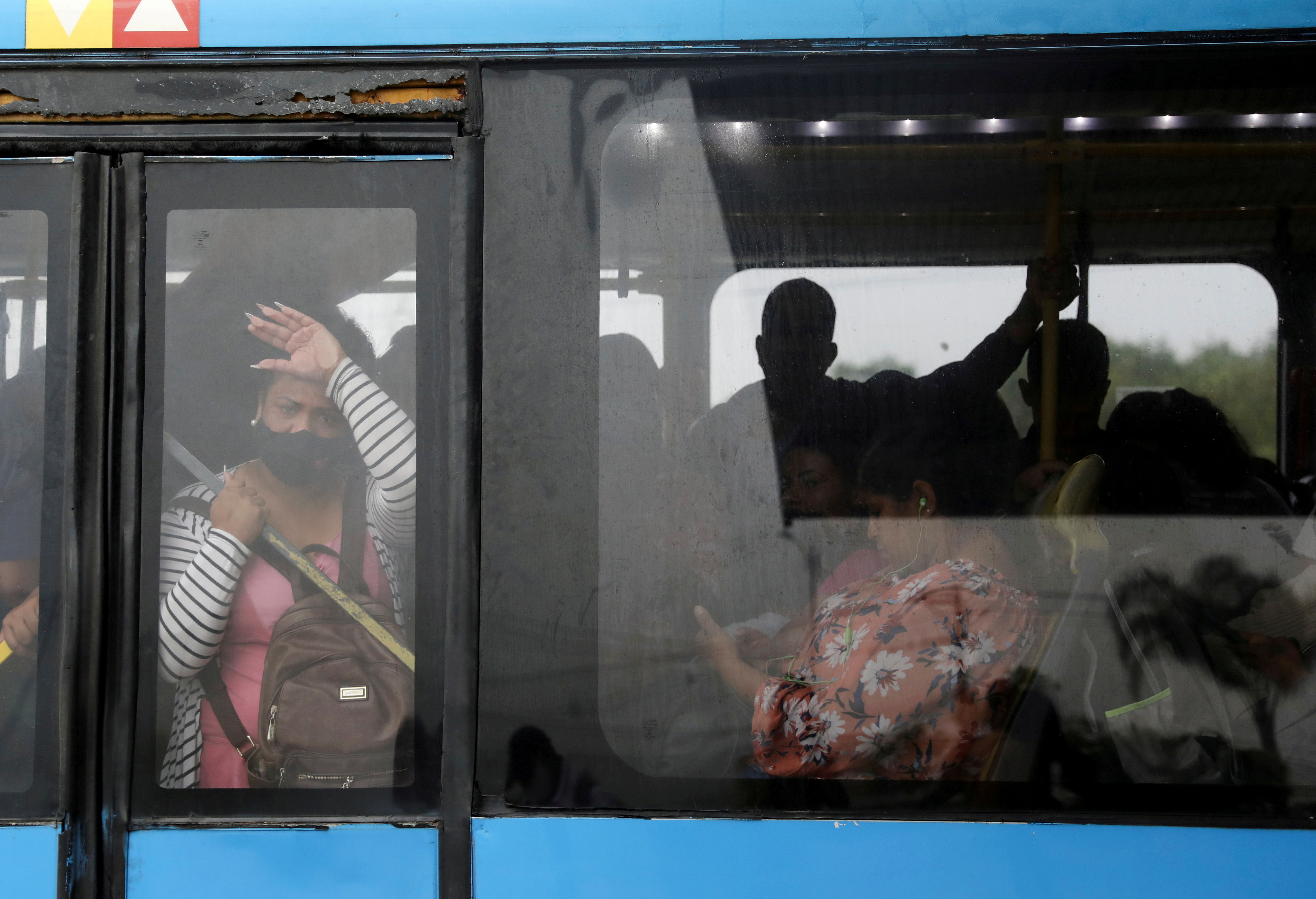
People travel on a bus during the vaccination campaign against the coronavirus disease (COVID-19) inside a Bus Rapid Transit (BRT) station in Rio de Janeiro, Brazil October 27, 2021. REUTERS/Pilar Olivares
BRASILIA, Nov 12 (Reuters) – Brazil’s Supreme Court on Friday suspended a government order that prevented companies from requiring employees to provide proof that they have been vaccinate against COVID-19 and stopped dismissals of those not immunized.
Brazil’s far-right President Jair Bolsonaro, a vaccine skeptic, has criticized vaccine passports required in other countries. Brazil has suffered the second-deadliest coronavirus pandemic outside of the United States.
Justice Luis Roberto Barroso said the pandemic had killed 610,000 Brazilians and it was reasonable to surmise that the presence of unvaccinated employees poses a threat to the health of the others.
“The lack of vaccination interferes with the rights of others,” he wrote in his judgment, issuing an injunction sought by four opposition parties.
The government order was issued earlier his month by Labor Minister Onyx Lorenzoni, who said that allowing companies to fire employees who refuse to get vaccinated was absurd and a violation of their rights.
What you need to know about the coronavirus right now

A specialist wearing personal protective equipment (PPE) sprays disinfectant while sanitizing a chapel inside the building of the Leningradsky railway station amid the outbreak of the coronavirus disease (COVID-19) in Moscow, Russia October 19, 2021. REUTERS/Maxim Shemetov/File Photo
Nov 15 (Reuters) – Here’s what you need to know about the coronavirus right now:
China faces biggest Delta outbreak
China is battling its biggest COVID-19 outbreak caused by the highly transmissible Delta variant, with some areas restricting entry by people from the northeastern city of Dalian where infections have grown faster than elsewhere in the country in the past week.
This marks China’s most widespread Delta outbreak, which has affected 21 provinces, regions and municipalities. It is smaller than many outbreaks in other countries but authorities in China are anxious to block the transmission under the government’s zero-tolerance guidance. read more
Britain expected to extend booster programme to under 50s
The British government is expected to extend its COVID-19 booster programme to people under the age of 50 to drive down transmission rates as winter approaches, the Times reported.
The Joint Committee on Vaccination and Immunisation (JCVI) is expected to give its approval on Monday to extending the rollout, the newspaper reported, adding the details of the age groups had not been confirmed. read more
Cambodia ends quarantine for vaccinated travellers
Cambodia will stop requiring quarantine for travellers who have been vaccinated for COVID-19 starting on Monday, Prime Minister Hun Sen said.
Hun Sen said travellers will have to show a negative test taken 72 hours prior to travel and have two vaccine doses. Cambodia has vaccinated nearly 90% of its more than 16 million people, one of Asia’s highest inoculation rates. read more
Florida lawmakers meet over vaccine mandates
Florida lawmakers will meet in a special legislative session on Monday, called by Republican Gov. Ron DeSantis with the goal of thwarting coronavirus vaccine mandates.
In a week-long session, the lawmakers, largely dominated by the Republican party, are slated to consider four bills that would impose new penalties on businesses and local governments that require workers to get vaccinated against COVID-19, according to the agenda released by the governor’s office. read more
Long COVID rare in college athletes
College athletes who become infected with the coronavirus are very unlikely to have any lasting effects, a large U.S. study suggests. Researchers tracked more than 3,500 athletes from 44 colleges and universities and from more than 20 different sports who tested positive for the virus. Only 1.2% reported symptoms lasting more than three weeks, with 0.06% reporting symptoms lasting more than three months, the researchers wrote in the British Journal of Sports Medicine.
“For the vast majority of athletes, this study shows that a return to play is possible without lingering COVID symptoms,” study leader Dr Jonathan Drezner of the University of Washington in Seattle said in a statement. “But any new chest pain or cardiopulmonary symptom should be taken seriously. Even if initial cardiac testing is negative after a COVID-19 illness, chest pain while exerting yourself should be evaluated.” read more
WORLD STATS
Latest News
November 15 (GMT)
Updates
- 31 new cases in Papua New Guinea [source]
- 2 new cases and 1 new death in Saint Lucia [source]
- 47 new cases in New Caledonia [source]
- 24 new cases in Liechtenstein [source]
- 58 new cases and 1 new death in Afghanistan [source]
- 1,547 new cases and 128 new deaths in the Philippines [source]
- 947 new cases and 25 new dea
The post States Rush Ahead On Boosters, Summary, World Stats appeared first on The St Kitts Nevis Observer.