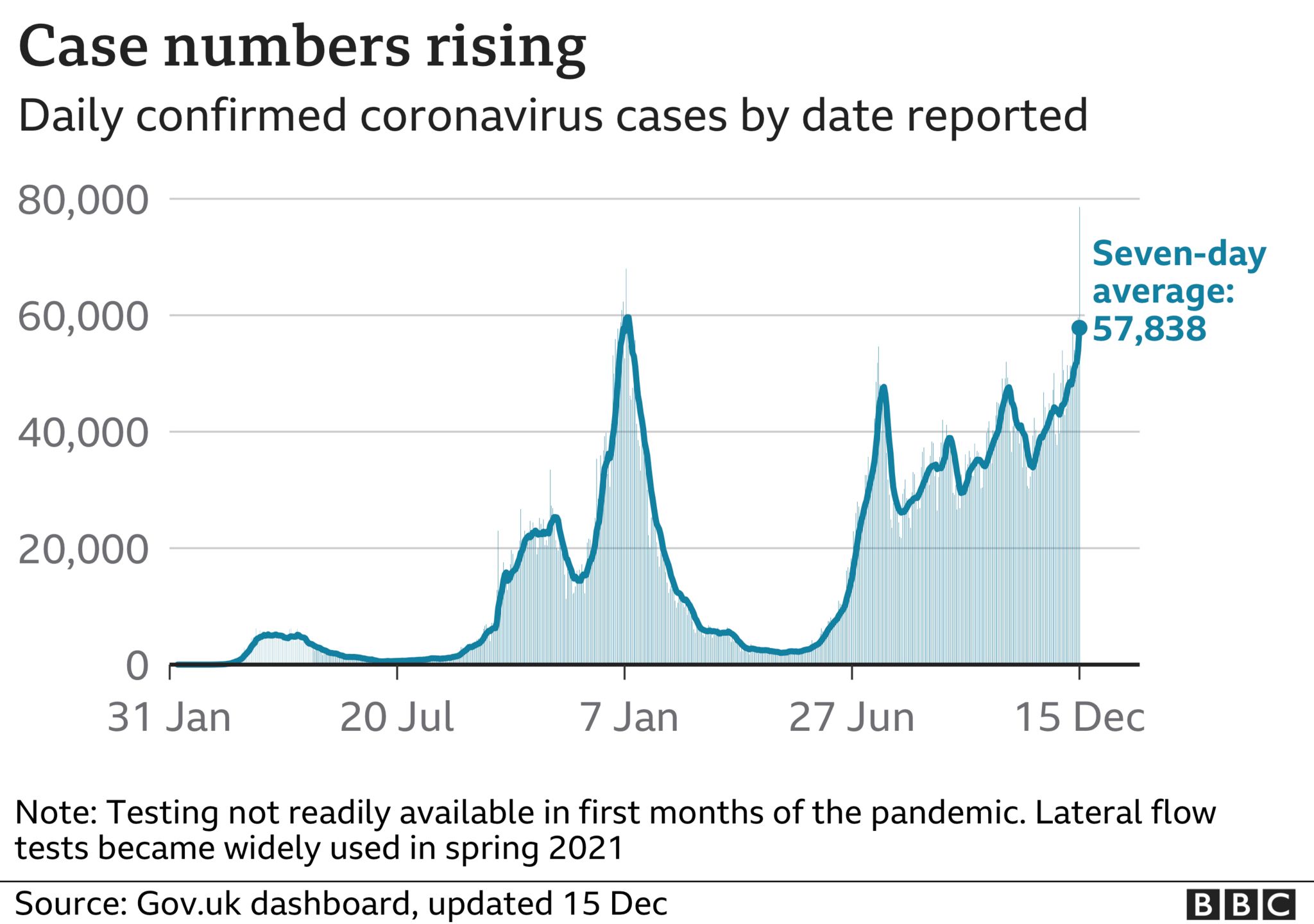
The UK has reported its highest number of daily infections, 79,000, since the pandemic began, and England’s chief medical officer has warned that more Covid records will be broken.
Speaking at a Downing Street news briefing, Prof Chris Whitty said the Omicron variant was moving at a phenomenal pace and that case numbers would continue to hit new highs over the coming weeks.
In that case, infections will reach a level that will exceed testing capacity. So why is it happening and what does it mean for the NHS? Here are three takeaways from a record day.
1. We’re seeing two epidemics at once
Omicron is spreading rapidly, but Delta is not disappearing. It means we have two variants circulating together. It is still early days, but it does appear to be different from what we have seen before when Alpha wiped out the original variant circulating in the UK and was then itself displaced by Delta.
This is likely to be because Omicron is able to get past some of the body’s defences built up by vaccination and previous infection. The two variants are not competing for the same people.
It means at the moment we have a fairly stable number of cases of Delta – as we have had pretty much since the summer.
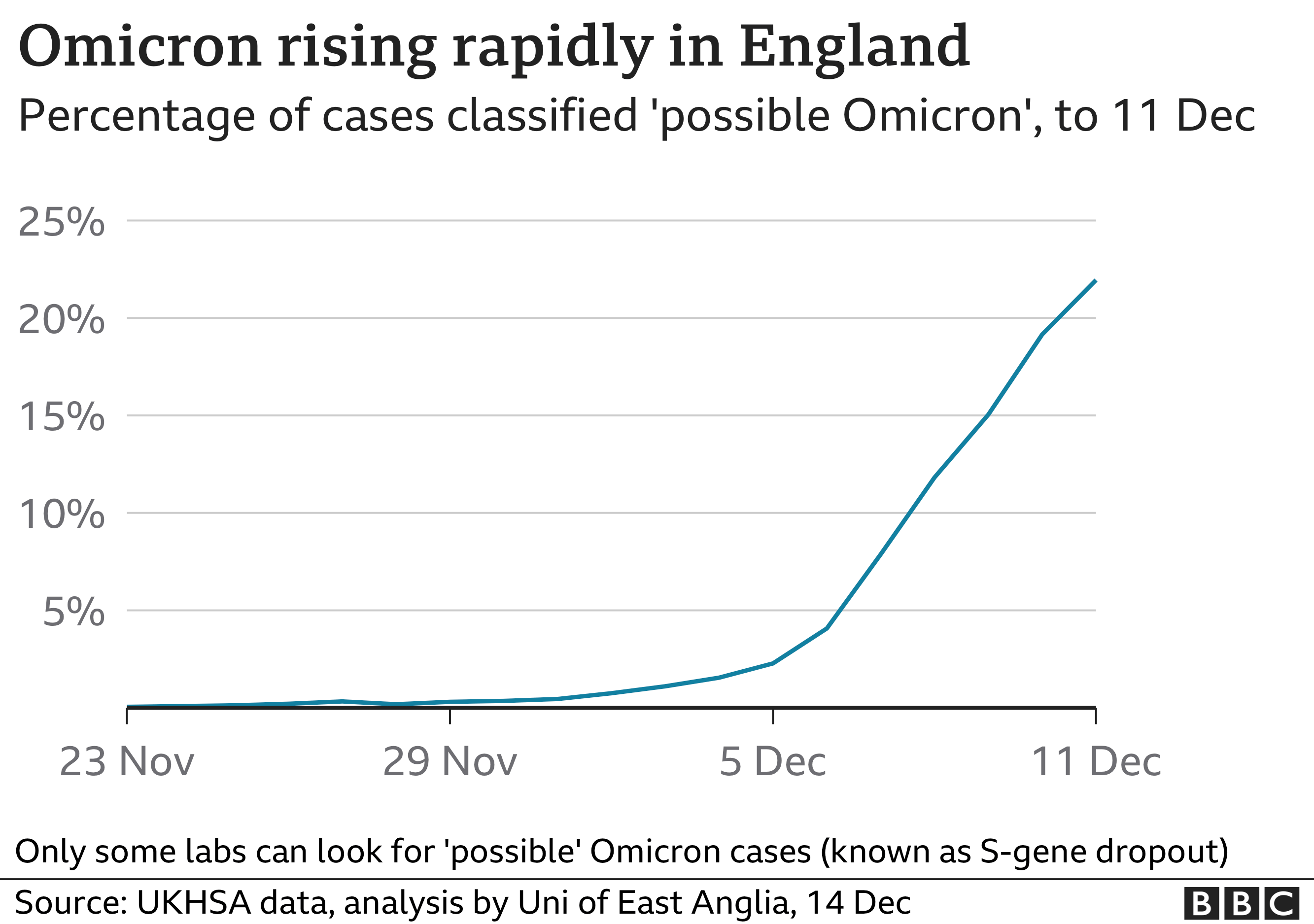
But Omicron cases are rising rapidly and driving the overall number of cases up. Latest data suggests about a quarter of cases are Omicron – that would mean around 20,000 of Wednesday’s reported 79,000 cases have been caused by the new variant.
It is quite possible these two variants will circulate together for a while, although the expectation is that Omicron will eventually displace Delta given how much immunity vaccination and our high levels of infection give against that variant.
2. Infections are rising at break-neck speed
Health officials have been saying for days that we should expect cases to surge.
And these are just the ones that come forward for testing – the true level of infections will be much higher.
Omicron cases are rising rapidly, probably now doubling every two days, so it was only a matter of time before a new high was set – although the lack of testing at the start of the pandemic means comparisons with that wave are difficult.
Expect new records to be set day after day as these numbers are only going to go up from here.
If the two-day doubling continues, by Christmas Day 640,000 Omicron infections would be being recorded and early in the new year the whole population will have been infected.
That said, the cases would never be spotted as testing capacity is limited to fewer than one million a day.
Clearly, however, that rate of growth will slow. There are already signs this has started happening in South Africa.
But not before we get to – in the words of UK Health Security chief Dr Jenny Harries – staggeringly high rates of infection.
3. The threat to the NHS is uncertain
What is not clear is what it means for serious illness.
There are suggestions Omicron is causing milder illness.
There is logic to that – reinfections or infections post vaccination are likely to be milder.
But if infections continue to rise as quickly as they are, that will push up hospital admissions.
Even if the severity of the virus is halved, as soon as the total number of infections double, hospitalisations will go up.
Left unchecked, with no extra restrictions than we have now, the peak will come quickly. How big it will be is uncertain.
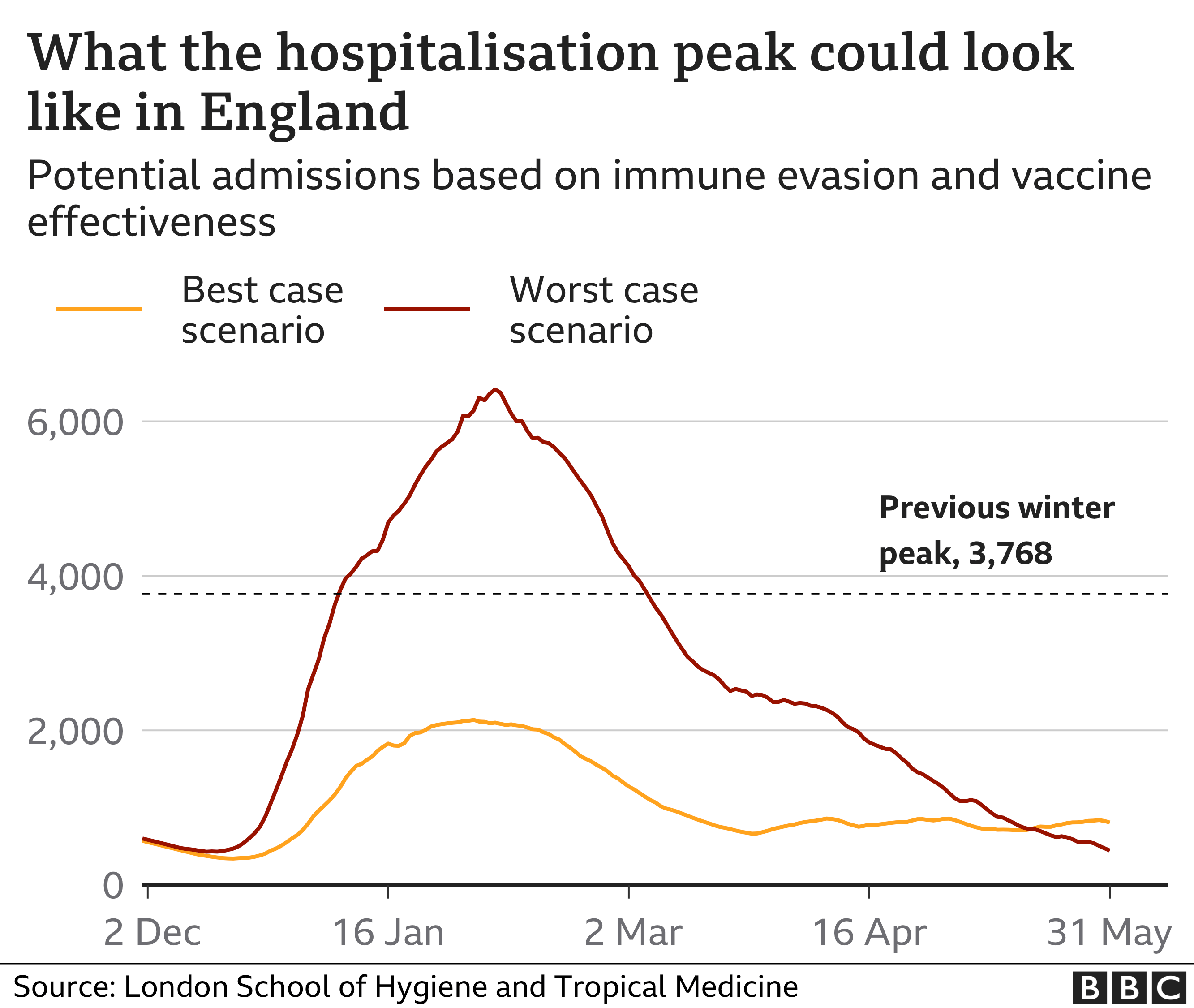
Modelling from the London School of Hygiene and Tropical Medicine has suggested that in a best-case scenario hospital admissions in England could peak at just over 2,000. But in a worst-case scenario they could exceed 6,000.
To put that into context, last winter it topped out at 3,700 a day after lockdown was introduced.
Privately ministers accept that if the numbers go past 2,000 a day, with no sign of them levelling off, the NHS would be at real risk.
================================================
Omicron not derailing US vaccine strategy

© Getty
No big change-up in the composition of the vaccines is imminent to fight omicron, President Biden’s chief medical adviser Anthony Fauci said Wednesday.
Fauci said at this point there is no need for a modified vaccine specifically to fight the omicron variant, instead urging people to get a booster shot of the existing vaccine.
“Our booster vaccine regimens work against omicron,” Fauci, the government’s top infectious disease expert, said at a press briefing. “At this point there is no need for a variant-specific booster.”
Vaccine makers like Pfizer said that they had started work on a modified vaccine for omicron soon after it was discovered in case it was needed, and that it could be available in less than 100 days. But as more data has emerged, there have been some reassuring signs about the effectiveness of three doses of the existing vaccines against omicron, though protection from two doses significantly falls off.
Not having to implement a new vaccine could eliminate many logistical and supply hurdles to the vaccination effort.
Data so far on current vaccines: Fauci said the omicron variant “undoubtedly compromises the effects” of two doses of the Moderna or Pfizer vaccines in preventing infection with the omicron variant. Effectiveness of the Pfizer vaccine with two doses fell to just 33 percent in a South African study, though there was better protection against severe disease, at 70 percent.
Early studies have shown much stronger protection after three doses, though. Early data from the U.K. showed effectiveness against infection with three doses rose back to 75 percent, from about 30 percent after two doses.
============================================
MOST BREAKTHROUGH HOSPITALIZATIONS INVOLVE SENIORS
A large majority of fully vaccinated patients hospitalized and diagnosed COVID-19 between June and September were seniors, according to a Kaiser Family Foundation (KFF) analysis released Wednesday.
Almost 70 percent of fully vaccinated patients admitted to hospitals with confirmed COVID-19 were aged 65 and older, making up a “disproportionately large share” of breakthrough hospitalizations.
Ten percent of breakthrough hospitalizations occurred among those younger than 50, and one-fifth occurred among those aged 50 to 64.
But unvaccinated COVID-19 hospital patients skewed younger, with 41 percent of cases involving patients younger than 50 and 30 percent involving those aged 50 to 64.
Seniors who experienced breakthrough cases also appeared to have shorter hospital stays on average. The median stay for fully vaccinated patients was 5.6 days, compared to 6.7 days for those who were unvaccinated.
A larger portion of fully vaccinated hospital patients had a comorbidity than unvaccinated COVID-19 patients. But less breakthrough patients had COVID-related respiratory complications or treatments, indicating they may have been admitted for “unrelated reasons.”
“If this is the case, it would mean that the gap in risk of COVID-19 hospitalization between vaccinated and unvaccinated people is even greater than previously known,” KFF noted.
The post UK: Record Daily Cases–2 Variants Together, Most Vaxed People with Covid are Seniors, More appeared first on The St Kitts Nevis Observer.