WHO sees more evidence that Omicron causes milder symptoms
GENEVA, Jan 4 (Reuters) – More evidence is emerging that the Omicron coronavirus variant is affecting the upper respiratory tract, causing milder symptoms than previous variants and resulting in a “decoupling” in some places between soaring case numbers and low death rates, a World Health Organization official said on Tuesday.
“We are seeing more and more studies pointing out that Omicron is infecting the upper part of the body. Unlike other ones, the lungs who would be causing severe pneumonia,” WHO Incident Manager Abdi Mahamud told Geneva-based journalists.
“It can be a good news, but we really require more studies to prove that.”
Since the heavily mutated variant was first detected in November, WHO data shows it has spread quickly and emerged in at least 128 countries, presenting dilemmas for many nations and people seeking to reboot their economies and lives after nearly two years of COVID-related disruptions.
However, while case numbers have surged to all-time records, the hospitalisation and death rates are often lower than at other phases in the pandemic.
“What we are seeing now is….the decoupling between the cases and the deaths,” he said.
His remarks on the reduced risks of severe disease chime with other data, including a study from South Africa, which was one of the first countries where Omicron was detected.
However, Mahamud also sounded a note of caution, calling South Africa an “outlier” since it has a young population, among other factors.
And he warned that Omicron’s high transmissibility meant it would become dominant within weeks in many places, posing a threat to medical systems in countries where a high proportion of the population remains unvaccinated.
VACCINATION, NOT VACCINES, ARE THE CHALLENGE

A man takes a coronavirus disease (COVID-19) test at a pop-up testing site as the Omicron coronavirus variant continues to spread in Manhattan, New York City, U.S., December 27, 2021. REUTERS/Jeenah Moon
While Omicron seemed to be slipping past antibodies, evidence was emerging that COVID-19 vaccines still provided some protection, by eliciting a second pillar of the immune response from T-cells, Mahamud said.
“Our prediction is protection against severe hospitalization and death (from Omicron) will be maintained,” he said, saying this also applied to vaccines developed by Sinopharm and Sinovac that are used in China, where Omicron cases remain very low.
“The challenge has not been the vaccine but the vaccination and reaching those vulnerable populations.”
Asked about whether an Omicron-specific vaccine was needed, Mahamud said it was too early to say but voiced doubts and stressed that the decision required global coordination and should not be left to manufacturers to decide alone.
“You may go ahead with Omicron and put all your eggs in that basket and a new variant that is more transmissible or more immune-evasive may appear,” he said, adding that a WHO technical group had held recent meetings on vaccine composition.
The best way to reduce the impact of the variant would be to meet the WHO’s goal of vaccinating 70% of the population in each country by July, rather than offer third and fourth doses in some countries, he said.
As case numbers due to Omicron have soared, some countries, including the United States, have cut down isolation or quarantine periods in a bid to allow asymptomatic people to return to work or school.
Mahamud said that leaders should decide based on the strength of the local epidemic, saying Western countries with very high case numbers might consider trimming isolation periods to keep basic services functioning.
However, places that have largely shut it out would do better to maintain the full 14-day quarantine period.
“If your numbers are very small, you better be invested in keeping that number very, very low.”
===============================
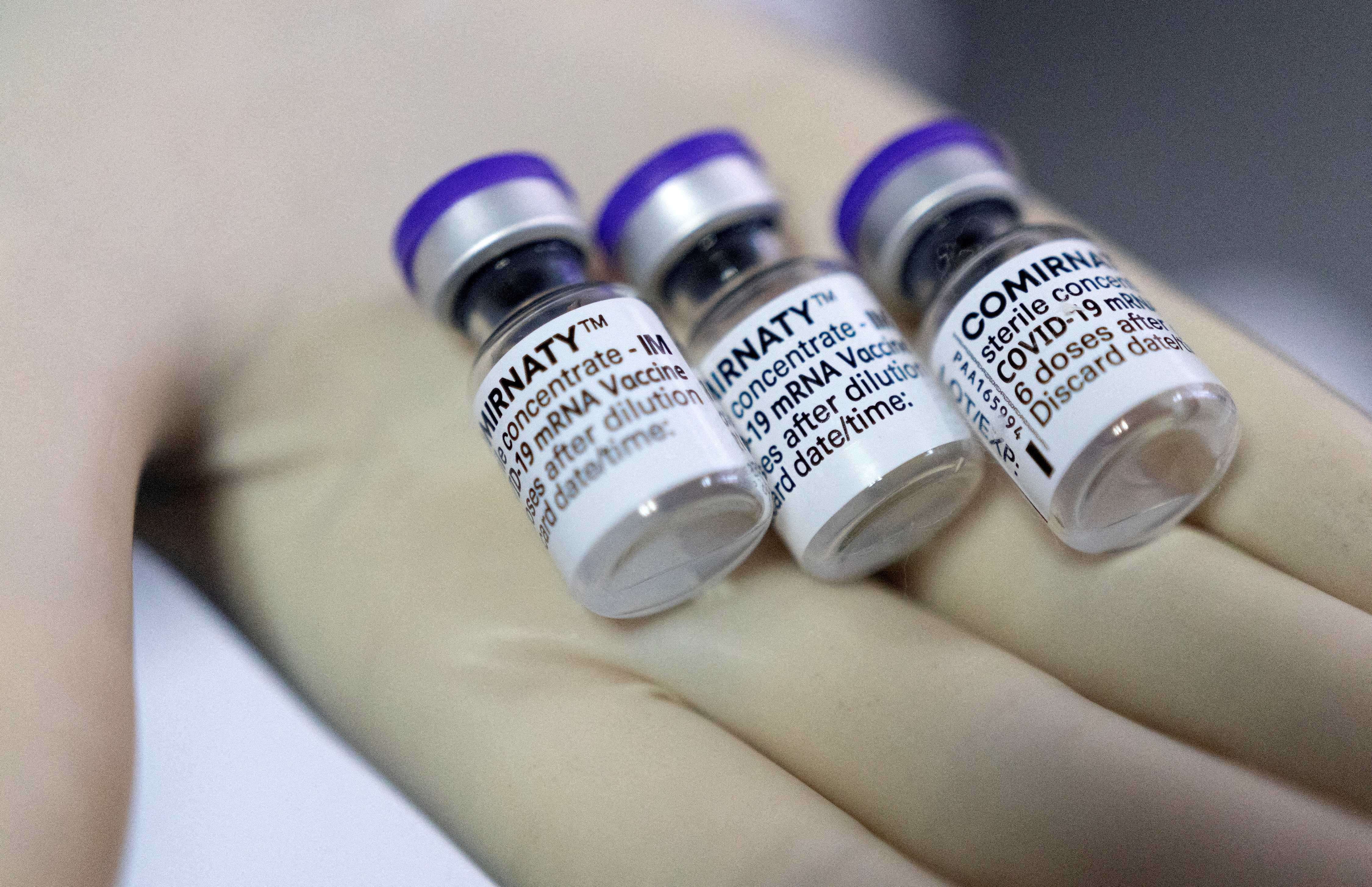
Omicron evades immunity better than Delta, Danish study finds
==============================
Panama tightens vaccination requirements for public officials as COVID cases rise
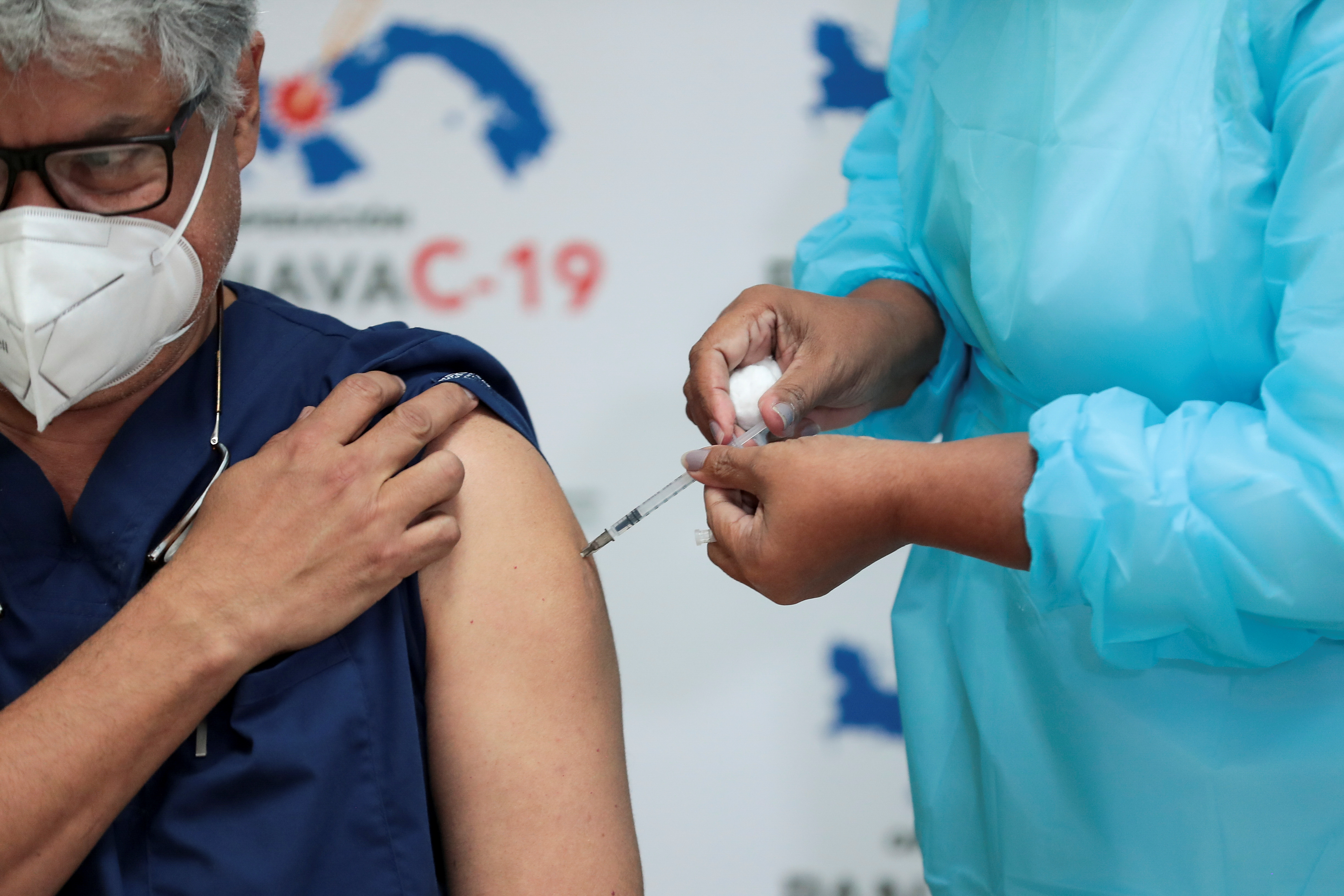
A Panamanian health worker receives the second shot of the Pfizer-BioNTech COVID-19 vaccine at the Santo Tomas Hospital, in Panama City, Panama February 17, 2021. REUTERS/Erick Marciscano
PANAMA CITY, Jan 5 (Reuters) – Panama moved to require all public officials to get vaccinated against COVID-19 or undergo weekly coronavirus testing, the health minister said on Wednesday, as the Central American country grappled with a surge in coronavirus cases.
Health Minister Luis Francisco Sucre announced in a news conference that Panamanian President Laurentino Cortizo had signed the decree, which mandated public functionaries receive three doses of a coronavirus vaccine or provide proof of a negative COVID-19 test each Monday.
“If there is something that cannot be stopped, it is the government institutions that have to continue to function,” Sucre said, adding the measure would take effect on Jan. 28.
Panama registered 4,372 new COVID-19 cases on Wednesday.
At least 6 million vaccine doses have been administered in Panama to its population of about 4.2 million people, according to government data.
About 90% of the target population, or those above 12 years old, has received at least one vaccine dose and 81% has had a second dose.
The government last month said it would cut the rollout time for booster doses in half, after the country detected its first case of the Omicron variant.
More than 400,000 booster doses have been administered.
AstraZeneca seeks U.S. approval for drug cocktail to prevent COVID
Oct 5 (Reuters) – AstraZeneca (AZN.L) has requested emergency approval from U.S. regulators for its antibody cocktail, the first protective shot other than vaccines against COVID-19, another potential major step in the global fight to combat the virus.
While vaccines rely on an intact immune system to develop targeted antibodies and infection-fighting cells, Astra’s biotech compound known as AZD7442 contains lab-made antibodies designed to linger in the body for months to contain the virus in case of an infection.
COVID-19 therapies based on the same class of monoclonal antibodies are sold by rivals Regeneron (REGN.O), Eli Lilly (LLY.N) and GlaxoSmithKline (GSK.L) and its partner Vir (VIR.O) to stop the disease from worsening during early, milder stages of the infection.
The AstraZeneca therapy, designed to last several months to a year, could protect people who do not have a strong enough immune response to COVID-19 vaccines due to, for instance, chemotherapy or anti-rejection drugs after organ transplants.
The drug, given in two sequential injections, could also supplement a vaccination course for those, such as military personnel, who need to booster their protection further, AstraZeneca has said.
The U.S. Food and Drug Administration authorized Regeneron’s drug in September for use in preventing COVID-19 after exposure to infected people. AstraZeneca’s application is however for prevention before any exposure.
Astra’s AZD7442 fell through in the post-exposure setting in a trial in June. Another trial is ongoing to test the drug as a treatment of the infected. read more
In a statement on Tuesday, the Anglo-Swedish drugmaker said it included data in its filing with the FDA from a late-stage trial that showed the drug reduced the risk of people developing any COVID-19 symptoms by 77%. The positive trial data was published in August. read more
SUPPLY TALKS
A U.S. authorisation for AZD7442 – based on antibodies discovered by Vanderbilt University Medical Center in the United States – could be a major win for AstraZeneca, whose widely used COVID-19 vaccine has yet to be approved by U.S. authorities.
Talks regarding supply agreements for AZD7442 are ongoing with the United States and other governments, AstraZeneca said.
The company agreed in March to supply up to half a million extra doses of the antibody cocktail to the United States. The $205 million U.S. extension deal built on a U.S. contract a year ago for initial supplies of 200,000 doses. read more
In June last year, the U.S. provided $23.7 million in early funding for the development project.
Britain’s government also has an in-principle agreement over a million doses of AZD7442. The government declined to provide an update.
Under a plan to set up a global production network, Astra enlisted contract manufacturer Lonza (LONN.S) a year ago to produce the antibody treatment in Portsmouth, New Hampshire, starting in the first half of 2021.
The company did not immediately respond to a request for an update on the supply and production agreements.
Astra’s pioneering filing contrasts with delays in its quest for approval for its COVID-19 vaccine Vaxzevria in the United States, where the vast majority of those willing to get immunised have already received shots from the Pfizer-BioNTech (PFE.N)(22UAy.DE) alliance, Moderna (MRNA.O) or Johnson & Johnson . read more
The post Omicron Milder, Evades Immunity, Panama Reacts to Surge, Astra Zenica Seeks OK, More appeared first on The St Kitts Nevis Observer.