The Biden administration is increasing support for COVID-19 vaccinations to 11 countries in sub-Saharan Africa as part of a broader effort to boost vaccination rates.
The effort from the U.S. Agency for International Development (USAID) will focus on getting shots into arms in Angola, Côte d’Ivoire, Eswatini, Ghana, Lesotho, Nigeria, Senegal, South Africa, Tanzania, Uganda and Zambia.
Experts have urged more action on global vaccinations both for humanitarian reasons and even for the self-interest of wealthier countries like the United States, given that new variants of the virus can develop anywhere and end up threatening the whole world.
The surge in support, which was first reported by The Washington Post, comes as part of a broader effort, called the Initiative for Global Vaccine Access, that was announced in December with $315 million for vaccine delivery.
Will White House ask for more funding? Some advocates and Democrats in Congress have been urging the Biden administration to step up its efforts to vaccinate the world, including with support for $17 billion in additional funding for global vaccination efforts, as well as moves to share the know-how for making vaccines and to ramp up manufacturing.
It remains unclear whether the Biden administration will request more funding for global vaccinations from Congress, after officials signaled a need for $30 billion more in funds focused on domestic needs earlier this week.
==========================================
Dominican Republic ends mask mandate, all other COVID-19 Rules
Municipal workers gather fresh produce that is being discarded as fewer people are shopping at the market, during the outbreak of the coronavirus disease (COVID-19), in Santo Domingo, Dominican Republic April 15, 2020. REUTERS/Ricardo Rojas
SANTO DOMINGO, Feb 17 (Reuters) – The Dominican Republic ended all COVID-19 public health restrictions on Thursday, including a mask mandate and vaccine checks in public spaces, despite not yet reaching the government’s vaccination target of 70% coverage for adults.
President Luis Abinader made the announcement on social media and in a televised message late Wednesday.
“It’s time to recover all our freedoms and way of life,” he said.
The Caribbean nation, which shares the island of Hispaniola with Haiti, started relaxing COVID-19 containment measures last July, when authorities ended a nighttime curfew that had been in effect since March 2020.
Prior to the latest announcement, the government had required face coverings in public places and proof of vaccination before riding public transportation or showing up at local businesses to work or shop.
Health Minister Daniel Rivera told reporters on Thursday that ending the containment measures was due to “constant reductions” in both COVID-19 infections and death rates.
Officials have registered more than 4,300 fatalities due to COVID-19, and while only eight of the country’s 32 provinces have reached the 70% vaccination target, new infections have dipped by about 10% over the past four weeks, according to health ministry data.
After Abinader’s order was announced, health worker union leader Senen Caba expressed concern that the decision to end coronavirus restrictions could discourage unvaccinated Dominicans to get their jabs.
Reporting by Ezequiel Abiu; Writing by David Alire Garcia; editing by Diane Craft
===============================================
WHO: DECLINE IN NEW COVID-19 CASES COULD BE TIED TO DROP IN TESTING
A World Health Organization (WHO) epidemiologist said this week that the drop in new COVID-19 cases may in part be a result of changing testing rates and advised people to be cautious before celebrating downward trends.
“If you look at the overall epidemic curve, there are fewer cases that were reported in the last week than were in the previous week, but we need to look at this very carefully,” Maria Van Kerkhove, technical lead for the WHO’s COVID-19 response team, said during a live Q&A on Wednesday.
Kerkhove noted many countries have dropped testing requirements, and called it a concerning development due to the “intense level” of viral circulation that is still occurring.
Kerkhove said that while recent trends are “certainly” going in the right direction, there are still many cases that are going unreported. Apart from new coronavirus cases, Kerkhove said the continuing increase in COVID-19-related deaths is now a larger concern while noting that death rates are varying in different part of the world.
====================================
Covid: UK NHS bosses call for free tests and isolation to remain
Prime Minister Boris Johnson could announce an end to free testing and the self-isolation period on Monday
BBC- A group that represents NHS bosses has called for free Covid testing to remain, despite speculation that it could be scrapped.
The NHS Confederation also said 75% of senior staff in England did not want self-isolation rules to end.
Prime Minister Boris Johnson is expected to announce new relaxations to Covid rules in England on Monday.
This could include scrapping PCR test centres and free lateral flow tests as part of a “living with Covid” strategy.
The government has spent billions of pounds on testing throughout the pandemic. Experts believe in future it could be used only in hospitals and care settings, or to deal with major outbreaks.
In the survey of more than 300 NHS leaders, four-fifths said they disagreed with the expected plan to end free testing.
And they also expressed the need for regular testing to continue for health staff and key workers.
Asked on Thursday if free Covid tests would be scrapped next week, Health Secretary Sajid Javid said: “We are looking at how we learn to live with Covid. And that does mean the protections we’ve enjoyed over the last few months, that they all should be reviewed.
“So we’re looking at the very latest data and next week we’ll have more to say about it.”
Matthew Taylor, chief executive of the confederation, said: “Hospital admissions and deaths linked to coronavirus continue to fall nationally and this is allowing the NHS to bring back many routine services that it was asked to de-prioritise during the peaks of the pandemic, including some non-urgent elective procedures.
“With the success of the vaccine and new Covid treatments, this offers real hope as we learn to live with the virus.
“But the government cannot wave a magic wand and pretend the threat has disappeared entirely.”
He said not enough was yet known about how much long-term protection vaccines provided and there was still the uncertainty of future strains developing.
Professor Dame Helen Stokes-Lampard, who chairs the Academy of Medical Royal Colleges, says the change being proposed by the government “feels very sudden”.
“We do have to learn to live safely with Covid in the medium term. That does not mean pretending the threat to our health, and in some cases life, simply no longer exists,” she said.
“We should take a more gradual, phased approach to relaxing the rules and carefully watch what happens to the rates of infection – particularly in healthcare settings or other environments where people are particularly at risk.”
Lateral-flow tests are currently free for everyone
A group of charities representing the 500,000 people in the UK with impaired immune systems have also called for free Covid testing to remain.
Fredi Cavander-Attwood, from the MS Society, said: “It is not our goal for blanket restrictions to be reinstated. We simply want all 500,000 immunocompromised people, including some with MS, to be protected and supported to manage their risk so they can live normal lives.
“That’s why the government’s plan must include sensible, simple measures, like maintaining free testing, strengthening employment protections for people at risk, making sure they get treatment quickly if they get Covid-19 and having a plan for the use of preventative treatments.”
Education Secretary Nadhim Zahawi told the BBC in January that there were no plans to ask people to pay for lateral-flow test kits – but more newspaper reports that the government is considering the idea have emerged since then.
The Department of Health and Social Care says it is continually monitoring the risks to protect the most vulnerable. People with weakened immune systems are currently advised to “consider extra precautions to reduce their chance of catching Covid-19”.
“We are hugely grateful to all NHS and care staff who have gone above and beyond, and we continue to support them,” a spokesperson said.
“Thanks to our phenomenal vaccine rollout, antivirals and testing programme, we are one of the freest countries in Europe.
“We continue to monitor the data closely and next week we will set out our plans on how we will live with Covid-19 in the long term.”
===============================================
Hybrid working is here to stay, say managers
Image source, Getty Images
Working from home for part of the week has become the norm for some employees, a survey of managers has suggested.
More than 80% said their firms had adopted hybrid working – most since the pandemic, a survey for the Chartered Institute of Management (CMI) found.
But senior leaders are also actively encouraging employees to return to the workplace, a majority of managers said.
The institute said firms should embrace hybrid work as “best practice”.
“It would be very short sighted of bosses not to see some correlation in the shift in the working world, and the move towards hybrid [working],” said CMI chief executive Ann Francke.
“We are experiencing an uptick in productivity, and an uptick in many companies results. We’re not saying everyone should work from home 100% of the time, we’re saying the best practice is to have a blend, so when you come into the office you can do those things that are very difficult to do remotely.”
The survey for the professional body, exclusively shared with the BBC, found that 84% of managers said their firms had adopted hybrid working and two-thirds said this had been prompted by the Covid pandemic.
Large companies were more likely than small ones to have brought in hybrid working practices, while jobs in factories, transport and trades were less likely to offer the option.
The survey found that firms offered staff flexibility to choose which days they came into the office.
Coaxed back slowly?
Work from home guidance in England, which was put in place in December to try to curb the spread of the Omicron variant, was lifted in January.
Similar guidance was relaxed in Scotland, but remains in place in Northern Ireland and Wales.
As Covid restrictions have eased, commuter numbers have risen.
But more than a fifth of train services that were running before the Covid pandemic have not returned.
The survey polled 1,237 managers, with 41% working in the private sector, and 59% the public and non-profit sectors.
Flexibility ‘sweet spot’
Aoife Fitzmaurice, chief of staff at Sage, which provides accounting, payroll and payment systems, plans to keep hybrid working in place.
While there was “huge demand” from employees to have the option to work from home, Mr Fitzmaurice said they were also “missing the human connection”.
Ms Fitzmaurice explained that a “framework of flexibility” was necessary so that agreements could be made by each team to set the “sweet spot” of a combination of home and office work.



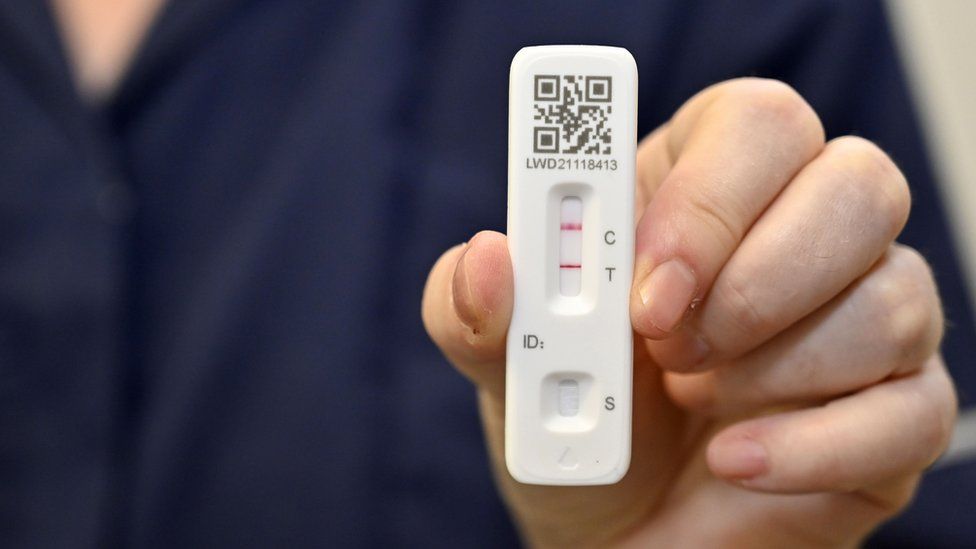
 Image source, Getty Images