BASSETERRE, St. Kitts — St. Kitts and Nevis is one of the very few countries in the world that have put measures in place which have successfully contained the spread of COVID-19, but the Ministry of Health is assuring that the success is not at the expense of government’s efforts to eradicating non-communicable diseases.
“If I have COVID-19, I get into your space, you get COVID-19,” observed Minister of Health the Hon. Akilah Byron-Nisbett. “You can get sick, you can die. It is the measures that we are taking, wearing our masks, and social distancing is what is stopping the spread of it as rapidly as it can be spread, so we got to understand that.”
The Hon. Byron-Nisbett, who was addressing a COVID-19 Vaccination Information Session held at the Bronte Welsh Primary School in West Basseterre on March 3, noted that St. Kitts and Nevis is not seeing the spread of COVID-19 as it is happening in the rest of the world where people face the possibility of dying from it faster than they can die from a non-communicable disease.
“However, the efforts to contain non-communicable diseases are continuing, because for non-communicable diseases it is a lifestyle change that is required,” pointed out Byron-Nisbett. She noted that NCDs can be put on check by eating right, exercising, and having regular check-ups.
Byron-Nisbett made the statement in response to a question posed by a member of the public who wanted to know why so much attention was being given to the COVID-19 pandemic while there were more people dying from non-communicable diseases.
“You heard about SKN Moves initiative that Ministry of Health have?” the minister asked. “We do it every single year where we encourage persons to exercise, eat right and have regular check-ups. We have walks for SKN Moves – the Prime Minister has a monthly walk, and it is part of the SKN Moves initiative, and we try to get persons to change their lifestyles.”
Medical Chief of Staff at the JNF General Hospital, Dr. Cameron Wilkinson, who was the featured speaker at the session, echoed the minister’s sentiments. He posited that the questioner was making an assumption that the Ministry is not dealing with the NCDs with a case urgency, saying that by getting rid of COVID-19, they will be able to continue to focus on the non-communicable diseases that are killing persons.
“The thing about a non-communicable disease, though, is you can decide you are going to exercise, eat healthy, and control your hypertension and not drop down dead from hypertension,” said Dr. Wilkinson. “But COVID-19, that lady can come and give you a bottle of water that is contaminated, you put it to your nose and mouth you come down with COVID-19 and you are dead in three/four/five days and that is the difference.”
Answering to a question whether persons who would have taken the vaccine will still be required to quarantine, Dr. Wilkinson said: “The quarantine period will only change when most of us do the right thing – the persons who can be vaccinated, take the vaccine. That is why it is important for all of us who can take the vaccine we go forward and take it.”
According to Dr. Wilkinson, those taking two doses will still have to quarantine when they come into the country until such time that between 33,000 and 36,000 persons are vaccinated, the number that will give St. Kitts and Nevis the herd immunity status.
The Hon. Byron-Nisbett, Area Parliamentary Representative for St. Christopher Three (West Basseterre) and also minister of ICT, Entertainment, Entrepreneurship and Talent Development, was pleaded with her constituents to sign up to go and take the vaccine.
“I have a question: who will be willing to be vaccinated?” posed Byron-Nisbett. “Those willing raise your hand so that we could see who will be willing.”
Hands shot up in the air, and one participant replied that her appointment was at 12:30 p.m. the following day. Another participant asked if he could get it there and then, but the Minister told him that the two nurses present at the session did not have the vaccines.
The next COVID-19 Vaccination Information Session for West Basseterre will be held on Wednesday, March 10, at the St. Johnston Community Centre starting at 6:30 p.m.
Going for the jab: Members of the public at a COVID-19 Vaccination Information Session held at Bronte Welsh Primary School in West Basseterre give an indication that they are ready to take the COVID-19 vaccination.
BASSETERRE, St. Kitts — Parliamentary Representative for Constituency #4, The Honourable Lindsay Grant, supported the Bill shortly entitled the Jury (Amendment) Bill, 2021, which was passed into law at the sitting of the National Assembly on March 4, 2021.
Minister Grant said that the Bill is to “facilitate the criminal procedure rules which are to come on board very shortly.”
“I must say Mr. Speaker that the amendment that we seek to make with respect to the Jury Act is really very late in coming,” he said.
He continued, “This is because nearly all our Jury Acts within the Eastern Caribbean have come out of the United Kingdom Jury Act of 1870.”
Additionally, Minister Grant said, “If we look at the Act throughout the region, in particular with respect to alternate Jury which is really the critical amendment being sought today… in a number of Eastern Caribbean countries, the alternate jury has already been in place in several of those countries Mr. Speaker.”
He named countries such as Trinidad and Tobago, Saint Lucia, Antigua and Barbuda, and the British Virgin Islands as some countries that already have the alternate Jury in place.
“It is a matter that is not controversial; it is a matter that is tried, tested, and proven in the region and so what we are here doing today Mr. Speaker is mainly tidying up our Jury Act for what is to come in the criminal procedure role,” Minister Grant said.
BASSETERRE, St. Kitts — The Criminal Procedures (Amendment) Bill, 2021, which was successfully passed on March 4, 2021, during the Sitting of Parliament, received support from the Honourable Jonel Powell, Minister of Education, Youth, Sports and Culture.
“This Bill forms part of a suite of three bills which need an amendment in order to facilitate the conferment of powers of the Chief Justice to establish rules, criminal procedure rules to be exercised within the Eastern Caribbean Supreme Court,” said Minister Powell.
Minister Powell expressed that in his capacity as an Attorney-at-Law, he appreciates the rules that are outlined in the Criminal Procedures (Amendment) Bill, 2021, thus he is happy to lend his support.
He stated, “In 2000, the court would have established Civil Procedure Rules which have provided significant assistance to the exercise of law in our jurisdiction and throughout the Eastern Caribbean.”
“The establishment of these rules is expected to…create more efficiency within the rule of law and the exercise of the various procedures. We expect to have some uniformity in terms of the application of the various rules which currently exists, as well as to have more efficiency in terms of speed when dealing with matters,” said Minister Powell. “The Honourable Attorney-General [the Honourable Vincent Byron Jr.] would have addressed the issues of persons on remand, getting justice faster, the swifter exercise of matters before the court, and to effectively ensure that justice is not just done quickly but seen to be done quickly.”
The Magistrates Code of Procedure (Amendment) Bill, 2021, which seeks to confer jurisdiction on the Chief Justice to make criminal procedure rules for the Magistrate’s Court, and the Jury (Amendment) Bill, 2021, which seeks to provide for alternate jurors were also successfully passed.
A 12-year-old Gisborne boy has been reunited with his family after going missing overnight. Police launched an appeal for sightings of Caleb Takoko, 12, last night after he left his home on Aberdeen St about 5pm that evening.He…
Ashleigh Wyse is among Kiwis hugging their loved ones tighter today after thousands evacuated homes across the country amid fears waves would hit coastal towns and cities.Three offshore quakes — including a massive 8.1 rupture near…
VIRUS LATEST* Audrey Young: Why the Valentines cluster was the least-loved lockdown of all * Steven Joyce: It’s time we climbed out of the Covid bunker * What you can and can’t do in levels 2 and 1 * How the emergency phone…
Test your brains with the Herald’s morning quiz. Be sure to check back on nzherald.co.nz at 3pm for the afternoon quiz. To challenge yourself with more quizzes, CLICK HERE.
BASSETERRE, St. Kitts –The Team Unity Cabinet of Ministers met on Monday, March 01, 2021, at the Ministry of Finance Conference Room, under the chairmanship of Prime Minister Dr. the Honourable Timothy Harris. Several issues affecting the Federation of St. Kitts and Nevis were deliberated on.
• Cabinet began after the chair and several members of Cabinet had attended the funeral service for Beatrice Llewellyn Lam, and Cabinet recorded its condolences to her children and extended family. The Chair of the Cabinet, Ministers of Health and Foreign Affairs, other officials from the Ministry of Health, and members of the National COVID-19 Task Force were on hand at the RLB International Airport to receive 20,000 vaccines through a bilateral arrangement between the Government of St. Kitts and Nevis and the Government of India. Cabinet was advised by the Chair that St. Kitts and Nevis will gift the Government of Grenada with 2000 vaccines from what it had received.
• The National COVID-19 Task Force gave its weekly briefing to the Cabinet where the usual update on statistics with respect to infections, recoveries, and deaths locally, regionally, and internationally was given, in addition to flights and movements of passengers in and out of the Federation for the past week. With the arrival of the 20,000 vaccines, citizens and residents could now walk into the designated health centers without long delays. Cabinet was updated on the number of vaccinations which has already been done, and the plan for engaging the private sector, civil society, and government departments with a large staff. The public education programme with the Communications Unit of the Ministry of Health has been rolled out and so far, is well supported by the Task Force and is moving along seamlessly.
• Cabinet also approved submissions, which would see more construction in the sector, and Cabinet discussed legislation that would redound to the economic benefit of the Federation.
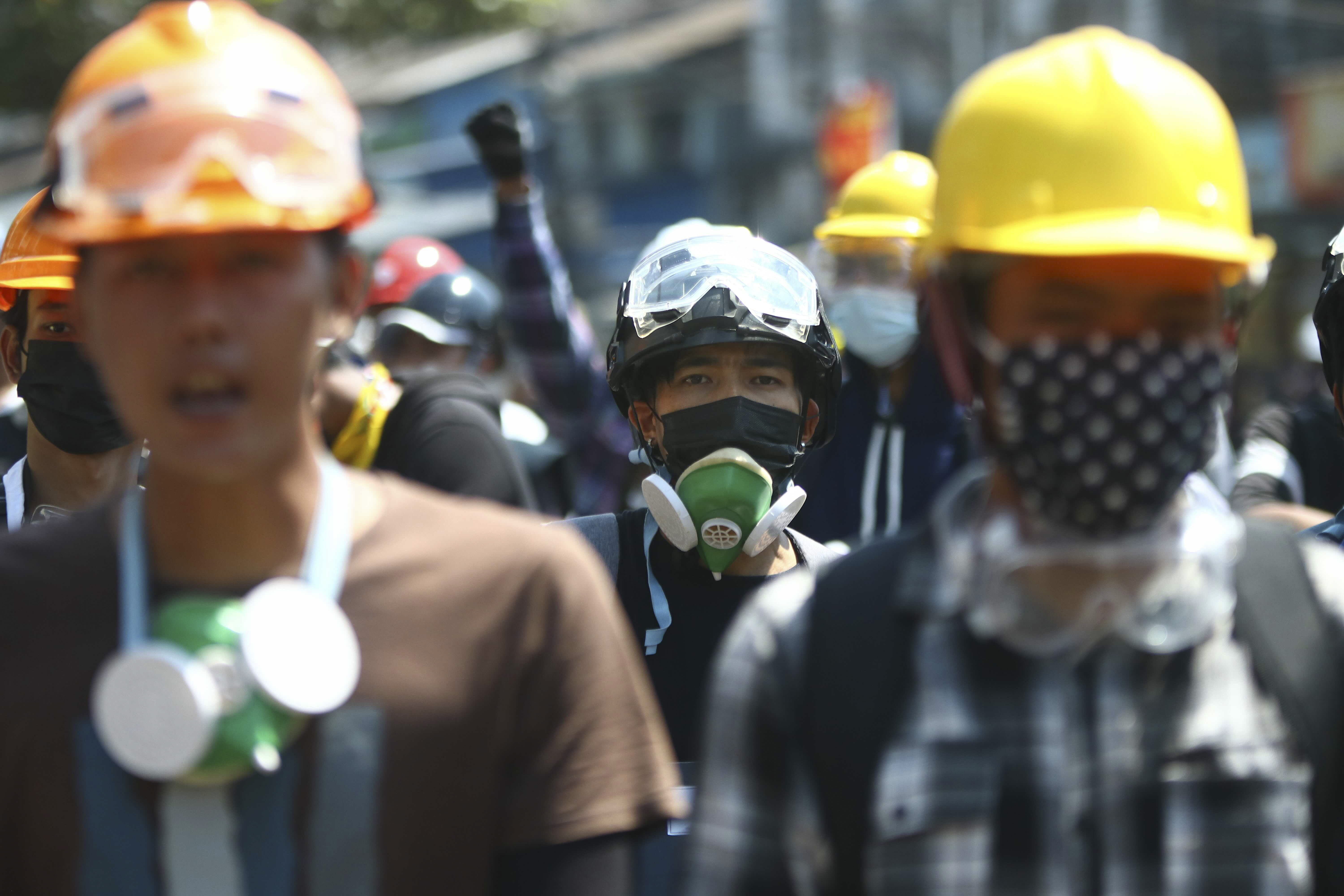
YouTube has removed five channels run by Myanmar's military for violating its guidelines.
The video service announced the move on Friday, as demonstrators defied growing violence by security forces and staged more anti-coup protests ahead of a special UN Security Council meeting on the country's political crisis.
YouTube said it was watching for any further content that might violate its rules.
It earlier pulled dozens of channels as part of an investigation into content uploaded in a coordinated influence campaign.
The decision by YouTube followed Facebook's earlier announcement that it had removed all Myanmar military-linked pages from its site and Instagram, which it also owns.
The escalation of violence by security forces has put pressure on the world community to act to restrain the junta, which seized power on February 1 by ousting the elected government of Aung San Suu Kyi.
Large protests against military rule have occurred daily in many cities and towns.
Security forces escalated their crackdown this week with greater use of lethal force and mass arrests.
More than 1000 people had been arrested, the independent Assistance Association for Political Prisoners said.
Protests continued in the country's biggest cities, Yangon and Mandalay, and elsewhere on Friday, and were again met by force from police.
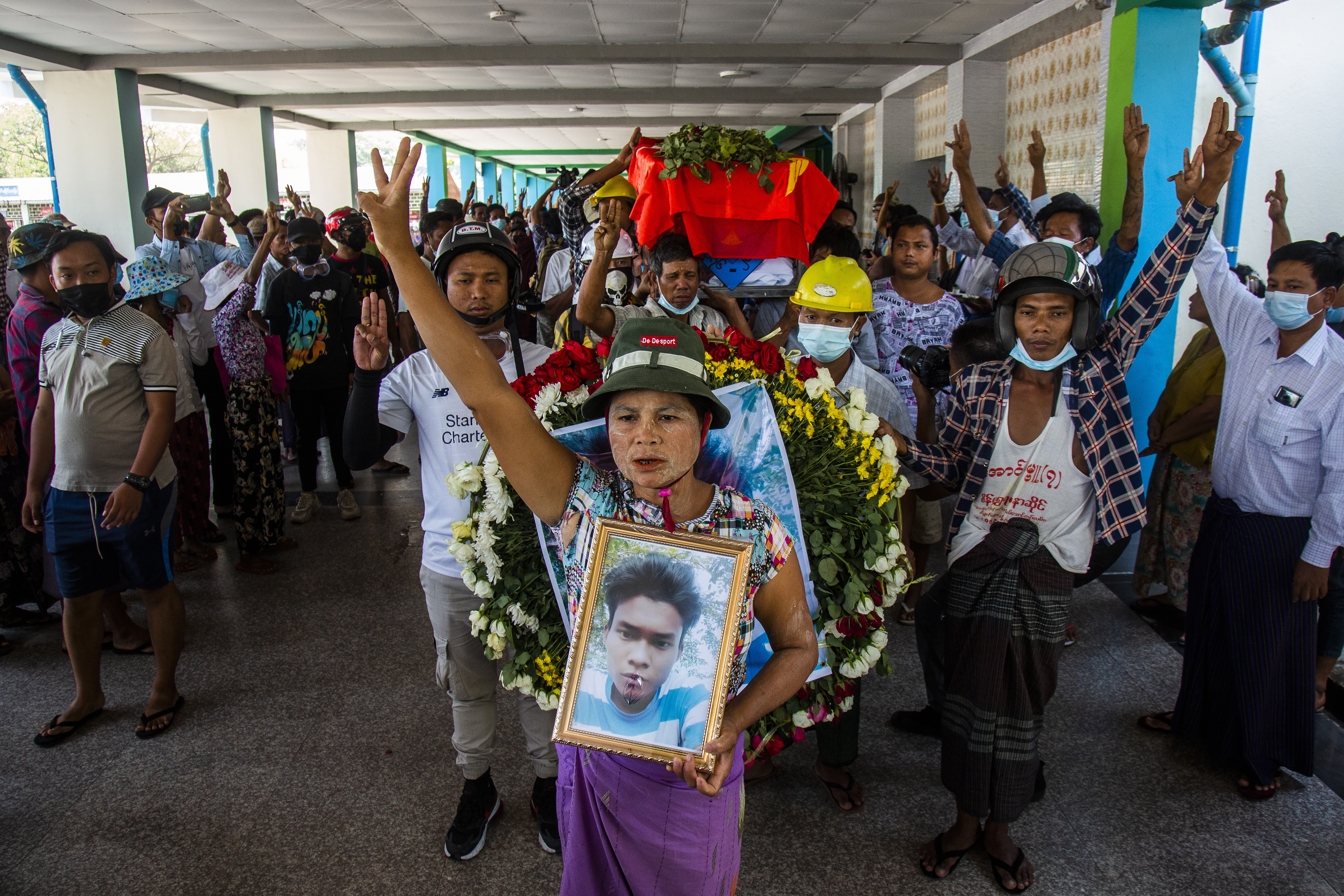
Many cases of targeted brutality have been captured in photos and videos that have circulated widely on social media.
Videos showed security forces shooting people at point-blank range and chasing down and savagely beating demonstrators.
The United States called the images appalling and the UN human rights chief said it was time to "end the military's stranglehold over democracy in Myanmar".
The world body's independent expert on human rights in the country, Tom Andrews, urged Security Council members to watch the videos before their closed-door consultations on Friday.
While many abuses are committed by police, there is even greater concern about military forces being deployed in cities across the country that are notorious for decades of brutal counter-insurgency tactics and human rights abuses.
In Yangon, members of the army's 77th Light Infantry Division have been deployed during anti-coup protests.
The 77th was also deployed in Yangon in 2007 to suppress anti-junta protests, firing upon protesters and ramming them with trucks, witnesses told Human Rights Watch.
The 99th Light Infantry Division has also been deployed, including in Mandalay.
It also has been accused of war crimes in Shan state, another ethnic minority area, in 2016 and early 2017.
Any kind of coordinated action at the UN will be difficult since two permanent members of the Security Council, China and Russia, are likely to veto it.
Even if the council did take action, UN special envoy to Myanmar Christine Schraner Burgener cautioned this week it might not make much difference.
She said she warned Myanmar's army the world's nations and the Security Council "might take huge strong measures."
"The answer was, 'we are used to sanctions and we survived those sanctions in the past,'" she said.
When she also warned Myanmar would become isolated, Schraner Burgener said, "the answer was 'we have to learn to walk with only a few friends.'"
The Association of South-East Asian Nations has urged a halt to violence and the start of talks on a peaceful solution in Myanmar.
The 10-member regional grouping, which includes Myanmar, is constrained from enacting serious measures by a tradition of acting by consensus and reluctance to interfere in each other's internal affairs.
However, one member, Singapore, was outspoken on Friday in criticising Myanmar's coup.
"It is the height of national shame for the armed forces of any country to turn its arms against its own people," its foreign minister, Vivian Balakrishnan, said in Parliament.
But he also warned the approach favoured by some Western nations, of pressuring Myanmar's generals with sanctions, would not be effective.
The US, Britain and several other countries have already started to use that approach.
"Despite all our fervour and earnest hopes of reconciliation … the keys ultimately lie within Myanmar. And there's a limit to how far external pressure will be brought to bear," he said.
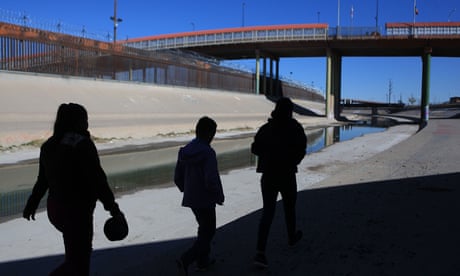
Guardian (UK)- A dusty soccer ball lay idle and forgotten a few days ago at an empty dwelling that had been knitted together from billowing, fraying plastic tarps tied to dead trees in the Mexican city of Matamoros.
The vignette of the abandoned shelter is expected to replicate across the makeshift migrant camp in the coming weeks, wedged between the edge of the city and the swirling Rio Grande, across the border from south-east Texas.
‘There isn’t capacity’: Mexican shelters struggle as migrants head north again
Hundreds have been hovering, somewhere between living and existing, since 2019 under Donald Trump’s program known as “Remain in Mexico” while their immigration cases are processed in the US.
After several 11th-hour delays, people are now starting to depart the camp to argue their asylum cases in the United States.
Nearly 25,000 people out of at least 70,000 who crossed the US-Mexico border and were sent back, under the policy known more formally as the Migrant Protection Protocols (MPP), are now eligible to be reprocessed on the US side.
If squalid, dangerous camps in places like Matamoros become obsolete, few will mourn.
The DHS under Trump had said of migrants forced to wait that “Mexico will provide them with all appropriate humanitarian protections for the duration of their stay”.
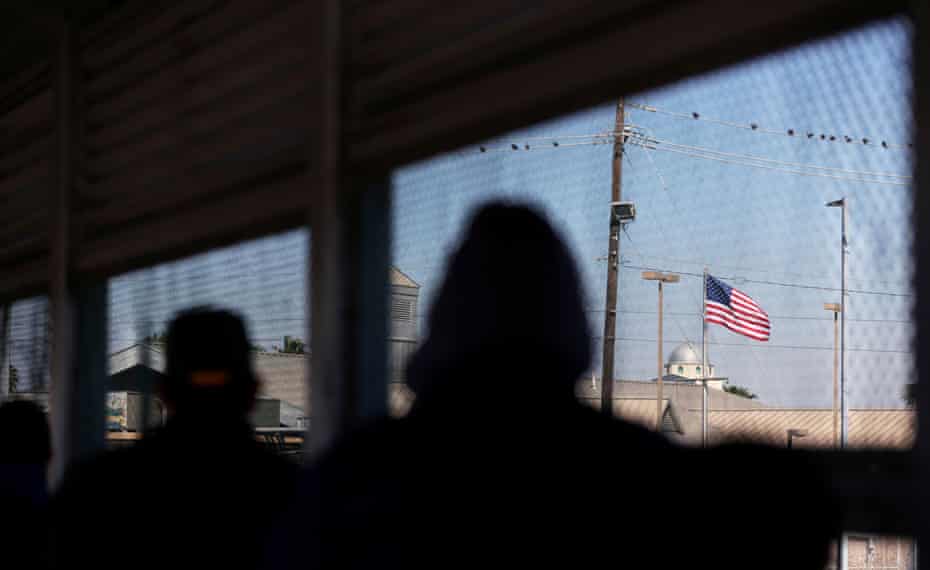
A US flag is pictured at Matamoros-Brownsville international border bridge, as seen from Matamoros, Mexico, on 19 February. Photograph: Daniel Becerril/Reuters
Yorlene, a 32-year-old Honduran mother traveling with daughters aged 10 and 15, who asked to withhold her full name over security fears, had not found such help when sent back across the border to an area that the state department advises Americans to avoid because of crime and kidnapping.
She had no assistance and at first just stayed on the concrete plaza next to the traffic lanes that lead to and from the international bridge across the river from Matamoros to Brownsville, Texas.
“We lived here,” Yorlene said, pointing to the pavement. “We’d throw something over it and we’d sleep on that. For three months, that’s how I had my daughters living.”
She’s now been waiting for 18 months.
The camp in Matamoros sprouted up over time, as thousands arrived, most fleeing danger, crushing poverty, corruption and violence in Central America.
As donated tents populated the plaza and began spreading into a fenced-off park, migrants were moved away from public sight, closer to the river, in an area frequented by smugglers and drug traffickers.
“Only we know what we’ve seen,” a different Honduran mother, who preferred not to share her name at all, for safety reasons, told the Guardian.
“From bathing in that river as decomposing bodies passed by, without a head, to bathing in the river as dead, decomposing animals passed by,” she said. Others shared similar accounts.
A human body without a head typically indicates someone decapitated by the area drug cartel. A human body still with its head could easily be a migrant who has drowned crossing the Rio Grande.
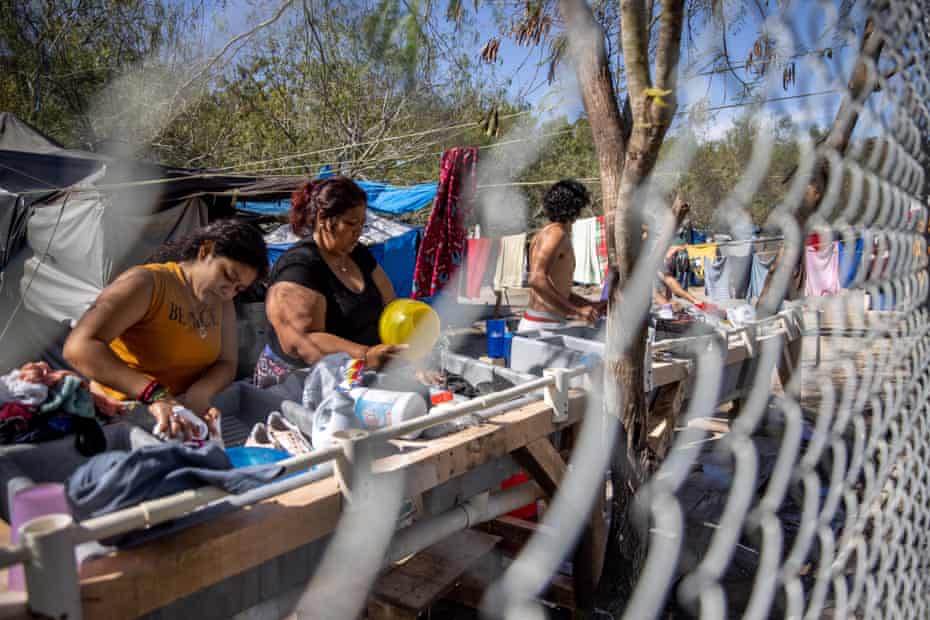
Central American immigrants wash clothing inside a camp for asylum seekers in Matamoros on 7 February. Photograph: John Moore/Getty Images
The woman talked as she sat on a cot in the tent of a camp neighbor, with two other mothers, wearing multiple socks, sweaters and blankets wrapped around their waists late last month, the morning after one of the coldest nights of the year as deadly temperatures engulfed the region.
Fences erected by the Mexican government keep the camp largely cut off from reporters and locals. But a discreet breach in the fence on one side is frequently used by the maña, a term used to describe cartel members, people inside said.
Dangers lurk. Women living with children but especially those living alone, like Iris, 26, who had traveled from El Salvador, remain vigilant after dark.
“It was about 12 at night. Twelve on the dot, because I saw the hour,” Iris said, recalling a mid-February incident at her tent.
Inside Trump’s tent immigration courts that turn away thousands of asylum seekers
“I heard this little thing, the zipper on the tent, screech,” Iris said. A man, crouched down on the outside of her tent, was trying to get inside, she said.
The night was cold and there was a howling wind.
“‘Ay, Dios mío,’ I said, as I saw him trying to open the zipper. But he couldn’t get it open because I have a small lock on it inside,” she said. She drew her phone under the pile of blankets that lay over her and called her tent neighbor, a man camping a few steps away.
When his phone rang loudly it scared the intruder away. That night, Iris sought safety by moving into the tent of a friend, Dayana, to sleep alongside her and her 10-year-old brother.
Jodi Goodwin, an immigration attorney who began offering legal assistance to migrants from the start of MPP in Matamoros, said it was difficult for migrants to prepare for their court cases without a safe environment and counsel.
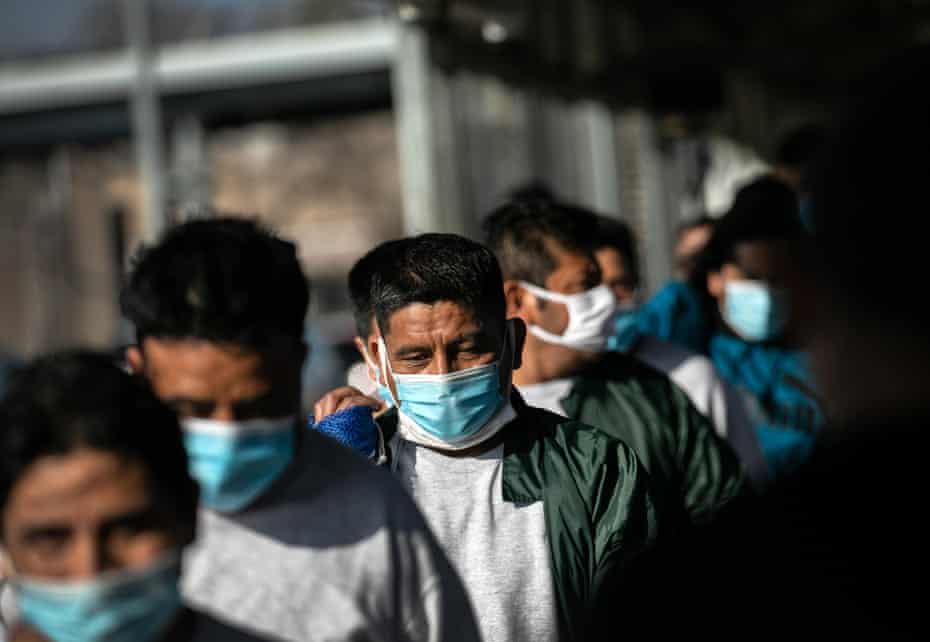
Mexican deportees walk across the Gateway international bridge into Mexico after being deported by US immigration authorities on 24 February. Photograph: John Moore/Getty Images
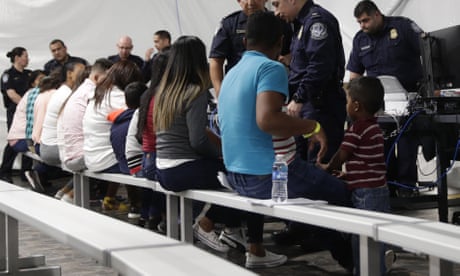
Omar Castañeda, a 54-year-old Honduran father of two, told of attending a US immigration hearing, held in a so-called tent court next to the international bridge in Laredo, further west in Texas.
After returning to the Mexican side, he was approached by men he believed were from the cartel operating in that region.
“When we talked to them, they asked for the password,” Castañeda said.
Cartels operating on the border extort money from migrants traveling independently in return for sharing a password that will help them safely navigate through organized crime’s smuggling routes.
“We had to show them our papers … They stand in front of the bridge, and they’re looking at each person who comes in. If you don’t have an explanation for them, they just take you,” Castañeda said.
He said he and his sons had previously been kidnapped. Cartels target migrants and, especially if they find out they have relatives in the US, demand ransom payments.
Attorneys such as Charlene D’Cruz, who represents Castañeda, are hoping that even people who initially lost their asylum cases while waiting in Mexico in fear of their lives will be allowed to enter the US and be reassessed in due course.
“People who have closed cases – they got screwed by a very unjust, cruel system. Why should they suffer any more?” D’Cruz said.
Last week, just a few hours before the first group of 27 migrants from the camp, including Castañeda, were allowed into the US, a jovial atmosphere bloomed.
The sound of singing children floated over the chain-link fence and concertina wire.
Crowds of people who help out at the camp cheered as the 27 were permitted to walk across the bridge into Texas and board a charter bus, heading for another bus journey or a flight to stay with US-based relatives or sponsors until their next court dates.
Where there had been despair and frustration, there were now tears of relief and cautious smiles from those re-entering the US after waiting so long.
Those left behind hope they would be next.
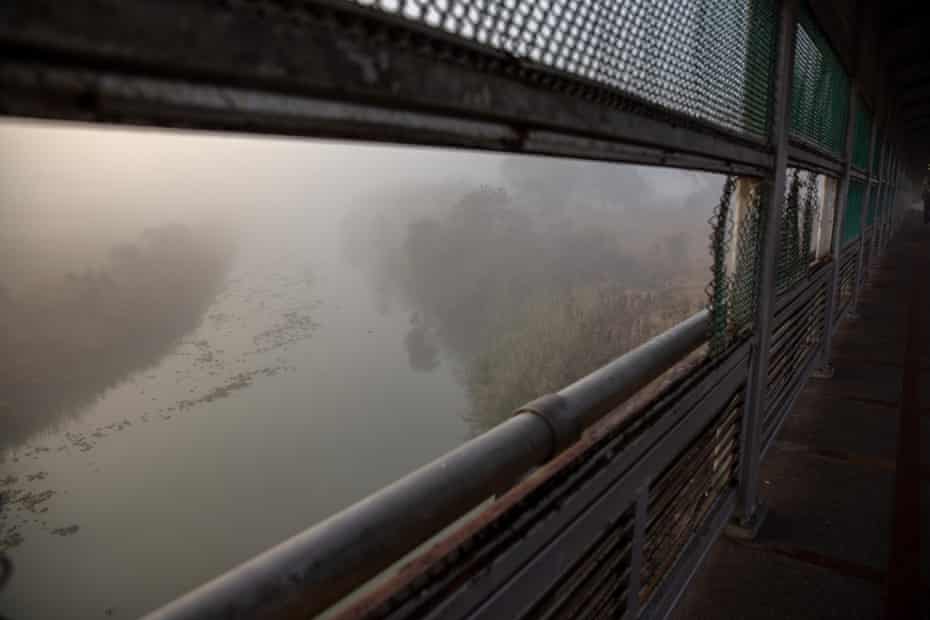
The Rio Grande flows under a dense fog at the US-Mexico border crossing on 23 February. Photograph: John Moore/Getty Images
“God knows we’re here, forgotten by the world,” the Honduran woman who told of bodies in the river, said.
She added: “We’re not bad people. We’re humans who can feel, just like you.”
Over the following days, US officials began reprocessing all the families at Matamoros camp, about 700 people, who are eligible, before turning to assess others there and elsewhere in Mexico.
Iris lost her night-time protective tent-mates when Dayana and her family entered the US last Friday.
She felt fresh worry as she faced nights alone again in the camp.
“They’re getting into the tents,” Iris said on Friday night, this time messaging via WhatsApp, of the men who try to sneak in upon sleeping women.
She is currently not eligible to be reprocessed, after US judges denied her asylum claim and appeal when she told of death threats by criminal gangs in El Salvador. She’s not sure what will happen next.
Some days later, Iris said the camp was largely empty, and the few, single women remaining were banding together at night.
Tarps in the camp were left flapping in the breeze at sleeping sites now deserted.
In the few makeshift tents still occupied others endure, wondering when, or even if, their “wait in Mexico” will end.