The e-commerce company wasn’t moving at all in the premarket, prior to Musk’s early morning call out. It’s now set to be the biggest gainer in the S&P 500 when markets open.
All posts by FreeNews
'Extremely dangerous' tornado leaves 100 million people in the US on alert
A "large and extremely dangerous" tornado has left people with serious injuries and caused significant damage in parts of Alabama in the United States.
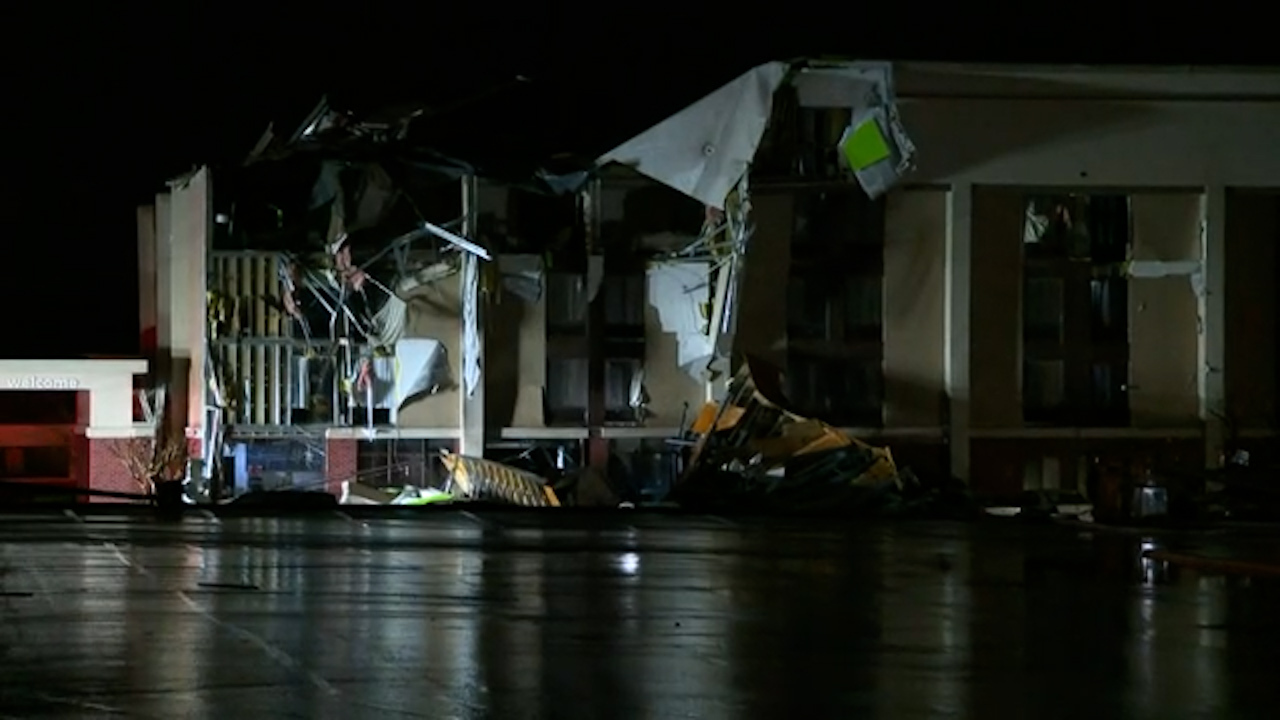
National Weather Service (NWS) in Birmingham, Alabama, said Jefferson County and surrounding areas were thrashed by the tornado on Monday night, including ripping through a hotel and tearing off part of the roof of a church.
Jefferson County Coroner Bill Yates confirmed at least one fatality related to the tornado with search and rescue operations are still underway.
READ MORE: Tropical cyclone watch issued for Far North Queensland
Injuries ranging from minor to serious have been reported with victims transported to area hospitals, Jim Coker Director of Jefferson County Emergency Management Agency (EMA) told CNN.
He did not say how many people were injured.
Mr Coker told CNN the damage from the tornado is "considerable," which "hit a heavy retail and residential area."
A house collapsed on a family, but their condition is not known at this time, Mr Coker said.
There are five fire department heavy rescue teams from Jefferson County responding to the areas of Fultondale and Centre Point.
Jefferson County EMA is using a drone and helicopters to track the path of the storm along with the NWS, according to Coker.
Hotel and church suffer damage
Video footage shows that the Hampton Inn in Fultondale, which is located just north of Birmingham and has a population of around 9000, according to census data, sustained significant damage during the storm.
It has been reported that guests staying at the hotel were able to escape the building and sought shelter in a nearby restaurant when another line of storms came through.
NWS Birmingham said in a tweet, they are monitoring reports "after a tornado impacted the Fultondale area of Jefferson Co. a short time ago."
"Significant damage has been reported. We will inspect the damage to determine the strength of the tornado."
https://twitter.com/NWSBirmingham/status/1353939999302045697?s=20
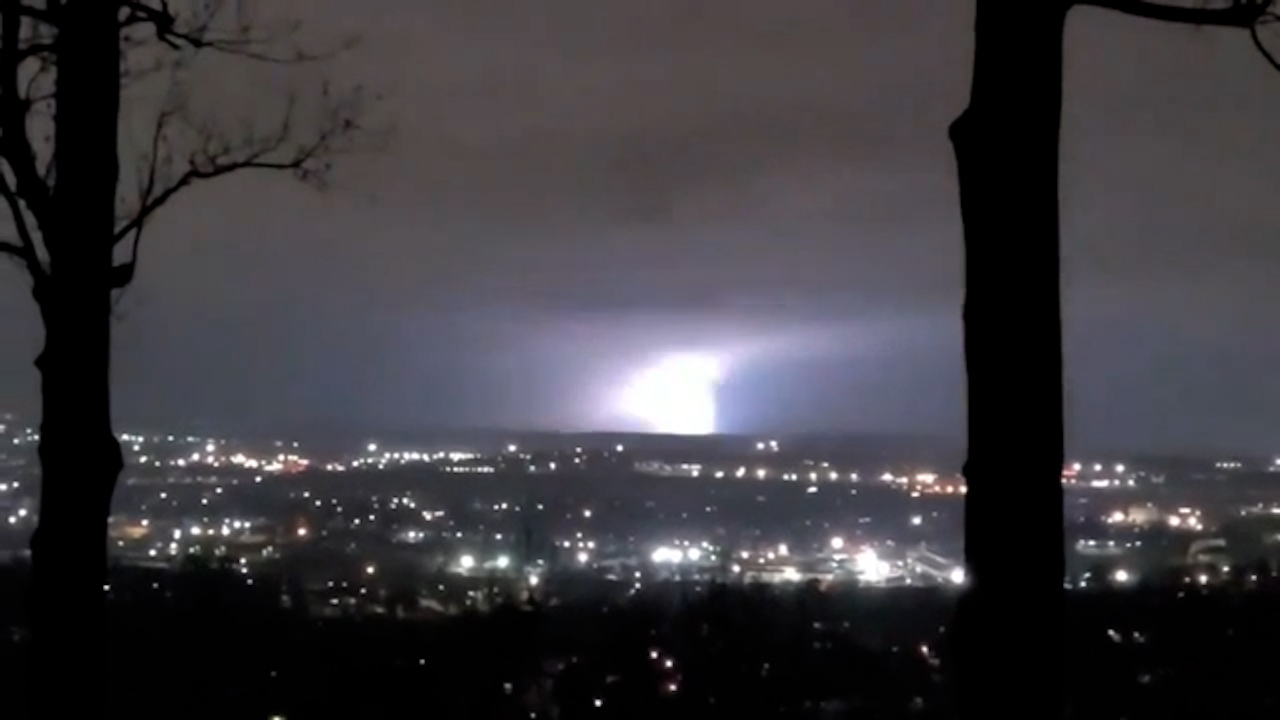
"At 10.54 PM CST (3.54pm AEDT), a confirmed large and extremely dangerous tornado was located over Chalkville, or near Trussville, moving east at 50 mph (80.5km/h)," the agency said earlier on Twitter.
About 21 kilometres northeast of Birmingham, the city of Centre Point, which has a population of more than 16,000, also saw "quite a bit of damage" from the storm, Mayor Bobby Scott said.
Mr Scott said that the back half of Hilldale Baptist Church's roof is missing, and the city's recreation centre also suffered damage in the storm.
"Looks like we will have a long day ahead of us tomorrow," Mr Scott said.
"Hopefully we can get everything covered up.
"We don't have any injuries to report right now so we're definitely grateful for that."
The Jefferson County EMA has asked people to stay out of the area as first responders try to reach the most damaged locations.
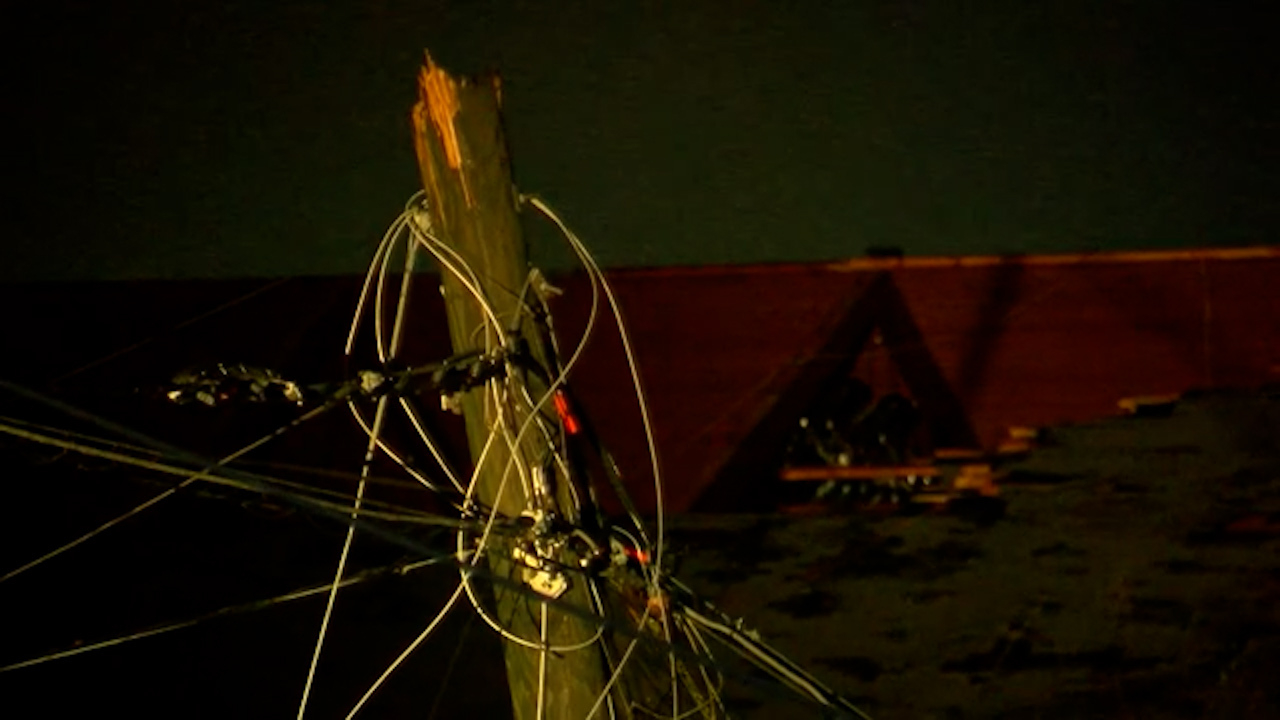
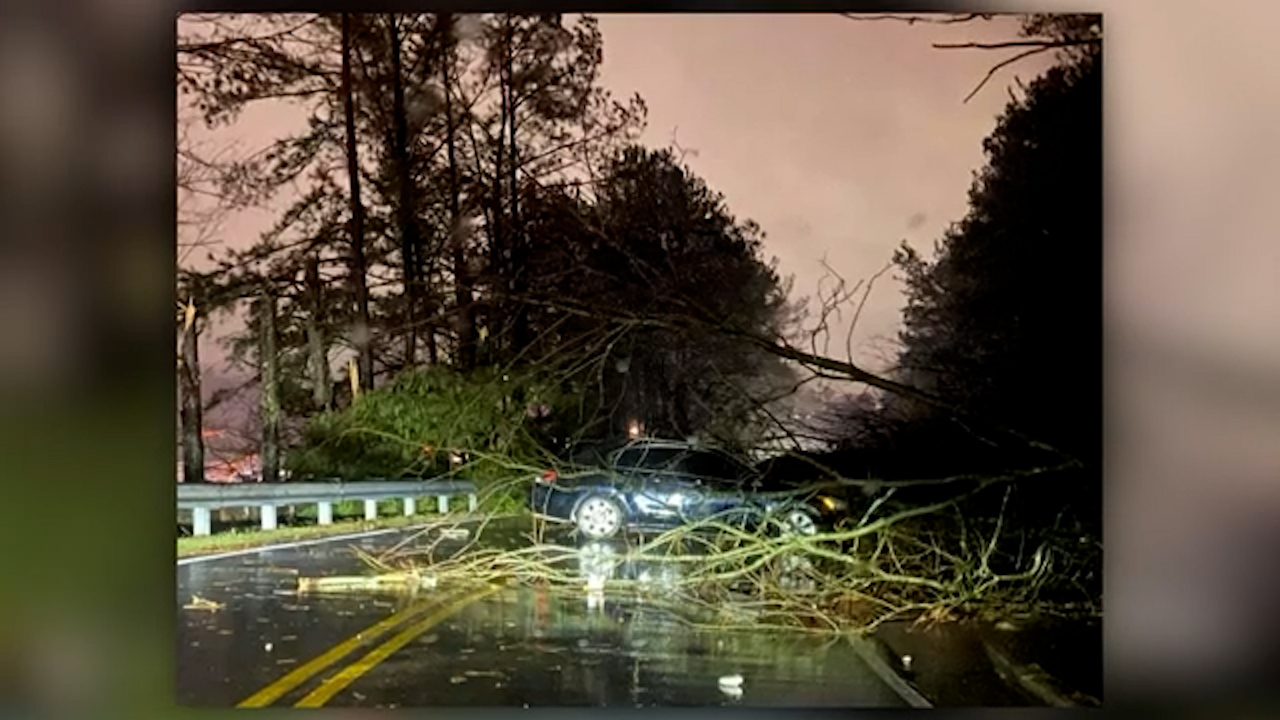
"On top of road dangers such as power lines and debris … traffic is clogging the roads," Jefferson County EMA said on Twitter.
Eleven schools in the area will be closed for both in-person and virtual learning Tuesday following the storm.
https://twitter.com/EMAJeffCoAL/status/1353961918210387968?s=20
Tornado warnings in effect through Tuesday morning
A tornado warning was issued Monday night for Jefferson County, Alabama, NWS Birmingham said in a tweet.
The agency has since issued tornado warnings and watches for several counties as the line of storms moves northeast through the state.
A tornado watch remains in effect for parts of Alabama and Georgia.
The line of storms is part of one of two larger systems that has more than 100 million people under winter weather alerts.
The storm will dump significant snow from the Central Plains to the mid-Atlantic Coast through Tuesday night.
The deepest snow will pile up across Iowa.
Some of the snow will be very heavy, with rates of up to five centimetres an hour, according to the Weather Prediction Centre.
Water Shortage a Growing Caribbean Problem
Noreen Nunez lives in a middle-class neighborhood that rises up a hillside in Trinidad’s Tunapuna-Piarco region.
Accessed by a long, winding road bordered by trees, the houses, built in the 1970s and 1980s, are mainly painted in pastel shades. Dotted among fruit trees in their sizeable backyards are huge water tanks, mounted on concrete slabs.
The tanks are evidence that even this affluent community is not insulated from the water-stress experienced across the Caribbean.
Residents fill the tanks from the main pipes to use during scheduled outages by the water authority. But the supply is often unreliable and further impacted by low pressure for those living further up the hill.
Nunez says outages have become a regular occurrence, with water often shut off for all but a few hours during the night.
“Most of the time you have to buy food from outside or have food catered and buy bottles of water to drink,” she said. “You use disposable dishes.”
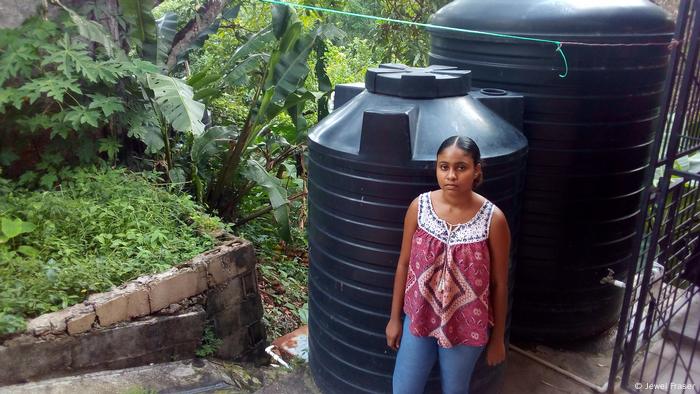 A neighbor of Noreen Nunez stands next to her water tanks, which have become a vital necessity for dealing with water shortages
Patchy infrastructure and leaky pipes
Antigua and Barbuda, St. Vincent and the Grenadines, and St. Kitts and Nevis are all classed as water scarce, which the UN defines as countries with less than 1000 cubic meters per capita of renewable water resources a year.
Barbados’ situation, with only 350 cubic meters per capita, is especially grave, according to Keithroy Halliday, general manager of the Barbados Water Authority.
While most people outside of rural mountainous areas in the Caribbean are connected to the public water supply, they frequently face outdated infrastructure in need of repair, resulting in major losses of drinking water.
Alan Poon King, head of Trinidad and Tobago’s Water and Sewerage Authority (WASA), says the utility loses as much as 60 million gallons of water each day from leaking infrastructure — and that much again is wasted by problems like leaking taps on private properties.
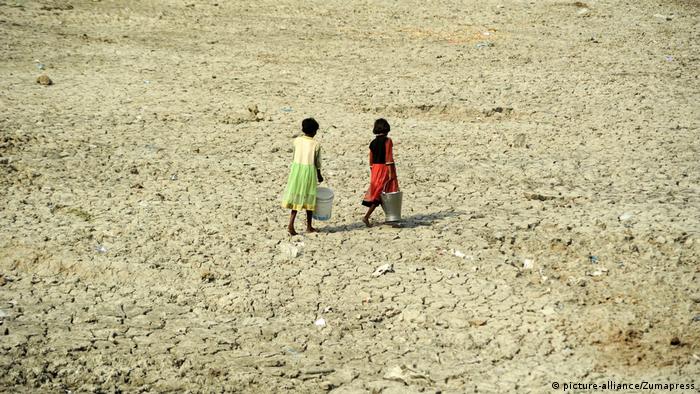
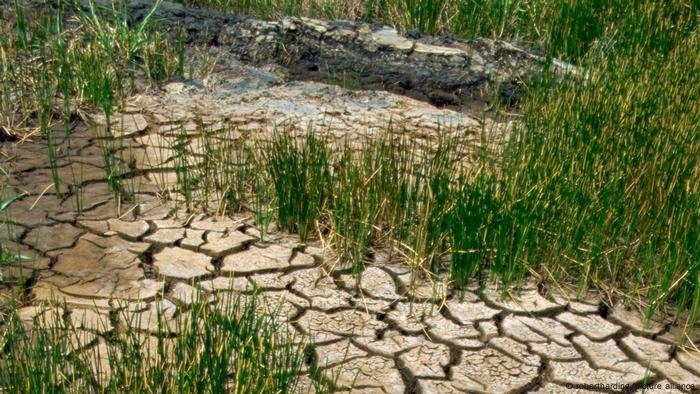 Climate change has increased drought which is exacerbating water problems on the islands
The picture is similar in Jamaica, which Peter Clarke, managing director of the country’s Water Resources Authority, says suffers from “a serious loss of water that has been produced and is supposed to be delivered, but it is not reaching the end user because of the aging infrastructure — it’s leaky, it’s perforated.”
Climate change increases pressure
If these structural problems are left unaddressed, things are only likely to deteriorate as the planet heats up.
“There are many other problems that are facing the water sector in the Caribbean and climate change is exacerbating those existing, underlying conditions,” said Adrian Cashman, who sits on the global technical advisory committee for the Global Water Partnership.
Officials say drought conditions across the region over the past couple of years mean there just hasn’t been enough rain to replenish aquifers at the usual rate.
“This past summer [in Jamaica] we went through a significant drought,” said Clarke. “It really was challenging for the water supply providers.”
In Trinidad and Tobago, Poon King said it was difficult to quantify the impacts of climate change, but that it was an ongoing challenge: “We’ve seen reduced precipitation that could be anywhere in the range of 10-20% in the dry season.”
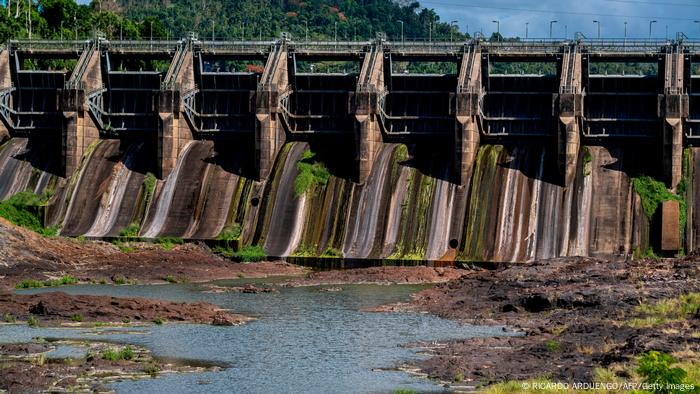 Last year Puerto Rico experienced water rationing following a drought
Halliday said climate change has already “significantly impacted” Barbados’ water supply, too. All of Barbados’ internal renewable water resources come from rainfall, he explained, and in 2019 the country saw its lowest recorded levels since 1947.
Climate finance and water-wise living
The Caribbean region enjoys relatively high standards of living, with most countries defined by the UN as “upper-middle income.” This excludes them from much international development funding. At the same time, high levels of public debt combined with their vulnerability to climate change makes it difficult to secure investment in infrastructure.
However, one of the region’s first major water projects financed by the Green Climate Fund (GCF), which was set up to help developing countries cope with the changing climate, is currently underway in Grenada.
Project head Hans-Werner Theisen says about half of the €45 million the GCF has allocated to the project will be spent improving infrastructure like water tanks, reservoirs and pipes. There will also be financial incentives to cut water waste from sectors like agriculture and tourism, which are among the biggest consumers of water.
Encouraging the public to use water more carefully is key to the project in Grenada, too. “What I think is very important is that everyone, every citizen, can contribute to water-saving measures, so we have to be water-wise in day-to-day living,” Theisen said.
Elsewhere, Barbados has passed laws prohibiting the use of potable water for washing cars, gardening, filling swimming pools and similar activities. As in Jamaica, people are encouraged to use wastewater for such activities.
Water, water everywhere…
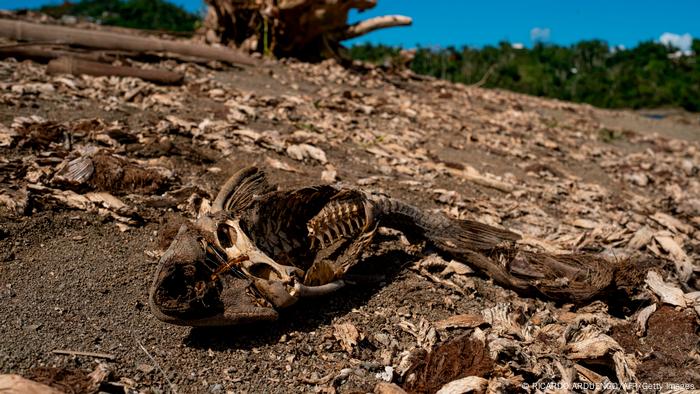 Barbados and Jamaica encourage residents to be very careful with their water use
Despite day-to-day water outages, a 2017 UN Water report showed most people in the Caribbean have access to a safe — if irregular — water supply.
But in Trinidad, Nunez is infuriated living on an island with 360-views of the turquoise waters and nothing coming out of the tap.
“Water and air are things that humans need to live,” she added. “I can’t understand how on an island surrounded by water, they can’t find some way of using — desalinating — the water.”
According to 2019 figures, the region gets some 12% of its water supply from desalination. Poon King said in Trinidad and Tobago that figure is 20% but expanding this is problematic due to high energy costs.
For Nunez, water shortages are out of step with her country’s development status. Trinidad and Tobago have profited from its oil reserves. Yet despite its high income, it struggles to adequately supply this most basic of necessities.
“There are glass buildings and universities and huge international airports and everything like this, but there is no water,” she said. “We’ve got the latest architectural structures and homes and houses, but it seems like indoor sanitary ware and kitchens are just for show.”
The post Water Shortage a Growing Caribbean Problem appeared first on The St Kitts Nevis Observer.
Body recovered from Murray River in desperate search for man feared drowned
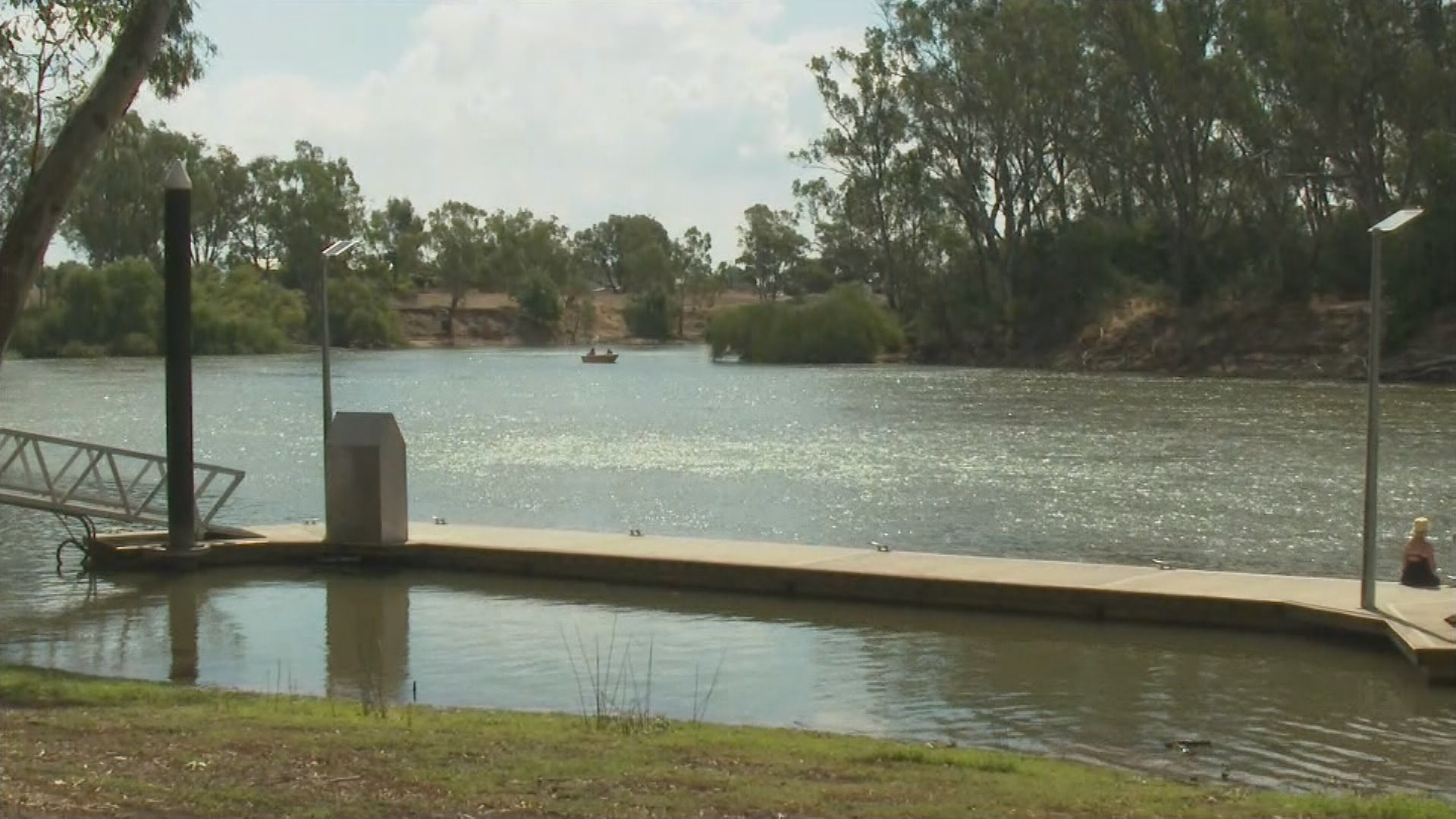
The body of a man has been recovered from the Murray River this evening, hours after he got into difficulties whilst swimming in a popular waterhole in Victoria's north.
Emergency services were called to Thompsons Beach on the Muarry River near Cobram at about 1pm today following reports the man went under the water and didn't resurface.
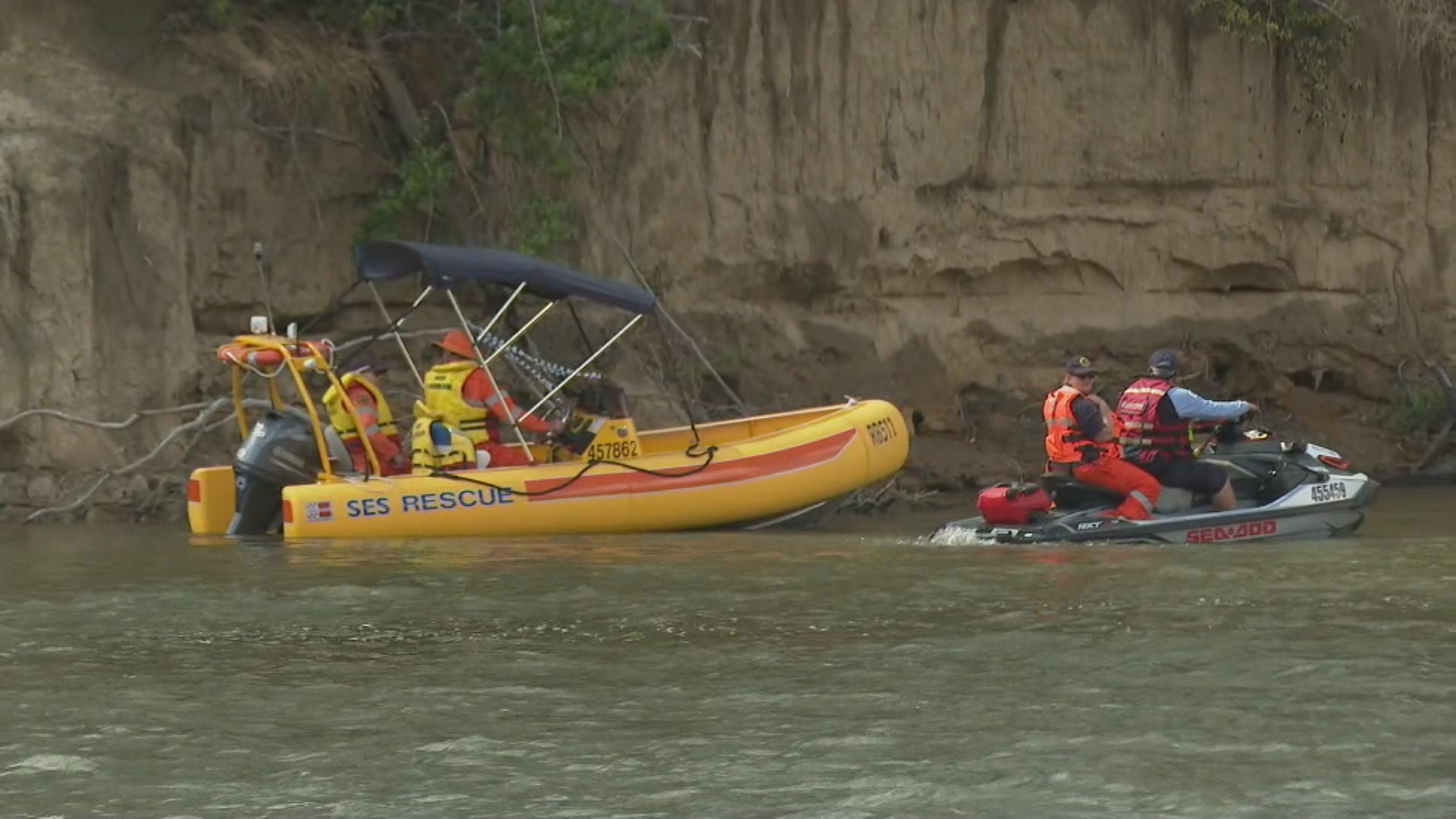
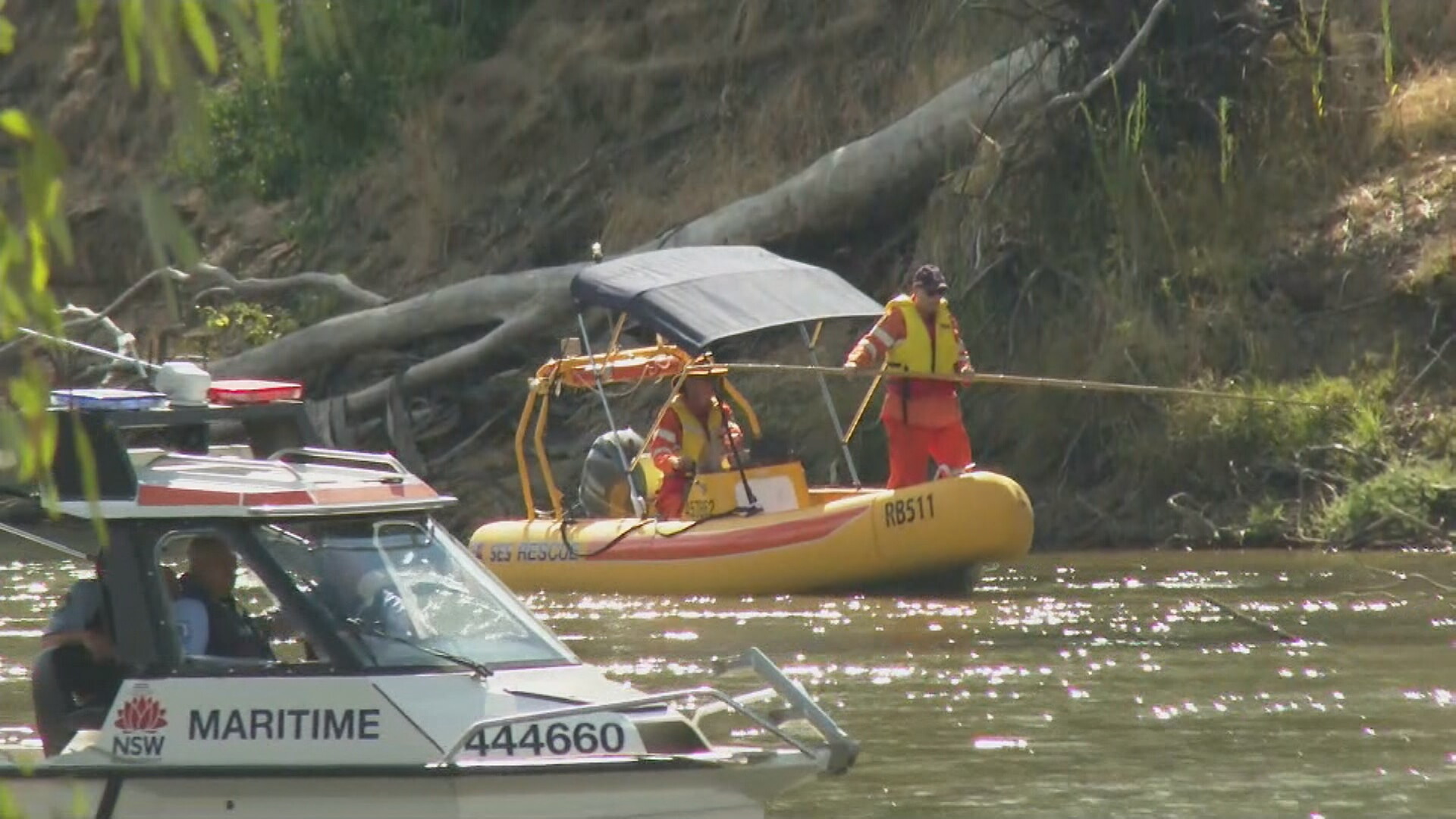
Members of the SES, Victoria and NSW police as well as member of the public joined the search for the man feared drowned.
At approximately 8.40pm, members of the Victorian Police Dive Unit located the 35-year-old submerged in four-metres of water, and he was declared deceased.
Authorities told 9News the man, from St Kilda, was on holidays with friends when the incident occurred.
"Friends entered the water here at Thompson beach and proceeded to swim across the river. However, on the way across one of the males came into some difficulties and sunk beneath the surface," NSW Police Acting Inspector David Forland told 9News.
"His friends were not able to help him at the time."
Witnesses say the man was taken by the current of the river.
"Everyone was having fun… and unfortunately this sort of thing can happen to anyone really," one witness, Peter, told 9News.
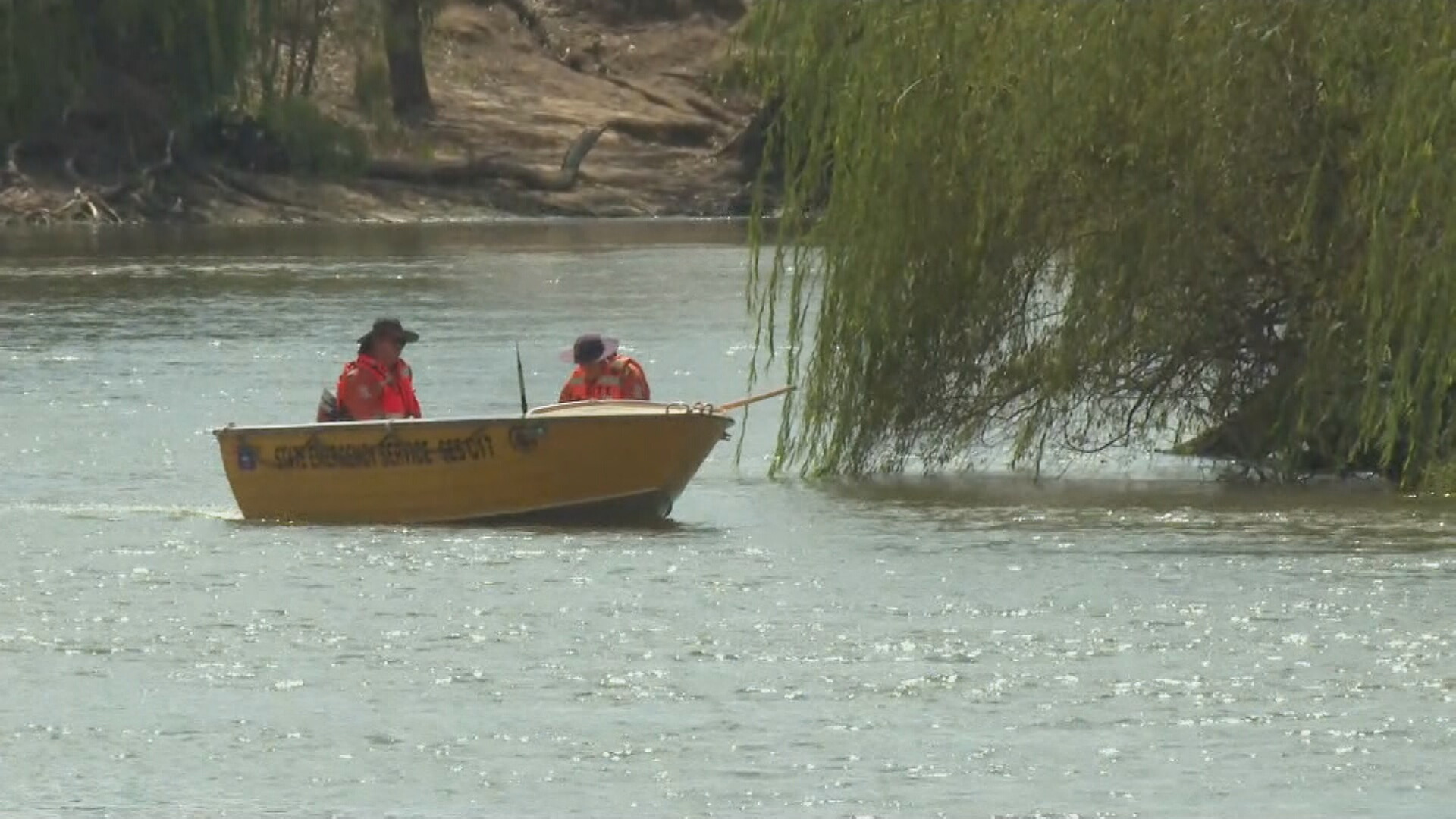
"He was swept down on the embankment over there on the other side and was last sighted right near this small boat," another witness said.
The incident comes after a deadly start to the year for swimmers, with seven people drowning in the past two weeks in Victoria and NSW.
More Anti-Lockdown Rioting Sweeps Holland
A third night of rioting has shaken the Netherlands as protesters rampaged through towns and cities around the country after government introduced a night-time curfew.
About 150 people were arrested on Monday in Amsterdam and Rotterdam, where shops were vandalised and looted, and the mayor, Ahmed Aboutaleb, issued an emergency decree giving police broader powers of arrest.
“These people are shameless thieves, I cannot say otherwise,” he said. “I had to threaten them with the use of teargas – a far-reaching measure. I find that sad, because I have never had to do that in my entire career as mayor.”
But trouble also flared in smaller centres around the country such as Den Bosch, Zwolle, Amersfoort, Alkmaar, Hoorn, Gouda – where several cars were set on fire – and Haarlem, where police were attacked with stones.
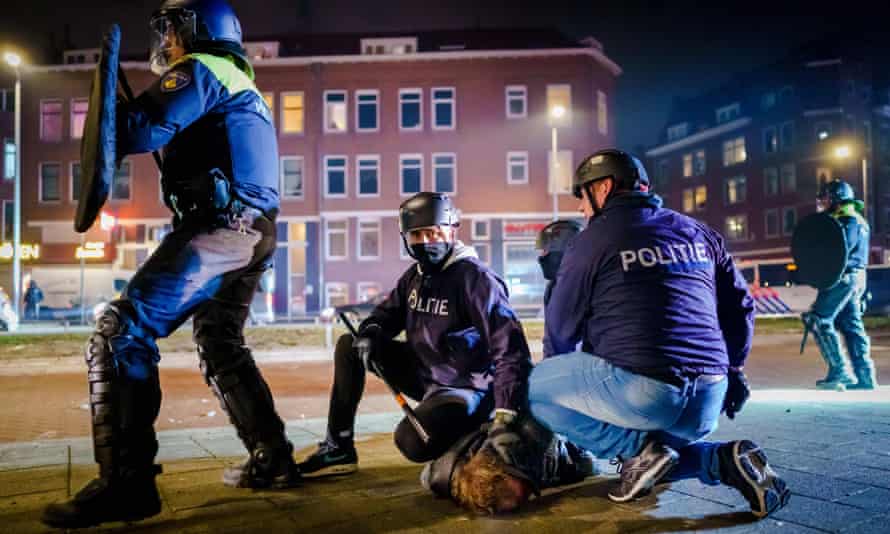
Officials said the rioters, who reportedly used social media apps to organise, were overwhelmingly teenagers, and questioned the extent to which they were motivated by opposition to the 9pm curfew, which came into force on Saturday.
“This is serious disturbance of public order,” said the mayor of Haarlem, Jos Wienen. “The measures are tough for everyone, we all want to be free to move. But that does not entitle anyone to start fires, let off fireworks and commit vandalism.”
The prime minister condemned the weekend riots in which anti-lockdown protesters attacked police and set cars on fire. “What motivated these people has nothing to do with protest; this is criminal violence,” Mark Rutte said.
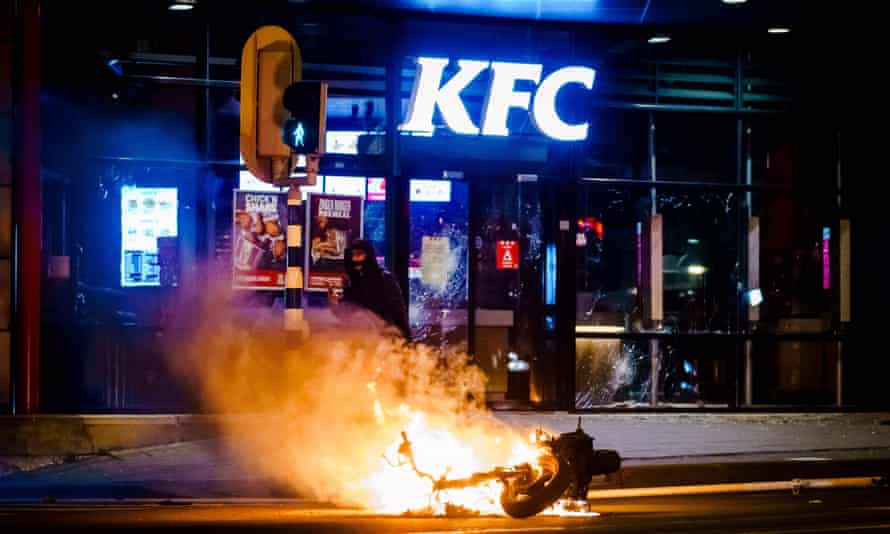
Police said 300 people were detained on Saturday and Sunday after youths threw rocks and in one case knives at officers, attacked a hospital and burned down a Covid testing station. More than 5,700 fines were issued for breaking the curfew.
Bars and restaurants have been shut in the Netherlands since October, with schools and non-essential shops following suit in mid-December. Infection numbers are falling but authorities fear the possible faster spread of the UK variant of the virus.
Rutte’s government is acting in a caretaker capacity before the election, scheduled for 17 March, after resigning last week over a child benefit scandal.
Koen Simmers, the head of the national police union, told Dutch television officers were prepared should the rioting continue. “I hope it was a one-off but I’m afraid it could be a harbinger for the days and weeks to come,” he said.
The post More Anti-Lockdown Rioting Sweeps Holland appeared first on The St Kitts Nevis Observer.
Mexican President & Country’s Richest Person have COVID
Latin America’s richest man Carlos Slim has tested positive for Covid-19. The 80-year-old Mexican telecommunications billionaire was only showing “light symptoms” and was doing “very well”, his son wrote in a tweet.
It comes a day after Mexican President Andrés Manuel López Obrador, 67, also contracted the disease.
Mexico is among the world’s worst hit nations, with more than 1.7 million confirmed cases since the pandemic began, and over 150,000 deaths.
In Monday’s tweet, Mr Slim’s son Carlos Slim Domit wrote that his father was “making very good progress with Covid-19 after more than a week of minor symptoms”.
Carlos Slim had been seen at Mexico’s National institute of Nutrition for clinical analysis, the tweet added.
The tycoon and his family, who control Mexico’s largest telecoms provider America Movil, are worth an estimated $52bn (£38bn), according to Forbes magazine’s list in 2020.
Mexico continues to experience its worst moment since the pandemic reached the country last year, the BBC’s Mexico correspondent Will Grant reports. Hospitals in the capital Mexico City are overflowing, and the infection rate shows little sign of slowing down.
President López Obrador announced that an agreement had been reached with Russia for delivery of 24 million doses of the Sputnik V vaccine in the next two months – but in the short term the outlook for many Mexican families remains bleak, our correspondent says.
The post Mexican President & Country’s Richest Person have COVID appeared first on The St Kitts Nevis Observer.
Corona Latest: Deaths-UK 104,000; US 431,000; Brazil-217,700
The data from the UK’s national statisticians show there have been nearly 104,000 deaths since the pandemic began, the highest in Europe.
The figures, which go up to 15 January, are based on death certificates. The government’s daily figures rely on positive tests and are slightly lower.
It comes after a surge of cases in December, leaving the UK with one of the highest Covid death rates globally.
The Office for National Statistics and its counterparts in Scotland and Northern Ireland registered 7,776 deaths involving Covid in the most recent week.
Brazil Vaccine Rollout Stalls from Syringe Shortage
Brazil began its national vaccination programme a week ago, but there are already reports of serious problems in the roll-out.
Scientists say the country is close to running out of vaccine, syringes and other vital equipment, and they blame Jair Bolsonaro’s government for the shortcomings.
With a population of 212 million and sprawling geography including some extremely remote communities, Brazil has a mammoth task ahead.
Critics say the government is failing in the vaccine roll-out – the vice-president of the Brazilian Society for Immunology Isabella Ballalai blamed the “incompetency” of the health ministry.
There are also complaints of people being vaccinated out of turn.
Brazil currently has about six million doses of Chinese vaccine SinoVac, as well as two million of the Oxford-AstraZeneca jab.
More than 215,000 people have died in Brazil from Covid-19, with about 1,000 fatalities a day during this current wave of infections.
The post Corona Latest: Deaths-UK 104,000; US 431,000; Brazil-217,700 appeared first on The St Kitts Nevis Observer.
Jamaica: 4 Hacked to Death in Grisly Homeless Murder Spree
Lionel Johnson, 47, lights a cigarette while sitting outside the Kingston and St Andrew Municipal Corporation temporary night shelter on Church Street. Deported from New York almost two decades ago, Johnson said he has no relatives here in Jamaica. He said he was shocked to hear about the brutal attacks on the homeless that left four dead and two injured.
The cold, haunting streets of Kingston were frozen with fear on Monday night as the capital’s nomads snuggled in corners or retreated to shelters in the aftermath of the grisly murders of four homeless men and the wounding of two others.
The macabre scenes spanned an arc of 9.5km (6.0 miles), stretching from the shopping strip of Half-Way Tree to downtown and further west near Bumper Hall.
Kingston Mayor Delroy Williams called the incidents a “stain” on the nation – a contrast to what he viewed as improving relations between the public and the homeless population.
While attacks, even deadly ones, on homeless persons occur occasionally, Jamaicans awoke to a scale of carnage to the city’s vulnerable as infamous as it was horrific.
The police said their probe into what appeared to be coordinated attacks was ongoing as they pursued several leads. Some of downtown’s homeless who spoke to journalists believe that one of their own might have been responsible for the bloodbath.
The investigations might also delve into questions of whether the savagery was the work of a serial killer. It is uncertain whether the acts were committed by a single person.
Barrington Hall bemoaned the murder of his soulmate and friend ‘Soljie’, one of the four men killed in the streets between Sunday night and Monday morning. Soljie met his demise on the outskirts of the civil and tax division of the Kingston and St Andrew Parish Court – chilling irony of the injustice that befell him.
Hall, who has been homeless for years and regularly hangs out with Soljie, mused that he might have suffered a similarly bloody fate if he had slept near his pal on Sutton Street as usual.
“Dem say me miss it. I sleep out here. Me and she, too,” Hall told The Gleaner, referencing a nearby homeless woman.
“We talk about woman and thing and we smoke, enuh … . Sometimes I beg him a draw or I buy my own and ting, yuh know. Otherwise he was just a friend.”
Two deceased were found on Hanover Street in the Kingston Central Police Division and a fourth in Kingston West in the vicinity of the Mother White Bridge.
The injured men were found at a Constant Spring Road plaza and on Derrymore Road in the St Andrew Central Police Division.
A resident of central Kingston who lives in the area where the downtown murders occurred told The Gleaner on Monday that the attacks were an indictment on the State and the people of Jamaica. He was seen busily covering bloodstains with sawdust.
“Homeless people are being murdered on the streets and not being protected by the citizens and the State, especially in COVID time.
“If they were allowing people on the street over time, maybe somebody would see the act and try and stop it,” the man, who requested anonymity, said, hinting at the nightly islandwide curfews that run from 10 p.m. to 5 a.m.
Another resident, Marlon Carter, was more concerned about the attacker and the motive.
He theorised that the modus operandi was consistent with the threats issued by a mentally ill man who roamed central Kingston.
“He was here before, but him come back about two weeks now. Every madman afraid of him. He is insane and threatens people before him attack,” he said.
The police could not confirm whether that person was a suspect.
Security personnel at the Poor Relief Department in Kingston indicated that arrangements were being made to accommodate as many homeless persons as possible overnight.
There are an estimated 2,000 homeless people in Jamaica, around 700 of them in Greater Kingston. The capital’s downtown region accounts for about 500 of them.
Lionel Johnson was among a few lonely souls who battled the chill on a Kingston sidewalk Monday night.
The 47-year-old deportee from the United States has no family and was fearful of what the night held for him on Church Street.
Earlier on Monday, Minister of Local Government and Rural Development Desmond McKenzie also condemned the attacks.
“While these are clearly horrific and criminal acts, I am left to wonder if this is the outcome of an outburst of madness. It challenges me to do even more for our homeless population,” McKenzie said in a statement.
Opposition Leader and PNP President Mark Golding called for immediate action to be taken by the Government in response to the killings.
“This morning’s (Monday’s) incidents are further evidence of the severity of the crisis of violence in our nation, where Jamaica has become a place in which our most vulnerable and defenceless can be so heartlessly attacked and murdered in our capital,” Golding said.
The post Jamaica: 4 Hacked to Death in Grisly Homeless Murder Spree appeared first on The St Kitts Nevis Observer.
S.A. Pres. Accuses Wealthy Nations of Hoarding COVID Vaccine
The president of South Africa, Cyril Ramaphosa, has called on wealthy countries to stop hoarding excess Covid-19 vaccines, as he said the world needed to act together to fight the pandemic.
Ramaphosa, who currently chairs the African Union, said African countries wanted access to vaccines as quickly as other nations.
South Africa’s Covid outbreak is the worst in Africa, with 1,417,537 cases confirmed since the start of the pandemic, and 41,117.
The post S.A. Pres. Accuses Wealthy Nations of Hoarding COVID Vaccine appeared first on The St Kitts Nevis Observer.
Covid 19 coronavirus: Cook Islands cancels flight bound for Rarotonga tomorrow
The Cook Islands has cancelled a flight bound for Rarotonga tomorrow.Cook Islands Prime Minister Mark Brown said they want to allow more time for tests of the close contacts of the Northland Covid-19 community case to come back.Of…