A Rotorua Lotto player has won $8.5 million in tonight’s draw. The player won Powerball First Division, after buying their ticket at Western Heights Foodmarket. Read More ‘Life-changing’ $18m Lotto Oamaru win: Mayor’s fingers…
All posts by FreeNews
Covid 19 coronavirus: The number of people passing through MIQ passes 100,000
The number of inbound travellers who have passed through New Zealand’s managed isolation and quarantine facilities has tipped 100,000. The milestone was confirmed on the Ministry of Business Innovation and Employment’s website today….
Aus Open quarantine 'fully funded by Tennis Australia'
Clarity has finally been provided around the sensitive issue as to who is footing the bill for the Australian Open hotel quarantine program, after a public dispute between Tennis Australia and the Victorian Government.
Craig Tiley, CEO of Tennis Australia, told 3AW this morning the cost would surpass $40 million and the government would "absolutely" be contributing.
But in a statement issued late today, the peak body clarified it was funding the program.
"Tennis Australia is funding the AO quarantine program.

"The Victorian Government support relates to ongoing discussions about funding for an extension to the agreement to host the AO in Melbourne and a range of other assets to help promote the city and the state, domestically and internationally," the statement reads.
Not long after Mr Tiley made the claim on 3AW, emergency services minister Lisa Neville firmly stated the government was not paying for Australian Open hotel quarantine.
"I want to be really clear about this … hotel quarantine is fully funded by Tennis Australia," she said.
"We do support the Australian Open as an event, but that is separate to the Australian Open quarantine program."
READ MORE: Regional Victoria travel vouchers snapped up within 20 minutes
https://twitter.com/andrew_lund/status/1351692064963010561?ref_src=twsrc%5Etfw
Ms Neville said there was no question about who was paying and that Victorian taxpayers would not be contributing to the program.
Mr Tiley said the Australian Open usually brought in about $370 million to the Victorian economy each year and created roughly 12,500 jobs which would be understandably down this year as a result of the coronavirus pandemic.
He also told 3AW that crowd capacity could go to 50 per cent capacity granted no outbreaks occurred near the February 8 start date.
The Australian Open site will be divided into three zones, with contact tracing and COVID safe practices applied throughout the tournament.

Mr Tiley said six cases linked to the Open were currently in medi-hotels after returning positive tests, none of which are players.
Two players were deemed positive cases by the Department of Health and Human Services yesterday, but these are understood to be inactive shedding cases so those people are not in a medi-hotel but remain in a quarantine environment.
All players and support staff are now in Melbourne for the Australian Open, with the first lot of arrivals reaching day six of their hotel quarantine period.
Ōpōtiki councillor to complain to Race Relations Commissioner over Grey Power newsletter
A councillor says he will complain to the Race Relations Commissioner after his use of te reo Māori while saying a karakia at a Grey Power meeting was labelled an “insult”.Ōpōtiki councillor Louis Rapihana said he…
Pōhutukawa tree massacre accused remanded for home detention
The man who massacred eight expensive pōhutukawa trees with a chainsaw in an upmarket Auckland suburb last year has been remanded on bail while a sentence of home detention is considered.Alexei Leandios Hodder, 40, had pleaded…
Canberra scientist leaves legacy in ground-breaking cancer research trial
A Canberra father who died less than a year after being diagnosed with a rare cancer will leave behind an enduring legacy with a world-first Australian study supported by his research fund set to begin.
Scientist Matthew Fisher passed away on January 8 this year from a rhabdomyosarcoma – a soft-tissue cancer more common in children.
"He was a kind and gentle person," his wife Naomi told nine.com.au.
"Matt was very reserved but he really loved life and was such a positive person. He had just a nice presence about him.
"He was also so brave and so stoic in the way he battled the cancer."
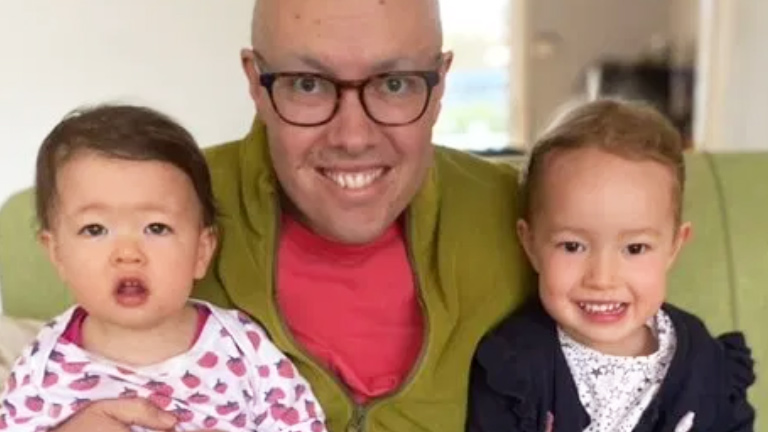
Mrs Fisher said her husband first noticed something was wrong when he lost the sensation in his left leg in February last year.
"A couple of weeks later he found a lump in the pelvis. He went to the GP and then after a few days he was in quite a bit of pain so he went to emergency," she said.
It was at Canberra Hospital where he was diagnosed with rhabdomyosarcoma.
"It was like the perfect storm when he was diagnosed. March is when all the coronavirus lockdowns started happening. The beginning of his treatment almost coincided to the day of when schools got shut down," Mrs Fisher said.
Mr Fisher worked as a chemical patent examiner and had a PhD in chemistry.
Mrs Fisher said her husband put his knowledge to good use and thoroughly researched his illness, making sure he knew the exact make-up of the chemotherapy drugs he was taking.
She said they joked he would be "micromanaging his drugs until the very end, asking the doctors exactly how many milligrams he was being administered".
World-first study could benefit many
It was Mr Fisher's dying wish to help further research into bone and soft-tissue sarcoma cancers, about which little is known.
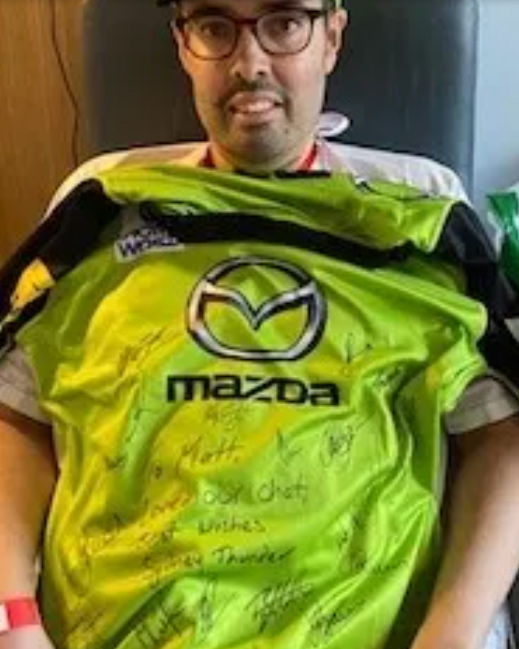
Around 1000-1500 patients in Australia are diagnosed of a sarcoma every year.
It is one of the least common cancers in adults but accounts for about 10 to 15 of all childhood cancers.
"A couple of months before Matt died, when we found more metastases, he told me that he would like to raise money for research," Mrs Fisher said.
"He just wanted to help other families, so that no family would have to go what we would go through."
So far, more than $55,000 has been raised through the Matthew Fisher Sarcoma Research Fund, run by the philanthropic Cooper Rice Brading Foundation.
All of the funds will go towards a ground-breaking sarcoma study at Sydney's Garvan Institute of Medical Research.
The study, due to begin within weeks, will trial a drug commonly used to treat psoriasis on 32 patients with sarcomas over the next 12 to 18 months, Professor David Thomas, an oncologist and Head of the Cancer Theme of the Garvan Institute, said.
The study will build on work previously done by researchers at the Garvan Institute which identified a gene – called interleukin-23 – as playing an important role in allowing osteosarcoma, or bone cancer, to develop.
Coincidentally, some drugs already used on the market to treat psoriasis work by blocking the same interleukin-23 gene.
So researchers tested the drug on mice with osteosarcomas.
"When we used drugs that blocked interleukin-23 we were able to slow down the growth and shrink the tumours when these mice were carrying tumours," Professor Thomas said.
"The purpose of the study now is to see whether the drug will work with patients with sarcomas and well as working for patients with psoriasis.
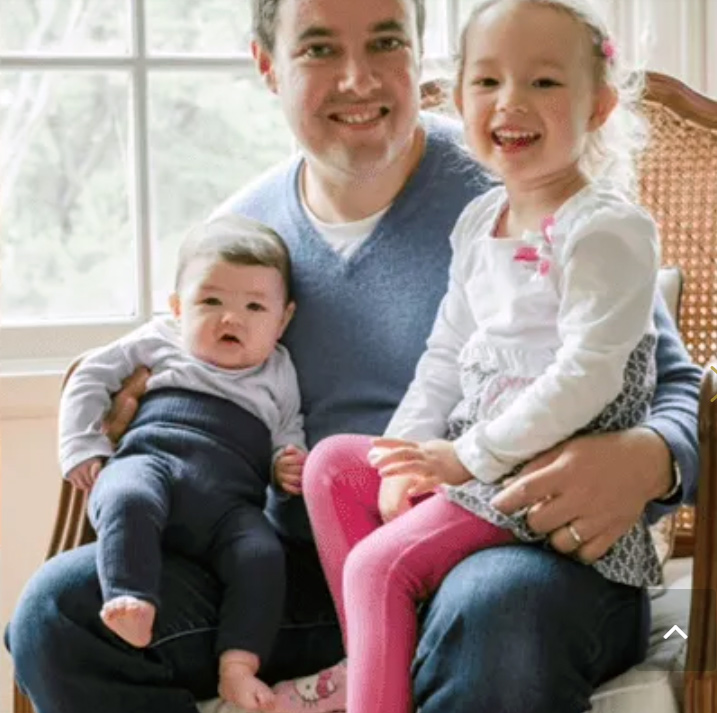
"This will be the first study of its kind worldwide, it's opening up new territory. Interleukin-23 may be promising for a wide variety of cancers but nobody has ever treated cancer patients with an interleukin-23 blocking agent before.
"We have got our fingers crossed. If it works it will open up whole new treatments for many cancer patients, including patients with sarcoma."
Professor Thomas said fundraisers such as Mr Fisher's played a crucial role in enabling the pursuit of new areas of cancer research.
"The first investment in any new area is often supported by philanthropic support rather than by government," he said.
"Philanthropy is catalytic in its capacity to take new ideas and get them to the point where governments can take over where there is a hint of promise.
"Studies like ours are enormously dependent on philanthropic support."
Tania Rice-Brading, from the Cooper-Brading Foundation, said she was in awe of what Mr Fisher's research fund had managed to achieve in such a short period of time.
"It really leaves me without words. It's bittersweet. I would have much rathered that the trial was up and running so that Matt could have been a beneficiary. But It's an amazing legacy that he has left behind and it will help so many," she said.
Contact reporter Emily McPherson at em********@******om.au.
Hāwera double homicide: 55yo father and 15yo son killed, investigation continues
The father and son killed in a Hāwera home early Monday morning have been confirmed by police as 15-year-old Regan Frost-Lawn and 55-year-old Stephen John Frost. Their bodies were found by police who were called to a property…
School computer network blocks 2000 online threats a minute
School computer networks blocked more than 2000 online threats every minute when students returned to school after the first Covid-19 lockdown last year.The schools’ Government-funded Network for Learning (N4L) says it blocked 120…
Auckland Transport unveils fleet of electric buses for new AirportLink service
By Steve Forbes, Local Democracy Reporter Auckland Transport has today rolled out new electric buses that will run on the AirportLink between Manuaku and the Auckland International Airport.The vehicles will be operated by Go Bus…
Joe Biden Inauguration: New Zealand DIA deploys online counter-terror team
Warnings of violent political acts in the United States have prompted New Zealand authorities to deploy an online counter-terrorism team.The Department of Internal Affairs is assigning staff to monitor online platforms before, during…