Category Archives: headline

Now Pfizer Has Anti-COVID-19 Pill That Works

Pfizer announced on Friday that its pill to treat Covid-19 had been found in a key clinical trial to be highly effective at preventing severe illness among at-risk people who received the drug soon after they exhibited symptoms.

The antiviral pill is the second of its kind to demonstrate efficacy against Covid. It appears to be more effective than a similar offering from Merck, which is awaiting federal authorization.

Pfizer’s pill, which will be sold under the brand name Paxlovid, cut the risk of hospitalization or death by 89 percent when given within three days of the start of symptoms.

Pfizer said an independent board of experts monitoring its clinical trial had recommended that the study be stopped early because the drug’s benefit to patients had proved so convincing. The company said that it planned to submit the data as soon as possible to the Food and Drug Administration to seek authorization for the pill to be used in the United States.

“The results are really beyond our wildest dreams,” said Annaliesa Anderson, a Pfizer executive who led the drug’s development. She expressed hope that Paxlovid “can have a big impact on helping all our lives go back to normal again and seeing the end of the pandemic.”

The treatment could become available in the next few months, though supplies are likely to be limited at first. The Pfizer and Merck pills are both geared toward patients regarded as high-risk, such as those above the age of 60 or with conditions like obesity that make them more susceptible to severe consequences from Covid.

The post Now Pfizer Has Anti-COVID-19 Pill That Works appeared first on The St Kitts Nevis Observer.

Points Standing Leader Unity Halted by Molineux in #7 Domino League

BASSETERRE, ST. KITTS, November 5, 2021 (MMS-SKN) — It was an evening of anguish for three former champion teams of Constituency Number Seven Dr the Hon Timothy Harris Domino League on Thursday November 4 at the new Lodge-Ottley’s Community Centre, as the keenly contested competition entered the twelfth segment of play in the 26th edition of the league.

Unity Domino Club, a team that is leading on the points standing table, received a sound beating at the hands of Molineux Domino Club. In a game that had Molineux open up an early 4-0 lead saw Unity rallying back to have the game tied at 6-6, but Molineux showed that they still have playing power in them when they finished the game as the 13-9 winner.

Defending champion team, Tabernacle Domino Club did not have it that easy as they had to work extra hard to stop former champion team Parsons Domino Club with a 13-11 beating. The game between former champion team, Lodge Domino Club and Sylvers Domino Club ran into a dispute and was abandoned when Sylvers was leading 11-9.

In a very tight game Tyke Isaac of Phillips Domino Club skilfully navigates the board to be able to overcome Unstoppable Domino Club with a 14-12 win.


In the most hotly contested game of the evening, Phillips Domino Club and Unstoppable Domino Club had gone neck-and-neck all the way to the end and after tying 12-12, the game could have gone either way. But Phillips’ Captain Allington ‘Leggy’ Berridge and player Desroy Tate could not stand any knockabout at that late stage and decisively stung Unstoppable with a 100-0 clean game that earned them a bonus game for a 14-12 win.

In other games, Saddlers Domino Club beat Guinness Domino Club 13-8; Christ Church Domino Club beat Small Corner Bar Domino Club 13-8; and Mansion Domino Club beat Ottley’s Domino Club 13-5.

Even with the loss at the hands on Molineux, at the end of the twelfth segment of play in the 26th edition of Constituency Number Seven Dr the Hon Timothy Harris Domino League, former champion team Unity is still firmly at the top on the points standing table with 54 points. It is followed by Phillips who have 46, Lodge 44 points, and Molineux 44 points.

Others, in order, are Mansion 42 points, Christ Church 39 points, Parsons 38 points, Sylvers 36 points, Tabernacle 36 points, Saddlers 36 points, Unstoppable 23 points, Guinness 21 points, Small Corner Bar 20 points, and Ottley’s 12 points.

Constituency Number Seven Dr the Hon Timothy Harris Domino League, which is the longest running such league in the Federation of St. Kitts and Nevis, is sponsored by Prime Minister and Area Parliamentary Representative for St. Christopher Seven (Bellevue to Ottley’s), Dr the Hon Timothy Harris.

Thirteenth, and final, segment of play in this single round of play in the 26th edition of the league plays off on Tuesday November 9 at the new Lodge-Ottley’s Community Centre, where defending champion team Tabernacle will face it off with Small Corner Bar.

Other games will see leader on points standing table Unity coming up against Phillips, two former champions Lodge and Parsons will come up against each other, Saddlers vs. Sylvers, Mansion vs. Unstoppable, Molineux vs. Guinness, and Ottley’s vs. Christ Church.

Lashley Weekes of Christ Church Domino Club makes a move during their game with Small Corner Bar Domino Club, where his team emerged the 13-8 winner.


The post Points Standing Leader Unity Halted by Molineux in #7 Domino League appeared first on The St Kitts Nevis Observer.

Activists Rally at UN COP26 Climate Conference

  • Thousands march through Glasgow
  • Activists take conference stage at COP26
  • Conference president tells negotiators to push harder
  • House to vote on Biden package, including climate measures

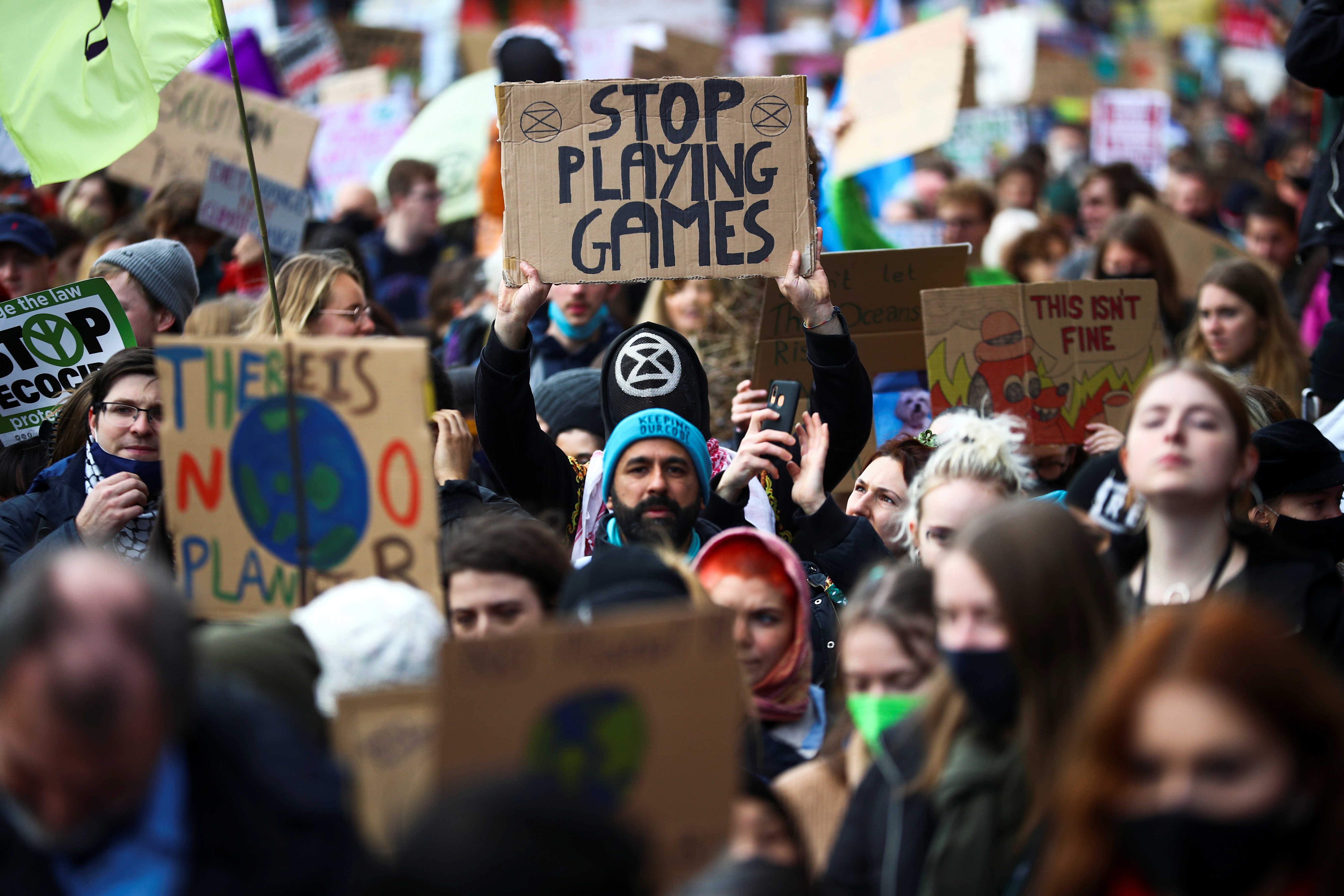
GLASGOW, Scotland, Nov 5 (Reuters) – Thousands of young campaigners marched through the streets of Glasgow on Friday to demand that world leaders at the U.N. climate conference safeguard their future against climate change.

Inside the COP26 conference venue in Glasgow, Scotland, civil society leaders were taking over discussions at the end of a week of government speeches and pledges, which included promises to phase out coal, slash emissions of the potent greenhouse gas methane and reduce deforestation.

Campaigners and pressure groups have been underwhelmed by the commitments made so far, many of which are voluntary or set deadlines decades away.

Those marching held placards and banners with messages that reflected frustration with what Swedish activist Greta Thunberg described as “blah-blah-blah” coming from years of global climate negotiations.

“You don’t care, but I do!” read one sign, carried by a girl sitting on her father’s shoulders.

Thunberg galvanised young people around the world to take action in “Fridays for Future” school strikes – which began with her standing every week outside the Swedish parliament.

“If you were smarter, I’d be in school” was the message carried by another protester. Many of the marchers took the day off school to take part.

The British president of the two-week conference acknowledged that much more needed to be done to secure more ambitious commitments to stop the world’s slide into climate catastrophe, urging national negotiators to step up the pace.

“It is not possible for a large number of unresolved issues to continue into week 2,” Alok Sharma said in a note published by the United Nations.

“The Earth’s climate is changing!” read one schoolchild’s placard, under a hand-painted picture of a globe on fire. “Why aren’t we?”

ACTION IN CONGRESS

On Friday, the U.S. House of Representatives was due to vote on President Joe Biden’s mammoth “Build Back Better” package, including $555 billion of measures aimed at halving greenhouse gas emissions by 2030 and adapting to climate change. read more

The COP26 talks in Glasgow aim to secure enough national promises to cut greenhouse gas emissions – mainly from fossil fuels – to keep the rise in the average global temperature to 1.5 degrees Celsius, which scientists say is a tipping point towards far more extreme weather events.

To that end, the United Nations wants countries to halve their emissions from 1990 levels by 2030, on their way to net-zero emissions by 2050, meaning the world would release no more climate-warming gases than the amount it is simultaneously recapturing from the atmosphere.

Demonstrators holding placards attend the Fridays for Future march during the UN Climate Change Conference (COP26), in Glasgow, Scotland, Britain, November 5, 2021. REUTERS/Dylan Martinez

So far, the summit has yielded deals to try to phase out coal over the next three decades – albeit without the world’s biggest consumer, China. Some have also pledged to reduce deforestation and curb methane.

The Glasgow talks also have showcased a jumble of financial pledges, buoying hopes that national commitments to bring down emissions can actually be implemented. read more

U.S. climate envoy John Kerry said on Friday it was possible to reach a deal at the summit settling the final details of the rulebook for how to interpret the 2015 Paris Agreement.

Kerry said the United States was in favour of having the most frequent possible assessments of whether countries were meeting their Paris Agreement goals to reduce greenhouse gas emissions, saying it would be “negligent” to leave Glasgow with assessments set too infrequently.

THE ARCTIC COMES TO GLASGOW

Elsewhere this week, city mayors have been huddling over what they can do to advance climate action back home.

“National governments are slow to communicate – very bureaucratic, internally and between each other,” said Los Angeles mayor Eric Garcetti, chair of the C40 global mayors’ network for tackling climate change.

But a clear picture has yet to emerge on how far these voluntary initiatives could moderate global warming.

The head of the International Energy Agency, Fatih Birol, said on Thursday that emissions cut pledges made so far – if all implemented – could potentially restrict warming to 1.8C. But some U.N. negotiators and non-profit organisations said that assessment was too rosy, and much more work had to be done. read more

Former U.S. Vice President Al Gore offered conference-goers a lengthy and scientific video and photo presentation filled with shocking images of climate-fuelled natural disaster, from flooding to wildfires.

“We cannot allow this to become the new normal,” Gore said.

Professor Gail Whiteman, founder of the climate activist group Arctic Basecamp, said she hoped protest actions and campaign events could add urgency to the discussions.

An iceberg was shipped by her group from Greenland via Iceland to the east coast of England, then by truck to Glasgow. On Friday, it was the size of a passenger vehicle, and was melting in an exhibition centre.

“Studies are showing that if we lose the snow and ice in the Arctic, we will amplify global warming by 25 to 40%,” she said. “We felt that negotiators here had to actually come face to face with the Arctic, so we brought the iceberg.”

Additional reporting by Katy Daigle in Glasgow; Editing by Kevin Liffey and Janet Lawrence

The post Activists Rally at UN COP26 Climate Conference appeared first on The St Kitts Nevis Observer.

Leaders of smaller islands stand up amid climate destruction and unkept promises

By Sir Ronald Sanders  

COP26 in Glasgow offered no hope to small island states which continue to face destruction and extinction.

COP26 was always going to be nothing but a theatrical performance, well-choregraphed by the world’s industrialized nations that want to give the impression that they are actually taking strong and enforceable action to curb Climate Change.

As I write the formal meeting is not ended. The fanfare is completed, principal actors have made obligatory presentations and left the stage to the negotiators. But the script is already written. All that was going to be offered has been put on the table and it amounts to more promises without binding and enforceable commitments, and no money that could make a difference.

Representatives of small and developing states attended with little hope and even less expectations. Yet, they were determined to raise their voices again, hoping that, at last, they might be heard. Barbados’ Prime Minister Mia Mottley was impressive when, at the opening ceremony, she declared that a 2-degree Celsius rise in global temperature would be a “death sentence” for island and coastal communities. The President of Palau,  Surangel S. Whipps, Jr, was equally strident, saying “you might as well bomb our islands instead of making us suffer only to witness our slow and fateful demise.”

But, in truth, the leaders of industrialized nations who attended came with their positions already taken. The strategy was clearly to make more promises to ward off criticism, even though previous promises remain unfulfilled. Among the earlier promises were that they would pay a $100 billion annually into a global fund to help developing countries adapt to climate change and mitigate further rises in temperature.

The other broken pledge was that they would ensure that the global temperatures were kept to 1.5 °Celsius above pre-industrial levels.  The world is on track now for a minimum of 1.9 °Celsius if major polluting countries honour the commitments they have made. At that point, small islands and low-lying coastlands  will be in calamitous conditions.

All that the industrialized nations have done is to extend the pledges for meeting commitments to 2050 and 2070, while maintaining or increasing their greenhouse gas emissions in the short to medium term.  This means that over the next two decades, small island states and countries with low-lying coastlands will suffer significant erosion and other extreme weather conditions that will hurt their economies, displace people from their habitats and cause civil disruption as employment is reduced and poverty increases.

There were three major commitments arising from the conference.  “The Glasgow Leaders’ Declaration on Forests and Land Use” is not transparent, it has no binding obligations for financing and no enforceable date has been set. Deforestation is already a global environmental and humanitarian crisis. Action should be taken now, or the absorption rate of CO2 by forests will continue to decrease significantly, thus accelerating the pace of Climate Change.

A pledge to cut methane emissions is also not transparent and not enforceable. In any event, China, India and Russia are major methane emitters and they have made no commitments, even though methane is the second most abundant greenhouse gas, after carbon dioxide.

On coal production – one of the greatest drivers of greenhouse gas emissions – while 40 countries agreed to phase it out, no such commitment was made by the major coal producing countries – China, India, Australia and the US.

Given those realties, however much COP26 may be hailed – as were past COP meetings – it delivered little for small island states except an initiative by a few countries, including Australia, India and the UK to help them build climate resilient infrastructure.  Enough details are not yet available to determine the efficacy of this initiative which has limited participation by rich countries.

The most significant event for small states surrounding COP26 was one which two of them took to establish a Commission of Small Island Developing States on Climate Change and International Law. The two countries, Antigua and Barbuda and Tuvalu have since been joined formally by Palau while other small states are settling internal procedures to join the collective action.

In announcing the establishment of the Commission on the first day of COP26, Antigua and Barbuda’s Prime Minister, Gaston Browne, explained that all efforts to get polluting countries to address the loss and damage that they have inflicted on small states, have been ignored. “We are pursuing the matter in the international legal system on the basis that he who damages must provide restitution. In other words, the polluter must pay.”

Director-General of the Commonwealth Foundation and international lawyer, Dr Anne Gallagher, hailed the commission’s establishment as a “wonderful, welcome and overdue development” since “the existing rules of international law have not been utilized to their full extent to hold countries to account for actions that they know are causing damage and continue to cause damage”.

The first act of the Commission, which is supported by a team of experienced international lawyers, will be “to request advisory opinions from the International Tribunal for the Law of the Sea (ITLOS) on the legal responsibility of States for carbon emissions, marine pollution, and rising sea levels”.

Kausea Natano,  the Prime Minister of Tuvalu whose island is facing extinction summed up the objective of forming the Commission.  He said, “For us, climate justice is a matter of survival. It is time to put words into action, to save small island states, and to save the world from impending disaster.”

There are, of course, sceptics of this bold move by small countries, but the initiating leaders have nothing to lose by standing-up for justice for their nations. The alternative is to sit by while their countries suffer interminable damage and losses to the detriment of their people – and that’s the very least of it.

So, hail the leaders of Antigua and Barbuda, Tuvalu and Palau for their courage, resolve and leadership at a time when all three qualities are needed.

Responses and previous commentaries: www.sirronaldsanders.com  


(The writer is Antigua and Barbuda’s Ambassador to the United States and the Organization of American States.   He is also a Senior Fellow at the Institute of Commonwealth Studies at the University of London and Massey College in the University of Toronto.  The views expressed are entirely his own)  

The post Leaders of smaller islands stand up amid climate destruction and unkept promises appeared first on The St Kitts Nevis Observer.

Seabed Survey: UK Supports Maritime Trade, Economic Growth in Cayman Islands

SThe UK Hydrographic Office (UKHO) will support maritime trade and economic growth in the Cayman Islands as it embarks on a new programme of seabed mapping surveys this month, the organisation has announced.

The surveys will unlock vital new information about the waters around the Cayman Islands and will enable safe navigation and the continued development of the islands’ sustainable blue economy.

Under the UK Government’s Overseas Territories Seabed Mapping Programme (OTSMP), UKHO will collect a range of geospatial data in waters around the islands to a depth of 40 metres. The survey will also have its estimated carbon impact offset by Fugro, who have been awarded the contract to conduct the data gathering.

The survey will be conducted by a small aircraft using LIDAR (light detection and ranging) data gathering techniques. The aircraft will fly twice daily for periods of up to four hours at a time over the islands, operating at a height of around 300m. While it is airborne, the aircraft’s onboard survey equipment will gather information on water depth and land heights, as well as high resolution images of both land and sea.

Phil Payne, Survey Delivery Manager, UKHO, said: “This is the first survey we have contracted where we have specifically asked for the environmental credentials of the company, and how the footprint of the survey will be minimised while still delivering the required products. In this instance, the company will not only be minimising their footprint, but also offsetting the estimated amount of CO2 produced, making it – I believe – the first near-carbon neutral lidar survey.”

Data from these surveys will initially be used to update nautical charts of the waters around the Cayman Islands, including navigable approaches to the territory’s important trade hubs and cruise terminals. This will enable UKHO to fulfil its role as the Primary Charting Authority for 71 coastal states around the globe, including the UK.

Information captured during the surveying, including seabed topography and aerial mapping, will also be used to help preserve the marine environment and enable the Cayman Islands government to sustainably harness the territory’s marine economic resources.

The marine data sets delivered by the survey will also provide UKHO with information to identify the precise location of seagrass beds, which play a vital role in storing ‘blue carbon’.

Speaking on the survey programme, Kerrie Howard, Hydrographic Programme Manager, UKHO, said: “I am delighted that we are able to undertake this important survey on behalf of the Cayman Islands Government. It will improve the safety of shipping around the islands and provide a wealth of data to support understanding, management and protection of the marine and land environments.”

Almost all activity in our oceans, from shipping to monitoring delicate marine environments, depend on accurate seabed mapping data that illustrates the shape and movement of natural underwater features. So, for island states like the Cayman Islands, the collection of this data is vital to supporting safe trade and sustainable economic growth and protecting their communities from the effects of climate change.

The post Seabed Survey: UK Supports Maritime Trade, Economic Growth in Cayman Islands appeared first on The St Kitts Nevis Observer.
‘Money to be Made in Pig Farming’- Nevis Livestock Extension Officer Claxton says

NIA CHARLESTOWN NEVIS — “There’s a lot of money to be made in pig production,” so says Mr. Rohan Claxton, Livestock Extension Officer with responsibility for Production on the Maddens Stock Farm, in the Department of Agriculture on Nevis.

He made the comment while encouraging farmers on the island to use a different system for their pig farming, as the department continues to ensure food security on Nevis.

“We are encouraging farmers to adapt the new methods of farming, to invest in better pen construction and the new breeds that the department is making available, and to implement better sanitation and hygiene practices.

“We want people to get away from the backyard style, one pig in a pen and keeping it for a year before slaughtering,” he said.

According to Mr. Claxton, the department has introduced the landrace breed of pigs and brought back the purebred Duroc pig. They are also in the process of constructing new pens for the pigs at the stock farm.

“The landrace is very prolific. So far, our average litter size is 12.  Survival, we have a 10 percent mortality rate which means we lose about two, three sometimes.

“We are presently constructing a new pig unit which will have the necessary structure in place to save the piglets. We have a design for foreign crates and we are going to set a proper managing programme to wean the piglets on time, and then we sell pigs for distribution,” he explained.

The Livestock Extension Officer also spoke of the cost cutting feeding practices which have been introduced for the pig breeding programme.

“Maybe once a week we collect the by-products of the Agro-processing plant. The peelings from the mango, the cassava, the guavas, the five finger and we use them to feed the pigs. That helps with their diet. They are high in protein also.

“Apart from giving concentrates which is almost 80 percent of what we do. We feed the concentrates – the sow ration and the pig grower – but to reduce cost we also feed the spent hops and the Brewers grains which is a by-product of the Carib Brewery and a waste product but it is very high in crude protein to help with the growth and the performance of the pigs,” he said.

Mr. Claxton noted that in the past pig farmers were deterred by the importation of pork from Brazil.  However, with the changes being implemented, the Department of Agriculture is hoping to counter importation with quality pork and better prices.


The post ‘Money to be Made in Pig Farming’- Nevis Livestock Extension Officer Claxton says appeared first on The St Kitts Nevis Observer.

Saint Kitts & Nevis Perfect Destination for Taiwan Tourists


TAIPEI (Taiwan News) — The 2021 Taipei International Travel Fair got underway Friday (Nov. 5), as Saint Kitts and Nevis, a diplomatic ally of Taiwan, works non-stop to promote its tourism.

Taiwan News talked to Saint Kitts and Nevis Ambassador to Taiwan, Jasmine E. Huggins, to learn more about its goals at the fair and about what the country has to offer Taiwanese tourists.

Huggins said the Caribbean nation depends heavily on tourism, so it is trying to present itself as an alternative destination for Taiwanese consumed by wanderlust. Currently, Taiwanese do not require any visa to visit the country, she said.

Huggins said her country is an exciting and COVID-safe destination due to its pandemic management and high rate of fully vaccinated Kittians, which has reached over 70%, while the percentage of Kittians with one shot is more than 76%. “We believe that as long as you’re vaccinated, and you’re looking for a fantastic, interesting happy time in the Caribbean, please consider Saint Kitts.”

As many observers predict global tourism will return to pre-COVID levels by 2024, the ambassador said that Saint Kitts will also work toward that goal, especially with regard to the cruise industry. She said that over 1 million passengers visited the nation during the 2018-2019 cruise season.

The ambassador listed the nation’s UNSECO site, Brimstone Hill Fortress National Park, historical places, gourmet cuisine, and pristine beaches as unmissable attractions. With regard to beach activities, Huggins recommended snorkeling, diving, and golfing, as some golf course holes are “right on the ocean.”

The ambassador said that Saint Kitts’ pork knuckle, conch chowder, and goat soup are all must-try local fare. Their national dish, salt fish, is typically served with coconut dumplings, breadfruit, and spicy plantains, she added.

Huggins mentioned that her country is working to export its domestically-produced hot sauces and rum to Taiwan, namely Llewellyn’s Hot Pepper Sauce, Clifton Estate Spiced Rum, and Brinley Gold Shipwreck Rum.

While describing her nation’s beauty, she referred to the local slang term “limin’,” which she defined as “coming to someplace like a bar, hanging out with your friends, drinking local rum, delicious food, and chatting with friends about current events.”

She encouraged Taiwanese to come to St. Kitts and Nevis to enjoy something different.

“We are safe, we are open, we are beautiful. You will have a good time,” she said.

For more information about Saint Kitts and Nevis tourism, please click here.

The post Saint Kitts & Nevis Perfect Destination for Taiwan Tourists appeared first on The St Kitts Nevis Observer.

Migrants Injured in Clashes with Mexican Troops

MEXICO CITY, Nov 4 (Reuters) – Dozens of migrants traveling north to Mexico City clashed with the National Guard in the southern state of Chiapas on Thursday, near to where a Cuban national was killed on Sunday by the militarized police force.

The group of mostly Central American women and children resumed their journey on Monday in the Pijijiapan municipality of Chiapas, after fatigue and illnesses among some members prompted a two day break.

“There are two injured migrants, they were badly beaten. The officers tried to surround them with their shields,” Luis Garcia, who helped organize the migrant caravan, told Reuters over the phone.

“Everything was chaotic. It’s not right that the authorities keep acting this way. Despite all the repression we’re not going to stop,” Garcia said, adding that authorities had escorted away migrants in at least four buses.

The National Guard did not immediately respond to a request for comment.

National Guard troops, who donned helmets and riot shields, confronted migrants, according to images on social media. Other videos shared with Reuters showed several migrants being detained by National Migration Institute agents.

The National Migration Institute also did not immediately respond to a request for comment.

The clashes occurred near to where a Cuban migrant was shot dead by the National Guard while four others were wounded by National Guard officers early on Sunday in an area where a caravan of migrants was heading towards the U.S. border.

About 3,000 people set off on foot last month from the Mexican city of Tapachula on the Guatemalan border. Many have rejected visas offered by Mexico, saying they distrust the authorities.

Reporting by Jose Torres and Lizbeth Diaz; Writing by Anthony Esposito; Editing by Aurora Ellis

The post Migrants Injured in Clashes with Mexican Troops appeared first on The St Kitts Nevis Observer.

Search for life on other worlds tops astronomy to-do list

A US survey of astronomers puts the search for extraterrestrial life at the top of their to-do list for the next 10 years.

In a report issued Thursday by the National Academy of Sciences, Engineering and Medicine, astronomers stressed the need to continue the hunt for potentially habitable planets circling other stars, building on the “extraordinary progress” already made.

The ultimate goal, they noted, is to capture pictures of any Earth-like worlds that might be out there.

READ MORE: NASA detects signs of possible first planet beyond our galaxy

This image, called the Hubble eXtreme Deep Field (XDF), combines Hubble observations taken over the past decade of a small patch of sky in the constellation of Fornax. With a total of over two million seconds of exposure time, it is the deepest image of the Universe ever made.

“Life on Earth may be the result of a common process, or it may require such an unusual set of circumstances that we are the only living beings within our part of the galaxy, or even in the universe. Either answer is profound,” the report stated.

“The coming decades will set humanity down a path to determine whether we are alone.”

Also ranked high: exploring the origins and evolution of black holes, neutron stars, galaxies and the entire universe.

READ MORE: Giant planet found orbiting a dead star shows what may happen when our sun dies

At the same time, the 614-page report stressed the need for greater diversity among astronomy’s ranks — still predominantly male — and suggested that NASA consider a science team’s diversity when doling out money for research or projects.

The survey is done every 10 years and draws input from scores of mostly US-based scientists.

The latest report recommends that NASA create a new office to oversee space observatories and overlapping missions in the coming decades.

First up should be a telescope that’s significantly bigger than the Hubble Space Telescope that would be capable of spotting planets that are 10 billion times fainter than their stars, the report stated.

Once the necessary technologies are ready, this telescope could be ready to launch in the 2040s for around $14.91 billion, followed by other mega observatories in the billions of dollars.

But the report emphasised the need for smaller, more modest missions as well.

Launching one spacecraft per decade with a cost cap of $2.03 billion, it stated, balances science with timeliness.

The report noted the threat in years past of cost overruns and delays in major projects.

Due to finally blast off next month, the NASA-led James Webb Space Telescope — designed to scan the early universe and explore the atmospheres of other worlds — is a prime example of that.

Yet its launch promises to be “a momentous occasion that will shape the course of astronomy and astrophysics in the coming decades," the report noted.

The report — sponsored by NASA, National Science Foundation, Energy Department and Air Force — noted that the survey was conducted during a health crisis.

While the pandemic has underscored the importance of science, “the ultimate economic and social impacts of the pandemic remain unclear, adding to the uncertainty of the future landscape.”

The report urged NASA, the National Science Foundation and Energy Department to treat harassment and discrimination “as forms of scientific misconduct,” add more diversity to its upper levels, and consider diversity when funding a project.

Non-Communicable Diseases in Caribbean Worsening Covid Impact

Loop- The high prevalence of non-communicable diseases (NCDs) in the Caribbean – such as high blood pressure, diabetes and cancer – is exacerbating the impact of the COVID-19 pandemic.

It is also hindering the subregion’s progress towards achieving sustainable development due to their multiple health, economic and social consequences, according to the authorities, representatives of international organizations and specialists participating Thursday in a virtual event organized by the Economic Commission for Latin America and the Caribbean (ECLAC).

The event was held ahead of the 20th meeting of the Monitoring Committee of the Caribbean Development and Cooperation Committee (CDCC), to be held on Friday.

“Not only does the COVID-19 pandemic continue to rage in the Caribbean,” Executive Secretary of ECLAC Alicia Bárcena affirmed, emphasizing that it is “one of the subregions of the world with the highest prevalence of non-communicable diseases (NCDs).”

Data from the World Health Organization (WHO) shows that NCDs are the main cause of death in the subregion’s countries, ranging from 57 per cent in Haiti to 83 per cent in Barbados.

In each Caribbean country, more than half of all deaths annually can be attributed to non-communicable diseases, which also contribute significantly to a disability, Bárcena warned.

The pandemic has aggravated the risks that people with non-communicable diseases face: not only do they continue to be at greater risk of dying or suffering severe illness from COVID-19 infection, they also have been affected by interruptions in health care due to services being overburdened, Bárcena also explained.

In this context, the high-level United Nations representative called for accelerating vaccination efforts. The rate of full vaccination in the Caribbean amounts to 35.2 per cent, with great heterogeneity between countries. This percentage, she indicated, is below the global rate (39 per cent) and that of Latin America (47.5 per cent).

“The entire region of Latin America and the Caribbean should strengthen production, distribution and access to medicines and vaccines. To achieve this, on September 18, ECLAC presented the Plan for self-sufficiency in health matters requested by the Community of Latin American and Caribbean States (CELAC). We are moving from design to implementation of the plan, with focal points in all the countries and various meetings planned for the coming months. We hope the Caribbean will join us,” Bárcena stated.

In his remarks, Minister of Finance, Economic Planning and Information Technology in St. Vincent and the Grenadines Camillo Gonsalves expressed appreciation for the opportunity to address the problem of non-communicable diseases at a time when all Caribbean countries are fighting the pandemic and many of their ministers and leaders are talking about climate change and the subregion’s future in the framework of the 26th Conference of the Parties to the United Nations Framework Convention on Climate Change (COP 26).

“Non-communicable diseases are responsible for 6 of the 10 main causes of death in the subregion” and they entail a heavy economic cost for governments, due to high health expenditures, as well as for people, Minister Gonsalves said.

NCDs have a disproportionate impact on people living in poverty, which means that addressing them constitutes a development challenge for the Caribbean, which is also true for other phenomena such as climate change, he noted.

“Non-communicable diseases are within our control, they are preventable,” Minister Gonsalves acknowledged, affirming that current policies are not effective because they are not sufficiently focused on prevention, nor do they include cross-sector and coordinated approaches.

The specialists on the panel of Thursday’s event called on governments to invest in a comprehensive approach to NCDs, with a focus on strengthening primary care and preventing risk factors such as an unsuitable diet, physical inactivity and tobacco and alcohol abuse. They also urged for taking growing mental health problems into consideration.

Bárcena contended that it is critical to achieving greater equity in access to essential medicines, reduced waiting times and reduced out-of-pocket payment burdens for people, while also expanding partnerships with academic institutions in the Caribbean and reinforcing inter-agency collaboration. The idea of using taxes on unhealthy products is also generating interest and should be carefully weighed using sound socio-economic analysis, she added.

The ECLAC top official also stressed that to procure a resilient post-pandemic recovery, Caribbean countries need a healthy and productive. The GDP of the Caribbean dropped by 7.7 per cent in 2020 as a result of the pandemic, compounding the high rates of indebtedness faced by the subregion’s countries. ECLAC estimates that in 2021, the Caribbean’s GDP will only grow by 4.1 per cent.

“By taking an economic approach to the analysis of the NCD problem, we hope that policies aimed at promoting health and preventing disease will not only be cost-effective but that they may also be cost-saving, thereby making government health expenditures more effective,” Bárcena emphasized, adding that this is a problem for society as a whole, which must be addressed beyond the health field.

The post Non-Communicable Diseases in Caribbean Worsening Covid Impact appeared first on The St Kitts Nevis Observer.