Category Archives: headline

Deliver on Pomises, Developing World Tells Rich at COP26 Climate Talks

  • COP26 aims to secure tougher measures to cut CO2 emissions
  • Developing countries demand overdue climate financing
  • Weekend G20 summit failed to set positive tone
  • Thunberg tells leaders: ‘It’s code red for the Earth’

GLASGOW, Nov 1 (Reuters) – A crucial U.N. conference heard calls on its first day for the world’s major economies to keep their promises of financial help to address the climate crisis, while big polluters India and Brazil made new commitments to cut emissions.

World leaders, environmental experts and activists all pleaded for decisive action to halt the global warming which threatens the future of the planet at the start of the two-week COP26 summit in the Scottish city of Glasgow on Monday.

The task facing negotiators was made even more daunting by the failure of the Group of 20 major industrial nations to agree ambitious new commitments at the weekend.

The G20 is responsible for around 80% of global greenhouse gases and a similar proportion of carbon dioxide, the gas produced by burning fossil fuels that is the main cause of the rise in global temperatures which are triggering an increasing intensity of heatwaves, droughts, floods and storms.

“The animals are disappearing, the rivers are dying and our plants don’t flower like they did before. The Earth is speaking. She tells us that we have no more time,” Txai Surui, a 24-year-old indigenous youth leader from the Amazon rain forest, told the opening ceremony in Glasgow.

Delayed by a year because of the COVID-19 pandemic, COP26 aims to keep alive a target of capping global warming at 1.5 degrees Celsius (2.7 Fahrenheit) above pre-industrial levels.

To do that, it needs to secure more ambitious pledges to reduce emissions, lock in billions in climate financing for developing countries, and finish the rules for implementing the 2015 Paris Agreement, which was signed by nearly 200 countries.

The pledges made so far would allow the planet’s average surface temperature to rise 2.7C this century, which the United Nations says would supercharge the destruction that climate change is already causing.

More than 100 global leaders late on Monday pledged to halt and reverse deforestation and land degradation by the end of the decade, underpinned by $19 billion in public and private funds to invest in protecting and restoring forests. read more

U.N. Secretary-General Antonio Guterres reminded delegates that the six hottest years on record have occurred since 2015.

Other speakers, including activists from the poorer countries hardest hit by climate change, had a defiant message.

“Pacific youth have rallied behind the cry ‘We are not drowning, we are fighting’,” said Brianna Fruean from the Polynesian island state of Samoa, which is at risk from rising sea levels. “This is our warrior cry to the world.”

In 2009, the developed countries most responsible for global warming pledged to provide $100 billion per year by 2020 to help developing nations deal with its consequences.

The commitment has still not been met, generating mistrust and a reluctance among some developing nations to accelerate their emissions reductions.

Leaders of countries such as Kenya, Bangladesh, Barbados and Malawi called rich nations to task for failing to deliver.

“The money pledge to least developed nations by developed nations … is not a donation, but a cleaning fee,” Malawi’s President Lazarus McCarthy Chakwera said.

“Neither Africa in general, nor Malawi in particular, will take ‘no’ for an answer. Not any more.”

President Xi Jinping of China, by far the biggest emitter of greenhouse gases, said in a written statement that developed countries should not only do more but also support developing countries to do better.

BIG HITTERS STAY HOME
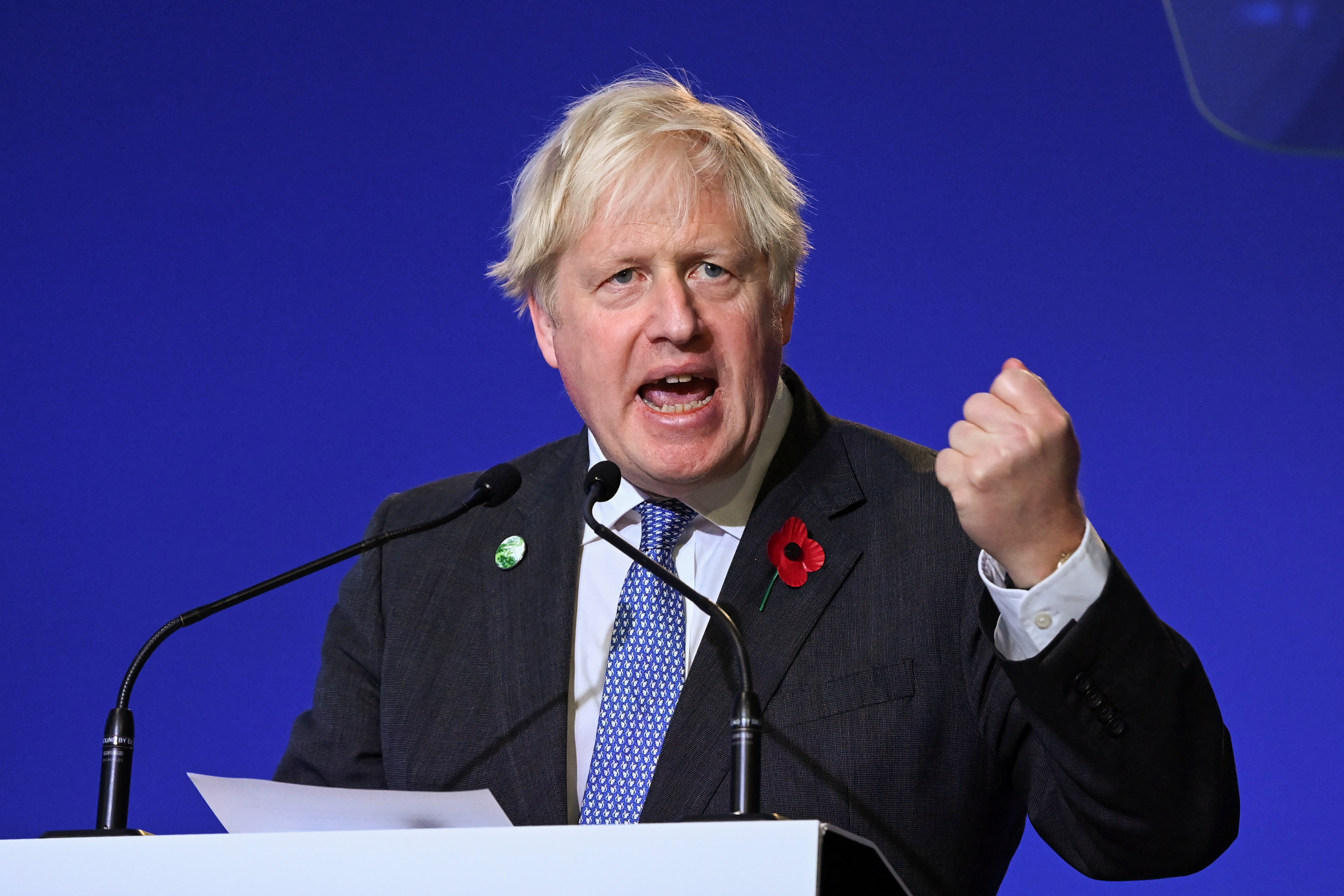
Britain’s Prime Minister Boris Johnson speaks during the opening ceremony of the UN Climate Change Conference (COP26) in Glasgow, Scotland, Britain November 1, 2021. Jeff J Mitchell/Pool via REUTERS

Xi’s absence, along with that of Russia’s Vladimir Putin, president of one of the world’s top three oil producers together with the United States and Saudi Arabia, may hinder progress.

Activist Greta Thunberg appealed to her millions of supporters to sign an open letter accusing leaders of betrayal.

“This is not a drill. It’s code red for the Earth,” it read.

“Millions will suffer as our planet is devastated — a terrifying future that will be created, or avoided, by the decisions you make. You have the power to decide.”

Meanwhile, India and Brazil, two of the largest polluters, both used the platform to provide new emission cutting pledges.

“We will act responsibly and search for real solutions for an urgent transition,” Brazilian President Jair Bolsonaro, who has presided over more than two years of deforestation, said.

Brazil said it would cut its greenhouse gas emissions by 50% by 2030, compared with a previous pledge of 43% in that period.

However, the cuts are calculated against emissions levels in 2005, a baseline which was retroactively revised last year, making it easier for Brazil’s targets to be met.

Prime Minister Narendra Modi set 2070 as a target for India to reach net-zero carbon emissions, much later than those set by other polluters and twenty years beyond the U.N.’s global recommendation. read more

The G20 failed to commit to the 2050 target to halt net carbon emissions, undermining one of COP26’s main aims, at a weekend meeting in Rome.

Instead, they only recognised “the key relevance” of doing so “by or around mid-century”, and set no timetable for phasing out domestic coal power, a major cause of carbon emissions.

The commitment to phase out fossil fuel subsidies “over the medium term” echoed wording they used as long ago as 2009.

‘CALAMITOUS THREATS’

Discord among some of the world’s biggest emitters about how to cut back on coal, oil and gas will make progress difficult in Glasgow, as will the rich world’s failure to stick to promises.

Barbados Prime Minister Mia Mottley compared the vast sums pumped into the global economy by rich countries’ central banks in recent years with those spent on climate help.

“Can there be peace and prosperity if one-third of the world lives in prosperity and two-thirds lives under seas and face calamitous threats to our wellbeing?” she said.

Developed nations confirmed last week they would be three years late in meeting the $100 billion climate finance pledge – which many poor countries and activists say is insufficient anyway. read more

U.S. President Joe Biden said the rich must do more, admitting that “right now we’re falling short,” while French President Emmanuel Macron also called on all developed countries to deliver their fair share of funding.

Biden announced in September that the U.S. would double its climate finance to $11.4 billion per year, but several climate thinktanks and activists say this still falls far short of what its contribution should be. read more

World leaders wrapped up the first day of COP26 at a reception hosted by Prince Charles and other members of the British royal family. Queen Elizabeth, who has been advised by her doctors to rest, sent a video message.

Additional reporting by Jeff Mason, Katy Daigle and Mark John; Writing by Gavin Jones and Kevin Liffey; Editing by Barbara Lewis and Alexander Smith

The post Deliver on Pomises, Developing World Tells Rich at COP26 Climate Talks appeared first on The St Kitts Nevis Observer.

Nicaragua Accused of Running Internet Troll Farm for Fake News

The company behind Facebook and Instagram has removed more than 1,000 fake accounts in Nicaragua which it says were part of a disinformation campaign by the government.

Meta said those who ran the accounts included staff at the telecoms regulator and the Supreme Court. It comes ahead of presidential elections this weekend with the president’s main challengers jailed.

The United States has described the election as a sham.

The accounts were controlled by Daniel Ortega’s government and the FSLN ruling party, Ben Nimmo, threat intelligence lead for Facebook parent company Meta, told the AFP news agency.

Facebook closed 937 accounts, 140 pages and 24 groups, as well as 363 Instagram accounts, he said.

All accounts were shut down last month.

The disinformation campaign allegedly began in 2018 as an effort to denigrate the opposition. It spread to other platforms, including TikTok and Twitter.

In 2018, Mr Ortega’s regime cracked down on protests, killing more than 300 people. Tens of thousands of have since fled into exile.

“The goal was to flood the online conversation in Nicaragua with pro-government and anti-opposition messages,” he said.

Facebook said in a statement the network was “a coordinated effort… to corrupt or manipulate public discourse by using fake accounts to build personas across platforms and mislead people about who’s behind them”.

Analysis suggests that people were posting on the accounts as their day job, with a break for lunch.

The government has been arresting opponents and critics since June on charges of treason or money-laundering. Many say the charges are baseless and designed to facilitate Mr Ortega’s re-election.

The EU’s foreign policy chief recently called Nicaragua “one of the worst dictatorships in the world”.

The post Nicaragua Accused of Running Internet Troll Farm for Fake News appeared first on The St Kitts Nevis Observer.

In Heart of Mexico City, Tourists Embrace Day of the Dead Celebrations

MEXICO CITY, Nov 1 (Reuters) – Foreign tourists and Mexicans taking part in Day of the Dead celebrations flocked to downtown Mexico City on Monday, drawn by elaborate offerings to the departed.

Visitors peered at large altars decorated with chocolate skulls, fruit and freshly-cut marigolds around Zocalo Plaza, Mexico City’s bustling main square built near the ruins of the Aztec Empire’s most holy temples.

Shrines honoring the dead at the Zocalo are part of a tradition that blends Catholic rituals with the pre-Hispanic belief that the dead return once a year from the underworld.

“In people from all cultures, there’s this fear of death, but here you can see them celebrating that,” said Miguel Torres, a tourist from Colombia whose face and lips were painted in deathly black and white.

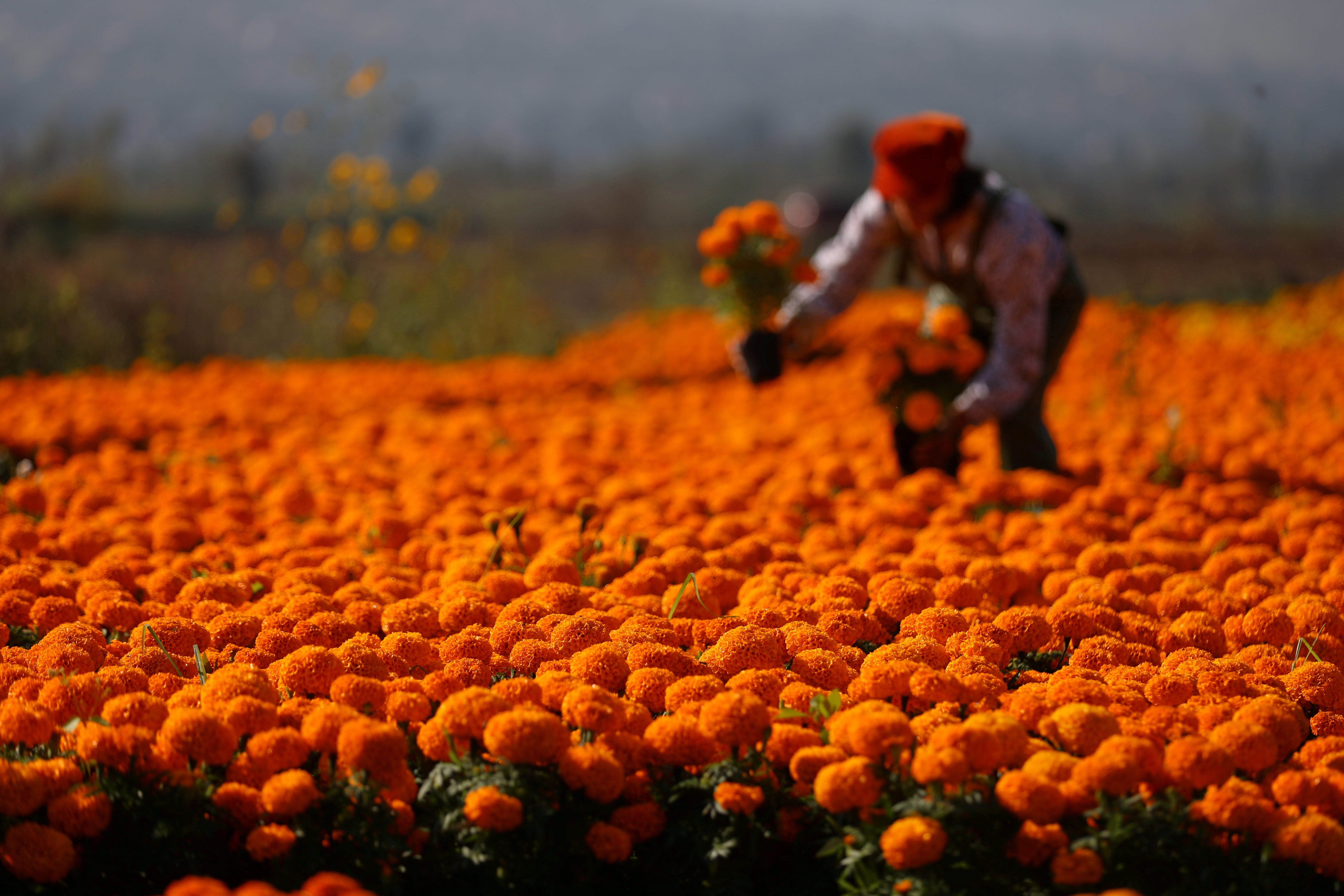
A woman harvests Cempasuchil marigolds to be used during Mexico’s Day of the Dead celebrations at San Luis Tlaxialtemalco nursery, in Xochimilco on the outskirts of Mexico City, Mexico October 28, 2021. REUTERS/Edgard Garrido/File Photo

“It’s important to get to know new cultures and to see that death is a new stage that sooner or later must come to everyone.”

Adorned with traditional Mexican bread as well as bananas, oranges and maize, the altars also had pictures of the elderly who had passed away. Tourists posed for photos next to giant white skulls painted with bright flowery images.

“The skulls, the shamanic part beneath it seems very profound to me, it goes to the roots of what the meaning of death is,” said Dayan Melendez, a U.S. tourist from Colorado.

“For me, it’s very emotional and I think we’re renewing the indigenous culture so it doesn’t scare me.”

Writing by Drazen Jorgic; Editing by Karishma Singh

The post In Heart of Mexico City, Tourists Embrace Day of the Dead Celebrations appeared first on The St Kitts Nevis Observer.

COP26: World Leaders Promise to End Deforestation by 2030


By Georgina Rannard
BBC News

More than 100 world leaders will promise to end and reverse deforestation by 2030, in the COP26 climate summit’s first major deal.

Brazil – where stretches of the Amazon rainforest have been cut down – will be among the signatories on Tuesday.

The pledge includes almost £14bn ($19.2bn) of public and private funds.

Experts welcomed the move, but warned a previous deal in 2014 had “failed to slow deforestation at all” and commitments needed to be delivered on.

Felling trees contributes to climate change because it depletes forests that absorb vast amounts of the warming gas CO2.

UK Prime Minister Boris Johnson, who is hosting the global meeting in Glasgow, will call Tuesday’s deal a “landmark agreement to protect and restore the Earth’s forests”.

“These great teeming ecosystems – these cathedrals of nature – are the lungs of our planet,” he will say at a COP26 event later where world leaders are meeting to discuss forests and land use.

The two-week summit in Glasgow is seen as crucial if climate change is to be brought under control.

The countries who say they will sign the pledge – including Canada, Brazil, Russia, China, Indonesia and the Democratic Republic of the Congo, the US and the UK (the full list is here) – cover around 85% of the world’s forests.

Some of the funding will go to developing countries to restore damaged land, tackle wildfires and support indigenous communities.

Governments of 28 countries will also commit to remove deforestation from the global trade of food and other agricultural products such as palm oil, soya and cocoa.

These industries drive forest loss by cutting down trees to make space for animals to graze or crops to grow.

More than 30 of the world’s biggest financial companies – including Aviva, Schroders and Axa – will also commit to end investment in activities linked to deforestation.

And a £1.1bn fund will be established to protect the world’s second largest tropical rainforest – in the Congo Basin.

Prof Simon Lewis, an expert on climate and forests at University College London, said: “It is good news to have a political commitment to end deforestation from so many countries, and significant funding to move forward on that journey.”

But he told the BBC the world “has been here before” with a declaration in 2014 in New York “which failed to slow deforestation at all”.

He added that this new deal did not tackle growing demand for products such as meat grown on rainforest land – which would require high levels of meat consumption in countries like the US and UK to be addressed.

Ecologist Dr Nigel Sizer called the agreement “a big deal” – but that some will find the target of 2030 disappointing.

“We’re facing a climate emergency so giving ourselves another 10 years to address this problem doesn’t quite seem consistent with that,” said Dr Sizer, a former president of the Rainforest Alliance.

“But maybe this is realistic and the best that they can achieve.”

2px presentational grey line

What was the failed 2014 agreement?

  • The New York Declaration on Forests was a voluntary and legally non-binding agreement on deforestation in 2014
  • It aimed to half deforestation by 2020, and halt it by 2030 – and 40 governments eventually signed up. But some key countries like Brazil and Russia weren’t among them
  • But the agreement failed, a report in 2019 found, saying deforestation was still continuing at an alarming rate
2px presentational grey line

The deal’s signatories will include a number of key countries.

Indonesia is the world’s largest exporter of palm oil, a product found in everything from shampoo to biscuits. Production is driving tree destruction and territory loss for indigenous people.

Meanwhile, Russia’s huge natural forests, with more than one fifth of the planet’s trees, capture more than 1.5 billion tonnes of carbon annually.

In the planet’s biggest rainforest, the Amazon, deforestation accelerated to a 12-year high in 2020 under Brazilian President Jair Bolsonaro.

Asked whether leaders like Brazil’s Mr Bolsonaro could be trusted to abide by the pledge, the UK’s Environment Secretary George Eustice said “we should be really positive when countries engage”.

“Last time there was an attempt at getting such a commitment on forests [in 2014], Brazil didn’t take part, neither did Russia, neither did China.

“Brazil, they’ve really engaged with us on this agenda. It’s a big step for them.”

But pressed on whether the agreement will be enforceable, Mr Eustice said: “It doesn’t go as far into talking about enforcement mechanisms and so forth, that’s not the nature of these agreements.”

He said what was different about this pledge in particular is that there is “the finance to back [it] up”.

More on Climate Change bottom strapline

COP26 climate summit – The basics

  • Climate change is one of the world’s most pressing problems. Governments must promise more ambitious cuts in warming gases if we are to prevent greater global temperature rises.
  • The summit in Glasgow is where change could happen. You need to watch for the promises made by the world’s biggest polluters, like the US and China, and whether poorer countries are getting the support they need.
  • All our lives will change. Decisions made here could impact our jobs, how we heat our homes, what we eat and how we travel.
More on Climate Change bottom strapline

Ana Yang, executive director at Chatham House Sustainability Accelerator, who co-wrote the report Rethinking the Brazilian Amazon, said: “This deal involves more countries, more players and more money. But the devil is in the detail which we still need to see.”

She said it was a “big building block” in the mission to keep global temperature rises below 1.5C. But many people living in the Amazon, including in its urban areas, depend on the forest for their livelihoods and they need support in finding new incomes, she added.

Tuntiak Katan, from the Coordination of Indigenous Communities of the Amazon Basin, welcomed the deal, saying that funds should be invested in supporting indigenous communities who are able to manage and protect forests.

Mr Katan, an indigenous Shuar from Ecuador, told the BBC indigenous communities globally protected 80% of the world’s biodiversity but faced threats and violence.

“For years we have protected our way of life and that has protected ecosystems and forests. Without us, no money or policy can stop climate change,” he said.

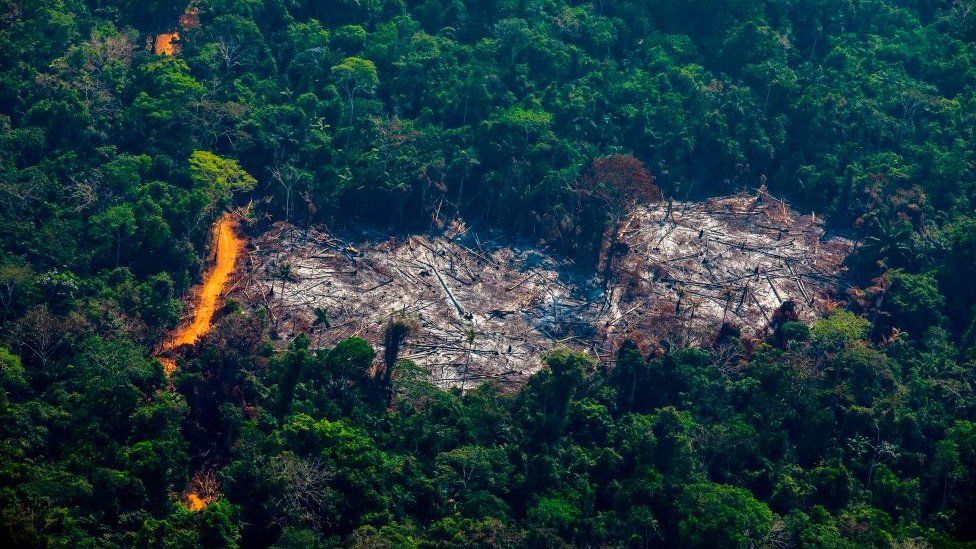
Aerial view of deforestation in the Menkragnoti Indigenous Territory in Altamira, Para state, Brazil
Deforestation has accelerated in the Amazon in recent years

One of the biggest causes of forest loss in Brazil is to grow soy beans, much of which goes to China and Europe for animal feed for pigs and chickens, said Dr Sizer. “We all end up consuming that, unless we’re strict vegetarians and we don’t eat soy. It’s a very serious problem that we’re all connected with.”

Trees are one of our major defences in a warming world. They suck carbon dioxide out of the atmosphere, acting as so-called carbon sinks. They absorb around one third of global CO2 emitted each year.

Currently an area of forest the size of 27 football pitches is lost every minute.

Depleted forests can also start to release CO2. If too many trees are cut down, scientists are worried that the planet will reach a tipping point that will set off abrupt and unpredictable climatic change.

The post COP26: World Leaders Promise to End Deforestation by 2030 appeared first on The St Kitts Nevis Observer.
Demand for Livestock & Quality Meat Increasing at Government Owned Farm in Nevis

NIA CHARLESTOWN NEVIS The Department of Agriculture on Nevis continues to build its livestock capacity and increase meat production in its quest to ensure food sustainability on the island.
Mr. Rohan Claxton, Livestock Extension Officer with responsibility for Production on the Maddens Stock Farm, says a breeding programme which was introduced in 2016 is bearing fruit.

“We started a breeding programme in 2016. During that year we had a total of 30 breeders… The calves that we got in 2017 we selected them to be replacement heifers along with the nucleus herd the Senepol.

“So to date we have a total of 47 breeders which means this year we expect 47 calves. To date we have 37 calves so we are expecting another 10 calves by year end,” he said at the farm on October 29, 2021. 

Mr. Claxton noted that new breeds were introduced to improve the quality of the cattle and of the meat they produce.

 “The breeds that we introduced [are] the Brown Angus and the Red Angus along with some Brahman bulls that we had previously. So cross breeding is one of the techniques used in order to develop the genetics or breeds on the island.

“Why we chose these breeds? The angus is well known worldwide as a beef producer, grows very fast, and the genetics is very, very excellent. The meat marbling is very good. The texture of the meat is very good. So that is why we are introducing this breed so it can grow fast to reach market weight,” he said.

According to the Livestock Extension Officer, there has been an increasing local demand for beef produced from cattle at the Maddens Stock Farm and as a result they have been concentrating on producing cows to sell to farmers who are interested in improving the genetics with their stock. They also supply the Department of Agriculture’s Abattoir.

 “We normally supply the Abattoir when there is need to because the demand for beef is tremendous. I’m sure many of you went to local restaurants and you realise you are eating local ground beef, and the Abattoir also provides beef patties. The choice cuts, you will see them around in the supermarket.

“So presently the demand for beef has taken off. Some time ago we had cattle we used to call “beef festival” where we used to sell beef for $5.00 when nobody used to take it. Now the demand is there the supply is insufficient. Presently at the Abattoir, it’s $8.50 a pound [and] butchers $10.00 a pound,” he said.

Mr. Claxton said the nucleus herd at Maddens in up in the region of 100 heads and described them as being in pristine condition though rainfall was a challenge throughout the year with the exception of some in September.

However, in the absence of rain they had to resort to feeding them with supplements and to cut grass from elsewhere and transport to the cows to keep them alive.

“We supplement the cows with the spent hops and the Brewers grains. Those grains really, is a mixture of barley… the Brewers grain and the beer hops. So after all extractions … once it is fed in small amounts… gives it high protein high protein performance for the animals to benefit from.

“The main herd we tried to maintain them with the Brewers grains or spent hops and that has been our life saver. If you look at the animals, they are in prime condition because we had some rains during September and then the paddocks with the grasses [have] grown back so now they get some lush green,” he said.

According to Mr. Claxton, when it comes to foraging, each cow must consume at least 20 percent of its body weight. The average body weight of the cows at Maddens is around 800 to 1000 pounds, which means they should consume at least 20 to 30 pounds of grass on a daily basis, in order to get their protein to develop and grow and provide milk for their calves.

The cattle population in Nevis is low, under 300 heads at most. However, in the 60s and 70s the island had more than 7,000 heads of cattle and would export at a time when farmers engaged with mixed farming and cattle rearing.

Mr. Claxton said at that time Nevis exported livestock to St. Baths, St. Eustatius, St. Kitts, Guadeloupe, Martinique and also exported donkeys

The post Demand for Livestock & Quality Meat Increasing at Government Owned Farm in Nevis appeared first on The St Kitts Nevis Observer.

COVID-19 leads to home renovation boom

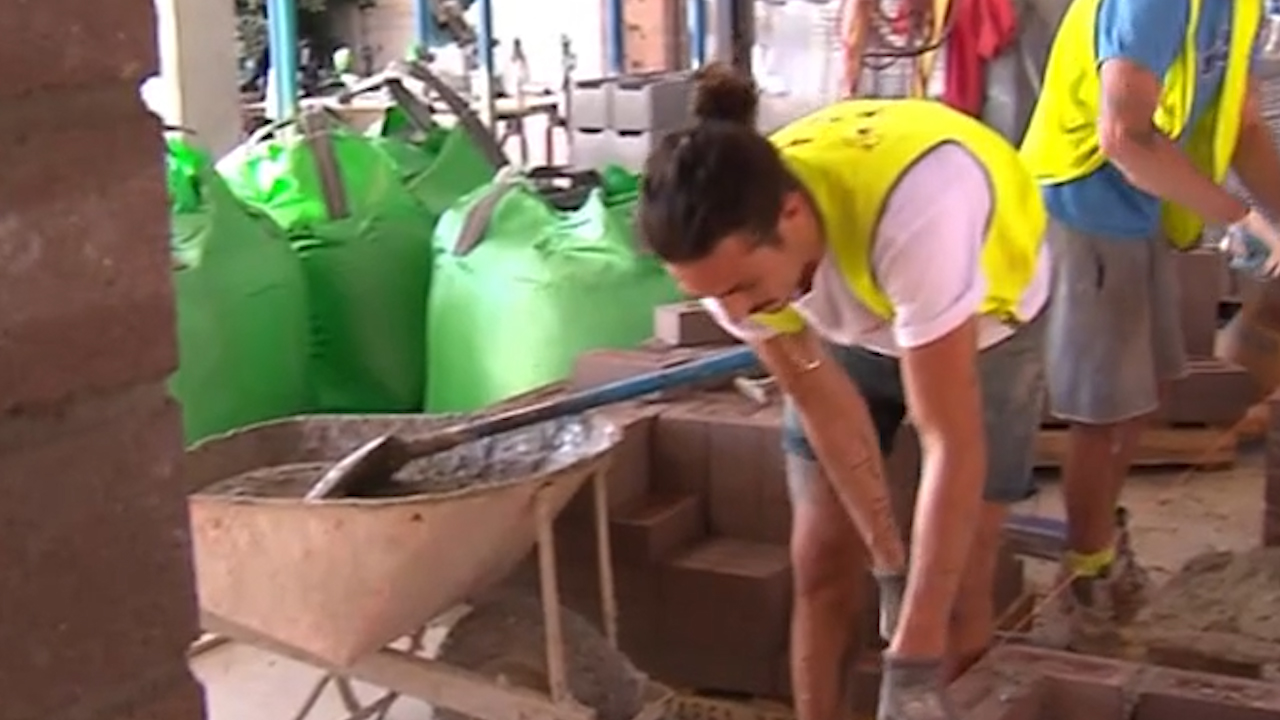
Australians have been pouring money into their homes during COVID-19, sparking a renovation boom.

In the past 12 months, owner-occupiers took out $4.38 billion in loans to fund alterations, additions, repairs, and rebuilds.

In August alone, owner-occupiers took out a huge $500 million in loans.

READ MORE: Leaked text message in spat between French PM and Morrison

Sydneysiders are spending big on renovations.

There has been a 143 per cent increase compared to last year in renovation loans.

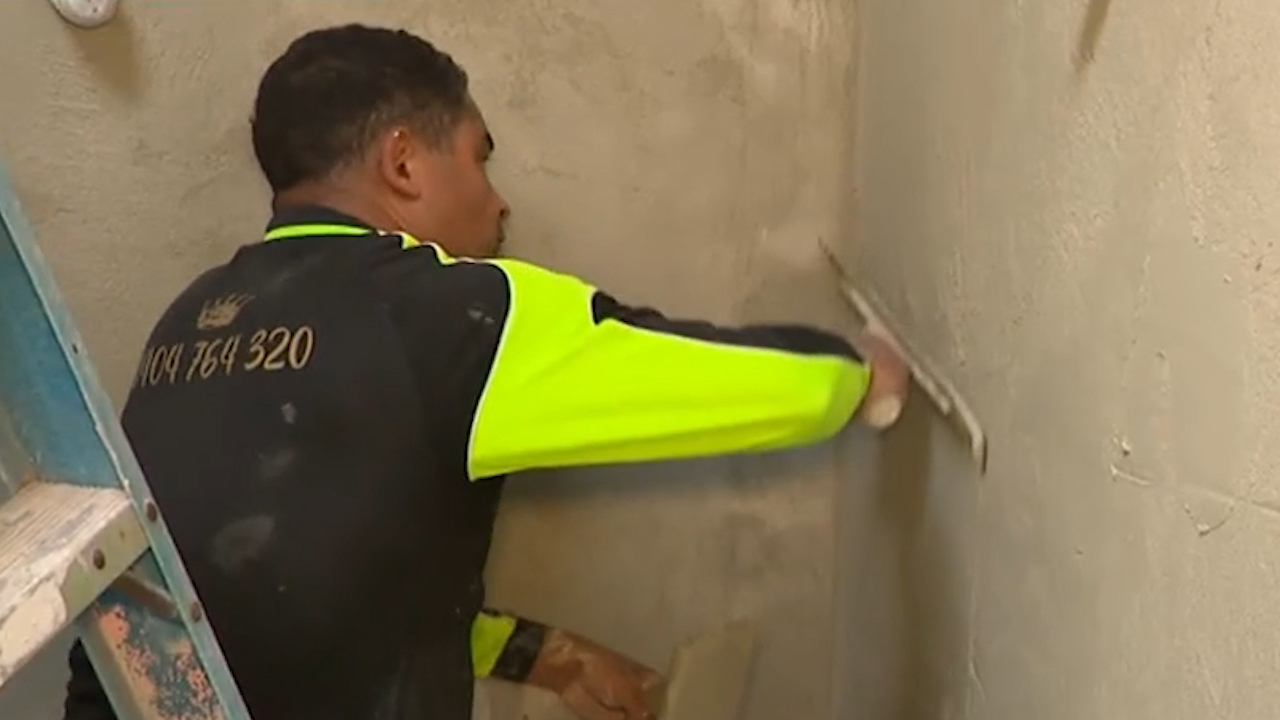
David Stableford and his wife bought their Balgowlah home, in Sydney's Northern Beaches, two years ago.

The pair has already finished one major renovation and now they're finishing off a new bathroom.

"Investing in our own property was the obvious thing to do. We bought the worst house on the best street so we were always going to renovate," Mr Stableford said.

James Algar, from Mortgage Choice, said many Australians are looking to renovate their homes.

"I'd probably say it's up by 100 per cent, the kind of clients that are looking to do renovations where they would have more traditionally looked at moving or upgrading rather than embark on a major project," Mr Algar said.

READ MORE: Disneyland Shanghai goes into snap COVID-19 lockdown

Sydneysiders are spending big on renovations.

Not only is there a renovation boom, but house prices have also increased meaning there is higher equity.

Higher equity combined with lower interest rates has made it easier than ever to fund renovations.

A home buyer who bought a median-priced property in September 2019 with a 20 per cent deposit, paying principal and interest, could potentially draw $330,000 while still retaining their 80 per cent loan to value ratio.

Sally Tindall, from RateCity, said if someone has owned their home for two years or more is likely to be sitting on a "growing mountain of equity."

"You might not realise just how much of your home you actually own now," she said.

READ MORE: Why is petrol so expensive right now?

Mr Stableford said he pulled out equity for the renovations but his payments had remained the same as his previous mortgage.

"So we pulled out a few hundred thousand in equity, so it was a no brainer," he said.

The information provided on this website is general in nature only and does not constitute personal financial advice. The information has been prepared without taking into account your personal objectives, financial situation or needs. Before acting on any information on this website you should consider the appropriateness of the information having regard to your objectives, financial situation and needs.

NSW marks 50 years of mandatory seatbelts

In the post-World War Two economy, when Australia rode into a vibrant and profitable world of export on the sheep's back, private car ownership came quickly to the reach of the country's baby booming middle class.

As the newsreel of the time noted, "at Tom Ugly's Bridge over Georges River, they squeeze through two lanes at a rate of 13,500 cars per lane per day."

With more cars, many more cars, would come a parallel rise in road deaths.

LIVE UPDATES: Verry Elleegant wins Melbourne Cup | Where every horse finished

NSW marks 50 years of mandatory seatbelts

"Exponentially, it was increasing at a rapid rate," says Head of Transport Safety at Transport NSW, Peter Dunphy.

"In the early 1970's, road fatalities had peaked at around 1300; it was increasing rapidly."

But in November 1971, NSW would be one of the first in the world to make it mandatory to wear a seat belt.

"If you look at last year, in comparison to 1970, 284 lives were lost on our roads; that's a reduction of 78 per cent," says Paul Toole, Deputy Premier and Regional Transport and Road Minister.

READ MORE: Leaked text message in spat between French PM and Morrison

NSW marks 50 years of mandatory seatbelts

Many older cars still didn't have seat belts, and it took time and education, to make wearing a belt a default setting.

One ad campaign would feature two eggs in two egg mobiles, as elucidated by the plum cheeked narrator, one with a seat belt, one without.

They take turns to drive into a wall.

It's no spoiler that beltless ol' mate doesn't fare so well.

But the new road safety policy drew instant results.

"After the first year, there was a 25 per cent reduction in fatalities in NSW," says Peter Dunphy.

"It was really revolutionary policy, and world leading at the time."

READ MORE: Disneyland Shanghai goes into snap COVID-19 lockdown

Apparently, the current stats say there's a 99 per cent uptake and compliance with seat belt wearing.

But it would take many years for the message to become habit.

NSW marks 50 years of mandatory seatbelts

And that has meant, for all the circles of families and friends affected by fatal car accidents, a better 2021 than 1971.

"The statistics clearly show," says the Deputy Premier, "put your seat belt on; you're crazy if you don't."