Category Archives: headline

Colombia Unrest: President Duque Pledges Police Reform

BBC- Colombian President Iván Duque has vowed to modernise the country’s police and increase oversight of officers.

It comes after weeks of street protests and widespread allegations of human rights abuses.

More than 60 people have died in clashes with security forces, with at least three officers facing murder charges.

The violence has sparked international outcry and calls for an independent investigation into the deaths.

Last week negotiations stalled between President Duque’s government and an umbrella group of protesters called the National Strike Committee, but talks are expected to resume on Sunday.

In a statement, the president said he would ask Congress to approve measures to modernise the police, with the creation of a new human rights directorate and more officer training. A new complaints system would also be set up, along with disciplinary standards for officers.

The law will be proposed on the first day of the next legislative session in July, said Mr Duque.

He added that the government was also working on a law to establish a criteria for the legitimate use of force by police.

The president’s announcement comes as a delegation from the Inter-American Commission on Human Rights (IACHR) arrives in Colombia to assess the recent unrest.

Demonstrations began on 28 April against a now-withdrawn set of tax reforms. But the protests have escalated into a broad anti-government movement, with hundreds of thousands of people taking to the streets, and demands being made for reform of health and education, among other issues.

The protests have been held in defiance of a court order, which ruled that they should be postponed due to high incidences of coronavirus in Colombia. As a result, there has been a heavy police presence during demonstrations, and security forces have had deadly clashes with protesters – with most of the violence focused in the city of Cali

Authorities say at least 61 people, mostly civilians, have died during the demonstrations. But NGO Human Rights Watch has cited “credible reports” of 67.

Protesters have called on President Duque to denounce the use of excessive force by police. But the president has previously called on his political opponents to condemn the dozens of roadblocks erected by protesters around the country, which he blames for hampering the economy and causing the deaths of two babies trapped in ambulances.

Last week Michelle Bachelet, the UN’s human rights chief expressed concern at violence in Cali, and said that “all those who are reportedly involved” should be held accountable.

The post Colombia Unrest: President Duque Pledges Police Reform appeared first on The St Kitts Nevis Observer.
Study: Amazon Tribes Lived Sustainably 5,000 Years

By Victoria Gill
Science correspondent, BBC News

 A study that dug into the history of the Amazon Rainforest has found that indigenous people lived there for millennia “causing no detectable species losses or disturbances”.

Scientists working in Peru searched layers of soil for microscopic fossil evidence of human impact.

They found that forests were not “cleared, farmed, or otherwise significantly altered in prehistory”.

The research is published in the journal PNAS.

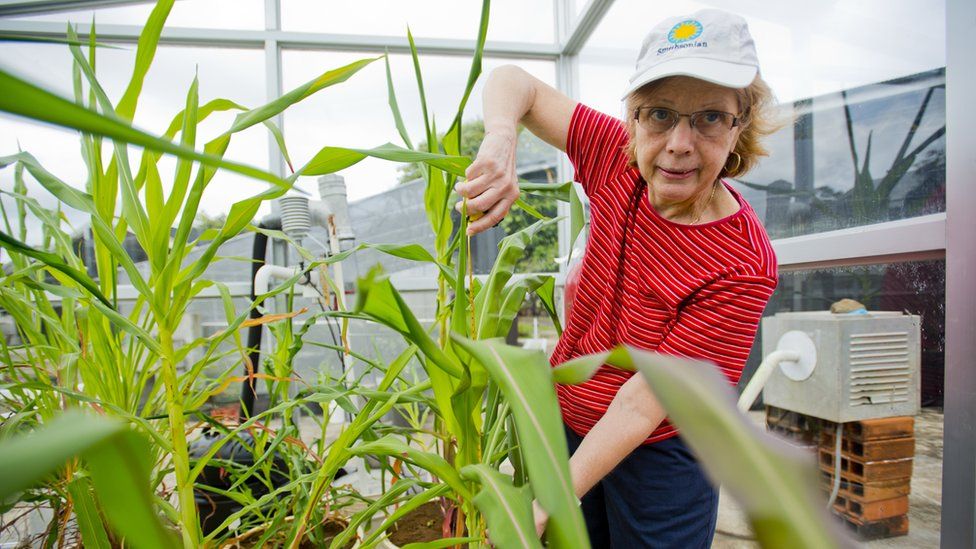
Dolores Pipernoimage copyrightSmithsonian
Dolores Piperno is based at the Smithsonian’s Natural History Museum in Washington DC and the Tropical Research Institute in Panama

Dr Dolores Piperno, from the Smithsonian Tropical Research Institute in Balboa, Panama, who led the study, said the evidence could help shape modern conservation – revealing how people can live in the Amazon while preserving its incredibly rich biodiversity.

Dr Piperno’s discoveries also inform an ongoing debate about how much the Amazon’s vast, diverse landscape was shaped by indigenous people.

Some research has suggested the landscape was actively, intensively shaped by indigenous peoples before the arrival of Europeans in South America. Recent studies have even suggested that the tree species that now dominates the forest was planted by prehistoric human inhabitants.

Dr Piperno told BBC News, the new findings provide evidence that the indigenous population’s use of the rainforest “was sustainable, causing no detectable species losses or disturbances, over millennia”.

To find that evidence, she and her colleagues carried out a kind of botanical archaeology – excavating and dating layers of soil to build a picture of the rainforest’s history. They examined the soil at three sites in a remote part of northeastern Peru.

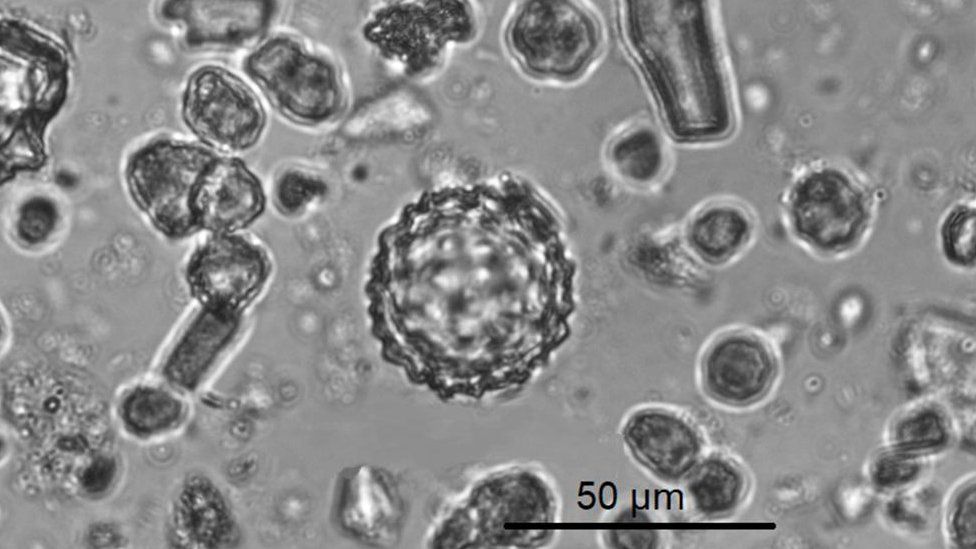
Phytolithsimage copyrightDolores Piperno/Smithsonian
phytoliths are microscopic plant fossils

All three were located at least one kilometre away from river courses and floodplains, known as “interfluvial zones”. These forests make up more than 90% of the Amazon’s land area, so studying them is key to understanding the indigenous influence on the landscape as a whole.

They searched each sediment layer for microscopic plant fossils called phytoliths – tiny records of what grew in the forest over thousands of years. “We found very little sign of human modification over 5,000 years,” said Dr Piperno.

“So I think we have a good deal of evidence now, that those off-river forests were less occupied and less modified.”

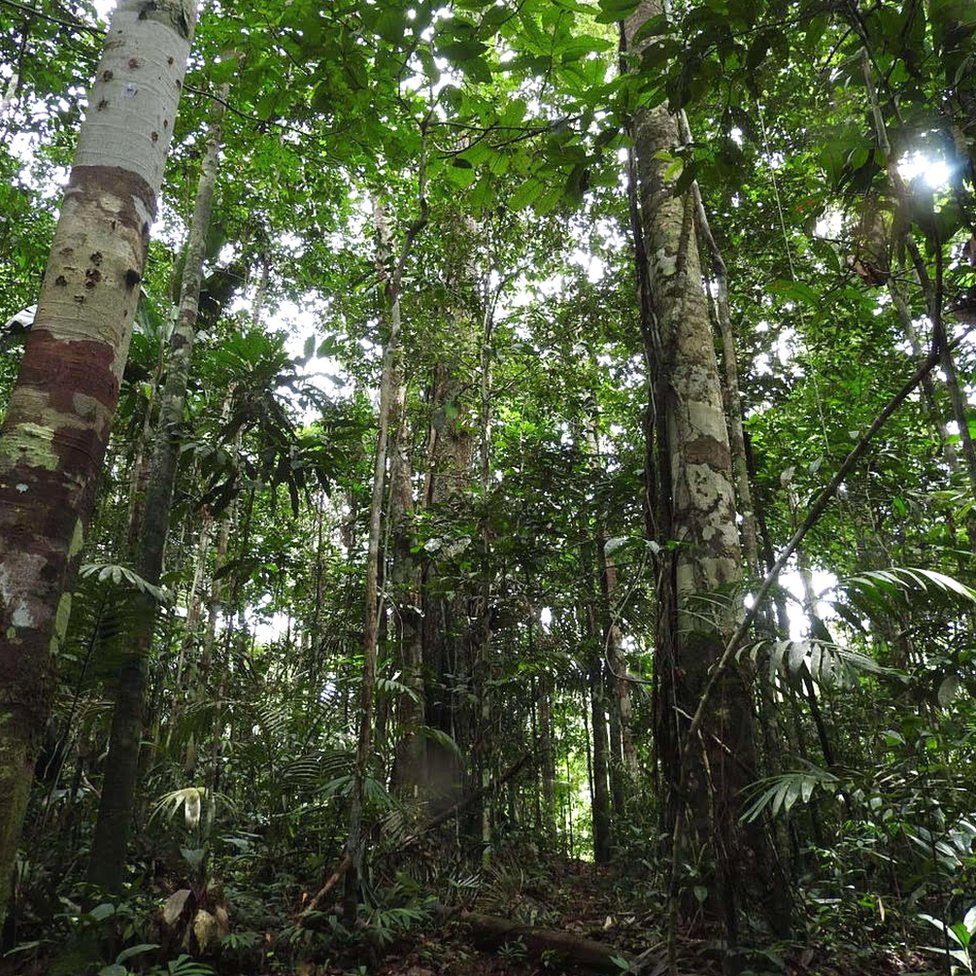
Amazon Rainforestimage copyrightCorine Vriesendorp
The researchers sampled soil from the rainforest

The scientists say their findings also point to the value of indigenous knowledge in helping us to preserve the biodiversity in the Amazon, for example, by guiding the selection of the best species for replanting and restoration.

“Indigenous peoples have tremendous knowledge of their forest and their environment,” said Dr Piperno, “and that needs to be included in our conservation plans”.

The post Study: Amazon Tribes Lived Sustainably 5,000 Years appeared first on The St Kitts Nevis Observer.
Peru: Leftist Castillo Moves Ahead in Election

BBC- Left-wing candidate Pedro Castillo has edged into the lead in a dramatic twist in Peru’s presidential election.

With 94% of votes counted, Mr Castillo overtook his right-wing rival, Keiko Fujimori, who is running for the presidency for the third time.

He has a lead of 0.1 percentage point, with just over 25,000 votes currently separating the two candidates.

They have both called for calm while the count is under way. This is Peru’s most polarised poll in recent history.

Ms Fujimori had been leading since the official count began, but as results from rural areas – where support for Mr Castillo is strong – started to come in, the gap between them narrowed.

On Monday she raised concerns of “irregularities” and “signs of fraud”, but provided no details.

The new president will be taking on a country in crisis as Peru struggles with a recession and the highest coronavirus death rate per capita in the world.

Peruvians have had years of political turbulence, with four presidents in the past three years. Seven of the country’s last 10 leaders have either been convicted of or investigated for corruption.

line

Peru at a glance

  • The country has a population of about 32 million
  • Inequality remains high, especially between those who live in urban and rural areas
  • The pandemic has hit it hard, and nearly a third of its people are now in poverty
  • It has been through a series of political crises in recent years and, last November, it was led by three presidents within the space of a week

Sources: World Bank, CIA Factbook

line

Household name v political newcomer

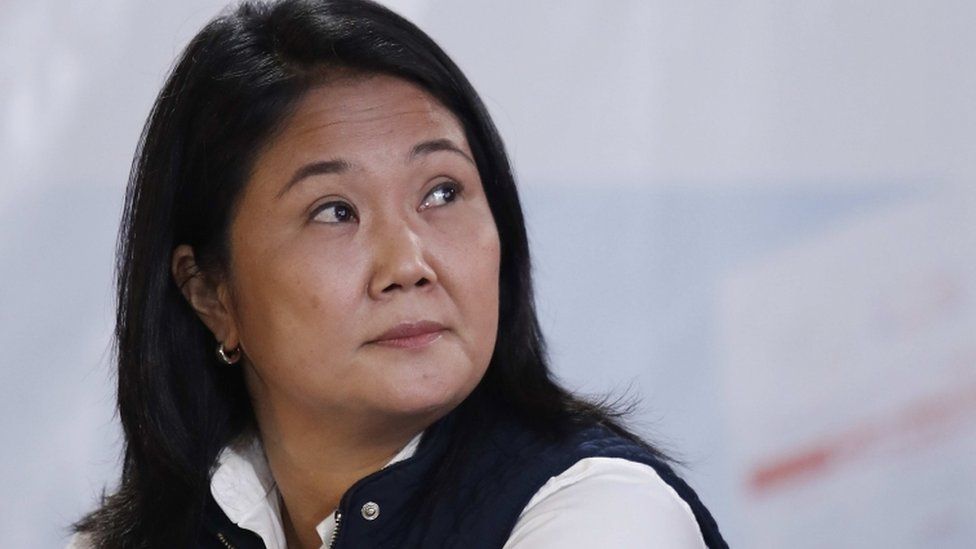
Keiko Fujimori, 46, is the leader of the right-win Popular Force party and a household name in Peru. As well as a former member of Congress, she was the runner-up in the 2011 and 2016 presidential election run-offs.

Peruvian presidential candidate Keiko Fujimori attends a press conference in Lima, Peru, 7 June 2021image copyrightEPA
image captionKeiko Fujimori presented little evidence to support her allegation of voting irregularities

She is also the daughter of jailed ex-president Alberto Fujimori, who is serving a 25-year sentence for corruption and human rights abuses. She has said that if she is elected, she will pardon her father.

Earlier, there were scenes of celebrations outside her party’s headquarters in the capital, Lima. However electoral officials said the early results reflected votes from urban areas, where she is most popular.

“What we have to look for is the unity of all Peruvians. That is why I ask both groups for calm, patience, peace, to those who voted and didn’t vote for us,” Ms Fujimori said.

Pedro Castillo, 51, is a relatively new face on the political stage, and was the unexpected winner in the first round vote in April.

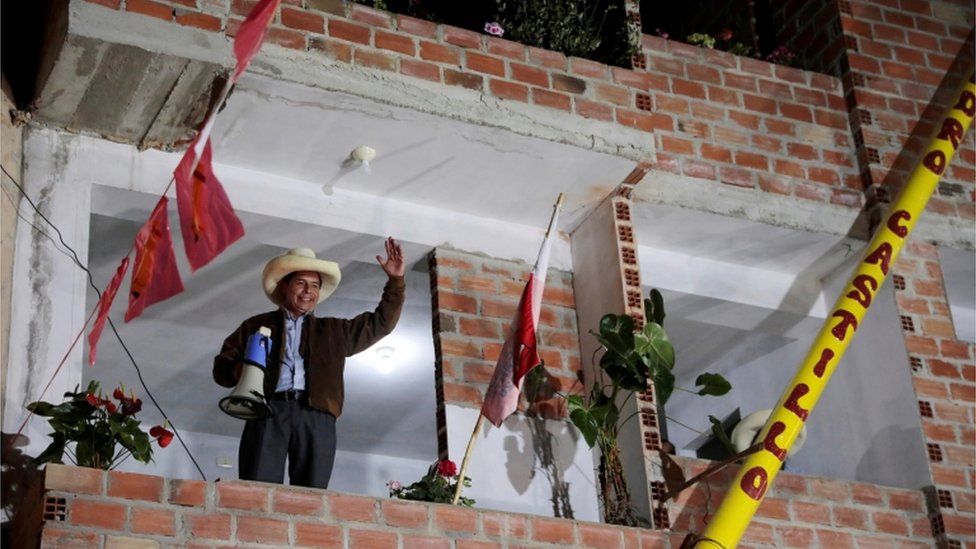
Pedro Castillo waves to supporters in the town of Tacabamba, as he waits for votes to be countedimage copyrightReuters
image captionPedro Castillo waves to supporters in the town of Tacabamba, as he waits for votes to be counted

An elementary school teacher, he is easily recognisable by his cowboy hat and oversized pencil that he campaigns with – the symbol of his Free Peru party.

He is the son of small-scale farmers and has gained the trust and support of many in the farming community and the trade union movement.

The post Peru: Leftist Castillo Moves Ahead in Election appeared first on The St Kitts Nevis Observer.

VP Harris Tells Cent. American Migrants Not to Come

BBC- US Vice President Kamala Harris has urged would-be migrants in Guatemala not to try to enter the United States illegally.

Speaking on her first overseas trip since taking office, she said the journey north was dangerous and would mainly benefit people smugglers.

Ms Harris warned people they would be turned back at the border.

She has been tasked by President Joe Biden with controlling a surge in migration at the southern border.

Ms Harris has described her task as finding solutions to tackle the root causes of the border crisis, including corruption and the lack of economic opportunities. Her staff say this first visit is primarily an information-gathering trip.

In a news conference alongside Guatemalan President Alejandro Giammattei, she warned against illegal migration to the US, saying: “Do not come. Do not come. The United States will continue to enforce our laws and secure our borders.”

She added: “If you come to our border, you will be turned back.”

Ms Harris said she wanted the US and Guatemala to “work together” to find solutions to “long-standing problems”.

She said people must be given a “sense of hope that help is on the way”.

“It must be coupled with relationships of trust. It must be coupled with tangible outcomes, in terms of what we do as leaders to convince people that there is a reason to be hopeful about their future and the future of their children,” Ms Harris added.

President Giammattei defended his government’s own record of fighting corruption and said the fight against drug trafficking should be an key part of tackling the issue.

He announced a new processing centre for migrants who had been sent back from the US and Mexico and said that the focus for both countries should be on creating prosperity.

Ms Harris said the US would send 500,000 coronavirus vaccines to Guatemala and provide $26m (£18.3m) to fight the pandemic there. The region has been hard hit by the virus, further worsening living conditions.

She also met civil society leaders and entrepreneurs in the country before travelling on to Mexico where she will hold talks with President Andrés Manuel López Obrador on Tuesday.

President Biden has been criticised by Republicans who accuse him of ignoring the crisis on the southern border.

But in a recent speech to Congress, he said: “When I was vice president, I focused on providing the help needed to address these root causes of migration. It helped keep people in their own countries instead of being forced to leave. Our plan worked.”

Presentational grey line

A trip underlining the scale of the task ahead

by Will Grant, BBC

For the Guatemalan government, there will have been some satisfaction in being the hosts of the vice-president’s first international visit. It is a sign of improved ties with Washington after the Trump administration. However, in reality, the Biden administration has few other feasible partners in the region, embroiled as they are in diplomatic tension or open conflict with the presidents of Honduras, El Salvador and Nicaragua.

The joint news conference revealed a number of things.

Certainly the rhetoric from the Biden administration is more compassionate than over the past four years. The vice-president mentioned “hunger, hurricanes and pandemic” as “acute” drivers of migration, and talked of empowering the indigenous community in Guatemala.

Certainly the promise of 500,000 doses of the coronavirus vaccine from the US will have been welcomed as the region lags well behind much of the world on the road towards a fully-vaccinated society.

But many Guatemalans will have met other measures with some scepticism.

The proposed anti-trafficking and anti-smuggling measures will struggle to unpick the sophisticated criminal networks, which run the migrant and drug routes north. Despite much talk of creating jobs and incentives inside Guatemala, many know that Washington’s plan also involves bolstering the police and security forces to better prevent migrants from leaving in the first place. And the promise of hundreds of millions in development aid will also ring alarm bells over exactly how those funds will be administered.

Indeed, the discussion of a corruption task force appeared to touch a raw nerve with President Giammattei, who became defensive as he denied “meddling” in the work of anti-graft prosecutors in the country.

If nothing else, this trip has underlined the scale of the task ahead.

Presentational grey line

What are the key items on Ms Harris’s agenda?

The border

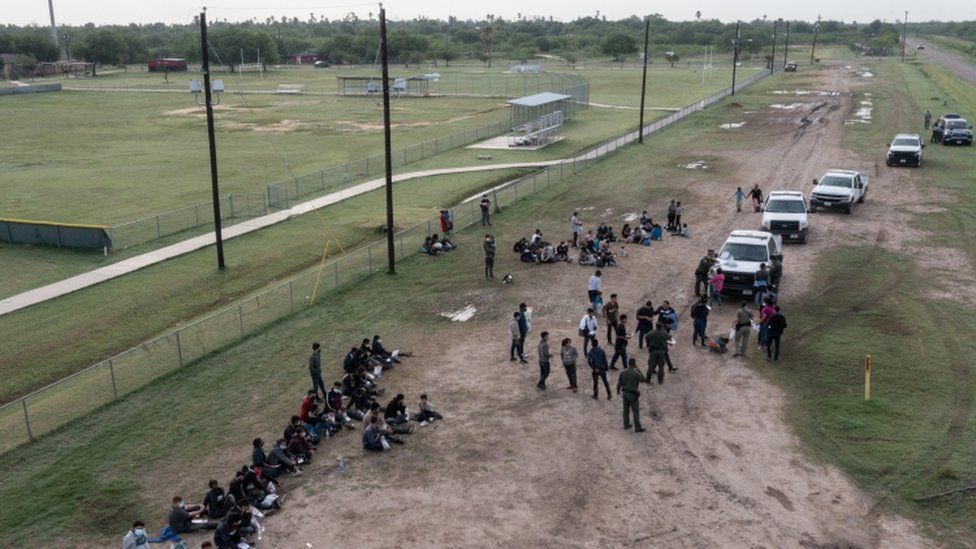
More than 178,000 migrants arrived at the border this April, the highest one-month total in more than two decades, according to US border officials.

Asylum seeking unaccompanied minors from Central America are seen on the left in this aerial image after crossing the Rio Grande river into the United States from Mexico in La Joya, Texas, U.S., May 14, 2021image copyrightReuters
Thousands of asylum seekers from Central America head for the US-Mexico border

Of those migrants, more than 40% originated from the Central American region known as the Northern Triangle: Guatemala, Honduras and El Salvador.

This will be the main focus of Ms Harris’ trip.

Corruption

A central issue contributing to the border crisis is the corruption of government officials in the region, who have been accused of aiding in drug and human trafficking.

Ms Harris will to discuss the situations in Guatemala and Mexico. But the vice-president has yet to speak to the leaders of Honduras and El Salvador.

“We have the capacity to give people hope,” Ms Harris said last month. “Part of giving people hope is having a very specific commitment to rooting out corruption in the region.”

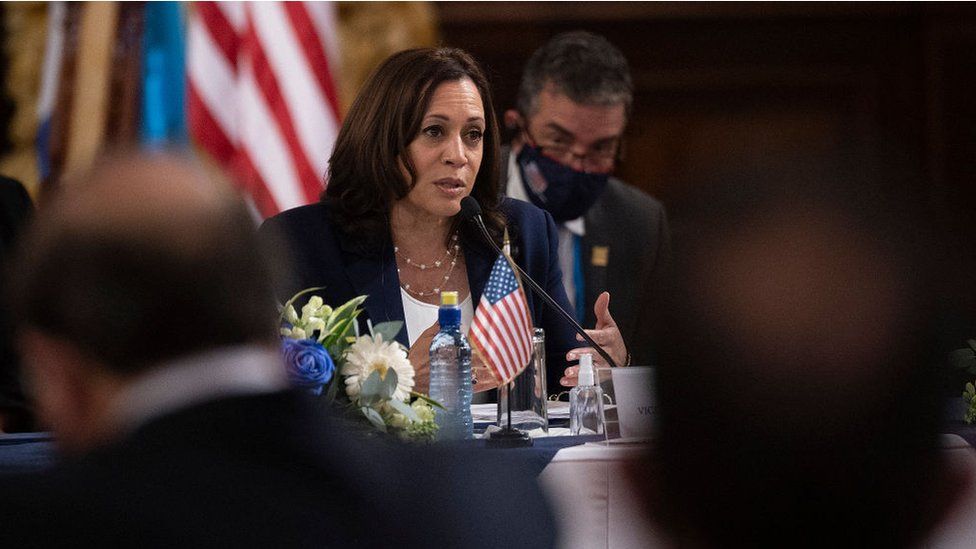
Ms Harris holds talks with the Guatemalan president on Monday
Vice Pres. Harris holds talks with the Guatemalan president on Monday

Economic growth

Many migrants leaving the Northern Triangle say they are fleeing violence, discrimination and poverty.

The steady “brain drain” of locals has exacerbated problems caused by decades of political instability.

These countries have also stressed that they are feeling the most adverse effects of global warming – most notably hurricanes – despite hardly contributing to climate change.

Ms Harris said in her press conference in Guatemala that “we are doing the work of requiring certain progress be made” in order to attract US investment to the region.

She also pledged US investments towards agriculture, entrepreneurship and affordable housing, as well as for “a young women’s empowerment initiative to increase education and opportunities for girls and women.”

The post VP Harris Tells Cent. American Migrants Not to Come appeared first on The St Kitts Nevis Observer.
Quarantined couple denied chance to see newborn son

A Melbourne couple have not been able to nurse their newborn son and remain stuck in Queensland as requests to see the baby boy continue to be denied.

They are expected to leave quarantine tomorrow and be reunited.

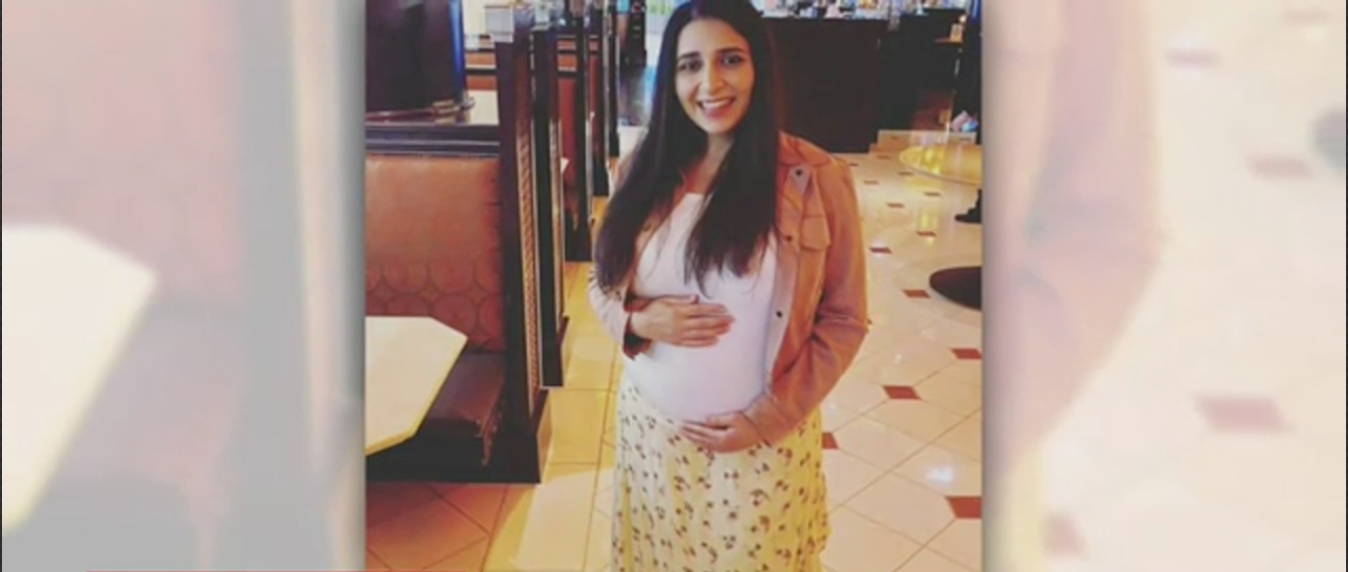
Sarah and Moe Haider, originally from Epping, arrived in Brisbane from Doha on May 26 and have not had the chance to hold their new son, Ilyas.

Mr Haider said the couple's request for an exemption to meet their son in person after a premature birth was rejected by Queensland Health.

READ MORE: Melbourne's Delta coronavirus outbreak linked to returned traveller

The new father said he and his wife were desperate to finally see their baby.

"She didn't have a second, a glimpse, she didn't have a touch, she didn't physically see him," he told 9News yesterday.

"She didn't even hear him, she said, 'I heard him once they took him out the room and he was crying in the hallway' … that's her first memory of our son," Mr Haider said.

The family were originally supposed to fly into Melbourne May 24, but their flight was cancelled and they instead flew into Brisbane.

Ms Haider needed an emergency C-section and was taken from hotel quarantine to hospital to give birth on June 1.

READ MORE: Eligible Victorians can now apply for Commonwealth support payment

After she gave birth Ilyas was taken to a the neonatal section while his parents were separated from him in a COVID-19 ward.

Queensland health authorities have not yet granted the new parents an exemption to see their boy.

Their only connection to him is through FaceTime, Mr Haider said.

The parents have returned multiple negative COVID-19 tests and been vaccinated.

They are expected to leave quarantine tomorrow and be reunited with Ilyas.

Victoria Acting Premier James Merlino said health authorities continued to face difficult decisions when it came to stamping out coronavirus.

READ MORE: Liberals 'should be ashamed' over Daniel Andrews accident questions, says Merlino

"The only way for us to get to the other side of the pandemic, to be out of this, is successfully vaccinating our population and having purpose-built facilities to deal with highest risk," he said today.

"We will have risk to deal with, not just for the next few months, but for a long period to come.

"I know these are really difficult and there are individual examples that really tear at your heart."