By at least one measurement, Xi’s plan has worked. At some point between 2015 and today, China has assembled the world’s largest naval force. And now it’s working to make it formidable far from its shores.
In 2015, the People’s Liberation Army Navy (PLAN) had 255 battle force ships in its fleet, according to the US Office of Naval Intelligence (ONI).
As of the end of 2020, it had 360, over 60 more than the US Navy, according to an ONI forecast.
Four years from now, the PLAN will have 400 battle force ships, the ONI predicts.
Go back to 2000, and the numbers are even more stark.
“China’s navy battle force has more than tripled in size in only two decades,” read a December report by the leaders of the US Navy, Marines and Coast Guard.
“Already commanding the world’s largest naval force, the People’s Republic of China is building modern surface combatants, submarines, aircraft carriers, fighter jets, amphibious assault ships, ballistic nuclear missile submarines, large coast guard cutters, and polar icebreakers at alarming speed.”
Some of those will be the equal or better of anything the US or other naval powers can put in the water.
“The PLAN is not receiving junk from China’s shipbuilding industry but rather increasingly sophisticated, capable vessels,” Andrew Erickson, a professor at the US Naval War College’s China Maritime Studies Institute, wrote in a February paper.
Those include ships like the Type 055 destroyer — which some analysts say betters the US Ticonderoga-class cruisers for firepower — and amphibious assault ships that could put thousands of Chinese troops near foreign shores.
Where the US stands
While China is expected to field 400 ships by 2025, the goal of the current US Navy shipbuilding plan, a goal with no fixed date, is for a fleet of 355 — a substantial numerical disadvantage.
That’s not to say the US Navy has seen its days as the world’s premier fighting force come to an end.
When counting troops, the US Navy is bigger, with more than 330,000 active duty personnel to China’s 250,000.
Analysts point out several other factors in Washington’s favor.
The US Navy still fields more tonnage — bigger and heavier armed ships like guided-missile destroyers and cruisers — than China. Those ships give the US a significant edge in cruise missile launch capability.
The US has more than 9,000 vertical launch missile cells on its surface ships to China’s 1,000 or so, according to Nick Childs, a defense analyst at the International Institute for Strategic Studies.
Meanwhile, the US attack submarine fleet of 50 boats is entirely nuclear powered, giving it significant range and endurance advantages over a Chinese fleet that has just seven nuclear-powered subs in its fleet of 62.
Close to home, however, the numbers move in Beijing’s favor.
“The big advantage the Chinese navy holds over the US Navy is in patrol and coastal combatants, or corvettes and below,” Childs said. Those smaller ships are augmented by China’s coast guard and maritime militia with enough ships combined to almost double the PLAN’s total strength.
Those are troubling signs for Washington as it grapples with budget and pandemic problems that are much larger than China’s. Analysts worry the trend lines, including China’s announcement Friday that it will increase its annual defense budget by 6.8%, are going in Beijing’s direction.
Nobody can match China’s shipbuilding
You can’t have the world’s largest navy if you can’t build a lot of ships. China gives itself that ability by being the world’s largest commercial shipbuilder.
In 2018, China held 40% of the world’s shipbuilding market by gross tons, according to United Nations figures cited by the China Power Project at the Center for Strategic and International Studies, well ahead of second place South Korea at 25%.
Put in a historical perspective, China’s shipbuilding numbers are staggering — dwarfing even the US efforts of World War II. China built more ships in one year of peace time (2019) than the US did in four of war (1941-1945).
“During the emergency shipbuilding program of World War II, which supported massive, mechanized armies in two theaters of war thousands of miles from home, US shipbuilding production peaked at 18.5 million tons annually, and the United States finished the war with a merchant fleet that weighed in at 39 million tons,” said Thomas Shugart a senior fellow at the Center for a New American Security and former US Navy captain, in testimony before Congress last month.
“In 2019, during peacetime, China built more than 23 million tons of shipping, and China’s merchant fleet … totals more than 300 million tons,” Shugart said.
The Chinese state-owned companies churning out commercial shipping are also the engines of its naval buildup.
“In conflict, excess PRC industrial capacity, including additional commercial shipyards, could quickly be turned toward military production and repair, further increasing China’s ability to generate new military forces,” Erickson, of the US Naval War College, wrote last year.
The infrastructure in place, the workforces involved and the technology employed in those commercial shipyards is applicable in turning out warships in quantity.
That’s something China does very well. “Between 2014 and 2018, China launched more submarines, warships, amphibious vessels, and auxiliaries than the number of ships currently serving in the individual navies of Germany, India, Spain, and the United Kingdom,” according to the China Power Project.
“At the rate China is building naval vessels, and with the capabilities those newer warships have, I would say that they’ve already progressed from what was a coastal defense navy, to what is now probably their region’s most powerful navy — with some global reach — and are on their way to building a world-class power projection navy if they continue growing as they have,” Shugart told CNN.
The power of missiles
Beijing has been methodical in its naval buildup, with much of its numbers to date concentrated on craft such as corvettes, frigates and diesel-electric-powered submarines that would be useful in waters around China, said Sidharth Kaushal, research fellow at the Royal United Services Institute in London.
“The bulk of China’s shipbuilding, such as its force of (approximately) 75 Type 056 corvettes, are smaller vessels of the corvette/frigate size,” Kaushal said. Contrast that to the US Navy, whose closest ship to the frigate class, the littoral combat ship, now numbers only around 15 combat-dedicated vessels.
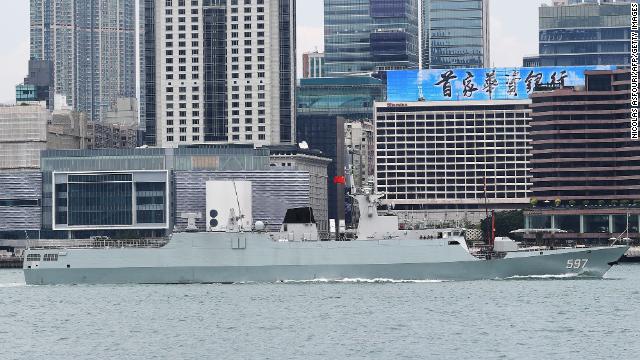
A Type 056 corvette, above, of the Chinese navy transits Hong Kong’s Victoria Harbor in 2019.
Corvettes form the biggest chunk of the People’s Liberation Army Navy fleet, with 72 in service as of February 2021, according to a report in state-run Global Times.
The corvette force is ideal for tighter, shallower ocean environments, like China’s key areas of concern, the South China Sea; around Taiwan; and the Senkaku/Diaoyu islands in the East China Sea, controlled by Tokyo but claimed by Beijing.
The ships the PLAN puts to sea near Chinese shores are protected by a large ground-based missile force.
The missiles “problematize US power projection and prevent overwhelming naval and air power from striking the Chinese mainland,” said Kaushal. “However, this also has the effect of facilitating power projection against local nations, as these nations are far more vulnerable when the maritime links that enable the US to support them are severed.”
For instance, if the US Navy was unable to operate in the South China Sea because of the Chinese missile threat, it would have a hard time protecting the Philippines, with which Washington has a mutual defense treaty.
US military leaders are also cognizant that in 2021 the PLA Navy is much more than ships.
“Take a look at what China’s really investing in,” US Chief of Naval Operations Adm. Mike Gilday said this week in an interview with Breaking Defense. “Yes, they are putting more ships in the water, but they’re investing heavily in anti-ship missiles as well as satellite systems to be able to target ships.”
All that gives China a strong hand to play in any possible conflict close to home. And China is adamant its military is defensive.
“The development of China’s national defense aims to meet its rightful security needs and contribute to the growth of the world’s peaceful forces,” said the country’s 2019 defense white paper, titled “China’s National Defense in the New Era.”
“China will never threaten any other country or seek any sphere of influence.”
So why is the PLA Navy building aircraft carriers, amphibious assault ships and large, powerful destroyers and cruisers suitable for operation far from China?
Near seas defense vs far seas protection
Protecting the Chinese mainland and its territorial claims around the region are what Beijing calls “near seas defense.”
China’s massive naval buildup coincides with it reinforcing its claims to almost all of the 3.3 million square-kilometer (1.3 million square-mile) South China Sea by building up tiny reefs and sandbars into man-made artificial islands heavily fortified with missiles, runways and weapons systems.
“Islands and reefs in South China Sea have unique advantages in safeguarding national sovereignty and maintaining a military presence in the open sea,” read a December 2020 article in Naval and Merchant Ships, a Beijing-based magazine published by the China State Shipbuilding Corporation, which supplies the PLA Navy.
But they can’t stand alone, the magazine noted. In the events of hostilities, outposts in the southern reaches of the waterway could require reinforcements from near China’s southern coast, more than a day’s sailing away, it said.
Piling resources in the near seas to achieve that level of control could be problematic for China, some argue. It may leave China vulnerable to a distant naval blockade that could deprive it of vital materials from abroad, severing what are termed sea lines of communication, or SLOC for short.
“China does not control the straits and transit lanes on which its economy depends and ‘once a crisis or war at sea occurs, (China’s) sea transport could be cut off,’” Jennifer Rice and Eric Robb, senior intelligence analysts at the US Office of Naval Intelligence, wrote in a paper for the US Naval War College’s China Maritime Studies Institute last month. “The regional focus of near seas defense is also insufficient to address the increasingly global scope of China’s economic interests.”
To bring Chinese military power to bear on its global interests, they said, China has begun implementing “far seas protection.”
“Far seas protection reflects Beijing’s direction for the PLAN to ‘go global,’ … part of a larger Chinese government policy to encourage the expansion of China’s economy and cultural outreach,” Rice and Robb wrote.
Part of the play is perception. For decades now, nothing has quite projected military power as the image of a US Navy aircraft carrier in waters far from home. It’s something China craves, analysts say.
“Some Chinese military analysts suggest it is imperative for the PLA to safeguard China’s overseas interests and note that sending out the PLAN is essential to establishing China’s image as a great power,” Rice and Robb wrote.
Dozens of corvettes can’t do that. So China has ramped up its production of ships that form an aircraft carrier task force, like guided-missile cruisers and nuclear-powered submarines, which have much longer endurance than the diesel-electrics that comprise most of the PLAN fleet.
The PLA Navy has two aircraft carriers in service, but their endurance without refueling is limited to less than week, according to the China Power project. That makes them more suitable for use in places like the South China Sea rather than in far oceans.
But more carriers are in planning and production. The newest planned Chinese carrier is expected to be equipped with a nuclear power reactor and electromagnetic catapults that will enable it to launch aircraft with more firepower and greater range than the existing carriers.
Rice and Robb point out that two Chinese defense white papers, from 2015 and 2019, say long-range naval forces are necessary to help with international peacekeeping, disaster relief and naval diplomacy — in other words, flying China’s flag overseas.
But they issue a warning. “The peacetime nature of these activities can obscure far seas protection’s wartime applications. The concept encourages offensive operations during wartime, despite the defensive strategy its name implies,” they wrote.
Citing Chinese publications, they add, “One source urges naval forces to ‘control key strategic channels’ far from China. Another source advocates employing strategic ‘fist’ forces formed around aircraft carriers. … Another wartime mission is to strike important nodes and high-value targets in the enemy’s strategic depth to ‘ease pressure on the near-seas battlefield.’”
What’s possible now — and later
Although the Chinese navy would be a formidable opponent for any foe, its practical abilities don’t yet match its aspirations.
Firstly, the PLAN would require aircraft carrier battle groups with far stronger air wings than the Chinese fleet’s current capabilities.
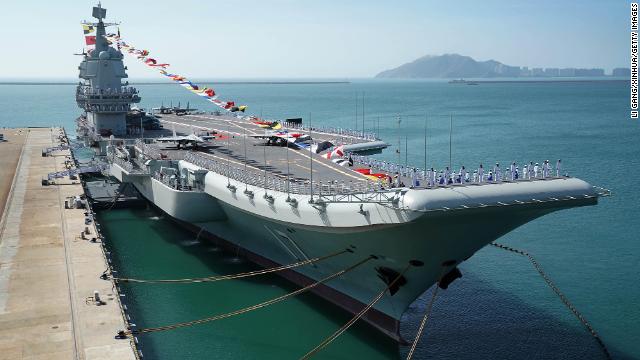
The Shandong, above, is the newest of China’s two active aircraft carriers.
Commissioned in 2019, it is an updated version of its predecessor, the Liaoning, which is a platform originally built for the Soviet navy.
The Shandong carries an air wing of approximately four dozen aircraft split between fighters and helicopters. The Shandong is conventionally powered, meaning it can only operate about six days at sea before refueling.
The PLAN’s two active carriers are conventionally powered and based on old Soviet designs. That limits the range of the ships themselves, the range and number of aircraft they carry, and the payloads of munitions on those aircraft.
In short, they are not even near peers to the US Navy’s fleet of 11 aircraft carriers. And just one of those US carriers makes an intimidating statement while steaming off a foreign shore.
“A US Navy aircraft carrier, its air wing, is more powerful than most countries’ entire air forces,” said Eric Wertheim, editor of the US Naval Institute’s “Combat Fleets of the World.”
The PLA Navy is not there yet. Note how limited China’s long-range naval power projection has been to date.
China’s aircraft carriers haven’t ventured farther than the western Pacific, let alone to projected power globally. While PLAN ships have deployed to the Indian Ocean, the Mediterranean Sea, and into the North Atlantic to northern Russian ports, they’ve done so in small numbers and infrequently.
Just last week, state-run tabloid Global Times reported on a Chinese naval expedition group of at least five ships led by a guided-missile destroyer crossing the equator and sailing into the open sea. It did not give an exact location of the equator crossing but noted the group had likely been at sea for three weeks.
“Such missions enable the PLA to get familiar with the high seas as China eyes to build a blue-water navy,” the report said.
Global Times said a year ago a similar expedition group ventured out into the Pacific, an event noted by Roderick Lee, director of research at the US Air Force’s Air University China Aerospace Studies Institute.
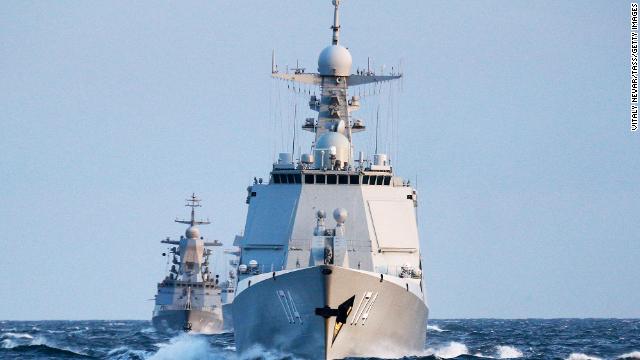
A Chinese navy Type 052D destroyer, front, takes part in an exercise with the Russian navy in the Baltic Sea in 2017.
The ship, of which China had built 25 as of August 2020, is a prime example of how China is making modern warships with the ability to project naval power around the world, analysts say.
Sources: Global Times, US Naval Institute
“The key takeaway from this training event is that the PLAN is developing the proficiencies to sustain limited offensive strikes against US forces — perhaps as far out as Hawaii,” Lee wrote for the Jamestown Foundation’s China Brief.
“The PLA Navy is making significant progress in joint operations, damage control, logistics, and intelligence — to the extent that they may soon be able to operate on the doorstep of US Navy port facilities in wartime.”
But other analysts say the realization of the PLAN’s blue-water efforts could be years, if not decades, away.
“By 2049 China aims to have a global military that’s able to fight and win wars and project power globally,” Meia Nouwens, senior fellow for Chinese defense policy at the International Institute for Strategic Studies, said last week as the think tank released its annual world “Military Balance” report.
Along that timeline, analysts say they are looking for certain benchmarks to measure progress. They include establishing more overseas bases to support the PLAN — it has only one, in Djibouti on the Horn of Africa — and building heavy air transport to supply those bases.
“An interesting one will be when a Chinese carrier group makes a long-range deployment of significance, potentially into the Indian Ocean,” Childs, the International Institute of Strategic Studies defense analyst, said.
Other notable deployments could include going into the Arctic and possibly the Atlantic, Childs added.
The Taiwan question
But in the near term, the center of attention is Taiwan, the democratic self-governing island that the powers in Beijing say is a historical and inalienable part of their sovereign territory.
Beijing’s 2019 defense white paper said the island’s authorities were “intensifying hostility and confrontation, and borrowing the strength of foreign influence.”
“The ‘Taiwan independence’ separatist forces and their actions remain the gravest immediate threat to peace and stability in the Taiwan Strait and the biggest barrier hindering the peaceful reunification of the country,” the paper said.
And in a press conference in January, a Chinese Defense Ministry spokesman made clear where the military stands. “Taiwan is an inalienable part of China,” Senior Col. Wu Qian said.
“The PLA will take all necessary measures to resolutely defeat any attempt by the ‘Taiwan independence’ separatists, and firmly defend national sovereignty and territorial integrity.”
In a speech in 2019, Xi said “not a single inch of our land” could be ceded from China.
“We should safeguard the sovereignty and territorial integrity of the country and achieve full unification of the motherland,” he said.
In many ways concerning Taiwan, Xi has set up the PLA Navy fleet to do that.
As noted, the concentration of smaller surface ships like corvettes and coastal patrol craft are suited for combat near shores. And there’s only about 130 kilometers (80 miles) of relatively shallow water between Taiwan and the Chinese mainland, ideal for the corvettes.
Those six dozen or so corvettes, for example, can carry two anti-ship missiles each with ranges of up to 200 kilometers (125 miles). Imagine the tracking and missile defense headache that creates for the US Navy surface fleet in the Pacific, which can only muster about three dozen destroyers.
PLA capital shipbuilding can also been seen in the lens of Taiwan.
Late last year, the Type 075 landing helicopter dock (LHD), a 35,000- to 40,000-ton multipurpose ship about half the size of China’s two in-service aircraft carriers, embarked on sea trials.
As one of the biggest amphibious assault ships in the world, the Type 075 has a full flight deck to handle helicopters, and a flooded well deck that can launch and recover hovercraft and amphibious vehicles, according to an analysis from the Center for Strategic and International Studies (CSIS). It also has the capacity to carry 900 ground troops, who the helicopters and hovercraft can put ashore.
The ship, the first of three in the water or in production, “considerably elevates China’s ability to transport, land, and support ground forces operating outside the Chinese mainland,” analysts Matthew Funaiole and Joseph Bermudez Jr. wrote for the CSIS.
“The new class of ship … represents a significant step forward for enhancing China’s amphibious capabilities.”
But if China were to invade Taiwan, it would need far more than 900 ground troops to control and occupy the island.
And that brings us back to those numbers, including the coast guard, the maritime militia, even those merchant ships China produces like no one else can.
“We would be wise to assume that China will bring all of its tools of maritime power to bear in ensuring success in a cross-Strait invasion,” Shugart, the CNAS analyst, told Congress, who drew an analogy to the escape of British forces from France in World War II to visualize his point.
“In something like the form of a reverse-Dunkirk, we should expect that instead of only dealing with dozens of gray-painted PLA Navy amphibious vessels and their escorts, we would likely see a Taiwan Strait flooded with many hundreds of fishing boats, merchant ships, and Coast Guard and Maritime Safety Administration vessels.”