CARTAGENA, Colombia Feb 3 (Reuters) – Colombia has launched a new strategy to fight drug trafficking, aiming to control cyberspace to tackle criminal groups involved in the cocaine trade, as well as block their financial transactions, Defense Minister Diego Molano said on Thursday.
The “Esmeralda” initiative, unveiled in the Caribbean city of Cartagena, will see support from 36 countries including the United States, Colombia’s main ally in the war on drugs.
“We hope to develop new and innovative tactics in the coming years in the fight against the global scourge of drugs,” Molano said at the III International Anti-Drugs Congress.
Crime-fighting agencies around the world will increase their cyber presence, including with undercover agents, to tackle the growing distribution of drugs online, Molano said.
Artificial intelligence will also be used to monitor the selling and trafficking of chemical ingredients used in drug making, to protect legal sales but prevent use in narcotics, he added.
Colombia is considered the world’s top cocaine producer. Illegal armed groups including leftist guerrillas and criminal gangs descended from right-wing paramilitaries are deeply involved in production and trafficking.
The South American country cut the size of coca crops, cocaine’s chief ingredient, by 7% in 2020, but potential production rose 8% to 1,228 tonnes a year, according to the United Nations.
Colombian authorities seized a record 672 tonnes of cocaine last year.
Reporting by Luis Jaime Acosta Writing by Oliver Griffin; Editing by Richard Chang
LIMA, Feb 3 (Reuters) – Peru’s new prime minister, Hector Valer, denied on Thursday that he had beat his daughter and late wife – the subject of two police complaints – as the country’s third Cabinet in six months appeared to be on increasingly shaky ground.
“I am not an abuser, I am not someone who hits (others), I am not what the complaint at the police station says,” Valer said at a news conference on his third day on the job.
The allegations put Peru’s Cabinet at fresh risk of failing to earn a confidence vote from Congress, with some parties saying they would vote against him.
Peruvian President Pedro Castillo was in Brazil on Thursday and has yet to comment on the allegations. Castillo, a member of a Marxist-Leninist party, named Valer to the job earlier this week after his former prime minister resigned over disagreements with him.
The allegations, which first surfaced in local media, include a police report from 2016 in which Valer’s daughter alleges Valer slapped, punched and kicked her “in the face and other parts of the body.”
Valer’s wife died three months ago, he said.
Valer denied the alleged violence toward his wife and said he had merely “reprimanded” his daughter. He showed photos of the two together that he said were on his daughter’s Facebook page, saying they offered proof that the two are on good terms.
“I reprimanded my daughter like any parent does inside their own home, not once but many times,” Valer said. “Those reprimands I think have helped my daughter today be a surgeon doctor.”
If Valer cannot earn Congress’ green light, Castillo will have to name a new Cabinet. But if Congress rejects that Cabinet as well, Peru’s constitution allows the president to shut down Congress and call for new legislative elections.
Valer said his Cabinet’s failure in Congress could perhaps strengthen Castillo’s position, because it would put the president closer to having a “gold bullet, which is the dissolution of Congress.”
Peru’s prime minister is a powerful figure. The PM is the chief adviser to the president and also presides and helps appoint the rest of the Cabinet.
Reporting by Marcelo Rochabrun in Lima Editing by Matthew Lewis
BRASILIA, Feb 3 (Reuters) – Brazil’s President Jair Bolsonaro met with Peru’s President Pedro Castillo on Thursday and pressed him on a project to build a cross-border road that would allow Brazil access to the Pacific.
Peru has so far shown little interest in the plan, which would link Cruzeiro do Sul in the western Brazilian state of Acre to the Peruvian city of Pucallpa, across an area of virgin rainforest.
Bolsonaro reiterated the interest of the Brazilian government in building the road, creating “great potential to increase economic integration,” said a joint statement issued after the meeting in the Acre capital of Porto Velho.
Brazil’s far-right leader donned a Peruvian cowboy hat and gave a thumbs-up sign as he posed for photos with Castillo, a member of a Marxist-Leninist party who has moved progressively to the right.
The two men agreed to facilitate trade between their countries, streamline customs red-tape and step up security on their borders to fight drug trafficking and arms smuggling, the joint statement said.
But the cross-border road, which has a cost estimate of some 500 million reais ($94 million) on the Brazilian side, has encountered resistance.
Environmentalists and federal prosecutors in Brazil oppose the project because it would cut through untouched rainforest for 110 kilometers (68 miles) in the Serra do Divisor National Park, one of the most untouched areas of Brazil.
But the Brazilian government’s department of transportation has already authorized a tender to contract a company to build the road.
“We are interested in an exit to the Pacific. Here it just depends on us and Peru, and no other country,” Bolsonaro told reporters before the meeting.
Reporting by Lisandra Paraguassu; Writing by Carolina Pulice and Anthony Boadle; Editing by Rosalba O’Brien
The director of the World Health Organization’s (WHO) Europe office said on Thursday that the region is entering a “plausible endgame” as COVID-19 deaths start to slow down.
Hans Kluge said during a news briefing that European countries have a “singular opportunity” to take control of COVID-19 transmission because of several factors, according to The Associated Press:
1. High levels of immunization from the vaccines and natural infection
2. The virus’ tendency to spread less in warmer weather
3. The lower severity of the omicron variant
“This period of higher protection should be seen as a cease-fire that could bring us enduring peace,” Kluge added at the briefing.
Looking ahead: Kluge said health authorities should be able to control any new variant that may emerge, noting that spring “leaves us with the possibility for a long period of tranquility and a much higher level of population defense against any resurgence in transmission,” the AP reported.
However, Kluge urged everyone in the region to get vaccinated and called for “a drastic and uncompromising increase in vaccine-sharing across borders.”
The context: Countries in Europe, including Denmark, Norway and Britain, have slowly been lifting coronavirus restrictions in recent weeks, with Sweden being the latest, according to the AP.
================================================
World faces ‘bumpy, difficult’ Covid transition, says senior scientist
Tensions in societies around the world over the current Covid situation are going to be very difficult to handle, one of Britain’s most senior scientific figures has warned.
Sir Jeremy Farrar, the director of the Wellcome Trust, who stepped down as a government scientific adviser in November last year, warned the idea of simply “exiting” a pandemic is not realistic.
“I just don’t think you wake up on Tuesday and it’s finished. It’s not going to happen like that,” he said in an online meeting of the Royal Society of Medicine.
“The transition from [the] acute phase of the pandemic to something new, not yet defined, it’s really difficult – bumpy, different around the world, different within a single country, with the degree of inequity that’s happened globally, but also nationally,” he said.
Farrar noted one problem is that while some people may argue the pandemic is now in the past, and the situation in the middle of the pandemic was exaggerated, others believe it’s far from over.
US to donate an additional 500m Covid vaccines to poorer countries, says Biden
“And so the tensions, I think, within societies are going to be very difficult to handle,” he said.
Farrar added that while he has sympathy with the disruption of education and the health and economic impacts of Covid he is concerned about the speed at which some want to move on.
“My concern is that there will be too fast a shift to saying it’s all over and we will lose the humility of accepting that we’re only two years into a novel human pathogen, that is still a huge amount of uncertainty,” he said, adding it is also crucial to resolve the problem of vaccine inequality.
While Farrar said the most likely scenario is that there will be a transition to Omicron becoming endemic, as the variant is less severe than others, it is not the only possibility.
“My worry in the push to try and move on from this [is that] we ignore those other scenarios, which are less rosy but we should be absolutely prepared for,” he said.
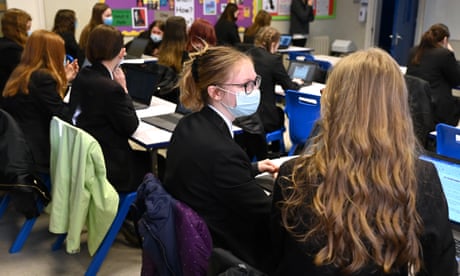
Boris Johnson tells schools in England to end mask-wearing policy
Read more
Farrar added that while he agreed it is time to begin easing Covid restrictions in the UK, he is in favour of keeping some measures.
“I would be in favour of continuing for instance, mask wearing on public transport, in enclosed spaces, etc,” he said. “And I would be pushing ever harder on trying to encourage people to be vaccinated, get their boosting doses, and make sure that everybody has access to the vaccines from a UK perspective.”
Farrar also warned that he has deep concerns about the global Covid situation, warning that the pandemic has been made worse “by a catastrophic failure of global diplomacy”.
“The ongoing geopolitics of east /west but increasingly, understandably, north/south, because of vaccine inequity is going to lead to really troubling years ahead and will have ramifications beyond pandemics to our ability to come together to solve issues of inequality, of issues of climate change, of issues of drug resistance, of issues of migration and conflict,” he said.
===========================================
India’s death toll exceeds 500,000
India’s death toll from Covid-19 has crossed 500,000, Reuters reports, a level many health experts say was breached last year but obscured by inaccurate surveys and unaccounted dead in the hinterlands, where millions remain vulnerable to the disease.
The country, which has the fourth-highest tally of deaths globally, recorded 400,000 deaths by July last year after the devastating outbreak from the Delta variant of the coronavirus, according to official data. Some experts believe the figures were much higher.
“Our study published in the journal Science estimates 3 million Covic deaths in India until mid-2021 using three different databases,” Chinmay Tumbe, an assistant professor at the Indian Institute of Management, Ahmedabad who co-authored the study, told Reuters.
Last month, the Indian government dismissed the study as baseless in a notification saying there is a robust system of birth and death reporting.
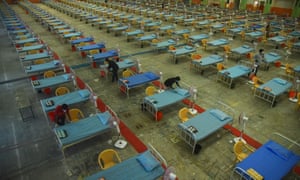
A makeshift Covid-19 care facility at Chennai Trade Centre. Photograph: Idrees Mohammed/EPA
India’s states record deaths from Covid-19 after collating data from their districts. In the last few months, several states have updated the number of deaths, some under pressure from the country’s top court. In most instances, authorities said there were lapses due to delayed registrations and other administrative errors.
India is currently in the midst of a third wave of the coronavirus led by the Omicron variant, which some top experts say is already in community transmission although federal officials say most cases are mild.
Last month, the government eased testing norms and told states to drop mandatory testing for contacts of confirmed cases unless they were old or battling other conditions. But, with the number of tests falling, the government issued a revised circular warning states they would miss the spread of the virus.
But, as many infected people took the option of not testing at all, total infection numbers may not reflect the extent and severity of cases, said Gautam Menon, a professor of physics and biology at Ashoka University near the capital who has been tracking the spread of the virus.
According to official figures, India’s overall number of Covid-19 infections has reached 41.95 million, the second-highest globally behind the United States.
India’s cumulative tally of 500,055 deaths on Friday included 1,072 fatalities reported over the last 24 hours, according to the federal health ministry. Out of this, 335 deaths were reported from the southern state of Kerala that has, for weeks, been updating data with deaths from last year.
Russia hurdles daily Covid record again – to almost 170,000 infections
Russia broke its daily Covid record again on Friday with infections surging to 168,201, Reuters reports.
That’s a 242% jump on the 49,127 cases detected on Friday two weeks ago, which was itself a record-breaker.
Russia, gripped by Omicron, has smashed its daily Covid record practially every day for the past two weeks. Thursday saw 155,768 cases.
The labour ministry has recommended working from home. But the Kremlin has ruled out a national lockdown. Meanwhile, at the local level some cities have imposed restrictions to crimp the virus’s spread.
A further 682 deaths from Covid-related causes were reported in the past 24 hours. Russia has the world’s 2nd highest Covid death toll of over 700,000, behind only the US. (Russia has the 9th highest populaiton worldwide.)
NIA CHARLESTOWN NEVIS – Keeping the culinary heritage of Nevis alive as much as it possibly can, is the key reason behind the Nevis Agro Processing Centre’s move to preserve the island’s traditional foods.
Mr. Huey Sargeant, Permanent Secretary in the Ministry of Agriculture says they are committed to documenting and producing some of Nevis’ traditional recipes when he spoke to the Department of Information on January 31, 2022.
“They continue to produce confectionary like tamarind balls and jams and so on, and one of the things as well at the Agro Processing Unit, is that we’ve committed to preserving a lot of our traditional foods. We have a situation where a lot of our traditional agro processors are transitioning to the great beyond and we’ve lost a few – notably we have Mrs. Alison Cornelius and Mrs. Olvis Dyer and they were some of the major agro processors.
“We have Mrs. Stapleton as well who is not producing as much as she used to, and what we are seeking to do from the agro processing unit is to be able to get some of these recipes at least and document them, so that we can preserve part of our culinary culture on the island. So it is not only just producing but we are seeking to be able to document and have for display when we have activities like our Open Day or Fruit Festival or even World Food Day,” he said.
Mr. Sargeant noted that while there are semblances of the widely sought-after cultural delights available, they do not follow the same recipes as that of yesteryear.
“These traditional items like traditional coconut cake… I see we have coconut drops in some of the bakeries, not knocking any of the bakeries, but they might be a little bit deficient in coconut.
“We have sugar cake, that traditional sugar cake had some ginger in it and so on, some of these unique recipes that my parents grew up on and to a lesser extent I grew up on. So that is another part of the work that we are doing at agro processing,” he said.
The St Kitts-Nevis Football Association (SKNFA) has received and reviewed an online article
published today in The Guardian newspaper in the United Kingdom titled “Fifa investigates after St. Kitts appoint coach accused of sexual abuse.”
The SKNFA wishes its stakeholders and the general public to know that FIFA has not contacted the SKNFA to investigate any of the allegations contained in the said article.
Prior to hiring Mr. Ahmed Mohamed as the SKNFA’s Director of Football the SKNFA conducted a serious and fulsome due diligence exercise involving consultations with members of the BarbadosFootball Association, CONCACAF and other persons who knew Mr. Mohamed personally. The SKNFA was, and remains, fully satisfied that Mr. Mohamed is of good character – the allegations made against him being false – and he has the requisite technical ability to perform his functions to take SKNFA football to higher levels.
The SKNFA acknowledges the seriousness of the allegations referenced in the article, but we are of the firm belief that the article was maliciously contrived by a certain faction of persons who wish to tarnish the good name of the SKNFA and our recently appointed Director of Football.
The SKNFA will continue to create an environment, where our players, male and female, can achieve their maximum potential in a safe, fun and professional environment.
Washington — U.S. special operations forces conducted a large-scale counterterrorism raid in northwest Syria overnight Thursday, and President Joe Biden said the operation had left the ISIS terror group once again without a leader.Mr. Biden’s brief statement early on Thursday came after residents, rescuers and a monitoring group reported multiple deaths from the raid, including among civilians.
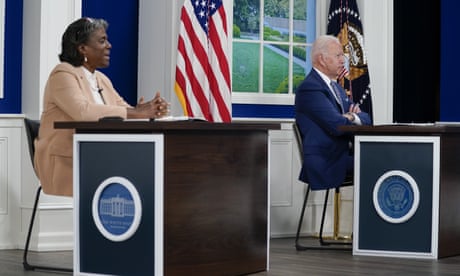
The White House released a statement from President Biden, who described the raid as a “counterterrorism operation to protect the American people and our Allies, and make the world a safer place.”
Abu Ibrahim al-Hashimi al-Qurayshi, the current leader of ISIS, was “taken off the battlefield” in the operation, Mr. Biden said, confirming that all U.S. forces who took part had returned safely. The president said he would address the American people later on Thursday about the raid. His statement made no mention of the reported civilian casualties.
A senior Biden administration official told CBS News senior White House and political correspondent Ed O’Keefe on Thursday that al-Qurayshi “exploded a bomb that killed him and members of his own family” as the raid got underway.”
Speaking later Thursday morning at the White House, Mr. Biden said the choice was made to go after the ISIS leader with a special forces raid, rather than a missile strike, in an effort to avoid civilian casualties. He said al-Qurayshi “chose to blow up” both himself and the entire third floor of the home he was holed up in, which led to the death of his own family members.
The president lauded the U.S. forces who carried out the raid, and called it “testament to America’s reach and capability to take out terrorists anywhere they hide in the world.”
“We will come after you and find you,” Mr. Biden warned other terror leaders.
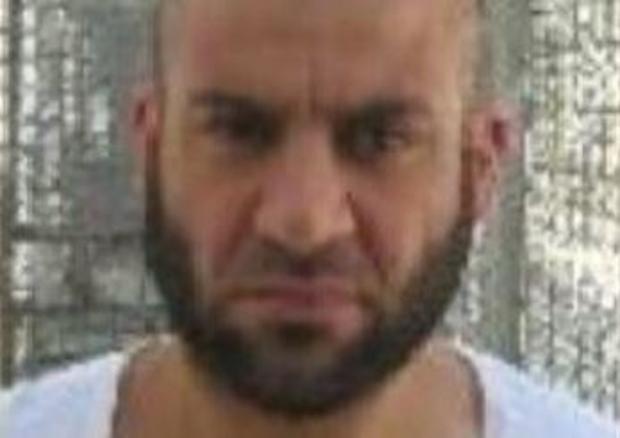
An undated photo shows Abu Ibrahim al-Hashimi al-Qurayshi, who became the leader of ISIS in 2019 until he was “taken off the battlefield” in a U.S. military raid in northwest Syria on February 3, 2022.
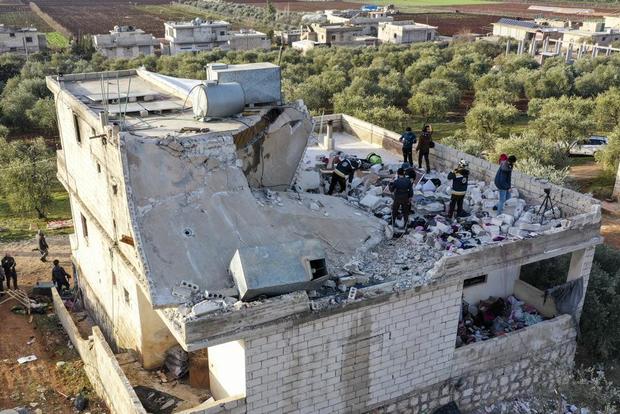
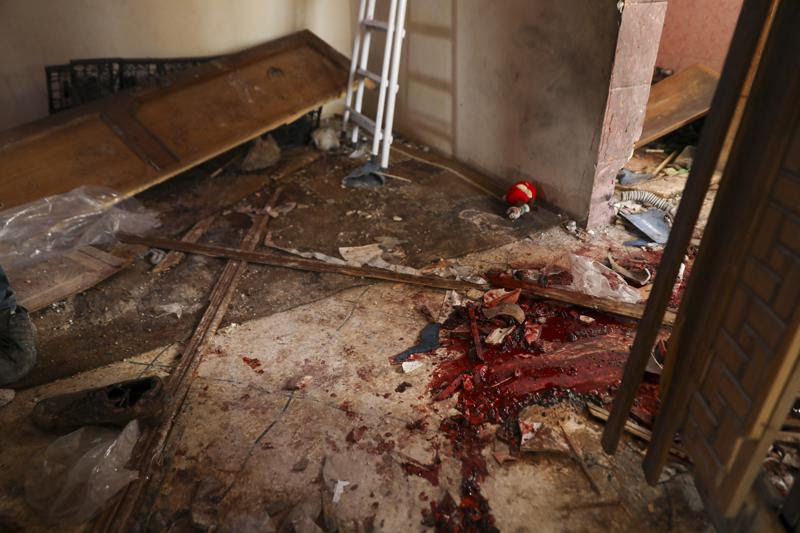
Several residents told The Associated Press they saw body parts scattered around a house in the village of Atmeh, near the border with Turkey. They spoke on condition of anonymity for fear of reprisals following the raid, which they say involved helicopters, explosions and machine-gun fire.
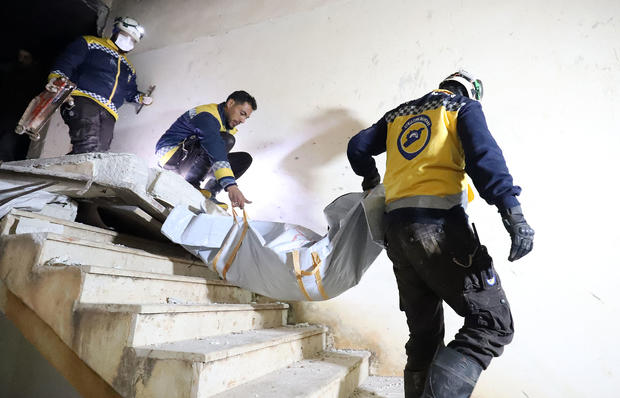
The Britain-based Syrian Observatory for Human Rights, which relies on a network of sources on the ground in Syria and has been a largely reliable source of information during the grinding civil war in the country, said the strike left at least 13 people dead, including four children and three women. The “White Helmets,” a volunteer rescue agency, said four women and six children were killed.
The senior administration official who spoke to O’Keefe on Thursday also said al-Qurayshi’s own bomb had killed women and children in his family.
“While we are still assessing the results of this operation, this appears to be the same cowardly terrorist tactic we saw in the 2019 operation that eliminated” al-Qurayshi’s predecessor, the official said.
People inspect a heavily damaged house following an operation by the U.S. military in the Syrian village of Atmeh, in Idlib province, Syria, February 3, 2022, during which ISIS leader Abu Ibrahim al-Hashimi al-Qurayshi was “taken off the battlefield,” according to President Joe Biden. AP Photo/Ghaith Alsayed
Images purported from the aftermath of the raid quickly appeared on social media showing the bodies of victims, including small children.
Charles Lister, senior fellow with the Washington-based Middle East Institute, remarked to Reuters that the U.S. forces “clearly … wanted whoever it was alive.”
Syrian civil defence evacaute a body on February 3, 2022 following an overnight raid by U.S. special operations forces against suspected jihadists in northwestern Syria. ABDULAZIZ KETAZ/AFP via Getty Images
The Syrian Observatory for Human Rights said troops from the U.S.-led coalition using helicopters landed in the area and attacked a house. It said the forces clashed with fighters on the ground.
Taher al-Omar, an Idlib-based activist, also said clashes broke out between the fighters in the area and special ops forces.
The residents and activists in the area described seeing a large ground assault, with U.S. forces using loudspeakers asking women and children to leave the area.
There was at least one major explosion. A U.S. official said one of the helicopters in the raid suffered a mechanical problem and had to be blown up on the ground. The U.S. official spoke on condition of anonymity to discuss details of the military operation.
The military operation got attention on social media, with tweets from the region describing helicopters firing around a building near Atmeh. Flight-tracking data also suggested that multiple drones were circling the city of Sarmada and the village of Salwah, just north of there in Idlib province.
The clandestine operation came with ISIS apparently trying to stage a comeback after its effort to establish a caliphate failed in 2019, following several years of fighting in Syria and Iraq. In recent weeks and months, the group has launched a series of attacks in the region, including a 10-day assault late last month to seize a prison in northeastern Syria.
A U.S.-backed Kurdish-led force said Monday that the Gweiran prison, also known as al-Sinaa prison, is now fully under its control. The Syrian Democratic Forces (SDF) said more than 120 of their fighters and prison workers died in the effort to thwart the ISIS plot. The prison houses at least 3,000 ISIS detainees.
The attempted prison break was the biggest military operation by the extremist group since ISIS was defeated and members scattered to havens in 2019. The U.S.-led coalition carried out airstrikes and deployed American personnel in Bradley Fighting Vehicles to the prison area to help the Kurdish forces.
The U.S.-led coalition has targeted high-profile militants on several occasions in recent years, aiming to disrupt what U.S. officials say is a secretive cell known as the Khorasan group that is planning external attacks. A U.S. airstrike killed al Qaeda’s second in command, former Osama bin Laden aide Abu al-Kheir al-Masri, in Syria earlier this year.
CNW- Prime Minister Dr. Ralph Gonsalves says “Vincy Mas” will return to St. Vincent and the Grenadines’ cultural calendar in March this year. But he cautioned that the coronavirus (COVID-19) vaccination rate would determine the festival’s size.
“It was decided clearly that we will have Carnival this year,” Gonsalves said on a radio program on Sunday. He told listeners that health authorities will ramp up their vaccination effort over the next two months, with the hope of vaccinating 70 percent of the 80,000 people who are 12 years and older.
As of Sunday, health authorities have administered 63,669 doses of COVID-19 vaccines.
The country’s government paused Vincy Mas for the past two years due to the coronavirus pandemic. Gonsalves says the decision to hold the festival this year was made at Cabinet last Wednesday, after a two-hour discussion with the Carnival Development Corporation (CDC).
The people need Vincy Mas to ‘release’
He said that there are three primary functions of Carnival. Vincy Mas is a mass cultural event that showcases talent in mas, calypso, pan, and other areas and is an economic activity.
“Every society needs occasions when you have a release. It’s a catharsis. You’re doing work all the time, and you have to have something which you let off your energy; you release it. There are all sorts of events. You do that with sports. You do it with cultural events.”
Carnival, he said, is one such activity, with thousands of people involved “and those who don’t come out, enjoy it at home and increasingly, on various internet platforms. And the public sector and the private sector are very much engaged.”
Prime Minister Gonsalves noted that in addition to the pandemic, St. Vincent and the Grenadines had been affected by the explosive eruption of the La Soufriere volcano and the impact of Hurricane Elsa last year.
“It has been a difficult time for our nation. And in addition to the cultural dimension, and in addition to the economic, there is a need for some kind of collective relief. At least so we think in Cabinet. I’d be interested to hear what people think about this,” Gonsalves said. he added that the CDC’s proposal was “reasonable” and took into account the existing COVID-19 protocols and levels of vaccination.
Gonsalves ramping up a bigger COVID-19 vaccination campaign
“So naturally, I raised the question what kind of carnival would we have if we go for 70 percent vaccination by the end of March.
“So we try and do that in February and March — we do an all-out bigger campaign than ever. This is not just a question of getting the vaccine rate up, that’s one thing, but really we need something bigger than this slimmed-down version of Carnival,” Gonsalves said, adding that linking the size of Vincy Mas to the vaccination levels is not an opportunistic move.
“This is something which is strategic, both in terms of health, and for us, as a people to have this release after this tremendous strain and pressure and part of our quest to repair — fresh hope in life and living and for us to feel better,” he said.
Prime Minister Gonsalves said that Cabinet had asked the CDC to provide data as the government might not know until April “whether we’re going to have something big, or something scaled down.”
He said some Carnival makers might begin planning, and, for example, mas bands wanting to compete in the King and Queen of the Band competition may wish to start making their costumes.
Mas bands may have skepticism, but Gonsalves is confident
He said some mas bands might be cynical about whether the government will reach the vaccination target.
“Well, I want to know, what the sums involved are if we have to provide reimbursement in whole and substantial part for work which people do in the artistic, creative field, in the months of February and March, or even into April, which they may not be able to use if the format is more constrained.
“You have to do these things simultaneously. And you have to hope that the best results come in each and every little thing that you’re doing towards this grand goal of a pretty normal Carnival,” he added.
WASHINGTON (AP) — U.S. special operations forces conducted a large-scale counterterrorism raid in northwestern Syria overnight Thursday, in what the Pentagon said was a “successful mission.” “The mission was successful,” Pentagon press secretary John…Read More
MOSCOW (AP) — Russian President Vladimir Putin is heading to Beijing amid the soaring tensions over Ukraine on a trip intended to help strengthen Moscow’s ties with China and coordinate their policies in the face of Western pressure. …Read More
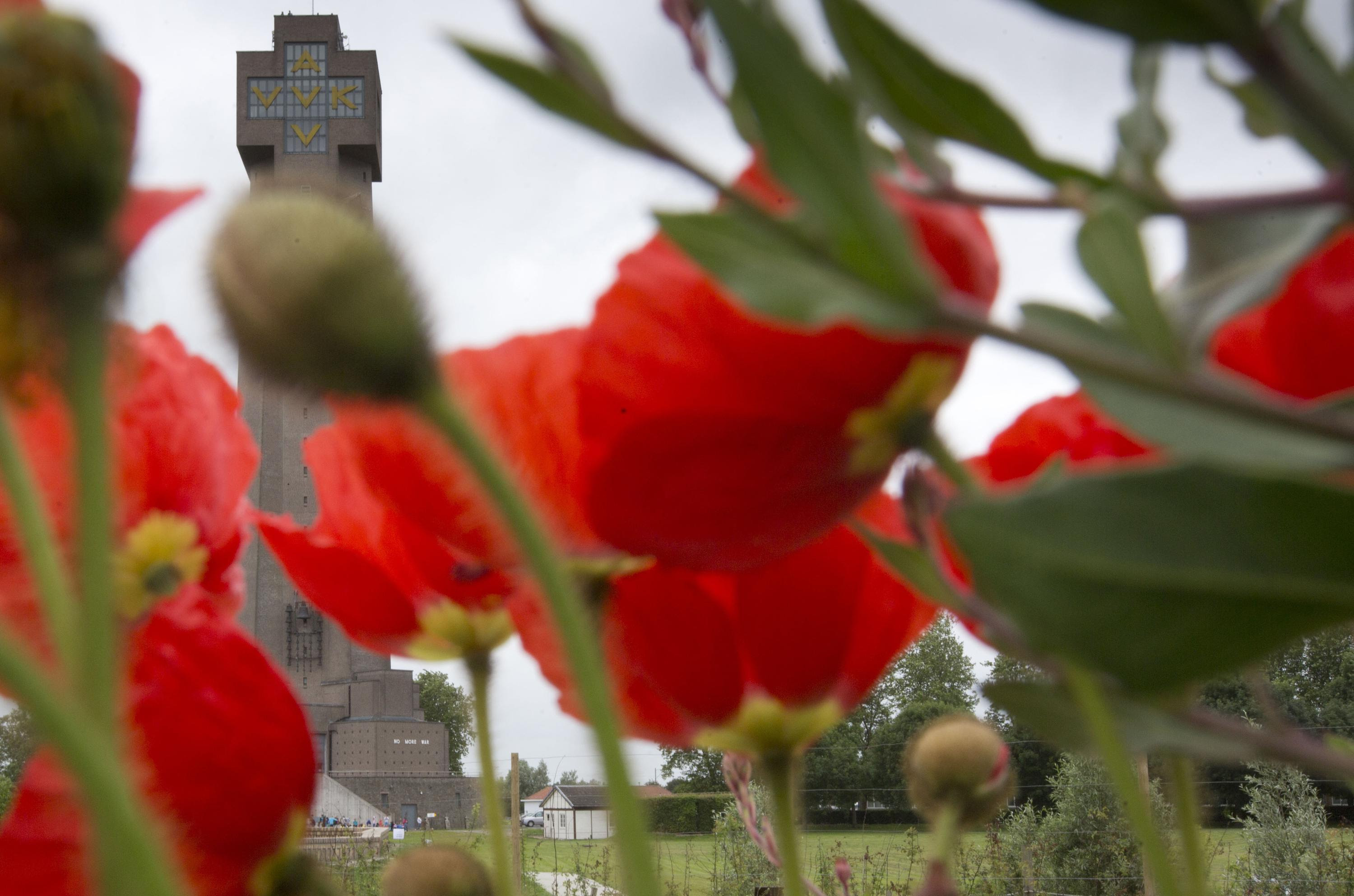
SAINT-SYMPHORIEN, Belgium (AP) — Scarred by losing tens of millions of lives on their soil in two world wars, many European Union nations have been wary ever since about military spending. Now, as Russian pressure builds at the Ukrainian border, th…Read More
BEIJING (AP) — Long before the global pandemic upended sports and the world in general, the 2022 Winter Olympics faced unsettling problems. It started with the fact that hardly anybody wanted to host them. …Read More
MIAMI (AP) — Technology to hide a ship’s location previously available only to the world’s militaries is spreading fast through the global maritime industry as governments from Iran to Venezuela — and the rogue shipping companies they depend on to mo…Read More
With American hospitals facing a dire shortage of nurses amid a slogging pandemic, many are looking abroad for health care workers. And it could be just in time. There’…Read More
CHICAGO (AP) — A major winter storm with millions of Americans in its path brought a mix of rain, freezing rain and snow to the central U.S. as airlines canceled thousa…Read More
Washington’s NFL team is now known as the Commanders. The new name unveiled Wednesday comes 18 months after the once-storied franchise dropped its old moniker following…Read More
WASHINGTON (AP) — A wandering chicken was caught sneaking around a security area at the Pentagon, a local animal welfare organization said. The loose hen was found Mond…Read More
In the early days of communism in Cuba, Fidel Castro had pledged that every child under seven would have a liter of subsidized milk every day.
For some time, they did — but today, many go without.
To circumvent the US embargo against Cuba and lagging domestic production, milk has to come from the other side of the world in an obstacle race that deprives many on the island of the staple.
Regla Caridad Zayas, a 59-year-old diabetic, said the milk powder that the Cuban state supplies monthly to her and others with special dietary needs dried up months ago.
She is supposed to get a kilo of powder, which makes 10 liters (2.6 gallons) of milk, every month.
Sitting at a rickety table from which she sells coffee outside her house, Zayas said the bodegas, or subsidized food stores, no longer carry the commodity.
In the supermarket, it is also nigh impossible to find: milk has become the latest casualty in a long history of chronic food shortages in Cuba, which on Monday marks six decades of US sanctions.
And it will continue to be in short supply in Havana and four other provinces, due to a lack of “financing, boats and suppliers,” Internal Trade Minister Betsy Diaz said in October.
To find milk powder, Cuba looks all the way to New Zealand — its main supplier with 18,470 tons in 2020 — as well as Belgium (6,628 tons) and Uruguay (3,695 tons), according to specialized export and import data site Trade Map.
– Containers stuck –
Official Cuban data shows that the island produced 455 million kilograms of fresh milk in 2020, far short of what it needs.
According to the PanAmerican Dairy Federation, each person should have access to 150 liters of milk per year — some 1.6 billion liters, and about the same in kilograms, for Cuba’s 11.2 million inhabitants.
The cheapest and easiest would be to get the milk from the United States — one of the world’s largest exporters and less than 200 kilometers (124 miles) from Cuba’s coastline.
Since 2000, food products have been excluded from the US embargo on trade with Havana. But Cuba must pay cash and in advance — onerous conditions for a country in deep economic crisis, with little foreign exchange and no access to loans.
Getting products from the other side of the planet is not easy, either: more than 10,000 containers of food and other products were stuck last month in ports around the world due to pandemic supply chain issues, the government said.
For decades, revolutionary leader-turned-president Fidel Castro made a point of supplying cheap, subsidized milk to all children under the age of seven and people with chronic diseases.
His brother and successor Raul proposed in 2007 to go even further by “producing milk so that all those who want to drink a glass of milk can do it.”
But today, even the guaranteed monthly ration of three kilos of powdered milk for children is running out. For other recipients such as Zayas, there is none.
– Milk was ‘sacrosanct’ –
“Truly, everything is disappearing,” said Claudia Coronado, a 29-year-old mother of two children aged three and seven, while standing in one of Havana’s ubiquitous food queues.
“We were used to not having chicken for a month, but milk, that was always sacrosanct.”
“I have a daughter of eight, she’s no longer getting milk,” said Jenny Mora, 29, who said she often has no choice but to turn to the black market and pay exorbitant prices.
The store outside of which the two women are queuing only accepts foreign currency — itself also only available on the parallel market.
A sachet of one kilogram (two pounds) of milk powder costs $6.30 — a fortune in a country where the average monthly salary is $163.
Economist Omar Everleny Perez said that without government help, it was more profitable for farmers to sell their product on the black market.
– Lean cow, low yield –
Farmer Domingo Diaz, 79, blames the US embargo for “about 90 percent” of the milk shortage.
He blames the communist government for the rest.
Though it raised the purchase price to help producers, the government did nothing to secure access to cow feed, he said.
Undernourished, the animals produce very little.
“The milk problem affects everyone, it drives me mad, too,” said Diaz, as he tried to squeeze milk from a lean beast.

 *****@
 *****@
 *****@
 *****@
 *****@
 *****@
 *****@
 *****@
 *****@
 *****@
 *****@
 *****@