Tag Archives: caribbean

Peru Communities Reject Latest Proposal to End Las Bambas Mine Conflicts

SAYHUA, Peru, Jan 17 (Reuters) – Leaders of a group of Peruvian communities said in a public hearing on Monday that they rejected a government proposal to prevent future blockades affecting the Las Bambas copper mine.

Capacmarca district leaders said they would analyze the proposal for 15 days before deciding whether to once again block the mining road used by Las Bambas to transport its copper onto a seaport. read more

The road has been blocked by local communities since Las Bambas, owned by China’s MMG 1208.HK began operations in 2016. Blockades have totaled over 400 days on and off since then and most recently forced the mine to suspend operations in December.

The refusal to sign the proposal, which would have committed Las Bambas to financially support Ccapacmarca, is a blow for the government of leftist President Pedro Castillo. His administration has tried to prioritize the needs of poor mining communities while also relying on profits from the sector.

Las Bambas is one of Peru’s largest copper mines. The Andean nation is the world’s No. 2 copper producer and mining is a key source of tax revenue for the country.

Reporting by Marcelo Rochabrun, writing by Hugh Bronstein; Editing by David Gregorio

The post Peru Communities Reject Latest Proposal to End Las Bambas Mine Conflicts appeared first on The St Kitts Nevis Observer.

Brazil’s Bolsonaro to Visit Suriname and Guayana for Talks on Oil Cooperation

BRASILIA, Jan 17 (Reuters) – Brazilian President Jair Bolsonaro will visit Suriname and Guayana on Thursday and Friday for talks on economic cooperation following recent discoveries of oil and gas by Brazil’s two neighbors, the foreign ministry said on Monday.

Bolsonaro and the presidents of Suriname, Chandrikapersad Santokhi, and Guayana, Irfaan Ali, will hold a working lunch in the Surinamese capital Paramaribo on Thursday to discuss “projects of common interest,” a ministry statement said.

It said the three governments were resuming a strategic dialogue at a time of “prospects for greater economic and social development in Suriname and Guyana, driven by recent discoveries of oil and gas.”

Representatives of Brazil’s state-controlled oil company Petrobras (PETR4.SA) are expected to accompany Bolsonaro for talks on cooperation in oil and gas and possible investments.

Reporting by Anthony Boadle; Editing by Karishma Singh

The post Brazil’s Bolsonaro to Visit Suriname and Guayana for Talks on Oil Cooperation appeared first on The St Kitts Nevis Observer.

Fauci: Too Soon to Be Overly Optimistic, Australia Covid Surge, Unvaxed Greeks to be Fined, More

Dr. FAUCI: TOO SOON TO SAY IF OMICRON FINAL WAVE OF PANDEMIC

Anthony Fauci said on Monday that it is too soon to say whether omicron is the final wave of the COVID-19 pandemic.

The White House chief medical adviser, while speaking at the World Economic Forum’s Davos Agenda online conference, said that “it is an open question whether it will be the live virus vaccination that everyone is hoping for,” according to CNBC.

“I would hope that that’s the case. But that would only be the case if we don’t get another variant that eludes the immune response of the prior variant,” he added.

Omicron is the most transmissible variant to appear so far, but seems to cause fewer hospitalizations and deaths than previous mutations of the virus, which has made many question if the pandemic is finally close to an end.

The new variant already accounts for over 94 percent of the cases in the U.S., according to the Centers for Disease Control and Prevention (CDC), which shows how quickly the highly transmissible variant has displaced the previously dominant delta variant.

Fauci’s comments come a week after Europe’s top medical product regulation agency said that the COVID-19 omicron variant may be pushing the pandemic into becoming endemic.

=================================

Australia suffers deadliest day of pandemic as Omicron drives up hospital cases

SYDNEY, Jan 18 (Reuters) – Australia suffered its deadliest day of the pandemic on Tuesday as a fast-moving Omicron outbreak continued to push up hospitalisation rates to record levels, even as daily infections eased slightly.

Australia is dealing with its worst COVID-19 outbreak, fuelled by the Omicron variant of the coronavirus that has put more people in hospitals and intensive care than at any time during the pandemic.

A total of 77 deaths was recorded, exceeding the previous national high of 57 last Thursday, official data showed.

“Today, is a very difficult day for our state,” New South Wales (NSW) Premier Dominic Perrottet said during a media briefing as the state reported 36 deaths, a new pandemic high.

Only four of those who died in NSW had received their booster shot, prompting the state’s health officials to urge people to avoid delays and get their third dose soon. Thirty-three were double-dosed.

“There needs to be a sense of urgency in embracing the booster doses,” NSW Chief Health Officer Kerry Chant said. “For Omicron, we know that the protection is lower and we need that next boosting to get that higher level of protection.”

The surge in case numbers battered consumer confidence last week, an ANZ survey on Tuesday showed, triggering self-imposed lockdowns and stifling spending even as states looked to avoid lockdowns and keep businesses open.

Omicron also dented Prime Minister Scott Morrison’s approval ratings, according to a widely watched poll on Tuesday, putting opposition Labor into a leading position months out from a federal election.

Amid rising hospitalisations, Victoria on Tuesday declared a “code brown” in hospitals, usually reserved for shorter-term emergencies, that would give hospitals the power to cancel non-urgent health services and cancel staff leave.

To help public hospitals cope, the federal government has activated a plan for private hospitals to provide up to 57,000 nurses and more than 100,000 staff to Omicron-affected areas around the country, Health Minister Greg Hunt said.

While authorities usually do not specify the coronavirus variant that leads to deaths, officials have said most patients in intensive care were infected with the Omicron strain, with unvaccinated young people forming a “significant number”.

Queensland said none of Tuesday’s record 16 deaths in the state had received booster shots. Of the 45 people who have died in the state due to COVID-19 since Dec. 13, only one had received their third dose.

“Please come forward and get your booster, we know that it makes a difference,” state Health Minister Yvette D’Ath said.

About 73,000 new infections were reported on Tuesday, down from a high of 150,000 last Thursday. So far, Australia has reported about 1.6 million infections since the pandemic began, of which around 1.3 million were in the last two weeks. Total deaths stood at 2,776.

Reporting by Renju Jose; Additional reporting by Sonali Paul in Melbourne; editing by Richard Pullin
===================================================

Bulgaria reports new peak for daily coronavirus cases

SOFIA (Reuters) – Bulgaria reported 9,996 COVID-19 cases on Tuesday, setting a new recorFFd daily tally following a surge of cases of the Omicron coronavirus variant.

Health authorities in the European Union’s least vaccinated country said 161 deaths had been reported on Tuesday.

Bulgaria changed its rules that could prompt new restrictions, linking them to the occupancy of intensive care beds rather than the number of new infections.

For now, health authorities are not imposing new measures, with 5,223 people in hospitals and 541 in intensive care units.

The country of 7 million people has reported 830,604 infections since the start of the pandemic and 32,247 COVID-related deaths.

Reporting by Tsvetelia Tsolova; Editing by Tomasz Janowski

====================================================

Czech Republic sees biggest daily jump in COVID cases since Dec 1

PRAGUE, Jan 18 (Reuters) – The Czech Republic reported on Tuesday more than 20,000 new cases of COVID-19, the biggest single-day rise since Dec. 1, the Health Ministry said.

The central European country of 10.7 million is bracing for a new wave of the pandemic as the Omicron variant of the coronavirus begins pushing up cases.

The government has shortened quarantine and isolation times as part of new measures while also launching mandatory testing of employees at companies, which got underway this week.

On Monday, the Health Ministry recorded 20,270 new coronavirus infections, up from 7,342 a week earlier.

Hospitalisations, which peaked above 7,000 in early December in the last wave, stood at 1,660 on Monday, up a touch from Sunday.

Reporting by Jason Hovet; Editing by Kim Coghill
=================================================

UNVACCINATED GREEKS 60 AND ABOVE NOW FACE FINES

Individuals ages 60 and older who reside in Greece face fines beginning Monday if they are not vaccinated against COVID-19.

Older individuals who are not inoculated will be fined 50 euros, which is equivalent to $57, in January, according to The Associated Press. If they still do not get the shot, they will be fined 100 euros, equal to $114, every month going forward.

The new policy, which was announced in November, comes as Greece’s vaccination rate trails that of the European Union average. Roughly two-thirds of Greece’s 10.7 million person population is fully vaccinated against COVID-19, but the EU has an inoculation rate of slightly more than 70 percent, according to the AP.

Individuals with valid health concerns will be exempt from the new policy, government spokesman Giannis Oikonomou said, according to the AP. This includes people who were recently infected and individuals who experienced delays with their applications for home vaccination.

Oikonomou said, however, that “the law will be fully enforced,” according to the AP.

The post Fauci: Too Soon to Be Overly Optimistic, Australia Covid Surge, Unvaxed Greeks to be Fined, More appeared first on The St Kitts Nevis Observer.

Tonga Tsunami: Ash Hampers Relief Efforts as Scale of Damage Emerges

BBC- Ash cloaking a runway has hampered relief efforts to Tonga, as the scale of the damage from a volcanic eruption and a tsunami becomes clear.

New Zealand is trying to send clean drinking water and other supplies but planes cannot land at the main airport.

Some of Tonga’s small outlying islands have suffered substantial damage, aid agencies say.

Two people have been reported dead, but with communications limited there are fears the true toll could be higher.

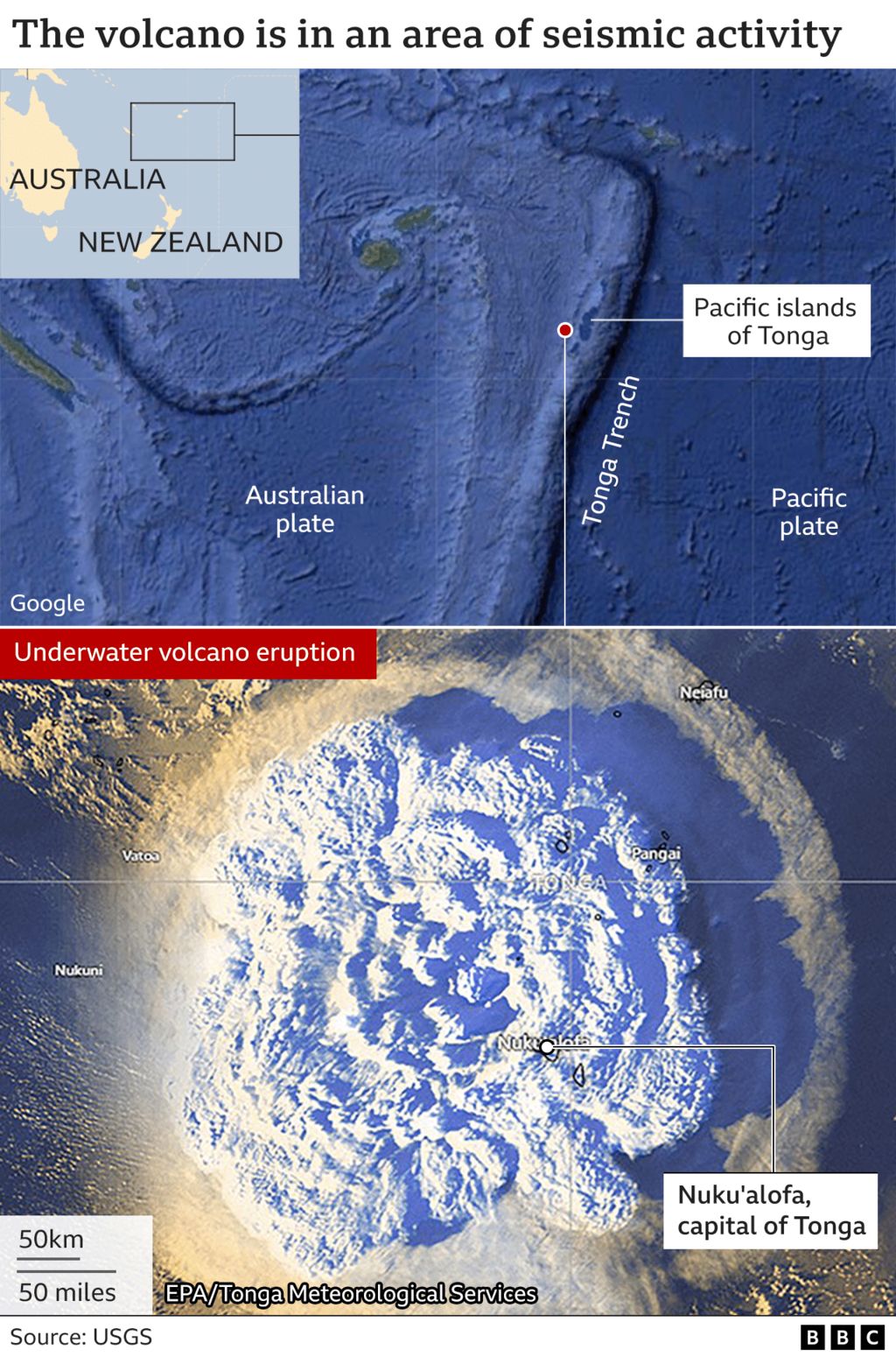
An underwater volcano erupted on Saturday, showering Tonga with ash and triggering a tsunami.

Tonga is made up of more than 170 islands scattered over an area of the South Pacific roughly the size of Japan. Just over 100,000 people live in Tonga, the bulk of them on the main island of Tongatapu.

The UN reported extensive damage to property on western beaches of Tongatapu. In the capital Nukuʻalofa, the New Zealand High Commission said aside from the waterfront, the area is largely undamaged.

But there are concerns about the Ha’apai group of islands, which lies north of Tongatapu.

Surveillance flights showed an entire village destroyed on one island and buildings flattened on another.

Tonga’s deputy head of mission in Australia, Curtis Tu’ihalangingie, told Reuters the pictures were “alarming”. “Possibly there will be more deaths and we just pray that is not the case,” he said.

On Tuesday New Zealand foreign affairs minister Nanaia Mahuta said that “water is among the highest priorities for Tonga at this stage”. Aid agencies say it is likely that volcanic dust and the tsunami had contaminated Tonga’s water supplies.

But the ash, that has turned Tonga’s normally lush green landscape into a muddy brown, needs to be cleared before New Zealand’s planes can land.

A group of Tongans have been sweeping the ash off the runway, 1News reported. It is likely to take at least until Wednesday before the runway is clear.

Communications with the island chain have been disrupted after the single underwater cable connecting Tonga to the rest of the world was severed in the eruption.

Tongans living abroad have been anxiously waiting for news from relatives and loved ones back home, as reports say it may take up to two weeks to restore phone and internet lines.

The Red Cross said even satellite phones, used by many aid agencies, had poor service due to the effects of the ash cloud.

The eruption was felt as far away as in the US. In Peru, two people drowned in abnormally high waves while beaches near the capital Lima were closed off following an oil spill.

A map shows location of Tonga in the South Pacific, and a close-up shows the vast plume of ash and steam seen from a satelliteImage source, EPA
1px transparent line

The post Tonga Tsunami: Ash Hampers Relief Efforts as Scale of Damage Emerges appeared first on The St Kitts Nevis Observer.

Prime Minister Harris: Our 2022 Must Be Better Than Our 2021

BASSETERRE, ST. KITTS — Like all other countries around the world, the Federation of St. Kitts and Nevis has faced challenges brought about by the prevailing Covid-19 pandemic, but Prime Minister Dr the Hon Timothy Harris is assuring the country that his Team Unity Government is all out to make 2022 a better year for everyone than was their 2021.

“Our tomorrow – our new year – must be better than our 2021, as we serve a God that is abundantly able to make it better,” said Prime Minister Harris on Sunday January 16. “So, those of you because of the shutdowns and the lockdowns were not able to enjoy a full year’s work, 2022 – with God’s grace – can be better for you and for your family.”

Dr Harris made the remarks at the House of Deliverance New Testament Church of God on Main Street, Tabernacle Village, where he had joined the leadership and membership of his hometown church for Sunday morning worship. The sermon was delivered by Senior Pastor Octavia Charles-Warner.

“For those who are hoping for homes, 2022 can be a better year for you,” announced the Prime Minister. “We have put, for example in our budget, $10 million-plus to assist National Housing Corporation (NHC) to build out some homes for our people so that 2022 will be better than 2021.”

He also revealed that by month end the government will make available 15 houses in Mansion to those most in need. The houses were built through the assistance of the Government of Venezuela and according to the Honourable Prime Minister interviews will be completed this week so that by the 28th, or thereabouts, a handover ceremony will be held. He noted: “Those who will benefit, your 2022 will be better than your 2021.”

Government also took note that it is quite expensive seeking haemodialysis treatment and cancer care locally. As a result, in the last budget, the Government was compassionate enough to say that for this year it will reduce the cost of seeking dialysis and cancer care by 50% so that the patients’ 2022 will be better than 2021.

“Still expensive and that is why we are encouraging people to practise what we have learnt – prevention is better than cure,” advised Dr Harris, who also has lead responsibility for Human Resource Development, Health and HIV/AIDS issues in the CARICOM’s quasi-cabinet. “If we could avoid getting ill, better for us. If we could reduce our sugar intake, and reduce our salt intake, and don’t consume too much alcohol, the better it will be for our health and so we need to bring that particular discipline.”

The Government, he noted, hopes that a new year 2022 will bring a fresh start to better health to so many of the people, notwithstanding the country is in the pandemic, and notwithstanding that everyone has to exercise care in terms of the Covid-19.

“I am very pleased that whenever we come, the church is well prepared, giving us reminders that the virus is still with us and we must continue to observe the protocols,” said Dr Harris. “I think that one of your banners had a message about it, and when I saw that I said, this is what we really need to do – remind people so that our children can go to school without interruption again. But that will only happen if our teachers are vaccinated, if they are wearing their masks, if they are sanitising so that the environment could be a good one.”

Further stressing Team Unity Government’s wish that people’s tomorrow – the new year 2022 – will be better, Dr Harris said that he was aware that some of the people are out of jobs as had been alluded to by visiting Kittitian Pastor Eldred Henry, who is based in the British Virgin Islands.

“We have provided in the budget that this year, for those who continue to be unemployed for a very long period we will extend a $1,000 monthly payment, and in another three weeks, I will be able to indicate when that will happen. And so, as we think about the future, I want us to be positive and to do much positive things.”

Accompanying the Prime Minister were members of Constituency Number Seven Group led by Peoples Labour Party (PLP) National Women’s Representative Mrs Sonia Henry. Also present was one of the two PLP National Trustees, Mr Heston Hamm, and members and supporters from the various Peoples Labour Party’s constituency executive branches on St. Kitts.

The post Prime Minister Harris: Our 2022 Must Be Better Than Our 2021 appeared first on The St Kitts Nevis Observer.

CTO Hopeful of Gradual Rebound Despite Onset of Omicron Variant


CMC- The Caribbean Tourism Organization (CTO) said Thursday it remains positive about the continued rebound of the tourism industry even in the face of the uncertainty caused by the ongoing pandemic.

Despite the region grappling with the effects of the new Omicron variant which is affecting international travel adversely, the CTO said it is heartened by the recovery experiences and the lessons learned in 2021.

“Over the past eighteen months, Caribbean destinations, without exception, have shown their resilience in creating strategies for recovery, incorporating frequently updated travel protocols, and collaborations with regional and international partners in the areas of health and economic support and development. Recovery in each instance has taken place while ensuring the health and safety of residents and visitors alike.

“The year 2021 has given us an indication that there is light at the end of what has been a long tunnel which began in March 2020…. While the results to date have not indicated a return to 2019 levels, the exceptional results recorded in the summer to year-end period of 2021 show that a scaled or gradual rebound is likely and very possible by the end of 2022.,” it said in a statement.

The CTO noted that by mid-2021, there was a turnaround in tourism activity, with the Caribbean exceeding the global average for stayover arrival growth and tourism’s contribution to gross domestic product (GDP).

During the third quarter of 2021, there were 5.4 million tourist arrivals to the region, almost three times the arrivals for the same period in 2020, but still 23.3 per cent below 2019 levels.

“Preliminary reports suggest that this progress continued through to the end of the last quarter. Consequently, it is estimated that tourist arrivals for 2021 will exceed 2020 levels by 60 to 70 per cent,” the regional tourism organization stated.

“These experiences and lessons have taught us that travel and hospitality can co-exist with the pandemic affecting both our destinations and markets.”

According to the CTO, recovery strategies, continuously being adapted to existing circumstances, based on continued partnerships and collaboration, advocating for safe and healthy visitor experiences and prioritizing the health of residents, have proven to be the formula for recovery of the sector.

It added that there is a demand for the region’s tourism product, as shown by its ability to outpace the global growth average for arrivals, and “it is our responsibility to ensure that we continue to position the region to meet this demand in new and refreshed ways”.

“Even as we work on our short-term strategies for recovery of the sector, we urge longer-term approaches to promote sectoral sustainability. Building on our 2021 World Tourism Day message, we encourage moving towards social inclusion and creating smart destinations based on smart businesses as key planks which will lead to sustainability,” it said.

Noting that the region’s human resources are critical to the success of the sector, the CTO said that during 2022, it hopes “to build on a regional study of human resources to maintain the excellence of our hospitality”.

The post CTO Hopeful of Gradual Rebound Despite Onset of Omicron Variant appeared first on The St Kitts Nevis Observer.

New Study Highlights COVID-19 Vaccine Hesitancy in 6 Caribbean Countries

The typical profile of a Caribbean national refusing the vaccine to combat COVID-19 is someone who is out of formal work, and educated to secondary level.

This is the finding of a new study on vaccine hesitancy in six Caribbean Community countries.

The study was commissioned by the United Nations Children’s Fund (UNICEF) and funded by the United States Agency for International Development.

It examines the extent of, and reasons for, vaccine hesitancy and whether the minds of vaccine hesitant persons can be changed.

The study, conducted by the Barbados-based Caribbean Development Research Services Inc (CADRES), was conducted in Barbados, Trinidad and Tobago, Dominica, Grenada, St. Lucia, St. Vincent and the Grenadines.

These countries have indicated that between 40 and 46 percent of their population have been vaccinated.

Need for more medical and scientific information

More than 5,000 people were surveyed and according to the study 24 percent of the unvaccinated respondents believe the vaccines were developed too quickly and are uncertain about what is in them.

One in five said taking the vaccine is a choice and they simply choose not to do so.

Fifty-one per cent of the respondents cite the need for more medical and scientific information, over 40 per cent want to know more about side effects and efficacy, while 30 percent want information on the impact of the vaccine on sexual health and their ability to have children.

In addition, 39 per cent said they may re-think their position if they required the COVID-19 vaccination to travel overseas, while 34 percent may reconsider if it was necessary to get or to keep a job.

The study also highlighted respondents’ thoughts on vaccinating their children. Whereas 62 per cent across the six countries said they were vaccinated themselves, most were against vaccinating their children, with only 24 percent at pre-school, 31 percent at primary level and 48 percent at secondary level.

The need to tailor vaccine promotion interventions was highlighted. The study found that what works with one country and with one person doesn’t necessarily work with another and that finding ways to reach the typical vaccine-hesitant individual – young and not working in the formal sector – with targeted interventions is seen as vital.

“This report will help feed into our behavior change management program. So your profile of the unvaccinated in Trinidad and Tobago will certainly help us come up with a more focused policy intervention and communications strategy,” said Trinidad and Tobago’s Health Minister Terrence Deyalsingh.

UNICEF’s Representative for the Eastern Caribbean Area, Dr. Aloys Kamuragiye, pledged strengthened commitment.

“I urge you take this data seriously. I urge you to continuously invest in research…UNICEF stands ready to support you as you seek to develop evidence-informed interventions and I look forward to our continued collaboration in 2022 as we address vaccine hesitancy,” he added.

/CMC

The post New Study Highlights COVID-19 Vaccine Hesitancy in 6 Caribbean Countries appeared first on The St Kitts Nevis Observer.
WORLD VIEW: US & UK Probing Texas Synagogue Siege, N. Korea with 4th Missile Launch, Funding for Historic Black Churches, More

Jan. 17, 2022

Alternate text
  •  U.S. and British authorities continue investigating the weekend standoff at a Texas synagogue that ended with an armed British national dead and a rabbi crediting past security training for getting him and three members of his congregation out safely.
  • Novak Djokovic is heading home to Serbia after his deportation from Australia over its required COVID-19 vaccination ended the No. 1-ranked men’s tennis player’s hopes of defending his Australian Open title.
  • North Korea fired two suspected ballistic missiles into the sea in its fourth weapons launch this month, South Korea’s military said, with the apparent goal of demonstrating its military might amid paused diplomacy with the United States.
  • A new effort to preserve historic Black churches in the U.S. has received a $20 million donation to help congregations, including one that was slammed during the tornado that killed more than 20 people in Mayfield, Kentucky, last month.

Andrew Meldrum, Africa News Editor

The Associated Press

The Rundown

I'm an image

COLLEYVILLE, Texas (AP) — U.S. and British authorities Monday continued an investigation into the weekend standoff at a Texas synagogue that ended with an armed British national dead and a rabbi crediting past security training for getting him and…Read More

I'm an image

DUBAI, United Arab Emirates (AP) — Novak Djokovic arrived early Monday in Dubai after his deportation from Australia over its required COVID-19 vaccination ended the No. 1-ranked men’s tennis player’s hopes of defending his Australian Open title. …Read More

I'm an image

WILMINGTON, Del. (AP) — Two days after the presidential election on Nov. 2, 2020, the Oath Keepers were already convinced that victory had been stolen from President Donald Trump and members of the far-right militia group were making plans to marc…Read More

I'm an image

SEOUL, South Korea (AP) — North Korea fired at least one projectile into the sea on Monday, South Korea’s military said, in a fourth weapons launch this month as it demonstrates its military might amid pandemic border closures and paused diplomacy…Read More

I'm an image

BIRMINGHAM, Ala. (AP) — A new effort to preserve historic Black churches in the United States has received a $20 million donation that will go to help congregations including one that was slammed during the tornado that killed more than 20 people …Read More

OTHER TOP STORIES

LONDON (AP) — Tesla is turning to Mozambique for a key component in its electric car batteries in what analysts believe is a first-of-its-kind deal designed to reduce …Read More

COVID-19 infections are soaring again at U.S. nursing homes because of the omicron wave, and deaths are climbing too, leading to new restrictions on family visits and a…Read More

TEL AVIV, Israel (AP) — Mansour Abbas broke a longstanding taboo when he led his Arab party into Israel’s governing coalition last year. The bold move appears to be pay…Read More

PARIS (AP) — France’s parliament approved a law Sunday that will exclude unvaccinated people from all restaurants, sports arenas and other venues, the central measure o…Read More

The post WORLD VIEW: US & UK Probing Texas Synagogue Siege, N. Korea with 4th Missile Launch, Funding for Historic Black Churches, More appeared first on The St Kitts Nevis Observer.

Norwegian’s Gem Cuts Short Caribbean Cruise Over Covid Outbreak

Passengers were stuck at sea after a Norwegian Cruise Line cancelled its Caribbean trip mid-voyage due to a Covid-19 outbreak on the ship.

The Norwegian Gem, which was on a 10-day sail, docked the ship in Philipsburg, St Maarten, on Friday and decided to return to New York “shortly”.

The ship left its origin port, New York, on 9 January. The next day, passengers were informed that two stops would be cut down. However, four days into the sail, passengers were told that the rest of the trip was cancelled due to Covid-19 related circumstances.

“As we continue to navigate the fluid public health environment, while focusing on delivering a safe experience for all on board, we made the difficult decision to cancel Norwegian Gem’s current Caribbean sailing, due to Covid-related circumstances,” a spokesperson for Norwegian Cruise told NBC News.

The cruise line added that they did not have an estimated time of arrival to New York.

The post Norwegian’s Gem Cuts Short Caribbean Cruise Over Covid Outbreak appeared first on The St Kitts Nevis Observer.

Brazil: Economy Hurting as COVID-19 Cases Continue to Spike

1/3

People wait to receive medical attention and to be tested for the coronavirus disease (COVID-19) at Princess Isabel Palace, where a healthcare unit specialising in COVID-19 and flu symptoms has been set up, in Rio de Janeiro, Brazil January 12, 2022. REUTERS/Lucas Landau

RIO DE JANEIRO/SAO PAULO, Jan 14 (Reuters) – Brazil is suffering a sharp rise in COVID-19 cases as the Omicron variant spreads through the country, putting pressure on health services and weighing on an already sputtering economy.

Insufficient testing and a data blackout caused by hackers have made it harder for experts to track the spread of the highly contagious variant in Brazil, but there are increasingly clear signs it is hitting Latin America’s largest nation hard.

Confirmed cases have almost doubled since last week, with the rolling average for the past seven days surging to 52,500, from 27,267 last Wednesday.

Experts believe the actual number is much higher, due to a shortage of tests and patchy systems for reporting and public disclosure of data.

So far deaths – at around 120 a day – remain far lower than last year, when Brazil was briefly the global epicenter of the pandemic with more than 3,000 deaths per day.

With more than 620,000 dead, Brazil has the third-highest death toll from COVID-19, behind the United States and Russia, according to Reuters calculations.

President Jair Bolsonaro has been widely criticized for his handling of the pandemic, rallying against lockdowns, refusing to wear a mask in public and opting not to get vaccinated.

Epidemiologists hope a strong vaccination campaign, which has seen 67% of the population fully inoculated, will dent the impact of the current wave of infections.

But as demand rises for health services, hospitals are also suffering staff shortages as doctors and nurses self-isolate after testing positive for the virus.

“If you don’t know a friend who’s got the virus at the moment, it means you don’t have any friends,” said César Eduardo Fernandes, head of the Brazilian Medical Association (AMB).

“The situation is worrying and it is possible some services will collapse,” he said, adding that staff absences at hospitals had tripled in four weeks since the Omicron wave hit.

A São Paulo physicians union on Friday threatened a strike next Wednesday by doctors staffing public clinics in the country’s biggest city to demand reinforcements. The union said front-line doctors were suffering from exhaustion and understaffing as infected colleagues are forced to isolate.

‘WITHOUT RELIABLE DATA’

The variant is also slamming the wider economy. Brazil’s National Association of Restaurants said 85% of its members are dealing with staff absences, with some 20% of the workforce out.

Airlines Azul SA (AZUL.N) and Latam Airlines Group (LTM.SN) were forced to cancel flights due to a shortage of staff, resulting in long queues in some airports.

To try and alleviate the impact, the Health Ministry reduced this week the quarantine period for asymptomatic COVID-19 patients to seven days, from 10.

Several states have canceled Carnival celebrations, hoping to slow the spread. Rio de Janeiro and Sao Paulo have both banned the famous street parties, though for now both cities still plan a samba parade.

Scientists worry the full scale of the outbreak might only become clear in coming weeks.

Some Health Ministry databases have been offline since an apparent ransomware attack on Dec. 10 seriously hampered the government’s ability to gather data from state health authorities. Testing remains well below that of South American peers.

“We’re completely without reliable data,” said Alexandre Naime Barbosa, head of epidemiology at Sao Paulo’s State University.

Reporting by Pedro Fonseca and Eduardo Simoes Writing by Stephen Eisenhammer Editing by David Gregorio and Paul Simao

The post Brazil: Economy Hurting as COVID-19 Cases Continue to Spike appeared first on The St Kitts Nevis Observer.