Tag Archives: caribbean

Two People Drowned by Abnormally High Waves in Peru after Tonga Volcano Eruption

LIMA, Jan 16 (Reuters) – Two people drowned off a beach in northern Peru, the local civil defense authority reported on Sunday, after unusually high waves were recorded in several coastal areas following Saturday’s eruption of an underwater volcano in Tonga in the Pacific Ocean.

The death of two people by drowning occurred on Saturday on a beach located in the Lambayeque region, Peru’s National Institute of Civil Defense (Indeci) said in a statement.

The underwater volcano off Tonga erupted on Saturday, prompting tsunami warnings and evacuation orders in Japan and causing huge waves on several South Pacific islands, where images on social media show waves crashing against homes on the shores. read more

More than 20 Peruvian ports were temporarily closed as a precautionary measure amid warnings that the volcano was causing abnormally high waves, Indeci said.

The Peruvian police said on Twitter that the two victims were found dead by officers from a Naylamp beach police station. The tweet said “the waves were abnormal” in the area and that it had been declared unsuitable for bathers.

TV images showed several homes and businesses flooded by seawater in coastal areas in northern and central Peru.

The Peruvian Navy had reported that a tsunami alert was ruled out for the Pacific Coast country.

In Japan, hundreds of thousands of people were advised to evacuate on Sunday as waves of more than a meter hit coastal areas, public broadcaster NHK reported. read more

The footage on social media showed large waves crashing into coastal homes in several South Pacific islands.

Reporting by Marco Aquino, writing by Hugh Bronstein. Editing by Jane Merriman

The post Two People Drowned by Abnormally High Waves in Peru after Tonga Volcano Eruption appeared first on The St Kitts Nevis Observer.

Hundreds of U.S.-Bound Migrants in Caravan Stuck at Guatemala Border

TEGUCIGALPA, Jan 15 (Reuters) – Hundreds of Hondurans and Nicaraguans on Saturday reached the Guatemalan border but were prevented from crossing by Guatemalan security forces, the first such U.S.-bound migrant caravan to be formed this year in Central America.

Some migrants at the Izabel border crossing in Guatemala threw objects at Guatemalan security forces, who pushed them back with riot shields, according to a video shared by Guatemalan authorities.

The caravan set off days before leftist President-elect Xiomara Castro takes office in Honduras on Jan. 27. She has vowed to revive the economy and combat corruption that stokes waves of mass migration to the United States.

Earlier in the day, the migrants, mostly young people carrying backpacks on their shoulders and women with children, left a bus terminal in the northern city of San Pedro Sula for the Honduran border post of Corinto, across from Izabel. Some were pushing children in baby carriages.

“There is no work,” said Pablo Mendez, a Honduran carrying his 2-year-old daughter in his arms. “That is why people are leaving in this caravan.”

Reuters video footage showed large groups of hundreds of people walking across San Pedro Sula, with many crossing busy highways on foot. Another group had set off in the dark early in the morning.

Guatemalan authorities said about 100 people crossed into Guatemala at unauthorized border crossings, and later added that some 36 people have been returned to Honduras.

Previously, Honduran police have formed roadblocks to prevent many such caravans from reaching the border crossing. Guatemalan security forces have also clashed with migrant groups when they tried to force their way across without documents.

The first caravan of the year comes after deep economic hardship and poverty that plagues 62% of the Honduran population, made worse by the coronavirus pandemic and two back-to-back hurricanes in 2020 that hobbled the economy.

In Nicaragua, political crackdowns by President Daniel Ortega’s government before and after the Nov. 7 presidential elections have led to a surge in migration.

Euclides Mendes, a Nicaraguan migrant, said the size of the caravan gave him hope that the treacherous journey would be safe.

“It’s true that we’re going to walk a lot, but we’re going, and the important thing is to get to the finish line,” Mendes added.

Additional reporting by Sofia Menchu Writing by Drazen Jorgic Editing by Marguerita Choy and Jonathan Oatis

The post Hundreds of U.S.-Bound Migrants in Caravan Stuck at Guatemala Border appeared first on The St Kitts Nevis Observer.

UK: Cocaine Worth $10m Found in Colombian Banana Shipment

Cocaine with a street value of $10 million has been discovered hidden in a shipment of bananas from Colombia.

Border Force officers found 103kg (227lb) of the Class A drug on 6 January while searching a vessel that had arrived at the Port of Southampton.

The government agency said its officers could be “proud of their work in preventing this drug consignment from reaching our communities”.

The Home Office has been asked whether any arrests have been made.

Banana shipment in Southampton
The drugs were hidden among a shipment of bananas from Colombia

The ship was selected for inspection by officers after a scan identified an “anomaly”, the Home Office said.

They subsequently found 20 pallets of bananas on board containing four holdalls, each of which was packed with about 25 wraps of cocaine.

Tim Kingsberry, regional director of Border Force South, said: “Drug supply chains are violent and exploitative, degrading neighbourhoods across our country.

“This seizure, and others like it, send a clear message to anyone considering attempting to smuggle illegal drugs into the country that we remain committed and prepared to tackle drug supply chains.”

Shipment of cocaine seized in Southampton
The ship was selected for inspection by officers after a scan identified an “anomaly”
Presentational grey line

The post UK: Cocaine Worth $10m Found in Colombian Banana Shipment appeared first on The St Kitts Nevis Observer.

UK: Windrush Immigrant’s Son Loses High Court Fight

The son of a Windrush generation immigrant has lost a High Court fight with the Home Secretary Priti Patel.

Damian Gabrielle, 39, who moved from St Lucia to Britain at 18, wants to challenge the decision to “refuse to regularise” his immigration status.

A High Court judge refused to give him the go-ahead to seek a judicial review.

Mr Gabrielle, of Catford, south-east London, says he is “devastated” by Mrs Justice Ellenbogen’s conclusion that he did not have an arguable case.

Lawyers representing Mr Gabrielle said his father, Alexander Prospere, arrived in the UK after leaving St Lucia aged 19 in 1961.

Barrister Grace Brown, who led Mr Gabrielle’s legal team, told the judge the government’s Windrush Scheme said a child of a Commonwealth citizen parent who arrived in the UK before the age of 18 could qualify for leave to remain.

Ms Brown said Mr Prospere was a “Windrush victim” and argued that he was unable to support his son’s bid to enter the UK before Mr Gabrielle turned 18 because his status as a British citizen was not confirmed until 2019.

People arriving in the UK between 1948 and 1971 from Caribbean countries have become known as the Windrush generation.

It refers to the ship MV Empire Windrush, which docked in Tilbury on 22 June 1948, bringing workers from Jamaica, Trinidad and Tobago and other islands, to help fill post-war UK labour shortages.

The ship carried 492 passengers, many of them children.

The post UK: Windrush Immigrant’s Son Loses High Court Fight appeared first on The St Kitts Nevis Observer.

Antigua: Tourism Minister Concerned Over Airline Caribbean Flight Cancellations

CMC- Antigua & Barbuda Tourism Minister Charles “Max” Fernandez says the local tourism industry has been dealt yet another blow following news that US-based carrier, JetBlue, will be canceling flights to Antigua and Barbuda. This comes after Air Canada’s cancellation of flights to the region.

The airline indicated it is mostly cutting routes it had added during the pandemic in the hopes of luring more passengers even as the number of flights had dropped. Between January 6 2020, and January 4 2021, it said, there was a 43.5 per cent decrease in scheduled flights worldwide.

About 65 per cent of the slashed routes are to Latin American and Caribbean destinations.

In a recent statement, the Tourism Minister said the move by the airline affects a number of destinations and was not a direct indictment against Antigua and Barbuda.

“But it is not good news for air arrivals…I think it is all a result of what is happening with the Omicron virus. It is very contagious and there is a tremendous amount of absenteeism and I believe they are cutting back because they have no staff,” he said.

JetBlue’s announcement comes just over a week after Air Canada announced its cancellation of flights to Antigua and Barbuda and other sun destinations.

He however said that on the brighter side, Canada-based airline, Sunwing, is returning to the destination as of Saturday, and will be operating weekly flights to the island.

“One hundred and forty passengers will be on the flight,” Fernandez said.

“This is good news to put alongside what is happening. Within another month or so, it is believed that the fourth wave [of Covid] would have started to decline and we are anticipating that this would allow for those who postpone their holidays [to] reschedule,” he added.

The post Antigua: Tourism Minister Concerned Over Airline Caribbean Flight Cancellations appeared first on The St Kitts Nevis Observer.

Is COVID-19 Becoming Endemic?, T&T Mass Protests, UK Isolation Changes, World Stats, More

Endemic Covid: Is the pandemic entering its endgame

by James Gallagher
BBC
people walking into the sunsetImage source, Getty Images

Who hasn’t let out an exasperated “Is the pandemic finished yet?” or a “When can I just get on with my life?” over the past two years? I know I have.

The answer to those questions could be… very soon.

There is growing confidence that Omicron could be hurtling the UK into the pandemic endgame.

But what comes next? There will be no snap of the fingers to make the virus disappear. Instead, the new buzzword we’ll have to get used to is “endemic” – which means that Covid is, without doubt, here to stay.

So, is a new Covid-era truly imminent and what will that actually mean for our lives?

“We’re almost there, it is now the beginning of the end, at least in the UK,” Prof Julian Hiscox, chairman in infection and global health at the University of Liverpool, tells me. “I think life in 2022 will be almost back to before the pandemic.”

What’s changing is our immunity. The new coronavirus first emerged two years ago in Wuhan, China, and we were vulnerable. It was a completely new virus that our immune systems had not experienced before and we had no drugs or vaccines to help.

The result was like taking a flamethrower into a fireworks factory. Covid spread explosively around the world – but that fire cannot burn at such high intensity forever.

There were two options – either we would extinguish Covid, as we did with Ebola in West Africa, or it would die down but be with us for the long term. It would join the swarm of endemic diseases – such as common colds, HIV, measles, malaria and tuberculosis – that are always there.

infographic showing pandemic, endemic and epidemic disease patterns

For many, this was the inevitable fate of a virus that spreads through the air before you even know you’re sick. “Endemicity was written into this virus,” says Dr Elisabetta Groppelli, a virologist at St George’s, University of London.

“I am very optimistic,” she says. “We’ll soon be in a situation where the virus is circulating, we will take care of people at risk, but for anybody else we accept they will catch it – and your average person will be fine.”

Epidemiologists, who study the spread of diseases, would consider a disease endemic when levels are consistent and predictable – unlike the “boom and bust” waves so far in the pandemic.

But Prof Azra Ghani, an epidemiologist at Imperial College London, says other people are using it to mean Covid is still around, but that we no longer need to restrict our lives.

She thinks we’ll get there “rapidly”, adding: “It seems like it’s taken a long time, but only a year ago we started vaccinating and we’re already an awful lot freer because of that.”

The only major curve ball would be a new variant that can outcompete Omicron and cause significantly more severe disease.

How bad?

It is important to remember that endemic does not automatically mean mild. “We have some huge killer diseases that we consider endemic,” says Prof Ghani. Smallpox was endemic for thousands of years and killed a third of people who were infected. Malaria is endemic and causes around 600,000 deaths a year.

But we are already seeing the signs that Covid is becoming less deadly as our bodies become more familiar with fighting it.

Covid

In the UK there has been a vaccination campaign, a booster campaign and waves of Covid involving four different variants of the virus.

“When Omicron has finished and moved through, immunity in the UK will be high, at least for a while,” says Prof Eleanor Riley, an immunologist at the University of Edinburgh.

The high level of infections has come at a price, with more than 150,000 deaths in the UK. But it has left a protective legacy in our immune systems. That immunity will wane so we should expect to catch Covid in the future, but it should still reduce the chances of becoming seriously ill.

Prof Hiscox – who sits on the government’s New and Emerging Respiratory Virus Threats Advisory Group – says that means most people won’t be badly affected.

“Should a new variant or old variant come along, for most of us, like any other common cold coronavirus, we’ll get the sniffles and a bit of a headache and then we’re OK.”

What will it mean for our lives?

There will be people – mostly the old and vulnerable – who will die from endemic Covid. So there is still a decision to be made about how we live alongside it.

“If you’re willing to tolerate zero deaths from Covid, then we’re facing a whole raft of restrictions and it’s not game over,” Prof Hiscox explains.

But, he says, “In a bad flu season, 200-300 die a day over winter and nobody wears a mask or socially distances, that’s perhaps a right line to draw in the sand.”

Lockdowns and restrictions on mass gatherings will not come back and mass testing for Covid will end this year, he expects.

The near certainty is there will be booster vaccines for the vulnerable come the autumn in order to top up their protection through winter.

“We need to accept the fact that our flu season is also going to be a coronavirus season, and that is going to be a challenge for us,” says Dr Groppelli.

However, it is still uncertain how bad winters will be as the people who die from flu and Covid tend to be the same. As one scientist put it, “You can’t die twice.”

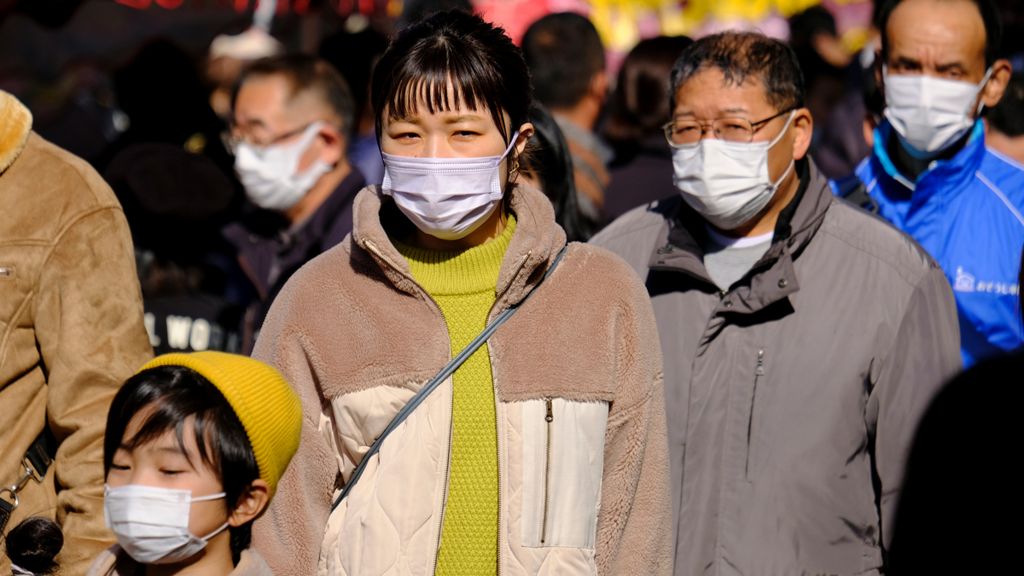
Prof Riley thinks we won’t be compelled to wear face masks after Omicron, but they will become “a much more common sight” as they are in parts of Asia as people choose to wear them in crowded places.

Mask-wearers in JapanImage source, Getty Images

She adds: “The likely scenario is life won’t look much different to the autumn of 2019, when we all turned up for our flu vaccines.”

What about the rest of the world?

While the UK is ahead of most of the world due to a combination of vaccines and a large number of infections, the planet is not remotely close to seeing the end of the pandemic.

Poorer countries are still waiting for vaccines to give to their most vulnerable people. Meanwhile countries that kept Covid at arms’ length have had very few deaths, but also have less immunity in their populations.

The World Health Organization has been clear the world is a long way off describing Covid as endemic.

“For the world it is still a pandemic and an acute emergency,” Dr Groppelli concludes.

=====================================================

T&T: Hundreds protest against COVID policies, several held by police

CMC

Several people were held by the police on Sunday as they mounted a protest against the government’s handling of the COVID-19 pandemic in Trinidad and Tobago.

The protest – dubbed the “Push Back” protest, got underway early Sunday with hundreds marching around the Queen’s Park Savannah in solidarity against Prime Minister Dr Keith Rowley’s handling of the pandemic and the vaccination policy for government workers.

Chanting “Rowley must go“, the protesters were led by social activist Umar Abdullah of the First Wave Movement.

According to the police, Abdullah and his supporters were asked to leave, as they did not have a permit from the acting Commissioner of Police to protest. However, the crowd persisted and the march went on.

The police say that shortly after 2 pm (local time), after several attempts were made to disperse the large crowd, the riot police were called in and officers began detaining protesters, while other officers fired tear gas canisters at the crowd.

The protest took place just hours after Rowley announced that the government has delayed the implementation of its vaccine policy for public health workers until mid-February.

The policy was originally slated to come into effect on Monday.

Speaking late Saturday, Rowley also announced the establishment of a five-member team to investigate the factors contributing to the clinical outcomes of COVID-19 patients.

UK Self-isolation rule changes

Self-isolation rules for anyone testing positive for Covid have been cut in England to five full days in a bid to help tackle staff shortages. But quarantine only ends when lateral flow tests give negative results on days five and six. The change was introduced by the government after a review of the medical evidence. Meanwhile, in Scotland large outdoor events like football matches can take place again after rules were relaxed.

Isolation graphic
Short presentational grey line

Djokovic’s visa ban

After being deported from Australia on Sunday over his visa battle around his Covid vaccine status, Novak Djokovic could return to the country before his three-year ban is up. The unvaccinated top tennis player won’t be playing in the Australian Open but Prime Minister Scott Morrison says he could be allowed entry sooner than three years under the “right circumstances”.

Novak Djokovic (centre) at Dubai's airport. Photo: 17 January 2022Image source, Reuters
Short presentational grey line

Cooking through Covid

After moving to New York five years ago, Emre Uzundag and Yonca Cubuk became homesick during lockdown. Spending a lot of time in their apartment, the husband and wife team started cooking more Turkish foods to help them cope with the stresses of the pandemic. After some rave reviews they decided to launch a takeaway from their kitchen, and a food delivery app gave them a platform to tell their story. Take a look.

Emre Uzundag and Yonca CubukImage source, Yonca Cubuk
line
===============================================

WORLD STATS

Coronavirus Cases:

328,936,055

Deaths:

5,558,861

Recovered:

267,791,398
Highlighted in green
= all cases have recovered from the infection
Highlighted in grey
= all cases have had an outcome (there are no active cases)

[back to top ↑]

Latest News

January 17 (GMT)

Updates

  • 30,726 new cases and 670 new deaths in Russia [source]
  • 26,881 new cases and 2 new deaths in Japan [source]
  • 19,132 new cases and 76 new deaths in Mexico [source]

Archived:

January 2020 – February 2020

line

The post Is COVID-19 Becoming Endemic?, T&T Mass Protests, UK Isolation Changes, World Stats, More appeared first on The St Kitts Nevis Observer.

Martinique with More Than 7,000 COVID-19 Cases in One Week

Martinique has recorded an explosion of new COVID-19 cases with 2,235 new confirmed cases recorded in 24 hours.

According to the Agence Regionale de Sante (ARS), there are 112 hospitalisations and 35 patients in critical condition.

The total number of deaths since the start of the epidemic is 805.

ARS states the indicators related to the number of deaths have to be interpreted with caution due to the time in registration in administrative software by hospital institutions.

Throughout this week Martinique has posted high COVID-19 figures:

  • On January 13 – 1,117 new cases recorded in 24 hours  

  • On January 12 – 2,301 new cases recorded in 24 hours  

  • On January 11- 1, 246 new cases recorded in 24 hours  

  • On January 10- 1,842 new cases recorded in 24 hours

The French Caribbean Island since March 2020 has recorded 65,380 confirmed cases.

On Wednesday, PAHO during its COVID-19 briefing said 42 countries and territories in all Subregions of the Americas including the Caribbean have detected the Omicron variant.

It was also noted that in the Caribbean, Puerto Rico and the Dominican Republic are reporting the highest numbers of new infections, although other islands like Jamaica, Aruba, Curaçao, and Martinique are also seeing significant jumps in COVID-19 cases.

The post Martinique with More Than 7,000 COVID-19 Cases in One Week appeared first on The St Kitts Nevis Observer.
MALTA: THE CROSSROADS OF ANCIENT MEDITERRANEAN HISTORY

TRAVEL by Eric Mackenzie Lamb

The Republic of Malta has always been one of the places I’ve wanted to visit. But due to today’s ever-changing Covid-19 restrictions on travel, the small island nation was difficult to get to. However, I did finally make it last summer. And what I saw was nothing short of fascinating. And that’s not even mentioning its history.

First, some background.Malta is an island country of the European Union consisting of an archipelago in the Mediterranean Sea. It lies 50 miles south of Italy, 176 miles east of Tunisia, and 207 miles north of Libya. With a population of around 515,000 over an area of just 122 square miles, it’s the world’s tenth smallest country in area. And its capital, Valletta, is the smallest in the E.U.

First, some background.

Malta is an island country of the European Union consisting of an archipelago in the Mediterranean Sea. It lies 50 miles south of Italy, 176 miles east of Tunisia, and 207 miles north of Libya. With a population of around 515,000 over an area of just 122 square miles, it’s the world’s tenth smallest country in area. And its capital, Valletta, is the smallest in the E.U.

Malta’s rugged coast. Image by the author.

The country’s national language is Maltese, which was derived from Sicilian Arabic over centuries, while English serves as its second official language.  Below is an example of how strikingly different they are from each other.

Inhabited since approximately 5,900 BC, Malta’s location in the central Mediterranean has historically given the island great strategic importance as a naval base, with a succession of powers having contested and ruled the islands, including Phoenicians, Carthaginians, Romans, Greeks, Arabs, Normans, Aragonese, the Knights of St John, and the French and British. Each left an indelible mark on the country’s culture. In 58 AD, Paul the Apostle remained in Malta for three months after his ship washed up on the island’s shore during a storm. Malta has had Christianity for centuries, although it was predominantly Muslim while under Arab rule. Muslim rule ended with the invasion of the island by Roger I and the Knights of Malta in 1091. Today, Catholicism is the country’s official religion but its  constitution guarantees freedom of worship for all.
Malta became a British colony in 1813, serving as a way station for ships as well as headquarters for the British Mediterranean naval fleet. During World War II, despite being besieged by the Axis powers, Malta became a strategic base for British military operations in North Africa. In 1964, the British parliament passed the Malta Independence Act. The country became a Republic in 1974 and a member state of the Commonwealth of Nations, with its own seat at the United Nations. It officially joined the European Union in 2004.When the Suez Canal opened in 1869, Malta’s strategic position, halfway between the Strait of Gibraltar and Egypt, proved to be its main asset and was considered an important stop on the way to India, a vital trade route for the British.Malta has three UNESCO World Heritage sites, as well as seven temples which are some of the oldest free standing structures in the world.

Finally, something you may not know: in 1989, Malta was the venue for a historic meeting between US President George H.W. Bush and his Russian counterpart Mikhael Gorbachev, an event which marked the end of the Cold War.Oh, and lest we forget: Malta even has its own carnival during the week leading up to Ash Wednesday. A touch of Caribbean culture?

The post MALTA: THE CROSSROADS OF ANCIENT MEDITERRANEAN HISTORY appeared first on The St Kitts Nevis Observer.

Caribbean Airlines New Boeing 737-8 Takes to the Sky

Caribbean Airlines Boeing 737-8 aircraft took to the skies for the first time today, January 14. The airline’s Boeing 9Y-CAL maiden jet service departed the Piarco International Airport destined to the Norman Manley International, Kingston, Jamaica.

Earlier today Caribbean Airlines hosted a brief ceremony at the Piarco International Airport to launch the new aircraft, which offers passengers exceptional levels of convenience and comfort. The re-fleeting coincides with the airline’s 15th anniversary. Some lucky customers on the inaugural service won an extra 15,000 miles and all customers received bags of goodies and other memorabilia!

Caribbean Airlines’ CEO, Garvin Medera, in commenting said: “The introduction of this new aircraft into service, represents Caribbean Airlines’ initiative to ‘REset Expectations’ for 2022.The 737-8 is the most technologically advanced aircraft in the world and it brings a range of benefits for Caribbean Airlines, our customers, and the environment. Fuel and maintenance costs are lower, each plane has 10 more seats than its predecessor with a total of 160 seats and the aircraft offers state-of-the-art technology and an upgraded level of comfort in both the business class and economy cabin, including in seat power for mobile devices, a new sky interior, sleek modern seats and much more.”

Mr. Medera continued: “We’re really excited about the plans and improvements for the coming year, all done with you in mind. Be sure to stay informed via our social media channels and follow us on #REcalibrate as we REset Expectations in 2022.”

The post Caribbean Airlines New Boeing 737-8 Takes to the Sky appeared first on The St Kitts Nevis Observer.

