A magnitude 4.8 earthquake was recorded in the vicinity of three islands in the Caribbean, Saint Kitts and Nevis, Antigua and Barbuda and Guadeloupe. There are no reports yet of any damage and injuries.
The UWI Seismic Research Centre (UWI SRC) said it occurred today around 8:58 am local time at a depth of 21 kilometres.
According to the Automatic Earthquake Location from the UWI Seismic Research Centre, the quake struck:
106 km N of Basseterre, Saint Kitts and Nevis
164 km NW of Saint John’s, Antigua and Barbuda
262 km NW of Point-à-Pitre, Guadeloupe
Persons who commented on the UWI Seismic Research Centre’s Facebook page reported the quake as being felt in Saint Martin/St Maarten, Anguilla, St Barts, St Eustatius and St Kitts.
Loop News- Income support prior to Christmas will soon be in the hands of the most vulnerable and workers in St Vincent and the Grenadines with the allocation of EC$10 million through various programmes.
Christmas pay-day for central government employees is December 16. “So be careful with spending, January 2022 is going to be a long month,” the government said in a statement.
Meanwhile, support for the most vulnerable will be distributed through various programmes.
Under the Ministry of Social Development the following payments will be made:
Payment of a cash transfer of $800 per household to 3,247 World Food Programme (WPF) household beneficiaries, as a transition from the existing WPF programme to the Soufriere Transitioning Grant for December 2021.
This one-time cash payment covers payments for November and December 2021 ($400 per month per household).
Payment of one-time cash payment, similar to the above, for 171 households in the red and orange zones from the WPF programme but they were unreachable during the registration and assessment process.
The following is income support for different categories of persons affected by the volcanic eruptions:
221 small business owners in the red and orange zones: One-time cash transfers of $1,200 ($400 for each of the months of October to December 2021). This cash transfer will be done in two tranches: $800 before Christmas 2021 and $400 at the end of January 2022.
91 Tourism site vendors: A one-time cash transfer of $900 ($300 for each month of October to December 2021) paid in two tranches: $600 before Christmas; $300 in January 2022).
490 school vendors: A one-time cash payment of $600 ($300 for each month November to December 202) paid in two tranches: $400 before Christmas; $200 in January.
The government says in total the cost of this support is just over $3.3 million to 4, 220 beneficiary families.
There is also a huge pre-Christmas distribution of food packages through community groups and churches, particularly but exclusively in red and orange zones.
By Melissa Wong
The State has also listed income support of $1,000 to farmers (Belle Isle to Richmond and Mt Grenan to Fancy) for the months of November and December ($500 for each month) as follows:
Chateaubelair District- 637 farmers- $637,000
Troumaca District- 888 farmers- $888,000
Georgetown (including North of the Dry River)- 2,164 farmers- $2,164,000.
This represents in total, a payout of $3,689,000 to 3,689 farmers.
Additionally, BRAGSA is carrying out a $3 million road cleaning programme for Christmas 2021. Over, 5000 people are employed on this nationally.
In total, these programmes amount to some $10 million to some 13,000 beneficiaries. The government notes there are other ongoing support programmes, inclusive of the normal safety net supports, which are assisting many more thousands of perso
(The writer is Antigua and Barbuda’s Ambassador to the U.S. and the OAS. He is also a senior fellow at the Institute of Commonwealth Studies at the University of London and at Massey College in the University of Toronto. The views expressed are entirely his own)
US President Joe Biden declared at the opening of a “Summit on Democracy”, which he convened on December 9, that “democracy needs champions”.
He is perfectly right. And, he has good reason for saying so. Last year, the US – which trumpets itself as the bastion of democracy – almost became a fascist state after President Donald Trump, supported by a pliant Republican party, did everything he could to maintain power, including encouraging a mob march on the US Congress on January 6 in the wake of his loss of the presidency to Biden.
It was a frightening time for the world where fascist and autocratic leaders had emerged in Europe, Asia, Africa and Latin America determined to rule with little regard for human and political rights, or for democratic principles generally, especially a free press and freedom of citizen expression.
Had Donald Trump succeeded, his behaviour would have emboldened the existing tyrannical leaders and spawned a few more. Tension and conflict would have escalated, dividing the world not on traditional ideological grounds, but on a contest between those that value democracy and those who regard it as a nuisance and an obstacle to their own control.
Democracy in the US was undoubtedly gravely threatened by President Trump’s desire to hold power at any cost; to dismantle what his one-time political adviser, Steve Bannon, described as the ‘deep state’, but which is really the checks and balances of public servants sworn to uphold the US Constitution and the law; and to threaten and coerce compliance even by elected officials in the US Congress.
But that is not the only aspect of US democracy that was – and remains – a threat. The emergence of the ‘Black Lives Matter’ movement and the wanton and unconscionable killing of black people by police and Individuals, empowered by centuries of oppression and repression, are manifestations of the flawed state of democracy and human rights in the US.
Justice for black people without whose enforced servitude and without whose blood, the US would never have been built (and the word ‘never’ is used without fear of contradiction), is the putrid sore in US society. Democracy in the US will remain flawed and human rights will continue to be unserved, until, as the Reverend Martin Luther King Jr, said, “justice runs down like water and righteousness like a mighty stream”.
The saving grace of the US, unlike in many countries in Latin America, Asia and Africa and a few in Europe, is the strong commitment of decent and well-thinking people to protecting and preserving the institutions of the US. Persons such as the Secretary of State of Georgia, Brad Raffensperger, who President Donald Trump told to find 11,780 votes so that he could overturn his defeat by Biden in that state, and lay claim to the Presidency. Outstanding were the judges of the US Supreme Court and state courts, including those appointed by Trump, who put upholding the law above any other consideration.
The prospect of Donald Trump returning to the Presidency in 2024 no doubt brings a shudder down the spine of many, including President Biden. So, this Summit on Democracy is not just concerned with “the global competition of the 21st century” which the President said “is one defined by democracies versus autocracies”; it is also about competition for the soul of the US and the direction it takes.
The agenda of the Summit was set by the US government, even though over a hundred leaders were invited. They were each given the agenda and asked to speak on particular issues which focused on combating corruption, defending against authoritarianism, and promoting human rights.
However, opening the Summit, President Biden said that “working with our Congress, we’re planning to commit as much as $424 million in the next year to shore up transparent and accountable governance, including supporting media freedom, fighting international corruption, standing with democratic reformers, promoting technology that advances democracy, and defining and defending what a fair election is”.
But an essential element is missing from the US plan. It takes no account of the imperative of spending money on correcting global economic inequities and on development. Essential to sustaining democracy globally is development. In underdeveloped countries with large pockets of poor, unemployed and discontented, political parties exploit these conditions to foster unrest and civil disturbance.
So, it is all well and good to provide money to defend against authoritarianism and to promote human rights. These things are extremely important, but they are not enough. By themselves, they will not sustain democracy anywhere, including in the US.
In part, it was the dissatisfaction of the poor, the unemployed and the disgruntled who responded to President Trump’s coded message to “Make America Great Again”. It is also what helped to bring authoritarians to power in other parts of the world.
Two days of an organised and rigid virtual meeting with a pre-planned outcome statement, and a pledge of money to fight corruption, demand transparent and accountable governance, standing with democratic reformers, promoting technology that advances democracy, and defining and defending a fair election, may send a signal to countries not invited to the Summit, but it won’t satisfy hunger, unemployment, poverty and need.
If governments can’t overcome those conditions and improve the lives of their people, then no offering of democracy will cut it.
We must welcome President Biden’s efforts to champion democracy, but the plan needs rethinking – this time with the involvement, rather than the attendance, of the leaders of the most vulnerable countries.
CMC- At least 32 police officers have either resigned or retired from the St Vincent and the Grenadines Police force, while 13 others have not taken the vaccine under the government’s mandatory programme to get frontline workers vaccinated against the coronavirus (COVID-19) pandemic that has killed 75 people and infected 5, 645 others since March last year.
Prime Minister Dr Ralph Gonsalves, speaking on a state-owned NBC radio, said that of the estimated 1,200 officers including the Coast Guard Service and Fire Brigade, 32 had either resigned or retired before the mandate.
He said two of these former officers would not get any money under the police pension rules as one had served for one year and another for eight years.
“All the others, most of them have served over 20 years. Some of them late 20s and a couple in their early 30s, like 31, 32. One actually served 33 years. So that person is pretty much at the end of their 33 and a third, for their maximum pension.”
Gonsalves said he suspects that some of those who had retired didn’t want to take the COVID vaccine “and some of them, would have retired in any case, because every year you’ll have a certain number of retirements and resignations.”
He said that in addition to the officers who resigned or retired, there were 13 under the aegis of the Commissioner of Police, from the rank of constable to sergeant, who did not take the vaccine and, accordingly, “would have abandoned their jobs…
“And they’re deemed to have resigned their office because of their abandonment. One of them is a sergeant, two of them are corporals and the rest of the 13 there are constables.”
Earlier this week, Station Sergeant Brenton Smith, who is also head of the Police Welfare Association, said that the Public Service Commission had written to him, indicating that he was deemed to have resigned from his job.
Meanwhile, the St. Vincent and the Grenadines Teachers’ Union (SVGTU) says it is hoping for a strong showing at its picket in Kingstown later on Friday even as it acknowledged that state forces have undermined its industrial actions in the past.
“Well, that’s a very good question and a very good observation, because we know it happened, it has happened recently. … you can’t give up hope. The leadership of the Teachers’ Union is not daunted, we are not discouraged,” the union’s president, Oswald Robinson told a press conference.
The union plans to hold pickets in Kingstown and Union Island, and the administrative building in Canouan and Bequia. The latest action follows the strike action on Tuesday and Wednesday, which the union said has been a success.
Robinson said that Friday’s action will be a peaceful protest, adding “at the same time, we would send a clear message to the government of St. Vincent and the Grenadines.”
He said that the union had applied to the police for permission to use amplified sound during the activity, adding no permission is needed to hold the picket, as this is a right enshrined in the trade union law.
“And if there’s an attempt to stop this picket, we will picket because if you want the picket to stop, then you have to get rid of that wicked bill and the wickedness that you have well-orchestrated, to execute upon the nation.
“It’s not only teachers because if teachers have no money for the salaries in December, but it’s also going to affect teachers being able to send their children to school, to provide for the rest of the family,” Robinson said.
The government has enacted legislation mandating COVID-19 vaccines for teachers and other “frontline” workers by November 19 and the 10-day grace period expired last Friday.
Antigua and Barbuda’s Minister of Tourism and Investment, The Honourable Charles Fernandez has extended congratulations to Keisha Schahaff who will be the first Antiguan and Barbudan, and Caribbean woman to travel to space.
Schahaff is expected to travel to space in 2022, having won two seats on a Virgin Galactic space flight during a sweepstakes organised by Virgin Galactic in partnership with fundraising platform, Omaze.
“You will be carrying the whole of Antigua and Barbuda with you, and this type of recognition is priceless,” said the tourism minister as he extended best wishes to the future astronaut, during a meeting held yesterday.
Minister Fernandez presented Schahaff with a tropical bouquet and a tourism gift bag. The Minister offered the full support of the country and the Ministry of Tourism and Investment in assisting her on this “phenomenal” journey.
Celebrating the exciting news with Keisha Schahaff and offering their support are the Ministry of Tourism and the Antigua and Barbuda Tourism Authority. Pictured L-R: Julianne Christian Tourism Marketing Assistant, Maria Blackman Marketing Communications Manager, The Honourable Charles Fernandez Minister of Tourism and Investment, Keisha Schahaff Virgin Galactic sweepstakes winner, Colin C James CEO of The Antigua and Barbuda Tourism Authority and Karen Joseph Sports Tourism Officer within the Ministry of Tourism. (Photo credits: The Antigua and Barbuda Tourism Authority)
Schahaff stated that she is looking forward to representing her country and flying the Antigua and Barbuda national flag from space.
Also present at the meeting was CEO of The Antigua and Barbuda Tourism Authority Colin C James, Marketing Communications Manager Maria Blackman and Sports Tourism Officer within the Ministry of Tourism Karen Joseph.
“This is a remarkable opportunity,” said the Antigua and Barbuda Tourism Authority CEO James. “Since your win, you have represented Antigua and Barbuda extremely well and have made us all feel proud.”
“We look forward to working with you, and hope that your journey to space increases awareness of Antigua and Barbuda and inspires more persons to visit our twin-island paradise.”
The Antigua and Barbuda Tourism Authority launched a successful #YourSpaceInTheSun marketing campaign in 2020, to encourage persons to find all the space they need to relax and rejuvenate in Antigua and Barbuda, during the Covid-19 pandemic.
BEIJING/TAIPEI, Dec 10 (Reuters) – China and Nicaragua re-established diplomatic ties on Friday after the Central American country broke relations with Chinese-claimed Taiwan, boosting Beijing in a part of the world long considered the United States’ backyard and angering Washington.
China has increased military and political pressure on Taiwan to accept its sovereignty claims, drawing anger from the democratically ruled island, which has repeatedly said it would not be bullied and has the right to international participation.
China’s Foreign Ministry, announcing the decision after meetings with Nicaragua’s finance minister and two of President Daniel Ortega’s sons in the northern Chinese city of Tianjin, said the country had made the “correct choice”.
The break with Taiwan shrinks the island’s dwindling pool of international allies and is a blow to the United States.
It follows months of worsening ties between Ortega and Washington, and came on the day the U.S. State Department said it had applied sanctions on Nestor Moncada Lau, a national security adviser to Ortega, alleging he operates an import and customs fraud scheme to enrich members of Ortega’s government.
The U.S. State Department said Nicaragua’s decision did not reflect the will of the Nicaraguan people because its government was not freely elected.
“We do know, however, that this deprives Nicaragua’s people of a steadfast partner in its democratic and economic growth,” spokesperson Ned Price said in a statement. “We encourage all countries that value democratic institutions, transparency, the rule of law, and promoting economic prosperity for their citizens to expand engagement with Taiwan.”
Chinese Foreign Minister Wang Yi said Taiwan’s allies – now only 14 countries – have stayed with Taipei only because of pressure from the United States and Taiwan’s “dollar diplomacy”, accusations Taipei denies.
Nicaragua’s congress in 2019 accepted a $100 million loan from Taiwan, but Taiwan’s Foreign Ministry said on Friday that money, designed for economic reconstruction, has never been paid because of “procedural issues with allocation requirements” by the bank, which it did not name.
China’s Foreign Ministry, asked if China would give financial aid to Nicaragua, said the resumption in ties was a “political decision, definitely not a bargaining chip”.
‘MARCH TOWARDS THE WORLD’
Taiwan’s government said it was unbowed by Nicaragua’s decision.
Taiwan President Tsai Ing-wen said the island would not bend to pressure or change the determination to uphold democracy and freedom and “march towards the world”.
“The more successful Taiwan’s democracy is, the stronger the international support, and the greater the pressure from the authoritarian camp,” she said in Taipei.
A senior Taiwan official familiar with the matter told Reuters the timing was “provocative”, coming during the Biden administration’s Summit for Democracy, which Taiwan is attending, and a week before four referendums on the island, though they are on domestic issues like energy and pork imports.
At the now-defunct Nicaraguan embassy in Taipei, in a building in the leafy suburb of Tianmu, staff said the former ambassador was not in. Nicaragua’s flag outside had been removed by the time a Reuters reporter arrived mid-morning.
Ortega first cut ties with Taiwan in 1985, but they were re-established with the island in 1990 under then-Nicaraguan President Violeta Barrios de Chamorro.
One Taiwan-based diplomatic source, familiar with the region, said the move was not a surprise given Washington’s lack of leverage with Ortega due to the sanctions, and that looking to China for aid and support was a natural course of action.
“It appears that Ortega had had enough,” the source told Reuters, speaking on condition of anonymity.
Attention will now turn to another Taiwan friend, Honduras.
Aides for the incoming president Xiomara Castro have said she would not establish ties with China, backtracking from Castro’s earlier comments that she was open to starting formal relations with Beijing.
A second Taiwan-based diplomatic source told Reuters it was still a case of “watch this space” whether Honduras would ultimately go with Beijing.
Reporting by Yew Lun Tian, and Ben Blanchard, Yimou Lee and Sarah Wu; Additional reporting by Josh Horwitz in Shanghai; additional reporting by the Mexico City newsroom; Editing by Christopher Cushing, Gerry Doyle and Raju Gopalakrishnan
Nearly two years into the COVID-19 pandemic, the origin of the virus tormenting the world remains shrouded in mystery. Most scientists believe it emerged in the wild and jumped from bats to humans, either directly or through another animal….Read More
CHICAGO (AP) — Jussie Smollett’s conviction for lying to police about a racist, homophobic attack came nearly three years after his report of a horrifying hate crime quickly became part of a polarized political landscape, with people — in…Read More
NEW YORK (AP) — Companies of all sizes are rethinking their plans to send workers back to the office as the new omicron variant adds another layer of uncertainty. …Read More
WASHINGTON (AP) — President Joe Biden is looking to close his two-day virtual Summit for Democracy on Friday by shining a spotlight on the importance of election integrity, countering authoritarian regimes and bolstering independent media….Read More
TUXTLA GUTIERREZ, Mexico (AP) — Rescue workers rushing to a highway accident found a Dante-esque scene of death and injury after a freight truck jammed with as many as 200 migrants tipped over and crashed into the base of a steel pedestrian…Read More
KYIV, Ukraine (AP) — When Russia annexed Ukraine’s Crimean Peninsula and threw its support behind separatists in the country’s east more than seven years ago, Kyiv’s und…Read More
TRIPOLI, Lebanon (AP) — Ziad Hilweh knew his family might die on the way. But the risk was worth it, he said, to reach the shores of Europe for a new start with his wife…Read More
SILAT AL-DHAHR, West Bank (AP) — A year after being released from an Israeli prison following a 103-day hunger strike, Maher al-Akhras is barely able to walk. Frequent b…Read More
KAMPALA, Uganda (AP) — The capital of Uganda coughs itself awake on weekdays under a soft blanket of smog. Kampala’s hills come into sharper focus as the morning rush of…Read More
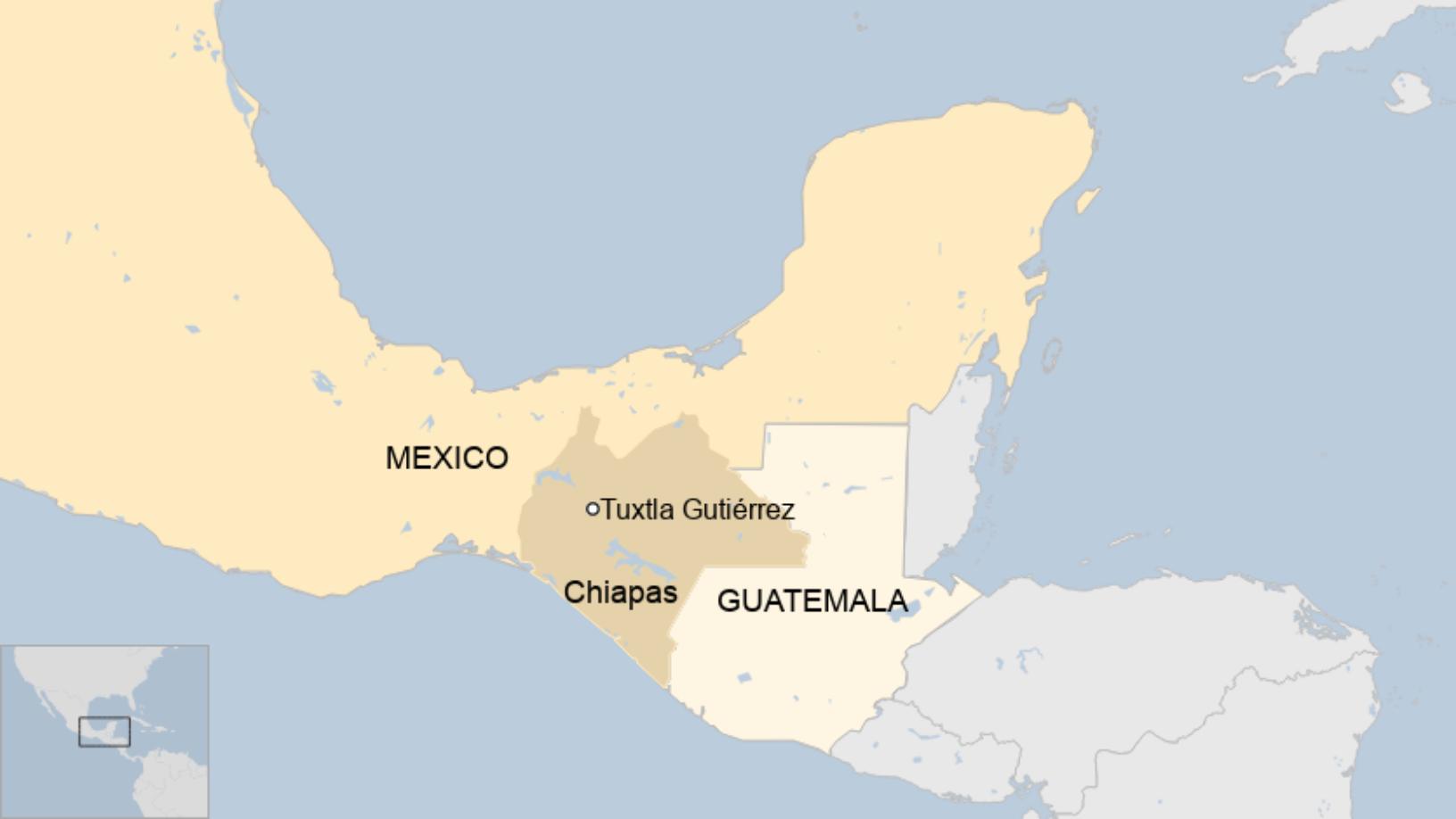
BBC- At least 54 people have been killed and scores more injured after the truck they were being transported in crashed in southern Mexico, authorities say.
More than 150 people, said to be migrants from Central America, were crammed into the truck’s trailer when it rolled in the state of Chiapas.
Pictures from the crash scene show victims strewn across the road next to the overturned truck.
There were also rows of what appeared to be bodies covered in white sheets.
It is one of the worst accidents of its kind in Mexico. Forty-nine people were confirmed dead at the scene and five more died in hospital, Chiapas Governor Rutilio Escandón said.
Some 105 people – 83 men and 22 women – were also injured in the crash, he said.
Emergency officials said the victims included men, women and children. Their nationalities have not been confirmed, but local officials said most of the people on board were from Honduras and Guatemala.
The truck was reportedly speeding when it flipped on a sharp bend and hit a pedestrian bridge on a main road leading to the Chiapas state capital Tuxtla Gutiérrez.
Chiapas, which neighbours Guatamala, is a major transit point for undocumented migrants.
Hundreds of thousands of migrants fleeing poverty and violence in Central America try to cross through Mexico each year in a bid to reach the US.
Many of them pay smugglers, who illegally transport them in crowded and dangerous trucks on the long journey.
The US-Mexico border is the deadliest single crossing in the world according to data from the International Organization for Migration (IOM). This year alone, at least 650 people have died trying to cross the border – more than in any other year since IOM’s records began.
There are also many deaths on the perilous journey towards the border, however these are harder to accurately document, the IOM said in a statement.
Mexico’s President Andrés Manuel López Obrador described the crash as “very painful” and wrote on Twitter that he “deeply regrets the tragedy”.
Last month, a migrant caravan heading through Chiapas found that the local authorities had clamped down so hard on people providing lifts to migrants, they effectively had to undertake the entire journey on foot.
That meant carrying their children in their arms in the blistering heat and torrential downpours of southern Mexico’s rural states.
It’s a tactic employed by the government to try to break the migrants’ will, to see if any will give up and turn back or accept asylum conditions in Mexico.
Throughout it all, trucks have continued to transport thousands of migrants right under the noses – or with the complicity – of the state authorities.
Their trailers filled with scores of families standing in cramped and unsafe conditions for hours, it’s a wonder such accidents aren’t more frequent.
Often the biggest danger to the migrants is from suffocation as the people-smugglers fail to provide sufficient ventilation or hydration for the trip.
Yet most of those in this horrific accident came from Central America and will have been escaping economic ruin, the effects of severe weather from climate change on their livelihoods or gang violence. Or some combination of all of these factors.
With that in mind, many thousands more will continue to consider the dangers of the road to be a risk worth taking to flee the unbearable conditions at home.
BBC- New Zealand will ban the sale of tobacco to its next generation, in a bid to eventually phase out smoking.
Anyone born after 2008 will not be able to buy cigarettes or tobacco products in their lifetime, under a law expected to be enacted next year.
“We want to make sure young people never start smoking,” Health Minister Dr Ayesha Verall said.
The move is part of a sweeping crackdown on smoking announced by New Zealand’s health ministry on Thursday.
Doctors and other health experts in the country have welcomed the “world-leading” reforms, which will reduce access to tobacco and restrict nicotine levels in cigarettes.
“It will help people quit or switch to less harmful products, and make it much less likely that young people get addicted to nicotine,” said Prof Janet Hook from the University of Otago.
The crackdown has been met with mixed reactions.
“I reckon it’s a good move, really,” one man told Reuters news agency. “Because right now there’s a lot of young kids walking around with smokes in their mouth. Public are asking how they’re getting these smokes.
“And it’s also good for myself too because I can save more money.”
However, others have warned that the move may create a black market for tobacco – something the health ministry’s official impact statement does acknowledge, noting “customs will need more resource to enforce border control”.
“This is all 100% theory and 0% substance,” Sunny Kaushal, chairman of the Dairy and Business Owners Group, a lobby group for local convenience stores, told New Zealand’s Stuff news site. “There’s going to be a crime wave. Gangs and criminals will fill the gap”.
New Zealand is determined to achieve a national goal of reducing its national smoking rate to 5% by 2025, with the aim of eventually eliminating it altogether.
At the moment, 13% of New Zealand’s adults smoke, with the rate much higher among the indigenous Maori population, where it soars to almost a third. Maori also suffer a higher rate of disease and death.
New Zealand’s health ministry says smoking causes one in four cancers and remains the leading cause of preventable death for its five million strong population. The industry has been the target of legislators for more than a decade now.
As part of the crackdown announced on Thursday, the government also introduced major tobacco controls, including significantly restricting where cigarettes can be sold to remove them from supermarkets and corner stores.
The number of shops authorised to sell cigarettes will be drastically reduced to under 500 from about 8,000 now, officials say.
In recent years, vaping – smoking e-cigarettes which produce a vapour that also delivers nicotine – has become far more popular among younger generations than cigarettes.
New Zealand health authorities warn however, that vaping is not harmless. Researchers have found hazardous, cancer-causing agents in e-cigarette liquids as well.
But in 2017 the country adopted vaping as a pathway to help smokers quit tobacco.
US Covid cases surge as vaccine progress slows and Omicron variant sparks fears
Ohio, as well as Michigan, Illinois, Indiana and Pennsylvania have seen a recent increase in cases and hospitalizations
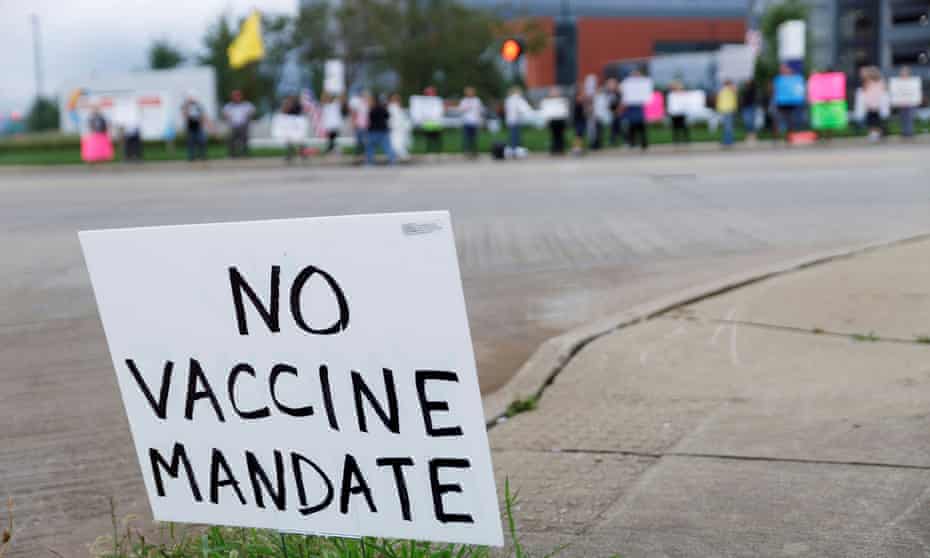
People protest vaccine mandates at Summa Health Hospital in Ohio in August. Photograph: Stephen Zenner/Reuters
For Dr Rina D’Abramo of the MetroHealth System in Cleveland, it’s difficult when patients in the emergency room tell her they have not been vaccinated.
“You can hear it in their voice when you say, ‘Are you vaccinated?’” said D’Abramo, who works at a hospital in the Brecksville suburb. “They shrink down and are like, ‘No. Now I know why I need to be vaccinated.’ ”
Unfortunately, there are plenty of people in Ohio and the rest of the US too who have not yet learned that lesson, even as infection rates nationally start to surge again amid fears of the possibly highly contagious new Omicron variant.
Ohio is one of the states that has seen the largest recent increases in hospitalizations due to Covid as the number of cases climbs across the country. There has been 19% increase in hospitalizations over the past two weeks in the United States, according to a New York Times analysis of data.
Ohio has a daily average of more than 4,400 people hospitalized due to Covid, which ranks fourth among states and represents a 29% increase over the past two weeks.
While the increased number of people vaccinated against Covid had inspired hopes that Americans would be able to experience a relatively normal winter, the rise in Covid cases; holiday gatherings; and unanswered questions about the Omicron variant have sparked fresh concerns and warnings from doctors and public health officials in the US.
“The yellow caution light has gone on because I think our progress in vaccination has slowed,” said William Schaffner, an infectious diseases expert at Vanderbilt University School of Medicine.
Forty percent of the US population has not been fully vaccinated, and the number of doses administered each day has decreased from about 3.3m in April to about 1.7m today, according to the Times.
Ohio is surrounded by states that have also seen a recent surge in Covid cases and hospitalizations. Pennsylvania and Michigan each have a daily average of more than 4,500 patients hospitalized, representing a more than 20% increase over the past two weeks. Illinois and Indiana have seen a 49% increase in hospitalizations.
D’Abramo diagnoses about 10 patients daily with Covid, and about 98% of them are unvaccinated, she said.
That trend has strained the capacity of hospitals in the Cleveland area. MetroHealth, Cleveland Clinic and University Hospitals announced last week that the surge has forced them to postpone some non-urgent surgeries.
“This action frees resources for patients with immediate and life-threatening needs and manages the demands on frontline caregivers, who have served with distinction throughout the pandemic,” reads a joint announcement.
At Beaumont Health, the largest healthcare system in Michigan, the emergency room and other parts of the hospital are full, primarily with patients who are not vaccinated, said Dr Matthew Sims, a Beaumont physician and director of infectious disease research.
“With Covid patients, they have to be in rooms. You can’t go into overload conditions where you turn conferences rooms into emergency rooms or hallways into wards. You can’t do that sort of thing when it’s a contagious disease,” said Sims.
Beaumont, like other hospitals in Michigan and across the country, has also had to contend with a staffing shortage. The federal government recently agreed to send 22 healthcare providers to a Beaumont facility in Dearborn and 22 providers to Spectrum Health in Grand Rapids, the Detroit News reported.
In addition to the shortage, “everyone who works in healthcare is getting very tired. We have been dealing with this for two years straight, and it wears on us,” said Sims.
Doctors continue to not only urge people to get vaccinated against Covid – and for those who are eligible to get a booster shot – but also to encourage people to wear N95 or KN95 masks during indoor gatherings and if possible, to gather outdoors or open doors and windows to improve filtration, said Dr Celine Gounder, an infectious disease specialist and epidemiologist at New York University.
Gounder also suggested that people take rapid Covid tests before holiday gatherings.
“I think we have chosen one of the most painful paths through the pandemic in this country” because of people’s refusal to get vaccinated, Gounder said. “I think we have prolonged our pain unnecessarily.”
Gounder and others now wait for more data on the Omicron variant, which has been detected in 19 states and 50 countries, National Public Radio reported Tuesday.
Researchers in South Africa have reported that Omicron may be more infectious but less severe than other forms of the virus.
While Schaffner emphasized that we are still awaiting more information, if the variant proves more infectious and much less likely to produce hospitalization, “then Omicron might actually be a bonus because we would be vaccinating, but Omicron would also be spreading among the unvaccinated, making them mildly ill and offering them some protection.”
That “would get us closer, faster, to so-called herd immunity, which would lead us to a more endemic circumstance,” rather than a pandemic, Schaffner said.
In the meantime, D’Abramo, the Ohio emergency physician, continues to grapple with the pandemic inside and outside her hospital. Two unvaccinated friends with a 10-year-old child recently became very sick with Covid, she said.
The wife remains on an ECMO life support machine; the husband was hospitalized for two weeks and is now home.
“To me, that’s a tragedy. There is no way to say she wouldn’t have gotten sick if she was vaccinated, but most likely, she wouldn’t have,” D’Abramo said.
At the hospital, she routinely has Covid patients waiting for beds in the intensive care unit. D’Abramo must decide whether to intubate them and connect them to a ventilator.
“I don’t ever come home from a shift and be like, ‘That was a nice, normal shift.’” D’Abramo said. “It’s nonstop and it does kind of feel like you get beat down because you are getting beat down by something that I thought would maybe be over this winter.”
The Centers for Disease Control and Prevention on Thursday signed off on booster shots of Pfizer’s coronavirus vaccine for 16- and 17-year-olds who are six months past their second shot, clearing the way for vaccinations to start.
The move comes amid a surge in infections nationwide due to the delta variant as well as uncertainty about the newly discovered omicron variant.
“Although we don’t have all the answers on the Omicron variant, initial data suggests that COVID-19 boosters help broaden and strengthen the protection against Omicron and other variants. We know that COVID-19 vaccines are safe and effective, and I strongly encourage adolescents ages 16 and 17 to get their booster if they are at least 6 months post their initial Pfizer vaccination series,” CDC Director Rochelle Walensky said in a statement.
The CDC’s announcement came just a few hours after the Food and Drug Administration (FDA) granted Pfizer an expansion of its emergency use authorization, to bolster protection against the delta and emerging omicron variant.
“With both the delta and omicron variants continuing to spread, vaccination remains the best protection against COVID-19,” acting FDA Commissioner Janet Woodcock said.
No advisory panel: The FDA said the decision to authorize boosters for 16- and 17-year-olds was based on extrapolating the safety and efficacy data it already had for people aged 18 to 55, as well as some real-world data on vaccinations of teenagers.
But the agency did not convene its outside expert advisory panel, which has previously raised questions about the risks of myocarditis and pericarditis — rare but serious cases of inflammation of the heart muscle and surrounding tissue, respectively — associated with the vaccine. The FDA said it felt the benefits outweighed the small amount of risk.
About half of parents said their 12- to 17-year-old has gotten at least one COVID-19 dose as the vaccination uptake among the age group has slowed in recent months, a Kaiser Family Foundation (KFF) poll found.
The November survey determined that 49 percent of parents said their 12- to 17-year-olds received at least one shot, and just 1 percent of these parents plan to get their children vaccinated right away, according to an update to KFF’s Vaccine Monitor published on Thursday.
Those percentages align with results from September and October, indicating the vaccination rate has flattened within the teenage age group in the fall after eligibility expanded to adolescents in the spring.
Thirteen percent of parents of teenagers said they want to “wait and see” before getting them vaccinated, and 3 in 10 parents said their adolescents would “definitely not” get the COVID-19 vaccine.
Among parents with 5- to 11-year-olds, 16 percent said their child had gotten at least their first shot during the first month the vaccines were available to the age group, while 13 percent said they plan to get their child vaccinated right away.
Still, almost a third of these parents said they expect to “wait and see,” and another 29 percent said their child will “definitely not” get vaccinated.
Most parents said there’s not enough information about the vaccines’ effectiveness, side effects and safety in children, despite scientific organizations nationwide and worldwide having designated the shots safe and effective for children.
==============================================
Tottenham’s Premier League game at Brighton called off over Covid outbreak
Conference League game against Rennes was also postponed
All top-flight clubs told to reintroduce ‘emergency measures’
Tottenham’s training ground on Thursday. The first-team section has been closed after the Covid outbreak. Photograph: Paul Childs/Action Images/Reuters
Tottenham’s Premier League game at Brighton on Sunday has been called off because of the Covid outbreak at the London club, as every top flight club was told to reintroduce “emergency measures” to limit infections.
Spurs said on Wednesday that eight players had tested positive, causing their Europa Conference League match against Rennes on Thursday to be postponed. The match at Brighton now also needs to be rearranged.
Tottenham’s Conference League tale of disaster awaits its latest twist
Read more
Tottenham’s manager, Antonio Conte, has described everyone at the club as “a bit scared” amid an escalation of positive Covid cases that prompted the first-team area of the training ground to be shut.
A Premier League statement read: “Brighton & Hove Albion’s home fixture against Tottenham Hotspur, due to be played on Sunday 12 December at 2pm, has been postponed following a Premier League Board meeting this afternoon.
“Tottenham asked for the match to be rearranged following a significant number of positive Covid-19 cases among players and relevant staff. This led to First Team facilities at the club’s training centre being closed after consultation with the Premier League and UK Health Security Agency.
“The Premier League Board has taken the decision to postpone the game following guidance from medical advisers, with the health of players and staff the priority. The postponed fixture will be rescheduled in due course and the Premier League wishes a quick recovery to those with Covid-19.”
Tottenham Covid outbreak: emotional Conte ‘scared’ by situation – video
After confirming the postponement, the Premier League board wrote to all 20 clubs advising of a return to “emergency measures” last seen in the summer, when a series of Covid outbreaks disrupted pre-season preparations. The measures will mandate the wearing of masks indoors, limit time spent in close contact – such as in medical treatment rooms – and also likely involve the return of spot inspections to make sure measures are being followed.
The change came alongside uncertainty over new government Covid measures known as “plan B”. Official government guidance says that as of next Wednesday, sports events “will be required by law to check that all visitors aged 18 years or over are fully vaccinated, have proof of a negative test in the last 48 hours, or that they have an exemption”.




 *****@
 *****@
 *****@
 *****@
 *****@
 *****@
 *****@
 *****@
 *****@
 *****@
 *****@
 *****@