BBC- Colombia has announced that the country’s most wanted drug trafficker will be extradited to the US after he was captured in a raid.
Dairo Antonio Úsuga, known as Otoniel, was seized after a joint army, air force and police operation on Saturday.
He led the country’s largest criminal gang and has been on the US Drug Enforcement Agency’s most wanted list for years.
US officials had placed a $5m (£3.6m) bounty on his head.
They accused him of importing at least 73 metric tonnes of cocaine into the country between 2003 and 2014.
What will happen to him?
Colombia’s Defence Minister Diego Molano told El Tiempo newspaper that the next step for officials was to comply with the US extradition order.
Authorities have now taken Otoniel to a military base in the capital Bogotá ahead of his extradition, according to newspaper El Nuevo Siglo.
Being locked up in a jail thousands of miles from their home country, in a place where they have few connections and no means to intimidate guards or prison directors is a fate many Colombian drug traffickers fear.
The late drug lord Pablo Escobar said that he would prefer “lying in a grave in Colombia than being locked up in a cell in the US”.
Except for a six-year period between 1991 and 1997, when Colombia’s constitution banned extraditions of Colombian citizens, a number of top level traffickers facing indictments in the US have been sent to stand trial there.
Otoniel, who was indicted in the the US in 2009, will faces a number of charges, including sending shipments of cocaine to the US, killing police officers and recruiting children.
How was he caught?
Otoniel was captured in his rural hideout in Antioquia province in north-western Colombia, close to the border with Panama.
The operation involved 500 soldiers supported by 22 helicopters. One police officer was killed.
Otoniel had used a network of rural safe houses to move around and evade the authorities, and did not use a phone, instead relying on couriers for communication.
In the past, police have found special orthopaedic mattresses for Otoniel in these sparse homes, as he suffered back pain from a herniated disc.
Police chief Jorge Vargas has said the drug lord was fearful of capture, “never approaching inhabited areas”.
But El Tiempo reported that authorities managed to pinpoint the location where he was eventually captured two weeks ago.
Chief Vargas said his movements were traced by more than 50 signal intelligence experts using satellite imagery. US and UK agencies were involved in the search.
Mr Duque described the operation as “the biggest penetration of the jungle ever seen in the military history of our country.”
Colombia’s armed forces later released a photo showing its soldiers guarding Otoniel, who was in handcuffs and wearing rubber boots.
There have been several huge operations involving thousands of officers to capture the 50-year-old in recent years.
BOGOTA, Oct 24 (Reuters) – Getting standardized rules for international travelers amid the coronavirus pandemic is the biggest hurdle for Latin American airlines, with their recovery threatened by a lack of consensus among health authorities, industry leaders said on Sunday.
Passengers suffer constant delays and restrictions as they travel between countries due to differing entry requirements established to curb the spread of different strains of the coronavirus, aviation industry directors said at a conference in Bogota, Colombia.
“Standardization is vitally necessary to build confidence so people return to flying,” said the Latin American and Caribbean Air Transport Association’s (ALTA) chief executive, Jose Ricardo Botelho.
The lack of accord between different countries, with frequent changes to air travel rules, leads to uncertainty for passengers, airlines, and airline staff, said Copa Airlines Chief Executive Officer Pedro Heilbron.
“When you carry passengers and there are thousands of requirements, it’s almost impossible that at least some passengers don’t have the right paperwork,” he told journalists in opening remarks at the ALTA annual conference.
Some countries even fine airlines for passengers’ non-compliance with the rules, Heilbron added, though did not say which ones.
Almost a year and a half of restricted travel has put airlines and airports across the globe under severe financial strain, necessitating a more complete re-opening of travel so that the industry can recover, saving millions of jobs.
“Generally speaking there are quite a few agreements and there is relative standardization, but the big differences come from health authorities,” said Lucas Rodriguez, the head Colombia’s civil aviation authority’s air transport office.
The need to meet new travel requirements has dented airlines’ balance sheets.
The International Air Transport Association (IATA), the industry’s main trade body, this month revised its estimate for airlines’ net losses this year to $51.8 billion, from a previous forecast of $47.7 billion.
IATA expects airlines to lose $11.6 billion in 2022 in revenue.
Reporting by Nelson Bocanegra and Carlos Vargas Writing by Oliver Griffin; editing by Diane Craft
Basseterre, St. Kitts, October 23, 2021 (RSCNPF): The Police are investigating an incident in which a woman died and a man was seriously injured.
On Thursday, October 21, 2021, the Police received a report of a house fire at Kittstodarts. Upon arrival at the scene, Officers met members of the St. Kitts and Nevis Fire and Rescue Services present. They had already extinguished the fire. The residents of the house, 18-year-old Annica Carey and 23-year-old Kevaune Rodriquez were found inside the structure. Carey was pronounced dead by the District Medical Doctor. An autopsy has been scheduled to determine her exact cause of death. Rodriquez received severe burns about the body and is currently warded at the JNF General Hospital in a critical condition.
Persons with information regarding this matter are urged to contact the Violent Crimes Unit by dialling 467-1887, 467-1888, 662-3468, their nearest Police Station or the Crime Hotline at 707 where information can be given anonymously. Investigations into the matter are ongoing.
CHARLESTOWN, NEVIS, October 22, 2021 (MMS-SKN) — Federation’s oldest co-operative credit union, the Nevis Co-operative Credit Union (NCCU), though faced with the most challenging period in its recent history as a result of the outbreak of the COVID-19 pandemic, is reporting a successful year of operation which resulted in a record operating income of $2.7 million in 2020.
“Maintaining the daily operations of our Credit Union in the midst of the ongoing health crisis has been difficult but because we understand your need to access financial resources to support yourselves and your families, and to keep your businesses open and functional, we have made the necessary investment in technology, physical structures and amenities, and human resources to ensure that our services are delivered without disruptions,” said NCCU President Mrs Vernesia Walters.
Mrs Walters made the remarks on Wednesday October 20 as she delivered President’s Remarks at the 48th Annual General Meeting (AGM) of the Society held under the theme, ‘Building Resilience Through Innovation and Collaboration’. The AGM was held at the Nevis Performing Arts Centre (NEPAC), Pinney’s Industrial Site, St. Thomas Parish, Nevis, where the Annual Report for the Financial Year Ended December 31, 2020 was presented to the members.
“We have all had to make significant adjustments in ensuring that the Nevis Co-operative Credit Union Limited continues to be a safe place to work and conduct business, by adhering to and enforcing the protocols established by the COVID-19 Task Force.”
Looking back at the year under review, Mrs Walters observed that many of the staff and committee members had to work remotely, attended multiple monthly meetings which at times went very late into the night, noting that many had to work long hours to keep abreast of their daily tasks. Despite the challenges, she said it was and still is their determination to ensure that the Nevis Co-operative Credit Union remains profitable and functional.
“Today, we celebrate the fruits of our labour in reporting to you another successful year of operation, which resulted in a record net operating income of $2.7 million in 2020,” said the President. “This is a significant moment in the journey of the Nevis Co-operative Credit Union Limited and we must commend the efforts of management and staff in ensuring that expenditures during this period were closely monitored and in keeping with our revised budget.”
The Annual General Meeting, which was held in a hybrid format with ‘In-Person’ participation by persons at the Nevis Performing Arts Centre and ‘Virtually’ via the Zoom Video Conferencing Platform, was chaired by General Manager Mr G. Sydney Newton. Meeting’s quorum was confirmed by Registrar, International Insurance, Financial Services Regulatory Commission (FSRC), Nevis, Mrs Simone Sargeant-Ottley.
“In just about nine months, on July 25, 2022, the Nevis Co-operative Credit Union Limited will celebrate its fiftieth (50th) anniversary,” President Walters told the members. “This is indeed an impressive achievement and a compelling reminder that we are a resilient people, who set out in 1972 to shape our destiny by our own efforts following the M.V. Christena disaster of 1970.”
She however regretted that many of their pioneers who blazed the trail have passed on to the great beyond but it was comforting that their hard work, personal sacrifices and labour of love have established a strong foundation on which the Nevis Co-operative Credit Union continues to build.
“We pause at this time to pay tribute to Mr Arthur L. Evelyn, OBE, CSM, JP and Mrs Olvis Dyer, MH, two of our stalwart pioneers who served the NCCU selflessly and contributed significantly to the growth and development of the Society, both of whom passed within the last two months,” observed Mrs Walters. “We wish to extend condolences to the families of the deceased and to say thanks for the contribution which their loved ones made to the Nevis Co-operative Credit Union.”
In honour of Mrs Olvis Dyer, who will be buried on Saturday October 30, the Credit Union moved its annual health walk that was slatted to have been held on that day to Saturday November 6. Participants will walk from Oualie to the Nevis Co-operative Credit Union, Featherbed Alley in Charlestown.
Minutes of the 47th Annual General Meeting, which had been held on September 23 last year, were presented by Secretary Mr Kris Liburd. Board of Directors’ Report for the year ended December 31, 2020, was presented by President Mrs Vernesia Walters, while Independent Auditors’ Report for the same period was presented via video link by Ms Raquel Glynn of BDO, Independent Auditors based in Antigua and Barbuda.
Treasurer’s Report for the year ended December 31, 2020 was presented by Treasurer Mr Brian Carey. He later rose to announce the declaration of dividends as recommended by the Board of Directors. Assistant Treasurer Mrs U. Alexa Pemberton presented the recommendation that the maximum liability (external borrowing) for Financial Year 2021 had been set at $10 million.
Credit Committee Report for the year ended December 31, 2020 was presented by Committee’s Chairperson Ms Catherine Forbes; while the Supervisory and Compliance Committee Report for the same period was presented by its Chairperson, Ms Hazel Chiverton, and Nominating Committee Report to the 48th Annual General Meeting was presented by Secretary Mr Kris Liburd.
Making presentations at the 48th Annual General Meeting of the Nevis Co-operative Credit Union (NCCU). L-R: General Manager Mr G. Sydney Newton; Secretary Mr Kris Liburd, and Assistant Treasurer Mrs U. Alexa Pemberton.
Door Prize Drawing: NCCU staffer, Customer Service Clerk/Teller, Miss Martha Dookham was drawn for the top prize which is presented to her by Administration, Member Services and Human Resource Manager, Miss Julet Chiverton.
Making presentations at the 48th AGM of the NCCU. L-R: Chairperson Credit Committee Ms Catherine Forbes; Treasurer Mr Brian Carey; Supervisory and Compliance Committee Report Chairperson Ms Hazel Chiverton.
Independent Auditors’ Report was presented via video link by Ms Raquel Glynn of BDO, Independent Auditors based in Antigua and Barbuda.
A cross section of ‘In-Person’ participants during the 48th Annual General Meeting of the Nevis Co-operative Credit Unit at the Nevis Performing Arts Centre (NEPAC), Pinney’s Industrial Site, St. Thomas Parish, Nevis,
BASSETERRE, ST. KITTS, October 22, 2021 (MMS-SKN) — Fireworks characterised the eighth segment of play in the 26th edition of Constituency Number Seven Dr the Hon Timothy Harris Domino League played on Thursday evening October 21, at the new Lodge-Ottley’s Community Centre, with two of the seven games being almost one-sided.
Former champion team Lodge Domino Club did almost the unthinkable when they whitewashed Saddlers Domino Club 13-0 in a game that lasted under three hours. The pair of McAllister Thomas and Javed Thomas of Lodge won seven games, one of them a bonus game after they would have scored 100 points before their opponents could get a single point.
Captain of Guinness Domino Club, Keithley Gaskin, in action as his team narrowly beat defending champion team Tabernacle Domino Club 13-12.
Also doing damage to the team from Constituency Number Six, Saddlers, were O’Niel Thomas and Edison Parris of Lodge who between them won six games, with two of the games earning the runaway 100 points before Saddlers players could get their dominos in order.
The game that took an even shorter time, under two and a half hours, was the one that showcased another former champion team Unity Domino Club as they beat Small Corner Bar Domino Club 14-5.
Starring on Unity side were Captain Desmond ‘Fergie’ Rawlins who paired with Antonio ‘Mash’ Phillip to win three games when they scored 100 points against none by their opponents for them to be awarded three bonus games. Everton Boon who returned after a long layoff teamed up with Bernard Wilson to get two bonus games, while Simeon ‘Cuban’ Liburd and Everton Boon won two bonus games for Unity.
In games where the opponents showed strong resistance, Guinness Domino Club had a narrow 13-12 win over the defending champion team Tabernacle Domino Club, and Unstoppable Domino Club beat Ottley’s Domino Club 13-11. The Unstoppable vs. Ottley’s game finished shortly after midnight.
Yet another former champion team, Parsons Domino Club beat Molineux Domino Club 14-6, while Phillips Domino Club ran-over Christ Church Domino with a 13-3 beating, and Mansion Domino Club beat Sylvers Domino Club 13-7.
At the end of the eighth segment of play in the 26th edition of Constituency Number Seven Dr the Hon Timothy Harris Domino League, former champion team Unity has widened its lead and remains at the top of the points standing table with 41 points. It is followed by Parsons 30 Points, Lodge 27 points, and Christ Church 26 points.
Others, in order, are Mansion 25 points, Saddlers 25 points, Phillips 24 points, Sylvers 24 points, Guinness 21 points, Molineux 21 points, defending champion team Tabernacle 20 points, Unstoppable 16 points, Small Corner Bar 12 points, and Ottley’s 11 points.
Constituency Number Seven Dr the Hon Timothy Harris Domino League is sponsored by Prime Minister of the Federation of St. Kitts and Nevis, and Area Parliamentary Representative for St. Christopher Seven, Dr the Hon Timothy Harris.
Ninth segment of play in this only round of play in the 26th edition of the league will play off on Tuesday October 26 at the same venue. The games will be Tabernacle vs. Saddlers; Parsons vs. Unstoppable; Unity vs. Mansion; Molineux vs. Lodge; Phillips vs. Sylvers; Small Corner Bar vs. Ottley’s; and Guinness vs. Christ Church.
In the meantime, the delayed game between Ottley’s Domino Club and Molineux Domino Club has been rescheduled and will now be played on Sunday October 24 at the new Lodge-Ottley’s Community Centre at 5:00 p.m.
Thomas Henderson of Mansion Domino Club makes a move as his team met and beat Sylvers Domino Club 13-7 on Thursday October 21.
Royal Caribbean Group’s ultra-luxury brand Silversea Cruises is set to launch the world’s first hybrid-powered cruise ship in the summer of 2023. This will also be the first ship with large-scale fuel cell technology to enable emission-free port operations. The fuel cells will provide 100% of power while at port.
“Silversea’s newest ship class is a significant leap forward in our commitment to sustainable ship design and our journey to reduce our environmental footprint,” said Richard Fain, chairman and CEO of Royal Caribbean.
This new class of ships, known as Project Evolution, will be driven by a trio of sustainable power sources, including a fuel cell system, battery technology and dual fuel engines using liquefied natural gas (LNG) as the main fuel.
The fuel cell system, a hydrogen-based technology, will supplement the main power supply and carry the ship’s total hotel load, up to four megawatts. Further, a bank of batteries supports optimizing the overall ship power system, saving fuel.
Meanwhile, LNG is a cleaner burning fuel, with the LNG-fueled propulsion systems emitting less CO2 and 97% fewer particulates than normal fuel oil used on ships.
“Incorporating fuel cells into our ships now is one example of how Royal Caribbean Group is preparing to use new technologies as we move to a non-carbon-based future,” Fain added.
The use of new hybrid technology allows Project Evolution to achieve a 40-percent overall reduction in its greenhouse gas emissions per double occupancy while comparing to the brand’s previous class of ships.
Project Evolution’s full suite of initiatives, developed in partnership with Meyer Werft Shipyard, will bring energy efficiency to a new level and will include some first-of-its-kind initiatives.
The company also noted that the ship class is also projected to achieve an Energy Efficiency Design Index (EEDI) rating of about 25 percent better than applicable International Maritime Organization (IMO) requirements.
Royal Caribbean Group is already known for a robust portfolio of technologies enhancing energy efficiency, waste treatment, and water management. The Group’s overall decarbonization journey will continue to evolve as and when alternative, non-carbon-based solutions become available.
Officials in Jamaica were still making calls to different embassies and ministers of foreign affairs to confirm details, Superintendent Stephanie Lindsay said.
She said police would release more information soon.
More than 40 suspects have been arrested so far in the presidential slaying, including 18 former Colombian soldiers and several Haitian police officers. Colombian authorities have said the majority of soldiers did not know the true nature of the operation.
Haitian authorities have said the mastermind behind the killing and the person or persons who financed it are still at large.
Police say they also are looking for other people accused of involvement in the killing, including a former Haitian senator and Joseph Badio, who once worked for Haiti’s Ministry of Justice and at the government’s anti-corruption unit until he was fired in May amid accusations of violating unspecified ethical rules.
Moïse was fatally shot at his private home in a pre-dawn attack in which his wife, Martine Moïse, was wounded.
The investigation into the killing has faced multiple obstacles and led to the dismissal of a justice minister and the chief prosecutor for the capital of Port-au-Prince. The first judge assigned to oversee the investigation stepped down in August citing personal reasons. He left after one of his assistants died in unclear circumstances.
Court clerks who were helping investigate the killing also have gone into hiding after receiving death threats if they didn’t change certain names and statements in their reports.
The presidential killing shocked the nation of more than 11 million people and has deepened the country’s political instability, with protesters on Thursday calling for the resignation of Prime Minister Ariel Henry as they decried a spike in crime and demanded better living conditions.
Henry recently told AP that he expects to hold presidential and legislative elections next year.
World Food Programme scrambles to provide relief through air and sea to earthquake victims as local violence soars
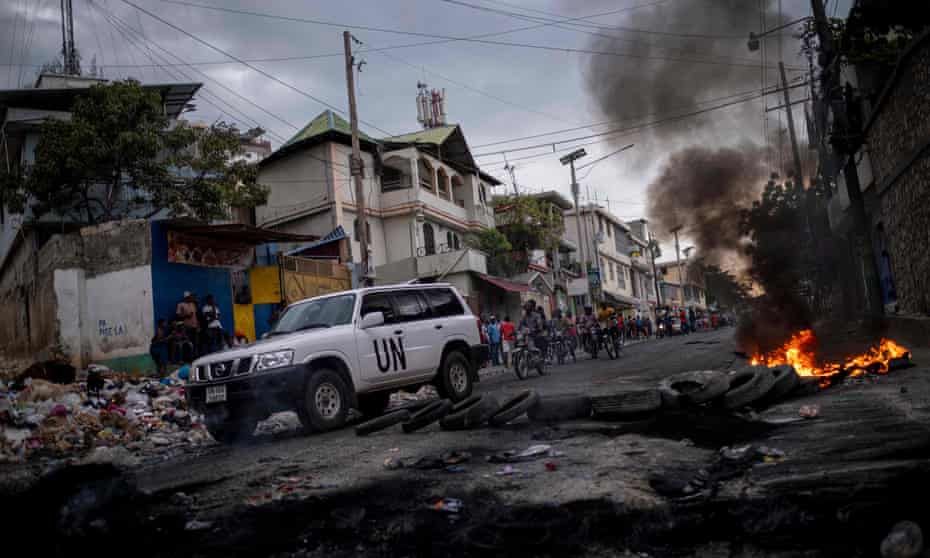
A UN vehicle drives past a barricade of burning tires during a demonstration against high prices and fuel shortages in Port-au-Prince, Haiti, on Thursday. Photograph: Ricardo Arduengo/AFP/Getty Images
The World Food Programme (WFP) is now using seafaring barges to ship supplies to earthquake victims in southern Haiti, after escalating gang violence made overland journeys unsafe for aid convoys.
Since the 7.2 magnitude earthquake struck the country’s southern peninsula in August, thousands of survivors have been sporadically cut off from Port-au-Prince, the capital, by roadblocks set up by warring gangs, leading relief workers to employ novel workarounds, including shifting aid to barges and helicopter airlifts.
“A recent upsurge in gang violence, including kidnappings, is impacting relief operations,” said Fernando Hiraldo, the acting UN humanitarian coordinator in Haiti on Thursday. “Violence, looting, road blockades and the persistent presence of armed gangs all pose obstacles to humanitarian access, a situation which is further complicated by very serious fuel shortages and the reduced supply of goods.”
The WFP – the world’s largest humanitarian organization – has carried out 18 voyages this month from Port-au-Prince to Miragoane, a coastal commune 62 miles away, bypassing violent neighborhoods on the outskirts of the capital.
From Miragoane, trucks continue by road to Les Cayes, the largest city in the region and a hub for relief efforts. Helicopters also fly twice daily to the region with staff and supplies.
The earthquake leveled many rural villages and hamlets, killing at least 2,200 people and leaving tens of thousands homeless – piling misery on a country already addled with fuel shortages, political turmoil and crippling poverty.
Kidnap of foreign missionaries confirms the power held by gangs in Haiti
Read more
More than 165 criminal gangs currently operate in Haiti, sometimes with tacit political support and often, better armed than the police, turning some neighborhoods into war zones where even police fear entering.
Across the capital, gangs kidnap the rich and poor alike for ransom, and extort business owners with impunity. Gang wars have escalated since president Jovenel Moïse was assassinated in his home in July.
Relief efforts to the south initially stuttered as aid trucks were turned back at roadblocks in the capital, though eventually, some were allowed passage.
In recent weeks, the law and order situation in the capital has deteriorated drastically, culminating in the brazen kidnapping of 17 missionaries on Saturday and a blockade on the road to Les Cayes.
“Growing insecurity is not only hampering the humanitarian response but is creating new humanitarian needs”, Hiraldo said. “Since June, gang violence in the Port-au-Prince area has displaced at least 19,000 people and has affected 1.5 million.”
… we have a small favour to ask. Tens of millions have placed their trust in the Guardian’s high-impact journalism since we started publishing 200 years ago, turning to us in moments of crisis, uncertainty, solidarity and hope. More than 1.5 million readers, from 180 countries, have recently taken the step to support us financially – keeping us open to all, and fiercely independent.
With no shareholders or billionaire owner, we can set our own agenda and provide trustworthy journalism that’s free from commercial and political influence, offering a counterweight to the spread of misinformation. When it’s never mattered more, we can investigate and challenge without fear or favour.
Unlike many others, Guardian journalism is available for everyone to read, regardless of what they can afford to pay. We do this because we believe in information equality. Greater numbers of people can keep track of global events, understand their impact on people and communities, and become inspired to take meaningful action.
We aim to offer readers a comprehensive, international perspective on critical events shaping our world – from the Black Lives Matter movement, to the new American administration, Brexit, and the world’s slow emergence from a global pandemic. We are committed to upholding our reputation for urgent, powerful reporting on the climate emergency, and made the decision to reject advertising from fossil fuel companies, divest from the oil and gas industries, and set a course to achieve net zero emissions by 2030.
If there were ever a time to join us, it is now. Every contribution, however big or small, powers our journalism and sustains our future.Support the Guardian from as little as £1 – it only takes a minute. If you can, please consider supporting us with a regular amount each month. Thank you.