Tag Archives: caribbean

Washington on High Security for Sept.18 Pro Capitol Riot Rally

Taking no chances, Capitol Police and other law enforcement officials are ramping up security measures ahead of Saturday’s rally in Washington to support the pro-Trump insurrectionists who attacked the Capitol earlier in the year.

Security officials and congressional leaders appeared to be blindsided by the riot of Jan. 6, when a violent mob of Trump supporters overwhelmed police officers and stormed the Capitol in a failed attempt to overturn President Biden’s election victory.

Eight months later, the Capitol’s top security officers are long gone. But their replacements are scrambling to ensure that the tragic events of Jan. 6 don’t recur on their watch.

Capitol Police have installed temporary high-tech security cameras to allow them a vaster view of the Capitol complex. A Capitol security board on Monday approved a plan to reinstall a seven-foot fence around the main Capitol building, which had stood for months after January’s deadly assault.

The board also said it has issued an emergency declaration, which will allow Capitol Police to deputize outside law enforcement as “special” Capitol Police officers on Saturday.

And unlike the lead up to Jan. 6, when a number of lawmakers were warning of rampant violence during Congress’s vote to formalize the election results, Speaker Nancy Pelosi (D-Calif.) and other Hill leaders have been requesting security briefings ahead of Sept. 18, including one held Monday, to ensure officials have a game plan if violence erupts this weekend.

“We are here to protect everyone’s First Amendment right to peacefully protest,” Capitol Police Chief Tom Manger said in a statement after the briefing. “I urge anyone who is thinking about causing trouble to stay home. We will enforce the law and not tolerate violence.”

Leaving Monday’s briefing, Senate Majority Leader Charles Schumer (D-N.Y.) said he sees a clear distinction between the security planning now versus January.

“They seemed very, very well-prepared — much better prepared than before Jan. 6,” he said. “I think they’re ready for whatever might happen.”

Pelosi offered a similar assessment, saying she’s seen “much better communication” between security officials heading into Saturday’s rally. Yet she also took a subtle shot at the former security heads, lamenting that congressional leaders were left out of the loop in January.

“It seems much better,” Pelosi said after Monday’s briefing. But “I don’t have anything to compare to, because we weren’t briefed before.”

Adding to the urgency surrounding the security planning, Capitol Police officers early Monday morning arrested a 44-year-old California man for possessing a bayonet and a machete just outside the Democratic National Committee headquarters, which sits just south of the Capitol and was targeted with a pipe bomb shortly before the Jan. 6 attack.

Both items are illegal in Washington.

The man, Donald Craighead, was driving a truck laden with white supremacist slogans and said he was “on patrol,” according to Capitol Police. Police said it was unclear if there was any connection between Craighead and this weekend’s demonstration at the Capitol.

Organized by Matt Braynard, a former Trump campaign staffer, Saturday’s “Justice for J6” rally is designed to highlight the treatment of hundreds of people who participated in the Capitol riot on Jan. 6. Many of those arrested have been held in jail for months awaiting trial, and former President Trump’s most vociferous allies — including a number of Republicans on Capitol Hill — are characterizing them as political prisoners.

In July, Reps. Matt Gaetz (R-Fla.), Louie Gohmert (R-Texas), Paul Gosar (R-Ariz.) and Marjorie Taylor Greene (R-Ga.) staged a small protest of their own outside the Department of Justice in Washington after they were denied visits with some of the Jan. 6 detainees. And they’ve continued to press the case that those conservatives are being persecuted for their political beliefs.

“The reason why they’re taking these political prisoners is because they’re trying to make an example, because they don’t want to see the mass protests going on in Washington,” Rep. Madison Cawthorn (R-N.C.), another fervent Trump ally, said during a recent rally in his district.

But other high-profile Republicans have rejected that argument, forcefully condemning the insurrectionists as domestic terrorists. In a speech marking the 20th anniversary of the Sept. 11 attacks, former President George W. Bush likened foreign terrorists to those who carried out the violent assault on the U.S. Capitol on Jan. 6.

“We have seen growing evidence that the dangers to our country can come not only across borders, but from violence that gathers within,” Bush said in a speech in Shanksville, Pa. “There is little cultural overlap between violent extremists abroad and violent extremists at home.

“But in their disdain for pluralism, in their disregard for human life, in their determination to defile national symbols, they are children of the same foul spirit. And it is our continuing duty to confront them.”

Among the various security measures being escalated before Saturday, the reinstallation of the Capitol security fence is likely to be the most controversial. The original fence was erected in the days following the deadly rampage at the Capitol on Jan. 6 and quickly became a symbol of both the failure of law enforcers to secure the building and the ongoing effort by Trump to overturn his election defeat.

It also infuriated Republicans in Congress, who accused Democrats of politicizing Jan. 6 by exaggerating the violent threat posed by Trump’s supporters. Closer to home, neighbors in the vicinity of Capitol Hill also pushed hard to have the fence removed.

Manger appears to recognize the volatile nature of the fence debate, vowing Monday that it won’t remain in place very long.

“The fence will go up a day or two before” Sept. 18, he told reporters Monday, “and if everything goes well it will come down very soon after.”

A wild card in Saturday’s security plans is the National Guard. By the evening of Jan. 6, dozens of National Guard troops were on hand helping to secure the Capitol complex and drive rioters back toward the National Mall. And thousands of service members from around the country patrolled the Capitol grounds in the days, weeks and months after the attack.

But it’s unclear if the National Guard will provide direct support to Capitol Police officers on Saturday. As of Monday, a formal request had not been made from the Capitol Police Board to the Pentagon, but law enforcement and national security officials are talking. And it’s possible some Guard troops will be put on standby near the Capitol complex that day, sources said.

“We maintain constant interagency communication, certainly have since the 6th of January for sure, and I expect that that communication will continue,” said Pentagon spokesman John Kirby. “But I’m not aware of any specific requests or specific communications right now.”

Rebecca Kheel contributed.

The post Washington on High Security for Sept.18 Pro Capitol Riot Rally appeared first on The St Kitts Nevis Observer.
US CDC: Unvaccinated 11 Times More Likely To Die from COVID-19, UK Boosters for Seniors, More

By Justine Coleman

The Hill

The Centers for Disease Control and Prevention (CDC) announced results from a study Friday that found unvaccinated individuals were 11 times more likely to die from COVID-19 than fully vaccinated people.

The research, spanning more than 600,000 people in 13 jurisdictions, also determined that unvaccinated populations were over 10 times more likely to be hospitalized — figures that underscore COVID-19 vaccines protect recipients from deaths and hospitalizations.

The study also showed that unvaccinated people were 4 1/2 times more likely to contract COVID-19 than the fully vaccinated.

The studies come just one day after President Biden announced a new rule that would require private companies with 100 employees or more to mandate vaccinations or frequent coronavirus testing.

The Biden administration as a whole has pushed for the use of vaccines as the best way to combat the pandemic.

CDC Director Rochelle Walensky on Friday made the case for vaccines yet again, citing the study along with two others and stating that COVID-19 shots still work to protect recipients from the worst of the disease amid the rampant spread of the delta variant.

“As we have shown study after study, vaccination works,” Walensky said during the briefing. “CDC will continue to do all we can do to increase vaccination rates across the country by working with local communities and trusted messengers and providing vaccine confidence consults to make sure that people have the information they need to make an informed decision.”

“The bottom line is this: We have the scientific tools we need to turn the corner on this pandemic,” Walensky said. “Vaccination works and will protect us from the severe complications of COVID-19. It will protect our children and allow them to stay in school for safe in-person learning.”

The agency and Biden administration are promoting the data behind the vaccine effectiveness in their bolstered push to get the unvaccinated shots.

The U.S. has made progress with vaccinations, reaching 75 percent of adults who have had at least one dose earlier this week.

But the portion of unvaccinated people continues to affect the U.S.’s trajectory in the pandemic, with the unvaccinated making up almost all of the growing hospitalizations and deaths.

The other two studies in the CDC’s Morbidity and Mortality Weekly Report (MMWR) released Friday focused on the vaccine’s effectiveness against hospitalization.

One involving five Veterans Affairs Medical Centers found the mRNA vaccines’ overall effectiveness against hospitalization reached 86.8 percent.

Another similarly calculated that effectiveness at 86 percent among patients in emergency departments, urgent cares and hospitals across nine states.

However, the studies also provided some evidence that the effectiveness of the vaccines are starting to wane among the older population, prompting the researchers to call for further investigation.

For the patients in emergency departments, urgent cares and hospitals across nine states, the effectiveness among those aged 75 and older was 76 percent, while among those aged 18 to 74, effectiveness reached 89 percent.

But researchers urged caution, with the report saying “this moderate decline should be interpreted with caution and might be related to changes in SARS-CoV-2, waning of vaccine-induced immunity with increased time since vaccination, or a combination of factors.”

The study involving Veterans Affairs facilities determined that the mRNA vaccine effectiveness among those aged 65 and older was 79.8 percent, compared to 95.1 percent among those aged 18 to 64.

More than 82 percent of those aged 65 and older are considered fully vaccinated, according to CDC data.

Surgeon General Vivek Murthy said Friday the administration is aiming to get “as close to 100 percent as possible” through expanded outreach.

“We know that every senior matters in terms of getting them vaccinated as a potential life saved,” he said, adding that booster vaccinations “will likely be helpful” for the older population.

The Biden administration had announced it planned to start administering additional shots to recipients on Sept. 20 beginning eight months after their second shot.

But the plan led to criticism from some experts who said the administration was getting ahead of the review process at the Food and Drug Administration (FDA), although officials say the strategy depends on FDA approval.

====================================================

Boris Johnson to confirm Covid booster jabs for over-50s in UK

Programme follows approval of vaccinations for 12- to 15-year-olds and is aimed at heading off winter rise in infections

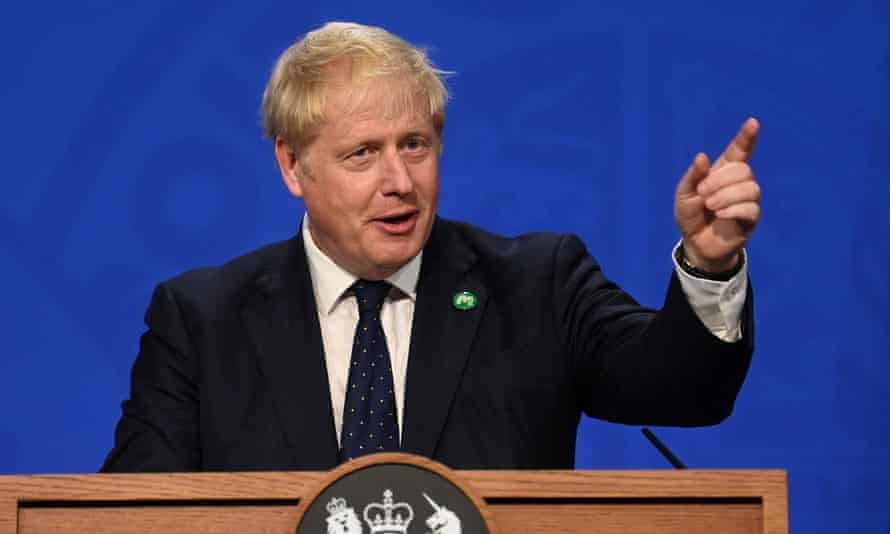
The prime minister, Boris Johnson
The prime minister, Boris Johnson, is also expected to oppose another lockdown even if coronavirus infection rates increase. Photograph: Toby Melville/Reuters


Boris Johnson is to confirm the start of a booster jabs programme for the over-50s on Tuesday after government scientists finally approved vaccinations for older schoolchildren.

Setting out a widespread acceleration of the vaccine programme before what ministers concede will be a difficult second winter coping with the virus, the prime minister will also signal his opposition to any further lockdowns this year.

In a press conference on Tuesday afternoon, the prime minister will highlight the need to keep some measures in reserve, which could include a return to compulsory mask-wearing in some settings, telling people to work from home where possible and the reintroduction of social distancing across England.

But he will put the vaccination programme at the heart of his approach to trying to keep Covid hospitalisations and deaths at manageable levels during the colder months when people are more likely to gather indoors and in the run-up to Christmas.

However the plans to offer jabs to children aged 12 to 15, approved by the UK’s four chief medical officers on Monday, immediately provoked concern from teaching unions who warned that schools were being put in an “invidious” position.

They called on ministers to confirm the programme would be overseen by specialists so teachers would not become caught up in issues of consent, or having to deal with anger from anti-vaccination groups.

One NHS trust has told schools it expects the first injections to be completed within six weeks.

Paul Whiteman, general secretary of the National Association of Head Teachers, said: “It is essential that the government immediately confirms that the process surrounding vaccinations will be run and overseen entirely by the appropriate medical teams.”

The Joint Committee on Vaccination and Immunisation (JCVI) is now understood to have endorsed boosters to be given to all over-50s and the clinically vulnerable, given fears about waning immunity.

The rollout is expected to take the same form as the first phase of Covid vaccine distribution begun in December 2020, with the oldest prioritised first before jabs are offered to the lower age groups.

Sajid Javid, the health secretary, will make a statement to the Commons confirming the move, with Johnson fielding questions from the media in a press conference later in the afternoon.

The prime minister will say: “The pandemic is far from over but, thanks to our phenomenal vaccine programme, new treatments and testing we are able to live with the virus without significant restrictions on our freedoms.

“Today I will set out a clear plan for the autumn and winter, when the virus has a natural advantage, to protect the gains we have made.”

Although ministers are expected to relinquish some emergency Covid powers, the government will still retain the ability to enforce a lockdown and tell people to quarantine who test positive.

And despite announcing over the summer that vaccine passports will be required for entry to nightclubs and other large crowded venues, Johnson is also expected to confirm what Javid said on Sunday – that the controversial documents will not be introduced on 1 October. However, the policy will be kept in reserve, much to the frustration of dozens of Tory MPs, who were preparing to vote against such a move to kill it off.

Many privately thought the chances of legislation passing to introduce vaccine passports were slim, given the high level of opposition among Johnson’s own backbenchers, and have told the Guardian the government should rule out their introduction entirely. One said: “The very concept of vaccine passports needs to be ruled out for good, as they are fundamentally unconservative, discriminatory and would lead to a two-tier society that I am confident no one actually wants to see.”

Johnson’s “winter plan” will prepare people for what Labour have warned could be “the worst winter in living memory” for the NHS, with the dual pressures of Covid and flu expected to place even more strain on the health service.

A government insider said that to guard against another lockdown, the prime minister would announce the potential return of “the sorts of interventions we’ve seen before”. They added: “It’s just the choice of in what combination and at what level of cases, deaths and hospitalisations they could be triggered”.


The decision on boosters has become one of the most protracted and complex issues the JCVI has tackled during the pandemic, with significant debate over whether any extra immunity granted by mass third jabs brings a net public health benefit, given the resources involved and the potential impact on areas such as other vaccination programmes.

On Thursday last week the committee held a meeting on the issue which lasted more than four hours, with members given very strict warnings against speaking to the media.

While the JCVI was deciding, there was increasing, if implicit, pressure from ministers to agree to a widespread booster programme, with ministers ordering the NHS to prepare for an immediate rollout once agreement was reached.

Some politicians and scientists, including Sir Jeremy Farrar, the director of the Wellcome Trust, have also stressed it would be unfair for the UK to roll out booster vaccines while millions of people in poorer countries still do not have access to even a first jab, and warned this could lead to the creation of potentially new variants of concern.

Announcements on rules for international travel are not expected to be made tomorrow but could come as early as Thursday.

The red, amber and green lists are expected to be replaced with a “go” and “no go” list of countries, acquiescing to Labour’s longstanding call for a simpler two-tier system.

Sources said there was a deliberate nudge built into the plan that would encourage people to get vaccinated by scrapping the requirement to quarantine and get a PCR test for those returning from “go” places but potentially keeping it in place for those who are not fully inoculated.

There were 30,825 new Covid cases announced on Monday and 61 deaths – lower than the recent daily figures because of the weekend reporting lag.

==================================================

WORLD SUMMARY

Topics

The post US CDC: Unvaccinated 11 Times More Likely To Die from COVID-19, UK Boosters for Seniors, More appeared first on The St Kitts Nevis Observer.

UWI INAUGURAL SIR OWEN S. ARTHUR LECTURE – THE MISSING PIECE

By  Everson W. Hull, Ph. D

On Wednesday September 8th, Caribbean development enthusiasts were treated to a very thoughtful lecture delivered by Dr. H. Gene Leon, the newly elected President of the Caribbean Development Bank.  It was the inaugural address, in a newly established lecture series in honor of the very distinguished Sir Owen S.  Arthur, with a very fitting title – “Re-designing Economic Growth Strategies”.

Dr. Leon’s lecture was outstanding in drawing attention to a number of very thoughtful growth strategies. It was refreshing to observe the wide range of alternative approaches that were offered for consideration.  The depth and breadth of his focus was most impressive, including his  recognition of the significance of the large talent pool that is widely dispersed across the region.

Notwithstanding, while teetering about the edge of a solution to the lethargic performance that has handicapped our region, his presentation fell short.  The very distinguished doctor knocked on the door; but like others who have come before him, chose not to step inside.

He did not allow himself to offer specific actions that would motivate individual members of our very talented labor force to produce at their optimal level; in implementing the policy actions that he very carefully outlined.   Using the language of his discipline, it would be fair to say, that the proposed policy actions, albeit necessary, were not sufficient.

Of special concern, is the likelihood that the region will be left in the same low productivity bucket that it has occupied over the past 40 years.  The ordinal performance ranking, as measured by per capita income, is not radically different from what it has been forty years ago.  The Bahamas which was at the head of the performance class forty years ago has consistently sustained its lead in each and every year; and the most recent World Bank data shows the gap widening.  Very few CARICOM countries have significantly improved their ordinal performance ranking relative to their peers that existed 40 years ago.  As a result, we remain badly exposed to every obstacle that is strewn in our path.

The rapid innovations in technology and associated new innovations that were detailed by the distinguished presenter are most important.  There is concern, however, that we will continue to fall short of extracting optimal performance from our labor force, unless each worker is offered an Incentive-Based-Compensation Plan that clearly links compensatory rewards to the productivity of each individual.

This is a matter of serious concern.  In the overwhelming majority of workplaces across the region, in both Latin American and the Caribbean, we have forgotten the individual.  Our speeches and policies suggest that the individual does not exist.  There are no performance scorecards that measure his or her individual performance.  We have no scorecard or method in place for carefully measuring and comparing the individual’s performance this year with his or her performance last year.

The absence of a performance scorecard and commensurate rewards will not work in cricket.  It will not work in soccer and did not work at the just completed Olympics where each individual, who did the grunt work and outperformed his or her peers, earned a prize.

The reality is that folks, in the same pay bucket, do not show up to work each day and knock themselves out in the delivery of goods and services because of love for country.  Although we are deeply ethnocentric, each has an infinite range of aspirations.  To illustrate, they aspire to making their rental payments on time, to take care of their families and to send their kids to the finest and often most expensive schools.

These very healthy aspirations, invariably come into conflict with a rigidly fixed pay band in which each employee receives the identical pay.  There are no rewards for supra-normal performance.   This is a recipe for disaster.  The brilliant and highly talented employee has no incentive to outperform his colleague, Joe Six Pack, who is in the same pay band.  The absence of these incentives and rewards is harmful to our member states.  The resultant lower rates of productivity / efficiency, as measured by output-per-manhour, increase the cost of production, reduce the volume of highly valued goods and services brought to market, increase our level of imports, and trap our member states at low growth rates, leaving each of our member states, without exception, operating far short of their full productive potential.

The distinguished guest lecturer does not have to look very far to see and observe incentive-driven compensation structures that have been working effectively in motivating work effort, and higher rates of productivity.   Both the Canadian and US Governments have in place incentive-based compensation plans.   And, the majority of those who have fled our shores are, for the most part, gainfully employed under a pay-for -performance plan.  Each of our member states has a ready pool of workers throughout the diaspora who have left our shores and are currently working in, or have worked under, a pay-for-performance plan.  Many will be pleased to share their experiences in the design and implementation of these structures, for gratis.

The distinguished professor has provided much food for thought.   The missing piece is the individual Incentive-driven Compensation Plan.  We do not have to re-invent the wheel.   Others have effectively addressed these productivity issues.   Every U.S. company of asset size greater than US $10 million is required to publish its Incentive Based Compensation Plan in its SEC Form 10-K and DEF 14A filings.  If our region is to break out of the pack and accomplish the mission objectives most carefully outlined by the distinguished presenter, it must have in place a compensation and reward structure that motivates each of our workers to be innovative and creative in producing at their optimal performance level, thrusting our member states closer to their highest productive potential.

The post UWI INAUGURAL SIR OWEN S. ARTHUR LECTURE – THE MISSING PIECE appeared first on The St Kitts Nevis Observer.

Twenty Years After 9/11 the War on Terrorism is Evolving with New Tactics

Twenty years after Sept. 11, 2001, attacks set off the global war on terrorism, now that war is evolving.

The U.S. withdrawal from Afghanistan is ushering in a new era as the Biden administration seeks to balance the continued need to keep terrorist threats in check with both a war-weary public and newer global challenges such as competition with China.

As a result, the so-called forever wars may not be ending any time soon, but the way they are being fought is changing as the United States shifts to a greater reliance on “over the horizon” forces and individual strikes over broader military conflict.

“What we’re seeing is an evolution, and it’s an evolution in how it is the United States has decided to contend with the terrorist threat and how the forever wars are conducted,” said Becca Wasser, a fellow at the Center for a New American Security.

“This might be the next part of this broader evolution to see what really works when you’re removed even further,” she added. “It’s definitely going to be sort of a period of trial and error. And, unfortunately, when it comes down to counterterrorism, there’s not a lot of room for trial and error, especially if there are potential risks to the U.S. homeland. I think over time, the United States will find a formula that works. But I think there’s going to be a lot of back-and-forth before Washington can really get to that point.”

President Biden’s decision to fully withdraw from Afghanistan, a mission that was completed at the end of August, capped an era of U.S. history that began 20 years ago when al Qaeda hijackers crashed planes into the World Trade Center, the Pentagon and a field in Pennsylvania, killing nearly 3,000 people.

Shortly after the attacks, the United States invaded Afghanistan. In the ensuing 20 years, U.S. military counterterrorism operations spread around the globe, with troops targeting al Qaeda, its affiliates and, later, ISIS everywhere from Iraq and Syria to Libya to Yemen to Somalia to the Philippines.

The 2001 authorization for the use of military force passed in response to the 9/11 attacks has been invoked for military operations in at least 19 countries, according to a 2018 Congressional Research Service report.

U.S. concerns over the last two decades have also evolved, including efforts to pivot foreign policy away from the war on terrorism toward so-called great power competition with Russia and China, as well as a rising threat from domestic, white supremacist terrorists.

“Unlike on 9/11, the U.S. is in a different position today on the domestic terrorism side,” said Seth Jones, director of the transnational threats project at the Center for Strategic and International Studies. “We do see definitely more concerns today from domestic terrorism. I think that’s probably going to continue for the near term.”

But the terrorist threats abroad remain.

“One of the fallacies of the GWOT era is that this was something that could come to a conclusion, that all of a sudden the terrorist threat was going to be eliminated. And, unfortunately, that’s not how terrorism works,” Wasser said, using an acronym for the global war on terrorism. “It’s not a single enemy that you can quell and quash and isn’t going to rise back.”

Though Biden withdrew from Afghanistan, there are no plans at the moment to pull out the 2,500 U.S. troops in Iraq or the 900 in Syria helping local forces prevent an ISIS resurgence, though Washington and Baghdad recently rebranded the Iraq operation as purely advisory.

After a pause at the beginning of the Biden administration, U.S. strikes against Somalia’s al Qaeda affiliate have recently picked back up, with American forces conducting at least four strikes against al Shabaab in July and August.

And in Afghanistan, with the Taliban back in power, U.S. officials are also on the watch for a resurgent al Qaeda.

“The whole community is kind of watching to see what happens and whether or not al Qaeda has the ability to regenerate in Afghanistan,” Defense Secretary Lloyd Austin told reporters traveling with him in Kuwait this week.

“The nature of al Qaeda and ISIS-K is they will always attempt to find space to grow and regenerate, whether it’s there, whether it’s in Somalia, whether it’s in any ungoverned space,” Austin added, referring to the Afghan branch of ISIS.

Over the past 20 years, terrorist threats have come in “waves and reversal,” Jones argued as he expressed concern about a coming “fifth wave.”

“The campaign has gone through a series of waves and then reversals,” he said. “So waves meaning there’s been a surge in terrorist activity. And then it’s been reversed by either an effective counter terrorist campaign or bad terrorist activity, poorly run, poorly organized. And so I think we’re coming potentially now to the tail end of a reversal where al Qaeda and the Islamic State have actually suffered serious damage. They lost control of significant territory, they’ve been on the run, and the U.S. is now releasing pressure.”

Even though there are no U.S. troops on the ground, Biden has pledged to continue targeting terrorists in Afghanistan through “over the horizon” forces — or drones, manned aircraft and other assets based beyond Afghanistan’s borders.

The U.S. has already carried out two over-the-horizon drone strikes after last month’s attack at the Kabul airport that killed 13 U.S. troops. But officials have not identified the supposed “high profile” targets of the first strike, and reports on the ground say at least 10 civilians were killed in the second strike, with a New York Times visual investigation saying the target was an aid worker.

Experts and some military and intelligence officials have warned that over-the-horizon operations in Afghanistan will be difficult without a presence on the ground collecting intelligence. Further, no basing agreements with Afghanistan’s neighbors means flying from long distances, most likely from the Gulf region.

“Over the horizon is a crazy concept for Afghanistan with no bases, with no allies and partners on the ground, with no intelligence infrastructure,” Jones said.

Barry Pavel, director of the Atlantic Council’s Scowcroft Center for Strategy and Security, similarly argued relying on over-the-horizon forces will make it more difficult to track terrorist threats.

“This ‘over the horizon,’ wonderful bumper sticker, it’s pretty hard to do, and it takes more resources even to do it minimally because they have to fly from longer distances, you have to maintain the orbits. It’s just going to be harder,” he said.

But as U.S. counterterrorism efforts evolve, Pavel also sees an opportunity to do something the United States has done a “terrible job” at in the last 20 years: diplomacy, development and other efforts to address “the sources of alienation that lead people, in particular in the Middle East, to choose this as a very dangerous profession.”

“We’re gonna have to keep doing this until we do a better job of drying up the sources of why people get motivated to do this kind of stuff, and that’s a long term proposition that I don’t think we’re making very good progress on,” he said. “The Biden administration has an opportunity here, especially as an administration that wants to reduce the emphasis on military instruments.”

The post Twenty Years After 9/11 the War on Terrorism is Evolving with New Tactics appeared first on The St Kitts Nevis Observer.

OAS to Oversee the Bahamas Election

CNW- The Organization of American States (OAS) says it will deploy an Electoral Observation Mission (EOM) to observe the general elections in the Bahamas scheduled for September 16.

The OAS said Secretary General Luis Almagro has appointed Denis Godwin Antoine as chief of mission.

Ambassador Antoine is the former Ambassador Extraordinary and Plenipotentiary of Grenada to the People’s Republic of China (2016-2019) and Ambassador/Permanent Representative of Grenada to the United Nations (2013 to 2015).

According to the OAS, he served as Grenada’s Ambassador to the United States of America and Permanent Representative to the OAS, and non-resident Ambassador for Grenada to Mexico and Panama concurrently, from 1995 to 2009.

The OAS said the mission will begin its deployment on September 9 and is comprised of 17 experts and observers from nine different countries.

“While the majority of the mission’s members are working in-person, some are carrying out their duties remotely,” the OAS said. “In the Bahamas, they will meet with government officials, electoral authorities, political leaders, candidates, representatives of civil society and other relevant actors, which will allow for a comprehensive analysis of the process.

“The mission will focus its work on the examination of issues related to electoral organization, electoral technology, electoral boundaries, electoral registries, political-electoral financing and the political participation of women,” the OAS added.

It said this is the third time that it will deploy an EOM in the Bahamas.

After the elections, the OAS said the mission will present a preliminary report with its observations and recommendations “aimed at contributing to the continued strengthening of the electoral process in the country.

The post OAS to Oversee the Bahamas Election appeared first on The St Kitts Nevis Observer.

Mu Variant of COVID-19 Detected in Jamaica

CNW- Health and Wellness Minister, Dr. Christopher Tufton, says the Mu strain of the Coronavirus (COVID-19) will be manageable once the established public health protocols are followed.

Tufton urged members of the public not to panic, as new strains of the virus will enter Jamaica due to people traveling to the island from other parts of the globe.

“This new strain is not going to lead to more people dying or getting ill. We are still studying it, and while we have an obligation to announce, we are not announcing for you to panic…it is for you to be aware; it is not a failure of the system or the process,” he told reporters.

He said what is required is continuous vaccination, social distancing, and regular hand washing and sanitisation as the observance of the health protocols will help to “build our capacity to resist the virus as we restore some form semblance of normality”.

Last week, Tufton had said that it is imperative that the Jamaican population be protected against the virus.

“Now that we know that there is the Mu variant in the Caribbean and it is one of concern, then we will pay particular attention to ensuring that we not only test for Delta and the others but we test for this particular one as well.

“We have collected samples and sent them to three sites outside of Jamaica for those samples to be tested,” he said, noting this is among the reasons the government is forging ahead with the national vaccination programme to get the majority of the population inoculated

The post Mu Variant of COVID-19 Detected in Jamaica appeared first on The St Kitts Nevis Observer.

US Vax Stats Bad, UK COVID Cases Soar, Grenada Surge, Delta in Bahamas, World Stats

US Worst Vaccination Stats of G-7 Nations

Until May 19, 2021, America was second out of G7 nations in the percentage of people who had received at least one dose of a COVID-19 vaccine, behind Britain but ahead of Canada, France, Italy, Germany and Japan.

On Thursday, according to the University of Oxford’s Our World in Data project with Japan’s most recent reported figures, the United States sits last, with 61.94 percent of Americans receiving the first dose compared to 62.16 percent of the Japanese population. Canada is top of the pile now with 74.25 percent.

Perhaps the most interesting thing about the data is the shape of the graphs, with Japan’s slow rollout showing late takeup but a very steep curve (so now more people are being vaccinated very quickly) whereas the U.K.’s line is the flattest of any G7 country, suggesting most people who are willing to get a vaccine have done so.

America’s line is relatively flat, with many unwilling to get the vaccine but is tracking in a similar pattern to Germany and Canada, suggesting that the anti-vax movement in the U.S. is no more prevalent here than in some other major economies.

What happens now? The vaccine mandate in the U.S. is a strong indication of where Biden wants to go, with the president calling this a “pandemic of the unvaccinated.” Expect both vaccination numbers, and resistance to it, to increase quickly in coming weeks.

======================================================

UK Has 2nd Highest Worldwide Infection Rate–Lancet Editor

The editor-in-chief of medical journal The Lancet has warned that the UK has among the highest number of coronavirus cases in the world, saying: “The pandemic hasn’t gone away yet.”

While Richard Horton said it is positive that two-thirds of UK population is vaccinated, it has the highest number of infections globally after the US.

He told Sky News:

We’re the second highest number of infections of any country in the world after the United States, we’re seeing hospitalisations rise by about 5% every week, there are 1,000 new deaths every single week, we’ve got 1,000 people on ventilators across the country. In other words, the pandemic hasn’t gone away yet. So we’re in a very finely balanced situation.

Leading epidemiologist Prof Neil Ferguson has said the UK must boost its immunity by vaccinating more teenagers to stop the risk of “a large autumn and winter wave”.

The Imperial College professor told BBC Radio 4’s Today programme that there will be some effect of ditching Covid passports in England but that he hopes another national lockdown will not be needed.

While he said nothing can be ruled out, he hopes that another lockdown will not be needed. “With this level of immunity that we have in the population, if we do need to further drive down transmission then it may not require full lockdown.”

==================================

Grenada: 182 new COVID cases recorded; 50% police force unvaccinated

Concern has been mounting among security officials in Grenada following reports that approximately 20-per cent of the officers attached to the Royal Grenada Police Force (RGPF) are now infected with COVID-19.

As a result, some officers have been working in shifts of up to 16 hours per day.

According to the Health authorities, the island started recording an upsurge in mid-August.

The latest figures have revealed that local actives cases moved from 5 on August 17 to 1791 on September 10.

Health authorities have since declared that the island is affected by community spread with the Delta variant which was detected in early August as the main strain.

“There are a number of policemen I think is over 160 odd policemen who are infected and many of them have to self-quarantine, and it is affecting them and their families and it’s affecting the productive level of the force,” said Dr Keith Mitchell, Prime Minister and Minister for National Security.

“It’s a tough act for everybody, with the lockdown this weekend, almost every police having to be working 15 to 16 hours, otherwise, we won’t be able to achieve a significant impact with the lockdown we are implementing,” Dr Mitchell said in a live interview late Friday.

“They are trying their best, they are giving the Government the support they can, the leadership is trying but at the same time there are serious limitations,” said the Prime Minister who explained that the purpose of the weekend lockdown is to reduce the movement of people “because when people move the virus moves.”

In a recent interview, Edvin Martin, Commissioner of Police disclosed that less than 50% of the Force were vaccinated but educational sessions facilitated by members of the medical fraternity were in progress with a view to getting officers to become vaccinated.

Data from the Ministry of Health has shown an increase in vaccination since the cases began to increase but it’s not clear if some of the newly vaccinated with the first dose are Police Officers.

The legislation establishing the Police Force allows for 1025 sworn positions for the maintenance of law and order, the preservation of the peace, the protection of life and property, the prevention and detection of crime, the enforcement of all laws and regulations with which it is charged, and the apprehension of offenders.

In a bulletin issued late on Saturday, the Ministry of Health announced that 182 new cases of COVID-19 were recorded, bringing the total number of confirmed cases to 2,345.

============================================

Delta Variant Main Strain in the Bahamas

Health authorities in The Bahamas say the Delta variant is the predominant strain of the coronavirus (COVID-19) in the country, as it continues to grapple with the impact of the virus that has killed 453 people and infected 19,139 others since March last year.

The Ministry of Health in a statement said that results received from the FIOCRUZ Laboratory in Brazil, confirmed the presence of the highly transmissible Delta variant.

It said that the National Reference Laboratory had submitted 98 SARS-CoV-2 virus-positive samples to the FIOCRUZ Laboratory for genomic sequencing. The samples were collected between May 6 to August 8 this year from individuals on New Providence, Grand Bahama, Abaco, Andros, Eleuthera, Exuma and Bimini. According to the ministry 41 of the cases were the Delta variant, while there were 39 cases of the Alpha variant.

“There are 18 samples still going through the testing process. The new sequencing results confirm that the Delta variant is the predominant variant in The Bahamas, followed by the Alpha and Gamma variants,” the ministry said in the statement, adding “it is noteworthy to mention that the Alpha variant is more transmissible than the original COVID-19 virus, and the Delta variant is known to be more transmissible than the Alpha variant.

“Consequently, all major health facilities in New Providence and Grand Bahama are experiencing increased numbers of cases, hospital admissions and deaths due to COVID-19.”

The Ministry of Health said that the health care system of both the public and private sectors is now severely challenged and over-burdened, and as a result, non-COVID-19 cases requiring health care are at risk of not being able to access life-saving health care.

“Given the predominance of these highly transmissible variants in the country, it is essential to seek medical care early and avoid home remedies that delay accessing medical care. Do not delay seeking medical help if you experience signs and symptoms of COVID-19. Contact your healthcare provider or nearest public health clinic for more information,” the ministry warned.

It urged members of the public  to avoid gatherings of groups of more than five people, remain physically distant, wear a mask at all times, and wash hands regularly.

“Additionally, we strongly encourage all citizens and residents of The Bahamas to be vaccinated. COVID-19 vaccinations are proven to be safe.  They are known to decrease the severity of illness, hospitalizations, and deaths, if infected with the virus that causes COVID-19 and all its variants,” the ministry added.

WORLD STATS

Coronavirus Cases:

225,580,776

Deaths:

4,646,136

Recovered:

202,193,092
Highlighted in green
= all cases have recovered from the infection
Highlighted in grey
= all cases have had an outcome (there are no active cases)

[back to top ↑]

Latest News

September 13 (GMT)

Updates

  • 22,541 new cases and 448 new deaths in Iran [source]
  • 1,149 new cases and 16 new deaths in Nepal [source]
  • 1,291 new cases and 14 new deaths in Libya [source]
  • 18,178 new cases and 719 new deaths in Russia [source]
  • 7,213 new cases and 55 new deaths in Japan [source]

The post US Vax Stats Bad, UK COVID Cases Soar, Grenada Surge, Delta in Bahamas, World Stats appeared first on The St Kitts Nevis Observer.

World View: California Recall Poll, N. Korea Missile Test, Israel Responds to Gaza Rockets, More

Sept.13, 2021

Alternate text
  • California Democratic Gov. Gavin Newsom has urged voters to defeat a looming recall that could remove him from office.
  • President Joe Biden will promote his administration’s use of the Defense Production Act to aid in wildfire preparedness during a western swing in which he’ll survey damage in Idaho and California.
  • North Korea says it successfully test-fired newly developed long-range cruise missiles.
  • And in the third straight night of fighting in the Middle East, Israeli aircraft struck a series of targets in the Gaza Strip in response to rocket launches out of the Hamas-ruled territory.
  • School starts for about a million New York City public school students 
  • Downtown businesses cope with new reality
  • Britney Spears gets engaged

VANESSA GERA

Warsaw, Poland

The Associated Press

The Rundown

I'm an image

LOS ANGELES (AP) — In a blitz of TV ads and a last-minute rally, California Democratic Gov. Gavin Newsom urged voters Sunday to turn back a looming recall vote that could remove him from office, while leading Republican Larry Elder broadly criticized…Read More

I'm an image

WILMINGTON, Del. (AP) — President Joe Biden will promote his administration’s use of the Defense Production Act to aid in wildfire preparedness during a western swing in which he’ll survey wildfire damage in Idaho and California. …Read More

I'm an image

SEOUL, South Korea (AP) — North Korea says it successfully test fired what it described as newly developed long-range cruise missiles over the weekend, its first known testing activity in months that underscored how it continues to expand its militar…Read More

I'm an image

JERUSALEM (AP) — Israeli aircraft struck a series of targets in the Gaza Strip early Monday in response to a series of rocket launches out of the Hamas-ruled territory. It was the third consecutive night of fighting between the enemies. …Read More

I'm an image

NEW YORK (AP) — Classroom doors swing open for about a million New York City public school students on Monday in the nation’s largest experiment of in-person learning during the coronavirus pandemic. …Read More

OTHER TOP STORIES

NEW YORK (AP) — Downtown businesses in the U.S. and abroad once took for granted that nearby offices would provide a steady clientele looking for breakfast, lunch, everyd…Read More

WASHINGTON (AP) — First, some blamed the deadly Jan. 6 attack at the U.S. Capitol on left-wing antifa antagonists, a theory quickly debunked. Then came comparisons of …Read More

LOS ANGELES (AP) — Britney Spears announced her engagement Sunday to her boyfriend Sam Asghari with an exuberant post displaying a diamond ring engraved with the word “li…Read More

LOD, Israel (AP) — An Israeli defense contractor on Monday unveiled a remote-controlled armed robot it says can patrol battle zones, track infiltrators and open fire. The…Read More

The post World View: California Recall Poll, N. Korea Missile Test, Israel Responds to Gaza Rockets, More appeared first on The St Kitts Nevis Observer.

Trinidad and Tobago the Dominant Regional Force in Gas Production by2025

A total of seven natural gas projects are expected to start operations in Trinidad and Tobago during 2021-2025.

by: GlobalData
Trinidad and Tobago is expected to contribute around 25% or 820mn ft3/day of the Americas natural gas production in 2025 from planned and announced projects (new build projects, excluding the US L48), according to GlobalData, a leading data and analytics company.
The company’s report, Americas Oil and Gas Upstream Development Outlook to 2025, reveals that 514mn ft3/d of natural gas production in Trinidad and Tobago in 2025 is expected from planned projects with identified development plans, while 306mn ft3 is expected from early-stage announced projects that are undergoing conceptual studies and are expected to be granted approval for development.A total of seven natural gas projects are expected to start operations in Trinidad and Tobago during 2021-2025. Of these, Colibri and Matapal are some of the key projects that are expected to collectively contribute around 58% of the natural gas production in the country in 2025.

Svetlana Doh, Oil & Gas Analyst at GlobalData, comments: “Despite quite a positive outlook for the country’s production in the near term, GlobalData projects that natural gas output in Trinidad and Tobago will start declining after 2024.

Since most of the developed and undeveloped shallow water blocks are already licensed, more aggressive exploration work needs to be conducted regarding deepwater acreage. The country offered some deepwater blocks in the 2020 deepwater competitive bid round, but the round was delayed until 2021. Further delays could be expected due to the sudden death of Trinidad and Tobago’s energy minister in April 2021.”

GlobalData identifies the US as the second highest country in the Americas with 608mn ft3/d of natural gas production in 2025 or around 18% of the total Americas natural gas production in the year (excluding the US L48). Brazil follows with natural gas production of 538mn ft3/d from planned and announced projects in 2025.

Among oil and gas companies, BP, China National Petroleum, and Petroleo Brasileiro SA lead with the highest natural gas production of 421mn ft3, 412mn ft3/d and 387mn ft3/d respectively, in 2025 from planned and announced projects (excluding the US L48).

The statements, opinions and data contained in the content published in Global Gas Perspectives are solely those of the individual authors and contributors and not of the publisher and the editor(s) of Natural Gas World.

The post Trinidad and Tobago the Dominant Regional Force in Gas Production by2025 appeared first on The St Kitts Nevis Observer.

Haiti’s Main Political Parties Reach Temp Govt. Deal

Haiti’s main political forces reached an agreement to establish a transition government until the holding of presidential elections and a constitutional referendum next year.

hich the figure of provisional President disappears. A Council of Ministers under the leadership of Ariel Henry as Prime Minister will now rule the Caribbean island.

The opposition forces highlighted that the negotiations allowed the integration of the diaspora in the formation of a new Provisional Electoral Council, the release of political prisoners, and a commitment for the reestablishment of security and the dismantling of gangs.

“The Democratic and Popular Sector (SDP) has taken the political and historic decision to sign the political agreement for the peaceful and consensual governance of this interim period.” SDP spokesman Andre Michel said.

“It was not an easy decision… But we understood that the time has come to build this country on a consensual basis of permanent dialogue,” he added.

Henry welcomed the agreement, noting that the deal gathered almost all the legitimate demands voiced by several sectors to achieve social reforms.

“I am confident that this deal will allow conducting, in harmony and good understanding, the affairs of the State during the interim period which I wish to be as short as possible,” Henry said.

The agreement established the holding of presidential elections by the end of 2022. It also included a national constituent assembly made of 33 members appointed by institutions and civil society organizations.

The assembly will have three months to prepare a new Constitution to be voted in a referendum by Haitians.

The post Haiti’s Main Political Parties Reach Temp Govt. Deal appeared first on The St Kitts Nevis Observer.