CW- Cricket West Indies president, Ricky Skerritt, has defended the decision to allow the Caribbean side to tour the United Kingdom last year at the height of the global COVID-19 pandemic saying it was worth the risk.
He contends major benefits had been derived from the move, including the cementing of England’s series in the region next January.
Skerritt, who is seeking re-election at month end along with vice-president Dr Kishore Shallow, said negotiations about the traditionally lucrative series began during discussions over the historic bio-secure three-Test tour.
And the former St Kitts and Nevis cabinet minister said that due to CWI’s commitment to fulfilling the tour amidst the challenging circumstances posed by the coronavirus, the governing body had been able to also advance a proposal to the England and Wales Cricket Board for an even bigger tour.
“The other benefit is that we started negotiating since back then for their (England) next tour to the West Indies which is scheduled for January 2022 which is less than a year from now,” Skerritt told Grenada Sports’ TalkSports YouTube channel.“And the goodwill generated between us has now allowed us to put on the table and get good traction on expanding that tour.
“Now an England tour for the West Indies is always a very good thing for the West Indies financially and economically because we get more money for the broadcast which we own, because England has a much bigger and more lucrative cricket market, and [Caribbean] countries who host the England team get economic benefits from the tourism impact.”
Tours of the region by the England side have been estimated to generate economic activity of around US$60 million, in what is viewed as a major boost for tourism-dependent economies.
The last tour in 2019 comprising three Tests, five One-Day Internationals and three Twenty20s, was projected to earn CWI alone close to US$20 million.
CWI had faced criticism from some quarters for proceeding with the tour last year even as the UK remained in a lockdown due to the onset of the pandemic, and was also chastised for not securing a financial windfall from the ECB in exchange for playing the series.
However, Skerritt said trying to squeeze money out of the ECB in exchange for the tour amounted to “extortion”, and argued there were other more far-reaching benefits which had been realised.
“Extortion is illegal, extortion is corruption. We don’t get into extortion,” Skerritt stressed.
“It is not allowed. It is against the spirit and the rules of the Future Tours Programme. The only people who make money out of a tour is the hosts, other than with your own sponsorship, so us going to England benefited our major sponsor Sandals. You don’t have to be a rocket scientist to understand that.
“England is a major market for Sandals. Wherever we go, we take their brand with us so in going to England, helped to meet our agreement with Sandals to continue promoting their brand because if we’re not promoting their brand, they’re not going to pay us.
“So first and foremost, going to England benefited us financially from our arrangement with our major sponsor.”
He continued: “Secondly we got the ECB to allow us to bring a significant number of A-team players. I know we had over [25] players in England at one time. This was good exposure for a lot of our young cricketers that augured well for their preparation and growth.
“So even if they didn’t play in the official Test series, they were practicing, they were net bowlers, they were standby players etcetera.”
With the series, West Indies became the first international team to undertake a tour during the pandemic, playing in what has come to be known as the “bio-secure” bubble.
And Skerritt said the decision was one the regional governing body was proud of.
“So we have no regrets at all about how we handled the England situation. If we didn’t go to England, they were other teams that were ready to go,” he noted.
“Pakistan went to England, Australia went to England right after us. Why would [anyone] think we were the only team that can tour England?”
He added: “I’m happy to say we’ve been able to create this bio-secure bubble in collaboration with the ECB. We’re the pioneers in that. You hear it happening all over the world now but we’re the pioneers.
“We were the first ones to partner with the ECB and prepare what we call a bio-secure bubble, and which is now the model used all over the world.”
Skerritt is being challenged for the CWI presidency by Guyana Cricket Board secretary, Anand Sanasie, who has as his running mate Barbados Cricket Association vice-president, Calvin Hope.
The Bahamas men’s national soccer team is preparing for its first qualifying match for the FIFA World Cup Qatar 2022 hosting St. Kitts & Nevis at the Thomas A. Robinson National Stadium here in The Bahamas, on Saturday March 27, starting at 7 p.m.
Like other national and club squads in the country, The Bahamas’ Junkanoo Boys, as they are called, have had to train under immense circumstances due to the restrictions brought on by the presence of the COVID 19 pandemic.
In March 2020, when lockdowns and shutdowns were instituted, the squad was coming off its first round matches of the CONCACAF (Confederation of North, Central American and Caribbean Association Football) Nations League, finishing with a 3-1 win/loss record and advancing to the next round of play.
After a six-month layoff, the team got special permission from the Competent Authority on the advice of Ministry of Health officials to resume training under strict guidelines and safety measures. Advanced training would have only been permitted if there were no reported cases of COVID-19 and if the agreed protocols were followed. Thankfully, there was no outbreak of COVID-19 during the sessions.
Fast forward to today. Under the guidance of Team Bahamas Head Coach Nesley Jean and his management team, the squad returned from Bradenton Florida, on Monday, March 8, where they competed in two FIFA (International Federation of Association Football) approved friendly matches against Bermuda.
The games were very competitive as both coaches, Nesley Jean and Kyle Lightbourne, sought to identify and select the best players available to take into their qualifying matches.
Under rigorous COVID-19 testing protocols, the team lost the first match 3-0 with Coach Jean making quite a number of substitutions in order to view all of the players in a competitive environment. In the second match, the game ended in a scoreless draw. Team Bahamas squandered quite a number of chances to score and record a win.
Chosen to represent The Bahamas against St. Kitts & Nevis are: Dylan Pritchard, Troy Pinder, Marcel Joseph, Evelt Julmis, Terry Delancy, Peter Julmis, Happy Hall, Ian Lowe, Lesly St. Fleur, Cameron Hepple, Michael Butler, Isiah Collie, Logan Russell, Alexander Thompson, Elijah Mitchell, Valentino Hanna, Ambry Moss, Jean Francois, Jacob Charles and Nicholas Lopez.
The squad had to undergo the Bahamas government’s mandatory five-day testing protocols, and every member received a negative result – validating the protocols put in place by FIFA, the Bahamas Football Association (BFA) and The Bahamas Ministry of Health.
The match against St. Kitts & Nevis will be played in an empty stadium so as to conform to health and safety standards and prevent the spread of the virus.
Forward Harrison Panayiotou has been called up by the Saint Kitts and Nevis national team ahead of their upcoming World Cup Qualifiers.
Harrison, who has been capped 25 times previously by his national side, will depart for international duty on the 21st March, taking on Puerto Rico at home on the 25th before playing away to the Bahamas on the 28th.
In doing so, Harrison will unfortunately miss our games against Chesterfield at home (23rd March), Solihull Moors away (27th March) and potentially Notts County at home on the 30th March.
Good morning from Warsaw. Asian Americans are grieving after an attack on Atlanta-area massage parlors that killed eight people, mostly Asian women. The white gunman has been charged in the killings as investigators seek a motive in the worst mass killing in the U.S in almost two years.
President Joe Biden gives little credit to Donald Trump as the U.S. sees a pandemic recovery.
Meanwhile, Republicans seize on Trump’s trademark issue of immigration as they try to regain the upper hand in the face of Biden’s early popularity.
Also this morning:
World awaits review from Europe’s medical regulator on whether AstraZeneca shots are linked to blood clots
Ford says remote work will outlast pandemic for thousands of its workers
15th-century Chinese bowl found at yard sale sells for $722,00
Asian Americans were already worn down by a year of pandemic-fueled racist attacks when a white gunman was charged with attacking three Atlanta-area massage parlors and killing eight people, most……Read More
ATLANTA (AP) — A series of shootings over nearly an hour at three Atlanta-area massage parlors left eight people dead and raised fears that the attack was yet another hate crime against Asian… …Read More
WASHINGTON (AP) — In President Joe Biden’s war against the coronavirus, former President Donald Trump hardly exists. The Democratic president ignored Trump in his first prime-time address to… …Read More
LONDON (AP) — The world is awaiting a decision from Europe’s top medical regulator on whether its initial investigation into whether there is any evidence to show the AstraZeneca coronavirus… …Read More
WASHINGTON (AP) — Delegation trips to the border. Apocalyptic warnings. A flurry of new conferences. Republicans still divided over former President Donald Trump’s legacy are seizing on his… …Read More
WASHINGTON (AP) — Legislation creating an independent, bipartisan panel to investigate the Jan. 6 insurrection at the U.S. Capitol is stalled, for now, with Democrats a…Read More
WASHINGTON (AP) — Forgive progressives who aren’t looking forward to the sequel of their personal “Nightmare on First Street,” a Supreme Court succession story. The ori…Read More
DETROIT (AP) — It’s a question occupying the minds of millions of employees who have worked from home the past year: Will they still be allowed to work remotely — at le…Read More
HARTFORD, Conn. (AP) — An exceptionally rare 15th century porcelain bowl made in China that somehow turned up at a Connecticut yard sale and sold for just $35 was aucti…Read More
MOSCOW (Reuters) – Russia wants an apology from the United States after President Joe Biden said he thought Vladimir Putin was a killer and may retaliate against Washington unless it gets one, a senior Russian lawmaker said on Thursday.
In an ABC News interview broadcast a day earlier, Biden said “I do” when asked if he believed the Russian president was a killer.
He also described Putin as having no soul, and promised he would pay a price for alleged Russian meddling in the 2020 U.S. presidential election, something the Kremlin denies.
In a highly unusual move following Biden’s interview, Russia on Wednesday said it was recalling its ambassador to the United States for urgent consultations over the future of U.S.-Russia ties.
Konstantin Kosachyov, deputy chairman of parliament’s upper house, said Biden’s comments were unacceptable, would inevitably inflame already bad ties, and ended any hope in Moscow of a change of U.S. policy under a new U.S. administration.
He said Moscow’s recall of its ambassador was the only reasonable step to take in the circumstances.
“I suspect it will not be the last one if no explanation or apology follows from the American side,” Kosachyov said in a Facebook post.
“This kind of assessment is not allowed from the mouth of a statesman of such a rank. This kind of statement is not acceptable under any circumstances,” he added, calling it a watershed moment in U.S.-Russia ties.
The Kremlin has not yet responded publicly to Biden’s comments, but is likely to do so later on Thursday.
Artur Chilingarov, a pro-Kremlin lawmaker in the lower house of parliament, called for a “tough reaction” from Moscow in comments made to Russia’s Ekho Moskvy radio station.
Russia’s ties with the West, already languishing at post-Cold War lows since 2014, have come under new pressure over Russia’s jailing of Kremlin critic Alexei Navalny whose freedom the West has demanded.
Russia has dismissed that as unacceptable interference in its domestic affairs.
The United States has said it is preparing new sanctions against Russia over an alleged hack and the alleged election meddling.
Biden told ABC “You’ll see shortly” when asked what consequences Russia would face for its alleged behaviour.
Reporting by Tom Balmforth and Anton Kolodyazhnyy; editing by Andrew Osbor
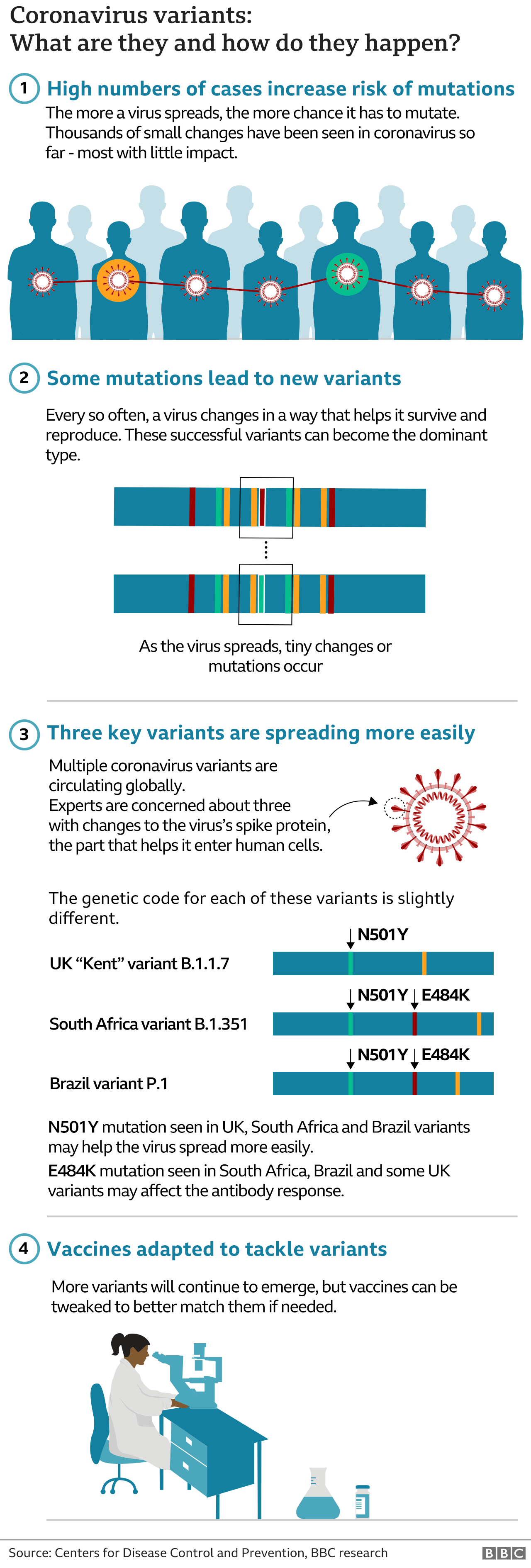
Measures such as washing your hands, keeping your distance from other people and wearing a face covering will still help prevent infections. Because the new variants appear to spread more easily it is important to be extra vigilant.
What’s happening to the virus?
The UK, South Africa and Brazil variants could be much more contagious or easy to catch.
All three have undergone changes to their spike protein – the part of the virus which attaches to human cells.
As a result, they seem to be better at infecting cells and spreading.
The Brazil variant emerged in July and has this E484K mutation too.
The Brazil variant emerged in July and has this E484K mutation too.
Will vaccines still work?
Current vaccines were designed around earlier versions of coronavirus, but scientists believe they should still work, although perhaps not quite as well.
A recent study suggests the Brazilian variant may be resisting antibodies in people who should have some immunity because they have caught and recovered from an earlier version of coronavirus.
Variants could emerge in the future that are different again.
Even in the worst case scenario, vaccines could be redesigned and tweaked to be a better match – in a matter of weeks or months, if necessary, say experts.
As with flu, where a new shot is given each year to account for any changes in circulating flu viruses, something similar could happen for coronavirus.
What is being done about it?
More variants will emerge.
Scientists around the world are on the look-out and any important ones will be closely studied and monitored.
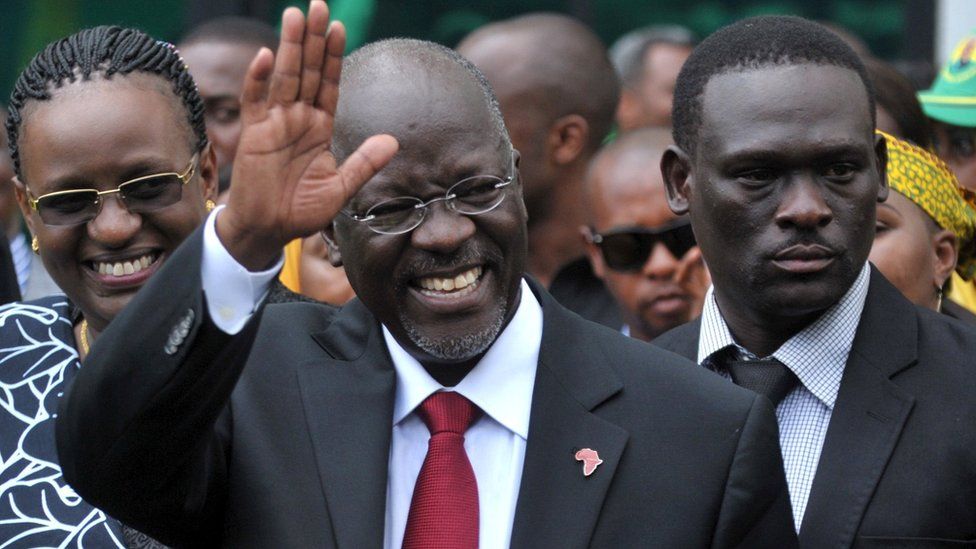
BBC- Tanzania’s President John Magufuli has died aged 61, the country’s vice-president has announced.
He died on Wednesday from heart complications at a hospital in Dar es Salaam, Samia Suluhu Hassan said in an address on state television.
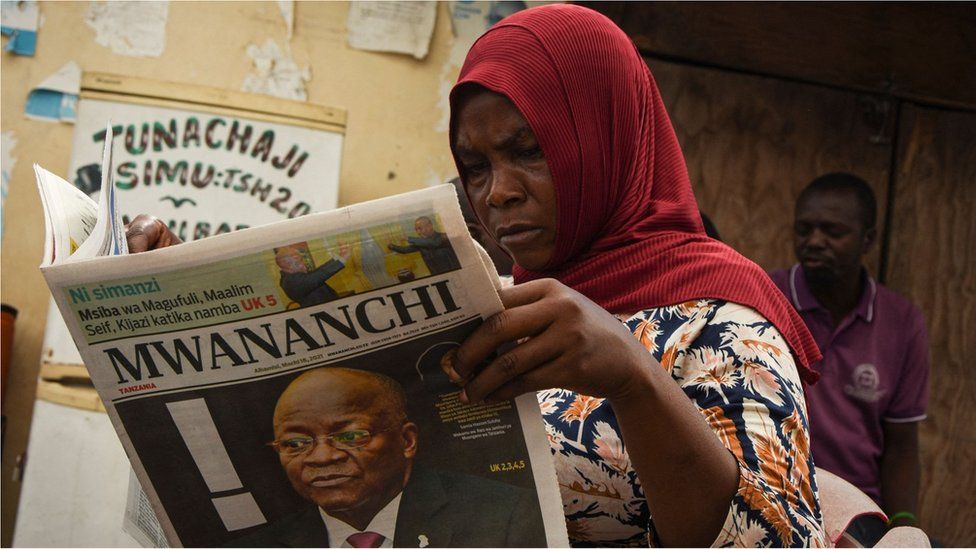
Magufuli had not been seen in public for more than two weeks, and rumours had been circulating about his health.
Opposition politicians said last week that he had contracted Covid-19, but this has not been confirmed.
Magufuli was one of Africa’s most prominent coronavirus sceptics, and called for prayers and herbal-infused steam therapy to counter the virus.
“It is with deep regret that I inform you that today… we lost our brave leader, the president of the Republic of Tanzania, John Pombe Magufuli,” Vice-President Hassan said in the announcement.
She said there would be 14 days of national mourning and flags would fly at half mast.
According to Tanzania’s constitution, Ms Hassan will be sworn in as the new president within 24 hours and should serve the remainder of Magufuli’s five-year term which he began last year.
Magufuli was last seen in public on 27 February, but Prime Minister Kassim Majaliwa insisted last week that the president was “healthy and working hard”.
He blamed the rumours of the president’s ill-health on “hateful” Tanzanians living abroad.
But opposition leader Tundu Lissu told the BBC that his sources had told him Magufuli was being treated in hospital for coronavirus in Kenya.
John Magufuli at a glance
Magufuli was first elected president in 2015
Born in Chato, north-west Tanzania, in 1959
Studied chemistry and maths at the University of Dar es Salaam
Worked as a chemistry and maths teacher
First elected as an MP in 1995
Became a cabinet minister in 2000
First elected president in 2015
When Covid-19 arrived in Tanzania, Magufuli called on people to go to churches and mosques to pray. “Coronavirus, which is a devil, cannot survive in the body of Christ… It will burn instantly,” he said.
He declared Tanzania “Covid-19 free” last June, saying the virus had been eradicated by three days of national prayer.
He also mocked the efficacy of masks, expressed doubts about testing, and teased neighbouring countries which imposed health measures to curb the virus.
“Countries in Africa will be coming here to buy food in the years to come… they will be suffering because of shutting down their economy,” he said, according to the Associated Press.
Tanzania has not published details of its coronavirus cases since May, and the government has refused to purchase vaccines.
“To spread rumours that he’s sick smacks of hate,” Mr Majaliwa said at the time.
A legacy set for debate
Analysis by Dickens Olewe, BBC News
John Magufuli cultivated an image of a rambunctious action man, a departure from his predecessors’ demure and stately styles.
His interventionist leadership won him fans beyond Tanzania, especially in the East African region where he once inspired the #WhatWouldMagufuliDo Twitter hashtag that was shared by supporters of his no-nonsense approach to fighting corruption.
There will be vigorous debate about his legacy and whether his successor should stay the course or change direction.
But this discussion cannot be divorced from the current trend on the continent, where support for democracy remains strong but most people are increasingly disillusioned by the failure to deliver the promised dividends.
So while a significant number of Africans would prefer an action-driven leader like Magufuli, they equally want leaders who govern honestly and a government that respects them and does not hide information about their president’s health.
Magufuli’s death has been attributed to a long-standing heart condition, but many will still suspect that he succumbed to Covid-19.
It is an irony that the pandemic he so strenuously denied has outlasted him, turning his once-heralded presidency into a cautionary tale for the region and the continent.
Magufuli was declared president on his 56th birthday in October 2015. He was elected for a second term following a disputed poll last year.
He was hailed for his anti-corruption stance during his time in office, but he was also accused of cracking down on dissent and curtailing certain freedoms.
His critics agree that Magufuli contributed to Tanzania’s development. He invested in large infrastructure projects such as a standard-gauge railway to connect the country with its neighbours, major highways, and a bus system in the commercial hub of Dar es Salaam.
He also increased electricity production, reducing the need for power rationing.
But it is his approach to Covid-19 that many analysts say will define his legacy.
African leaders pay tribute
In Tanzania, people have reacted with grief and disbelief to the news of Magufuli’s death.
One, Joseph Petro, told the BBC he thought Magufuli was a “caring” leader, adding “he was helping people in one way or another”.
“I am really pained. I am personally pained,” he said.
image copyrightAFP
Another, Illuminata Abel, offered similar sentiments: “He was not my relative, but he was someone who listened to people’s problems, and he was down to earth.”
African leaders have also come out to pay tribute.
Kenya’s President Uhuru Kenyatta said: “I have lost a friend, colleague and visionary ally,” and declared a seven-day period of national mourning in Kenya.
Former Nigerian President Goodluck Jonathan called Magufuli a “partner in democracy” and a “patriot who loved his country”.
But Tanzanian opposition leader Tundu Lissu told the BBC that Magufuli’s “politics, policies and Covid denialism” had “driven the country towards disaster”.
Bloomberg analysed financial documents and other filings from May 2016 and January 2021 to calculate Mr Trump’s wealth before and after he became US president.
Mr Trump’s commercial real estate accounts for about three-quarters of his net worth. The office towers he owns or co-owns have seen big drops in valuations as more people work from home, a trend that could last in the long term.
Bloomberg, which provides financial news and data, estimates a 26% drop in the value of his main commercial property holdings.
He also owns, manages or licenses his name to about a dozen hotels and resorts, plus 19 golf courses.
Although golf has become popular during the pandemic as a socially distanced outdoor sport, Mr Trump’s two courses in Scotland have consistently lost money, filings show.
After the Capitol Hill siege in January, the Professional Golfers’ Association (PGA) of America ended an agreement to host its 2022 championship tournament at Mr Trump’s New Jersey golf course, saying it would hurt the group’s brand.
media captionTrump describes allegations he avoided taxes as “fake news”
Deutsche Bank, the only bank willing to lend to him after his bankruptcies in the 1990s, also said after the riots that it would not do business with him again.
Mr Trump also owns a fleet of planes that includes a Boeing 757. These planes are decades old and have been marked down in value over the years, according to financial disclosures seen by Bloomberg.
Seven planes were valued at around $59m in 2015 and five were valued at about $6.5m in 2020. The value of Mr Trump’s aircraft has dropped over the years, in part because he has sold some of his fleet.
Criminal investigation
During his presidency, Mr Trump’s finances were regularly in the spotlight and he has been very secretive about how much tax he pays.
Last month the Supreme Court ordered Mr Trump to hand over his tax returns and other financial records to prosecutors in New York.
For months they have been trying to obtain eight years’ worth of Mr Trump’s personal and corporate tax returns.
The investigation was originally started in 2018 to examine the Trump Organization’s role in hush-money payments made during the 2016 presidential campaign to two women who said they had had affairs with Mr Trump.
Book deal?
As a former president, Donald Trump can expect to sign some lucrative media deals to recover some of his lost wealth, such as a post-presidential memoir.
Barack and Michelle Obama reportedly got paid about $65m for their memoirs, while Bill Clinton earned a $15m advance for his 2004 book.
Bloomberg says the most obvious way Mr Trump can profit post-presidency is with a news channel or social media platform that would appeal to his 74m voters in the 2020 election.
(CNN) Former Brazilian President Luiz Inacio Lula da Silva is calling on US President Joe Biden to ensure vaccine equity, in an exclusive interview with CNN’s Christiane Amanpour.
Speaking from Sao Paulo, Brazil, da Silva said the US has a surplus of vaccines and suggested the excess could be donated to countries in need.
“One suggestion that I would like to make to President Biden through your program is: it’s very important to call a G20 meeting urgently,” da Silva told Amanpour. “It’s important to call the main leaders of the world and put around the table just one thing, one issue. Vaccine, vaccine and vaccine!”
He added, “The responsibility to international leaders is tremendous so I’m asking President Biden to do that because I can’t … I don’t believe in my government. And so, I couldn’t ask for that for Trump, but Biden is a breath for democracy in the world.”
Former Brazilian President on whether he’ll run for election 00:27
In da Silva’s first interview since a Supreme Court justice annulled his 2017 convictions of
corruption and money laundering last week, the former leader also said he would not decline an invitation to run in the country’s presidential election next year.
“When it comes the moment to run for the elections, and if my party and the other allied parties understand that I could be the candidate, and if I’m well and my health with the energy and power that I have today, I can reassure you that I will not deny that invitation, but I don’t want to talk about that. That’s not my main priority. My main priority now is to save this country,” da Silva said.
The South American nation has been setting record daily virus deaths repeatedly in recent days as another brutal wave of Covid-19 sweeps the country. The resurgence has overwhelmed medics fighting on the pandemic’s frontline with an increasing number of hospitals across the country reaching capacity.
On Tuesday, Brazilian Health Ministry research institution Oswaldo Cruz Foundation called the current emergency in the country “the greatest health and hospital collapse in the history of Brazil.”
But in a surprise move last Monday, a Brazilian Supreme Court judge annulled his convictions and ordered that the cases be processed again at the Federal Court of Brasilia. If the ruling is upheld — and if Lula is not re-convicted before the candidacy filing deadline — he would technically be able to stand for office again and challenge current President Jair Bolsonaro in 2022 .
Political clash on the horizon?
Da Silva, who helped found the left-wing Workers Party, has largely refused to be drawn on running for office, saying last Wednesday that he “doesn’t have time to think about candidacy in 2022.”
However, the former President — better known as Lula — has launched a scathing attack on Bolsonaro, telling Brazilians last week not to “follow any stupid decision by the President and the Minister of Health” and urging people to get vaccinated. He also condemned the current administration’s handling of the pandemic, saying many deaths from the virus “could have been avoided.”
“If we had a president who respected the population, he would have created a crisis committee to guide the Brazilian society on what to do every week,” the ex-president added.
Bolsonaro defended his handling of the healthcare crisis in the face of da Silva’s remarks, telling CNN Brasil last week that his government empowered local officials and arguing that imposing lockdown measures — which he has refused to do — would only “lead the citizen to a situation of poverty.”
Bolsonaro has previously said he hoped Brazil’s Supreme Court would restore da Silva’s convictions, and accused his predecessor of 2022 ambitions. “Former President Lula is now starting his campaign. Because he has nothing good to show and this is the [Workers Party] rule, their campaign is based on criticizing, lying and misinforming,” he said.
While the elections are still 18 months away, Brazil’s coronavirus outbreak will likely play into voter’s sentiments. Bolsonaro’s disapproval ratings reached their highest level to date at 54%, according to the Datafolha polling institute’s latest survey results issued on Wednesday.
Brazil has the second-highest numbers of Covid-19 in the world with 11,603,535 cases and 282,127 coronavirus-related deaths as of Tuesday, according to data compiled by Johns Hopkins University.
Hospitals are swamped with cases across the country. The latest analysis from CNN shows that ICU occupancy rates in 25 out of Brazil’s 26 states plus its federal district are at or above 80%. Of those, 14 states have ICU occupancy rates at or above 90% which puts them at imminent risk of collapse.
On Tuesday, the governor of Brazil’s second most populous state, Minas Gerais, said the health system simply could not support new patients.
“I don’t want Minas Gerais to become a horror movie,” Romeu Zema said in a press conference to announce the implementation of the “purple phase” across the state, the most restrictive of the Minas Gerais plan to handle the pandemic.
“Any new infected (person) can mean one more death because the state does not have the capacity to take in new patients,” said Zema.
Bolsonaro’s crisis management under fire
Since the beginning of Brazil’s vaccination campaign on January 17, the country has administered more than 12.5 million vaccine doses across its population of over 211 million. More than 9 million people have received at least one dose while just over 3 million people have been given a second dose, according to the latest data from the country’s health ministry.
As the country’s coronavirus spread outpaces its vaccination rollout, criticism is mounting. According to the same Datafolha institute’s poll, which interviewed 2,023 people by telephone on March 15 and 16, 54% of Brazilians found Bolsonaro´s performance bad or awful — up from 48% in late January.
The poll report also said 43% of Brazilians blame Bolsonaro while 20% blame their state governors for the current state of the pandemic in Brazil.
Regarding Bolsonaro´s presidency, 44% of those polled think it is bad or awful, four points higher than in the last poll, and the highest since he took office in January of 2019. Thirty percent of the respondents judge Bolsonaro´s rule as good or great and another 26% see it as regular.
Bolsonaro this week appointed a new health minister — the fourth in a year — as ICU and mortality rates skyrocketed. The new minister, cardiologist Marcelo Queiroga, replaces army general Eduardo Pazuello, but there is little sign of any change in the administration’s approach to the crisis.
On Tuesday, Queiroga in an interview with CNN Brasil echoed the President in saying that lockdowns only apply in “extreme situations” and would not be imposed by the federal government.
Journalists Rodrigo Pedroso and Marcia Reverdosa contributed to this report from Sao Paulo, Brazil. CNN’s Caitlin Hu also contributed from New York, Matt Rivers from Rio De Janeiro and Vasco Cotovio from London. CNN’s Lauren Said-Moorhouse wrote from London
PORT-AU-PRINCE, Haiti (AP) — Masked officers who said they belonged to a disgruntled sector of the Haitian police force known as Fantom 509 stormed several police stations in Port-au-Prince on Wednesday, freeing jailed comrades accused of participating in an alleged coup against embattled President Jovenel Moise last month.
The group of officers, along with some civilians, set a police station ablaze and then headed to a local Nissan auto dealership, which was looted and vandalized. Among the officers storming the station were police in uniform with their faces covered to avoid being recognized.
The day began with officers and police academy cadets marching toward police headquarters to demand that the bodies of five officers killed during a raid last week on the Village of God shantytown be recovered from the gang still holding them. The shantytown is run by the 5 Seconds gang.
The ill-fated raid, which took place five days ago, was aimed at arresting gang members but resulted in the death of the five officers and the wounding of several others.
Things heated up in Haiti’s capital Wednesday when disgruntled officers took to the streets demanding the release of their arrested colleagues. They told local media they belonged to Fantom 509.
Political strife in Haiti has deepened as opposition leaders claim Moïse’s five-year term has expired. They had demanded that he step down on Feb. 7. On that day, Moïse announced that authorities had arrested 23 people accused of plotting a coup to kill him and overthrow his government, including a high-ranking police official and a Supreme Court judge favored by the opposition.
Hours after the arrests, the opposition nominated a supposed transitional president that no one has recognized and have organized protests.
Guardian (UK) Delaying the winter lockdown caused up to 27,000 extra deaths in England, the Resolution Foundation thinktank has claimed as it accused the government of a “huge mistake” which should be central to any public inquiry into the UK’s handling of the pandemic.
In an assessment of policy over the last year, it said delaying the start of the latest lockdown until January, despite evidence of fast-rising cases before Christmas, led to around a fifth of all fatalities caused by the virus. It said these could have been avoided if restrictions were put in place quickly enough to prevent the death rate rising from early December.
While it praised the vaccination programme – delivering jabs three times faster than Europe – and financial support for firms and workers which has included £6,700 for every household on average, it said mistakes on lockdowns were repeated “three tragic times”. It added that allowing extra deaths did not limit economic impacts, but rather increased them, because it only precipitated longer and more onerous lockdowns.
“Going timidly and late on lockdowns has been a disaster – causing many thousands of avoidable deaths,” said Mike Brewer, chief economist at the foundation. “Furthermore, delays to restrictions have meant them needing to be tougher and longer-lasting than in other countries, thereby worsening the economic damage.
“The Covid-19 pandemic has touched everyone, but lower-income families have borne the brunt of the crisis in terms of their lives and livelihoods. This shouldn’t be forgotten as we look to rebuild post-pandemic Britain.”
The report details how when Italy announced a national lockdown on 9 March 2020, Boris Johnson waited two weeks before doing the same in the UK. In September after cases started rising again and the government’s scientific advisers urged a circuit breaker lockdown, the government did not introduce an England-wide lockdown for over five weeks and this winter “the pattern of letting the caseload surge before acting” was repeated.
“Christmas was ‘semi-cancelled’, with reduced or no inter-household contact allowed, only on 19 December,” the foundation said. “And, despite still-surging numbers, a full return to national lockdown was not announced until 4 January, by which point we were seeing over 50,000 cases a day across the UK.”
Labour calls for full Covid public inquiry starting in June
Read more
Economic policy was far more successful, the thinktank said.
Crisis-related spending totalling £340bn has meant that “the worst recession for 300 years has seen the smallest rise in unemployment of any recession in living memory”.
It added: “Amazingly, household income has been broadly similar in 2020 to its 2019 level in aggregate, despite GDP falling by almost 10%.”
However it said the most “glaring failure of economic policy” was on sick pay, which still means 2 million low-earners receive only £96 a week if they are sick. This meant the incomes of people being asked to stay at home to save lives were not protected, which undermined the stay at home message, limited the effectiveness of the test-and-trace system and increased infections.
Downing Street has been approached for comment.
================================================
Biden administration invests $10B in school COVID-19 testing program
The Biden administration is investing $10 billion to ramp up COVID-19 testing in schools in an effort to increase testing across the country and help schools reopen for in-person learning.
The funding comes from the $1.9 trillion American Rescue Plan and will be distributed to states and certain cities next month by the Centers for Disease Control and Protection (CDC) as part of a strategy to help get schools open in the remaining months of this school year.
The CDC and state and local health departments will provide technical assistance to states and schools setting up and implementing these programs.
The money will be used to provide diagnostic tests to symptomatic teachers, staff and students, as well as “serial screening” for those who don’t have symptoms but might have been exposed to an infectious person. The idea behind serial screening testing is to help schools identify asymptomatic people who may be contagious so that prompt action can be taken to prevent transmission
Backstory: Biden has put a major focus on reopening schools this year. He urged states to prioritize teachers for vaccinations and school staff to get at least one shot by the end of March.
Questions raised: But the guidance from CDC about reopening schools does not say testing or screening is a priority. CDC says schools should offer referrals to diagnostic testing for symptomatic students and staff at all levels of community spread, but there’s not a whole lot of data showing the benefits of screening. CDC recommends it as a complementary strategy to other mitigation measures.
What does it mean? With some teachers’ unions still resisting in-person learning even after being prioritized for vaccinations, it’s not clear these extra steps will help.
CDC addresses vulnerable communities
Included in the funding announcement for schools was a $2.25 billion initiative to address health equity issues. The grant, funded through the U.S. Department of Health and Human Services, will expand health services to help reduce COVID-19 health disparities.
CDC said the funding is the agency’s largest investment to date to support communities affected by COVID-19-related health disparities.
The two year grants will go to 108 public health departments for bolstered COVID-19 testing and contact tracing capabilities in underserved communities and populations, including racial and ethnic minority groups and people living in rural areas.
“Everyone in America should have equal opportunity to be as healthy as possible,” CDC director Rochelle Walensky said in a statement. “This investment will be monumental in anchoring equity at the center of our nation’s COVID-19 response—and is a key step forward in bringing resources and focus to health inequities that have for far too long persisted in our country.”
===========================================
WHO: AstraZeneca vaccine benefits outweigh risk
The latest development in the overseas AstraZeneca saga: The World Health Organization on Wednesday recommended that nations continue using the vaccine against the coronavirus created by Oxford University and the pharmaceutical giant AstraZeneca, after some European countries halted its use over safety concerns. The vaccine is not currently approved for use in the U.S.
In a statement, the WHO said its Global Advisory Committee on Vaccine Safety was assessing safety data, and that it was staying in touch with the European Medicines Agency, the European Union’s version of the Food and Drug Administration (FDA).
Backstory: About a dozen nations, mostly in Europe, have paused their use of AstraZeneca vaccines after a few people who received the shot developed dangerous blood clots.
However: The WHO said blood clots are common, and that vaccination campaigns should continue.
“Vaccination against Covid-19 will not reduce illness or deaths from other causes. Thromboembolic events are known to occur frequently. Venous thromboembolism is the third most common cardiovascular disease globally,” the agency said. “At this time, WHO considers that the benefits of the AstraZeneca vaccine outweigh its risks and recommends that vaccinations continue.”
=================================================
An ominous trend: German COVID-19 cases rise amid AstraZeneca vaccine suspension
Coronavirus infections are on the rise in Germany as the country has joined more than a dozen European nations in suspending the Oxford-AstraZeneca COVID-19 vaccine over concerns of blood clots.
The Robert Koch Institut, Germany’s center for infectious diseases, on Tuesday reported about 83.7 COVID-19 cases per 100,000 people, a jump from 68 just one week prior. The institute said that this number could reach 200 by mid-April.
Possible third wave: Dirk Brockmann, a Robert Koch Institut epidemiologist, told Germany’s ARD television that the spike in cases indicates a third wave of COVID-19 in the country that was initially praised for its early response to the pandemic.
Brockmann specifically attributed the increase to the government’s easing of nationwide safety restrictions even as a new more transmissible variant has spread throughout the country.
Experts warn that the increased rate of infection, as well as the suspension of the AstraZeneca vaccine, could delay the country’s progress toward reaching herd immunity.
FDA official: US AstraZeneca stockpile not in danger of expiring
While Europe simultaneously wrestles with national vaccine suspensions and AstraZeneca’s own delivery shortages, the US is still sitting on a pile of tens of millions of doses. They aren’t going anywhere, and a top health official Wednesday said they’re not in danger of expiring.
“I do not believe we are at risk of throwing this out at any time in the near future,” Peter Marks, the director of the Food and Drug Administration’s vaccine center, told a House panel.
The federal government preordered 300 million doses of the vaccine under the Trump administration, but issues with clinical trials have held up its authorization and the FDA is still waiting on additional data.
Officials have said the stockpile is intended to make it easier to quickly distribute the vaccine across the country if the company receives FDA clearance in the coming weeks.


 *****@
 *****@
 *****@
 *****@
 *****@
 *****@
 *****@
 *****@
 *****@
 *****@