The British Broadcasting Corporation (BBC) has corrected an article that linked a variant of Covid-19 to Antigua and Barbuda.
Antigua and Barbuda diplomat Sir Ronald Sanders, who spoke to our newsroom on Wednesday, said the information had remained uncorrected despite British health officials walking back claims that a new Covid-19 variant originated here.
Sir Ronald accused the BBC of damaging the country’s tourism industry.
On the BBC’s website, in an article updated Thursday morning, the company wrote that the story has now been updated to reflect new information on UK variants on the Public Health England (PHE) website.
The broadcast company says PHE previously reported two cases of the VUI-2021-03-01 variant had been found in the south-east of England in individuals who had recently been to Antigua.
PHE now says that despite the travel history of these cases, there is no scientific evidence to determine where this variant first emerged.
Observer reached out to the BBC’s Press Office for a comment but has not yet received a response.
Prime Minister Gaston Browne has already written to UK Prime Minister Boris Johnson requesting 100,000 vaccine doses in restitution.
Nevis government officials are investigating two alleged COVID-19 protocol breaches by travelers visiting the Four Seasons Nevis resort last week.
Visitors staying at the 350-acre luxury resort under national “Vacation in Place” guidelines reportedly left the property in two separate incidents, violating local and national quarantine protocols.
The travelers were placed in a government isolation site in accordance with Nevis’ COVID-19 procedures. Two guests left the resort without authorization for approximately two hours on March 11. On March 13, another six guests left the resort’s compound.
“This past weekend, guests of a group visiting Four Seasons Resort Nevis violated Vacation in Place guidelines and in accordance with local protocols were placed in a government isolation site,” said resort officials in a statement. “Additionally, the government suspended the ‘Vacation in Place’ designation for the remainder of the group.
“The Resort has been in full cooperation with local authorities from the time we were made aware of the violations,” the statement adds. “We take all government-issued Covid-19 regulations seriously and actively communicate all relevant information to guests both prior to and upon arrival to ensure they are aware of local regulations. The health and safety of our guests, residents, employees, and community remain our top priority.”
The government denies it is holding Uighurs in detention camps in the Xinjiang region in north-western China. It says the camps are “re-education” facilities being used to combat terrorism.
Because access to Xinjiang is heavily restricted by the Chinese, Amnesty spoke to Uighurs who were able to flee Xinjiang before the repression of the Uighur people intensified in 2017.
Mihriban Kader and Ablikim Memtinin fled from Xinjiang to Italy in 2016 after being harassed by police and pressured to give up their passports, Amnesty said. They left four children in the temporary care of grandparents, but the grandmother was taken to a detention camp while the grandfather was interrogated by police, the charity said.
“Our other relatives didn’t dare to look after my children after what had happened to my parents,” Mihriban told Amnesty. “They were afraid that they would be sent to camps, too.”
In November 2019, Mihriban and Ablikim received a permit from the Italian government to bring their children to join them, but the children were seized by Chinese police on the way and sent to a state-run orphanage, Amnesty said.
“Now my children are in the hands of the Chinese government and I am not sure I will be able to meet them again in my lifetime,” Mihriban said.
Omer and Meryem Faruh, who fled to Turkey in late 2016, left their two youngest children, aged five and six, with grandparents because they did not yet have their own travel documents, Amnesty said. They found out later that the grandparents had been arrested and sent to a camp and have not heard from their children since.
Amnesty’s report calls on China to provide full and unrestricted access to Xinjiang for UN human rights experts, independent researchers and journalists, and for all children held without their parents consent to be released to family.
“China’s ruthless mass detention campaign in Xinjiang has put separated families in an impossible situation: children are not allowed to leave, but their parents face persecution and arbitrary detention if they attempt to return home to care for them,” said Alkan Akad, Amnesty International’s China researcher.
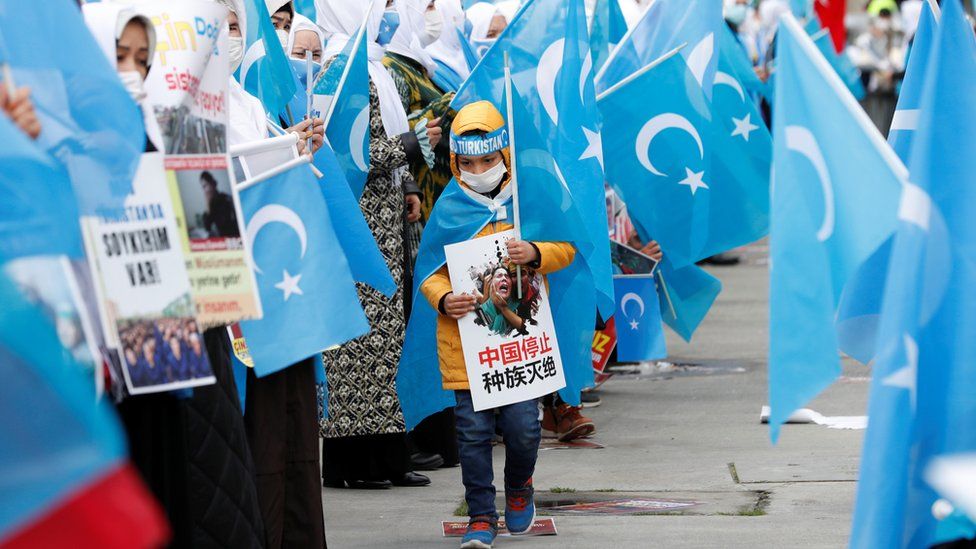
image copyrightReuters
image captionA protest in Istanbul earlier this month against China’s treatment of the Uighur people
The Chinese state has created a vast and secretive network of camps in Xinjiang and is estimated to have detained more than a million Uighurs and people from other Muslim minority groups.
Reports have emerged in recent years of appalling human rights abuses, from forced sterilisation of Uighur women to torture and systematic rape inside camps.
China denies there are any human rights abuses taking place, and has called former camp detainees in exile liars and actors. China is also accused of intimidating and smearing witnesses who have spoken up, and of using witnesses’s relatives in Xinjiang as leverage against them.
Sao Paulo (CNN) More than 45,000 people have been killed in Brazil by the pandemic in the past month, but Brazilian President Jair Bolsonaro says there’s a “war” against him personally.
In the coastal city of Rio de Janeiro, intensive care units are 95% full. Fifteen other state capitals are similarly verging on collapse, with ICU occupancy over 90% — a deluge of hospitalizations that has accompanied a sharp rise in Covid-19 cases in the country.
While Covid-19 cases are beginning to plateau or decline in many countries, Brazil is reporting record daily numbers. Just on Wednesday the country saw its largest daily jump in cases since the start of the pandemic — 90,303 new cases.
“Here it became a war against the President. It seems that people only die of Covid,” Bolsonaro, who wasn’t wearing a mask, told supporters outside the presidential palace on Thursday.
“The hospitals are 90% occupied. But we need to find out how many are from Covid and how many are from other illnesses,” he said.
Many state health departments in Brazil do show data for both ICU capacity dedicated to Covid-19 and to other illnesses.
On Thursday, Brazil’s health ministry reported 2,724 more people had died from the virus that day, bringing the total to 287,499. Those numbers make Brazil the second worst-affected country in the world in terms of case and deaths numbers, after the United States.
Bolsonaro, who has long downplayed the gravity of the pandemic, also said Thursday he regrets the country’s deaths, but questioned the efficiency of lockdown measures, which he has resisted imposing.
“Of course, we want a solution and regret any death, but why did the lockdown exist? You are seeing the population suffering from unemployment. Introduce me to a country where the fight against the Covid is working,” Bolsonaro said.
As cases surge, the Brazilian President is facing fierce criticism from citizens, potential political rivals, and local officials across the country, many of whom have demanded that Bolsonaro step up federal action.
Former President Luiz Inacio Lula da Silva, who has not ruled out running for office again in 2022, has slammed the current administration’s response to the pandemic, saying Thursday that “there is no control in Brazil.”
Over the weekend, a joint letter by the country’s governors called on the President to restrict the operation of airports, ports, highways, and railways in the country, among other measures. Many have already imposed local lockdown measures
The National Front of Mayors (FNP) also sent a letter to the president and the health ministry Thursday asking for “immediate measures” to address critical shortages in supplies and medicines, including oxygen and sedatives.
“It is unreasonable for people, Brazilian citizens, to be driven to such desperate deaths by ‘drowning in the dry’ or to have to be tied up and maintain consciousness during the delicate and painful process of intubation and throughout the period people are kept intubated,” the letter says.
Brazil’s Federal Pharmacy Council (CFF) says the current flood of Covid-19 cases raises “extreme concern” as there is also evidence of shortages of neuromuscular blockers, and other drugs used in intensive care, like Midazolam, essential for humane and safe intubation.
The Council for Health Secretaries has confirmed to CNN that those medications are at a critical level and could run out within 20 days.
Journalist Marcia Reverdosa reported from Sao Paulo and CNN’s Radina Gigova from Atlanta. Rodrigo Pedroso and Caitlin Hu contributed to this story.
MEXICO CITY (AP) — Mexican officials said Thursday they have found an oil field with possible reserves of 500 million to 600 million barrels, but President Andrés Manuel López Obrador vowed not to pump more than 2 million barrels per day nationwide, the amount he says is needed to supply domestic demand.
“This new policy means not pumping more oil than is needed to cover domestic demand for fuels,” López Obrador said. “In quantitative terms, this means that during our administration we will not pump out of the ground more than two million barrels per day.”
In part, that is wishful thinking. The state-owned oil company Petroleos Mexicanos, or Pemex, currently produces only about 1.75 million barrels per day.
But Pemex Director Octavio Romero said the newly identified onshore Dzimpona 1 deposit, located in the Gulf coast state of Tabasco, should help the company boost daily production to 2 million barrels by the end of this year.
He said Mexico’s proven total reserves, which had fallen from 16 billion barrels in 2006 to 7 billion when López Obrador took office Dec. 1, 2018, have slowly recovered to about 7.4 billion barrels and should reach 7.8 billion by the end ofg 2021.
Romero also revealed Pemex has been widely delaying payments to its suppliers and contractors. He acknowledged the problem has become so bad that some suppliers have turned to bribing officials or turning to hiring middlemen to try to get paid for work they have done.
He said that with the coronavirus pandemic and drop in demand, “Pemex’s finances were highly affected.”
Romero urged business owners to have confidence that Pemex will eventually pay its debts, and announced a public website of payments, to stem a flood of public information requests from people waiting to get paid.
“Businessmen, have absolute confidence that Pemex will fully honor its commitment and pay all its debts,” Romero said.
MANAGUA, Nicaragua (AP) — Nicaragua’s Indigenous groups complained Thursday to the InterAmerican Commission on Human Rights about land takeovers and killings that have hit the Miskito and Mayangna communities on the country’s Caribbean coast.
The commission, which is part of the Organization of American States, held the hearing by internet link due to the coronavirus pandemic.
Indigenous activists and rights groups said there were 13 killings, eight people wounded and the forced displacement of one community in 2020 linked to land takeovers by non-Indigenous settlers.
The activists said the government of President Daniel Ortega has not done enough to address the problems on the jungle-clad coast, something his administration denied.
Activists told the commission that many of the “settlers” moving into lands taken from them were ex-soldiers linked to timber and illegal logging interests. Residents of some communities have been forced to leave because of the continued violence.
“The displacement of communities under siege to larger towns like Puerto Cabezas, Waspam or Honduras has created a very serious situation, because they do not have access to food or health services,” said Lottie Cunningham, who leads the Center for Human Rights and Justice of the Atlantic Coast of Nicaragua.
“They live in terrible conditions,” she added.
Part of the land takeovers have occurred in the Bosawas nature reserve, which has been hit by illegal mining and logging despite its status as a protected area.
“The settlers have violently stolen our land and the authorities have allowed that,” said Juan Carlos Ocampo, an activist with the Prilaka Community Foundation.
He said residents temporarily left the hamlet of Sangni Laya after settlers chopped down coconut trees and destroyed crops, leading to what he called “a food crisis” for the inhabitants.
One of the worst attacks came in January 2020, when settlers burned 16 houses in the Indigenous community of Alal and killed at least four inhabitants. As recently as March 4, an attack on the Mayangna community of Kimak Was left one person wounded and another missing.
Nicaragua’s attorney general, Wendy Morales, cited a list of laws that she said have benefitted indigenous groups. She denied the government had tolerated human rights violations and said investigations had been opened into 18 complaints of land takeovers.
MEXICO CITY (AP) — Gunmen apparently from a drug gang ambushed a police convoy Thursday in central Mexico, killing eight state police officers and five prosecution investigators in a hail of gunfire, authorities said.
The massacre of the 13 law enforcement officers in the State of Mexico was the country’s single biggest slaying of law enforcement since October 2019, when cartel gunmen ambushed and killed 14 state police officers in the neighboring state of Michoacan.
The Thursday ambush sparked a huge search for the killers in a rural, gang-plagued area southwest of Mexico City, which is surrounded on three sides by Mexico State. The dead law enforcement officers worked for the state.
While Mexico State contains suburbs of the capital, it also includes lawless mountain and scrub lands like the one where the attack occurred.
Rodrigo Martínez Celis, the head of the state Public Safety Department, said soldiers, marines and National Guard troops were combing the area by land and from the air looking for the killers.
“The convoy was carrying out patrols in the region, precisely to fight the criminal groups that operate in the area,” Martínez Celis said. “This aggression is an attack on the Mexican government.
“We will respond with all force,” he added.
There was no immediate indication as to what gang or cartel the gunmen might have belonged to. Several operate in the area around Coatepec Harinas, where the attack occurred.
The town is near a hot springs resort known as Ixtapan de la Sal, which is popular among Mexico City residents as a weekend getaway. But it also relatively close to cities like Taxco, where authorities have reported activities by the Guerreros Unidos gang apparently allied with the Jalisco cartel and by the Arcelia gang, dominated by the Familia Michoacán crime organization.
The attack appears to present a challenge for President Andrés Manuel López Obrador, who has pursued a strategy of not directly confronting drug cartels in an effort to avoid violence.
The top drug regulator for the European Union announced Thursday that AstraZeneca’s coronavirus vaccine is safe and effective to use, after over a dozen countries halted administering its use over concern of blood clots.
However, the European Medicines Agency (EMA) also said it could not rule out a link to the blood clots, and said it would add a warning to the product in order to draw attention to the possibility of such rare side effects.
Including the warning and conducting outreach to health professionals and the public “will help to spot and mitigate any possible side effects,” said Emer Cooke, the executive director of the agency.
The EMA said the benefits of protecting people against COVID-19 with a vaccine far outweigh possible risks.
More than a dozen countries in Europe have temporarily suspended use of the vaccine, including Germany, France, Italy, Spain, Ireland, Norway and Denmark. They have been waiting on the EMA’s recommendations on how to proceed.
“Our scientific position is that this vaccine is a safe and effective option to protect citizens against COVID-19,” Cooke said. “We made this review our highest priority.”
The EMA published its findings, noting that out of about 20 million people who received the vaccine, there were only seven cases of blood clots in multiple blood vessels and 18 cases of blood clots in the brain.
“A causal link with the vaccine is not proven, but is possible and deserves further analysis,” the agency said.
The EMA investigation was focused on a small number of brain clots that have been reported following vaccinations. Most of these occurred in people under 55 and the majority were women.
The World Health Organization earlier this week endorsed the safety of the shot, and the United Kingdom’s top medical regulator on Thursday gave a similar message, urging countries to continue offering the shot.
But even if countries resume vaccinations immediately, experts think some damage has already been done.
Not only could the pauses set back vaccination efforts across Europe, but they could have ripple effects across the world and undermine confidence in the vaccine.
Hundreds of millions of Europeans are facing the prospect of another strict lockdown as the continent struggles with a new wave of COVID-19 infections and a flawed vaccine rollout. The fallout from suspending AstraZeneca’s shots could slow it down even more.
Italy, France, Germany and several other countries will resume administering AstraZeneca jabs from Friday after Europe’s medicines regulator said the vaccine was “safe and effective” and its benefits outweighed its risks.
Portugal will resume on Monday, Spain and the Netherlands next week, while Sweden’s public health agency said it would take “a few days” to decide.
The European Medicines Agency (EMA) had launched a review after about 30 cases of unusual blood clotting and low platelet counts in recipients of the vaccine prompted more than a dozen EU countries to suspend its use.
The EMA’s director, Emer Cooke, said the agency’s safety committee had reached “a clear scientific conclusion” and had not found that the vaccine was associated with an increase in the overall risk of blood clots.
However, it did uncover “a small number of cases of rare and unusual but very serious clotting disorders”, and Cooke said the EMA could “not rule out definitively a link between these cases and the vaccine”, which was being investigated.
A warning in the vaccine information would draw attention to “possible rare conditions” to help recipients and healthcare professionals “prevent and mitigate any possible side-effects”, she said.
Covid vaccine side-effects: what are they, who gets them and why?
Several EU countries embarking on a third wave of coronavirus driven by more infectious new variants and struggling to accelerate sluggish inoculation programmes welcomed the decision. Italy’s prime minister, Mario Draghi, said AstraZeneca vaccinations would resume on Friday. Germany’s health minister, Jens Spahn, made a similar announcement, as did Cyprus, Latvia, Lithuania and Slovenia.
The French prime minister, Jean Castex, said he would get vaccinated on Friday to set an example.
Cooke said: “We have vaccines that can prevent death and hospitalisation. We need to use them. A lot of member states are waiting for the outcome of this safety review. Countries can now make an informed decision so as to the safety of the vaccine.”
Austria, the Baltic states, Denmark, France, Germany, Ireland, Italy, the Netherlands, Portugal, Spain and Sweden, along with non EU-member Norway, were among the European countries to either pause use of the vaccine or ban specific batches.
Cooke said investigations were continuing into the rare events, but she added: “About 7 million people have now been vaccinated in the EU with the AstraZeneca vaccine, and 11 million in the UK … I want to reiterate that our scientific position is that this vaccine is a safe and effective option to protect citizens against Covid-19.”
She said the agency’s investigation to date had not uncovered any problems related to specific batches of the shot or manufacturing sites. “If it was me, I would be vaccinated tomorrow,” she said. “But I would want to know what to do if I had any problems – and that’s what we’re doing now.”
Britain’s medicines regulator the MHRA also said the evidence did not suggest that the AstraZeneca vaccine caused blood clots, but it too was still investigating a very rare and specific type of blood clot in cerebral veins.
The MHRA said there had been five cases of cerebral venous sinus thrombosis (CVST) combined with a low platelets count in recipients of the vaccine in the UK, and there was no need to pause inoculations.
A British expert, Prof Sir Munir Pirmohamed, who chairs the Commission on Human Medicines, said that even if a link between CVST and the shot was found, it was unlikely the UK vaccination campaign would be halted since the incidence rate was so low.
Norway’s expert group said on Thursday that after investigating the cases of three health workers who had fallen ill with the same combination of CVST and low platelet counts, one of whom died, they believed a strong immune reaction to the vaccine was the cause.
“We have no other history in these patients that could give such a strong immune response,” Prof Pål Andre Holme said. “I am absolutely certain it is these antibodies that are the cause and see no other reason than … the vaccine that triggers it.”
The World Health Organization’s global vaccine safety panel is examining the vaccine data and the precise clinical circumstances of each rare blood coagulation case and will publish its findings on Friday.
AstraZeneca has said the number of cases of blood clots reported “is lower than the hundreds of cases that would be expected among the general population”.
Denmark, the first country to suspend the shot last week after a 60-year-old woman died from a “highly unusual” blood event, and Germany, where three recipients have died from the rare cerebral vein thrombosis, have said they acted on strictly scientific grounds.
Because of the extreme rarity of the events, the decision to pause the shot has been criticised as political, with Belgium saying it was “irresponsible”.
The AstraZeneca vaccine was already perceived by many in the EU as second best after several national agencies postponed its authorisation for the over-65s because of a lack of data. Experts fear the suspensions may further depress its take-up.
US Plans to Send Astra Zenica Vaccine to Mexico, Canada
President Biden’s administration plans to send millions of doses of the AstraZeneca COVID-19 vaccine to Mexico and Canada, the White House confirmed Thursday, a development that comes as the U.S. faces a surge of migrants at the southern border with Mexico.
Press secretary Jen Psaki confirmed the plans, which were first reported by Reuters and The Washington Post, but said that they were not yet finalized.
“Our first priority remains vaccinating the U.S. population, but the reality is the pandemic knows no borders,” Psaki told reporters. “Ensuring our neighbors can contain the virus is mission critical to ending the pandemic.”
Psaki said that officials are working to finalize plans to give Mexico 2.5 million doses and give Canada 1.5 million doses of the AstraZeneca vaccine, which has not yet been approved in the United States. She said that the U.S. has 7 million “releasable” doses of AstraZeneca vaccine in total and suggested the administration could share extras with other countries in the future.
“Balancing the need of letting the approval process play out of the AstraZeneca vaccine as it is taking place in the U.S. with the importance of helping stop the spread in other countries, we are assessing how we can loan doses,” she said. “That is our aim, it is not fully finalized yet but that is our aim and what we’re working toward.”
The plans coincide with an effort by the administration to get a handle on the surge of migrants at the southern border. Homeland Security Secretary Alejandro Mayorkas said in a statement early this week that the number of attempted crossings there is on pace to reach its highest level in two decades.
Asked Thursday whether the vaccine announcement had anything to do with conversations about addressing the border crisis, Psaki suggested the two issues were not related.
“There have been expectations set outside of, unrelated to any vaccine doses or requests for them that they would be partners in dealing with the crisis on the border. And there have been requests, unrelated, for doses of these vaccines. Every relationship has multiple layers of conversations that are happening at the same time,” she said.
The agreement is not expected to impact Biden’s plan to make the vaccine available to all U.S. adults by the end of May.
It comes after Mexican President Andrés Manuel López Obrador and Canadian Prime Minister Justin Trudeau requested vaccine doses from the U.S. Mexico and Canada will be expected to pay back the U.S. with doses later this year, according to Reuters.
On the border issue, Mexico has vowed to take back more Central American families “expelled” while the U.S. has an emergency health order in place, the Post reported.
Biden had previously said his officials were “talking with several countries” about the United States’ supply of the AstraZeneca vaccine, which has not yet been approved by the Food and Drug Administration.
The president had said his priority is to vaccinate Americans and ensure the pandemic is under control in the U.S. before helping other countries. But he noted, “If we have a surplus, we’re going to share it with the rest of the world.”
The COVID vaccine gap is exoected to be the main topic when leaders of the Organisation of Eastern Caribbean States (OECS) Commission meet with the Director General of the World Health Organisation (WHO) Dr Tedros Adhanom Ghebreyesus and his team Friday (March 19).
The meeting comes as OECS Authority will hold its sixth meeting chaired by Dominican Prime Minister Roosevelt Skerrit.
Director General of the OECS, Dr Didacus Jules, is anticipating a productive outcome with the WHO and hopes that this meeting will help bridge the vaccine gap for OECS Member States.
“The Special Meeting of the OECS Heads of Government with WHO is critical for two main reasons: it will allow the OECS to join with Director General Tedros in advocating for more equitable access to vaccines and unlocking supplies for developing states,” Jules said.
“This Special Session will give the OECS Authority an opportunity to explore approaches to filling the gap between vaccines accessible through the COVAX Facility and bilateral sources, and highlighting the health needs of our Member States. Finding a timely solution is critical from a public health standpoint but will also provide the building blocks to resuscitate, repair and rebuild the economies across our region.”
Ahead of the meeting, Tedros said: “Many Caribbean States have led the way in protecting their populations from COVID-19 with careful implementation of public health measures. I am honoured to work side by side with OECS Heads of Government in fighting the pandemic and am committed to ensuring equitable access to vaccines, diagnostics and treatments to support Caribbean communities.”
“Collaborating with partners through the Access to COVID-19 Tools Accelerator and its COVAX Facility, WHO is working to ensure vaccines are distributed as rapidly and equitably as possible, to help bring the pandemic under control in the Caribbean and globally.”
Pan-American Health Organisation (PAHO) Director, Dr Carissa Etienne, as well as the Executive Director of the Caribbean Public Health Agency (CARPHA) Dr Joy St John, are expected to join the discussions.
COVAX, the global mechanism for equitable distribution of vaccines, is expected to increase shipments of coronavirus vaccines soon, with many Caribbean countries getting their first shipments in coming days, according to Pan American Health Organization (PAHO) Director Dr. Carissa Etienne.
Jamaica on Monday became the first Caribbean country to get the Oxford-AstraZeneca vaccine shipment through the COVAX facility. A total of 15 Caribbean countries will receive just over 2.1 million doses by May, according to allocation figures provided for the first round of deliveries.
“Next week, we expect that many countries in the Caribbean will start to see the first COVAX shipments arrive on their shores,” Dr. Etienne said at her weekly virtual media briefing.
In total, PAHO has placed orders for more than 3.4 million doses. Dr. Etienne said that over the next few days, PAHO’s Revolving Fund will deliver 728,000 of those COVAX-procured vaccines to five countries.
“For all these countries – even those which received small donations earlier this month – these COVAX deliveries will enable the start of steady vaccination efforts,” she said. “We are happy that vaccines through COVAX are being delivered but we recognize that the need for more vaccines and sooner is great in the Americas.”
Noting that only two vaccine manufacturers are dispatching millions of doses to dozens of countries around the world, the PAHO director said “this is a bottleneck that still prevents us from getting vaccines to every country at the same time, but shipments will become more regular as more doses are available to COVAX in the next few months”.
The upcoming shipments follow delivery of 400,000 doses of COVAX-procured vaccines to regional countries, including Peru, Guatemala, El Salvador, Honduras, and Jamaica.
“With COVID vaccination campaigns underway throughout our region, we’re at the beginning of the end of this pandemic. But while there’s reason for hope, we must also remember that doses are limited, and it will be several months before we can rely on vaccines to control this virus,” Dr. Etienne said.
She added that as vaccinations are administered, “our goal must be to save as many lives as possible by prioritizing early doses for those who are at highest risk of infection”.
“The health workers who are treating COVID patients, the elderly and those living with existing conditions must come first,” Dr. Etienne said.
At the same time, the PAHO chief said, countries must maintain public health measures – hand washing, social distancing, and mask-wearing. Even people who have been vaccinated should adhere to the measures, she added.
“Stopping this pandemic will require both that we limit new infections and that we expand access to vaccines. So, we must not let our guard down now. Let’s keep hope alive,” Dr. Etienne said.
Even as vaccines arrive, Dr. Etienne pointed out, COVID-19 is accelerating its spread in about half of the countries in the Americas.
The number of cases is rising in many South American countries, including Uruguay, Ecuador and Venezuela.
In the Caribbean, new infections are declining but many islands, including Jamaica, are reporting a rise in COVID 19-related deaths.