The Norwegian Government has decided to send an expanded emergency medical team to Haiti to assist the country in the aftermath of the earthquake on 14 August, which was followed by a devastating tropical storm.
The supplies and equipment are provided by the Directorate for Civil Protection and the Norwegian Directorate of Health. Credit: DSB
The team is being sent in response to a request for assistance from the authorities in Haiti.
‘The health services in Haiti were already under pressure before these natural disasters struck. Haiti has now requested assistance from Norway in connection with the response. We are therefore sending a specially trained emergency medical team of around 30 people. We are also sending supplies to set up a clinic in the affected area and equipment for a camp to accommodate the team and other humanitarian aid workers. The team will be equipped to treat a minimum of 100 patients per day,’ said Minister of Foreign Affairs Ine Eriksen Søreide.
Norway will provide an expanded emergency medical team (Nor EMT), which includes health, logistics and security personnel, as well as personnel to run the camp where the team and other workers will stay. After Norway has completed its mission, the equipment will be donated to the Haitian authorities for further use.
The Nor EMT team is scheduled to depart for Haiti on 6 September. The mission is initially expected to last for six weeks. The Norwegian Directorate for Civil Protection is cooperating with the Norwegian Directorate of Health to assemble the team and organise the supplies and equipment.
‘Nor EMT personnel are highly trained, and have broad experience in providing assistance under very difficult conditions. The team will be able to provide great help to Haiti as it deals with this immense crisis,’ said Minister of Justice and Public Security Monica Mæland.
Haiti is in urgent need of assistance. The massive devastation caused by the earthquake on 14 August was exacerbated by the tropical storm that arrived two days later. Approximately 2 200 people have died, and over 12 000 are injured. Very few of Haiti’s inhabitants have been vaccinated against Covid-19, and there are fears that cholera and other infectious diseases will spread quickly in the wake of the disasters.
‘There is widespread shortage of medical supplies and equipment in the country. Infrastructure and roads have been destroyed in many places, and the health service is buckling under the strain. Haiti needs our help, and Norway stands ready to provide assistance,’ said Minister of Health and Care Services Bent Høie.
‘We are worried that the lack of clean water in the affected areas will lead to outbreaks of cholera and other infectious diseases. There is an urgent need for medical assistance,’ said Ms Eriksen Søreide.
What is a Nor EMT?
The Norwegian Emergency Medical Team (Nor EMT) was established in 2018. Nor EMT can be quickly deployed to respond to emergencies such as earthquakes, other natural disasters and serious outbreaks of disease if the UN, the EU or an individual country request assistance. The team consists of specially trained personnel and is equipped to treat a minimum of 100 patients per day. Nor EMT can provide much needed primary health care, treat and stabilise acute medical conditions, and transfer and transport patients to the appropriate treatment facility. The Nor EMT team supplements the activities of NGOs in crisis situations. It is part of the EU Civil Protection Mechanism, which aims to provide support and strengthen the crisis management capacity of member states and WHO.
Pan American Health Organization Director Carissa F. Etienne warned that 75% of the population in Latin America and the Caribbean has yet to be fully vaccinated against COVID-19 and reported that PAHO is accelerating its drive to expand vaccine access throughout the region.
“Three-fourths of people in Latin America and the Caribbean have not been fully immunized,” Dr Etienne said during her weekly media briefing. “More than a third of countries in our region have yet to vaccinate 20% of their populations. And in some places, coverage is much lower.”
“Vaccination rates remain in the teens in the several Caribbean and South American countries and coverage is still in the single digits in Central American nations like Guatemala, Honduras, and Nicaragua,” she continued.
In Haiti and Venezuela, fragile health systems and political challenges have further delayed immunizations. “Unfortunately, countries with high coverage are the exception in our Region,” she emphasized.
Dr Etienne said that in total, 540 million COVID-19 vaccine doses must be delivered to ensure that all countries in Latin America and the Caribbean can cover at least 60% of their populations. “So we must expand vaccine access in our region, especially in the places that are lagging,” she said.
In response to the shortage, PAHO has launched a fresh drive for donations. “We are working to draw the attention of developed countries to the urgent need to donate vaccines to Latin America and the Caribbean,” Dr Etienne said.
In addition, PAHO is using its Revolving Fund to procure vaccines for member states. Already PAHO has received requests from 24 countries for COVID-19 vaccines, which will be available in the final quarter of this year and 2022.
“We are also thinking ahead and making plans to significantly improve regional vaccine manufacturing capacity,” Dr Etienne said. “Just last week, we launched a new platform that convenes, partners, around a shared vision of boosting state-of-the-art vaccine production in Latin America and the Caribbean.”
The first initiative under the platform is to facilitate the transfer to the region of the mRNA vaccine technology used in highly effective COVID-19 vaccines. PAHO has received 32 proposals from private and public companies that want to participate in the endeavour.
Finally, Dr Etienne urged countries to prioritize the most vulnerable for vaccination, such as the elderly, health workers and those living with pre-existing conditions. Countries should make sure that logistics systems can absorb vaccine doses and cold chains can keep them cool and that health systems are ready to deliver doses fast once they arrive.
WASHINGTON (AP) — A deeply divided Supreme Court is allowing a Texas law that bans most abortions to remain in force, for now stripping most women of the right to an abortion in the nation’s second-largest…Read More
NEW YORK (AP) — Relentless rain from the remnants of Hurricane Ida sent the New York City area into a state of emergency early Thursday, as the storm carried into New England with threats of more tornadoes…Read More
SRINAGAR, India (AP) — Indian authorities cracked down on public movement and imposed a near-total communications blackout Thursday in disputed Kashmir after the death of Syed Ali Geelani , a top separatis…Read More
WASHINGTON (AP) — It looked like a zombie apocalypse. For the U.S. military pilots and aircrew about to make their final takeoffs out of Afghanistan, the sky was lit up with fireworks and sporadic gunfire …Read More
KABUL, Afghanistan (AP) — Even in the final days of Washington’s chaotic airlift in Afghanistan, Javed Habibi was getting phone calls from the U.S. government promising that the green card holder from Rich…Read More
SACRAMENTO, Calif. (AP) — Just last week, managers overseeing the fight against the massive wildfire scorching California’s Lake Tahoe region thought they could have it conta…Read More
BERLIN (AP) — Angela Merkel will leave office as one of modern Germany’s longest-serving leaders and a global diplomatic heavyweight, with a legacy defined by her management …Read More
WASHINGTON (AP) — A House committee investigating the Jan. 6 U.S. Capitol insurrection has requested that telecommunications and social media companies preserve the personal …Read More
NEW YORK (AP) — Paramount Pictures on Wednesday postponed the release of “Top Gun: Maverick,” sending another of the fall’s top movies out of 2021 due to the rise in coronavi…Read More
Good morning. Here is today’s selection of top stories from The Associated Press at this hour to begin the U.S. day.
WASHINGTON (AP) — A deeply divided Supreme Court is allowing a Texas law that bans most abortions to remain in force, for now stripping most women of the right to an abortion in the nation’s second-largest…Read More
NEW YORK (AP) — Relentless rain from the remnants of Hurricane Ida sent the New York City area into a state of emergency early Thursday, as the storm carried into New England with threats of more tornadoes…Read More
SRINAGAR, India (AP) — Indian authorities cracked down on public movement and imposed a near-total communications blackout Thursday in disputed Kashmir after the death of Syed Ali Geelani , a top separatis…Read More
WASHINGTON (AP) — It looked like a zombie apocalypse. For the U.S. military pilots and aircrew about to make their final takeoffs out of Afghanistan, the sky was lit up with fireworks and sporadic gunfire …Read More
KABUL, Afghanistan (AP) — Even in the final days of Washington’s chaotic airlift in Afghanistan, Javed Habibi was getting phone calls from the U.S. government promising that the green card holder from Rich…Read More
SACRAMENTO, Calif. (AP) — Just last week, managers overseeing the fight against the massive wildfire scorching California’s Lake Tahoe region thought they could have it conta…Read More
BERLIN (AP) — Angela Merkel will leave office as one of modern Germany’s longest-serving leaders and a global diplomatic heavyweight, with a legacy defined by her management …Read More
WASHINGTON (AP) — A House committee investigating the Jan. 6 U.S. Capitol insurrection has requested that telecommunications and social media companies preserve the personal …Read More
NEW YORK (AP) — Paramount Pictures on Wednesday postponed the release of “Top Gun: Maverick,” sending another of the fall’s top movies out of 2021 due to the rise in coronavi…Read More
A nurse prepares a dose of the Soberana 02 vaccine during its clinical trials at a hospital amid concerns about the spread of the coronavirus disease (COVID-19) in Havana, Cuba, June 29, 2021. REUTERS/Alexandre Meneghini/File Photo
HAVANA, Sept 1 (Reuters) – Cuba will begin vaccinating adolescents against COVID-19 this week and younger children from mid-September as part of a drive to immunize more than 90% of the population by December, state-run media said on Wednesday.
All children ages 2 through 18 will receive at least two doses of the Cuban-developed Soberana-2 vaccine beginning Sept. 3, the official Cubadebate digital news outlet reported.
Health Ministry official Ileana Morales Suarez was quoted as saying the campaign would resemble annual vaccinations against various childhood diseases, taking place at thousands of community-based family medical practices and clinics.
Trials of the vaccine in minors found it to be safe and that it elicited a stronger immune response than in adults, according to state-owned manufacturer Finlay Institute.
The decision was announced at a weekly meeting of leaders and scientists to confront the pandemic on the Communist-run Caribbean island currently battling a Delta variant-driven surge that has strained its health system and hit the younger population much harder than previous versions of the virus.
Over the past week, Cuba averaged between 6,500 and 7,000 cases per day and 70 to 80 deaths, down significantly from a few weeks ago but still one of the highest rates in the world in terms of cases per 100,000 inhabitants.
Vaccination of the adult population primarily using another locally-developed shot, Abdala, will be stepped up with the goal of ensuring all eligible adults have at least begun the three-shot-treatment by the end of the month.
Cubans are desperate to get their kids back in school after months of home schooling, a prospect postponed again this September.
The country is suffering shortages of everything from food and medicine to parts and inputs for power plants and agriculture, due to closure of the tourism industry, tough U.S. sanctions and its own inefficiencies.
It desperately wants to tame the disease in time for the tourism season that begins in November.
Both Cuban vaccines, with a reported efficacy of more than 90%, have been approved by local regulators for emergency use, although the data has not yet been published in peer-reviewed journals.
In the capital, Havana, where more than 60% of the 2.2 million residents are fully vaccinated, cases and deaths per 100,000 residents are far below the national average, according to government statistics.
Currently around 50% of Cuba’s 11.3 million residents have received at least one dose of vaccine, with more than 3.5 million fully vaccinated.
Reporting by Marc Frank Editing by Daniel Flynn and Bill Berkrot
BRASILIA, Sept 1 (Reuters) – Brazil’s Supreme Court on Wednesday heard arguments for and against a cut-off date for land claims that indigenous people say are vital for their survival, while the government advocated for legal certainty for farmers in the agricultural powerhouse.
The top court weighed whether a state government applied an overly narrow interpretation of indigenous rights by only recognizing tribal lands occupied by native communities at the time Brazil’s constitution was ratified in 1988.
A lawyer for the largest indigenous umbrella organization APIB, Luiz Eloy Amado of the Terena people, said the rule was unconstitutional because there was no timeframe in the 1988 Constitution, which guaranteed the right to ancestral lands.
“The land question is fundamental for Brazil’s indigenous people,” Amado told the court. He added that some 800 claims, a quarter of which are in the final stages of recognition, would be stalled if the 1988 deadline was not rejected by the court.
Protected indigenous lands offer a bulwark against deforestation in the Amazon. A defeat in court for the indigenous people would set a precedent for the rollback of native rights that far-right President Jair Bolsonaro has sought with the backing of powerful farming interests.
The government’s solicitor general, Bruno Bianco, argued that the time framework gave legal security to farmers, many of whom have lived for decades on land once inhabited by natives who were pushed out by the arrival of European settlers.
Bianco said the issue was best decided by Congress, where a bill establishing the 1988 deadline as law has cleared a lower chamber committee. He said the court should put off a decision until after legislators pass the bill, a strategy supported by Brazil’s powerful farm lobby.
The court adjourned until Thursday, when 18 speakers will appear before the justices start discussing the issue.
Reporting by Ricardo Brito, writing by Anthony Boadle; Editing by Sandra Maler
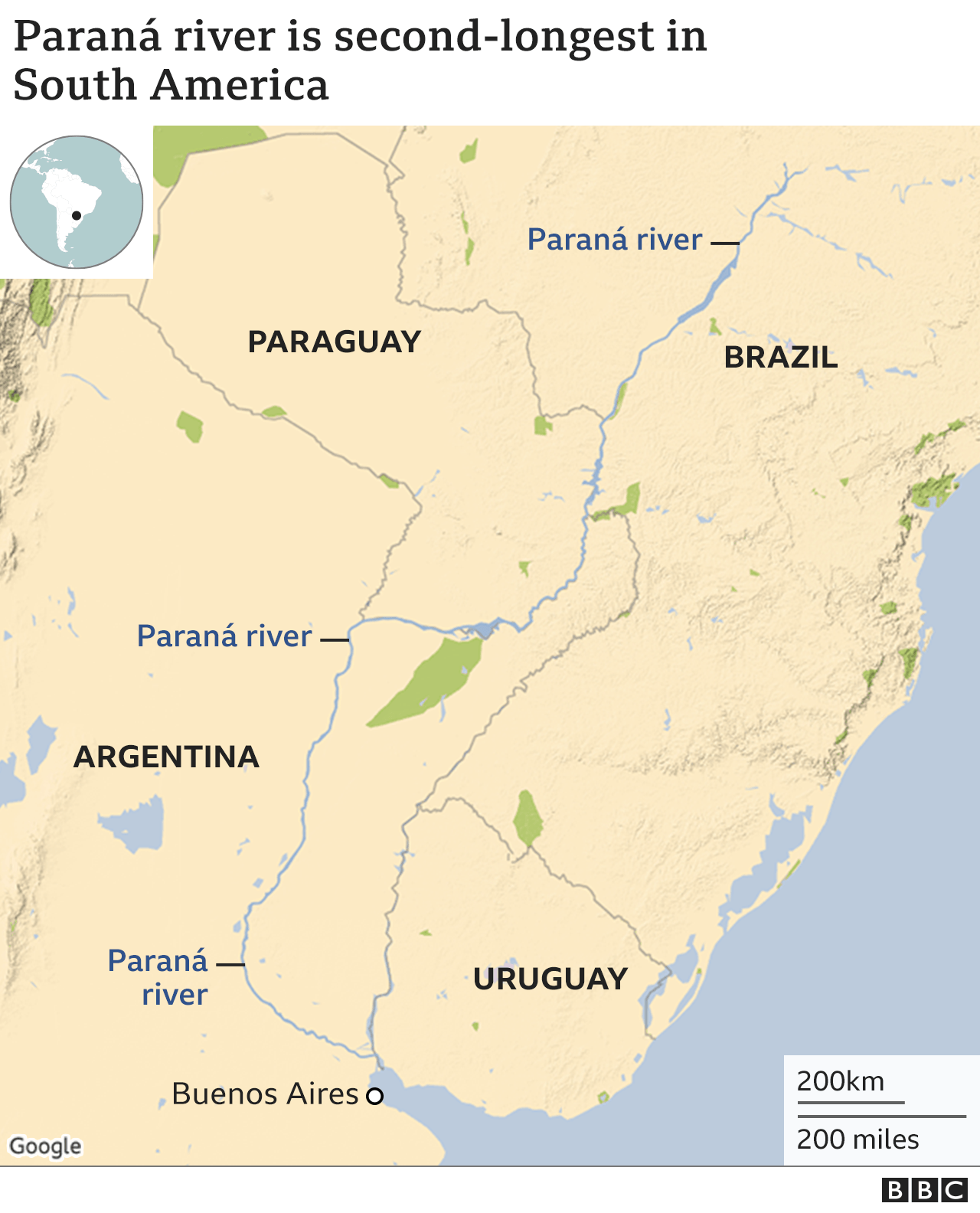
The water levels of the Paraná river, the second-longest in South America after the Amazon, are at their lowest since 1944.
The river is key to commercial shipping and fishing but also provides 40 million people with drinking water.
A drought in the region means water levels have dipped so low that fishers’ livelihoods are at risk.
Environmentalists fear that the drought has been made more severe by deforestation and climate change.
The Paraná is 4,880km (3,032 miles) long and flows south from south-east Brazil through Paraguay and Argentina.
It merges with the Paraguay and Uruguay rivers to form the Río de la Plata Basin.
“The Paraná is the largest, most biodiverse and the most important socio-productive wetland in Argentina,” geologist Carlos Ramonell told the AFP news agency.
Southern Brazil, where the Paraná’s source is located, has seen three years of below-average rainfalls.
The Paraguay river is also running very low
As a result, the Paraná’s flow rate has dropped from an average of 17,000 cubic meters a second to just 6,200.
The low water levels are causing problems for energy production with the hydroelectric plant that spans the Parana river between Argentina and Paraguay running at only 50%.
On Wednesday, Brazil’s Vice-President Hamilton Mourão warned that the drought could also lead to energy rationing in Brazil.
It is also hampering the transport of goods with ships not able to load up fully in case they run aground.
The Paraná is a key waterway for the transport of grains and the situation is forcing exporters to consider using land routes.
Forecasters say the drought could last until 2022.
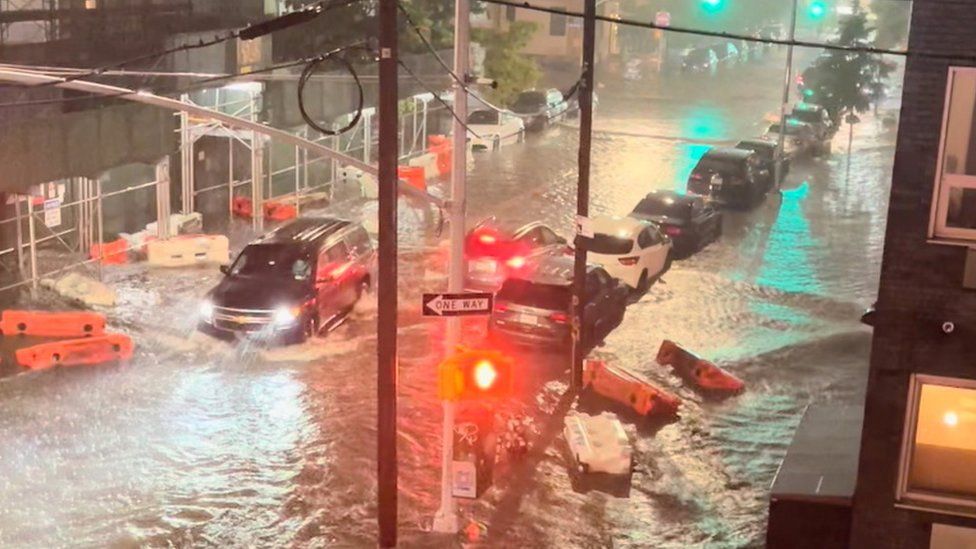
A state of emergency has been declared in New York City after it was hit by record rainfall and flash flooding as a result of Tropical Storm Ida.
Mayor Bill de Blasio said the city was “enduring an historic weather event” with “brutal flooding” and “dangerous conditions” on the roads.
Footage on social media showed water pouring into subway stations and people’s homes, and flooded roads.
New Jersey also declared an emergency and reported at least one death.
A person drowned in Passaic, New Jersey, the local mayor said, A tornado also destroyed at least nine homes in Mullica Hill, in the same state.
The roof of a postal building collapsed in Kearny, New Jersey, with people inside at the time, police said. Rescue crews are on the scene, but it’s not clear how many injuries there might be.
The National Weather Service said it had recorded 3.15 inches (8cm) of rain in New York’s Central Park in one hour.
New York police have urged people to stay off the roads and the fire department has said it is responding to calls from across the city.
The city’s subway has mostly closed, and many train services and flights out of New York and New Jersey are suspended.
image sourceReuters
image captionSocial media footage shows flooding in Williamsburg area of Brooklyn (Photo credit: Credit: Jaymee Sire)
The remnants of Hurricane Ida have been pushing north across the east of the country, having hit Louisiana as a Category 4 hurricane on Sunday.
Hundreds of thousands of homes in Louisiana remain without power and New Orleans is under a night-time curfew.
Many factors contribute to flooding, but a warming atmosphere caused by climate change makes extreme rainfall more likely.
The world has already warmed by about 1.2C since the industrial era began and temperatures will keep rising unless governments around the world make steep cuts to emissions.
American and Afghan allies left behind in Afghanistan have entered a fraught and uncertain period of limbo following the definitive conclusion of U.S. military evacuations out of the country.
Advocates estimate roughly 150,000 vulnerable Afghans remain in the country after a U.S. evacuation effort ended early Tuesday, while those who assisted the U.S. military who may now wish to leave with their families could add another 100,000.
Many who remain have gone into hiding over fear of violent retribution by the Taliban, likely targeted for work alongside American and coalition forces who battled and killed members of the Islamic fundamentalist group over two decades of war.
Many of these people face overwhelming confusion and fear over how to leave the country, from practical matters of appropriate travel documents and questions over when airports will reopen and how they will function to the uncertainty of whether the Taliban will respond to international pressure to ensure safe passage.
“The last few months have been incredibly challenging and disappointing for our clients, whose risk has increased exponentially with the Taliban takeover of Afghanistan,” Adam Bates, policy counsel with the International Refugee Assistance Project, told reporters, noting that “the majority of our clients were not able to leave Afghanistan on an evacuation flight.”
Out of more than 500 clients the group was trying to get out of the country, only about 130 were able to make it onto flights. Just a few dozen have made it onto U.S. soil.
“The immense joy that we felt for those few clients of ours who’ve managed to escape — primarily through sheer luck and their own perseverance and not the action of us — that joy has been overshadowed by the pain and frustration we feel for those hundreds of thousands who remain trapped,” he added.
Rabbi Will Berkovitz, CEO of the refugee resettlement organization Jewish Family Service, said that group has 127 people on the ground in Afghanistan — 23 families that qualify for Special Immigrant Visas (SIV) to the U.S. that were left behind in the evacuations.
“Many of them have all of their visa paperwork in hand and ready,” he said in an interview with The Hill. “Others, frankly, the U.S. Embassy took their passports in order to issue them a visa, and then when Kabul fell, they closed the embassy, and they never were able to get their passports back, so they are in a particularly dire situation.”
The organization is gaming whether people can evacuate over land routes but is distraught over whether access to cash and communication may be cut off at any moment. They have advised the people to stay in hiding over the next few days as the situation unfolds.
“The reality on the ground is, it’s exceedingly fluid. What’s true now may be false in 20 minutes. There’s no guarantee,” he said. “They’re all people that served with coalition forces, so they’re both targeted — but also our country promised to evacuate them to safety, and we haven’t upheld our promise, and so to me, the blood is on our hands.”
The Biden administration is stressing that it has built international consensus to pressure the Taliban to ensure safe travel for Americans left behind — whose numbers range between 100 and 200 — and Afghans who want to leave the country.
“More than half the world’s countries have joined us in insisting that the Taliban let people travel outside Afghanistan freely,” Secretary of State Antony Blinken said in a speech Monday.
The administration succeeded in evacuating more than 124,000 people from Afghanistan, but it’s unclear how many Afghans remain who qualify for Special Immigrant Visas to the U.S. or other priority refugee status and how the administration will help them leave the country.
Rep. Adam Kinzinger (R-Ill.) has asked the State and Defense departments to deliver within a week a breakdown of each vulnerable group the administration evacuated and those remaining in Afghanistan.
A number of groups have joined the chorus of criticism over their partners being left behind during what eventually became chaotic evacuation efforts out of Kabul.
The New York-based Women for Afghan Women was unable to secure evacuation for 500 of its most vulnerable staff. This group qualified for evacuation and refugee status for their association with a U.S. government-funded organization.
“Not a single person was evacuated,” Sunita Viswanath, co-founder of the group, wrote in an email to The Hill.
“We are incredibly demoralized and feel let down by America. How could the highest risk of the largest women’s organization — one funded by the U.S. State Department — not have been one of the most urgent groups to get out? Women just weren’t a priority,” she added.
Also left in Afghanistan are an estimated 150 journalists working for the Voice of America (VOA) and Radio Free Europe/Radio Liberty media outlets funded by the American government. That group numbers 500 people including their families, according to a congressional aide.
“We are incredibly disappointed that our efforts over the past few weeks to get our colleagues safe passage out of Afghanistan have been unsuccessful,” acting VOA Director Yolanda López said in a statement.
“We have been working day and night, pursuing every available option, only to hit countless obstacles and roadblocks. These men and women are part of our VOA family and we will not be deterred by these setbacks. We remain committed to continuing to do everything we can to help all of our journalists and their families who wish to leave the country and get them to safety,” she added.
Experts say the pool of those wishing to leave trumps the earlier estimates from the administration.
Research from the Association of Wartime Allies conducted in conjunction with American University last week found a conservative estimate of those who worked in some capacity for the American government or nongovernmental organizations or who served in the Afghan National Army along with their families could number 145,000.
Meanwhile, the report estimated that those who assisted U.S. military efforts for at least three years and who may now wish to leave with their families add another 30,000 to an SIV pipeline already numbering past 80,000.
“This is looking at the total potential pool of people who are desperate to get out of the country to save their own lives — not just those that have already filed applications but those who were caught up in bureaucratic denials,” said Adam Malaty-Uhr, a board member with the association who served nine months in Afghanistan.
Krish O’Mara Vignarajah, president of Lutheran Immigration and Refugee Service, which will help resettle Afghan evacuees, said America’s obligation doesn’t end with those who have already been evacuated.
“History will not just remember our nation by how many people evacuated in the eleventh hour but by how many people we leave behind,” she said.
Also unclear are the nuts and bolts of facilitating travel, from identity documents to finding safe areas of transit.
“This is an area of limbo that is extraordinary. If you chase any of the trails, it goes into an area you can’t even imagine,” a former senior State Department official told The Hill.
“The United Nations can offer a stateless person a passport, but they’re not geared up to do any of that right now,” the official continued. “Then what we have are people trying to leave by land borders, where there might be a few more options, including in all of these cases bribery. There are people making money off of this misery right and left.”
State Department spokesman Ned Price said the U.S. had assessed that Kabul’s Hamid Karzai International Airport can support resuming commercial operations.
But up in the air is how the Taliban will go about assigning responsibility for security and technical operations, possibly with the assistance of Qatar and Turkey.
The U.S. Embassy in Kabul, which had been handling travel documents for SIVs and other Afghans at risk, has moved its operations to Doha, Qatar, but it’s unclear how it will communicate with Afghans on the ground.
“The Doha office will perform as many functions as possible akin to what was done in our now-suspended Embassy Kabul,” Price said in a briefing with reporters on Tuesday.
The overriding question is how the Taliban will behave, with U.S. defense officials describing the group as “pragmatic and very businesslike” in helping facilitate evacuations for American citizens alongside the U.S. military, under threat of intense retaliation. Such promises are not guaranteed for Afghan citizens looking to flee without the presence of the U.S. military for the first time in 20 years.
NIA CHARLESTOWN NEVIS –The Department of Education is preparing for the start of the 2021/2022 school year on Nevis which will commence on September 06, 2021.
However, Ms. Zahnela Claxton, Principal Education Officer in the department told the Department of Information on August 31, 2021, that changes regarding the opening of school can be expected.
“September 6th is our start date and we will put information out to each school and their specific starting protocols. Some schools will have a rolling start and some schools will start in full on Monday but in relation to our early childhood centres, we will start in full on September 6th.
“Our primary schools, as I said, we will put that information out as to who is expected to come out on the 6th and the rolling dates after that, and for our secondary schools we will also put that information out and share with you and provide an update but we wanted to ensure that parents are aware that we are expecting, we are ready for our start of the new school year on September 6th 2021,” she said.
Meantime, the Principal Education Officer noted that the department is actively engaging in several activities ahead of schools reopening, including preparing parents to ensure a better parent/teacher relationship in the interest of the students’ educational development.
“This week most parents for our pre and primary schools have been called to be a part of the ‘Meet the Teacher’ activity.
“It is a thrust by the Department of Education to increase parental engagement to help parents to see where students are currently academically after some form or semblance of learning loss. We also know that it would give our teachers a metre stick, an idea of where our students are currently so that they can know where to start,” she said.
Ms. Claxton stated that the exercise is not expected to bring about perfection, and urged parents not to view it as an exam in which students would be graded.
“During the assessments we just want to see the areas for improvement, where we can help your child, and where we need to start. So this is a no-pressure activity. It is supposed to be fun, an opportunity for you the parents to also interact with your child’s teacher, and so we want to encourage you to come along. to bring your child, to be on time, to follow all the protocols to keep our children safe.
“It is by appointment only, so your school should have already contacted you. If they haven’t, reach out so that they can tell you when you are expected to be there, when is your appointed time. Please make it a date. Don’t be late. Ensure that you are there to be part of our “Meet the Teacher” activity 2021,” she said
For more news out of Nevis visit www.nia.gov.knyour window into Nevis.
MELBOURNE BEACH, Fla. — Florida Gov. Ron DeSantis (R) is facing resistance from a growing number of Republican-leaning counties over his handling of the recent surge in COVID-19 infections, in a rare bipartisan rebuke of the governor’s laissez-faire approach to the pandemic.
A number of school districts have moved to implement mask mandates for students in recent weeks in defiance of a July executive order from DeSantis that barred school officials from putting such requirements in place. And while most of those mandates originated in more liberal parts of the state, a handful of conservative-leaning areas have joined in.
Ron DeSantis
At the same time, DeSantis is still locked in a battle with Florida’s lucrative cruise industry over a ban on so-called vaccine passports as a growing number of major cruise lines announce plans to require passengers to provide proof of vaccination.
The backlash underscores the political perils posed by the pandemic, even for a rising Republican star like DeSantis, who is up for reelection next year and is seen as a possible contender for the 2024 GOP presidential nomination.
Florida is experiencing one of its darkest moments since the onset of the COVID-19 pandemic last year as the more contagious delta variant tears its way across the state.
As of Sunday, Florida was averaging more than 21,000 new infections each day, according to the Centers for Disease Control and Prevention’s Covid Data Tracker. More than 16,000 people are currently hospitalized, according to a Friday update from the Florida Hospital Association that showed a slight downward trend.
“Fingers crossed, we may be seeing the beginning of a downward trend in COVID-19 hospitalizations, but new cases remain near all-time highs, so it is much too early to declare victory,” said Florida Hospital Association President and CEO Mary Mayhew.
COVID-19 cases have surged in Florida despite a major push by the state for vaccinations. Florida currently ranks 20th among all 50 states and the District of Columbia in residents who have received at least one dose of a vaccine. More recently, DeSantis has taken to promoting a COVID-19 antibody treatment sold by the pharmaceutical company Regeneron as a way to fight the delta variant.
“COVID is going to be with us. You have tools to be able to best protect yourself,” he said at a news conference on Monday touting the antibody treatment. “Obviously, from a prevention perspective, the vaccination. But then if you are infected, particularly if you’re high risk, then what do you do? And this has just got to be something that everyone knows about.”
Still, DeSantis, who has been lauded by conservatives for his resistance to some of the strictest COVID-19-related measures, has largely gone with a hands-off approach to the outbreak. He backed legislation earlier this year effectively preempting local governments from imposing their own pandemic restrictions.
But the fight over pandemic-related rules and mandates has played out most prominently in the state’s public schools. DeSantis signed an executive order late last month banning school districts from implementing mask mandates — a move that has been the subject of increasing resistance from school boards, superintendents and many parents.
Roughly a dozen of the state’s 67 school districts have bucked DeSantis on the mask mandate ban. In recent days, more conservative counties have begun to make moves of their own.
On Monday, school board members in Brevard County — an area that DeSantis carried by nearly 17 points in the 2018 gubernatorial election — voted 3-2 to institute a 30-day mandatory mask policy.
The meeting came after a Friday ruling by a Florida judge allowing school districts to impose strict mask mandates, dealing a blow to DeSantis, who had argued that such decisions should be left up to individual parents.
One Brevard School Board member, Misty Belford, had previously voted against a mask policy before joining two other members in approving the mandate on Monday. She said that while she expects the DeSantis administration to appeal the judge’s ruling, the decision gave school board members “a small window to try to interrupt the spread” of the virus.
“We have a very serious crisis on our hands,” Belford said. “I think that we have a very small window of opportunity to do something to break this cycle and get some relief.”
Also on Monday, the superintendent of the school district in Lee County, a deep-red part of southwest Florida, announced a 30-day mask mandate for all students and staff beginning on Wednesday.
The decisions out of Brevard and Lee came on the same day that public schools in two other Republican strongholds, Sarasota County and Indian River County, began enforcing similar mask mandates for students. In each of the counties, students are able to opt out of the requirements with a signed note from a medical professional.
The DeSantis administration hasn’t taken the resistance to the governor’s executive order lying down. Despite the judge’s ruling, the Florida Department of Education on Monday followed through on a threat to withhold funds from two school districts — Broward County and Alachua County — that imposed mask mandates.
“We’re going to fight to protect parent’s rights to make health care decisions for their children,” state Education Commissioner Richard Corcoran said in a statement. “They know what is best for their children.”
To be sure, DeSantis remains well-liked among Florida Republicans more broadly. A Quinnipiac University poll released last week found his approval rating among GOP voters at an overwhelming 87 percent, while only 8 percent said they disapprove of his job performance.
And the recent COVID-19 surge doesn’t appear to have hurt DeSantis’s fundraising capabilities. Friends of Ron DeSantis, the governor’s political committee, raised nearly $5 million between Aug. 1 and Aug. 27.
By comparison, the two main Democrats challenging DeSantis in next year’s gubernatorial election, Rep. Charlie Crist (D-Fla.) and state Agriculture Commissioner Nikki Fried, have raised just over $3.2 million this year combined.
But the Quinnipiac poll also suggests some trouble for DeSantis, with his overall approval rating falling below the 50 percent mark to 47 percent. That’s still better than the 41 percent approval he notched in a July 2020 Quinnipiac survey, but it’s still well below his pre-pandemic high of 59 percent in March 2019.
When it comes to his handling of the coronavirus pandemic, however, DeSantis’s approval rating drops even lower to 46 percent, while he gets 44 percent approval for his handling of Florida’s public schools. The poll also found that 60 percent of Floridians support masking requirements for students, teachers and school staff.
DeSantis’s administration is also caught in another high-profile battle against the cruise industry as a growing number of cruise operators unveil vaccination requirements for passengers.
The Republican-controlled state legislature passed a measure earlier this year at DeSantis’s urging prohibiting businesses from requiring patrons to provide proof of vaccination. Norwegian Cruise Line Holdings sued over the law, and a federal judge handed down a ruling earlier this month allowing the company to require vaccinations for its passengers.
DeSantis’s office has vowed to appeal the ruling. But that hasn’t stopped other cruise operators in the state from implementing their own requirements.
So far Disney, Royal Caribbean, Carnival and MSC Cruises have announced vaccine requirements. Those decisions were influenced by an emergency order by the Bahamas effectively barring cruise ships from stopping in the country unless all eligible passengers are vaccinated.
The Quinnipiac University poll released last week found that a majority of Floridians — 63 percent — support vaccine requirements for cruise ship passengers.
=========================================
MODERNA STARTS DATA SUBMISSION FOR BOOSTER SHOT
Moderna said it has begun submitting data to the Food and Drug Administration (FDA) about a booster dose of its COVID-19 vaccine.
The data submitted is for the use of a booster dose of its authorized two-shot vaccine at the 50 microgram dose, the company said.
The company said neutralizing antibodies had waned “significantly” prior to boosting approximately six months after the second dose.
The Biden administration announced last month that boosters would be available the week of Sept. 20 to most people fully vaccinated eight months earlier.
Context: The announcement comes after the U.S. authorized third doses of both Moderna and Pfizer’s COVID-19 vaccines for immunocompromised people last month, but boosters for the general public are not yet authorized.
More than 1 million people have since received a third dose according to the Centers for Disease Control and Prevention, though the agency does not distinguish if the people were immunocompromised.
What’s next: Shortly after the announcement from Moderna, FDA scheduled a key meeting of its outside advisory committee on vaccines. The group will meet Sept. 17 to discuss data from the Pfizer-BioNTech booster application — just three days before the Biden administration’s self-declared start date. It’s not clear if the scientists will follow the administration’s plan, though their recommendations are non-binding.



 *****@
 *****@
 *****@

 *****@
 *****@
 *****@

 *****@
 *****@
 *****@

 *****@
 *****@
 *****@

 *****@
 *****@
 *****@
 *****@
 *****@
 *****@
 *****@
 *****@
 *****@
 *****@
 *****@
 *****@