New Orleans officials have imposed a citywide curfew as large parts of Louisiana and Mississippi remain without power following Hurricane Ida.
Mayor LaToya Cantrell said the curfew would last from 20:00 to 06:00 and police said there had been “several” incidents of looting in the city.
Energy companies are working to restore power but residents are being warned it could take weeks in some areas.
Meanwhile water services and infrastructure have also been hit.
Two people were killed and at least 10 injured after a section of highway collapsed near Lucedale, Mississippi on Monday.
Several cars were reported to have fallen into a hole that was 50 to 60ft (15 to 18m) long and 20 to 30ft deep, according to highway police.
Local authorities believe that some of the drivers may not have been able to see the road properly because of the heavy rains. The highway remains closed.
Over eight inches (20cm) of rain fell in the area during Ida, which reached the US mainland as a Category 4 storm on Sunday.
Residents urged not to return home
While Ida’s speed has slowed, authorities continue to warn of storm surges and heavy rains across the southern US.
By Tuesday afternoon, Ida was in Tennessee, soaking the area with intense rain and prompting flash flood warnings.
image sourceReuters
image captionNew Orleans and large parts of the region are without lights and power
Local officials have urged evacuated residents to delay their return home as more than one million homes and businesses remain without power, including most of New Orleans.
Mayor Cantrell said that she was hopeful “that we should have some level of transmission” by Wednesday but “that does not mean we will immediately see all the lights on in the city.”
Federal officials say that some 441,000 people in 17 parishes across the region have no water, and a similar number may be without power for up to a month.
It comes as heat advisories have been issued, with some areas expected to reach 95F (35C), according to weather officials say.
Louisiana Governor John Bel Edwards said some 25,000 line workers were working to restore power but admitted: “There are an awful lot of unknowns right now.”
Meanwhile Louisiana Lieutenant Governor Bill Nungesser has warned the death toll from Ida will likely rise in the coming days.
In addition to the two killed during the highway collapse, at least two other people have been reported dead during the storm.
In Louisiana, a man died while attempting to drive across a flooded area of New Orleans. Another man died after being struck by a tree near Baton Rouge.
“Knowing that so many people stayed behind in places like Grande Isle and Lafitte where flood waters have devastated those areas, we expect there will be more people found who have passed,” Mr Nungesser said.
Ida is expected to move next to the US northeast, with rain and threat of floods stretching from the Tennessee to the mid-Atlantic.
Washington, DC, Baltimore and Philadelphia are among the cities now under flash flood watches.
Joe Biden has said he takes responsibility for the bloody, often chaotic withdrawal from Afghanistan and said it should mark a new era in US foreign policy, relying less on military muscle.
Addressing the nation from the White House 24 hours after the last US soldier left Kabul, Biden sought to confront his critics about the handling of the withdrawal. He celebrated the evacuation of 124,000 civilians in the 17 days following the fall of the Afghan capital and said it was time to “turn the page” on the US role abroad, pointing to a less interventionist future.
“This decision about Afghanistan is not just about Afghanistan. It’s about ending an era of major military operations to remake other countries,” the president said.
Facing reporters in the state dining room, Biden looked into the camera and said he took responsibility for what he insisted was a “wise” decision. He admitted that his administration had not anticipated the speed of the Afghan army’s collapse, but also made clear there was plenty more blame to go around, singling out his predecessor and the former Afghan president Ashraf Ghani.
He pointed out he had inherited the Doha agreement from Donald Trump’s departing administration. That accord, signed with the Taliban a year earlier, did not make the promised US withdrawal on 1 May contingent on any political settlement inside Afghanistan, and it allowed the release of 5,000 Taliban prisoners. Biden said those released fighters “including some of the Taliban’s top war commanders, among those who just took control of Afghanistan”.
“By the time I came to office the Taliban was in its strongest military position since 2001, controlling or contesting nearly half of the country,” Biden said.
“So we’re left with a simple decision: either follow through on the commitment made by the last administration and leave Afghanistan, or say we weren’t leaving and commit tens of thousands more troops, going back to war.”
“I was not going to extend this forever war,” he said.
In that fundamental decision, Biden has solid support. A Pew Research Center poll published on Tuesday showed 54% of US adults agreeing that the decision to pull out was the right one. But there was limited enthusiasm for the way Biden went about it. Just over a quarter of those polled said the administration had done an excellent or good job while 42% said it had performed poorly.
Biden admitted that the assumption that the Afghan security forces would be able to hold out for some time following the US withdrawal “turned out not to be accurate”. But he suggested the biggest mistake was putting faith in Ghani, who abandoned Kabul and fled the country as the Taliban closed in.
He said that the Afghan people “watched their own government collapse and the president flee amid corruption and malfeasance, handing over the country to their enemy, the Taliban, and significantly increasing the risk to US personnel and our allies”.
Hours before Biden spoke, Reuters news agency published excerpts from the last telephone conversation between Biden and Ghani, on 23 July, in which it was clear that neither leader had any clue military disaster was so close at hand.
“You clearly have the best military,” Biden told Ghani, who is now believed to be in the United Arab Emirates. “You have 300,000 well-armed forces versus 70-80,000 and they’re clearly capable of fighting well.”
In the call, Biden pressed Ghani to address what he called the Afghan government’s “perception problem”.
“I need not tell you the perception around the world and in parts of Afghanistan, I believe, is that things are not going well in terms of the fight against the Taliban,” Biden said. “And there is a need, whether it is true or not, there is a need to project a different picture.”
Afghanistan’s neighbours offered millions in aid to harbour refugees
Republican leaders in Congress focused their line of attack on Tuesday on the fact that a few hundred US nationals had not evacuated, claiming the Biden administration had left them “stranded”.
The president, whose tone was defensive for much of the half-hour speech, said that sticking to the deadline of 31 August and cutting off the evacuation was the “unanimous recommendation of my civilian and military advisers”.
“Their recommendation was that the safest way to secure the passage of remaining Americans and others out of the country was not to continue with 6,000 troops on the ground in harm’s way in Kabul but rather to get them out through non-military means,” he said.
Biden noted that over 5,500 American civilians had been evacuated.
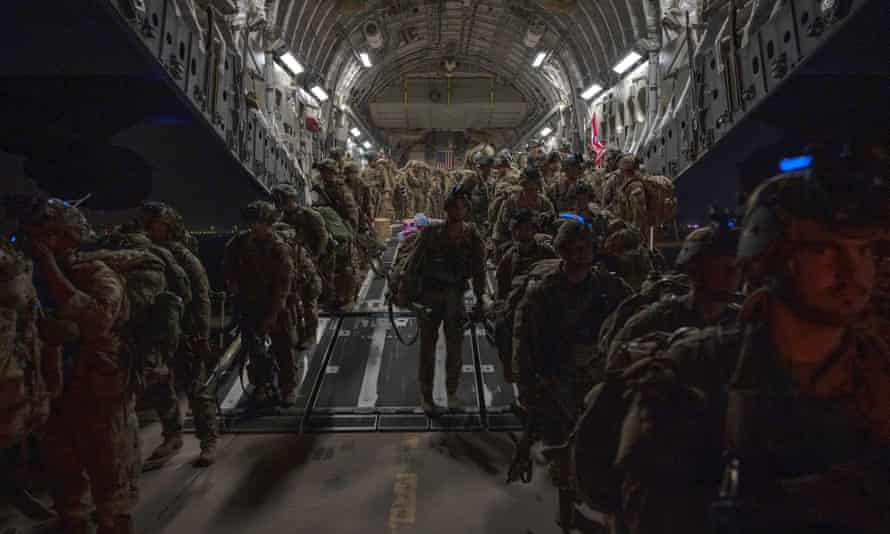
US troops disembark in Kuwait on Tuesday as the last American soldiers leave Afghanistan. Photograph: US Air Force/ZUMA Press Wire Service/REX/Shutterstock
“Now we believe that about 100 to 200 Americans remain in Afghanistan with some intention to leave,” he said. “Most of those who remain are dual citizens, longtime residents, who earlier decided to stay because of their family roots in Afghanistan.”
“For those remaining Americans, there is no deadline,” the president promised, saying US diplomacy would now focus on finding a way out for them.
Biden took particular issue with suggestions that a small US military contingent could have remained in Afghanistan propping up the Ghani government. He implied that such ideas come easily to those, the overwhelming majority, who do not have to bear the brunt of repeated deployments in America’s “forever wars”.
“I don’t think enough people understand how much we’ve asked of the 1% of this country who put that uniform on, willing to put their lives on the line in defence of our nation,” he said, in the most emotive passage of the speech, in which Biden invoked his son Beau, who had served in Iraq and died in 2015 of a brain tumour.
“A lot of our veterans and their families have gone through hell,” he said. “Deployment after deployment, years away from their families, missed birthdays, anniversaries, empty chairs at holidays, financial struggles, divorces, loss of limbs, traumatic brain injury, post-traumatic stress.”
He said 18 veterans took their own lives every day in America, although experts argue that it is unknown how many of those suicides can be attributable to military service. The veterans affairs department told the Daily Beast that calls to the veterans crisis helpline had risen significantly since Kabul’s fall.
“There’s nothing low grade, or low risk, or low cost about any war,” Biden said.
“We no longer had a clear purpose in an open-ended mission in Afghanistan. After 20 years of war in Afghanistan, I refused to send another generation of America’s sons and daughters to fight a war that should have ended long ago,” he said.
‘People are broken’: Afghans describe first day under full Taliban control
It was time to learn from the mistakes of Afghanistan, the president declared. He laid out the tenets of what is increasingly seen as a “Biden doctrine” in foreign policy.
“First, we must set missions with clear, achievable goals, not ones we will never reach. And second, we must stay clearly focused on the fundamental national security interest of the United States of America,” he said.
One of the biggest mistakes of the US war in Afghanistan, the president argued, was the relentless drift in objectives, from stopping al-Qaida from attacking the US to building a nation.
“Moving from that mindset, from those kinds of large-scale troop deployments, will make us stronger and more effective and safer at home,” he said.
Even as he talked about military retrenchment, however, Biden balanced it with threats against the Islamic State (IS), believed to have carried out last Thursday’s devastating bomb attack outside Kabul airport.
“We are not done with you yet,” he said. To those who wished America harm, Biden’s message was: “We will not forgive. We will not forget. We will hunt you down to the ends of the earth and you will pay the ultimate price.”
The relentless pursuit of vengeance through military means has led the US into “forever wars” in the past. Biden insisted that would not happen on his watch, but recent history suggests it is a hard habit to break.
Eleven years to the day before Biden’s speech, Barack Obama announced the end of the “combat mission” in Iraq. Four years after that, Obama ordered US forces back into country, to fight IS.
The US Center for Disease Control and Prevention (CDC) has issued a Level 4 Travel Health Notice for Saint Lucia due to COVID-19, indicating a very high level of COVID-19 in the country.
“Avoid travel to Saint Lucia. If you must travel to Saint Lucia, make sure you are fully vaccinated before travel. Because of the current situation in Saint Lucia, even fully vaccinated travellers may be at risk for getting and spreading COVID-19 variants.”
Tourists are advised against travelling to Saint Lucia due to the high rate of COVID-19 on the island.
The advisory was updated on August 30, 2021. Switzerland, Puerto Rico, North Macedonia, Guam, Estonia and Azerbaijan were all raised to Level 4 in the latest batch of updates as well.
Saint Lucia is currently experiencing a fourth wave of the virus, for the first time also dealing with the confirmed presence of the more contagious Delta variant on island, forcing the government to tighten COVID-19 protocols including imposing stricter curfews.
The Ministry of Health gave an update on the current situation stating, “From July 25, 2021, we note 2,583 cases at an average of 74 cases per day. Over the last 14 days we note five COVID-19 deaths and we have 1,970 active cases in country. The daily infection rate for the past week was 72.9 per 100,000 per day and an average of 132.0 cases per day.
In relation to this new wave, from July 25, 2021, 2,583 persons were positive. 51% are in the age group 25-49 years. 59% of the cases are female. The majority of the cases are from Castries, Gros- Islet, Babonneau and Dennery. Based on contact tracing data, the majority of the cases diagnosed are related to social activities. To date, from the positive cases diagnosed in country, 1.66% have been fully vaccinated.”
The ministry continued, “The response last weekend was not encouraging as the report from the enforcement agency included numerous breaches to curfew, large mass crowd activities at bars, beaches and private parties. We continue to ask the public to work with us and exhibit responsible behavior to manage this fourth COVID-19 wave.
This past week, the Ministry of Health and Wellness has continued collaboration with the Minibus Association. These meetings were aimed at discussing and strengthening collaborations and efforts in order to reduce the COVID-19 risk and to manage the spike in cases.
We continue to note positive cases related to this sector. We advise that the minibus drivers carry 10 or less passengers per load and that everyone keeps their mask on during the journey. Also, regular sanitation after every trip. It is important that the transmission risk be minimized to all who uses this valuable service.
At present we have available both the Pfizer and Astra Zeneca vaccine free of charge in country at the various wellness centers. Vaccination remains the most effective public health measure in managing infectious diseases. These vaccines have been proven to be safe and effective in protecting persons from developing COVID-19, its severe forms, complications, hospitalizations and death.
We continue to urge the public to access the various sites to get immunized at the soonest. Encourage your family and friends to get immunized so we can all be protected. We continue to advise the public to remain vigilant as increased transmission and risk of the Variants of Concerns is present. Let us all adhere to the protocols that are put in place to keep us safe. These include regular hand washing, use of face mask in public places, avoiding crowds and persons with respiratory symptoms and keeping frequently touched surfaces clean.”
Curfew hours for the immediate future are as follows:
Monday, 30th August 2021 to Friday, 3rd September 2021, from 7:00 pm to 4:00 am, with businesses, establishments, or offices ceasing operation at 6:00 pm
Saturday, 4th September 2021, from 4:00 pm to 4:00 am, with businesses, establishments, or offices ceasing operation at 3:00 pm
Sunday, 5th September 2021, twenty-four (24) hour curfew (4:00 am Sunday to 4:00 am Monday);
Monday 6th September 2021 from 7:00 pm to 4:00 am with businesses, establishments, or offices ceasing operation from 6:00 pm
ISLAMABAD (AP) — It was Nov. 13 , 2001. The sun had just begun to rise over the Hindu Kush Mountains when the Taliban disappeared from Kabul, the battered capital of…Read More
WASHINGTON (AP) — A defensive President Joe Biden called the U.S. airlift to extract more than 120,000 Americans, Afghans and other allies from Afghanistan to end a …Read More
SOUTH LAKE TAHOE, Calif. (AP) — Flames raced across treetops and through drought-stricken vegetation as firefighters scrambled Wednesday to keep a growing California…Read More
NEW ORLEANS (AP) — Louisiana residents still reeling from flooding and damage caused by Hurricane Ida scrambled for food, gas, water and relief from the sweltering h…Read More
NEW DELHI (AP) — India has dramatically increased COVID-19 vaccination rates in its vast rural hinterland, where around 65% of the country’s nearly 1.4 billion peopl…Read More
WASHINGTON (AP) — This summer’s coronavirus resurgence has been labeled a “pandemic of the unvaccinated” by government officials from President Joe Biden on down….Read More
BOYDTON, Va. (AP) — There was a time when Black farms prospered. Just two generations out of slavery, by 1910 Black farmers had amassed more than 16 million acres of…Read More
BEIRUT (AP) — Driving back to base after firing rockets toward Israeli positions from a border area last month, a group of Hezbollah fighters was accosted by angry v…Read More
Looking to kick back and enjoy the late days of summer with something non-alcoholic? There’s been a real transformation going on in the world of non-alcoholic bevera…Read More
LIMA, Aug 31 (Reuters) – A bus driving along a main highway in the Peruvian Andes plunged into an abyss and killed at least 29 passengers in the early hours of Tuesday, authorities said.
The incident happened near the town of Matucana, along Peru’s Central Highway, a corridor that connects the capital Lima to much of the central Andes. The bus was carrying 63 passengers, a police official told local news outlet Canal N.
The accident is the second involving a bus plunging from a road in Peru in a matter of days, after a bus carrying mining workers in a different part of the Andes also fell off a cliff and killed 16 on Friday.
The two incidents are unrelated, although bus plunges are not uncommon in Peru, especially in the Andes. The mountain range traverses the length of the country and its highways are often dangerous, overlooking tall cliffs.
MAPASTEPEC, Mexico, Aug 31 (Reuters) – Mexican immigration agents and security forces stepped up efforts to halt the progress of a caravan of hundreds of Central American and Caribbean migrants as they moved toward Mexico City from southern Mexico on Tuesday.
Entire migrant families including many with young children arrived at two towns in the southern state of Chiapas, Mapastepec and Escuintla, after passing through the Mexican town of Tapachula near the Guatemalan border, according to Reuters witnesses.
The number of children seeking to cross Mexico to get to the United States has risen dramatically since the start of this year as many families try to flee poverty, violenceand natural disasters.
On Tuesday, troops from Mexico’s National Guard and agents from the National Migration Institute (INM) sought to break up the latest caravan, detaining some migrants, including minors, the Reuters witnesses said.
The Mexican government has deployed more troops to its border with Guatemala in a bid to reduce the flow of migrants in recent months, pressured by U.S. officials to take strong action.
“They took them away,” a Guatemalan migrant called Bertha said of her children. Bertha, a mother of five, declined to provide her surname due to fears of reprisals.
She tearfully described how three of her young sons were detained by authorities after she left them momentarily with others to go and buy food. The night before, she said one of her daughters was taken from her.
Reuters was not able to independently confirm her account and the INM did not reply to a request for comment.
Videos shared online showed altercations between INM agents and some migrants amid efforts by the administration of President Andres Manuel Lopez Obrador to contain what he has called “irregular” immigration.
According to INM data, more than 35,000 migrant minors have been identified by officials so far this year, a three-fold increase from the same period last year.
About a third were traveling alone, the data showed, and most came from Honduras, Guatemala and El Salvador.
Reporting by Jose Torres in Mapastepec and Lizbeth Diaz in Mexico City; Writing by David Alire Garcia; Editing by Ana Nicolaci da Costa
Black surgeons are far less likely to be promoted than their white colleagues, according to analysis of NHS medics’ careers in England.
Black men who were junior surgeons in 2010 were 27% less likely to be promoted to consultants than white men between 2016 and 2020, while black women were 42% less likely.
The stark evidence of a glass ceiling has raised warnings that treatment may suffer unless senior ranks are made more representative and “old boys’ networks” dismantled. The Royal College of Surgeons described the study of more than 3,000 doctors as “deeply concerning”.
The figures compiled from NHS records by academics at the University of Surrey revealed that the proportion of consultants who were men actually increased over the decade from 57% to 63%.
“The most striking finding is that even when Indian women, white women and black men conform to white male patterns of working, the progression gap is wide and, in some cases, very wide,” said Prof Carol Woodhams of the University of Surrey Business school. “This is objective evidence that disadvantage against diverse groups in surgery is deep-rooted and a new progressive milieu in the NHS and the broader society has not yet translated into concrete and progressive outcomes.”
Citing figures that black women in the UK are four times more likely to die in pregnancy or childbirth, Elizabeth Egbase, a black woman of Nigerian heritage who became a permanent consultant in obstetrics and gynaecology in July, told the Guardian that improving the representation of black consultants was vital because “the workforce should represent the people we look after.”
She said the lack of existing black consultants makes it harder for junior surgeons to find their way up the ladder.
“We are having to figure out things more on our own rather than being given a cheat sheet,” she said, referring to the need to build a CV through publishing articles, speaking at conferences and accruing operating experience. “That tends to happen for people in a network and who have confidence. It used to be an old boys club and even though that has improved on gender, I don’t think it has on race.”
Tim Mitchell, vice-president of the Royal College of Surgeons, said: “The findings of this research are deeply concerning – women and ethnic minorities must be fully represented throughout the ranks of the surgical profession. We recognise that more needs to be done to ensure that all can reach the top of the profession, regardless of their background, gender or race.”
Samantha Tross, who became the UK’s first black female orthopaedic consultant in 2005 having arrived from Guyana as a child, said hospitals should set targets for numbers of ethnic minority consultants.
“I certainly faced racism and sexism during my time as a trainee,” she said. “There were times when there were extra duties to be done and it was always me who was chosen. In one hospital, a consultant requested me to assist him in his private practice outside my training time. He made no offer to pay me, yet the previous white, male trainee [who] asked to do the same thing was paid. There was one time when a consultant said to me are you sure this is what you want to do – as a black woman, it would be hard for you to progress in orthopaedics.”
An NHS spokesperson said: “While more than four-fifths of NHS staff feel their organisation acts fairly with career progression and the number of women and people from black and minority ethnic backgrounds in senior surgical roles is increasing, there is more work to do – which is why the NHS is providing intensive support to local areas to increase the number of people from these groups working in senior roles.”
Mexican photographer Alejandro Prieto’s image of a bird at the US-Mexico border wall has won a prestigious photo contest.
Mr Prieto was named the grand prize winner of the Bird Photographer of the Year competition after his image was selected from 22,000 entries.
His winning photograph depicts a roadrunner bird that has stopped in front of the wall.
He says the image highlights the threat to biodiversity that the wall poses.
The US-Mexico border region is a delicate ecosystem with regular animal and bird migrations moving north and south on the American continent.
In this region, a number of species need to cross the border to mate with their genetically different cousins, including the endangered North American jaguar and the black bear, which was re-introduced to Texas in the 1990s.
“The border wall crosses deserts, mountains and even mangroves. It is not just desert, and is in fact very biodiverse with more than 1,500 animal and plant species threatened by the wall,” Mr Prieto said.
“I have watched many different animals reach the wall before turning around and heading back,” he added.
Mr Prieto, from Guadalajara, was awarded £5,000 ($6,877) for winning the Bird Photographer of the Year competition. Other categories included Young Bird Photographer of the Year and Urban Birds.
NIA CHARLESTOWN NEVIS — The Nevis Health Promotion Unit (HPU) in the Ministry of Health is encouraging members of the public to participate in activities being organised for Caribbean Wellness Day observed annually on the second Saturday in September. The day seeks to draw awareness to non-communicable diseases in communities across the Caribbean.
This year’s activities are being scaled back to four due to the COVID-19 pandemic. Ms. Shevanee Nisbett, Senior Health Educator at the unit, in an interview with the Department of Information on August 30, 2021, urged the public to participate in the tailored activities.
“I’m asking everyone to continue to support the Health Promotion Unit as we fight the non -communicable diseases in our community and the Caribbean and worldwide by taking part in our activities this year. The Caribbean Wellness Day overall theme is “Power through collective action” and the theme for 2021 is “In it together: Building healthy communities.”
“We are asking that persons please participate as usual and of course for all of our activities as well as the walk. All of the COVID-19 protocols will be adhered to. We ask that you come with your mask on. We ask that you bring your water. We ask that you social distance when you are there, whether we are exercising to warm up or when we are walking as well as hand sanitizers should be used,” she said.
Ms. Nisbett stated that there are four activities planned for this year.
“We have a few activities that would be highlighting Caribbean Wellness Day. The first one would be the Caribbean Wellness Yoga Series where we will have yoga happening on three Saturdays throughout the month…
“Our new activity this year which we have used to incorporate the COVID-19 protocols…we have created a campaign called “Let’s Face It: Wear a Mask.” … On Friday, September 10th is our annual Sneaker Day, and Sneaker Day turns 5 this year. So we are doing a little twist with it… Our last activity would be our Caribbean Wellness Walk which is our annual walk,” she said.
The yoga sessions will commence on Saturday, September 04 at the Nevisian Heritage Village. On September 18 and 25 the sessions will be held at the Nevis Artisan Village and at Fort Charles respectively. All sessions will begin at 7 a.m. and end at 8 a.m.
For the “Let’s Face It: Wear a Mask” challenge which specifically targets primary and secondary school students, they are to design masks which carry a health message which can be depicted in pictures or words and must be in a JPG or PNG format. All entries, one per participant, must be submitted via email to: he*****************@****ov.com
For Sneaker Day which is in its 5th year, members of the public are asked to wear sneakers to work, school or casually to run errands, or just going about their day. That event is in effort to promote persons wearing comfortable shoes while encouraging them to be more active.
However, this year participants are being asked to be creative and design their masks and sneakers in colour or style making it part of their creative outfit for the day.Persons who take part in this event are asked to take a photograph with their sneakers on and post it to Nevis Hpu Facebook page using hashtags – #sneakerday2021, #maskon, #CashlessSKN. The most creative entrant will be awarded a prize.
For the Caribbean Wellness Day walk on Saturday, September 11, it will begin from at 5:30 a.m. with warm up exercises. The actual walk will commence at 6 a.m. from the entrance of Yachtsman Grill in Cotton Ground, moving along the Island Main Road through Charlestown and end at the Villa Grounds.
Ms. Nisbett explained how Nevis got involved in the observance of Caribbean Wellness Day which was created by the Caribbean Public Health Agency (CARPHA) to bring awareness to non-communicable diseases which she stated are burdening the health systems of the Caribbean.
“Every year we do a list of activities that would highlight non-communicable diseases, the effects it has on the community and what we can do to treat and prevent non-communicable diseases such as: hypertension, cancer, high cholesterol and diabetes for example,” she said.
Data comes as UK Prime Minister vows to press on with plan to make vaccination a condition of entry for nightclubs
The Piano Works in Farringdon, London, after reopening in July. The nightclub sector is sceptical about vaccine passports. Photograph: Alberto Pezzali/AP
Imposing vaccine passports is likely to make hesitant people even more reluctant to get Covid jabs, research involving more than 16,000 people has found as Downing Street vowed to press ahead with the plan within a month.
Boris Johnson announced in July that the government would make it compulsory for nightclubs and other crowded indoor venues to ensure customers have been fully vaccinated before allowing them entry.
“We set out broadly our intention to require vaccination for nightclubs and some other settings. We will be coming forward in the coming weeks with detail for that,” he said.
As well as helping to protect clubbers from the virus, the move is aimed at boosting vaccine uptake – but the research, to be published in the Lancet journal EClinicalMedicine this month, suggests it could be counterproductive among the most hard-to-reach groups.
The survey was carried out in April when most people were either unvaccinated or had received only one dose of a vaccine. It suggested the groups that are less likely to get vaccinated – including the young, non-white ethnicities and non-English speakers – also view vaccine passports less positively.
“This creates a risk of creating a divided society wherein the majority are relatively secure but there remain pockets of lower vaccination where outbreaks can still occur,” the authors wrote in the paper, which is currently in preprint form.
The analysis involved 16,527 people, of whom 14,543 had not yet had both vaccine doses. In this group, the vast majority (87.8%) indicated their decision on being jabbed would not be affected by the introduction of passports.
However, of the remaining 12.2%, about two-thirds suggested they would be less likely to get vaccinated if passports were introduced, while the rest said they would be more inclined. Vaccine passports were viewed less negatively by this group if they were only required for international travel rather than domestic use.
The lead author Dr Alex de Figueiredo from the London School of Hygiene and Tropical Medicine, said these percentages become significant when scaled up to the whole population.
Younger age groups, black British ethnicities (compared with white people) and non-English speakers were more likely to express a lower inclination to get vaccinated if passports were introduced. While these groups comprise a relatively small proportion of the UK population, they cluster geographically and tend to be less inclined to get vaccinated in the first place.
Evidence that imposing vaccine passports could have the reverse behavioural effect from that intended by ministers will strengthen the hand of Tory backbenchers determined to see off the plan if it comes to a vote in the House of Commons.
Labour has also expressed concerns, suggesting a system that included Covid testing as an alternative to vaccination would be a better approach since fully jabbed individuals can still catch and pass on the virus.
Research into the behavioural effects of vaccine passports suggests the scheme triggers social division, said Prof John Drury, a participant in the Sage subcommittee advising on behavioural science, who was speaking in a personal capacity and not involved in the survey.
“Not only would vaccine passports create exclusion, that exclusion would be structured by existing inequalities. You only need to look at the data on who isn’t yet vaccinated to understand this – the young, the poor, ethnic minorities stand to be excluded.”
The negative impact of vaccine passports – once the underlying intention to get jabbed was accounted for in the survey – was disproportionately found in males and highly educated people. It’s unclear why that is, said de Figueiredo.
The study echoes historical data that suggests those who are already medically disfranchised will not be made more receptive to jabs by the introduction of more coercive measures, according to Caitjan Gainty, a senior lecturer in the history of science, technology and medicine at King’s College London, who was not involved in the survey study.
Another issue with vaccine passports, especially in light of the highly infectious Delta variant of coronavirus, is their weak scientific basis, scientists say. Someone who is double-jabbed is still half as likely to be infected as someone unvaccinated, notes Paul Hunter, professor of medicine at the University of East Anglia.
Many people will have been vaccinated to get their freedoms back, but with high rates of breakthrough infections it’s not impossible that freedoms could be taken away or made conditional on further doses, adds de Figueiredo. “This could be rather problematic as people may tire of this, may start refusing vaccines, and it’s not improbable that this rubs off on other vaccinations.”
Proposals for vaccine passports have been met with scepticism from Britain’s nightclub sector, which warns it could harm their recovery, while live music industry representatives expressed a preference for the current entry requirement for most venues and festivals – which allows the choice of providing proof of double-vaccination or recovery from Covid or a negative test.
Vaccine passport schemes introduced abroad have evolved in different directions and triggered varied reactions. In France, tens of thousands protested over a health pass allowing people to access restaurants, bars, planes and trains. The government this week extended the mandate to certain categories of staff.
Denmark’s “coronapas” system has been in operation since April but is being dropped from 10 September as authorities believe the virus is no longer a “critical threat” to society. Bars, cafes, restaurants, museums and tattooists have been open for anyone who can show a negative test result less than 72 hours old, or a completed vaccination, using a digital certificate.
Israel, which has been at the forefront of the jabs rollout, has had a “green pass” for much of the year. It released an app in February showing whether people have been fully vaccinated against Covid or have presumed immunity after contracting the disease.
A QR code system introduced last year in China categorised people into different colours, with green allowing them to move around freely if QR codes are requested in public spaces for entry.
 image sourceReuters



 *****@

 *****@
 *****@
 *****@

 *****@
 *****@
 *****@

 *****@
 *****@
 *****@


