Russia speeds up vaccination drive; In Israel and beyond in Mideast, vaccines bring political power; With heavy hearts, Italians mark year of outbreak, pay tribute to dead
Russia’s rollout of its coronavirus vaccine is beginning to pick up speed in some of its more remote regions, but experts say the campaign is still moving slowly.
The region was hit hard by the virus in December. Experts blame the slow rollout on limited supplies of the vaccine, logistical difficulties in distribution and continued hesitance among some Russians.
The country doesn’t regularly release data on its vaccination rates, but the number who have gotten at least the first shot appears to be between 2 million and 3.2 million
Israel Vaccines: Moving on from oil and arms? Vaccines are emerging as the newest currency of choice in the Middle East. The reopening of Israel’s economy, an Israeli government prisoner swap with Syria and the arrival of vaccines in Gaza all illustrate how those with access to vaccines have political power in the turbulent region. Israeli Prime Minister Benjamin Netanyahu has been at the forefront of this trend, using his vaccination campaign to win over voters and punish those who refuse to get inoculated, Josef Federman reports from Jerusalem.
The disparities between Israel’s successful vaccination push with its own population and the Palestinians have drawn criticism from U.N. officials and rights groups. They contend that Israel, as the occupying power, is responsible for vaccinating the Palestinians, while Israel has argued that under interim peace agreements it is not responsible. Israel’s vaccination campaign has included its own Arab population.
Britain Vaccinations: The government has said it’s aiming to give every adult in the country a first dose of vaccine by July 31, as it prepared to set out a “cautious” plan to ease the U.K.’s lockdown. In addition, the goal is for everyone over 50 or with an underlying health condition to get a shot by April 15, rather than the previous target of May 1. More than 17.2 million people in Britain have been given the first of two doses of vaccine. Britain has had more than 120,000 coronavirus deaths, the highest toll in Europe. Jill Lawless reports from London.
Italy One Year Later: ”It was like a war film. We were completely alone,” the mayor of Vo, a wine-making town in the Veneto region, recalls. It was where the first known fatality from a locally transmitted case of the virus in the West occurred on Feb. 21, 2020, setting off alarm bells far and wide. In the days and weeks that followed, densely populated Lombardy would become the epicenter of Italy’s outbreak and, by the end of March, countries the world over would be under lockdowns to slow the spread of the virus that has now taken 2.4 million lives.
But Vo, from where Colleen Barry reports, as one of the first towns in the West to be isolated, has a unique story, providing some of the first scientific insights into the deadly virus. A year on, Italy has so far seen more than 95,000 known virus dead, the second-highest toll in Europe after Britain.
Iraq’s New Surge: Doctors are confounded by widespread shirking of precautions even as cases surge dramatically in Iraq. The country is now under a new, government-imposed curfew. A month ago, new infections in Iraq were as low as 600 a day but have now surged, reaching nearly 4,000 and approaching the peak from last September. Many defy hospital rules requiring masks, putting their faith, they say, in God instead. And for weeks, markets, malls and stores have been packed with people. A sociologist says that after years of facing war, violence and instability, COVID-19 “may not stack up as a major problem” in the minds of many Iraqis. Abdulrahman Zeyad reports from Baghdad.
Asia-Pacific Vaccines: Australia has started its COVID-19 inoculation program days after its neighbor New Zealand, with both governments deciding their pandemic experiences did not require the fast tracking of vaccine rollouts that occurred in many parts of the world. Other countries in the Asia-Pacific region that have dealt relatively well with the pandemic either only recently started vaccinating or are about to, including Thailand, Taiwan, Vietnam, Cambodia and Singapore.
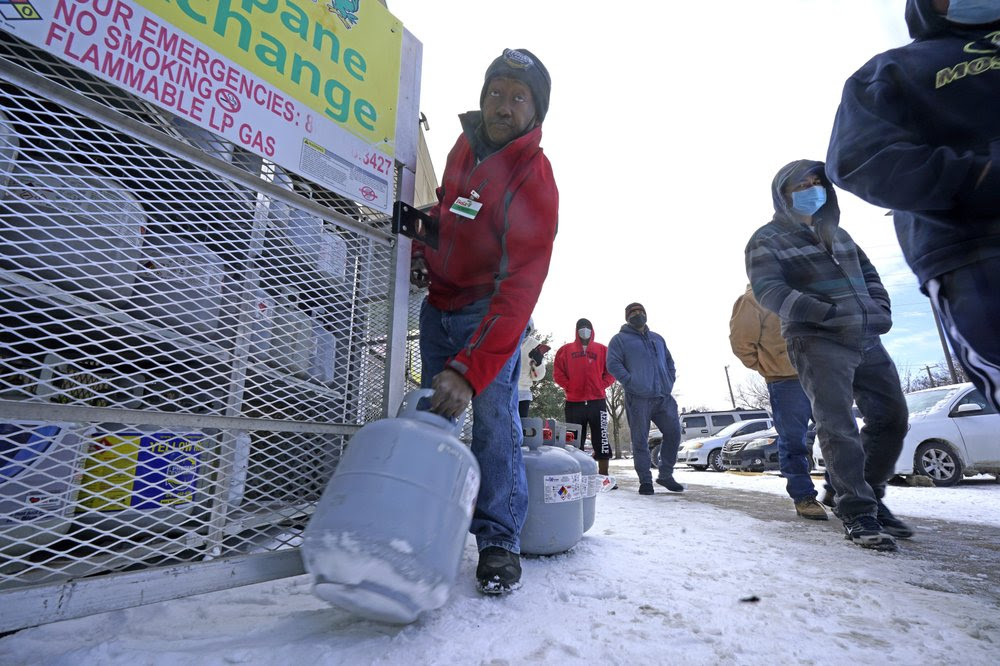
As temperatures plunged and snow and ice whipped the state, much of Texas’ power grid collapsed, followed by its water systems.
Tens of millions huddled in frigid homes that slowly grew colder, or fled for safety.
Images of desperate Texans circulated worldwide. To some, they evoked a less wealthy or self-regarding place. To others, they laid bare problems that have long festered.
More than 35 people in Texas have been confirmed dead. That number is expected to rise as roads cleared and relatives and first responders could check on missing loved ones.
How could this happen in a state that is the nation’s biggest energy producer and home to several of the world’s biggest energy companies?
The disaster can be traced to mistakes by Texas’ leadership and faults created by decades of opposition to more regulations and preparation.
Basically, the state is an island in the U.S. electrical system. There is one large grid covering the Eastern half of the country, another for the West, with Texas wedged between them.
Hospitals in U.S. South: They are grappling with water shortages as the region carries on with recovery efforts in the wake of the devastating winter storm. At the height of the storm, hospitals were left scrambling to care for patients amid record cold, snow and ice. The storm was especially damaging in parts of the country more accustomed to going through winter with light jackets and short sleeves. The icy blast ruptured water mains, knocked out power to millions of utility customers and contributed to at least 76 deaths. Juan Lozano, Jonathan Matisse and Adrian Sainz report.
EXPLAINER: Why some Texans are getting sky-high energy bills. The surge in pricing is hitting people who have chosen to pay wholesale prices for their power, which is typically cheaper than paying fixed rates during good weather, but can spike when there’s high demand for electricity. Many of those who have reported receiving huge bills are customers of electricity provider Griddy, which only operates in Texas.
That began on his first day, when Biden appeared at the Resolute Desk in the Oval Office wearing a mask.
The Democrat framed his first month as a time to start to “heal the soul” of the nation and restore the White House as a symbol of stability and credibility.
Biden has set out to demonstrate that the days of a seat-of-the-pants presidency are over.
He wants to show that the inflationary cycle of outrage can be contained. That things can get done by the book. That the new guy can erase the legacy of the “former guy.”
From the Earth’s climate and the Iran nuclear deal to what’s not on his desk (Trump’s button to summon a Diet Coke), Biden has been purging Trumpism however he can in an opening stretch that is wholly unlike the turmoil and trouble of his predecessor’s first month.
Protesters gathered in Myanmar’s biggest city despite the ruling junta’s thinly veiled threat to use lethal force if people answered a call for a general strike opposing the military takeover. Hundreds had gathered at a major intersection in Yangon after a group advocating civil disobedience called for people to unite for a “Spring Revolution.” Roads were blocked in front of landmarks like the Myanmar Central Bank and U.S. Embassy, and trucks overnight blared warnings against public gatherings. A junta statement carried on state TV said the protesters were carrying people “to a confrontation path where they will suffer the loss of life.”
U.S. federal aviation regulators ordered United Airlines to step up inspections of all Boeing 777s equipped with the type of engine that suffered a catastrophic failure over Denver Saturday. Pieces of the casing of the engine rained down on suburban neighborhoods. United says it is temporarily removing those aircraft from service. Boeing has recommended aircraft with the engines be grounded pending a decision on inspections. The announcements came after United Airlines Flight 328 had to make an emergency landing at Denver International Airport after its right engine blew apart just after takeoff.
The head of the United Nations’ nuclear watchdog says that Iran will begin offering its inspectors “less access” but will still allow the agency to monitor its atomic program. Rafael Grossi made the comments on arrival in Vienna late last night. He was careful to say that there still would be the same number of inspectors, but there would be “things we lose.” He did not offer many specifics, but Iranian Foreign Minister Mohammad Javad Zarif said that would include blocking the International Atomic Energy Agency from accessing footage on its cameras at nuclear sites.
New Zealand lowered its flags and made special note of those who couldn’t travel as it marked the 10th anniversary of the Christchurch earthquake that killed 185 people. Hundreds of people attended an outdoor service in Christchurch, which continues to rebuild from the magnitude 6.3 quake that destroyed much of the downtown. A separate service was also held in the northern Japanese city of Toyama, home to 12 students who died in the quake. Speaking at the Christchurch ceremony, New Zealand Prime Minister Jacinda Ardern said it was important to remember that 87 of the victims were foreigners and many of their families couldn’t be there because of coronavirus travel restrictions.
The U.S. death toll from the coronavirus topped 500,000 on Sunday, according to an NBC News tally — a milestone that underscores the grave threat the virus still poses even as more people are vaccinated.
The coronavirus has killed more than 2,462,000 people worldwide, according to data compiled by Johns Hopkins University. More than a fifth of all deaths worldwide have occurred in the the U.S., which has less than 5 percent of the global population.
NBC News’ tally showed that about 500,700 people had died of Covid-19 as of midnight Sunday ET. The number rivals the populations of Atlanta and Sacramento, California.
More than 28,206,600 cases have been confirmed in the U.S., according to the NBC News tally. The average number of daily new cases has declined in recent days, however. The number fell below 100,000 on Feb. 12 for the first time in months.
Family and friends attend the funeral of Humberto Rosales, who died from Covid-19 complications, at Memorial Pines Cemetery in Santa Teresa, N.M., on Dec. 3.Paul Ratje / AFP via Getty Images
Public health experts and top government officials have said precautions must remain in place to slow the spread of the virus.
“We are still at about 100,000 cases a day. We are still at around 1,500 to 3,500 deaths per day. The cases are more 2½-fold times what we saw over the summer,” Dr. Rochelle Walensky, the director of the Centers for Disease Control and Prevention, said Sunday on NBC News’ “Meet the Press.”
UK Study: Vaccines ‘Spectacular’ in Preventing Serious Illness
The Covid vaccination programme has been linked to a substantial reduction in hospital admissions, PA Media is reporting. The PA story goes on:
Researchers examined coronavirus hospital admissions in Scotland among people who have had their first jab and compared them with those who had not yet received a dose of the vaccine.
Scientists from the University of Edinburgh, the University of Strathclyde and Public Health Scotland examined data on people who had received either the Pfizer/BioNTech jab or the one developed by experts at the University of Oxford with AstraZeneca.
By the fourth week after receiving the initial dose, the Pfizer and Oxford/AstraZeneca vaccines were shown to reduce the risk of hospital admission from Covid-19 by up to 85% and 94%, respectively, they found.
==============================================
Green Passports’ in Israel
Israel took a large step toward normalcy yesterday, lifting COVID-19 restrictions on a wide range of businesses. The reopening comes with a catch: Only those with a “green passport”—a certificate showing a person has been vaccinated or has recovered from infection—will be allowed entry to gyms, theaters, hotels, concerts, and most synagogues.
The certificate itself, which relies on a QR code, has been criticized for being easy to forge. Israel has administered at least one vaccine dose to almost half of its population.
In related news, two studies of the Pfizer/BioNTech vaccine in Israel showed the treatment reduced transmission of the virus by about 90%, with the majority of the protection coming two weeks after the first shot. Additionally, data released by Pfizer revealed the drug can be stored at normal freezer temperatures, as opposed to the currently required ultracold storage. If approved, the new storage guidelines would dramatically simplify the logistics of vaccine distribution.
Elsewhere, the United Kingdom revealed it is on track to have all adults receive their first vaccine dose by July 31, one month ahead of schedule. The country has opted to extend the time period between doses to 12 weeks rather than the recommended three to four weeks. Some experts worry the strategy will spur dangerous mutations in people with partial immunity.
Today Boris Johnson is going to unveil what the government describes as its “roadmap for cautiously easing lockdown restrictions in England” and this will include the reopening of all schools on Monday 8 March. Here is our overnight preview story.
This is the third time Johnson has laid out plans for the easing of national lockdown in England and he is anxious to ensure that this one will be the last. In many respects his approach is more tentative than it was in May last year, when he launched the original Covid recovery strategy.
But in one at least one respect he is pushing forward more firmly than advisers might like. In Scotland and in Wales, which both went into this phase of lockdown ahead of England, schools are starting to reopen from today, but only for the very youngest pupils. But in England, as Nadhim Zahawi, the vaccination deployment minister told the Today programme, all pupils in England would go back to school.
Yesterday Prof John Edmunds, an epidemiologist who sits on Sage, the government’s Scientific Advisory Group for Emergencies, told the Andrew Marr Show that, if all pupils went back at once, he would expect R, the reproduction number, to rise to “something close to one, potentially slightly above”. (It is currently between 0.7 and 0.9 in England.) Asked if he thought primary schools should reopen first, he accepted that politicians had wider issues to consider, but went on: “Sticking to the epidemiology, yeah, of course it’s always safer to take smaller steps and evaluate.”
First of all, it’s no coincidence that the 8 March date has been chosen because the middle of February is when we offered the vaccine to the top four most vulnerable cohorts, and those who look after them. That is three weeks after that last person has had the first dose, when the protection really does kick in. And so we are being deliberately careful. And, of course, [we are] allowing teachers notice to be able to prepare.
So it’s ambitious, but it’s also careful, and it’s data driven.
BUENOS AIRES, Argentina (AP) — President Alberto Fernández removed Argentina’s health minister Friday after a well-known local journalist said he had been given a coronavirus vaccination preferentially after requesting one from the minister.
The president “instructed his chief of staff to request the resignation of health minister” Ginés González García, who is in charge of the government’s COVID-19 strategy, said a government official, who was not authorized to release the information and spoke to The Associated Press on condition of anonymity.
The firing comes on the heels of reports in recent days that mayors, legislators, activists and people close to political power received vaccine shots despite not being in the priority group of doctors, health personnel and the elderly authorized to receive them.
In a Twitter post, González Garcia said he acceded to the president’s request to step down, but insisted he was forced out over a “misunderstanding.” He said that the “vaccinated people belong to the groups included within the target population of the current campaign.”
Carla Vizzotti, the No. 2 official at the ministry under González García, will take over as minister, the state news agency Télam said.
The stir in Argentina follows an uproar in Peru last week after it was confirmed that more than 400 political officials and other prominent people, including then President Martín Vizcarra, secretly received doses of the vaccine produced by the Chinese pharmaceutical company Sinopharm before health professionals.
González Garcia’s removal came after journalist Horacio Verbitsky, whose stories and columns on a website and on the radio are seen as pro-government, said he called the minister to request a vaccination and González García summoned him to the Health Ministry where he received a Sputnik V vaccine shot Thursday.
“I decided to get vaccinated. I started to find out where to do it. I called my old friend Ginés González García, whom I have known long before he was a minister,” Verbitsky told a local radio station. “I went to the ministry and the team of vaccinators was there.”
Fernández’s government has been harshly criticized for Argentina’s slow vaccination operation. So far, the South American country has received about 1.5 million doses, mostly Sputnik V but also AstraZeneca, insufficient to immunize a population of 40 million.
Argentina has had 2 million people infected by the coronavirus and 50,857 deaths from COVID-19.
AP- In 2010, China, its economy roaring and state companies looking to expand globally, set its eyes on Latin America, a region starved of capital but rich in natural resources the Asian giant lacked. The result: a record $35 billion in state-to-state loans that year.
Fast forward a decade and the once-torrid relationship is starting to mature in ways that suggest China may be growing wary of its once do-no-wrong partner.
For the first time in 15 years, China’s two biggest policy banks — the China Development Bank (CDB) and the Export-Import Bank of China — made no new loans to the region in 2020, capping a multi-year slump driven by Latin America’s worsening economic slide.
The data comes from a new repor t by the Inter-American Dialogue, a Washington think tank, and Boston University’s Global Development Policy Center, both of which have been tracking for years China’s yuan diplomacy in Washington’s backyard.
China’s growing economic and diplomatic influence in the region has worried U.S. policymakers, who have been at a loss to counter its rise. The task now falls to the Biden administration, which has warned that the Chinese footprint in the region is a national security threat. But with China having displaced the U.S. as the top trading partner of several South American nations, catching up will be no easy task.
Meanwhile, the U.S. may have fallen even farther behind during the pandemic, when China donated more than $215 million in supplies — from surgical gloves to thermal imaging technologies — to allies in the region, according to the research. By comparison, the United State Agency for International Development and State Department has provided $153 million. China also conducted clinical trials or plans to manufacture vaccines in five countries — Argentina, Brazil, Chile, Mexico and Peru.
“Without a doubt part of the region’s COVID response has a Chinese face,” said Rebecca Ray, a Boston University economist and one of the authors of the new report. “It’s a missed opportunity for the U.S. but since the bottoming out of American manufacturing in the 1990s, there’s really no way to compete. Many of the same medical supplies China ships to Latin America we buy from China as well.”
But while the pandemic has opened the door to much-welcomed Chinese aid, it’s also made it harder for governments to pay their bills to Beijing. A deep 7.4% recession in the Latin America and the Caribbean last year wiped out nearly a decade’s worth of growth, according to International Monetary Fund data.
With borrowers squeezed, China has taken a hit. Last year, Ecuador negotiated to delay for a year nearly $900 million in debt payments serviced by oil shipments. Venezuela — by far the region’s biggest borrower — is believed to have received a similar grace period. At the same time,
“With the region facing unprecedented challenges, China is unlikely to lend any more for now,” said Margaret Myers, head of the Asia-Latin America program at the Dialogue. “Instead it has to grapple with its own problematic portfolio.”
The slowdown in lending to Latin America reflects a broader, global pullback, as China turns inward to bolster its own recovery efforts amid the pandemic. The ruling Communist Party has lent billions of dollars to build ports, railways and other infrastructure across Asia to Africa, Europe and Latin America in order to expand China’s access to markets and resources.
But Beijing has grown more cautious after some borrowers struggled to repay loans. Officials say they will examine projects and financing more carefully.
The China Development Bank and the foreign ministry didn’t respond to questions about the reasons for the decline in Chinese loans to Latin America.
Even though lending has dried up, Chinese buying of Latin America’s soybeans, iron ore and other commodities remained robust, at an estimated $136 billion. That’s despite a sharp rise of China’s purchases of American farm goods, a promise reached with the Trump administration to end a debilitating trade war.
Chinese state-run energy companies also aggressively bought up at fire sale prices energy assets from exiting Western investors. Overall, Chinese mergers and acquisitions surged to $7 billion in 2020, nearly double the amount of activity in 2019, according to the research.
Among the deals: the sale of Peru’s largest electric company by San Diego, CA-based Sempra Energy to China Three Gorges Corp. Another $5 billion deal giving State Grid Corp. of China control of a major utility in Chile was announced last year but not included in the data because it hasn’t been finalized.
For the region’s leaders, Chinese loans for big ticket infrastructure projects are hard to resist. Interest rates are low and unlike loans from the World Bank and IMF there are fewer strings attached and approval is faster, allowing leaders to tout accomplishments in time for the next election.
Even Colombia — Washington’s staunchest regional ally and a country that was cool to China’s entreaties — recently jumped on the bandwagon. Last year, a consortium including China Harbour Engineering Company broke ground on the capital Bogota’s first metro, a $3.9 billion project. No American firms placed bids for the project, which did not directly benefit from any Chinese loans.
U.S. officials have tried to push back, pointing out that U.S. overseas assistance is longstanding and more transparent.
“Beijing’s assistance in the region is generally aimed at advancing the People’s Republic of China’s commercial or political interests,” the State Department’s Bureau of Western Hemisphere Affairs said in a statement.
In January, at the end of the Trump administration, the U.S. International Development Finance Corporation signed an unprecedented agreement with Ecuador to finance up to $2.8 billion in infrastructure projects, money that it said could be used to “refinance predatory Chinese debt.”
But the DFC’s total funding — $60 billion — pale in comparison to the $1 trillion that China has earmarked for its “Belt and Road” initiative to expand influence around the world.
The U.S. loan package to Ecuador was significant because it also would require the government to privatize oil and infrastructure assets and to ban Chinese technology.
“This definitely would limit China’s influence,” said Myers. “But by burdening future generations with more debt, and encouraging the use of fossil fuels, does it really help Ecuador in the long run? If it doesn’t, then it could backfire against the U.S.”
___
Associated Press writer Joe McDonald in Beijing contributed to this report.
(Reuters) – The Manhattan District Attorney’s Office has subpoenaed a New York City property tax agency as part of a criminal investigation into Donald Trump’s company, the agency confirmed on Friday, suggesting prosecutors are examining the former president’s efforts to reduce his commercial real-estate taxes for possible evidence of fraud.
The subpoena issued to the New York City Tax Commission is the latest indication that Manhattan District Attorney Cy Vance Jr. is looking at the values Trump assigned to some commercial properties in tax filings and loan documents.
Along with information already subpoenaed from creditors, the tax agency documents would help investigators determine whether Trump’s business inflated the value of his properties to secure favorable terms on loans while deflating those values to lower tax bills for those same properties.
New York City Tax Commission President Frances Henn confirmed the subpoena in response to an inquiry from Reuters.
The subpoena likely would compel the agency to provide detailed income and expense statements the Trump Organization would have filed as part of an effort to lower tax assessments on some of its commercial properties, according to people familiar with the commission’s operations. Trump’s holdings include Trump Tower and Trump Plaza.
Those filings typically would include valuations submitted by the company to challenge the market values assigned to Trump’s property by the city’s tax assessors, they added.
Subpoenas also have been issued to at least two creditors that helped finance Trump’s real-estate holdings, Deutsche Bank AG and Ladder Capital Finance LLC, Reuters has previously reported.
Vance’s office declined to comment on the tax commission subpoena. Deutsche Bank also declined to comment. Ladder Capital did not respond to a request for comment. A representative for Trump and a lawyer for the Trump Organization also did not respond to requests for comment.
Vance has not commented specifically on the focus of his investigation but noted in court filings that his office is exploring “possibly extensive and protracted criminal conduct” at the Trump Organization, including possible falsification of records as well as insurance and tax fraud.
Vance’s investigation is the only known criminal probe of Trump’s real-estate business. New York State Attorney General Letitia James is leading a separate civil probe into whether Trump’s company falsely reported property values to secure loans and obtain economic and tax benefits.
The tax commission is New York City’s forum for adjudicating appeals of tax assessments set by the city’s Department of Finance, which manages property tax bills and collections. A spokeswoman for the New York City mayor’s office said the department had not been subpoenaed.
The tax assessments are based on a property’s market value, as determined by the department, so challenges require detailed documentation to show that the assigned value is not accurate, including revenue and occupancy data.
If Trump’s business claimed a substantially lower value for a property in its tax filings than it did in documents it submitted to creditors, the discrepancy could help back up a fraud charge, according to Daniel J. Horwitz, a white-collar defense lawyer who previously prosecuted tax and complex fraud cases during more than eight years in the Manhattan district attorney’s office.
If there’s a “material difference” between the property values claimed in tax filings and the values claimed in loan documents, he added, “that’s fairly compelling.
Guardian (UK) Stacey Plaskett of the US Virgin Islands, was the first delegate from an American territory to hold the position of impeachment manager in the Senate trial of Donald Trump.
Yet Plaskett’s status meant that she was unable to vote for Trump’s impeachment because she has no vote on the floor of the House of Representatives. The US Virgin Islands has no representation at all in the Senate. Its residents cannot even vote for president.
The anomaly illuminates America’s long unaddressed colonial history that leaves five territories floating in constitutional limbo, their residents – most of them people of color – effectively treated as second-class citizens.
But with the impetus of last summer’s protests against racial injustice, and the election of a Democratic president, one of those territories – Puerto Rico – is aiming to become the 51st state of the union. A parallel effort by Washington, District of Columbia (DC), is also closer than ever to its similar goal.
‘It is incredibly important to take a step back and look at who actually has real representation in democracy,” said Stasha Rhodes, campaign manager of 51 for 51, an organization pushing for DC statehood. “If you think about all the players that you mentioned, they all have a common thread: they’re all people of color. Does America have a true democracy if so many people of color are standing outside looking in and are not able to fully participate?”
There are five inhabited US territories: American Samoa, Guam, the Northern Mariana Islands, Puerto Rico and the US Virgin Islands. Apart from American Samoa, people born in the territories are US citizens and pay federal taxes such as Medicare and social security, though not federal tax on locally sourced income. Each territory sends a delegate to the House who can debate legislation and sit on committees but is not able to actually vote.
Puerto Rico was a Spanish colony until 1898 when it fell under US control as part of the terms that ended the Spanish-American war. In 1917 the Jones Act granted Puerto Ricans US citizenship and in 1952 it became a commonwealth of the US – but still without voting rights in American presidential elections.
Over the past half-century Puerto Rico has held six non-binding referendums on its status and last November voted 52%-47% in favor of statehood, a cause boosted by grievance over the federal government’s inadequate response to Hurricane Maria in 2017. In an interview last week with Axios on HBO, Governor Pedro Pierluisi said “Congress is morally obligated to respond” and predicted that a House bill will be introduced next month.
George Laws Garcia, executive director of the Puerto Rico Statehood Council, said: “You have a bunch of unelected individuals making decisions on behalf of the people of Puerto Rico over the desires and ideas and perspectives of the local elected officials, which I think is basically blatant colonialism.
“We had Hurricane Maria and the earthquakes and now Covid and, in all these instances when Puerto Rico needs federal resources, federal support, federal action, we don’t have the capacity to hold elected officials in Washington accountable for what they do because they don’t ever get any votes from Puerto Rico, and that includes the president as well as members of Congress.”
It is Congress that would have to approve the creation of any new state for the first time since Hawaii in 1959.
Republicans have cast the move as an unconstitutional power grab likely to give Democrats two extra seats in the Senate. Martha McSally, then a senator for Arizona, told NBC News last year that should Puerto Rico gain statehood, Republicans will “never get the Senate back again”.
Although Democrats control the House, a statehood bill would face a far tougher passage in the evenly divided Senate, where 60 votes are required to thwart the “kill switch” of a Republican filibuster. Despite progressives pointing to the racist history of the filibuster, key Democrats Joe Manchin and Kyrsten Sinema have already indicating unwillingness to eliminate it.
Garcia added: “The prospects of statehood are incredibly challenging, but they’ve been challenging for every other territory that has ever been admitted as a state. In my lifetime, it’s certainly the best possible odds that we could have.”
Almost all of Puerto Rico’s residents are Hispanic while nearly half of DC’s are African American. But as the nation’s capital, DC comes from a different historical, economic and constitutional perspective.
Its 700,000-plus residents – higher than the populations of Vermont and Wyoming – pay more per capita in federal income taxes than any state. They gained the right to vote in presidential elections in 1961 but still lack a voting member in the House or a voice in the Senate.
The movement for DC statehood is bigger and better organized than ever before. Last June the House passed a bill that approved it, the first time a chamber of Congress had advanced a DC statehood measure. It never stood a chance in the Republican-controlled Senate but Black Lives Matter protests in Washington gave the cause added potency.
A DC license plate reading ‘taxation without representation’. Photograph: Daniel Slim/AFP/Getty Images
Rhodes of 51 for 51 said: “Our most celebrated civil rights leaders were fighting for access to democracy. If you think about John Lewis and Martin Luther King, they were all fighting for access to voting and access to representation and so here in 2021 we’re still fighting in Washington DC for equal representation and a clear chance at participation in democracy.”
One key obstacle was removed when Trump, who had vowed “DC will never be a state” because it would be sure to elect Democratic senators, was beaten in the presidential election by Joe Biden, who has voiced support for the campaign.
Then came the insurrection at the US Capitol on 6 January. Nancy Pelosi, the House speaker, told reporters earlier this month: “If the District of Columbia could operate as a state, [what] any governor can do is to call out the national guard without getting the permission of the federal government. It shouldn’t have to happen that way.”
Eleanor Holmes Norton, DC’s non-voting member in the House, reintroduced the statehood bill last month, while the Democratic senator Tom Carper of Delaware reintroduced his companion statehood bill which currently has 39 Democratic co-sponsors.
Meagan Hatcher-Mays, director of democracy policy for the grassroots movement Indivisible, said: “It’s an issue of basic fairness. DC is not all government bureaucrats and lawyers. There are actual real people who live here, many of whom were tasked with cleaning up the mess of the January 6th insurrection. Those are DC residents and they have no vote in Congress at all and so it would seem to me that it would be a pretty easy lift for every Democrat in the Senate to say that’s wrong.”
Hatcher-Mays, a former aide to Holmes Norton, added: “We need to eliminate the filibuster to make DC the 51st state. This is the closest we have ever been to getting DC statehood and, if it’s going to happen, it’s going to happen this Congress, and it really has to happen or otherwise the Senate is in trouble. It’s really unrepresentative of the country as a whole and making DC a state would go a long way towards fixing that problem.”
The issue has cast light on the democratic deficit of the Senate, where small, predominantly white states get two seats each, carrying as much weight as vast, racially diverse states such as California. In 2018 David Leonhardt, an opinion columnist at the New York Times, calculated that the Senate gives the average Black American only 75% as much representation as the average white American, and the average Hispanic American only 55% as much.
Furthermore, in the 232-year history of the Senate there have been only 11 Black senators and Plaskett was the only elected Black woman at the impeachment trial. In such a context, Republicans’ opposition to statehood has been described as a bid to protect white minority rule.
LaTosha Brown, co-founder of Black Voters Matter, said: “At the end of the day, you have states from Utah to Montana to others that have gained statehood early on with less question, with less critique than DC and Puerto Rico. It is a fundamental democratic flaw and it reeks of hypocrisy. The only reason why it is a debate or even a question is because of who makes up the majority of both of those places.”
A previous bid for DC statehood was defeated in the Democratic-controlled House by an almost 2-1 margin in 1993 with President Bill Clinton reluctant to engage. This time, with Biden making racial justice a priority, the mood is different. There is a sense that Democrats’ control of the White House, Senate and House provides a historic opportunity.
Donna Brazile, a former interim chair of the Democratic National Committee, said: “This is about making America a more perfect union. It’s the oldest constitutional democracy in the world and yet some of its citizens do not have all the full voting rights because of where they reside. If we’re going to end racial injustice in America and talk about a new beginning for the country, we can’t sidestep old issues.”
A spate of pandemic-era violence has shined a light on anti-Asian bias, stoking concerns of division between two minority communities.
Guardian (UK)- A 91-year-old man shoved to the ground in Oakland, California’s Chinatown. A 50-something woman thrown into a set of newsstands in Flushing, Queens. An 84-year-old man fatally assaulted in San Francisco. A recent spate of violence against Asian elders has left many Asian Americans across the country feeling targeted, wondering whether these are random acts of crime – or fueled by anti-Asian bias.
The attacks have shaken Asian immigrant communities already struggling after a year of pandemic-related challenges, including racist taunts of “kung flu” or “China virus” and economic devastation for Chinatowns and other immigrant communities – and four years under an administration whose trade war with China fueled xenophobia.
Some, including Asian movie stars and celebrities, have called for greater recognition of the racism that targets Asian Americans. Some have demanded quick police action. And some have pointed the finger, not at the white political leaders who have long trafficked in xenophobic rhetoric, but at another minority group.
The suspects in some of these attacks were Black men, and some Asian Americans have responded with stereotypes of their own, blaming supposed anti-Asian sentiment from the Black community for the crimes. This narrative, which has not been supported by evidence, has nevertheless shoved a new wedge into age-old cracks between Black and Asian immigrant communities in the US.
“People want to have a Black villain and scapegoat,” said Carroll Fife, a longtime San Francisco Bay Area activist and Oakland city councilmember, who is Black. “People are right and justified to feel beset upon because Asian folks are othered in America. But you can’t fight racism with racism.”
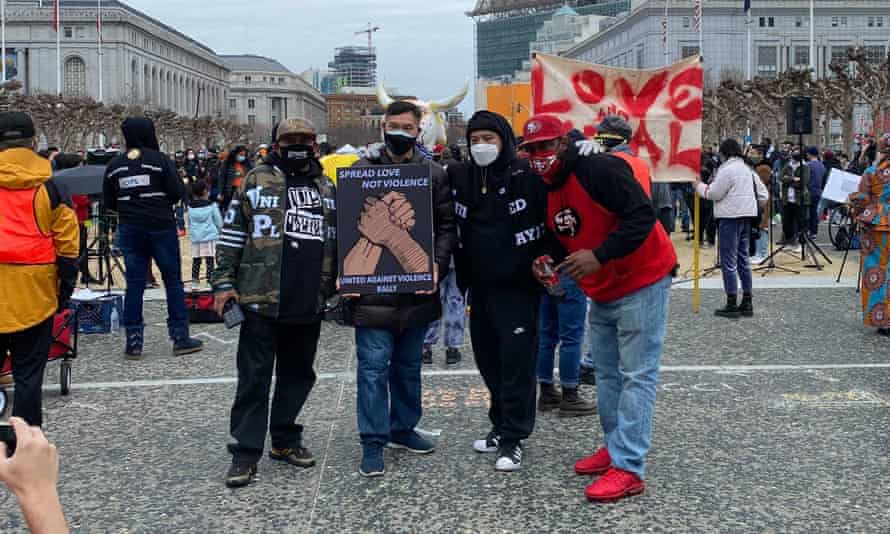
Organizers in the Asian and Black communities have been quick to denounce this rhetoric and call for solidarity. Last weekend, hundreds gathered in the Bay Area to call for solidarity and pay homage to the victims, wearing shirts emblazoned with “Black and Asian unity”.
People gather in San Francisco in a call for solidarity. Photograph: Vinny Eng
“Supporting our Asian community is not about dividing us. This support is for all of us suffering under white supremacy. We need to understand that so we can triumph and have public and personal safety,” said Eddy Zheng, an Oakland organizer and youth counselor.
But the issue is complicated and plucks at years of racial divisions.
Some Asian Americans are frustrated that discussion of attacks on Asians are being used as a teachable moment to discuss anti-Black racism. Others agree with Black Lives Matter activists that calling for more policing is the wrong approach to increasing community safety, and poses a threat to people of color.
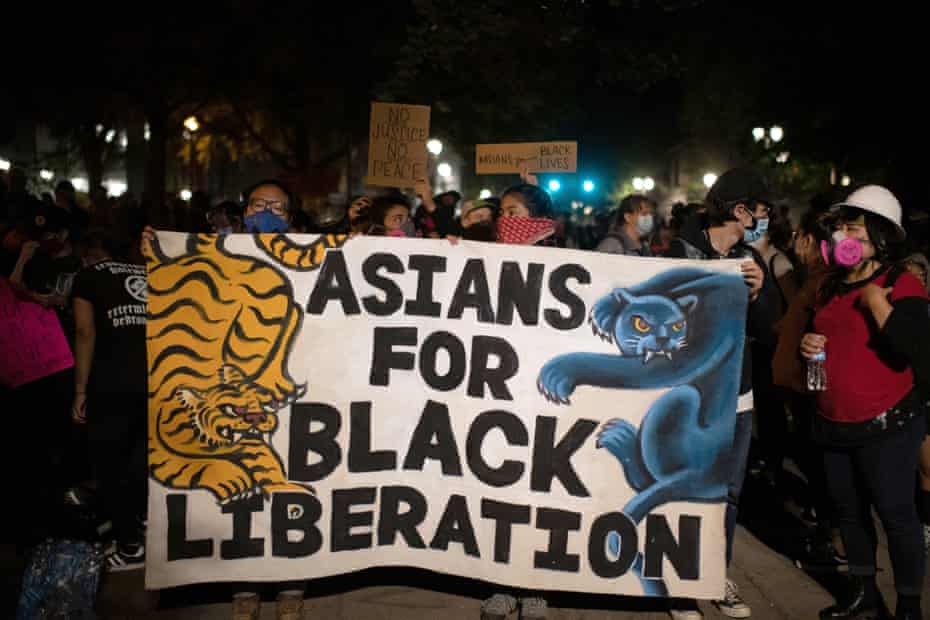
Organizers in both communities are now battling to balance the pursuit of justice for the crime victims with the broader goals of fighting racism in the US and increasing understanding and solidarity between Asian and Black communities.
“We all need to understand that it is possible to hold multiple realities at once,” said Cynthia Choi, co-executive director of Chinese for Affirmative Action in San Francisco. Communities can uplift and support the survivors of these attacks, she said. They can acknowledge complicated – and, at times, racist – feelings and educate people on the origins of racial divisions within each community without pitting communities of color against one another.
“I lived in Los Angeles in the aftermath of the civil unrest [the 1992 Rodney King riots and widespread destruction of Korean American businesses],” Choi said. “The lesson that keeps coming up for me is that this powder keg that is always about to ignite is by design. And if you don’t offer people the ability to live and to have opportunities and to see hope and to be able to take care of themselves, we’re going to continue to see generational cycles of violence.”
Thousands of accounts of hate crimes
In late January, a video of a man shoving a 91-year-old Asian man to the sidewalk in Oakland’s Chinatown went viral, with high-profile Asian Americans such as the actors Daniel Dae Kim and Daniel Wu posting about the attack on social media and offering a $25,000 reward for information leading to an arrest. With the attention, celebrities highlighted the killing of 84-year-old Vicha Ratanapakdee, a Thai grandfather who died after a teenager allegedly shoved him to the ground in San Francisco a week earlier. Both attacks appeared unprovoked.
The stories kept coming. A 64-year-old woman assaulted and robbed of her Lunar New Year money in San Jose. A 70-year-old woman robbed leaving a bank in Oakland. Local reports estimate that there have been at least 20 robberies or violent incidents in Oakland’s Chinatown within a two-week span.
These attacks took place as Asian Americans reported more than 2,800 first-hand accounts of hate crimes between late March and 31 December, everything ranging from being coughed and spat on to having “kung flu” shouted at them in grocery stores.
But while many perceive an increase in anti-Asian racism and violence, there is no evidence as yet to support the idea that recent Bay Area victims were targeted because they were Asian. Antoine Watson, 19, was arrested for the assault on Ratanapakdee and charged with murder and Yahya Muslim – who the Alameda County public defender says is homeless and struggling with mental health issues – was arrested for assaulting several people in Chinatown, including the 91-year-old. So far neither has been charged with a hate crime.
“Connecting this case to a rise in racist violence against Asian Americans is not appropriate,” the Alameda county public defender, Brendon Woods, said of the Oakland assaults.
The lack of evidence has not prevented some Asians from ascribing the assaults to anti-Asian bias. “It is becoming alarmingly clear to me now that attacks against our elderly are not isolated incidents,” tweeted the actor Simu Liu.
For some Asian elders in the Bay Area, memories of a decade-old spate of attacks on Asian elders in the city’s majority-Black Bayview district is fueling fears and bias. “It wasn’t always robbery or crimes of opportunity. The community felt they were racist hate-filled crimes, like knocking seniors onto Muni tracks. It was a very ugly situation,” said Adrienne Pon, executive director of San Francisco’s office of civic engagement and immigrant affairs.
It’s through that lens that some in the Asian community find themselves faced with uncomfortable conversations.
Before last year, Max Leung centered his advocacy on anti-Black racism. He was jailed after protesting against police brutality and went on a hunger strike in solidarity with the “Frisco Five”, who demonstrated outside the Mission police station demanding justice for people of color killed by San Francisco police officers.
But now he finds himself struggling in discussions with scared Asian elders and survivors of trauma ask him why they’re being targeted – and specifically, now, why they think they’re being targeted by Black people.
“No matter how you bring it up, the Asian community gets silenced and that frustration becomes internalized,” Leung said. “What about us? What about our frustration and our issues? You can’t be anti-racist without also acknowledging the Asian American experience.”
‘It’s about looking at the root cause’
Eddy Zheng, the Oakland organizer, however, has been watching this discourse play out and wondering how he, at the age of 10 growing up in the Guangdong region of southern China, had never met a single Black person yet was familiar with the derogatory Cantonese slang for Black people.
“For these communities, they’re just focusing on the harm and trauma they experienced without understanding the origins of this country and white supremacy,” Zheng said.
Betty Louie, an adviser to the San Francisco Chinatown Merchants Association, remembered that back when she had owned gift shops in the neighborhood, 25 years ago, “we would always be suspicious of the Black people who would walk in”. Then one day, a Black man decided to write her a letter about how it felt to be racially profiled in her store.
She felt awful. “I wrote him back,” Louie said. “He wrote back, and we just listened to each other.”
Organizers, activists and academics have repeatedly said that it is white supremacy, a system that oppresses non-white groups, that is at the crux of these racial divisions. It was white supremacy that created the model minority myth around Asians and allowed a hierarchy of races to come to be. It was white supremacy that redlined Black Americans into poorer neighborhoods and forced Asian immigrants into their space, creating tension over a scarcity of housing and resources.
A Black Lives Matter demonstration in Portland in July. Photograph: Mike Logdson/RMV/Rex/Shutterstock
But it’s not just white supremacy that pits the two communities against each other, it’s anti-Blackness, said Claire Jean Kim, a professor at the University of California, Irvine, who is currently working on a book titled Asian Americans in an Anti-Black World. Anti-Blackness is “everybody elevating everybody who is not Black and putting people who are black at the bottom”, Kim said. “Asian Americans are put in the position in that they are not white and not Black. The power of that is that there is a structural gap between Asians and Blacks,” she said.
This structural gap has become a crisis point repeatedly. There were the 1992 Rodney King riots. There were the international demonstrations in support of Peter Liang, the New York police officer who was convicted of fatally shooting an unarmed black father, Akai Gurley. Some in the Asian community believed he was being scapegoated.
Advocates and organizers confronting these divisions are working to prove that multiple truths can exist at the same time. Asians have been attacked and communities from all sides must rally around them, they said. The perpetrators in these crimes must be held accountable and uncomfortable conversations need to take place in all communities. And the only way to truly solve this violence is not by fighting, or by arguing who is discriminated against more, but by educating each other on the origin of structural racism and ending the cycle of violence.
“It’s the easiest thing in the world to say this is about Black criminality. It’s what we’ve been trained as a culture to say,” Kim said. “If we care about social justice, it’s not just about uplifting Asian people. It’s about looking at the root cause.”
Following the Oakland Chinatown attacks, more than 40 Bay Area Asian American organizations issued a joint statement that acknowledged a need for “cross-community education and healing in Asian American and Black communities that humanizes all of us rather than demonizes or scapegoats any community of color”.
The groups also strongly pushed for a public safety solution that was not rooted in law enforcement. Here, divisions arise again. Some members of the Asian community seek more of a police presence because they fear violence while members of the Black community fear for their lives with more police on the streets.
“It’s hard because we want people to really center it on survivors of violence, and how do we validate their feelings and fear?” said Zheng. “Accountability is important. When they say we want more cameras and surveillance and more police, they feel like that’s accountability for the people inflicting the harm, while we understand that hurt people hurt people.”
Nikki Fortunato Bas, the Oakland city council president, says she is working to build a community ambassador program akin to the one in San Francisco that features a group of unarmed people walking through neighborhoods and escorting seniors on their errands. Bas hopes the program can be a good example of ensuring public safety with minimal police involvement.
Meanwhile, violence against Asians continues across the country. Some of the suspects have been Black. Some of them have not. It’s exhausting for Asian Americans to keep having to bear witness. It’s exhausting for organizers to have to keep fighting off both anti-Asian and anti-Black racism in both communities.
But it’s also a moment.
“To me, this is an incredibly invigorating time because we’re finally talking about this,” said Cynthia Choi with Chinese for Affirmative Action. “I have three young daughters, and we talk all the time about how this is happening, what is our responsibility, the cultural work that is going to be necessary. We need to address the anti-Asian racism and we need to address the anti-Black racism. We need to hold all those things at the same time and not be against each other.”
BASSETERRE. St. Kitts — The effects of COVID-19 are felt globally, and many persons are seeking ways to minimize these effects on themselves and their families. Through a collaborative initiative – the backyard garden competition – between the Ministry of Tourism and the Ministry of Agriculture in St. Kitts is well on its way to helping with the fight against the negative effects of the Novel Coronavirus through gardening.
The backyard garden initiative seeks to mitigate the effects felt by nationals through several means, according to Kyle Flanders, Assistant Secretary in the Ministry of Agriculture.
“Providing food security is one of the many advantages of having a backyard garden,” explained Flanders. “Backyard gardens can be used to make sure that people have nutritious meals and food at their fingertips. Backyard gardens also alleviate hunger and its side effects.
“Having a backyard garden minimizes the onset of food insecurity,” said Flanders. “Due to job loss, some individuals be unable to maintain a consistent supply of healthy and nutritious food to feed their families, or have their eating patterns changed due to the lack of money. By engaging in the backyard garden competition, individuals can provide food for their family and food for the country if there is a surplus.
“COVID-19 and its impact in changing lifestyles have contributed to the rise in mental distress for many,” explained Flanders. “Participation in the backyard garden competition is one way to minimize stress and thereby contributing to the mental well-being of the gardener.”
“Farming in general increases life’s satisfaction, the quality of life and builds a sense of community,” explained Mrs. Therez Ambrose-Versailles, Tourism Research Officer in the Ministry of Tourism, citing findings of a study conducted by the International Association of Horticulture,
Mrs. Ambrose-Versailles pointed out that, through gardening, people are exposed to a productive way to lessen their stress while reaping the benefits of maintaining physical fitness.
BASSETERRE, St. Kitts — Caribbean Community (CARICOM) Foreign Ministers met virtually on February 19 with their Canadian counterpart, the Hon. Marc Garneau, in the first virtual CARICOM-Canada Meeting of Foreign Ministers. St. Kitts and Nevis was represented by Foreign Minister, the Honourable Mark Brantley.
Their dialogue focused on the COVID-19 pandemic and equitable access to vaccines, economic recovery and inclusive growth, and climate resilience and sustainability – all key elements in the region’s efforts to build back better.
In leading the discussion on COVID-19: “Building Back Better,” Foreign Minister Brantley thanked the government of Canada for its assistance in helping to strengthen the region’s ability to respond to the range of challenges posed by COVID-19 by the provision of Personal Protection Equipment.
Ongoing support was offered by the Pan-American Health Organisation (PAHO) and the Caribbean Public Health Agency (CARPHA). Hon. Brantley stressed that “if ever there was a time for real dialogue to jointly address pressing issues in ways that will bring concrete benefit to our citizens, that time is clearly now.” He highlighted three critical and actionable areas for cooperation including health systems, vaccine access, and economic impact.
Noting that the “COVID damage is deep, the recovery will be long, and the vision must be bold,” Brantley sought to bring a sense of purposeful urgency for cooperation in addressing the global pandemic. He championed the idea of moving beyond old development paradigms to more “substantive cooperation for sustainable development” including in green investments, renewable energy, and the blue economy.
Given the profound impact of the pandemic on the travel and tourism industry in St. Kitts and Nevis, Minister Brantley seized on the opportunity to call for “the resumption of flights from Canada at the earliest possible opportunity,” and the continuation of the technical dialogue that began last year between Canada and CARICOM on safe travel and tourism.
 *****@
 *****@


Guardian (UK) Stacey Plaskett of the US Virgin Islands, was the first delegate from an American territory to hold the position of impeachment manager in the Senate trial of Donald Trump.