Tag Archives: caribbean

Chaos Mars Afghan Evacuation Efforts; Biden Criticism Builds

The Hill

Violence on the road to Kabul’s airport and chaos at the gates are hampering efforts to evacuate Americans and vulnerable Afghans looking to flee the country following the Taliban takeover.

Adding to the mayhem is mixed messaging from the State Department, which is urging Americans and those with travel documents to head to the Hamid Karzai International Airport “as soon as possible” even though the U.S. Embassy alerted people that it could not guarantee safe passage.

People who make it past the gantlet of Taliban checkpoints report being turned away amid surging crowds that U.S. forces are trying to disperse.

The number of Americans in Afghanistan is believed to be between 10,000 and 15,000, with more than 80,000 Afghans who likely qualify for evacuation based on their work with the U.S. military and government.

The U.S. has so far only evacuated a fraction of those people.

Government officials from the National Security Council and the Department of Defense (DOD) told congressional staffers on a call Thursday that they have evacuated 6,741 individuals since Saturday, of which 1,792 are American citizens or lawful permanent residents.

“Which of course is absurd because we heard from DOD they could do up to 9,000 a day,” said one congressional staffer who spoke to The Hill after the call.

The U.S. military this week pledged to start evacuating 5,000 to 9,000 people per day.

“The latest report we heard was there are 10,000 to 15,000 American citizens in the country, so less than 20 percent are out, basically,” the aide said.

The staffer relayed that administration officials expressed distress over the deteriorating conditions, with one administration official saying, “conditions are awful and we are not blind to that.”

Another congressional aide said the Biden administration is “doing their best but they’ve been overwhelmed by folks in need of help.”

“You saw the announcement they sent for American citizens and green card holders that they should make their way to the Kabul airport — but as you know getting to that airport is a major challenge, with the Taliban controlling the way in,” the second aide said.

At the State Department briefing Thursday, Press Secretary Ned Price said there are 6,000 people “processed into the airport”  — a figure roughly matching the number of troops at Kanbul’s airport — while 20 planes are scheduled to take off between today and tomorrow.

Photos and video on social media show massive crowds outside the airport. One video showed a child passed through the crowd and handed over a security wall to a U.S. soldier.

An American citizen who reached the airport Wednesday evening provided a photo to The Hill of the massive crowds.

Further video showed Afghans on the road to the airport cowering in a roadside trench amid an eruption of massive gunfire.

An Afghan man sent me this video which he said was raked outside Kabul airport today. How are Americans and Afghans supposed to get through this? pic.twitter.com/PjRTvof5p5

Situational reports from a nongovernmental organization obtained by The Hill describe havoc at the airport, with entry gates inconsistently opening and closing.

“There remain so many people at the entrances to the airport that soldiers have been told to keep the gates closed, and pretty much not let anyone in,” according to a report from the National Democratic Institute. “Some checkpoints on the airport perimeter currently have no comms with the airport, thus no way of being able to verify persons requesting entry should be allowed.”

Sunil Varghese with the International Refugee Assistance Project (IRAP) said the government needs to quickly gain control and streamline the process.

“DOD and State are pointing the finger at each other and someone has to step up,” he said.

“And all of this hinges on the Taliban letting people wait at the airport so I just really hope the USG is working on some sort of plan so that an evacuation doesn’t turn into a massacre.”

People must run a gantlet of Taliban checkpoints to get to the airport, with reports of beatings, whippings and intimidation. Those fleeing must hide critical documents needed to get on a flight to get past the Taliban.

Sen. Tom Cotton (R-Ark.), a member of the Senate Armed Services Committee whose staff is helping aid evacuation efforts, said the situation outside the airport is “getting worse by the day.”

“My office has received numerous reports of American citizens and Afghan allies being harassed, beaten, and abused by Taliban thugs. These reports are in addition to the televised scenes of chaos at the airport perimeter,” he said in a statement.

He called for President Biden to expand the security perimeter around the airport to “rescue Americans trapped behind enemy lines.

“Anything less amounts to an abandonment of our fellow Americans and a shameful abdication of duty in a moment of crisis.”

Adding to the chaos are unsanitary conditions, with toilets and trash backing up. People have been told to bring their own water and be prepared to wipe their phone of data in encounters with the Taliban.

Melissa Keaney, a senior staff attorney also with IRAP, said that there is no real strategy in getting through Taliban checkpoints.

“Some of the advice is to actually have your [U.S.] documents, because the Taliban is not letting you through unless you show that you are a U.S. citizen or you’re entitled to get on an evacuation flight. Other pieces of advice that I’ve seen have indicated the exact opposite, that you should not have any of those types of documents with you,” she said.

The State Department says it is surging resources at the airport to evacuate Americans and vulnerable Afghans. Former ambassador to Afghanistan John Bass was sent to the airport to help with logistics around evacuations. Chargé d’affaires Ross Wilson remained at the airport with an embassy team even as the majority of staff were evacuated from the country.

Biden has committed to keeping American troops at the airport until every American who wants to leave is evacuated, pushing back against a tentative deadline of Aug. 31 that had been discussed with the Taliban.

The president has not yet offered those same commitments to evacuate Afghans who assisted the U.S. military and are in the process of applying for Special Immigrant Visas (SIVs), or vulnerable Afghans in general.

“If Biden does not keep the evacuation going long enough to get all of the people who have applied for SIVs and were hung up because our process has been slow and incompetent, than he is morally derelict,” said Ronald Neumann, president of the American Academy of Diplomacy and who served as ambassador to Afghanistan from 2005 to 2007.

The post Chaos Mars Afghan Evacuation Efforts; Biden Criticism Builds appeared first on The St Kitts Nevis Observer.

Bahamas: Cruise Passengers Will Have to Show Vaccination Proof

Cruise passengers heading to the Bahamas will soon have to show proof of vaccination before docking at a port — including on a cruise line’s private island.

Starting Sept. 3, cruise ships will not be able to dock in the Bahamas unless all passengers 12 and older supply proof they are fully vaccinated, according to an emergency order issued Thursday and posted to the Bahamas Customs & Excise Department website. The order will be in effect through at least Nov. 1.

To comply, ship captains must submit the passenger manifest with the passenger’s vaccination status, including when a ship stops at a cruise line’s private island in the country.

The order does not apply to crew members, children under 12, or anyone who is ineligible for the COVID-19 vaccine due to a medical reason.

Royal Caribbean — which saw several guests test positive for COVID-19 on cruises sailing from the Bahamas last month — will require all guests 12 and older be fully vaccinated on cruises visiting the island nation starting Sept. 3, including those leaving from Florida, according to the company. Previously, Royal Caribbean required all guests 12 and older to show proof of vaccination before boarding nearly all cruises except those leaving out of Florida.

The post Bahamas: Cruise Passengers Will Have to Show Vaccination Proof appeared first on The St Kitts Nevis Observer.

UK Approves First-of-Its-Kind Antibody Treatment for COVID-19

illustration of monoclonal antibodies

A monoclonal antibody (mAb or moAb) is an antibody made by cloning a unique white blood cell.

Ronapreve, the first drug designed specifically to tackle covid-19, gets approval

The UK has approved the first treatment to use artificial antibodies to prevent and fight the coronavirus. According to The Medicines and Healthcare products Regulatory Agency (MHRA), the drug may be used to prevent covid-19 infection, treat acute symptoms of the disease and reduce the likelihood of being admitted to hospital due to the virus. Sajid Javid, UK Health Secretary, said that he hoped it would be rolled out to patients soon.

Trials of the drug, called Ronapreve, took place before widespread vaccination and before the emergence of virus variants. The drug, previously known as REGN-Cov2, was given to former US president Donald Trump when he was admitted to hospital with covid-19 last year.

Ronapreve, developed by pharmaceutical firms Regeneron and Roche, is given either by injection or infusion and acts at the lining of the respiratory system, where it binds tightly to the virus and prevents it from gaining access to the cells, the MHRA said. It consists of monoclonal antibodies, proteins produced in the lab that mimic antibodies found in the immune system.

Astra Zenica will be seeking approval for its own monoclonal COVID antibody drug.

The post UK Approves First-of-Its-Kind Antibody Treatment for COVID-19 appeared first on The St Kitts Nevis Observer.

Gangs in Haiti are Abducting Doctors- Patients are Paying the Price


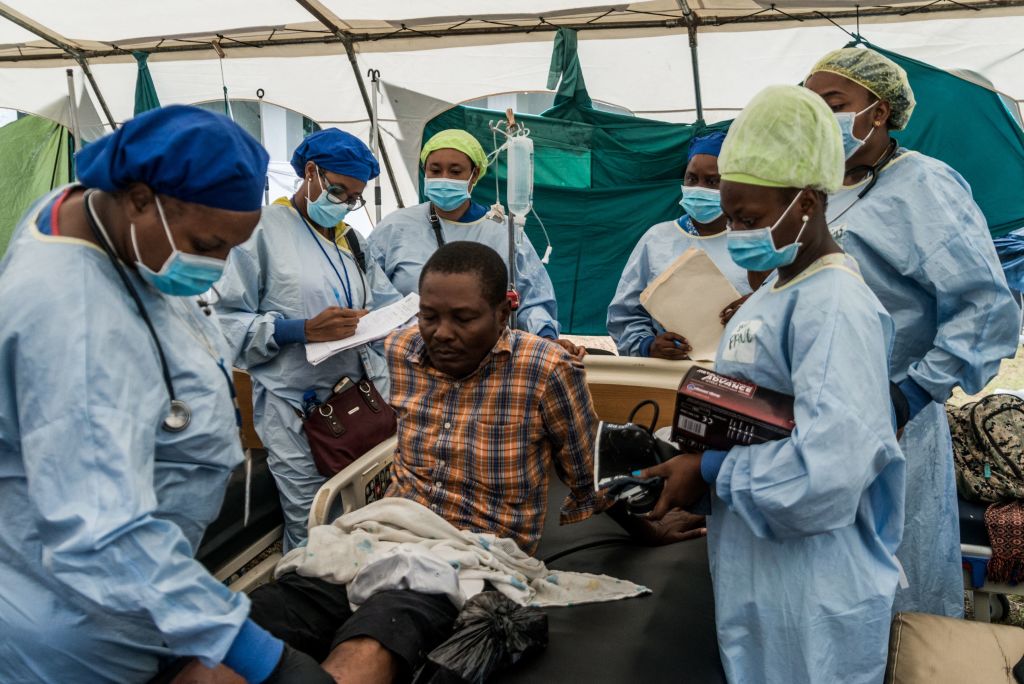
The Week- One of the few orthopedic surgeons in Haiti was abducted by gang members Wednesday in Port-au-Prince, leaving dozens of patients injured during Saturday’s 7.2-magnitude earthquake without anyone to treat them.

The victim, Dr. Workens Alexandre, works at the Bernard Mevs Hospital, where 45 of its 48 patients are waiting to have orthopedic surgery, The Associated Press reports. There has been an increase in gang violence in Haiti this year, and one official at the hospital told AP some health care workers, worried about their safety while driving to and from the hospital, have been staying on site for several days at a time.

On Tuesday, an obstetrician on his way to perform an emergency cesarean in Port-au-Prince was abducted by gang members, and because he was unable to get to the hospital, his patient and her baby died. Dr. Ronald La Roche, founder of the DASH network of hospitals, told AP he is “furious” at the gang members, adding, “They are responsible for the death of this woman and her child.” In protest of the abductions, La Roche said his hospitals will be closed for two days to non-emergency cases.

The death toll for the earthquake is close to 2,200, and that number is expected to rise. More than 12,000 people were injured, leaving hospitals already dealing with COVID-19 patients overwhelmed. AP reports that the families of the abducted doctors have been contacted by the kidnappers, but it is unclear how much they are asking for ransom.

The post Gangs in Haiti are Abducting Doctors- Patients are Paying the Price appeared first on The St Kitts Nevis Observer.

Trouble in Paradise: COVID-19 in French Polynesia Surpasses Deadly Surge in Caribbean

President Emmanuel Macron visited French Polynesia last month.
President Emmanuel Macron visited French Polynesia last month. AFP – LUDOVIC MARIN


Staff at the hospital in Taaone, Papeete, the capital of French Polynesia, have been forced to install two dozen beds in the entry hall to the establishment, currently submerged by a wave of coronavirus victims.

The rate of infection in the Pacific island chain far exceeds the 1,700 cases per 100,000 reported last week in Guadeloupe, and the 1,200 per 100,000 in Martinique, both described as requiring urgent action by French Health Minister, Olivier Véran, on his visit to the Antilles last week.

The coronavirus appeared to have been banished from French Polynesia, with practically no local infections reported between March and June.

The Delta variant has dramatically changed that picture, with 2,731 cases now being reported for every 100,000 inhabitants. On Wednesday, there were 303 new hospital admissions, 38 to emergency care, and 11 deaths.

Schools on the archipelago re-opened last week. Some establishments have been forced to close because of the high number of infections.

Weekend lockdown and extended curfew

Polynesians are currently subject to a weekend lockdown and a 9PM to dawn curfew.

Less than one-third of the population has been fully vaccinated against Covid-19.

According to Dr. Jacques Raynal, the local health minister, “98 percent of those needing emergency care” have not been inoculated.

Earlier this month, a wedding party at a French Polynesian restaurant was attended by hundreds of people — including top local figures — in defiance of existing rules and with no one wearing masks.

“We were not exemplary and I am infinitely sorry,” said the territory’s president Edouard Fritch, who was seen playing the guitar in images of the party that shocked many Polynesians. The mayor of the capital Papeete, Michel Buillard, was pictured providing the vocals.

The Indian Ocean island of La Réunion also remains in partial lockdown, a measure which has prompted protests and led to scuffles with the security forces.

In sharp contrast, the French overseas territories of New Caledonia, Saint-Pierre-et-Miquelon and Wallis et Futuna are currently reporting no Covid cases.

The post Trouble in Paradise: COVID-19 in French Polynesia Surpasses Deadly Surge in Caribbean appeared first on The St Kitts Nevis Observer.

Jamaica Mandates 7 Days of Total Lockdown Amid COVID-19 Spike

CNW- Prime Minister Andrew Holness announced the seven days of “no movement” during a press conference on August 19, one day after the Ministry of Health and Wellness confirmed that the delta variant was spreading among the population.

The no-movement days announced by the prime minister are Sunday, August 22; Monday, August 23; Tuesday, August 24; Sunday, August 29; Monday, August 30; Tuesday, August 31; and Sunday, September 5.

During these days, only essential workers will be allowed to leave their homes and only essential services such as pharmacies and hospitals will still be allowed to operate. All other persons will have to work from home.

“We have to prevent further transmission and the most effective way of slowing down transmission is to have a complete halt at a point. Stop movement. That’s what it comes down to simply,” Holness said.

Holness said that outside of the no-movement days the nightly curfew will begin at 7:00 pm and end at 5:00 am the next day, except on Saturdays when the curfew begins at 6:00 pm.

He noted, however, that to facilitate the implementation of the new measures, the curfew will be extended on Friday, August 20 and Saturday, August 21.

From August 25 to September 7, no funerals will be allowed to take place and burials will have a maximum capacity of 15 persons.

“The tighter measures we have introduced are necessary because our rising case numbers and hospitalisations are beyond the capacity of our public health system. I urge all Jamaicans to co-operate and to do their part. We all need to work together to get this third wave under control so that we can start opening schools,” Holness said.

Earlier today, Jamaica received some 208,000 doses of vaccines from the United States. Holness said the country currently has sufficient supply to substantially increase the country’s vaccination numbers.

The Prime Minister also warned that if the cases continue to spike through lack of compliance, “we will have no choice but to introduce further measures to restrict movement which will inevitably have an adverse impact on the economy and our livelihoods.”

The post Jamaica Mandates 7 Days of Total Lockdown Amid COVID-19 Spike appeared first on The St Kitts Nevis Observer.

Brazil to Send Humanitarian Earthquake Aid to Haiti

Brazil will send humanitarian aid to Haiti in the wake of last week’s devastating earthquake, the Brazilian Ministry of Foreign Affairs announced.

“Brazilian government decided to send a multidisciplinary humanitarian mission to Haiti on board of a cargo aircraft KC-390 Millennium of the Brazilian Armed Forces. The departure is scheduled for the next weekend,” the statement read.

The humanitarian mission will include rescue teams, specializing in urban search and rescue operations. Kits of medical supplies will also be sent, the foreign ministry added.

On 14 August a deadly 7.2 magnitude earthquake swept Haiti, with death toll topping 2,000 people. Over 12,000 people sustained injuries of different degrees of severity, and over 300 people are still not accounted for. Many countries, including the United States, EU members, Canada, Mexico, Venezuela sent humanitarian missions to Haiti, but up to 600,000 Haitians still require emergency assistance, according to the country’s authorities.

The post Brazil to Send Humanitarian Earthquake Aid to Haiti appeared first on The St Kitts Nevis Observer.

Cannabis Firms Catch a Whiff of Opportunity in Brazil

SAO PAULO, Aug 20 (Reuters) – International cannabis companies are showing interest in Brazil, both its large consumer market for medicinal products and a proposal that could legalize planting of the crop.

Major producers like Colombia’s Clever Leaves (CLVR.O) and Canada’s Canopy Growth (WEED.TO) are developing and selling medicinal cannabis products to a Brazilian consumer segment estimated at 10 million to 13 million people. This results from a 2019 regulatory change allowing the import, sale and manufacturing of such products.

But permission for cultivation of hemp and cannabis in Brazil would be a bigger prize. If granted, the industry could blossom in four to five years, based on the experience of other countries such as Colombia.

“By 2025, I would like to be planting hemp in the interior of Pernambuco,” said José Bacellar, founder of Canada’s VerdeMed, referring to a northeastern state known for illegal marijuana growing.

A proposal that would legalize cultivation was approved in June by a congressional committee. Lawmakers are weighing if it could be fast-tracked to the Senate for approval. If passed there, President Jair Bolsonaro would have to sign it into law.

While Bolsonaro’s far-right positions may seem an unlikely match for the bill, the proposal has support from some members of the powerful farm sector, a key constituency that helped him win the 2018 election.

SILICON VALLEY OF CANNABIS

In the quiet town of Viçosa in southeastern Brazil – which some call the Silicon Valley of cannabis – researchers are developing a hemp variety better suited to the tropics.

If the law is changed and research is successful, Brazil could become a top grower of cannabis and hemp, experts said.

Sérgio Rocha, director of ag-tech startup Adwa which is developing the hemp strain for Brazil, said about 3 million square kilometers (1.2 million square miles) of land would potentially be suitable for cultivating the new variety.

Brazil could overtake China, the world’s largest hemp producer, which has about 670 square kilometers (259 square miles) planted.

“Using a part of Brazil’s agricultural land would be enough to give the country the title of world’s largest producer and exporter of hemp fibers, seeds and flowers for medicinal and industrial purposes,” said Dennys Zsolt, an agronomist specializing in the plant.

Brazil bans growing of Cannabis sativa L, the plant that produces hemp and marijuana. Hemp, which has less than 0.3% of the psychoactive compound THC, contains CBD or cannabidiol. This non-intoxicating ingredient has been touted as beneficial for many health conditions including childhood epilepsy.

Growing the plants in Brazil would lay the foundation for a vertically integrated industry. A stable source of the raw material would support manufacturing of medicinal cannabis products, growth of a retail market and exports. Recreational cannabis would remain illegal.

Gabriela Cezar, chief executive of New York-based Panarea Partners investment banking firm, sees Brazil playing a leading role in hemp in Latin America, a region she calls the “epicenter of world hemp production.”

Panarea plans to form a Brazilian cannabis company focused on pharmaceutical products for pets while seeking to broker more cannabis deals in Brazil.

TROPICAL ADVANTAGE

Among Brazil’s advantages are lower growing costs because its warm climate allows plants to grow outdoors compared to greenhouses in some countries. Stable hours of sunlight due to Brazil’s proximity to the equator are another plus.

Canopy Growth is “actively monitoring the advancement of hemp regulations in Brazil,” David Culver, the company’s vice president of global government relations, said.

But nothing is certain without the change to Brazil’s law, though some signs suggest the prospects are favorable. When Rocha spoke to a congressional committee about hemp in 2019, he was surprised that conservative lawmakers were not hostile.

“After I finished presenting the maps and hemp’s potential, I was applauded,” he said.

Although the farm caucus has not taken a formal position, members of the group said a majority in both houses of Congress back the proposal. The farm caucus controls slightly fewer than half the seats in the two chambers, and the law requires approval by a simple majority.

Center-right lawmaker Fausto Pinato, a member of the farm caucus, said he supports the bill. “If you are authorizing the sale, why not cultivation?,” he said.

Reporting by Ana Mano in São Paulo, Jimin Kang in Seul and Maximilian Heath in Buenos Aires; Editing by Cynthia Osterman

The post Cannabis Firms Catch a Whiff of Opportunity in Brazil appeared first on The St Kitts Nevis Observer.

World View: US Kabul Airlift, VP Harris to Asia, Haiti Oxygen Plant Destroyed, Florida COVID, More

Aug 20, 2021

Alternate text

The Associated Press

The Rundown

I'm an image

WASHINGTON (AP) — The United States is struggling to pick up the pace of American and Afghan evacuations at Kabul airport, constrained by obstacles ranging from armed Taliban checkpoints to paperwork problems….Read More

I'm an image

WASHINGTON (AP) — The Taliban takeover of Afghanistan has given new urgency to Vice President Kamala Harris’ tour of southeast Asia, where she will attempt to reassure allies of American resolve following the …Read More

I'm an image

LES CAYES, Haiti (AP) — As if Haiti’s 7.2 magnitude earthquake, a tropical storm and the coronavirus pandemic weren’t enough, the temblor damaged the only medical oxygen plant in the southern part of the count…Read More

I'm an image

JACKSONVILLE, Fla. (AP) — As quickly as one COVID patient is discharged, another waits for a bed in northeast Florida, the hot zone of the state’s latest surge. But the patients at Baptist Health’s five hospit…Read More

I'm an image

Time was running out for Mohammad Khalid Wardak, a high-profile Afghan national police officer who spent years working alongside the American military. Hunted by the Taliban, he was hiding with his family in K…Read More

OTHER TOP STORIES

PORTLAND, Maine (AP) — Harvey Sutton, or “Little Man,” as he is known on the Appalachian Trail, won’t have long to bask in the glory of hiking its full length. After all, he …Read More

WASHINGTON (AP) — A North Carolina man who claimed to have a bomb in a pickup truck near the U.S. Capitol surrendered to law enforcement after an hourslong standoff Thursday …Read More

BEIJING (AP) — China is tightening control over data gathered by companies about the public under a law approved Friday by its ceremonial legislature, expanding the ruling Co…Read More

TOKYO (AP) — Japan’s space agency plans to bring soil samples back from the Mars region ahead of the U.S. and Chinese missions now operating on Mars, in hopes of finding clue…Read More

The post World View: US Kabul Airlift, VP Harris to Asia, Haiti Oxygen Plant Destroyed, Florida COVID, More appeared first on The St Kitts Nevis Observer.

Haiti Earthquake: The Forgotten Villages Cut Off from Help


By James Clayton and Stephane Vincent
BBC News, Les Cayes, Haiti

The prettily named village of Marceline is 30 minutes’ drive north of Les Cayes.

Before the earthquake hit it had two churches – Catholic and Baptist – a medical centre, a school and a voodoo community centre.

A tarmac road runs through the village, and off that tight paths cross banana trees, meandering by cinder block houses.

The town we arrive in is unrecognisable.

The drive up to Marceline is marked by landslides, and huge fissures in the road. The driver at times slows the car to a stop so he can negotiate the cracks.

The town of Les Cayes was badly affected by the magnitude 7.2 earthquake on 14 August. Perhaps one in six buildings collapsed.

Here it’s hard to find a house that is standing.

Kelly Phildor was a 15-year-old boy who was preparing for a new school term.

He was cheeky and full of life. His nickname was Kelly Forever, and he had scrawled that moniker on to his shirt.

“I didn’t realise his life would be so short,” his mother, Marie Rose, says.

Marie Rose
image captionMarie Rose says she has her son’s shirt wrapped around her waist “to give me strength”

Kelly had woken up early, and had left his home on Saturday morning. But his phone needed charging so he decided to return.

When the quake hit, a wall made of chunks of heavy cement and rock fell on top of him. It broke both of his legs and his skull. He didn’t stand a chance.

“I don’t know what to do. I have his shirt wrapped around my waist to give me strength,” Marie Rose says.

The level of destruction here is hard to comprehend. Both churches were obliterated.

In the voodoo community centre, people were getting ready for a dance in the chapel. They were waiting for the priestess to start proceedings when the quake struck.

The building caved in on itself.

A neighbour tells us that they managed pull out the body of the priestess, but there could be more than 25 people still under the rubble.

What everyone asks is why there is no help – no medicine, no search and rescue teams, no food and water – nothing.

Margaret Maurice and her eight children managed to survive their house collapsing with only minor injuries.

However, they are now left to fend for themselves, squatting on the rubble of their former homes.

“Do I have to scream to get the government’s attention,” she says, “or are we being left to die?”

She says she has little food and water, and the few aid trucks she’s seen have passed them by.

The government, aid agencies and the international community have all promised help.

But those promises mean little to people here.

The medical centre – a place where people could perhaps have sorted supplies – was also flattened.

Destroyed voodoo community centre in Les Cayes, Haiti
image captionThe voodoo community centre was obliterated by the powerful quake

Here in the mountains it can get cold and wet at night. Some people have flimsy tarpaulins, and some don’t even have that.

Occasionally there are short jolts, aftershocks, that add to the stress.

People here aren’t thinking about their long-term future – they’re focused on surviving.

But with all the village’s infrastructure utterly destroyed it’s hard to see how Marciline will recover.

Haiti is currently in political turmoil. The former president was assassinated last month. The country simply isn’t able to give villages like Marciline the assistance they need.

Everyone here has multiple friends and family members lost to this earthquake, which killed more than 2,000 Haitians.

But now, there are worries that more could die – not from the earthquake – but because basic supplies that were needed, never came.

The post Haiti Earthquake: The Forgotten Villages Cut Off from Help appeared first on The St Kitts Nevis Observer.