Tag Archives: caribbean

COVID-19 vaccination plan being rolled out on Feb. 22 in St. Kitts and Nevis

BASSETERRE, St. Kitts — St. Kitts and Nevis’ vaccination plan is now ready, and persons residing in the Federation will start receiving the vaccine against the Novel Coronavirus (COVID-19) from Monday, February 22, according to Prime Minister Dr. the Honourable Timothy Harris.

Prime Minister Harris made the announcement today during the first sitting of the National Assembly for the year.

“Our aim is not just for coverage of 20 percent of the population as is the goal of the COVAX facility but to have more than 70 percent population coverage thereby achieving herd immunity and wide scale protection of all our people here in St. Kitts and Nevis,” said Hon. Harris.

The Federation received 2,000 doses of vaccine from the Government of the Commonwealth of Dominica last week. It is set to receive an additional 21,600 doses by the end of February through the COVID-19 Global Access (COVAX) Facility.

Dr. Harris said the Federation’s vaccination plan will be rolled out in a phased approach, with the main goals being to prevent death and serious diseases as much as possible, preserve the orderly functioning of society, and to reduce the extra burden that COVID-19 is having on people already facing vulnerabilities.

“Our plan is to ultimately access enough COVID-19 vaccines to vaccinate at least 70 percent of our population to achieve the herd immunity threshold,” explained Dr. Harris. “We are in the process of expanding the storage capacities for vaccines at our two main hospitals. The vaccines will be transferred from these central storage points to the 17 Health Centers located on Nevis and on St. Kitts which are the designated vaccination sites on both islands. The Pan American Health Organization (PAHO) is providing technical support by training the community and public health teams to guarantee success of this vaccine implementation programme.”

As part of the vaccination plan, the National Immunization Committee developed a prioritization framework to guide the vaccination process which will occur in three phases. According to Prime Minister Harris, the plan outlines each of the target or priority groups to be vaccinated in each stage.

The Ministry of Health is now partnering with the IT Department to develop a registry which is being populated with names of persons to be vaccinated and a database to facilitate a COVID-19 vaccine safety surveillance.

The post COVID-19 vaccination plan being rolled out on Feb. 22 in St. Kitts and Nevis appeared first on The St Kitts Nevis Observer.

Google Fined $1.3m for Misleading French Hotel Rankings

AP- Google has agreed to pay a fine of 1.1 million euros ($1.3 million) after French authorities concluded the search engine displayed “misleading” rankings for French hotels.

Previously, Google used the official source Atout France as well as input from other hotel-industry websites in its algorithm to rank hotels from one to five stars.

After receiving complaints from hoteliers about Google’s rankings, the French government’s fraud and competition agency launched an investigation in 2019 and 2020. It said it was to monitor “the nature and fairness of the information provided by the platform” across 7,500 establishments.

Google said that it has now made the “necessary changes to only reflect the official French star rating for hotels on Google Maps and Search.”

The post Google Fined $1.3m for Misleading French Hotel Rankings appeared first on The St Kitts Nevis Observer.

Int. Monetary Fund Warns of Contined Low Caribbean Tourism

The International Monetary Fund (IMF) has warned tourism activity will remain subdued across the Eastern Caribbean Currency Union (ECCU) as the COVID-19 crisis has hit hard over the subregion.

“The near-term policy imperative is to protect lives and livelihoods and limit potential scarring, while ensuring medium-term debt sustainability with strengthened fiscal frameworks and maintaining financial system stability, with a view to safeguarding the quasi-currency board system,” said the Washington-based financial institution in a concluding statement of the 2020 discussion on common policies of member countries in the ECCU.

“Once the post-pandemic recovery takes hold, policies should focus on resuming fiscal consolidation, further strengthening the financial system, and accelerating other structural reforms to make the economy more competitive and resilient,” it added.

The IMF said the COVID-19 pandemic has taken a heavy toll on the ECCU economy, stating that tourism receipts “have dried up as visitor arrivals have come to a halt.”

It estimated that gross domestic product (GDP) has contracted by 16 per cent in 2020, with negative inflation and stagnant credit growth.

“With sizable revenue losses and spending pressures, aimed at limiting the socio-economic impact of the pandemic, fiscal positions have deteriorated significantly, raising public debt sharply,” the IMF said.

“The current account deficit is estimated to have widened sharply due to the decline in tourism exports,” it continued.

Nonetheless, it said the Eastern Caribbean Central Bank’s (ECCB) foreign asset position has “held up relatively well”, partly reflecting increased official financing.

The post Int. Monetary Fund Warns of Contined Low Caribbean Tourism appeared first on The St Kitts Nevis Observer.

Corona Effect: Barbados Announces Weekend Lockdown

The government of Barbados on Wednesday announced a weekend curfew as part of efforts to further restrict the unnecessary movement that it said is contributing to the spread of COVID-19.

The announcement came from Minister of Health and Wellness, Lieutenant Colonel Jeffrey Bostic at a press conference, even in the midst of an existing “national pause”, that includes a 7 p.m. to 6 a.m. curfew, which is due to end on February 28.

Bostic expressed concern that despite the current period of pause, which includes the limited operation of businesses, people appeared to be “leaving home for the sake of leaving home”.

Referring to the high volume of traffic on the island’s roads, the Health Minister said he made a recommendation to Prime Minister Mia Mottley and the Emergency Operations Centre “to do a little more” to significantly inhibit travel throughout the island, particularly over the coming weekend.

“This is a major part of the problem.… Accordingly, the Honourable Attorney General will very shortly be issuing a new directive, in which we shall impose a weekend curfew, whereby effective Friday 7:00 p.m. to Monday 6:00 a.m., it shall be unlawful for persons not in possession of the appropriate pass, or not involved in the vaccination exercise, either as a service provider or recipient of the vaccine, to leave the confines of their homes,” he said

“Simply put, if you are not directly involved in Operation Seek and Save or the National Vaccination Exercise, and if you are not coming from a medical facility on legitimate business, then you shall have absolutely no permission to be on the roads of Barbados from Friday 7 p.m. to Monday 6 a.m.”

Bostic said the pending weekend ban also applies to beaches and public parks which are open from 6 a.m. to 9 a.m. during the current period of national pause.

The Health Minister noted that the Royal Barbados Police Force would be instructed to apprehend and prosecute all persons violating this order.

As of Monday, Barbados has recorded 2,457 confirmed COVID-19 cases, the latest 126 of which included results of samples taken over a 12-day period.

There are now 731 active cases on the island. There have been 28 deaths since March 2020.

CMC

The post Corona Effect: Barbados Announces Weekend Lockdown appeared first on The St Kitts Nevis Observer.

A First: NYC Health Department Names Haitian MD Chief Medical Officer

New York City’s Department of Health and Mental Hygiene’s first chief medical officer, Haitian-born Dr. Michelle Morse

New York City’s Department of Health and Mental Hygiene (DOHMH) has appointed Haitian-born Dr. Michelle Morse to serve as the agency’s first chief medical officer (CMO).

“As the agency’s inaugural chief medical officer, Dr. Morse will have the responsibility of leading the agency’s work in bridging public health and health care, ensuring greater alignment and coordination with health care systems, and serving as a key liaison to clinicians and clinical leaders across New York City,” said the DOHMH in a statement on Tuesday.

“Dr. Morse’s experience has combined the best of public health, social medicine, anti-racism education, and activism,” said DOHMH Health Commissioner Dr. Dave A. Chokshi. “Health equity requires leaders who propel change and I am grateful that she has joined the Department to help us create a healthier, more equitable, city.”

Dr. Morse, who is also DOHMH deputy commissioner, said she was “honored to join the department and serve New Yorkers during this once-in-a-century pandemic because operationalizing health equity is more urgent than ever.

“My past experiences from coordinating earthquake and cholera response work in Haiti to developing new organizations and programs that advance health equity and accountability have brought me to this juncture,” she said. “I cannot wait to learn from my colleagues and team at the Health Department and the communities we serve across the c

Dr. Morse will succeed Dr. Torian Easterling as the head of the Centre for Health Equity and Community Wellness (CHECW), where she will oversee the agency’s work focused on increasing understanding of health inequities and capacity for action to end disparities within the DOHMH and the communities we serve, reducing premature mortality, with a focus on chronic disease, and ending racial inequities in the leading causes of preventable death.

Dr. Easterling was appointed to serve as the agency’s First Deputy Commissioner and Chief Equity Officer in September 2020.

Dr. Morse is an internal medicine hospitalist, co-founder of EqualHealth, and Assistant Professor at Harvard Medical School, the DOHMH said.

It said EqualHealth is a non-profit organization that builds critical consciousness and collective action globally in the pursuit of health equity for all.

Dr. Morse was previously the Deputy Chief Medical Officer for Partners in Health (PIH) and now serves on the PIH board of directors, the DOHMH said.

In 2015, the DOHMH said Dr. Morse worked with several EqualHealth partners to found the Social Medicine Consortium (SMC), a global coalition that seeks to use activism and disruptive pedagogy rooted in the practice and teaching of social medicine to address the miseducation of health professionals on the root causes of illness.

In 2018, Dr. Morse was awarded as a Soros Equality Fellowship working with colleagues to launch EqualHealth’s global Campaign Against Racism.

In September 2019, the DOHMH said she began a Robert Wood Johnson Foundation Health Policy Fellowship in Washington, D.C and worked with the US House of Representatives Ways and Means Committee, Majority Staff, on health equity priorities.

As a Howard Hiatt Global Health Equity resident in Internal Medicine at Brigham and Women’s Hospital from 2008-2012, Dr. Morse worked in Haiti, Rwanda, and Botswana.

The DOHMH said she focused her international work in Haiti, where she helped to coordinate Partners in Health’s (PIH) earthquake relief efforts, was a first-responder for the cholera epidemic, and worked on women’s health and quality improvement projects.

Dr. Morse earned her B.S. in French in 2003 from the University of Virginia, her M.D. from the University of Pennsylvania School of Medicine in 2008, and her MPH from the Harvard School of Public Health in May 2012.

CMC

The post A First: NYC Health Department Names Haitian MD Chief Medical Officer appeared first on The St Kitts Nevis Observer.

Illegal Masks, COVID Declining in UK, US Military Members Reject Vaccine

==============================================

A third of US Military Personnel Decline Corona Vaccines

A high-ranking military official on Wednesday said that a third of service members have declined to receive the coronavirus vaccine.

During a House hearing on the Armed Forces’ response to COVID-19, Rep. Mike Rogers (R-Ala.), the top Republican on the Armed Services Committee, asked Maj. Gen Jeff Taliaferro, the vice director for operations, what percentage of service members have declined to receive the vaccine.

“I think our initial look — and this is of course very early data — is acceptance rates are somewhere in the two-thirds territory, and of course it varies by different groups,” Taliaferro said.

No system in place: Pentagon officials had previously insisted that it did not know how many service members had refused to get the vaccine as it doesn’t have a system in place to track that information because the program is voluntary.

“It’s not the kind of thing that we’re centrally tracking here, that [the office of the secretary of Defense] has a database that we can just go pull from. That’s not the case right now,” top Pentagon spokesman John Kirby told reporters earlier this month.

DoD has also made it a policy to not report branch affiliations of those who have received the vaccine, Military Times reported in early February.

Pushing back: Kirby later on Wednesday pushed back on claims that officials are hiding information, saying again that the Defense Department doesn’t have a centralized system in place to track how many service members have declined the vaccine.

He said officials at the House hearing were citing broad data on vaccine acceptance rates that “mirror” trends in American society, and that the officials went on to say that it is not data that they are specifically following.

Not hiding: He also insisted that the Pentagon is not making any attempt to hide information on the number of troops who are deciding not to get vaccinated.

“Nobody is hiding data,” Kirby said. “There’d be no reason for us to hide data when we can certainly tell you how exactly many people are getting the vaccines.”

Still deployable: Rogers also asked if the service members who were not vaccinated were deployable.

Taliaferro stated non-immunized service members were deployable, saying the “services and commands” that have been set up over the past year have allowed the Armed Forces to operate in a “COVID environment.”

=======================================================

There has been a “strong decline” in levels of coronavirus infections in England since January, say scientists tracking the epidemic.

Imperial College London’s React study found infections have dropped by two-thirds across England since lockdown began, with an 80% fall in London.

But virus levels are still high, with one in 200 testing positive between 4 and 13 February.

This is similar to levels seen in late September 2020.

Although these are interim findings, based on more than 85,000 swab tests from randomly selected people, they suggest social distancing and restrictions are having an impact.

Prof Paul Elliott, director of the programme at Imperial, said the drop in infection rates was “really encouraging”.

It comes as Prime Minister Boris Johnson prepares to receive new data on the effect of vaccines on the spread of coronavirus, ahead of Monday’s publication of a roadmap for easing the lockdown in England.

Speaking on Wednesday he said it was “absolutely right” to take a “data not dates” approach to leaving lockdown, and stressed England would ease measures “cautiously”.

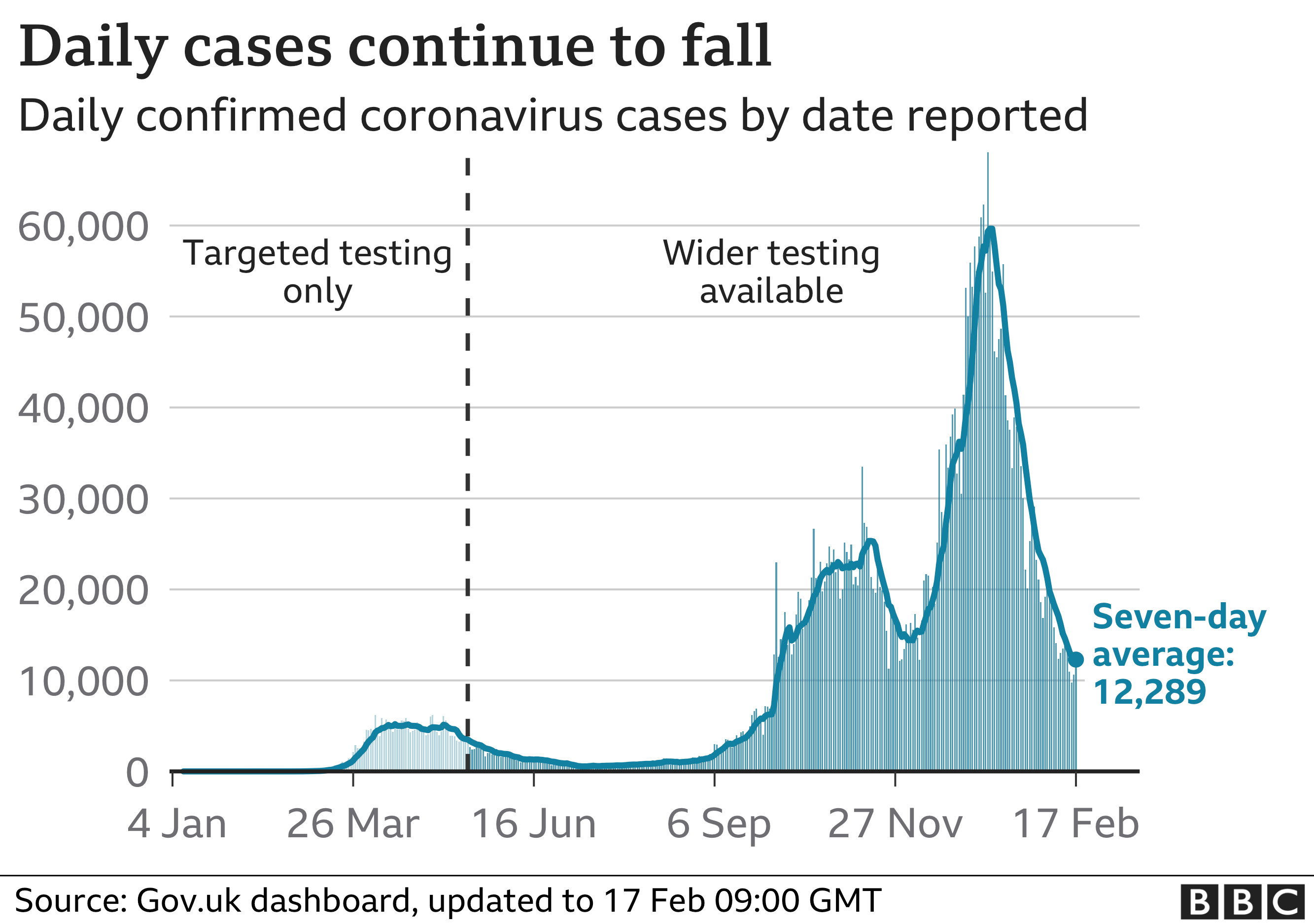
A further 12,718 coronavirus cases were reported across the UK on Wednesday – down 24% on the seven-day average – alongside another 738 deaths within 28 days of a positive test.

According to the Imperial College London team, during early-to-mid-February 0.51% of people in the study tested positive in England, down from 1.57% in early January. In London, positive tests fell from 2.83% to 0.54% over six weeks.

The study’s author Prof Steven Riley described the fall in cases in London as “dramatic” and said there had been “a strong downward trend since January – better than many hoped for”, which is equivalent to a halving of infections every 15 days.

The researchers estimated the R number – the average number of people one infected person will pass the virus on to – was around 0.72.

But more than 20,000 Covid-19 patients are currently in hospital in the UK, and although new daily cases and hospital admissions are falling, they are still relatively high.

NHS England figures show 80% of critical care beds were occupied in the week to 14 February, a slight fall from 83% the week before.

There are just under 4,800 patients in critical care, with 6,000 beds available.

Prof Elliott told BBC Radio 4’s Today programme: “Nobody wants to be in lockdown any longer than they have to be but a note of warning – the prevalence rates are still very high. They are as high as they were in September when they were on the increase and the numbers of people in hospital currently are at a level that they were in the first wave so we really have to be cautious.”

While the virus is declining in all nine English regions, and substantially in the capital, South East and West Midlands, it is falling less steeply in the North West, North East and Yorkshire and the Humber.

This could be linked to tougher lockdown rules being introduced earlier in London and south-east England after a pre-Christmas surge in cases related to the more transmissible virus variant first discovered in Kent.

The report found falls in infections across all age groups, with 18 to 24-year-olds and five to 12-year-olds currently having the highest virus levels – although still below 1%.

It estimates the over-65s have the lowest levels of virus at 0.3%.

Chart shows cases continuing to fall
=================================================

The post Illegal Masks, COVID Declining in UK, US Military Members Reject Vaccine appeared first on The St Kitts Nevis Observer.

Jamaica in Talks for Indian Made Corona Vaccine

THE Indian Government and Jamaica are engaged in talks to distribute the India-manufactured COVAXIN vaccine to Jamaica once it gets approval from the World Health Organization (WHO). Other Caribbean nations have also expressed interest.

High Commissioner of India to Jamaica Rungsung Masakui yesterday told members of the media, during a virtual interaction on Zoom, that India’s Ministry of External Affairs is facilitating the bilateral processes which all medical products must go through before agreements are made. He also disclosed that governments across the Caribbean have been provided with data on COVAXIN for use in their own analysis of the product.

Health Minister Dr Christopher Tufton confirmed that the Jamaican Government is in talks with India but did not disclose the extent of the conversations, conditions or whether any agreement had been made.

India’s drug regulator has given the green light to COVAXIN, made by Indian pharma company Bharat Biotech, a 24-year-old vaccine maker, which has a portfolio of 16 vaccines and exports to 123 countries. The vaccine, developed in collaboration with the Indian Council of Medical Research (ICMR) and National Institute of Virology (NIV), uses Whole-Virion Inactivated Vero Cell derived platform technology, which means it contains dead coronavirus, incapable of infecting people but still able to instruct the immune system to mount a defensive reaction against an infection.

When administered, immune cells can still recognise the dead virus, prompting the immune system to make antibodies against the virus. Two doses are given four weeks apart. The vaccine can be stored at 2°C to 8°C. Bharat Biotech says it has a stockpile of 20 million doses of COVAXIN, and is aiming to make 700 million doses out of its four facilities in two cities by the end of the year.

But manufacturers are still awaiting WHO approval, which they expect following the interim results of phase three of the trials, anticipated to be available by the end of February.

“I have no doubts, I feel quite confident and hopeful that COVAXIN will also get the WHO’s approval once this interim data is available after we reach a particular number of the infections that haven’t been looked at.

“These are international protocols that have to be kept in mind, so we are just waiting for that and I am sure once that data gets released to the world – hopefully as early as the weekend – with the efficacy data from India coming out, I think COVAX and the WHO will certainly approve COVAXIN, based on its efficacy and safety data that will be proven. I have no doubt in saying this at all; I’m very hopeful of this,” Suchitra Ella, joint managing director at Bharat Biotech, told the virtual meeting.


The post Jamaica in Talks for Indian Made Corona Vaccine appeared first on The St Kitts Nevis Observer.

Texas Weather: Residents Told to Boil Tap Water

BBC- Nearly seven million people in the US state of Texas have been told to boil tap water before consuming it after a deadly winter storm caused power blackouts at treatment facilities.

The huge storm sweeping across the southern US has killed at least 30 people and left millions without power.

Texas has seen widespread blackouts.

Freezing temperatures have also caused water pipes to burst, despite attempts by some homeowners to insulate them from the cold using blankets.

The state’s energy grid has been overwhelmed by a surge in demand as people try to keep warm in some of the coldest temperatures there in more than 30 years – hitting 0F (-18C) earlier this week.

On Wednesday, the head of the Texas Commission on Environmental Quality, Toby Baker, said that issues with water systems were affecting more than 260,000 people in the state.

The mayor of Houston, Sylvester Turner, urged people to switch off their water supplies to prevent pipes from filling with water and bursting when it freezes.

The post Texas Weather: Residents Told to Boil Tap Water appeared first on The St Kitts Nevis Observer.

Canada: No National Handgun Ban

Ottawa (CNN) The Canadian government proposed legislation Tuesday that would allow local communities to ban handguns, but stopped short of supporting a national handgun ban, which many gun control advocates had called for.

“These are the strongest measures to fight gun violence our country has ever seen,” Prime Minister Justin Trudeau said in a news conference Tuesday in the capital, Ottawa.

Trudeau’s Liberal government is making good on both a 2019 election promise for stricter gun control and an announcement last May, when Canada banned the sale of military-style assault weapons and promised more legislation would follow.

That pledge came after the deadliest mass shooting in Canada’s history, in which a heavily armed gunman dressed as a police officer killed 22 people in a shooting spree that terrorized residents of rural Nova Scotia.

The legislation, which would still take months to become law, also introduces a voluntary buyback program for the estimated 150,000 to 200,000 legally-owned assault-style weapons in Canada. Owners of the now-prohibited firearms can still choose to keep them, although they could no longer use them as guns and they would be subject to strict licensing and storage laws.

Mayors seek solution for worsening gun violence

Trudeau acknowledged there would be political fallout from both sides of the gun control debate. The mayors of Canada’s two largest cities, Toronto and Montreal, have advocated for a national handgun ban as gun violence worsens in those cities.

In a statement obtained by CNN, Toronto Mayor John Tory said city staff are reviewing the new set of proposed laws and that the city welcomes the federal government’s efforts to curb gun violence. But Tory also restated his city’s support for a national handgun ban.

“Toronto City Council has been clear that it supports a national handgun ban. The federal government has said the changes announced today would allow municipalities to ban handguns and include federal penalties for those who violate local bylaws. The City looks forward to receiving details from the Government of Canada on how such a ban would work and what its impact would be on gun violence,” Tory said in the statement.

Canada will list the Proud Boys movement as a terrorist group

Canada will list the Proud Boys movement as a terrorist group

Federal government officials said cities cannot act alone and that provincial governments, several of which have indicated they do not support banning handguns, would have ultimate jurisdiction.

Law enforcement officials say random gun violence in Canadian cities continues to worsen, with deaths increasingly linked to gang violence.

A teenage girl was killed in a drive-by shooting earlier this month in Montreal, prompting the mayor to again call for a national handgun ban.

“Obviously there are political elements in this but the core of why we are doing this, the core of why Canadians want this done, is to keep our communities safe. In Canada people can use guns for hunting and for sport shooting, not for personal protection. And there is no need (for) military-style assault weapons anywhere in this country,” said Trudeau.

In his news conference, Trudeau highlighted a key component of the new set of laws, the “red flag” and “yellow flag” provisions. He said they would help combat intimate-partner and gender-based violence by allowing people to apply to the courts to order the removal of a person’s firearm or to suspend their gun license.

Neither side happy

Gun control advocates noted that while the proposed legislation is comprehensive, it does not go far enough.

“This is imperfect legislation but a very Canadian approach to addressing a complex issue,” Dr. Philip Berger, senior adviser to Canadian Doctors for Protection from Guns, said in a statement. He added, “To make the further changes still necessary, the 80% of Canadians who support gun control need political parties other than the Liberals to step up and be accountable.”

If passed, the new law would also forbid the altering of the cartridge magazine component of a firearm and would ban depictions of violence in firearms advertising. There would be tighter restrictions on imports of ammunition and a ban on the import, export, sales and transfers of all replica firearms.

Canada working with the US to close travel 'loophole'

Canada working with the US to close travel ‘loophole’

Canada’s Conservative Party denounced the proposed legislation, saying it penalizes lawful gun owners and does not adequately address the issue of guns being smuggled into Canada from the United States.

“I think that Mr. Trudeau misleads people when he tries to suggest that buying things back from hunters and other Canadians who are law-abiding is somehow going to solve the problem of shooting and criminal gang activity in the big cities. It’s ignoring the real problem and it’s dividing Canadians,” Conservative Party leader Erin O’Toole said in a news conference Tuesday.

In a detailed technical briefing, the government outlined that it would continue to combat gun smuggling and trafficking by stepping up enforcement and increasing penalties. The Trudeau government has also said it will reach out to US President Joe Biden’s administration to find new ways to cooperate on gun smuggling issues along the border.

Update: This story has been updated to add more detail regarding the proposed legislation.

  • Paid Content
  •  

The post Canada: No National Handgun Ban appeared first on The St Kitts Nevis Observer.
Peru: Anger Grows Over Secret Vaccinations for Nation’s Wealthy

LIMA, Peru (AP) — Public indignation over secret coronavirus vaccinations for the wealthy and well-connected in Peru grew Wednesday, a day after the Vatican’s ambassador to the South American nation admitted he was inoculated ahead of health care workers and the poor.

The surreptitious vaccination of nearly 500 people, including a then-president, his wife and brother, has roused anger over inequality in a country that has been badly battered by the pandemic, which has taken the lives of at least 310 doctors.

Doctors and nurses in an impoverished neighborhood in the capital of Lima on Wednesday protested the secret vaccination effort and hung signs from the windows of a hospital’s intensive care unit that read, “Getting a vaccine is our right.”

The city’s archbishop, meanwhile, criticized the Vatican ambassador for accepting the vaccine.
Archbishop Carlos Castillo said on state television that he had contacted Pope Francis’ representative, Nicola Girasoli, and told him that he is part of a “list of privileged people who have acted behind the backs of the life of the people, of the suffering of the people. It is a list of unsupportive people.”

Girasoli, a 63-year-old Italian, confirmed in a statement Tuesday that he was vaccinated while serving as a consultant on “ethical issues” related to the Phase 3 trial that the Chinese state pharmaceutical company Sinopharm carried out in Peru starting in September.

The 487 people who received secret inoculations with the Chinese vaccine were not part of the 12,000 volunteers enrolled in the clinical trial to determine the vaccine’s efficacy before it began to be officially rolled out to the public.

The diplomat received his second dose on Feb. 11, a day after the press revealed that former President Martín Vizcarra, his wife and brother had been vaccinated in October while his administration was negotiating the purchase of the vaccines.

Vizcarra was removed by congress in November for alleged corruption in an unrelated case.

Girasoli has been apostolic nuncio in Peru since 2017 and worked in the diplomatic service of the Holy See for 36 years.

Pope Francis has repeatedly said the rich should not get priority for the vaccine. In a speech in August, he said it would be sad if “vaccine priority is given to the richest.”

“The pandemic has laid bare the difficult situation of the poor and the great inequality that reigns in the world,″ the pope said. ”And the virus, while it doesn’t make exceptions among persons, has found in its path, devastating, great inequalities and discrimination,” Francis said, adding “and it has increased them.

Peru has bought 1 million vaccines from Sinopharm, but they are not enough to inoculate the group deemed high priority — some 1.1 million doctors, nurses, police, firefighters, streetsweepers and others.

Foreign Minister Elizabeth Astete, Health Minister Pilar Mazzetti and two vice ministers involved in the country’s response to the coronavirus pandemic have been forced to step down in recent days. Astete acknowledged in her letter of resignation Sunday that she had secretly received the shot in late January, adding that “I could not allow myself the luxury of falling ill.”

Meanwhile, Mazzetti frequently lied in front of television cameras, including days after receiving thousands of vaccines bought from Sinopharm, when she said she was going to be the last to be vaccinated because “the captain is the last to leave the ship.”

The Andean nation has tallied more than 1.2 million cases of coronavirus and 44,056 deaths, according to Johns Hopkins University in the United States.′

The post Peru: Anger Grows Over Secret Vaccinations for Nation’s Wealthy appeared first on The St Kitts Nevis Observer.