Tag Archives: caribbean

Analysis: What’s the Impact of Taliban’s Return on International Order?

By Jonathan Marcus

Diplomatic analyst and former BBC Defence & Diplomatic Correspondent
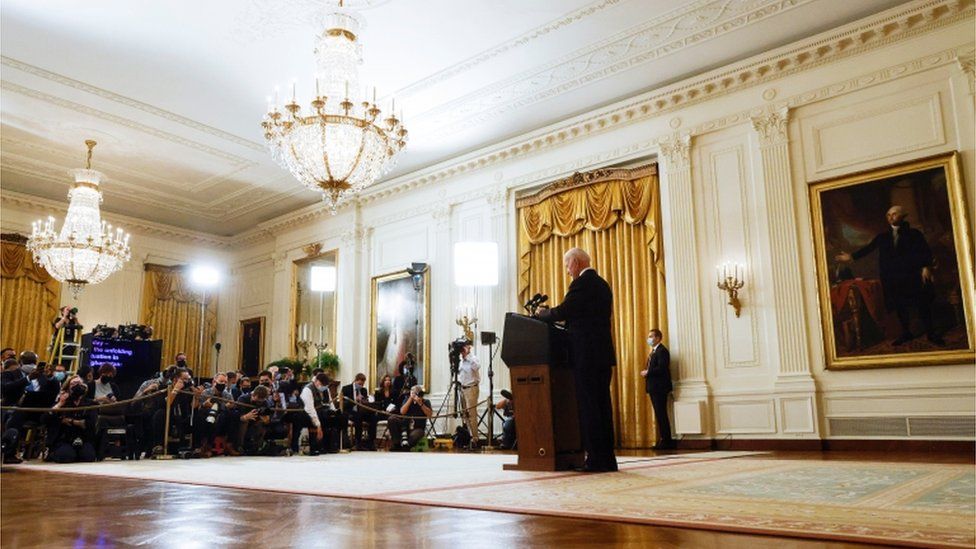
Joe Biden at a press conference with the media in front of himPresident Biden Press Conference

The Biden administration’s rush for the exit in Afghanistan has been accompanied by a similar rush to judgement among pundits and commentators who, by and large, have castigated the US president for a decision that many see as unnecessary and a betrayal, both of those who served in Afghanistan and of the Afghan people themselves.

The heartbreaking images from the airport in Kabul only reinforce this message. And there is justifiably a good deal of emotion to go round. The West has invested a lot of blood, time and money in Afghanistan. The Afghan people, much, much, more.

It is hard to argue with the criticism of the Biden administration’s precipitate departure. Afghanistan may indeed be un-salvageable, its governing structures too unrepresentative and corrupt. This though only underscores the argument that Afghanistan was not “lost” in the past two years but during the previous 20.

Nonetheless the decision to cut and run is being seen as a terrible blow to US credibility – to its reliability as a partner, and indeed to its moral standing in world affairs. How does this square with Mr Biden’s clarion cry on taking office, that America was back?

Comparisons are being made with Vietnam – the similarities with helicopters shuttling US nationals away from a falling city being too much for the newspaper front-pages to resist. But in reality – despite the superficial similarities -there are some important differences, too.

South Vietnam collapsed some two years after US troops left. Indeed it looks as though the Americans expected their Afghan allies to soldier on for a significant period without them. The US was humbled by Vietnam – its population deeply divided and its military morale damaged. But while Vietnam turned out to be a tragic side-show in the Cold War, the US still ultimately won that contest. Nato was not weakened. US allies around the globe did not shy away from expecting US support. The US remained the pre-eminent superpower.

Afghanistan is altogether different. Internal divisions in the US over this conflict have in no way been comparable to Vietnam’s. The Afghanistan mission was certainly unpopular at home but there were no mass rallies against it.

Crucially though, today’s international context is dramatically different from that of the 1970s. The US – indeed the West in general – is engaged in multiple contests, in few of which they are outright winners. The Afghan collapse is potentially a disaster in the so-called war on terror. But in the wider conflict between democracy and authoritarianism, Washington’s failure can only be seen as a serious set-back.

There will be smiles in Moscow and Beijing, at least for now. The Western model of liberal interventionism – promoted as a means of spreading democracy and the rule of law – has perhaps been tested to destruction in Afghanistan. One cannot see much enthusiasm for similar undertakings in the future.

Those of Washington’s allies who joined in the Afghanistan project are smarting. They feel badly let down. Even British ministers, jealous of their oft touted “special relationship” with Washington, have been openly critical of President Biden’s decision.

And for America’s European allies in general, it underscores how dependent they are upon the US and how little their views count once the White House decides to go in one particular direction.

So bad news for the West. But how long-lasting will be the smiles in Beijing, Moscow and even Islamabad? It was Pakistan that nurtured and gave safe haven to the Taliban for its own geo-strategic purposes. But if renewed Taliban rule produces a simple turning back of the clock – if international terrorism finds a renewed haven – then Pakistan may find that the growing turbulence in the region has decidedly negative consequences.

China is happy to see the US failure. Indeed, if Mr Biden’s reason to pull out from Afghanistan was due to his desire to re-focus US national power to rival a rising China, then this step has simply given China an opportunity to expand its own influence in Afghanistan and beyond.

China, though, must have concern, too. Its shares a short border with Afghanistan. It is actively persecuting its own Muslim minority and must be concerned at the possibility that anti-Beijing Islamist terrorists might seek to use Afghanistan as a base. No wonder then that Chinese diplomacy over recent weeks has been so eager to court the Taliban.

Russia, too, must have worries about the return of instability and terrorism. Maybe it feels a little better about itself now that the US has similarly been humbled by Afghan tribal fighters, just as the Soviet Union was in the late-1980s.

But its chief interest is the security of a large part of Central Asia, many of whose states are allies of Moscow. This summer Russia moved tanks to the Tajikistan-Afghan frontier for exercises intended to demonstrate its determination to prevent any spill-over from an Afghan collapse.

So in the short-term, the Afghan debacle certainly benefits the West’s opponents. But their attitudes were not going to change anyway.

What really matters are the ramifications among Washington’s allies. What will they take away from the Afghan experience? Beyond the immediate crisis, will the NATO countries, Israel, Taiwan, South Korea or Japan see the US as a less reliable partner? If they do, then Mr Biden’s decision to quit Afghanistan will prove fateful, indeed.

The post Analysis: What’s the Impact of Taliban’s Return on International Order? appeared first on The St Kitts Nevis Observer.

Haiti Quake: Death Toll Nears 2,000 with Many Still Missing

BBC- At least 1,941 people are known to have died in Haiti in Saturday’s powerful earthquake – a rise of more than 500 on the previous figure, officials say.

Nearly 10,000 people have been injured, and many are still missing after the the 7.2-magnitude tremor.

Rescue work has been hampered by heavy rains brought this week by Tropical Storm Grace to the Caribbean nation.

The UN says about 500,000 children now have limited or no access to shelter, safe water and food.

“Countless Haitian families who have lost everything due to the earthquake are now living literally with their feet in the water due to the flooding,” said Bruno Maes, the UN Children’s Fund (Unicef) representative in the country.

Tens of thousands of people left homeless by the quake had to decide whether to brave the storm under flimsy tarpaulins or risk returning into buildings damaged by the tremor and smaller aftershocks.

The south-west of Haiti appears to have suffered the worst of the damage from the quake, especially around the city of Les Cayes.

“Yesterday [Tuesday] evening, I took shelter near a church, but when I heard the ground shake again, I ran to return here,” city resident Magalie Cadet was quoted as saying by the AFP news agency.

She said so few structures remained standing that people had to relieve themselves on the city streets.

Some hospitals were left overwhelmed and in need of supplies, as medics struggled to treat the injured.

The earthquake compounds problems facing the impoverished nation, which is already reeling from a political crisis following the assassination of its president last month.

Prime Minister Ariel Henry, who is in power until fresh presidential election can be held, has declared a month-long state of emergency and urged the population to “show solidarity”.

Haiti has been hit by a series of natural disasters over the past years, including Hurricane Matthew in 2016.

The deadliest was the 2010 earthquake which killed more than 200,000 people and caused extensive damage to the country’s infrastructure and economy

The post Haiti Quake: Death Toll Nears 2,000 with Many Still Missing appeared first on The St Kitts Nevis Observer.

‘Nuts Man’ Praises Dept. of Agriculture for Its Peanut Cultivation

NIA CHARLESTOWN NEVIS (August 17, 2021) — Charlestown’s popular peanut vendor Mr. Calvin “Nuts Man” Williams of Gingerland who sells parched and boiled peanuts outside of Best Buy Supermarket has given high marks to the Department of Agriculture’s venture into peanut cultivation.

Mr. Williams who has been the top purchaser of the local nuts spoke to the Department of Information on August 16, 2021, in an invited comment on the peanuts grown at Farms and Indian River Estates.

“I’ve been selling nuts a good 10-12 years now. I used to get them from St. Kitts and overseas before I started getting them in Nevis. I just started buying local and they all right for now. They’re good enough to sell. The quality is like what I used to get from overseas, no problem with them. People enjoy the nuts…

“I have to continue to buy local nuts. It’s scarce right now. You have to buy everything you get. The nuts them good, they’re good. People should buy them locally. I buy five bags for the first,” he said.

Meantime Mr. Steve Reid, Chief Extension Officer at the department, stated that there a few reasons favouring large-scale peanut production including the beneficial effects of the plant.

“We are in New River where we have a storage facility where we would put our nuts to dry. The Department of Agriculture has ventured into planting nuts on a large scale and this decision was made because of a number of reasons.

“Nuts is one of those crops which we consider to have beneficial effects on the soil and they call it soil fixing bacteria where the roots of nuts and other legume plants would fix nitrogen in the soil. It actually helps to build the soil,” he said.

Mr. Reid added that it was felt rather than going the expensive way of applying fertilizer to lands that have been under cultivation for many years, the peanut plant would help to restore the soil paving the way for optimum performance from crops planted on the estates in the future.

The Chief Extension Officer also stated that another consideration to cultivating peanuts was that of not competing with farmers.

“Our market here in St. Kitts and Nevis is quite small…Right now most of the farmers are supplying supermarkets with local products. So in order for the government not to conflict with any of the farmers we decided as well to produce a crop that is needed; the demand is there but no farmer is doing it,” he explained.

Mr. Reid revealed that the preliminary results of peanut cultivation on Nevis has shown that the crop is simple and quick with an easy turn around with a healthy demand for the nuts.

The senior agriculture officer said a few farmers have inquired about getting seeds to plant and the department is encouraging farmers to do so because of its many benefits.

“We are encouraging farmers to take part because we realise it is a crop that can store well, and it has high return value as in the costing, and so farmers if they are interested, they may be able to contact the department at a later stage where we would have seeds available because we are going to be having a revolving programme,” he said.

Mr. Reid added that all the nuts produced would not be sold for eating purposes. Some would be used for planting material and some for feeding livestock on the government owned farms.

“We are using the tops of the nuts along with the deformed or small unmarketable nuts to feed to the livestock animals, mostly the cows at Maddens Estate. Nuts are high in protein and it helps to build the muscles and bodies when we feed it to these cows it is just as a feeler but it helps with their nutrition,” he said.


The post ‘Nuts Man’ Praises Dept. of Agriculture for Its Peanut Cultivation appeared first on The St Kitts Nevis Observer.

Nevis Tourist Authority’s Tribute to the Late Hon. Arthur Evelyn, First Min. of Tourism

NIA CHARLESTOWN NEVIS (August 17, 2021) — The Nevis Tourism Authority joins the wider Nevisian community in mourning the passing of the first Minister of Tourism in the Nevis Island Administration, the Hon. Arthur Evelyn, who has died at the age of 93.

The Ministry of Tourism and the NTA offer our deepest condolences to his family, friends, and colleagues on the transition of this committed public servant. He will long be remembered for his dedication to enhancing the quality of life for those he served.

As a member of the Nevis Island Assembly from 1983 to 1992, Mr. Evelyn was appointed as the first Minister of Agriculture, Lands, Housing, Labour, and Tourism, serving until 1987. It was during his tenure that the first land reform programme in Nevis was implemented, giving the people of Nevis an opportunity to own land.

For his contributions to the development of Nevis and his dedication to its people, the Nevis Island Administration in 2010 renamed the Old Treasury building in his honour.

Mr. Evelyn has been an outstanding servant of the people in a number of areas and we are forever grateful for his leadership and immense contribution not only to tourism but also to various sectors of our economy.

His passion for service extended to the business community, where he served as a dentist and registered pharmacist for many years, addressing the healthcare needs of many Nevisians.

He has served the community with distinction as a founding member of the Nevis Turf and Jockey Club, an active contributor to the Mental Health Association, Culturama, The Lions Club, The Blind Light, and Visually Impaired Society, and the St. Paul’s Anglican Church Vestry. He was also a founding member of the Nevis Historical and Conservation Society and the Nevis Cooperative Credit Union.

His life has been an example of extraordinary service and we wish his immediate family and the wider tourism fraternity comfort in the days ahead, as we all reflect on a life well-lived.

The post Nevis Tourist Authority’s Tribute to the Late Hon. Arthur Evelyn, First Min. of Tourism appeared first on The St Kitts Nevis Observer.

Eight nationals invested with 2020 Medal of Honour

BASSETERRE, ST. KITTS, August 17, 2021 (MMS-SKN) — At a colourful Investiture Ceremony held at Government House, Springfield in Basseterre, eight nationals were on Tuesday August 17 invested with the 2020 Medal of Honour (MH) by Governor General His Excellency Sir S.W. Tapley Seaton GCMG, CVO, QC, JP, LL.D.

Delivering remarks after seven of the eight honourees received the Medal of Honour, which is one of the two highest civilian honours the Federation of St. Kitts and Nevis bestows on its sons and daughters, Prime Minister Dr the Hon Timothy Harris informed them that their work, dedication and efforts were being publicly acknowledged and appreciated.

“We present these Medals to honour those who go above and beyond their call of duty,” said Dr Harris, who delivered his remarks under the theme ‘You are deserving of our Honour and Gratitude’. “This Medal of Honour is an acknowledgment that the recipient truly has put country before self.”

He added: “Today’s recipients have more than demonstrated this virtue. They are deserving of the Honour and they are deserving of our gratitude.”

The Prime Minister noted that in the times people are living, it is inspiring that there are people like the awardees who are prepared to put their fellow men, and the cause they believe in, first. Their example, he noted, is that service should be embraced and not avoided.

“The adversity we have all experienced this past year, a year like no other, has been more than countered by the great strength we have witnessed from many in our community, and the inspiration others have received from their service and from the example of our honourees,” pointed out the Honourable Prime Minister. “You, gathered here, are the community leaders who are inspiring all of us.”

Quoting from 2 Corinthians 9: 12-13, the Prime Minister told the honourees that the service they rendered is a lesson of what can be achieved when people are driven by their commitment to serve their people.

On behalf of the Federation he thanked the awardees for their passion, for their focus and their commitment, noting that they are truly helping to build a stronger and safer future for all the people of St. Kitts and Nevis, and that St. Kitts and Nevis as a Nation is stronger because of their collective efforts.

The awardees were Mrs Pearline Theresa Mussenden, for her role in Education; Mr Joseph Emmanuel Benders, pioneering in the field of Arts; Dr A. Linton Liburd, for his contribution in the field of Medicine; Mrs Patricia Mary Nurse-Clarke, for her role in Community Services; Mrs Pamela Elaine Brookes, for outstanding service in Nursing; Mr Charles Delvin McMaster, for outstanding Community Service; Mr Brian Dyer, for National Service in Crisis; and Dr Judy Nisbett, for National Service in Crisis.

Nevis-based Dr A. Linton Liburd was not present at the Investiture Ceremony and it was announced that he will be invested with the Medal of Honour by Deputy Governor General for Nevis Her Honour Hyleta Liburd at a later date in Charlestown, Nevis.

“Today we acknowledge, not just their service but the humility that each one brings to their area of service,” said Prime Minister Harris after he called out the names of the awardees and the areas of their service.

He told them: “Your service was not driven by a desire for attention. You did not seek reward or self-promotion. Your work was quiet and understated, driven by the motto that ‘a good deed is its own reward’.”

At the ceremony, which was co-chaired by Inspector Alphonso Hendrickson and Mrs Charisse Gumbs, Mrs Telca Wallace who is the Disaster Coordinator of the St. Kitts-Nevis Red Cross Society received the 161st Commonwealth Point of Light Award for St. Kitts and Nevis which had been conferred to her by Queen Elizabeth II.

Mrs Wallace is currently in Guyana on an International Federation of Red Cross (IFRC) assignment and was represented by her daughter, Ms Shai Wallace, who received the award from Governor General His Excellency Sir S.W. Tapley Seaton.

Present at the Investiture Ceremony were the Deputy Governor General for Nevis Her Honour Hyleta and Mr Elmo Liburd, and Governor General’s Deputy His Excellency Michael and Mrs Morton.

Also present were Speaker of the National Assembly the Hon Michael Perkins, Deputy Speaker Senator the Hon Dr Bernicia Nisbett, Cabinet Ministers – the Hon Eugene Hamilton, the Hon Jonel Powell, the Hon Alexis Jeffers, and the Hon Vincent Byron Jr. and Cabinet Secretary Mrs Josephine Huggins.

Others present included Resident Ambassador of the Republic of China on Taiwan, His Excellency Michael Lin, Commander of the St. Kitts and Nevis Defence Force Lt. Col J. Anthony Comrie, and Commissioner of Police Mr Hilroy Brandy.

The post Eight nationals invested with 2020 Medal of Honour appeared first on The St Kitts Nevis Observer.

Caribbean Reefs are Dying from a Mysterious Disease

The devastation caused by the disease is unprecedented. “You can lose colonies that were growing for hundreds of years in just weeks or months,” said one expert.
Vice


TEGUCIGALPA, Honduras—A mysterious, highly contagious and lethal disease is spreading across the coral reefs of the Caribbean Sea, alarming scientists and leaving a trail of skeletons in its path.


Its advance from Florida to the far reaches of the Caribbean could wipe out the majority of the hard coral across the sea, decimating reefs and the marine life they support for generations to come. The environmental damage would also disrupt the lives of millions of people in coastal communities who depend on the reefs for food or jobs.

“It’s basically like a coral Covid,” said Gabriela Ochoa, program manager at the Roatan Marine Park on the Bay Islands of Honduras, describing the disease’s rapid transmission. Affecting more than 20 species of hard coral, the harm that stony coral tissue loss disease (SCTLD) threatens to slow-growing coral reefs and their fragile ecosystems is irreparable.

“The only difference is the mortality rate of COVID doesn’t even compare to what we’re seeing in the reefs,” added Ochoa. In some coral species, the mortality rate reaches as high as 100 percent.

The first sign that a coral is infected is the appearance of a small lesion where the tissue, or the skin, is absent, revealing the bone. Patric Lengacher/Roatan Marine Park

The first sign that a coral is infected is the appearance of a small lesion where the tissue, or the skin, is absent, revealing the bone. Patric Lengacher/Roatan Marine Park

While other more well-known factors such as pollution and climate change have caused the loss of an estimated 60 percent of coral coverage in the Caribbean over the past three decades, the new disease is killing it at a much faster rate.

Once a colony is infected, death can come very quickly. “You can lose colonies that were growing for hundreds of years in just weeks or months,” said Melina Soto, Mexico Coordinator for the Healthy Reefs Initiative.

SCTLD was first discovered in 2014 off the coast of Florida, where it has since infected roughly half of the state’s reefs. The cause is unknown but humans are a likely culprit.

Theories divide along two main tracks. The first is that factors such as climate change and rising sea temperatures along with contaminants like untreated sewage and even sunscreen have reduced the reefs’ resiliency, making coral susceptible to existing bacteria. The second centers around the idea that a new pathogen emerged as a result of human activity.

In the end, the answer could be all of the above. “Like COVID, when you have other health problems, then you’re at higher risk when you get COVID,” said Ochoa.

Over the past seven years, the disease has spread across the Caribbean Sea, often traveling against currents, which suggests that the pathogen may be reaching new areas by clinging to boats. “One of the points that almost always repeats itself is that the first cases are found near ports,” said Soto.

In 2018, SCTLD was discovered in Mexico off the coast of Puerto Morelos, situated between the tourist hotspots of Cancun and Playa del Carmen near the northern tip of the Mesoamerican Reef — the world’s second largest. The disease has since spread hundreds of miles along the reef’s hard coral colonies all the way to its southernmost point around the Bay Islands in Honduras, where it was first detected in September 2020.

Brain corals have been the most affected, according to the Healthy Reefs Initiative, and the disease has put one rare species, pillar coral, at the brink of extinction. The first sign that a coral is infected is the appearance of a small lesion where the tissue, or the skin, is absent, revealing the bone. As the disease progresses, the coral is stripped of all tissue, leaving nothing but a dead skeleton.

Once an infection is present, the disease can spread across a reef system from coral to coral, or by fish or scuba divers hopping from an infected site to a healthy site.

Mitigating the effect is a costly, nearly insurmountable task. An antibacterial cream that is applied to the lesions has shown some success in stopping an infection, but it doesn’t provide any immunity to subsequent infections and the application is extremely labor intensive and expensive.

Instead, organizations are building coral nurseries in water tanks on land to conserve genetic diversity and breed new species with the hope of restoring reefs in the future. But with growth rates of just a couple centimeters per year, full restoration could take hundreds, if not thousands of years.

Soft corals, such as the elegant fan corals that sway with the current, are not affected by SCTLD. But the loss of hard corals is about more than just their genetic diversity

Hard corals are “reef builders” that are essential to a reef’s formation. As the hard corals die off, they erode and compact, reducing the protection against coastal erosion, flooding and hurricane storm surges provided by the reefs. Declining coral cover is also a loss of habitat for marine wildlife, including some 1,500 species of fish.

The damage to the Mesoamerican Reef and others across the region will have an impact that extends beyond the sea. “If we don’t have corals, then we don’t have everything else associated with them,” said Ochoa. Reef-related tourism alone generates about $8 billion for Caribbean economies each year.

Although there have been massive coral die-offs in the past, as well as other diseases that have affected reefs, the devastation caused by SCTLD is unprecedented. “We’ve never seen 23 different species of corals getting sick at the same time,” said Ochoa.

In many places, coral coverage has been reduced to half of what it was before the disease arrived and algae is taking over. What once was a flourish of bright colors is now dull and green.

The spread of such a contagious and lethal disease foreshadows a similar fate for reefs across the Caribbean Sea. “Reefs as we knew them will no longer be” in existence, said Ochoa.

The post Caribbean Reefs are Dying from a Mysterious Disease appeared first on The St Kitts Nevis Observer.

Tropical Storm Henri Forms South of Bermuda.

At 5 pm AST, the centre of Tropical Storm Henri was located over the Atlantic Ocean about 145 miles (230 km) southeast of Bermuda.

The US National Hurricane Centre (NHC) said Henri is moving toward the south-southwest near seven mph (11 km/h). A slow clockwise turn toward the southwest and then toward the west is expected during the next day or two.

On the forecast track, the centre of Henri should pass south of Bermuda tomorrow night.

Photo: NOAA

A Tropical Storm Watch is in effect for Bermuda.

Henri has maximum sustained winds that are near 40 mph (65 km/h) with higher gusts.

Tropical-storm-force winds only extend outward up to 35 miles (55 km) from the centre. The estimated minimum central pressure is 1010 mb (29.83 inches).

Some additional strengthening is forecast during the next couple of days.

The post Tropical Storm Henri Forms South of Bermuda. appeared first on The St Kitts Nevis Observer.

Guyana Welcomes New Cuban Health Brigade

Guyana has welcomed 56 Cuban health professionals, praised Cuba for its support to the country especially during the coronavirus (COVID-19) pandemic.

“Our heartfelt thanks for taking up the challenge, for being here, to come to serve Guyana presently at this time of crisis, a pandemic. We have laboratory technologists, pharmacists, we have an entire medical team, a complete brigade and you will be serving us, the Guyanese people, across the country,” said the Director-General of the Ministry of Health, Dr. Vishwa Mahadeo.

“I take his opportunity on behalf of our President, Dr. Mohamed Irfaan Ali and on behalf of our Minister of Health, Dr. Frank Anthony to welcome all of you and to tell you that we will try our best to make your life comfortable,” he told the Cubans at the ceremony held at the Cheddi Jagan International Airport (CJIA).

The Brigade includes 20 intensivists who will lend support primarily to the Infectious Diseases Hospital, medical specialists in general surgery, anesthesiology, internal medicine, gynecology, obstetrics and pediatrics.  The group also includes nurses, pharmacists and laboratory technicians.

“So, with this Brigade, we will be able to send more specialists in other regions, than the traditional regions to start training in pharmacy assistants, laboratory technicians and so on. So, this batch here, we should be able to make some strides that we had not made before with the composition,” Dr. Mahadeo said.

He said that Cuban Medical Brigades have been coming to Guyana for nearly 44 years and the government continues to be grateful to Havana for its support.

Last Friday, health officials bade farewell to the last Cuban Brigade which served Guyana for approximately four years.

CMC

The post Guyana Welcomes New Cuban Health Brigade appeared first on The St Kitts Nevis Observer.

EU Offers $3.5M to Aid Haiti’s Earthquake Recovery

In light of the devastating effects of the massive earthquake that struck Haiti on August 14, the European Union is allocating €3 million in humanitarian funding to address the most urgent needs of the affected communities.

Janez Lenarčič, Commissioner for Crisis Management said: “Urgent humanitarian needs are following the devastating 7.2 magnitude earthquake that struck Haiti. The EU is quickly mobilising support to this already extremely fragile country, where hurricanes and heavy rainfalls aggravate the dire situation even more. The earthquake strikes at a time when the COVID-19 pandemic and the escalating insecurity already posed a threat to the country. We stand ready to provide further assistance.”

In order to ensure the fastest possible intervention, EU funds will be implemented by humanitarian partners already active in the emergency response and will support and strengthen their capacity to swiftly provide humanitarian aid to the most vulnerable Haitians. The funding will address the most immediate needs such as the provision of medical assistance to local overwhelmed hospitals, water, sanitation and hygiene services, shelter and protection services for the most affected and disadvantaged communities.

Background

On 14 August, a 7.2-magnitude and 10-kilometres deep earthquake hit the southwestern part of Haiti, killing more than 1,300 people and injuring almost 6,000. Strong shakes have destroyed buildings and homes, severely damaged hospitals and schools and disrupted water networks, roads and bridges.

The earthquake strikes an already extremely fragile country, vulnerable to natural hazards and manmade disasters, and chronically unprepared to deal with the arrival of the coronavirus pandemic. Food shortages and malnutrition, disease epidemics and the humanitarian needs generated by the ongoing migration crisis already required sustained humanitarian assistance. Moreover, the COVID-19 crisis is contributing to worsen the ongoing food insecurity crisis in Haiti with 4.4 million people, 40% of the population.

The EU’s emergency Copernicus satellite service has been activated in the aftermath of the earthquake and is currently providing maps of the area. The EU’s 24/7 Emergency Response Coordination Centre is constantly assessing the situation to monitor developments and coordinate eventual further EU assistance.

The post EU Offers $3.5M to Aid Haiti’s Earthquake Recovery appeared first on The St Kitts Nevis Observer.

CDEMA Springs Into Action Over Haiti Quake Disaster

By Carlena Knight


The Caribbean Disaster Emergency Management Agency (CDEMA) is already making plans with officials on the ground in Haiti to assist following Saturday’s devastating 7.2-magnitude earthquake.

Executive Director Elizabeth Riley explained that discussions have been ongoing for two days and the body has committed to deploying fully vaccinated CDEMA officials to the disaster-hit country.

Concern is however being raised as Haiti is expected to be negatively impacted by Tropical Storm Grace. It is feared heavy rain brought by TS Grace could trigger landslides.

“We have been in discussions with them for the past two days as the information has come forward getting a better understanding of what has actually transpired where the regional system could best provide support.

“Haiti has made a formal request now to the CDEMA to provide support on the coordination side in their national emergency operations centre in Port-au-Prince, and we initiated those arrangements yesterday evening and, due to the pending threat of Grace, the timing for arrival is being scheduled just after the passing of Grace,” Riley said.

According to Riley, Haitian officials are still able to acquire certain supplies so the need would be to provide cash donations instead. Details, she said, will be given at a later date as discussions are still ongoing.

She admitted that this has been a challenging period for the regional body in balancing the Covid-19 pandemic along with the frequent disasters across the Caribbean.

“The reality is that we have had a number of events taking place back-to-back and, in fact, a number of them even happen in parallel.

“So, it has been quite a bit of making sure that we retain a higher-level view of all that is happening. We are trying to make the best decisions that we can based on information available on how to deploy the resources that we have in the region and, of course, those resources are limited and even more constrained as a result of what’s happening across the region with Covid-19. It has been a challenging time – that is just the reality,” she added.

According to Riley, the Covid spikes in the various countries sometimes limit the amount of support that can be given.

“In essence, it may limit our ability to be able to draw human resources from that country to support another. So, it’s been a very dynamic time for us,” she said.

She explains that the pandemic has also forced them to strategise how relief supplies are deployed but boasted that since that new protocol has been put in place, none of their CDEMA workers have tested positive for the coronavirus.

She revealed that the pandemic has, however, positively pushed the group to upgrade some of their programmes, like the Integrated Regional Logistics Hub in Barbados which helped in disseminating PPE gear and other Covid protective supplies to the 20 member states of CDEMA.

Nevertheless, the top CDEMA official is continuing to remind Caribbean residents “to remain vigilant and be prepared”.

The regional body joins a growing list of governments, agencies and celebrities who have pledged to assist the Caribbean country following last weekend’s natural disaster where at least 1,297 people are known to have died and an unknown number are still missing.

In fact, search and rescue teams have been arriving from the United States and Chile, with more on the way from Mexico. Cuban medical teams are already in Haiti where they are treating the injured citizens.

Japanese tennis star Naomi Osaka, whose father is from Haiti, said she would donate her earnings from next week’s Western & Southern Open to help finance relief efforts.

The earthquake compounds problems facing the impoverished nation, which is already reeling from a political crisis following the assassination of its president last month.

The post CDEMA Springs Into Action Over Haiti Quake Disaster appeared first on The St Kitts Nevis Observer.