France’s overseas territory of Martinique will enter a tougher lockdown for three weeks starting Tuesday to tackle a Covid-19 outbreak on the West Indian island, a local government official said on Twitter.
Martinique had already imposed an evening curfew, but the tougher Covid-19 lockdown, set to start from 7pm, will shutter non-essential shops, close beaches and clamp down on people’s movements.
Authorities in Martinique have also advised tourists to leave the island.
“We will be entering a second phase of lockdown … Shops will close, except for food shops and pharmacies,” said Stanislas Cazelles, the prefect for Martinique, who encouraged “all vulnerable tourists to leave the territory”.
“Hotels will be closed – except to professionals and residents of the territory; the same goes for seasonal rentals,” the prefect added. “Stores useful for the back-to-school period” will reopen “when the health situation has improved”, he said.
“Firms and civil services are also encouraged to participate in this lockdown, organising their services so that a maximum of employees can work from home,” Cazelles added.
The prefect said culture and leisure facilities would be closed, including beaches, which “will no longer be accessible to the public”.
Residents must also restrict their movements to a maximum one-kilometre radius from their homes.
“These rules are strict. They will be lifted as soon as the health situation allows it,” the official pledged, saying the measures would be re-evaluated “in 15 days”.
Last weekend, French Health Minister Olivier Véran appealed to volunteer doctors and nurses to travel to the overseas territories of Guadeloupe and Martinique as a wave of Covid-19 infections overwhelms hospitals on the two Caribbean islands.
On Tuesday, some 240 healthcare professionals are due to arrive to begin a 15-day mission in support. Véran is slated to travel to Martinique on Thursday.
Martinique has one of France’s highest Covid-19 incidence rates, with nearly 1,200 cases per 100,000 people and hospitals stretched to 227 percent of capacity. The island also has a low rate of vaccination against Covid-19 compared to mainland France; only 22 percent of Martinique’s population has received a first dose of the vaccine.
Tropical Storm Fred, the 6th named tropical cyclone of the Atlantic hurricane Season 2021 is next in line to turn towards the Caribbean and potentially also impacting the United States around the next weekend.
Tropical storm warnings have been posted across the eastern Caribbean as a system gathers power and takes shape southeast of Dominica, the National Hurricane Center said.
With winds of 35 miles (56 kilometers) per hour, the system will likely become Tropical Storm Fred late Monday or early Tuesday local time, the center said in advisory at 5 p.m. New York time.
The storm is threatening to hit Puerto Rico, the Dominican Republic, Haiti and potentially Cuba later this week, but its exact path remains unclear. The system will likely be south of Florida by this weekend if it survives the trek over the larger Caribbean islands.
“Regardless of the exact track, locally heavy rainfall and gusty winds are expected to spread across portions of the Leeward Islands, the Virgin Islands, Puerto Rico, and the Dominican Republic over the next day or two,” Daniel Brown and Philippe Papin wrote in forecast analysis.
Five storms have already been named across the Atlantic this year, including three that hit the U.S. They come as extreme heat waves, floods and fires are becoming more common around the globe. The United Nations on Monday released a landmark report Monday concluding that there is “unequivocal” evidence that human activities have warmed the atmosphere.
A record 30 storms formed in 2020, about twice the annual average. They caused $42.3 billion in losses and damage and killed 86 people in the U.S. alone, according to the National Centers for Environmental Information. In addition, back-to-back storms caused more than $3 billion to Honduras, Guatemala, and Nicaragua and left much of the region still struggling to recover.
Storms tracking into the Gulf of Mexico are closely watched because they can roil natural gas, oil, and orange juice prices as they tear through the region.
Just a few days after the official release of the recent NOAA seasonal outlook for the ongoing Hurricane Season, the tropical western Atlantic is about to churn a new Tropical Storm. It will be Fred. Typically, the 6th named tropical cyclone forms on August 28th, so the season remains nearly 3 weeks ahead of the schedule.
As we are now entering the mid-August period, the activity over the Atlantic Ocean statistically begins increasing. The very warm sea waters are coinciding with a major MJO wave, emerging into the Caribbean region and the tropical Atlantic from the west (Pacific). The combination of both will now boost the ongoing activity further.
Note, that the eastward-moving MJO wave normally has a major influence on the state of the atmosphere which allows tropical storms or hurricanes to develop. They require a very warm sea temperature (26 °C or above), high moisture, low vertical wind shear, and a surface low-pressure system.
Above: Tropical cyclone names for 2021
When such conditions as recently are in place, especially with extremely warm sea waters and great upper-level support by MJO waves and low shear in place, a tropical cyclone could become a hurricane very quickly. Even a violent, major hurricane when conditions are near perfect. According to the recent data, as we see, these will likely strongly influence the peak Atlantic hurricane season this year.
Besides the wind intensity and lowest pressure in the tropical cyclones, we also use a so-called Accumulated Cyclone Energy (ACE index). A parameter that we use to express the energy that was used during the tropical cyclone’s lifetime. So we can compare every tropical storm or hurricane with the other. There are 4 categories to classify storms by the ACE index, from the extremely active to above, near, and below-average activity.
Already five named tropical storms also mean that we are more than double the long-term average to this date, so a fast start this year. And keep in mind that these numbers normally rapidly increase as the tropical activity ramps up towards the peak of the Atlantic Hurricane Season.
Such water temperatures are a very significant signal for the upcoming tropical cyclones that may move across this part of the tropical region. As it often leads to an explosive development of the tropical systems when convective storms encounter such a warm and moist fuel ingested from the sea surface.
The recent weeks over the tropical Atlantic region had mostly calm weather patterns, allowing the SSTs to become anomalously warm, especially across the known region – the MDR region (Main Development Region) that extends across the Atlantic between Africa and the Caribbean Sea.
Below is a high-resolution animation of the Atlantic Basin oceanic waters temperature anomalies, covering the whole Atlantic Basin as well as the MDR region where the majority of the tropical cyclone formations occur.
Tropical Storm Fred forms in the very warm waters of Atlantic Ocean
Fred is the 6th tropical storm of the Atlantic hurricane season 2021 – SWE /MA
Having such significant temperature anomalies does hint at the enhanced potential for significant tropical cyclone development in the coming weeks as we are heading towards the most dangerous period around the peak of the Atlantic Hurricane Season, occurring from late August through September and October.
Very high sea temperatures will remain or even improve in the coming weeks ahead. And statistically, these SSTs are quite typical signs during August when an active Atlantic hurricane season follows.
MEXICO CITY, Aug 9 (Reuters) – Mexican President Andres Manuel Lopez Obrador and U.S. Vice President Kamala Harris spoke about migration, the battle against COVID-19, and the need to strengthen Central American economies, the White House said in a statement.
In a brief statement on Twitter, Lopez Obrador said the conversation, which started around 4 p.m. (2100 GMT), had been good and that he would provide more details on Tuesday.
The White House said the two leaders discussed ongoing bilateral cooperation to address “irregular migration” to the shared U.S.-Mexican border, and agreed to focus on bolstering Central American economies through investment in agriculture and climate resilience.
Harris updated Lopez Obrador on U.S. efforts, including the July 29 release of the U.S. strategy for addressing the root causes of migration in Central America.
The U.S. vice president also told Lopez Obrador that Washington was committed to sending additional doses of COVID-19 vaccines to Mexico, on top of the 4 million doses already delivered, the White House said.
Speaking before the call, a senior U.S. official said the vaccines could come from multiple manufacturers, including Moderna Inc (MRNA.O) and AstraZeneca PLC (AZN.L).
Earlier, Lopez Obrador said he and Harris would discuss reopening the U.S.-Mexico border, immigration and vaccines against COVID-19, new cases of which have jumped in Mexico.
Speaking at a regular morning news conference, the Mexican president said vaccinations along Mexico’s border with the United States had led to fewer hospitalizations and deaths in the face of rising infections on both sides.
“This is what I’m going to suggest today, that we can demonstrate that we’re not putting the population at risk,” Lopez Obrador said in the northern city of Ciudad Juarez, across the border from El Paso, Texas.
The United States has already lent a few million vaccine doses to Mexico, and would be sharing more with it than with any other country, reflecting the importance it attached to the bilateral relationship, the U.S. official said.
The countries’ 2,000-mile (3,200-km) border has been closed to non-essential travel since early in the pandemic last year.
Reporting by Daina Beth Solomon and Raul Cortes in Mexico City and Nandita Bose and Andrea Shalal in Washington; Editing by Dave Graham, Peter Cooney and Karishma Singh
VANCOUVER, Aug 9 (Reuters) – Long delays were reported at the border on Monday as Canada finally opened to fully vaccinated American tourists for the first time in 16 months, causing a rush of travelers during the busy summer season – and bottlenecks for a desperate tourism industry.
Government data showed a seven-hour wait for the Fort Frances, Ontario, and International Falls, Minnesota, crossing. Fort Frances advertises itself online as “rarely experiencing delays.”
Several crossings in Ontario and New Brunswick – between the states of New York and Maine – had waits of three hours.
Canada barred all leisure travel from the United States in March 2020 due to the COVID-19 pandemic. But as of Aug. 9 fully vaccinated Americans are able to enter the country.
International travelers who are fully vaccinated will be allowed to enter in early September.
Late on Friday, the Canadian government and border staff reached a tentative deal to end a strike that began earlier in the day and caused delays even before Americans began arriving. read more
Toronto’s Pearson International Airport, Canada’s biggest, has also asked travelers to brace for delays as American leisure travelers return.
Canada’s partial reopening comes just as new COVID-19 cases and hospitalizations in the United States hit a six-month high. read more
Prior to the pandemic, tourism was the fifth-largest industry in Canada, contributing C$105 billion ($83.4 billion) to GDP and providing one in 10 jobs, according to the Tourism Industry Association of Canada.
Travellers line up to enter Canada after border restrictions were loosened to allow fully vaccinated U.S. residents, after the coronavirus disease (COVID-19) pandemic forced an unprecedented 16-month ban that many businesses complained was crippling them, at the Peace Arch border crossing in Surrey, British Columbia, Canada August 9, 2021. REUTERS/Jennifer Gauthier
The border reopening, however, and the rules surrounding it may not be enough to save Canada’s outdoor tourism sector.
Hunting and fishing lodges in remote parts of the country – most of which rely on American tourists for business – are reporting cancellations of people who do not want to get fully vaccinated or comply with the 14-day quarantine.
“We wish we would have been able to open a month ago, and we wish that now that we are open the rules were easier to understand,” said Dominic Dugré, president of the Canadian Federation of Outfitter Associations.
Remote lodges are struggling to accommodate the multiple negative COVID-19 tests required of travelers.
Ken Gangler, 61, has owned three lodges in Manitoba over the past 37 years. The current one is 370 kms (230 miles) from the closest road, and accessible only via air.
“We’re scrambling to open up but because there was such little notice from the government, the airlines don’t have planes on the routes,” he said.
Gangler’s son and his partner paid C$3,900 ($3,103.37) for two round trip airline tickets from Orlando, Florida, to Winnipeg, compared with C$1,300 before the pandemic.
“People don’t want to pay these astronomical air fares,” Gangler said, adding that staff shortage is another issue. “It’s impossible to find staff because who wants to go to work for a month and a half?”
Reporting by Moira Warburton in Vancouver and Steve Scherer in Ottawa; Editing by Angus MacSwan and Dan Grebler
The Pentagon will require all military personnel to get the COVID-19 vaccine by Sept. 15, according to a new memo from Defense Secretary Lloyd Austin, released Monday.
“I will seek the president’s approval to make the vaccines mandatory no later than mid-September, or immediately upon” final approval by the Food and Drug Administration (FDA) “whichever comes first,” Austin wrote in the memo to troops.
He added that Pentagon officials “will also be keeping a close eye on infection rates,” currently on the rise now due to the highly contagious delta variant. If the rates begin to impact military readiness, “I will not hesitate to act sooner or recommend a different course to the President if l feel the need to do so. To defend this Nation, we need a healthy and ready force.”
“Secretary Austin and I share an unshakable commitment to making sure our troops have every tool they need to do their jobs as safely as possible,” Biden said in a statement.
“Being vaccinated will enable our service members to stay healthy, to better protect their families, and to ensure that our force is ready to operate anywhere in the world. We cannot let up in the fight against COVID-19, especially with the Delta variant spreading rapidly through unvaccinated populations. We are still on a wartime footing, and every American who is eligible should take immediate steps to get vaccinated right away,” he said.
The Pentagon now adds the coronavirus vaccine to the list of more than a dozen shots it requires service members to get, including shots for measles, mumps, diphtheria, hepatitis, smallpox and the flu.
Until now, the Pentagon had not mandated the COVID-19 vaccine as it remains under the FDA emergency use authorization. The department has previously been strongly encouraging troops to take the vaccine.
In his new memo, Austin said the military services will have the next few weeks to prepare and develop implementation plans.
“In the meantime, we will comply with the President’s direction regarding additional restrictions and requirements for unvaccinated Federal personnel. Those requirements apply to those of you in uniform as well as our civilian and contractor personnel,” he wrote.
The FDA may give final approval to the Pfizer vaccine between now and Sept. 15, but without such a green light, Biden must grant Austin a waiver to make the vaccines mandatory.
Austin noted that over the past week he had consulted closely with Joint Chiefs of Staff Chairman Mark Milley, the secretaries of the military departments, the service chiefs and medical professionals.
More than 1 million troops are fully vaccinated, with another 237,000 having received one shot, according to the latest Pentagon data.
The vaccination rates in each service vary widely. The Navy is the most vaccinated of the armed forces, with just over 74 percent of its active duty and reserve sailors given at least one shot, while the Marine Corps is closer to 50 percent.
Twenty-eight service members have died from COVID-19.
Austin’s memo is sure to receive pushback from conservatives, who have consistently turned public health guidance throughout the pandemic into a debate over individual freedoms.
Rep. Thomas Massie (R-Ky.), for example, has already introduced a bill to prohibit mandating the COVID-19 vaccine for troops and earlier this month tweeted that he had been “contacted by members of our voluntary military who say they will quit if the COVID vaccine is mandated.”
But House Armed Services Committee Chairman Adam Smith (D-Wash.), applauded Austin’s move, saying it’s “going to save lives and safeguard our military readiness.”
“Some may try and criticize the Secretary’s decision, using anti-vax arguments that are not supported by facts or science to politicize the conversation. These desperate attention seekers must be ignored. The health and safety of our troops, and our national security, is what truly matters, and mandatory vaccination is the proven solution to provide protection from the COVID-19 virus and delta variant,” Smith said in a statement.
The committee’s ranking member Rep. Mike Rogers (R-Ala.), also backed Austin, noting that the military already requires 17 vaccines for the benefit of its service members and readiness.
“Vaccines protect our men and women, many of whom live in cramped and crowded conditions, from the spread of disease while at home or deployed across the globe. Teleworking isn’t an option for the soldiers, sailors, marines, airmen, and guardians who work every day to confront near-peer rivals and non-state terrorists,” Rogers said in a statement. “We have already seen COVID-19 affect our readiness downrange. Our adversaries will take any advantage they can over us. We must not allow COVID-19 to be a hindrance on our force.”
Austin, meanwhile, urged service members to get the vaccine before it’s mandatory.
“To defend this Nation, we need a healthy and ready force. I strongly encourage all DoD military and civilian personnel – as well as contractor personnel – to get vaccinated now and for military Service members to not wait for the mandate,” he wrote.
World leaders including UK Prime Minister Boris Johnson have called the report a “wake-up call to the world”.
But some of the strongest reaction to its findings has come from countries that are set to be the worst hit.
“We are paying with our lives for the carbon someone else emitted,” said Mohamed Nasheed, a former Maldives president who represents almost 50 countries that are vulnerable to the effects of climate change.
The Maldives is the world’s lowest-lying country and Mr Nasheed said the projections by UN’s Intergovernmental Panel on Climate Change (IPCC) would be “devastating” for the nation, putting it on the “edge of extinction”.
According to the latest IPCC report, heatwaves, heavy rainfall and droughts will become more common and extreme. The UN’s chief has labelled it a “code red for humanity”.
The report says there is “unequivocal” evidence that humans are to blame for increasing temperatures. Within the next two decades, temperatures are likely to rise 1.5C above pre-industrial levels, it adds.
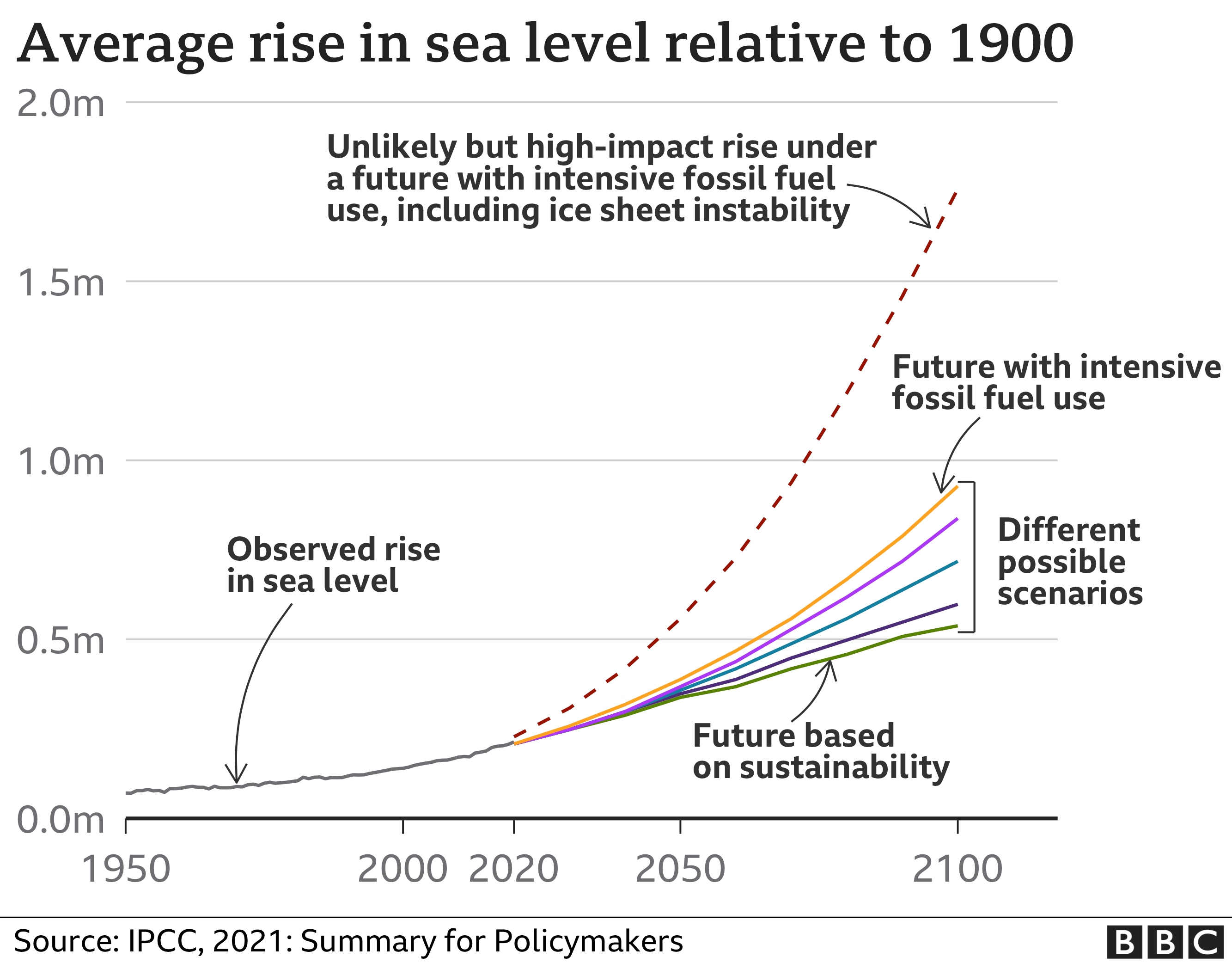
That could lead to sea levels rising by half a metre, but a rise of 2m by the end of the century cannot be ruled out.
That could have a devastating impact on low-lying coastal countries, said Diann Black-Layne, ambassador of Antigua and Barbuda, and lead climate negotiator for the Alliance of Small Island States.
“That is our very future, right there,” Ms Black-Layne said.
The report comes less than three months before a key climate summit in Glasgow known as COP26.
“Today’s report makes for sobering reading, and it is clear that the next decade is going to be pivotal to securing the future of our planet,” he said.
“We know what must be done to limit global warming – consign coal to history and shift to clean energy sources, protect nature and provide climate finance for countries on the frontline.”
Under the 2015 Paris Agreement, more than 190 governments agreed the world should limit global warming to 2C or ideally 1.5C above pre-industrial levels.
But the new report says that under all scenarios, both targets will be broken this century unless huge cuts in carbon take place.
US Climate Envoy John Kerry said that to reach the targets, countries urgently needed to change their economies.
“This is the critical decade for action, and COP26 in Glasgow must be a turning point in this crisis,” Mr Kerry said.
Climate activist Greta Thunberg, who confirmed on Monday that she will attend the COP26 talks, said the report “confirms what we already know… that we are in an emergency”.
“We can still avoid the worst consequences, but not if we continue like today, and not without treating the crisis like a crisis,” she said on Twitter.
NIA CHARLESTOWN NEVIS (August 09, 2021) —Since the Youth Impact 12 programme commenced in 2019, the Department of Youth initiative continues to garner interest.
Ms. Kerdis Clarke, Director of Youth in the Nevis Island Administration (NIA), made the disclosure while speaking with the Department of Information on August 09, 2021.
“When we first started the first cycle, we would have produced six awardees. For this year we are intending to award nine young people, so we would have seen an increase in terms of nomination, in terms of awardees and in terms of interest in the programme.
“Hence the reason why we are encouraging our general public to continue to pay special interest in the remarkable contributions of our young people as they contribute to nation building efforts,” she said.
Once Cycle 2 concludes at the end of August, the awards ceremony is planned for September 30, 2021 at the Nevis Performing Arts Centre (NEPAC). That day will also be celebrated as Caribbean Youth Day.
The Youth Impact 12 programme, with an awards ceremony at the end of every cycle, was created to amplify the efforts of the young people of Nevis between the ages of 18 and 30 years.
“They have contributed remarkably to nation building and we felt the need to highlight youth excellence.
“There are 12 categories that are usually in focus per cycle. The 12 categories include Youth Development, Sports Excellence, Youth in Agriculture, as well as Education and Lifelong Learning,” Ms. Clarke said.
Meantime, the Department of Youth is inviting nominations for September in the category of Patriotism; and October in the category of Education and Lifelong Learning. The deadline for submissions is August 20, 2021 and September 17, 2021, respectively.
The Director of Youth noted that the department would normally begin with the nomination process followed by the interview process before the nominees are selected and featured on the Department of Youth Facebook page and in local media.
BASSETERRE, ST. KITTS, August 9, 2021 (MMS-SKN) — Delivering a sermon based on Psalms 126:1-6 under the theme ‘The Lord has done great things for us’, Pastor Emeritus Eric Maynard of the Shiloh Baptist Church in Charlestown, Nevis, told the congregation on Sunday August 8 that the now successful church was started 50 years ago out of necessity.
At the worship service which was attended by Prime Minister of the Federation of St. Kitts and Nevis Dr the Hon Timothy Harris, Federal Minister of Health the Hon Akilah Byron-Nisbett, and Commissioner of Police Mr Hilroy Brandy among others, Pastor Eric Maynard said that he had just returned from Bible School in July 1971, when the then pastor at the Baptist Church in Brick Kiln called for his intervention.
Pastor Emeritus Eric Maynard of Shiloh Baptist Church in Charlestown delivering the sermon themed ‘The Lord has done great things for us’ on Sunday August 8. Prime Minister Harris is sitting in the front row, on the left.
He noted that the old Volkswagen bus that was used to transport church members from Charlestown to Brick Kiln had broken down the day before. The pastor asked Mr Eric Maynard, who had become a born again Christian five years earlier, to organise and have a service held at some place in Charlestown.
Even though it was a short notice, that Sunday August 8, 1971, they got together and met in the living room in the house of Brother St. Clair Clarke at Craddock Road in Charlestown where they had their first Sunday morning worship away from the Brick Kiln Baptist Church.
“And 50 years later, God would have it that 2021 is the same calendar of 1971,” pointed out Senior Pastor Maynard. “This is no coincidence – fifty years to the day. From there on we never looked back and the rest is history and here we are today.” He however admitted that the first three years were “dark and difficult days.”
Passing leadership from father to son is part of blessings from God: Pastor Wayne Maynard (left) introducing Pastor Emeritus Eric and Mrs Marilyn Maynard.
He told the congregation that when Pastor Wayne Maynard, who is his son, asked him to deliver the message on that auspicious occasion marking his 50 years in the ministry, he said he wrestled with the idea of preaching especially taking into account that the Prime Minister of the Federation would be present. But the younger Pastor Maynard finally convinced him that he should do the message for Sunday August 8, 2021.
Pastor Emeritus Eric Maynard thanked Prime Minister Harris for accepting the invitation to come to worship at Shiloh Baptist Church on that special day. He said someone had asked him how he and the Prime Minister got to be friends, and he said he believed God told the Prime Minster that he (Maynard) had been praying for him.
“God is my witness I did not tell the Prime Minister I pray for him every day,” said Senior Pastor Maynard. “I believe it is God who told him. I count it as an honour that I could call him whenever I want to, he can call me whenever he wants to and let me know what he wants me to pray about.”
According to the Pastor Emeritus, the struggles were real as it took them three years when the Lord turned their activities, and they realised the dream when they finally got started officially in October 1974.
“We moved from a living room to a wooden tent, then we moved on from the wooden tent when it caved in, to a rented house for a year, to the building what is now the Fellowship Hall, and from there here we are in our Sanctuary for which we give God thanks,” he summed up the 50-year journey. “This is a day of thanksgiving – a day of praise, for God has done great things for us. Tough times don’t last, tough people do.”
Prime Minister Dr the Hon Timothy Harris (centre) looks on as Pastor Emeritus Eric Maynard introduces himself to the Minister of Health the Hon Akilah Byron-Nisbett.Seen in church on Sunday August 8: From left standing in the front row are Prime Minister Dr the Hon Timothy Harris, Minister of Health the Hon Akilah Byron-Nisbett, and Commissioner of Police Mr Hilroy Brandy.
In reference to the Federation of St. Kitts and Nevis, Pastor Emeritus Eric Maynard said God has given the country natural blessings in the form of a great deal of sun, sea and sand, and natural beauty and he advised the congregation that they have to be thankful as they are living in paradise.
He also referred to the divine protection that God has given St. Kitts and Nevis, and people who have the wisdom to lead the population through the current Covid-19 pandemic. He criticised persons who are still resisting taking the vaccine on unsubstantiated claims that they might turn to crocodiles.
“God has blessed St. Kitts and Nevis, taking St. Kitts and Nevis out of the lions’ den,” said Pastor Eric Maynard. “There is a lions’ den called IMF. When they tell you jump, you just have to ask them how high. God gave the wisdom to get us out of that den. It took a great deal of planning and wisdom and God’s guidance and yet some people cannot appreciate that. God has blessed us.”
Sir Lester Bryant Bird left us this morning at about 5.30 lying peacefully in bed. He was 83. Antigua and Barbuda has lost a very special son.
Beyond any doubt, he is the architect of modern Antigua, responsible for successfully transitioning the country from an economy dependent on a defunct sugar industry into one of the leading tourism centres in the world.
Under his stewardship, Antigua and Barbuda became a high-income country, transforming the quality of jobs and housing and introducing high end tourist resorts.
When he lost the general elections in 2004, Antigua and Barbuda had the lowest rate of unemployment in the Caribbean of 5 per cent. Many people had the luxury of two jobs.
A keen sportsman, he played golf in his later years, but his passion was cricket. He was a superb pace bowler with a strategic knowledge of the game. At a different time, he might have been selected to represent the West Indies. Hie early triumph for Antigua and the West Indies was to win a bronze medal for long jump for the West Indies at the 1957 Pan American Games.
He was a committed regionalist. He was highly instrumental in establishing the Organisation of Eastern Caribbean States (OECS) serving twice as its Chairman – the first time he was not yet Prime Minister, but such was the confidence that leaders of the Eastern Caribbean reposed in him. He strongly influenced the decision to turn the Eastern Caribbean Currency Authority into a Central Bank that serves its member states so well today. He was convinced that the structures of unity and functional cooperation should be maintained in the OECS because the small size of the countries required unity for strength in regional and international bargaining.
In the wider Caribbean, he was literally and figuratively a giant. It was under his Leadership as Chair of CARICOM that with Jamaica’s PJ Patterson and Barbados’ Owen Arthur that the Regional Negotiating Machinery was established for collective bargaining with the European Union.
Known for his bold oratory, his annual speeches at the UN became a “must listen”, often reported by the international media. He fought tirelessly for a bigger voice in the international community for small states.
Sir Lester Bird was a progressive thinker whose vast experience and knowledge as tourism minister, foreign minister and prime minister served the people of the Caribbean well in the councils of CARICOM.
He had a testy relationship with Barbuda, an island in which he spent his summer holidays as a boy and for which he had great affection. He always said, “I am half Barbudan – my mother is Barbudan”. He dreamed of a developed Barbuda, companion to Antigua in the development of modern facilities and infrastructure. He might have achieved it, had he won the 2004 general election.
It is beyond question that Antigua and Barbuda and the Caribbean Community has lost a gold star in the Olympics of West Indian achievement. And, I have lost an irreplaceable friend and close collaborator of 44 years. I wish it were not so.
Rise, Lester, as you always have with your broad smile and the impish twinkle in your eye. You will continue to inspire through your work that must be recalled and retold for future generations.
Sir Ronald Sanders
Ambassador of Antigua and Barbuda to the Us and the OAS, former High Commissioner to the UK and Ambassador to UNESCO and the World Trade Organization
BASSETERRE, ST. KITTS, August 7, 2021 (MMS-SKN) — The St. Kitts and Nevis (SKN) Moves is an initiative of the Ministry of Health aimed at reducing the burden of non-communicable diseases (NCDs) by creating a healthy lifestyle culture, and for it to succeed in its mandate, Prime Minister Dr the Hon Timothy Harris is recommending that it should inculcate persons at a young age.
Prime Minister Dr the Hon Timothy Harris (holding the mike) addressing, at the Caribbean Cinemas parking lot, persons who participated in the SKN Moves second anniversary health walk.
The St. Kitts and Nevis (SKN) Moves which is observing a slate of celebratory events spanning a seven-week period to mark its second anniversary, held the marquee celebratory event – a health walk – on Saturday August 7. The events are being held by the Ministry of Health in collaboration with the Office of the Prime Minister.
Leading the participants in the event which saw them walk from Caribbean Cinemas, along F. T. Williams and Kim Collins Highways to the roundabout at the Eastern Caribbean Central Bank and back through Ponds Road and Cayon Street, were Prime Minister, Dr the Hon Timothy Harris, and Minister of Health the Hon Akilah Byron-Nisbett.
Commending Permanent Secretary in the Ministry of Education Mr William Vincent Hodge, who was a walk participant, Prime Minister Harris observed that what government and SKN Moves are attempting to do now is to inculcate people at a very young age – in pre-schools, primary schools, and secondary schools. He pointed out that if they succeed, they will have less work to do with the adults.
“We are going to partner strongly with the Ministry of Education because they control the largest number of young people,” said Dr Harris.
Noting that pre-schools, and primary schools have a population of around 5,000 and secondary schools with over 4,000, then within the education sector they have a large proportion of people in a population of just about 47,000. He remarked: “So imagine if we start there – how much stronger and safer we will be.”
Prime Minister Dr the Hon Timothy Harris and Minister of Health the Hon Akilah Byron-Nisbett and other walk participants seen at various stages during the walk.
Addressing participants at the end of the walk, Dr Harris who also has lead responsibility for Human Resource Development, Health and HIV/AIDS issues in the CARICOM’s quasi-cabinet, noted that St. Kitts Nevis (SKN) Moves is part and parcel of the Caribbean Moves initiatives that was launched by the CARICOM heads.
He noted that the CARICOM heads recognised that the Caribbean region and the CARICOM in particular had been much challenged by non-communicable diseases (NCDs) which are linked largely to habits of people who drink too much of the wrong things, and who do not exercise enough among others.
“Way back the CARICOM heads were able to get non-communicable diseases (NCDs) on the global agenda for attention so that the world could focus its energy in assisting us and assisting everyone affected by NCDs in living a healthier life,” he added.
Minimising, if not avoiding, the use of alcohol, doing away with smoking, and engaging in more physical activities would be critical in achieving the desired goals. He said that the St. Kitts Nevis Moves is about physical activity, with everyone finding something to do, whether it is walking, running, cycling, swimming, noting that there are so many activities and the more that persons do leisurely, the more healthy they can be in body and mind.
“So I am happy that with our learning to live better with Covid, we could gather and execute this because healthy living is still a must,” said Prime Minister Harris. “It is still necessary and the good thing about it, the power lies in each of us – what we do, what we say, how we think, all these we can control with effort.”
Permanent Secretary in the Ministry of Health Dr Delores Stapleton-Harris (left) and Permanent Secretary in the Ministry of Education Mr William Vincent Hodge (right) during the walk.
The Honourable Prime Minister commended the Ministry of Health and in particular Minister the Hon Akilah Byron-Nisbett, Permanent Secretary Dr Delores Stapleton-Harris, and all the functionaries in the Ministry of Health for organising another St. Kitts Nevis (SKB) Moves event.
Others from the Ministry of Health included Chief Medical Officer Dr Hazel Laws, Non-Communicable Diseases Programme Coordinator, Dr Marissa Carty, National HIV/AIDS Programme Coordinator and Health Educator, Dr Mathias Afortu-Ofre, and Administrative and Communication Officer at the Permanent Secretary’s office, Ms Marcia Bassue.
The Prime Minister thanked all who participated in the walk, notably the young people who had turned out in their numbers, and the delegation from the Embassy of the Republic of China on Taiwan led by the new Ambassador, His Excellency Michael Lin. He thanked the new ambassador for participating in the health walk at the commencement of his tenure. Ambassador Lin also participated in Prime Minister’s Monthly Health Walk held on Saturday July 31.
Young people took part in the walk in large numbers. They included two-year old Master Jahmaar Gonsalves seen leading his mother Ms Genel Boddie on Pond Road, and being congratulated by PM Harris at the end of the walk.
Before the participants set off, they were addressed by Permanent Secretary Dr Delores Stapleton-Harris, and Non-Communicable Diseases Programme Coordinator, Dr Marissa Carty, who gave details of celebratory activities taking place. Week One which celebrated World Breastfeeding Week was observed in the period August 1-7.
The remaining activities are: Week 2 – SKN Moves Anniversary Celebrations (August 8-14); Week 3 – Community in Ya Kitchen (August 15-21); Week 4 – Water Challenge (August 22-28); Week 5 – Mindfulness Challenge (August 29-September 4); Week 6 – Self Care and Management (September 5-11); and Week 7 – Caribbean Wellness Week (September 12-17).
NCD Programme Coordinator, Dr Marissa Carty (2nd right) addressing participants before they set off. Others are, from left, the Hon Akilah Byron-Nisbett, Prime Minister Harris, PS Dr Stapleton-Harris, and Chef Ya Chen.