Tag Archives: caribbean

Guyana-Brazil Increasing Anti-Virus Border Patrols

Guyana’s Minister of Health Dr. Frank Anthony says both the joint services in Guyana and the federal police in Brazil have increased border patrols between the two countries to reduce the risk of the spread of COVID-19.

He acknowledged that while there are challenges manning the border, efforts are being made by law enforcement on both sides to observe the order.

“While we have heightened our presence on our borders through the joint services, if people really want to slip through, I think there are possibilities of that happening. But it’s not only us who have heightened our presence on our border, on the Brazilian side, the federal police have also increased presence on their side,” the Minister said.

Dr. Anthony said this has been happening for more than a month.

“That’s because we have been in talks with them and we are very pleased that they have also increased their patrols and so forth. It is much tighter than it was before,” he said.

Dr. Anthony had previously indicated that Guyana’s land border with Brazil was closed and that that decision would remain in place for the foreseeable future.

“We allow for an official exchange of goods and services on Thursdays. So, every Thursday, there is an interlude where if there are goods from Brazil that is coming over to Lethem that’s allowed. Of course, given the protocols and everything, and from our side which goes across to Brazil as well,” he said.

Just last week, the government announced the suspension of air travel between Guyana and Brazil to reduce transmission of the new variants of COVID-19 found in that country.

That order also remains in place, Dr. Anthony said, noting monitoring and evaluation are also ongoing.

CMC

The post Guyana-Brazil Increasing Anti-Virus Border Patrols appeared first on The St Kitts Nevis Observer.

Guatemala Welcomes End of Trump Asylum Seeker Policy

GUATEMALA CITY (AP) — Guatemala said Friday the U.S. government is ending an arrangement that sent asylum-seekers who reached U.S. borders back to the Central American nation with an opportunity to seek protection there instead.

The Guatemalan government said in a statement it welcomed the decision to end the accord, known as a safe third country agreement.

“The Guatemalan government welcomes the statements of President Joe Biden regarding his administration’s commitment to our country and the region,” according to the statement.

As of December, only 20 of 939 Hondurans and El Salvadorans who have been turned back from the U.S. and flown to Guatemala decided to seek asylum there, and none of those have gained final approval. With so many returning to their home countries instead, the policy instituted by former president Donald Trump became known as “deportation with a layover.”

Similar arrangements were reached between the U.S. and El Salvador and Honduras. It was unclear if they were also ending. Biden’s team had earlier said he would work quickly to undo those deals.

Flights to Guatemala began in late 2019 and were halted when the coronavirus struck.

Ursula Roldan, a research director at Guatemala’s Rafael Landívar University, said the accords had long been viewed as illegitimate, and were reached in some cases with corrupt governments under the implicit assumption that in exchange, the U.S. would ignore allegations of corruption.

“What President Biden is doing is restoring the asylum and refuge system, is equivalent to once again providing transparency and clarity on these issues, and clarity in negotiations with other countries on immigration and asylum,” Roldan said.

The post Guatemala Welcomes End of Trump Asylum Seeker Policy appeared first on The St Kitts Nevis Observer.

Haiti: 23 Arrested in Moise Murder-Coup Plot, Opposition Names New Pres.

The president of Haiti says an attempt to kill him and overthrow the government has been foiled, amid a dispute over when his term ends.

At least 23 people were arrested, including a top judge and a senior police officer, the authorities said.

President Jovenal Moïse insists his term in office ends in February 2022.

But opponents say it finished on Sunday. Protesters took to the streets of the capital Port-au-Prince and other towns over his refusal to step down.

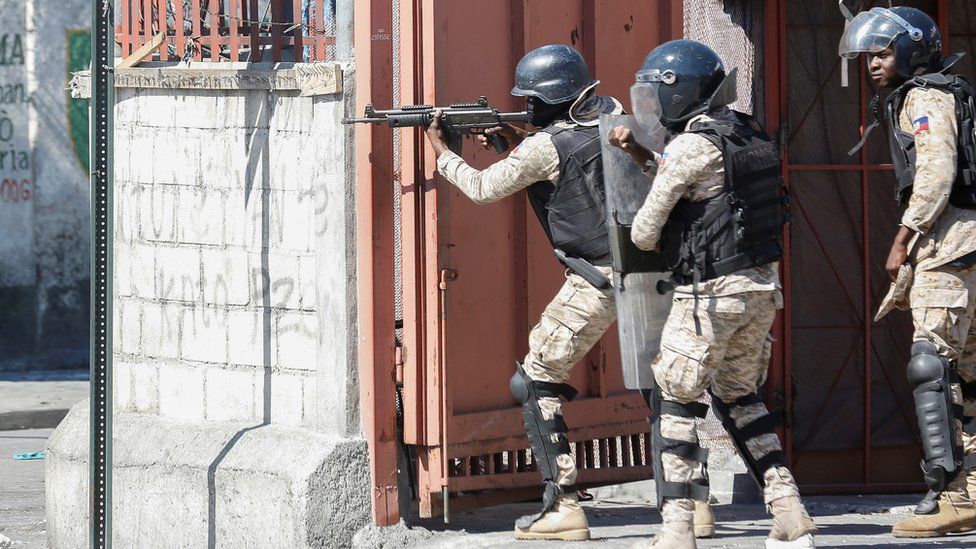
There were clashes with police, who responded with tear gas.

“We cannot accept that Jovenel Moïse violates the constitution of the country,” said one protester, Etienne Jean Daniel. “We demand that the constitution be respected.”

Another accused the authorities of “kidnapping” those accused of carrying out the coup. “I am demanding the release of these people quickly,” said Jean Reynold.

Armed police in Port au Prince, Haiti, on 7 February 2021image copyrightReuters

Security officials said there had been an “attempted coup d’etat” and cash and weapons – including assault rifles, machine guns and machetes – were seized as the arrests were made.

“I thank my head of security at the palace. The goal of these people was to make an attempt on my life,” President Moïse said. “That plan was aborted.”

The BBC’s Will Grant says Haiti’s political crisis comes down to two different interpretations of the constitution and the length of the president’s current term.

Opponents of President Moïse say it ends now after a volatile period in office following a disputed vote in 2016. Mr Moïse disagrees, arguing that he has one year left of his term and has no intention of stepping down before that date.

To punctuate its stance, Haitian opposition parties have named a top judge as interim leader overnight Sunday, the latest attempt to oust President Jovenel Moise, whose term they say has expired.

In a video statement sent to AFP, Judge Joseph Mecene Jean-Louis, 72, said he “accepted the choice of the opposition and civil society, to serve (his) country as interim president for the transition.”

After legislative elections were suspended in 2019, President Moïse is now in his second year of ruling by decree. Even if he manages to avoid being ousted, there are likely to be further protests ahead, our correspondent notes.

Haiti is the poorest country in Latin America with some 60% of the population living below the poverty line.

A group of US senators, in a letter to new Secretary of State Antony Blinken, has called on the Biden administration to withdraw Washington’s support for President Moïse..

The post Haiti: 23 Arrested in Moise Murder-Coup Plot, Opposition Names New Pres. appeared first on The St Kitts Nevis Observer.

Pres. Biden Brings Order & Normality Back to White House

The first weeks of President Biden’s administration have been a striking contrast with the chaos and turmoil of the Trump administration, bringing a sense of normality back to the White House and government.

Biden, along with Vice President Harris, begins each day receiving the President’s Daily Brief, usually before 10 a.m. His administration has revived the White House daily briefings every weekday.

And when he has signed executive actions, they have usually been paired with events where the president delivers scripted remarks on policy, and he has rarely answered shouted questions from reporters.

The White House also routinely sends out press releases that seem familiar. In the early days of the presidency, it issued a statement recognizing National Teen Dating Violence Awareness Month — a day that had been routinely marked by previous administrations but ignored under Trump.

The White House is returning to making visitor logs public on a quarterly basis, a practice that was held under the Obama administration but jettisoned under Trump. Former Obama officials have described Biden’s Cabinet as an extended family of sorts, filled with people whom he has worked with for years and trusts.

“I think one of the main objectives here was giving the presidency a sense of normalcy,” said one longtime Biden aide. “Enough of the crazy shit we experienced for four years.”

After a two-hour meeting on Monday with 10 GOP senators, there were no reports of anyone insulting one another — something that happened frequently when Democrats and Trump got together — though there was no deal either. Sen. Susan Collins (R-Me.) described the meeting as “cordial” and expressed gratitude to Biden for hosting them.

Biden’s tweets, written in lowercase letters, are frequently mundane policy missives. It’s a striking contrast with Trump’s hourly 280-character megaphone, where he often picked fights or criticized and mocked opponents.

“It’s so funny – I hear from friends on both sides of the aisle how cleansing it is to wake up in the morning without feeling that the day will be inflamed by a crazy tweet,” said former Rep. Steve Israel, who served as the chairman of the Democratic Congressional Campaign Committee in the Obama era. “Even people who disagree with President Biden say that at least we’re back to normal.”

Biden’s life outside of the bubble also echoes a time before the Trump era.

He went to church on his first Sunday in office — a routine White House aides expect to continue — at Holy Trinity in Georgetown and made a run for bagels afterward, with Secret Service agents placing the order at the window of the popular “Call Your Mother” deli.

The Bidens have brought their two German shepherds, Champ and Major, to the White House with them and they intend to get a cat. First lady Jill Biden, who has spent most of her career as a community college teacher, is continuing to hold a teaching position at Northern Virginia Community College.

When he was vice president, Biden sought to keep some normalcy in his life, too. He and Jill Biden slipped out of the Naval Observatory occasionally to catch a movie. He made headlines for getting pizza with one of his granddaughters.

He surprised a staffer when it was her birthday by stopping by the Italian restaurant where colleagues had gathered. He was also known to frequent Brooks Brothers on his way home from work at 1600 Pennsylvania.

The difference from the Trump years is stark — even those who worked in his White House acknowledge it.

“If you think about the first weeks of the Trump presidency, and even back in the transition, it was defined by disarray and jockeying for power,” said Anthony Scaramucci, who served as Trump’s communications director for 11 days.

From the beginning, Trump’s White House was marked by loud firings, tweets and fights that generated intense and constant press coverage. Trump’s decisions and actions were unpredictable, even among his staff, which unlike Biden’s, was filled with outsiders.

“Trump was elected because he didn’t have political or government or military experience,” said Barbara Perry, director of presidential studies at the University of Virginia’s Miller Center. “In fact, that was a selling point for him.”

She said that “in the minds of people who voted for him, it wasn’t a weakness it was a plus,” but argued that it did not lead to “informed leadership at the top.”

Chris Lu, who served as Cabinet Secretary in the Obama White House, drew a comparison between the new administration and the Obama, Clinton and Bush White Houses.

“It’s refreshing how normal it is. This is what happens in a normal White House. You have a process for making policy decisions, you have a message of the day, you have a president who sticks to the message. You have a sense of order,” Lu said.

It is not all hunky-dory, as Biden, who pegged himself a moderate Democrat during the campaign, is facing expected pressures from the left and the right as he enacts his agenda.

There have been familiar policy and political disputes ranging from the size and substance of the COVID-19 relief measure — Republicans have balked at the price tag —  to whether Biden is going too far  in restricting oil and gas drilling to reduce climate change.

Yet even the controversies at the White House seem like a return to normalcy. White House press secretary Jen Psaki was criticized by conservatives this week for dismissing a question about the Space Force, the sixth military branch established under Trump. She later issued a tweet that made it clear the Biden administration sees the Space Force as important, an apparent effort to dispel the criticism.

There’s a notable contrast with Capitol Hill, where tensions remain high one month after an angry pro-Trump mob attacked the Capitol. The House voted on Thursday to remove first-term Rep. Marjorie Taylor Greene (R-Ga.) from her committee assignments as punishment for a string of controversies, including remarks about school shootings being staged.

Both the Capitol and White House remained fortified by large fences, a daily reminder of the violence one month earlier. Psaki told reporters this week that the perimeter would be adjusted when it “makes sense from an overall security standpoint.”

Biden’s White House has sought to project order and control while taking over amid a deadly spike in the pandemic and a severe economic downturn. Biden has also tried to manage expectations, warning repeatedly that it will take months to change the course of the virus.

Trump was elected at least partly as a response by voters who disliked the Obama years and what they represented. This could suggest there’s at least some political risk to doing things the way they were done from 2009 to 2016.

Yet Democratic strategist Eddie Vale argued voters are likely to like the signals from Biden so far as a welcome break.

“Just having a sense of normalcy and routine is already making people feel better, but, it’s actually most effective because it’s also infused with competency that is already showing people with action that we are going to come back – or dare I say build back better – from this recession and pandemic,” he said.

The post Pres. Biden Brings Order & Normality Back to White House appeared first on The St Kitts Nevis Observer.
Caribbean Governments Bidding for COVID Vaccine Supplies

Caribbean Community governments appear to have left the daily management of the COVID-19 to medical professionals and have switched their focus to acquiring hundreds of thousands of doses of the vaccine with shipments lined up to arrive in several countries in the next month.

Guyana, Suriname, Jamaica, Barbados and Trinidad, among others, are all close to beginning mass vaccinations for those interested in being jabbed in the arms but community associate, Bermuda, is way ahead of the pack already immunizing 5,000 citizens with another 8,000 awaiting their turn Premier David Burt said this week. The prime minister

As authorities await shipments from Cuba, India, China, the UK and the US, authorities across the region are expressing concern about lax compliance across the region relating to the wearing of masks, social distancing and assembling in large numbers blaming such poor attitudes and approaches for positive infection spikes in recent weeks, linking this mostly to post Christmas activities and revelry.

In the case of Barbados which until the past six weeks appears to have had the situation under control, the island was from Wednesday slipping into a 15-day lockdown of non essential services to help tame a spike that officials blame on non compliance across the spectrum of published regulations.

Prime Minister Mia Mottley said a dusk to dawn curfew will remain in effect during the period and businesses and entities not considered as nationally essential must shut their doors during what she called as “a national pause.” This is the island’s second lockdown in nine months.

“We need now to be able to spread the message to everyone. There are still too many people regrettably who are not wearing masks, there are still too many people who are gathering unnecessarily and I want to remind Barbadians that this thing is not playing, this thing is real and to that extent, I am asking every one of us to join the effort in being able to encourage persons in our communities, in our households,” she said in a national broadcast on Tuesday. “On Sunday, at midday, I am asking for everyone in this country to pause, literally pause, to pray and to reflect on what we must do to save our nation and to save our people.”

Suriname has also tightened up on overnight activities in the wake of 33 deaths in January compared to a mere five in December.

Meanwhile, Jamaica Minister of Health, Chris Tufton announced the imminent arrival of 900,000 doses of Astra Zeneca vaccine later this month as authorities move to inoculate about 500,000 people 16 percent of the population in the first instance the Gleaner newspaper reported. The island’s death toll as of this week reached 352 from 15,800 cases.

Mottley also thanked India’s government for agreeing to send 50,000 doses in the coming weeks to Barbados following a request sent to New Delhi 12 days ago. “We have had commitments from the Government of India and we expect to receive very shortly the first supply for 50,000 persons which will be 100,000 vaccines and we hope to be able to start the deployment of that in the very near future.”

Nearby Guyana through Minister of Health,  Dr. Frank Anthony said the country will get about 120,000 doses from China and Astra Zeneca shortly as he listed frontline workers as among the first to receive jabs.

“We are making other arrangements to be able to acquire more vaccines, so we should have enough vaccines for the elderly and persons with co-morbidities. These arrangements haven’t been completed as yet, but we are very optimistic that we will have more vaccines for persons in those areas. When we complete the health workers and the elderly and people with co-morbidities, then we will go to the next level, which is other people in the population,” Anthony said.

Neighboring Suriname expects 79,200 doses of Astra Zeneca supplies by next month with Health Minister Amar Ramadhin saying that the country’s request “has been submitted to the WHO for approval and I recommend that we wait calmly for the results.”

The post Caribbean Governments Bidding for COVID Vaccine Supplies appeared first on The St Kitts Nevis Observer.
Biden Aims at Root Cause of Central American Immigration

President Biden is signaling not only an eagerness to reverse Trump-era immigration policies with his early executive actions but a willingness to go beyond the Obama administration.

A trio of orders signed by Biden last week seeks to make amends for the Trump administration’s family separation policy by establishing a task force dedicated to reuniting 545 children with their parents.

Biden also ordered a review of his predecessor’s public charge rule, which limited immigration opportunities for those who might need to rely on government assistance like food stamps or other social programs.

But it was Biden’s call for a sweeping review of the asylum and naturalization process — along with a pledge to try to address the root causes of Latin American migration — that excited immigration advocates.

“We’re not just rolling back back the Trump policies, which were at best superficial and ideological, but we’re going beyond the Obama administration,” said Thomas Saenz, president of Mexican American Legal Defense and Educational Fund.

“Certainly it presents a much much more sophisticated view of the refugee and asylum issues for the Western hemisphere than we have seen.”

The new Biden administration policy puts a particular focus on the Northern Triangle, the nickname given to neighbors Guatemala, Honduras, and El Salvador, where in recent years migration patterns have rivaled those of Mexican nationals.

The “root causes” strategy Biden’s order calls for would funnel aid to strengthen democracy, combat gang violence and boost the economy.

“This is a much more sophisticated view of seeing the issue from the root causes and a recognition that the root causes in the Northern Triangle are in part caused by the U.S.,” Saenz said.

That seismic shift from enforcement to aid is being hailed by many immigration experts as a more realistic long-term approach.

“We’re in a situation now where we can no longer lead with heavy handed enforcement and our approach needs to change, and I think what we’ve seen from the administration is absolutely an acknowledgement of that,” said Jorge Loweree, policy director at the American Immigration Council.

Others argue the policy, which differs from the Obama years, will prove more cost effective than recent border security measures, in addition to doubling as foreign aid.

“Starting a Marshall plan for Central America is a lot cheaper than building a wall or hiring immgiration officers. It can provide jobs and security in Central America that could turn off the faucet for refugees coming to the U.S. instead of building more tubs,” said Domingo Garcia, president of the League of United Latin American Citizens.

Advocates say Biden isn’t just proposing policies that go beyond the Obama years; he’s also striking a new tone on immigration and setting higher goals.

One of his orders calls for strengthening inclusion of recently naturalized citizens, a nod to potentially reducing the fees and test requirements associated with becoming a citizen.

There are also signs the Biden administration might diverge from the Obama years by enacting policies making it easier to come to the U.S., like directing the government to consider giving those fleeing domestic or gang violence the ability to apply for asylum. Current law only protects those fleeing discrimination based on race, religion, political views and other protected classes.

Biden also called for reviving another program the Trump administration targeted for elimination, one that allows minors from the Northern Triangle to apply for refugee status.

But Biden’s orders, along with a comprehensive immigration bill Biden sent to Congress that would provide an eight-year path to citizenship for some 11 million immigrants, are sparking backlash among some congressional Republicans.

“Through these actions, President Biden has sent the message loud and clear to the world that our immigration laws can be violated without consequence,” said House Oversight and Reform Committee ranking member James Comer (R-Ky.).

“These radical, far-left immigration policies will continue to enable the humanitarian crisis at the border, place more children in peril as they are brought dangerously to the southern border, encourage more illegal immigration, and undermine the rule of law.”

Sen. Josh Hawley (R-Mo.), who slowed the Senate’s confirmation of Homeland Security Secretary Alejandro Mayorkas by placing a hold on his nomination, said Biden’s nominee

had not “adequately explained how he will enforce federal law and secure the southern border.”

Garcia said Democrats will now be tested on showing that their policies are sensible.

“One of the attacks Republicans have against Democrats is that Democrats are for open borders. We have to show we’re not for open borders but for legal immigration in an orderly fashion.”

Immigration advocates argue Biden’s plans are a direct response to what they view as Trump’s failures.

“The last four years of asylum policies have been based on the premise that if we find a way to make it as difficult as possible and increase the hardship that people have to endure to get to us, people will give up or never come in first place. We’ve gone as far as to take children away from their parents at the southern border, but we’re seeing people continue to come,” Loweree said.

“It speaks to the conditions people are facing in their home country. People would not face that kind of risk if remaining in their home country weren’t such a dangerous proposition.”

That’s where advocates see a chance for Biden to treat the border differently than Trump did.

Biden’s order calls for expansion of shelter networks “to address the immediate needs of individuals who have fled their homes to seek protection elsewhere in the region.”

From Saenz’s perspective, the U.S. bears some responsibility for having contributed to a militarized Northern Triangle that is now creating refugees.

“We contributed to those conditions a lot, and not just with our drug policy but with our immigration policy,” he said.

“Pretty much everyone that’s leaving wants to get out of that situation because it’s so dangerous, and that’s as true in a war atmosphere like Syria as it is in the violent circumstances of the Northern Triangle.”

Loweree argued that Biden needs to go further than reuniting families that were separated during the Trump years.

“They also need to give considerable thought to some kind of compensation fund to provide redress for harms they faced from the previous administration,” he said.

Still, Loweree said the Biden administration has already taken great strides in a short amount of time.

“The reality is they’ve done a lot. They’ve been in office for two weeks, and they’ve done an extraordinary amount of work on immigration. It’s an indication of a new era.”

The post Biden Aims at Root Cause of Central American Immigration appeared first on The St Kitts Nevis Observer.
More & More Arrests for US Capitol Riot

in New York

Guardian (UK) A huge investigation has so far arrested 235 people, including far-right militants, members of the military – and otherwise unremarkable Trump fans

As prosecutors from the House of Representatives prepare to present their case against Donald Trump at his impeachment trial next week for incitement of insurrection, supporters who heeded his call on 6 January to “fight like hell” and went on to storm the Capitol Building are finding themselves in far greater legal peril.

The trial that kicks off in the US Senate on Tuesday could lead to a further vote that would permanently debar Trump from holding office in the future. By contrast, the mob of fervent Maga acolytes who broke into the US Capitol following an incendiary rally headlined by Trump could face prison for up to 20 years.


One month after the events which left five people dead including a US Capitol police officer, there is no sign of the Department of Justice and FBI letting up in their relentless pursuit of the insurrectionists. In the past week alone there have been arrests of alleged rioters in Seattle, Washington; Las Vegas, Nevada; Corinth, Texas; Garner, North Carolina; and Marion, Illinois.

All 56 FBI field offices are engaged in a huge investigation that ranks alongside the biggest the bureau has conducted. As Michael Sherwin, acting US attorney for Washington DC which is leading the hunt, has put it: “The scope and scale of this investigation are really unprecedented, not only in FBI history but probably DoJ history.”

David Gomez, a former FBI national security executive who spent years countering domestic terrorism, told the Guardian that the bureau would classify and handle the search as a “major case”.

“It is probably one of the largest investigations since 9/11,” he said.

Already the number of people who have been arrested, either by the FBI, Capitol police or local Washington DC officers has reached 235, spanning more than 40 states. As the investigation widens and deepens, the focus is tightening on anyone considered to have acted as a coordinator of the action in an attempt to take out the ringleaders.

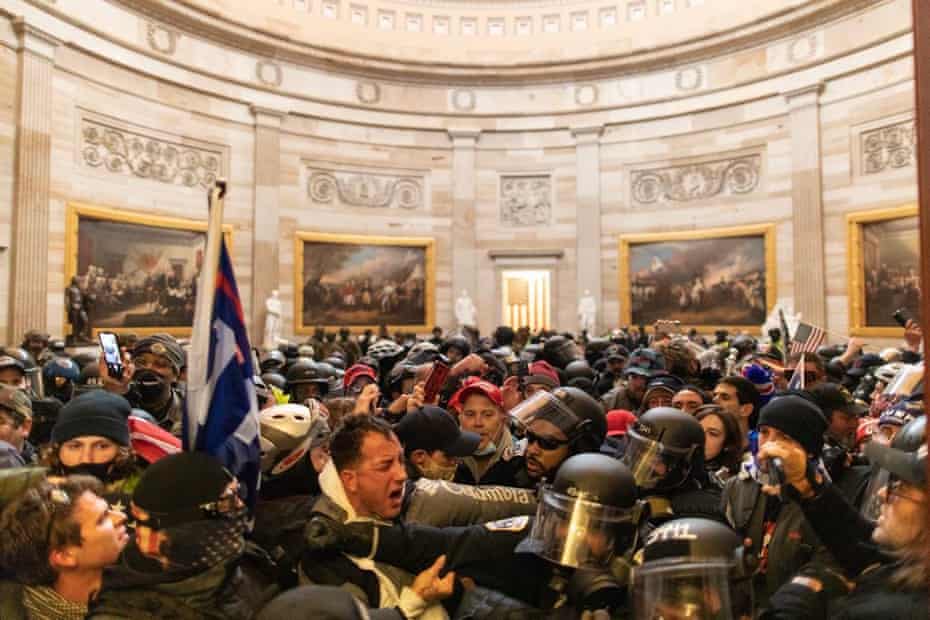
Police intervene against Trump supporters who breached security and entered the Capitol building.
Police intervene against Trump supporters who breached security and entered the Capitol building. Photograph: Mostafa Bassim/Anadolu Agency/Getty

The FBI has set up a special strike force of experienced federal prosecutors who have been given the express instruction to pursue aggressive sedition and conspiracy charges. So far at least 26 people have been charged with conspiracy or assault.

“Sedition is the most serious crime that anybody could be accused of from 6 January,” Gomez said. “It’s advocating the overthrow of the US government. It involves not just talking about overthrowing democracy but having the means and wherewithal to carry out those actions.”

As more has become known about those arrested, the strategy being pursued by the FBI has also revealed itself. In several cases, people who participated in the storming of the Capitol were picked up and charged with relatively minor offenses such as trespassing or theft of mail simply as a means to get them into prosecutorial clutches.

Once in the system, more serious charges could then be added as intelligence came in. That pattern of escalating charges can be seen in the cases of Nicholas DeCarlo from Texas and Nicholas Ochs from Hawaii.

Initially, the pair were accused of unlawful entry into federal property. But new conspiracy charges were added this week in which they are alleged to have planned out their travel across state lines, raised money to pay for it, and then made the trip to Washington DC in a premeditated attempt to obstruct the certification of Joe Biden as winner of the US presidential election.

If convicted, DeCarlo and Ochs each face maximum sentences of 20 years in prison and a $250,000 fine.

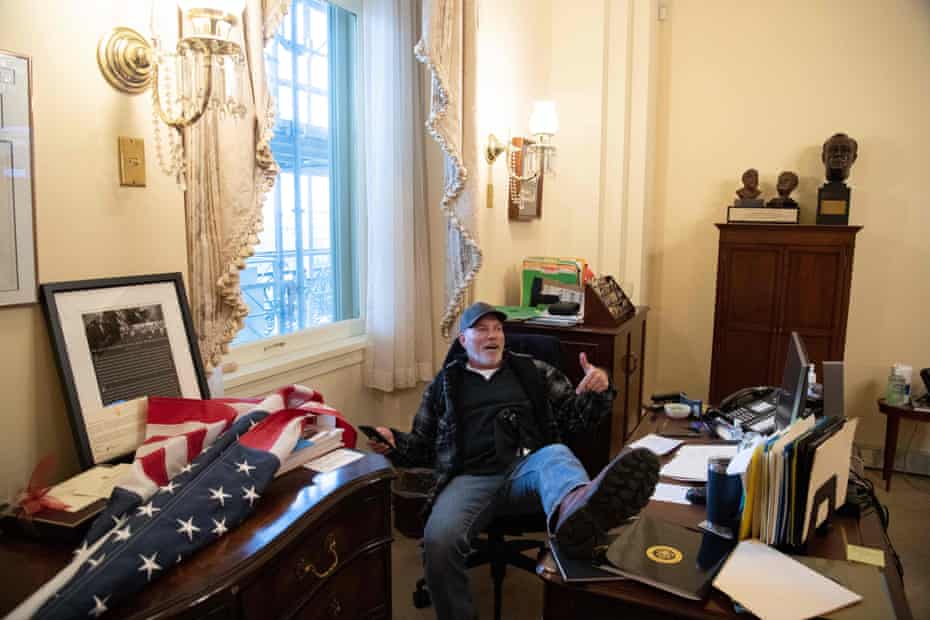
A supporter of US President Donald Trump sits inside the office of US Speaker of the House Nancy Pelosi as he protest inside the US Capitol in Washington, DC, January 6, 2021.
A supporter Donald Trump sits inside the office of the speaker of the house, Nancy Pelosi. Photograph: Saul Loeb/AFP/Getty Images

Prosecutors have made clear that they are ramping up the charges against select individuals as a means of discouraging further violence from Trump supporters and their far-right and white supremacist allies. “We are going to focus on the most significant charges as a deterrent, because regardless of if it was just a trespass in the Capitol or someone planted a pipe bomb, you will be charged and you will be found,” Sherwin said.

The FBI’s work has been greatly assisted by the plethora of intelligence swirling around online – in many cases posted by the suspects themselves. Take the hapless duo, DeCarlo and Ochs.

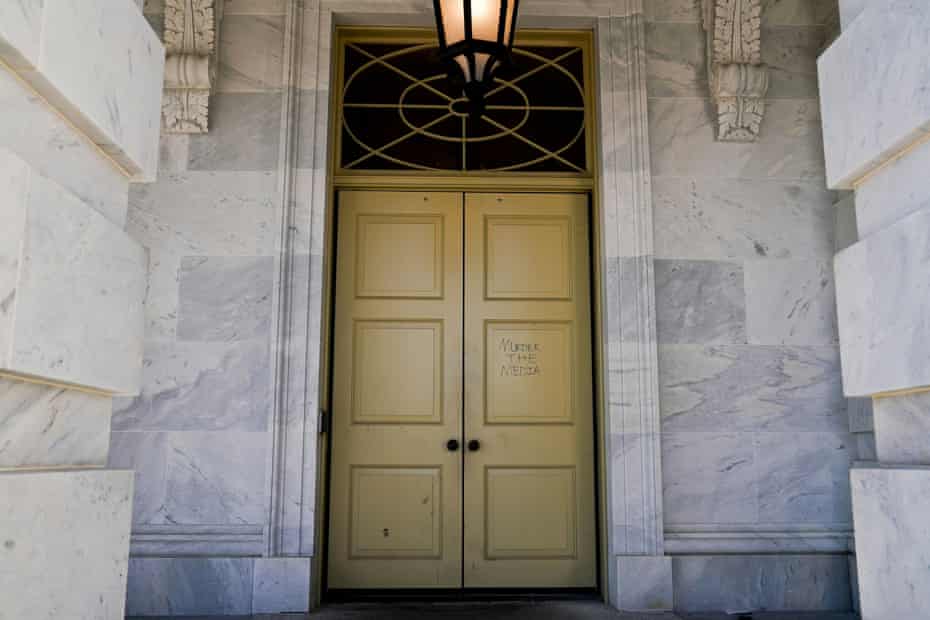
A photo of the pair, posing thumbs up in front of the memorial door of the US Capitol on which they had scrawled the words “MURDER THE MEDIA”, was easily found online. It has been included in the indictment against them, and earned them the special attentions of the media assault strike force set up by federal prosecutors to investigate violent threats against members of the media.

That photo is one of at least 200,000 digital media tips that have poured into the FBI from across the country, some coming from friends and even family members who recognized individual rioters from the profusion of video and stills footage plastered across the internet and promptly informed on them.

The phrase “Murder the media” is written on a door to the U.S. Capitol a day after supporters of U.S. President Donald Trump stormed the Capitol in WashingtonThe phrase “Murder the media” is written on a door to the U.S. Capitol a day after supporters of U.S. President Donald Trump stormed the U.S. Capitol Building in Washington, U.S., January 7, 2021.
The phrase ‘Murder the media’ is written on a door to the US Capitol a day after the insurrection. Photograph: Erin Scott/Reuters

As federal agents work their way through this mountain of digital information they are starting to get a feel for the kinds of people who were present that fateful day on the Hill. As feared, the leadership role played by far-right and white supremacist groups has veered into sight.

At least 10 members of the extremist group the Proud Boys are among the mounting number of those arrested, including Ochs, who according to the justice department claims to have founded a Honolulu chapter of the network. This week’s Washington state arrest was also of a self-declared Proud Boys leader – Ethan Nordean calls himself “sergeant of arms” of the Seattle chapter and is accused in court documents of having led a group of rioters into the Capitol.

On the back of mounting evidence of the Proud Boys’ leadership role in the attack, the Canadian government this week moved to designate the group as a terrorist organization.

Meanwhile, several members of the Oath Keepers, one of the largest far-right militia groups in the US, have also been arrested.

Another chilling element emerging from the indictments is the number of current and former law enforcement officers and military personnel who are among them. An analysis of the first 150 people to be arrested by CNN found that at least 21 had military experience, some ongoing.

Of those, eight were former marines, underlining the danger of elite military training designed to defend the country from international threats being turned back on itself and used to attack the heart of US democracy at home.

At least four law enforcement officers who were actively serving in their positions at the time of the 6 January attack have been accused, and have left their jobs. They include a Houston, Texas, police officer and a corrections officer from New Jersey.

One of the emerging truths that FBI detectives and prosecutors will have to wrestle with is that, despite the substantial presence of white supremacists and military personnel, most of those who have been arrested are what might be described as unremarkable Americans with no previous criminal records or history of extremist behavior.

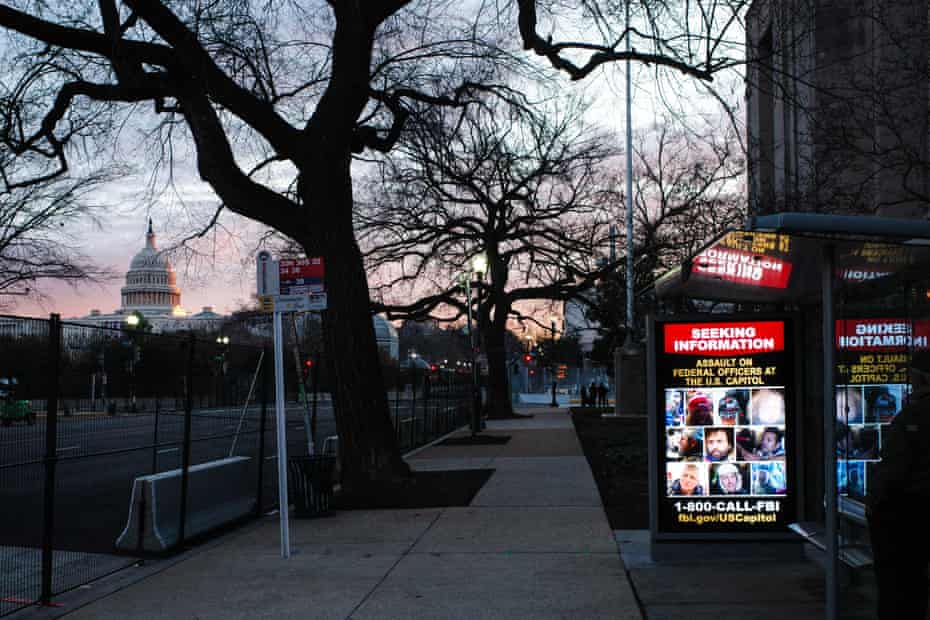
A wanted poster (R) by the FBI is displayed at a bus stop in the now-fenced Independence avenue southwest near the US Capitol (L), as security perimeters expand ahead of the inauguration in Washington, DC, USA, 18 January 2021. The FBI is seeking the public’s help in identifying the insurrectionists that stormed the US Capitol as the Congress worked to certify the electoral votes for the Presidential election.
An FBI wanted poster is displayed at a bus stop near the US Capitol. Photograph: Gamal Diab/EPA

Political scientists at the University of Chicago who studied the profiles of arrestees and published their conclusions in the Atlantic found that many were middle-class and middle-aged – with an average age of 40. Almost 90% of them had no known links with militant groups. Some 40% were business owners or with white-collar jobs, and they came from relatively lucrative backgrounds as “CEOs, shop owners, doctors, lawyers, IT specialists, and accountants”.

The one common denominator uniting this large group is not any extremist group, website or media outlet, but an individual – Donald Trump. This is why the connection between the pending impeachment trial and the ongoing FBI roundup of suspects is so critical.

The link has been made overtly in the defense cases being compiled by lawyers on behalf of several of the arrested rioters. Take Jacob Chansley from Arizona, the self-styled “QAnon Shaman” who went shirtless and wore a furry headdress with horns as he battled as far as the Senate dais during the Capitol assault.

His lawyers have offered him up as a witness during Trump’s trial. They say Chansley, who faces six charges including civil disorder, used to be “horrendously smitten” by Trump but now feels betrayed by him. They are also likely to use the argument that Chansley was misled by the then US president as a central argument in his own defense.

But Gomez is doubtful that the ploy will prove effective.

“I don’t think that’s going to hold water in federal court,” Gomez said. “‘I only robbed that bank because somebody told me to do it’ – I’ve never heard that line working for any crime.”

The post More & More Arrests for US Capitol Riot appeared first on The St Kitts Nevis Observer.
Kittitian Hill offers ‘staycation,’ not a vacation in place

BASSETERRE, St. Kitts — Kittitian Hill, a hotel resort located at Belle Mont Farm, set among 400 acres of organic farmland and the lush forests at the foothills of Mount Liamigua in St. Paul’s, is offering a “staycation” for citizens and residents living on St. Kitts and on Nevis.

Director of the National Emergency Operations Centre, Abdias Samuel, told the Cabinet that Kittitian Hill was approved for a “staycation.”

A staycation is defined as a vacation spent in one’s home country rather than abroad, or one spent at home and involving day trips to local attractions.

Kittitian Hill is not offering vacation in place for international travellers, as was stated by error in the Post-Cabinet briefing of Monday, February 1.

However, locals and visitors alike who have travelled to the country and cleared the 14-day quarantine period can also take advantage of the “staycation.”

A close-up of the Kittitian Hill Resort.

The post Kittitian Hill offers ‘staycation,’ not a vacation in place appeared first on The St Kitts Nevis Observer.
New case of COVID-19 reported; four individuals quarantined

BASSETERRE, St. Kitts – On February 4, the Federation confirmed one additional case of coronavirus disease. The international traveler landed in the Federation on January 30, from the United States.

The patient has been in quarantine at a COVID-19 certified hotel since arrival. The patient was notified and is now in isolation.

This additional case brings the number of COVID-19 confirmed cases to 40, with 28 cases in St. Kitts and 12 cases in Nevis. Thirty-six cases have fully recovered with no deaths. There are now four active cases. These patients are stable and are being monitored.

The Federation continues to adhere to the ‘St. Kitts and Nevis Health and Travel Protocols.’ They can be found at: https://www.knatravelform.kn.

All front-line workers continue to adhere to the COVID-19 protocols along the corridor of containment between the ports of entry and hotel/accommodation sites.

The Ministry of Health confirms that the following measures are being taken to restrict the spread of coronavirus:
• In-depth contact tracing to effectively assess the front-line workers with whom the recently diagnosed cases would have interacted; and
• Quarantine, monitoring and testing of contacts as indicated.

The Ministry of Health and Federal Government assures all citizens and residents that every effort is being made to prevent the spread of this virus locally.

With reports of the SARS -CoV-2 variant in the region and with increase in cases locally more and more persons are adhering to the COVID-19 prevention and control measures. These include:
• Wearing a face mask when in public places;
• Maintaining good hand hygiene;
• Maintaining a physical distance of at least 6 feet from others when in public places; and
• Avoiding crowds and events.

These control measures work. The Ministry of Health encourages everyone to continue. It encourages everyone to work together to maintain and protect the health and well-being of the people of the Federation.

The post New case of COVID-19 reported; four individuals quarantined appeared first on The St Kitts Nevis Observer.

MSR Media begins casting Nevisians for ‘One Year Off’ movie

Nevis Premier, Hon. Mark Brantley, Minister of Finance in the Nevis Island Administration, Foreign Investment, and Tourism.

CHARLESTOWN, Nevis — MSR Media, the production company filming ‘One Year Off’ on Nevis, has issued a casting call to select Nevisians for various roles in the movie.

The comedy film, the first of a two-movie production deal between MSR Media and the Nevis Island Administration (NIA) will begin production within the next few weeks. Several locals have already been hired for the pre-production process.

Nevis Premier, Hon. Mark Brantley, NIA Minister of Finance, Foreign Investment and Tourism, encouraged locals to take up the opportunity to be part of this historic venture and earn some money.

“I’m encouraging locals both here in Nevis and in St. Kitts to take advantage of the opportunities that this presents,” said Brantley. “Positions include acting, those who have the acting bug, and they will be hiring additional people to assist with various roles during this filming period which ought to extend until May.

“We know that the jobs are difficult and hope that people will take advantage of this opportunity and make some money, but also expose themselves to this new industry that we are seeking to build.”

The Premier emphasized that the NIA entered into the movie deal as part of its economic recovery plan to have persons employed and to generate revenue for Nevis.

“We are very excited about this new thrust that Nevis has made into film and film production as we try to diversify our economy and attract new and different investment,” he said.

Brantley said approximately US $1 million will be directly injected into the local economy as result of having the cast and crew for the movie filming and staying in Nevis for about four months.

Producer Phillippe Martinez said it is important to him to have Nevisians featured in the movie.

“In every film the casting of the supporting artistes who will appear in the film is a very exciting time,” said Martinez. “In this case it is even more-so as this is a wonderful way to meet the people of Nevis.

“I insisted that we want to use real people in the film; people who will appear in the film in their real jobs such as sellers in the farmers’ market, shoppers, restaurant owners, and bartenders,” explained Martinez. “It will be a great pleasure to introduce them to the new film industry in Nevis and a wonderful way for the filmmakers to include the people of Nevis in the making of films here.”

MSR Media is casting persons with previous acting or modelling experience for three speaking roles in the movie.

Robyn, a female 30-40 years-old; Joseph, a male 25 -30 years-old; and Farah, a female 30-35 years-old.

Interested persons should send a recent photo and resume to Ma***@*********co.uk.

The production company is also casting for supporting actors and non-speaking roles.

They are also seeking 40-to-50 men and women, ages 30-to-60, of diverse backgrounds for relaxed fun atmosphere scenes; 40-to-50 local men and women, including farmers and vendors, for market scenes; and 40-to-50 local men and women for beach-bar scenes.

Interested persons are asked to send a recent photo and contact information to Ma***@*********co.uk.

All persons cast for the film will be paid for their roles.

The post MSR Media begins casting Nevisians for ‘One Year Off’ movie appeared first on The St Kitts Nevis Observer.