Tamaulipas State Attorney General Irving Barrios Mojica said the officers would be charged with murder and abuse of power.
Who were the victims?
Sixteen of the victims were male and one female. Two of the bodies were so badly burned, their sex could not be established.
DNA tests have so far shown that two were Mexican nationals and two were Guatemalan.
Prosecutors are investigating whether the two Mexicans may have been involved in smuggling the rest of the group to the US.
The two Guatemalans so far identified were 22-year-old football player Marvin Tomás and Élfego Roliberto Miranda Díaz. Both are from the town of Comitancillo in Guatemala.
image copyrightJuventud Comiteca
Marvin Tomás played for a third-division football club in Guatemala
The remaining victims are also thought to have been from Guatemala. Forensic tests suggest they were shot before being set alight.
What was the alleged role of the police?
Few details are available. Prosecutors say that on the day of the killings, several vehicles carrying Guatemalan and Salvadorean migrants to the US were “escorted by armed individuals”.
Mr Barrios Mojica said the crime scene had been “altered”. He pointed to the fact that the pick-up truck on which the bodies were found had 113 bullet holes but no casing were found.
The state attorney general also described the reports filed by the officers as “contradictory”.
What’s the background?
Killings of migrants are not unusual. In 2010, 72 migrants were killed in San Fernando, also in Tamaulipas state. And in 2012, 49 dismembered bodies were found in Cadereyta in Nuevo León.
Both killings are believed to have been carried out by the powerful Zetas cartel.
The cartel controls much of the region and is thought to target immigrants who try to cross it without paying the gang for safe passage.
The fees paid to people smugglers often exceed $10,000 (£7,330) and competition for the migrants’ money is fierce.
Municipal and state police officers are often recruited by cartels – either by the offer of large sums or by threats – to turn a blind eye or even provide the cartels with safe passage.
Foreign Office minister James Cleverly has defended the government’s plan to quarantine travellers in hotels, which begins on 15 February.
Arrivals from Covid variant hotspots will have to stay in a hotel for 10 nights at their own expense.
Mr Cleverly said he did not know how many hotels had signed up yet.
Labour said the scheme should be extended to all international travellers – not just some countries.
The hotel quarantine requirements are being introduced in an effort to control the spread of new variants of coronavirus first identified in South Africa and Brazil, which scientists believe may be more infectious and may reduce the effectiveness of vaccines.
The rules affect UK residents and Irish nationals travelling from 33 countries on the “red list” – which covers much of South America, southern Africa, the United Arab Emirates and Portugal.
Non-UK travellers from these locations are currently banned from entry anyway, so that is why they are not – at this time – affected by the quarantine plan.
Hotels near airports including Heathrow, Gatwick, London City, Birmingham, Bristol, Manchester, Edinburgh, Glasgow and Aberdeen are expected to be booked up for quarantine.
The government said it is working “at pace” to secure the rooms it needs and has had discussion with more than 60 companies in the hotel and travel industries.
“In the face of new variants, it is important that the government continues to take the necessary steps to protect people and save lives,” a Department of Health and Social Care statement said.
Quarantined travellers will be served three meals a day in their rooms, with hot and cold options. Tea, coffee, fruit and water will be available.
The hotels would also be required to work with government-approved security staff, according to documents seen by the BBC.
These security guards will patrol inside and outside the hotel to “prevent unauthorised access”. Anyone wanting to smoke outside or get fresh air will also be escorted by security staff.
An industry source said the government estimated quarantine could cost about £80 a night.
“If they are taking rooms for 1,425 [newly-arrived] passengers per night until 31 March, that is a bill of £55m,” the source added.
Hotels ‘waiting to hear’
But many hotels have said they are waiting to hear more details from the government about how it will work.
The chair of the Manchester Hoteliers’ Association, Adrian Ellis, said some hotels “would be interested”.
“We had a meeting yesterday with about 35 members attending. We are waiting to hear – normally it would come from UK Hospitality – the guidelines, but unfortunately nothing has been received as of now,” he told BBC Radio 4’s Today programme.
“We understand what we can read in the media… but as of now we don’t know which hotels are assigned and we don’t know how the rules will work.”
Asked how many hotels had signed up, Foreign Office minister Mr Cleverly said: “I don’t have that detail at my fingertips.”
Speaking to BBC Breakfast, he added: “The announcement only came out at one minute past midnight this morning so it is unsurprising that no one has formally signed up to this. But the whole point of this is that we give the hotels notice.”
Documents suggest ministers expect more than 1,000 UK residents a day to return from places where new variants are prevalent.
“We’re planning for capacity greater than the expected numbers of people arriving from those countries,” said Mr Cleverly. “Ideally, what we are trying to do is limit as much as possible the number of people who are arriving from those countries.”
When asked why the policy did not apply to all UK arrivals, Mr Cleverly told the Today programme the logistics would be “difficult to implement” and would mean imposing hotel quarantine on people arriving from low-risk countries.
People in the UK are currently banned from travelling abroad unless they “first have a legally permitted reason to leave home”, such as work.
Many hotels in and around airports have lost bookings from holidaying customers who typically book in for a night to be near the airport for early-morning departures. That means they may be more likely to agree to the government’s main requirement that quarantine hotels agree to turn away all other customers and have their premises used solely by quarantining travellers.
Hotelier Mr Ellis, said: “My understanding is if you become a quarantine hotel, you can’t have other business. So those that are already open, for example dealing with business groups or business guests, as per the government guidelines, you can’t then become a quarantine hotel as well.
“So only those ones that are currently closed, and we are guessing near to the airport, will be the ones that are selected.”
‘Brand reputation’
Paul Charles, a travel consultant who is leading a campaign called “Quash Quarantine”, said many hotels are “concerned about the brand reputation being tarnished if they take in guests who could turn out to be positive” and staff are concerned they “may be subject to guests who pass on Covid”.
Government sources said they expect the prospect of paying for secure accommodation could see the numbers of travellers returning from high risk areas swiftly reduce.
Ministers are also likely to increase the fines for people who break the rules.
Details on how passengers will book their place in a quarantine hotel are expected to be set out by the government next week.
WASHINGTON (Reuters) – On Jan. 6, right after the deadly insurrection at the U.S. Capitol, 147 Republican lawmakers voted the way then-president Donald Trump and the rioters had demanded – to overturn his election loss, after months of Trump’s baseless claims that the election had been stolen.
A month later, the Republican party remains paralyzed by that false narrative. Fully 133 of those lawmakers, or 90%, are now declining to either endorse or repudiate Trump’s continuing insistence that he was cheated by systemic voter fraud, according to a Reuters survey of all 147 lawmakers and a review of public statements they made to explain their votes against certifying the Electoral College results.
Just two of those lawmakers told Reuters they believed the election was stolen through fraud; two others who did not respond to repeated inquiries made similar public statements previously. Ten of the 147 lawmakers told Reuters they do not believe the stolen-election narrative; they cited unrelated reasons for their failed attempt to invalidate millions of votes.
(For a graphic on the survey results, click https://graphics.reuters.com/USA-TRUMP/LAWMAKERS/xegpbedzdvq/index.html )
The refusal by the vast majority o
Former Senate Majority Leader Mitch McConnell
f the 147 lawmakers to take a firm stand on the truth of Trump’s central claim underscores the political peril they face as they struggle to appease voters on both sides of a rift in the Republican Party.
Many Republican lawmakers believe they can’t survive challenges in party primary elections without the votes of Trump supporters who are enraged at any suggestion that he lost a fair election to Democrat Joe Biden, Republican strategists said. The lawmakers also fear losing general elections against Democrats without the votes of more moderate Republicans and independents who are repelled by Trump’s false fraud claims and his alleged incitement of the Capitol insurrection.
The Reuters survey illuminates a semantic sleight-of-hand many Republican lawmakers have adopted to avoid taking a firm position on stolen-election claims that were discredited by judges in more than 60 lawsuits that failed to overturn the election result. Many lawmakers tried instead to thread a rhetorical needle – saying, for instance, that they would “stand with” Trump to protect “election integrity” or “the Constitution” – while avoiding any mention of Trump’s debunked fraud claims, the Reuters review of their public statements reveals.
Most lawmakers cited legal arguments that some states’ expansions of mail-in or early voting during the coronavirus pandemic violated the U.S. Constitution – a contention rejected by multiple courts in Trump’s failed challenges to the election result.
The lawmakers who declined to provide a yes-or-no answer to the Reuters survey included some of the most strident backers of Trump’s bid to overturn the election, such as Representative Mo Brooks of Alabama. Brooks spoke at Trump’s rally before the Capitol riots and encouraged “patriots” in attendance to start “taking down names and kicking ass.” In a Jan. 4 public statement explaining his vote to overturn the election results, Brooks railed against “the largest voter fraud and election theft scheme in American history.” But when asked directly by Reuters if Trump lost because of fraud, Brooks avoided a clear answer. He instead relied on technical arguments involving some states’ voting process changes, saying in a statement that Trump lost because some votes, in his view, were not “Constitution-compliant” and “lawful.”
While the vast majority of the 147 lawmakers never endorsed Trump’s outlandish fraud allegations, their support of his bid to overturn the election played a crucial role in perpetuating the stolen-election myth that has become a central flashpoint in American politics. The latest Reuters/Ipsos poll on the subject, taken Jan. 20 and 21, shows that 61% of Republicans still believed Trump lost because of election-rigging and illegal voting.
The lawmakers’ attempt to appease newly polarized camps of voters within the Republican Party “won’t fly” with voters on either side of that divide, said Gabriel Sterling, a top Georgia election official – and a Republican – who has been debunking what he called “nonsensical” election fraud claims since the Nov. 3 vote.
“They were trying to have their cake and eat it, too,” he said of the lawmakers.
That won’t work, Sterling said, because future voters will form their opinions on the lawmakers’ actions – their vote to overturn the election – rather than their words explaining their reasons. Both pro- and anti-Trump voters, he said, are going to see “147 people who agree with Trump that the election was stolen.”
Some Republicans are fed up in the wake of the Capitol riots they believe Trump incited. In one striking example, Reuters reported this week that dozens of Republicans who worked in the administration of former President George W. Bush are leaving the party out of disgust at the failure of most elected Republicans to disown Trump’s attempt to overturn the election.
(For full story, click https://reut.rs/3ay9xJ2 )
Trump’s false fraud claims are likely to figure in his impeachment trial next week in the Senate on a charge of inciting insurrection. Democrats face the steep challenge of convincing 17 Republicans to join in convicting the former president. His lawyers, in a document laying out his defense, have signaled Trump will continue to insist in the proceedings that his stolen-election story is true.
Republican strategist Alex Conant – a former aide to Republican Senator Marco Rubio of Florida and a former spokesman for the Republican National Committee – said Republican House members largely backed Trump’s bid to overturn the election out of fear of angering his base of voters. But those in more moderate districts – or senators who campaign in statewide races – could pay a heavy political price for their votes against certifying the results.
That dynamic was evident in the Jan. 5 losses by both Republican candidates in two U.S. Senate races in Georgia, who were perceived as strong backers of Trump’s fraud claims.
“Any race where independents are a factor, this becomes very awkward,” Conant said. “Senators are much more hesitant to go down the path of election fraud for that reason.”
Most of the 147 lawmakers come from heavily Republican House districts where voters backed Trump by wide margins. But 43 of them hail from more moderate House districts where they won their general election last November by less than 20 percentage points; within that group, 20 of the lawmakers won by less than 10 points.
Jason Miller, a representative for Trump, did not answer questions from Reuters about its survey results and the refusal of most of the 147 lawmakers to endorse the former president’s stolen-election claim.
The Biden White House did not respond to requests for comment.
HAWLEY, CRUZ DENY TRYING TO ‘OVERTURN’ ELECTION
On Jan. 6, the two houses of the U.S. Congress held votes on whether to accept the Electoral College results from the states of Arizona and Pennsylvania, though members also questioned other states’ elections during the debates. Congressional certification of the results, which occurs in every U.S. presidential election, has almost always been a formality in which members declare a winner after merely counting Electoral College votes previously submitted by each state, based on its popular vote.
(For a graphic on how the Electoral College works, click https://tmsnrt.rs/3lUKcgv https://tmsnrt.rs/3lUKcgv )
The 147 Republicans who voted to reject the two states’ results included 139 House members – about two-thirds of the party’s House caucus – and 8 of the 51 Republican senators serving at the time in the 100-member chamber.
Reuters asked the office of every lawmaker who voted against the certification of Electoral College results a single question at the heart of the political crisis: Do you believe that Donald Trump lost the election because of voter fraud? Reporters then followed up with each office to seek a yes-or-no answer and additional comment.
The vast majority – 133 – either declined to answer or did not respond to repeated inquiries. Reuters also reviewed all the lawmakers’ public statements and Twitter postings explaining their votes. For some members, Reuters also reviewed public statements and speeches at a rally Trump held just before the riot and on the floor of Congress before the vote on the election results.
The two senators who led the coalition of Senate objectors – Ted Cruz and Josh Hawley – both avoided directly endorsing Trump’s fraud claims even as they pushed for a special commission to investigate them. Both have faced backlash from corporate donors and moderate Republicans in the wake of the riots, as have many of the lawmakers who voted to reject Electoral College results.
A spokesman for Cruz declined to answer the Reuters survey question or to provide additional comment. Representatives for Hawley did not respond to repeated inquiries.
Hawley, outside the Capitol on Jan. 6, raised his fist in solidarity with protesters as they demanded that the “traitors” in Congress unseat Biden and install Trump. Yet after that protest devolved into a deadly riot, Hawley made no fraud claim in explaining his vote against the election results on the Senate floor. He instead focused solely on the argument that the Pennsylvania legislature in 2019 – which was then, as now, controlled by Republicans – violated the state constitution by expanding mail-in voting.
That’s the same argument from a failed lawsuit filed by Pennsylvania Congressman Mike Kelly and other plaintiffs. The state Supreme Court called the suit’s timing “beyond cavil” – meaning petty – noting that plaintiffs waited until after Trump lost to object to a law the state legislature passed in 2019, with bipartisan support, and to seek the “extraordinary” remedy of nullifying 6.9 million votes. The U.S. Supreme Court denied a petition to review the state court decision.
Both Cruz and Hawley, echoing many other lawmakers, have said they never intended to overturn the election.
“Let me be clear,” Cruz said in his speech inside the Capitol on the day of the riots. “I am not arguing for setting aside the result of this election.”
Days earlier, Cruz gave a different answer when pressed on the goal of his support for the idea of appointing an investigative commission into electoral fraud. Fox News host Maria Bartiromo asked him: What happens if the commission finds fraud?
“Then the results would have to be set aside,” he said, arguing that the nation’s founders gave Congress the ultimate power to determine “what counts as a valid vote.”
‘ABSURD’ LEGAL ARGUMENTS
After the riots, Cruz condemned Trump’s stolen-election rhetoric as reckless even as the senator continued to defend his vote to overturn the results. Trump never proved his claims of “massive fraud” or that the election was “stolen everywhere,” Cruz said in his podcast, the Verdict, on Jan. 23. “That’s not responsible, and you’ve never heard me use language like that.”
Conant, the Republican strategist, said such careful and contradictory positioning may not insulate the lawmakers who voted to overturn the results from blowback in future elections.
“Nuance is rarely a successful message in politics,” Conant said. “Whenever politicians try to be lawyerly or have it both ways, they end up turning off more people.”
In interviews and public statements, some of the 147 lawmakers now say their objections had nothing to do with voter fraud. More than 80 of them have cited one particular constitutional argument. They contend that, in battleground states Trump lost, state courts and election officials violated the U.S. Constitution by making procedural changes such as expanding mail-in voting or extending vote-counting deadlines without a vote of their state legislature.
That theory was rejected by judges ruling on some of the lawsuits filed by Trump and his allies, including a federal judge in Wisconsin who said it lacked “common sense.” Lawrence Douglas – a legal scholar who called the argument “absurd” – said such procedural changes by state election officials or courts are “quite routine,” and regularly delegated by state legislatures to election administrators.
Douglas, an election law specialist at Amherst College, said the passage of the Constitution cited by lawmakers – Article 2, section 1 – says only that state legislatures should determine “the manner” in which electors are chosen, such as by popular vote, as happens in every U.S. state. Process changes such as extending a mail-in ballot deadline have “nothing to do with changing the way electors should be chosen,” Douglas said.
HOW DEMOCRACY FAILS
Only a handful of the 147 lawmakers are explicitly backing Trump’s stolen-election claims. The two that told Reuters they believed voter fraud robbed Trump of victory are House members Paul Gosar of Arizona and Marjorie Taylor Greene of Georgia.
Two others – House members Louie Gohmert and Ronny Jackson, both of Texas – did not respond to the Reuters survey but have explicitly claimed in other public statements that Trump lost because of voter fraud. A handful of other lawmakers have publicly alleged widespread fraud but did not claim, in their statements explaining their votes, that the alleged fraud was extensive enough to change the election’s outcome.
Greene declined an interview request. A spokesman, Nick Dyer, confirmed that she believes the election was stolen. Greene said Trump “won by a landslide” in one recent video and made other similar statements.
Newly elected in November, Greene has taken a hail of criticism since joining Congress for her history of making allegedly anti-semitic statements and endorsing a host of outlandish conspiracy theories. The debunked theories she has embraced include QAnon, which holds that elite Democrats are part of a cabal of Satan-worshipping pedophiles and cannibals.
Gosar spokeswoman Jessica Lycos said the Arizona congressman “strongly believes” the election was stolen from Trump, though she added that “we can’t explain how it happened.” Gosar, she said, is convinced that statistical anomalies in Arizona’s election data suggest that hundreds of thousands of ballots had been altered or miscounted.
Arizona Secretary of State Katie Hobbs, a Democrat, called that claim one of many “vague” conspiracy theories that Gosar has promoted. Such baseless claims, she said, undermine “the foundation of our democracy.”
Most of the 10 Republican lawmakers who now say they don’t believe Trump lost a rigged election had previously issued relatively mild statements that avoided any direct allegation of fraud. But one of them – Rep. Madison Cawthorn, newly elected from North Carolina – made a speech at Trump’s rally on Jan. 6, firing up the crowd to “fight” the election result just before the storming of the Capitol.
“The Democrats – with all the fraud they have done in this election – the Republicans hiding and not fighting, they are trying to silence your voice!” Cawthorn shouted in the speech. “They have no backbone!”
Cawthorn spokesman Micah Bock told Reuters: “Rep. Cawthorn cannot prove fraud.” Bock said Cawthorn instead relied on the same constitutional theory most of his colleagues cited in explaining their votes.
Only Republican leaders can restore voters’ confidence in the security of U.S. elections, and only by firmly repudiating Trump’s fraud claims, said Nicholas Valentino, a University of Michigan political science professor.
“We’ve seen in many other countries how democracy fails,” he said, “and it fails most often in this way – because electoral outcomes are not considered legitimate by the citizens themselves.”
‘A managerial Mephistopheles’: inside the mind of Jeff Bezos
The Amazon founder’s relentless quest for ‘customer ecstasy’ made him one of the world’s richest people – now he’s looking to the unlimited resources of space. Is he the genius our age of consumerism deserves?
Guardian (UK) The first thing I ever bought on Amazon was an edutainment DVD for babies. I don’t recall making the purchase, but the data is unequivocal on this point: on 14 November 2004, I bought Baby Einstein: Baby Noah – Animal Expedition for the sum of £7.85. My nearest guess is that I got it as a Christmas present for my nephew, who would at that point have been one year old, and at the very peak of his interest in finger-puppet animals who cavort to xylophone arrangements of Beethoven. This was swiftly followed by three more DVD purchases I have no memory of making. Strangely, I bought nothing at all from Amazon the following year, and then, in 2006, I embarked on a PhD and started ramping up my acquisition of the sort of books that were not easily to be found in brick-and-mortar establishments. Dry treatises on psychoanalysis. Obscure narrative theory texts. The occasional poetry collection. Everything ever published by the American novelist Nicholson Baker.
I know these things because I recently spent a desultory morning clicking through all 16 years of my Amazon purchase history. Seeing all those hundreds of items bought and delivered, many of them long since forgotten, was a vaguely melancholy experience. I experienced an estranged recognition, as if reading an avant-garde biography of myself, ghost-written by an algorithm. From the bare facts of the things I once bought, I began to reconstruct where I was in life, and what I was doing at the time, and what I was (or wanted to be) interested in. And yet an essential mystery endured. What kind of person purchases within the space of a few days, as I did in August of 2012, a Le Creuset non-stick crepe pan, three blue and white herringbone tea-towels, and a 700-odd page biography of the Marxist philosopher Theodor Adorno? (The tea-towels are still in use, and so is the crepe pan, while the 700-plus page Adorno biography remains, inevitably, unread.) Perhaps the answer is as simple as: a person with an Amazon account.
My Amazon ordering peaked in 2018, a year in which I bought 92 books from the site. What strikes me as somewhat ironic now is how many of those books – bought from a company owned by a man who was, at that point, the richest person on Earth, and which is responsible for roughly the same annual carbon emissions as Norway – could be categorised under two major headings: anti-capitalism and climate change. There’s a good reason for this, or at any rate a clear one: I was at that point in the middle of researching a book about climate change, capitalism and apocalyptic anxieties. My point here is that my relationship with this company is an extremely vexed one. I think of myself as a socialist, but my purchase history leaves me no choice but to also think of myself as a loyal customer of Amazon.com.
The way that Amazon does business – its pressuring of suppliers, its systematic annihilation of retail competitors, its incessant harvesting of its customers’ data, its treatment of its own workers as little better than machines – is, of course, inseparable from the personal wealth of its founder, Jeff Bezos, who earlier this week stepped down as CEO of the company. But even if the means by which that wealth had been amassed were somehow unobjectionable, it would still stand, purely on its own terms, as a moral obscenity. It’s impossible to even conceive of the scale of this man’s wealth. It’s like trying to think about deep time: the mind’s eye glazes over. This is a man who makes about $149,000 with every passing minute. This is a man who, last July, in the midst of a global pandemic and a devastating economic crisis, increased his personal wealth by $13bn in the course of a single day. This is a man who, despite living on a planet where one third of human beings don’t have access to safe drinking water, told Business Insider magazine that “the only way I can see to deploy this much financial resource is by converting my Amazon winnings into space travel”.
Some further perversities: I make my living mostly through my books, and I rely, as such, on the relative robustness of the transatlantic book business. Amazon has, by and large, been bad for people like me, because it has been bad for the industries we rely on – publishing and retail bookselling. If you buy my book from Amazon, I receive a lower royalty than I would if you bought it from the bookshop around the corner. Amazon does not abide by the recommended retail price you see on the back cover. Because of its overwhelming market power, it sets its own retail price, and demands lower cost prices from publishers, whose lower margins are reflected in the writer’s royalties. It doesn’t make sense for me as a writer to be as loyal a customer as I am of a company like Amazon.
But here is where I encounter the problem of my own moral inertia. If a thing is available for purchase, and I want to buy it, I know for a near certainty that I will be able to get on Amazon, and that I will in all likelihood be able to get it quicker and cheaper than I would elsewhere. Just a moment ago, in fact, I got a notification on my phone – an email from Amazon informing me that a package I’d ordered had just been delivered. I went downstairs and opened the front door, and right there on the doorstep was a thin cardboard package, bearing the blandly smiling logo, and containing an illustrated book of Greek legends I’d ordered for my son a few days ago. I’d like to be able to tell you how much it would have cost me to get this book from another online seller, and how long it would have taken. But the truth is I don’t know, and I don’t know because it would have been a hassle to find out. A basically negligible hassle, maybe, but the point is that we live in a culture in which even negligible hassle amounts to a deal-breaker. It is a culture which Amazon helped to create and has come to exemplify, and of which I, as a consumer, am both beneficiary and product.
Amazon has established itself as the great path of least resistance, encircling the globe, along which in one direction goods flow, and in the other money. Almost 40% of all online purchases in the US are made on Amazon. In the UK, it’s about 30%. There are many criticisms to be made about Amazon’s corporate practices, its insidious effects on multiple levels of the economy, but you can’t say that it is not efficient, or that its efficiency is not in your interest as a consumer.
But I am not merely a consumer. There are times, in fact, when I can flatter myself into believing that I am not even primarily a consumer. I am also a person with political beliefs, and moral principles. There is a distinction between having those beliefs and principles and acting in a way that is consistent with them – and this distinction is, I think, crucial to understanding the meaning of Amazon.
What would it mean to resolve this contradiction – between my conception of myself as a person, and my Amazon purchase history? In one sense, it would be fairly easy. I could just stop arranging with Amazon.com for things to be sent to my house. It’s not like there aren’t plenty of other, less objectionable, places to buy books and other miscellaneous items online. I am, to be fair, struggling to think of another single retailer that would get me squared away with both the Adorno biography and the non-stick crepe pan, but the point is that I would in any case likely manage my consumer affairs just fine without Amazon. One of the advantages of the free market is that it will gladly accommodate your vague anti-capitalist preferences: there is no shortage of ethically palatable online retailers you can rely on, at least until Jeff Bezos finds out about them and acquires them. (I don’t want to throw myself entirely under the bus here, by the way: I try to buy from independent booksellers if it’s remotely convenient, and often enough when it’s not. I’m not going to pretend I don’t fall off the wagon, though.)
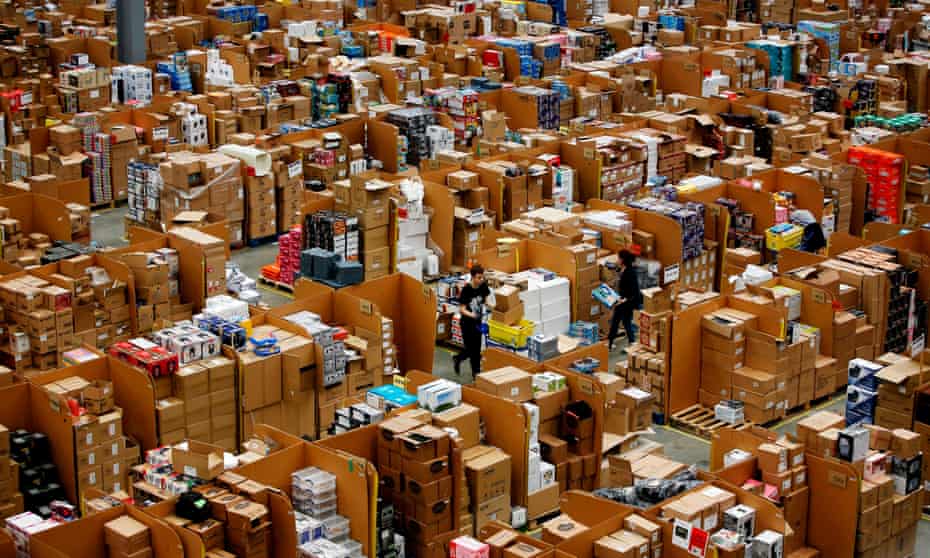
Amazon’s ‘fulfilment centre’ in Hemel Hempstead, November 2015. Photograph: Adrian Dennis/AFP via Getty Images
But the idea of “boycotting Amazon” arises out of a misreading of what Amazon actually is, and of its position in the contemporary marketplace. Amazon is not, and has not been for many years, merely a gigantic online shop that you can chose either to patronise or not. It is also, increasingly, the infrastructure undergirding the internet itself. Even if my task here was to convince you, the reader, that Amazon was bad and that you should boycott it – which we both know it is, and that you should – we would both of us still, in a strictly technical sense, be using Amazon. (Another, perhaps more accurate way of putting this would be to say that Amazon would still be using us.
Amazon Web Services (AWS), which launched in 2006 and is now the largest cloud computing platform in the world, provides hosting for the Guardian, and for tech mainstays such as Netflix and Twitter, as well as for industrial giants such as General Electric and Unilever. While researching this piece, I watched Amazon Empire: the Rise and Reign of Jeff Bezos, a highly informative – and highly critical – documentary, put out last year by the US non-profit public broadcaster PBS, which itself relies on Amazon’s cloud platform. In 2013, Amazon signed a $600m deal with the US government to host the top-secret workloads of its various intelligence agencies, including the CIA and NSA, via AWS’s Thomas Pynchon-ishly named Secret Region.
Jeff Bezos’s achievement has been to make it less and less possible, or at least less and less practical, to avoid Amazon. It’s not an especially large overstatement to say that his ambition is to dominate the entire economy. (As the American journalist Franklin Foer put it, “if Marxist revolutionaries ever seized power in the United States, they could nationalize Amazon and call it a day”.) When Amazon acquired Whole Foods in 2017, for $13.7bn, the market value of the US’s largest grocery companies immediately plummeted by billions. The following year, when Amazon bought a small online pharmacy concern called PillPack for $753m, the potential effects on the traditional pharmacy sector spooked investors badly enough to cause a sudden and steep decline in the value of retail giants such as Walgreens, CVS and RiteAid. And when Amazon announced a healthcare partnership with Berkshire Hathaway and JPMorgan Chase, aimed solely at providing coverage for these companies’ own employees, the major American health insurance providers instantaneously lost billions. How did Amazon come to occupy such an unprecedented role in contemporary life, and who is this extraordinary man who put it there?
One way to answer these questions would be to read that man’s collected writings – a thing that, against all expectations, turns out to actually exist. Last November, to very little fanfare, Harvard Business Review Press published a book called Invent & Wander: The Collected Writings of Jeff Bezos. Presumably by design, the title suggests an anthology of essays and intellectual interventions by a significant thinker, though in fact the first two-thirds of it is composed of Bezos’s annual letters to Amazon’s shareholders, with the final third, entitled My Life and Work, drawn from public talks and interview transcripts.
As a writer who has felt on occasion the sting of the one-star Amazon review, I will admit to a certain low-grade schadenfreude on reading Bezos’s unsatisfied customers sounding off in the comments on his own website. “I can’t believe I paid for this,” writes one disgruntled reader. Another claims that the book could have been put together “by a 5 year old” – somewhat unfairly, it has to be said, because whatever you think of the book’s form, its content is predicated on its author having founded one of the most successful businesses in history. It’s true that the book is not exactly the collected essays of Montaigne, but if you want to understand Amazon’s dominance, it might be useful to first try to understand the man who started it, and his thinking about it, however banal that thinking might be.
One thing I myself learned, for instance, was that before Bezos finally settled on Amazon as the name of his online store, he wanted to call it “Relentless”. Although friends eventually convinced him that he was erring on the side of the sinister, he did register the domain. Even now, if you type relentless.com into a browser, it will take you to Amazon. Despite those vaguely menacing associations – or, let’s be honest here, largely because of them – the name does capture some essential quality of the enterprise. Amazon is nothing if not relentless: in its incursion into the further reaches of the market, in its revenue growth, and in its ever-increasing presence in the everyday lives of its customers.
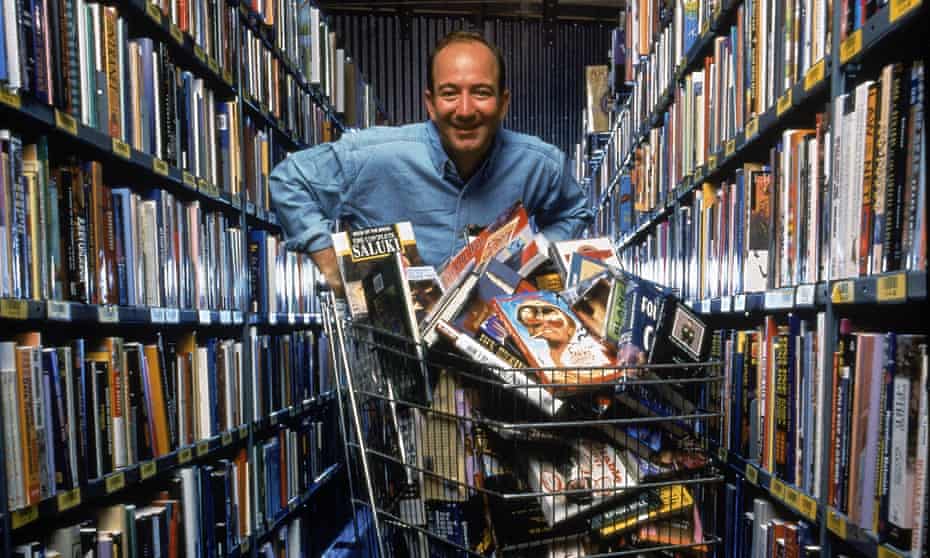
Jeff Bezos in Seattle, Washington, September 1998. Photograph: Rex Rystedt/Time & Life Pictures/Getty Image
It’s certainly a word Bezos himself likes the sound of. It occurs a total of 17 times in the book. We get references to, among many others, “relentlessly lowering prices”, focusing “relentlessly on our customers”, and “relentless commitment to long-term shareholder values”. And relentlessness is not merely a corporate value Bezos aims to instil in his own business; he also wants to empower others to be relentless in their own right. In his 2010 address to Princeton’s graduates, Bezos puts the following question to the emerging members of the US ruling class: “When it’s tough, will you give up, or will you be relentless?”
Relentlessness, in other words, transcends the category of mere corporate value, to become a kind of moral imperative. And if relentlessness is a good in itself, what might the evil of relenting look like? It might take the form of stasis, which, as we will see, is the great future nightmare that Bezos wants humanity to avoid at all costs. Amazon has never paid its shareholders a dividend. For most of its history, it never turned a profit, its practice being to plough everything into growth. The company is, in this sense, a rarified example of capitalism in its ideal form: not merely premised on the notion of endless growth, but apparently achieving it.
And what is it all for, this personal empire whose vastness and multifariousness is unprecedented in the history of capitalism? Is it just wealth, just power, just control? No, of course not. If you know anything about Silicon Valley techno-capitalism, the first thing you know is that it’s never about mere wealth, mere market domination. Such things are always a means toward an end – and the end, more often than not, is saving the world.
Every year, Bezos liquidates a billion dollars’ worth of his own Amazon stock, and puts it into a company he founded in 2000 called Blue Origin, which develops technologies aimed at facilitating travel to, and settlement of, manmade colonies in outer space. “We want to go to space to protect this planet,” as he put it in a 2019 speech, included in Invent & Wander under the title The Purpose of Going into Space. The big problem the Earth faces, according to Bezos, is not environmental destruction per se; it’s the prospect of running out of energy resources. But if we move into outer space, he argues, we will have access to unlimited resources, and there will be, to all intents and purposes, no limits to growth, or to the consumption of energy. “In a nutshell,” as Fortune journalist Brian Dumaine puts it in his book Bezonomics, “he wants to make Earth a residential and light industrial zone and move all the mining and heavy industry to space.”
“We could have a trillion humans in the solar system,” says Bezos, “which means we’d have a thousand Mozarts and a thousand Einsteins. This would be an incredible civilisation.” It’s worth wondering whether there might not already be thousands of Einsteins and Mozarts on this planet right now, and how many of them, due to accidents of birth and economic circumstance, are forced to expend their time and potential working as Amazon stockpickers or delivery drivers, further enriching Jeff Bezos – who would, if he were really as interested in cultivating human potential as he claims to be, probably pay people more, and let them take toilet breaks whenever they needed to.
What Bezos is proposing is a system of off-world colonies, located close to Earth, on which millions of people will be able to live out lives of pleasure and comfort. There’s a video of him giving this speech, and the presentation is complemented by a series of animated fantasias of what these colonies would look like: incredibly lavish illustrations of manufactured worlds rotating in space to create centrifugal gravity. Some of these colonies, Bezos says, could replicate existing Earth cities – and here we see an illustration of Florence, complete with geo-engineered Arne and Tuscan hills, entubed and adrift in space. These worlds, says Bezos, would not all have to have the same level of gravity. “You could have a recreational colony,” he says, “that kept zero G so you could go flying with your own wings.” And there would, in such places, be ideal climates. “This is Maui on its best day all year long – no rain, no storms, no earthquakes.”
Jeff Bezos speaking about space exploration in Washington DC in 2019. Photograph: Mark Wilson/Getty ImageIf these slowly rotating promised lands – with their perpetual shirt-sleeve climates, their low-gravity environments, their multitudinous Einsteins and Mozarts – are a kind of techno-capitalist Eden, then Bezos himself must be a benevolent god. But he’s not, to be clear, proposing that he construct these colonies himself: that will be the work of today’s children, and their children, and their grandchildren after them. What he is intending, with Blue Origin, is to provide the basic infrastructure for that building, in much the same way as pre-existing structures – state postal services, credit cards, the internet itself – allowed him to build Amazon. What he wants to do, he says, is not to build but “inspire” this future.
Last year, Bezos announced a combined donation of nearly $800m to various organisations working to fight climate change. But if the writings in Invent & Wander are any guide, he seems less interested in climate change per se than he is in the extent to which it would present a threat to resource consumption, and economic growth. It is, in other words, as though Bezos is surveying the prospect of a dying planet – of mass extinction, burning forests, drowning cities – and seeing the problems it could present for online shopping. “What happens,” Bezos asks, “when unlimited demand meets finite resources? The answer is incredibly simple: rationing. That’s the path we would find ourselves on, and that path would lead, for the first time, to your grandchildren and their grandchildren having worse lives than you. That’s a bad path.”
A world in which consumer goods are rationed is not a world in which Amazon could continue its endless growth. We must follow, in other words, the path of relentlessness, and we must follow it off the face of the Earth. It’s here that “relentlessness” is revealed as an ideological term. Bezos seems less interested in protecting the future of the planet than protecting the future of capitalism.
What are we to make of these celestial aspirations, this vision of the good life as one of endless consumption, limitless growth? And what, more to the point, are we to make of Bezos himself? In one sense, it’s hard to make anything of him at all. Despite his vertiginous wealth, and despite the extent to which his business interests have been skilfully woven into the fabric of our everyday lives, it’s weirdly hard to form any strong opinions about the man. He repels curiosity. The mind skitters off the beige gleam of his surfaces; the imagination scrabbles in vain for some purchase on the frictionless dome of his head.
Two years ago, when Bezos’s texts to his former lover Lauren Sanchez were leaked to the National Enquirer, the most remarkable thing about them was their blank efficiency, as of a customer service chatbot made flesh. “I love you, alive girl,” he wrote. “I will show you with my body, and my lips and my eyes, very soon.” And also: “I want to talk to you and plan with you. Listen and laugh…I basically WANT TO BE WITH YOU!!! Then I want to fall asleep with you and wake up tomorrow and read the paper with you and have coffee with you.” Even the outline of his spacefaring fantasies seems bland and unoriginal, a reheated mid-20th century vision of the future – no more ingenious, in the end, than Amazon.com itself, which for all its world-straddling success began as (and essentially remains) a Walmart you can go to on the computer.
But Bezos himself, like seemingly all wealthy entrepreneurs, claims not to be motivated by – or even especially interested in – wealth itself, or its mundane trappings. As he puts it in Invent & Wander, he never sought the title of “world’s richest man”. (Bezos is now, in fact, the world’s second richest person, having been overtaken just last month by Elon Musk.) He would much rather be known, he says, as “inventor Jeff Bezos” (my emphasis). In the statement he made to investors earlier this week on stepping down as chief executive, Bezos once more returned to the idea of himself as an inventor: “Amazon is what it is,” he said, “because of invention … When you look at our financial results, what you’re actually seeing are the long-run cumulative results of invention.”
The book, and in particular its introduction, by the biographer Walter Isaacson, who is best known for his book about Steve Jobs, is intent on framing Bezos as a contemporary renaissance man, a figure on the revolutionary order of your Leonardos, your Einsteins, your Ben Franklins (all of whom Isaacson has written books about). After running through the qualities he considers peculiar to such “true innovators” – passionate curiosity, an equal love of both the arts and the sciences, a Jobs-like “reality distortion field” that inspires people to pursue apparently impossible ends, and a childlike sense of wonder – Isaacson concludes that Bezos embodies all of them, and that he belongs in the pantheon of truly revolutionary thinkers.
Jeff Bezos with the Blue Origin crew capsule and New Shepard rocket booster in Colorado Springs, April 2017. Photograph: Chuck Bigger/Alamy
If you believe that capitalism is an inherently just and meritocratic system, whereby the most worthy people – the hardest-working, the cleverest, the most innovative – amass the greatest wealth, then it stands to reason that you would have to make some kind of argument for a man who had amassed more than $180bn in personal wealth as a presiding genius of our time. And just as Hegel looked at Napoleon and saw the world-soul on horseback, Isaacson views Bezos in similarly heroic light: the world-soul dispatched by delivery drone. The effort to portray him as such is, though, inevitably beset by bathos. “An example of how Bezos innovates and operates,” he writes, “was the launch of Amazon Prime, which transformed the way Americans think about how quickly and cheaply they can be gratified by ordering online.” There is no question that the introduction of Amazon Prime marked a major moment in the history of buying stuff off the internet, but to present it as the work of an ingenious inventor seems a stretch. For all the vastness of Bezos’s wealth and power, the banality of its foundation is undeniable. (There is, here, an unintended comedy to Isaacson’s hagiography, taking on as it does an almost mock-heroic tone: Bezos fomenting a kind of revolution in consciousness, around how “quickly and cheaply” consumers can get the stuff they order off the internet.)
Bezos has not been personally responsible for the introduction of any new technology into the world. He was not the inventor of online shopping. The year before Amazon.com was founded, the first consumer purchase was made on the world wide web: a copy of Sting’s album Ten Summoner’s Tales, purchased for $12.48 plus shipping, from an online store called NetMarket. Neither did he, or any of his employees, invent the e-reader: a company called Rocket was selling e-readers through Barnes and Noble in the late 90s, back when Bezos was still packing boxes with his own hands.
But it would clearly be wrong to claim that there is nothing radical about the nature of Bezos’s achievement. Amazon’s vast logistical innovations have made the consumer experience, from order to delivery, as frictionless as possible, and in so doing have changed the nature of consumerism. This is to say that it has changed the texture of the world. It’s not that Bezos is doing any one thing that no one had thought to do before: it’s that he’s doing it faster, more efficiently, and at unprecedented scale. His achievement, in this sense, can be seen as one not one of quality but of quantity. But the sheer scale of the quantity, the unprecedented mass and velocity of Amazon’s power, becomes itself qualitative – in the way that getting stung by two bees is quantitatively different from getting stung by one, but getting stung by a billion would be qualitatively different.
In his first ever annual shareholder letter, in 1997, Bezos laid out the principles that he felt defined the company he had taken public earlier that year. First and foremost among these was “Obsess over customers”.
The expression used to denote the company’s drive to perfect the consumer experience at every stage was “customer ecstasy”. The phrase sounds a bizarre note, and even a vaguely obscene one, but there is no question that there is a joyfulness to the experience of ordering something online and having it arrive the very next day. It feels as though you have been granted a kind of magical power, to summon the objects of your desires out of thin air. This is the precise feeling, no doubt, that Bezos wanted to invoke with the first name he had in mind for his company. Before he registered relentless.com, he intended to go with Cadabra, which he favoured for its magical associations. He eventually cooled on the idea, though, when his lawyer pointed out that, spoken aloud, the name sounded too much like the word “cadaver”. Let us pause here to appreciate the comic symbolism of Bezos’s inability to come up with a name for his company that doesn’t immediately suggest some dark unconscious content to its openly stated proposition. It’s as though the magical power Amazon grants to you, the customer, entails a kind of Faustian bargain whereby you must implicitly consent to all kinds of iniquities being carried out in your name.
When I think about this, I often think about an object that never came to exist. In 2016, Amazon was granted a patent for a “Human Transport Device”. The drawings that accompany the patent document depict a cage just large enough to contain one worker. The cage is mounted on a set of robotically controlled wheels, and features a long robotic arm with which the worker can carry out stock-picking tasks; the intention was to permit workers to enter into areas of warehouses where they would otherwise be endangered by the presence of the stock-picking robots by which they will, eventually, be replaced, and who in the meantime present a threat to their frail human bodies.
The patent went unremarked for two years until the academics Kate Crawford and Vladan Joler discovered it, and wrote about it in a document that accompanied a work (part research project, part art installation) entitled Anatomy of an AI System – a sprawling diagram, two metres high and five metres across, mapping the complex nexus of extractive and exploitative processes involved in the functioning of an Amazon Echo. The patent, they write, “represents an extraordinary illustration of worker alienation, a stark moment in the relationship between humans and machines … Here, the worker becomes a part of a machinic ballet, held upright in a cage which dictates and constrains their movement.”
Amazon never put the cage into production; when the patent was uncovered, the public reaction was one of horror, and the company acknowledged the whole thing as a terrible idea. But in its ghostly absence, this structure exemplifies the deal with the devil that you, the customer, enter into every time you click the “Buy Now” button. The true source of your magical power, its true cost, is the life of a worker labouring under deepening conditions of exploitation and control. Stockpickers at Amazon’s warehouses are surveilled and controlled to an extraordinary degree – handheld devices direct their movements, measure their productivity, and record the speed and efficiency with which they meet algorithmically set targets. At a warehouse in Staffordshire, workers were reported to be urinating in bottles because walking to the toilet and back could have led to them missing productivity targets, and ultimately losing their jobs. (In response to these reports, Amazon said that “we don’t recognize these allegations as an accurate portrayal of activities in our buildings”.) Since the pandemic, there have been numerous reports, and video recordings, of Amazon drivers relieving themselves in public. (“The disgusting moment Amazon delivery driver is caught on CCTV ‘doing a poo’ outside customer’s home after dropping off parcel,” read the headline of an article in the Manchester Evening News, which didn’t so much as gesture to the working conditions that might have contributed to this.)
The cage suggests a way of thinking about what distinguishes Amazon as a business, and Bezos as an innovator: the use of technology to push harder and farther than any previous company toward removing, at both ends of the supply chain, the human limitations to capital’s efficiency. Amazon reveals a world, that is, where capital is not something to be acquired in service of human ends, but as an end in itself. If other worlds must be constructed, slowly rotating in space, in order to serve these post-human ends, then so be it. The problem with the cage patent, in other words, was not just that it was dehumanising, but that it illustrated too explicitly the patterns of dehumanisation – of relentlessness in pursuit of customer ecstasy – that had already long been central to Amazon’s operations in the first place.
Amazon robots transport packages from workers to chutes at an Amazon warehouse in Goodyear, Arizona, 2019. Photograph: Ross D Franklin/AP
It’s tempting to argue that Amazon’s true innovation has been the ruthless exploitation of human labour in service of speed and efficiency, but that’s really only part of the picture: the aim is removing humans – with their need for toilet breaks, their stubborn insistence on sleeping, their tendency to unionise – as much as possible from the equation; the grim specifics of the labour conditions are only ever a byproduct of that aim. This has been an aim of capitalism since at least as far back as Henry Ford, and in an obvious sense it’s precisely the dynamic you experience every time you wind up with unexpected items in the bagging area at Tesco. As usual with Amazon, it’s not that something new is happening – it’s that an old thing is happening with unprecedented force, speed and efficiency.
To look at Crawford and Joler’s sprawling infographic is to experience a peculiar moral disorientation. They map a system that is, ultimately, too vast for comprehension, and within which your own position, as a consumer, is endlessly ambiguous. You – which is to say your customer ecstasy – are both the reason for its existence, and just another resource to be extracted for value, along with the the minerals being mined by people suffering under terrible labour conditions. Every time you interact with your Echo you are training the AI to work better, and to understand more about you, your habits and desires, which extracted data it uses to more efficiently sell you things. With an AI product like Amazon’s Echo, you are not just a consumer: you are also both a resource and an unpaid worker, providing information and training to a dynamic system based on feedback loops of data.
The problem here is the same sort of problem we are confronted with when attempting to think about the scale of Bezos’s wealth, or indeed Bezos himself: the mind struggles to gain purchase. One approach would be to just tap the sign that says “No Ethical Consumption Under Capitalism”, because the entire system within which we live is so morally bankrupt that no kind of decent accommodation with it can be reached – which would not be untrue, but also unquestionably something of a cop-out. It’s precisely because it works so well, as a consumer experience, that Amazon’s customers are inclined to keep using it, even though many of us understand the social evils it represents. There is, in other words, a system of moral feedback loops at work here, as complex and insidious as the data feedback loops that nurture Amazon’s AI. It’s also worth pointing out that there is always some marginally – or even greatly – less unethical consumer choice to be made, even under capitalism. The reality is that so few of them work as well as Amazon.
And here we come to the core of the problem: Amazon works too well. Its success and ubiquity as a consumer phenomenon makes a mockery of my ethical objections to its existence. (When I think of these objections, I imagine Bezos literally mocking me, laughing his famously weird, raptor’s laugh. “I don’t know why I have this laugh,” he writes, somewhat unsettlingly, in Invent & Wander. “It’s just that I laugh easily and often.”) Amazon thrusts my identity as a consumer into open conflict with my other identities – writer of books, holder of vaguely socialist ideals – in such a way that my consumer identity too often prevails.
We live in a world where the satisfaction of quotidian desires is the work of mere moments. Whatever you want (and can afford) can be brought to you, cheaply and with vanishingly minimal effort on your part. We know that this form of satisfaction doesn’t make us any happier, and in fact only damages the world we live in, but even so we continue pursuing it – perhaps because it’s in our nature, or perhaps because almost every element of the culture we exist in is calibrated to make us do so.
And so the problem, as such, is one of desire. It’s not that Amazon gives me what I want; it’s that it gives me what I don’t want to want. I want the convenience and speed and efficiency that Amazon offers, but I’d rather not want it if it entails all the bad things that go with it. To put it in Freudian terms, we are talking about the triumph of the consumerist id over the ethical superego. Bezos is a kind of managerial Mephistopheles for our time, who will guarantee you a life of worldly customer ecstasy as long as you avert your eyes from the iniquities being carried out in your name.
It is hard to recognise the Faustian nature of this bargain, just as it is hard to see clearly what Jeff Bezos is. In Isaacson’s introduction to Invent & Wander, he mentions a detail from Bezos’s childhood – no more or less banal than any other story I’ve encountered about the man – by way of explaining the origin of Amazon’s Echo. He loved Star Trek, and played a lot of Star Trek games with his friends as a kid. And the role he himself tended to play in these games was not Kirk, or Scotty, or even Spock. It was the Enterprise’s talking computer. In this detail of the childhood play of a man who would go on to change the world, we can glimpse something of the meaning of his presence in our lives. Bezos’s genius, such as it is, is that of an artificial intelligence, trained on the goals of endless wealth, and endless growth. And if he is, as Isaacson – and presumably Bezos himself – would like us to believe, a Leonardo or an Einstein of our time, what does that say about our time?
In his second shareholder letter, in 1998, included in the book as “Obsessions”, Bezos laid out the fundamental idea that underpinned Amazon’s drive to build the world’s most “customer-centric company.” “We hold as axiomatic,” he wrote, “that customers are perceptive and smart, and that brand image follows reality and not the other way around.” Intentionally or otherwise, the grandiloquence of the language here recalls the US Declaration of Independence: “We hold these truths to be self-evident, that all men are created equal, that they are endowed by their Creator with certain unalienable Rights, that among these are Life, Liberty and the pursuit of Happiness.” The bathos of Bezos’s allusion here – the vertiginous swoop from the rhetorical heights of “We hold as axiomatic” to the mundane invocation of savvy customers – tells us, I think, something profound about the world over which he now presides.
How our home delivery habit reshaped the world
Hypocrites and slave-owners though most of the Declaration’s signatories were, their language invokes an Enlightenment ideal of human beings as free and equal, and life itself as inherently meaningful. There is, by contrast, an almost comical smallness to Bezos’s echoing of that language, and the worldview it reveals. There is no “humanity” being invoked here, no “all men”; there is only “the customer”. There is no grander ideal to be glimpsed behind his words than that of being able to get stuff quickly and cheaply. There is no question that Amazon serves us. The fact that it serves us so well is the reason for its incredible success. But what it serves in us is something very small: the customer, who for all that smartness and perceptiveness Bezos invokes, is a mere husk of a human being.
• Follow the Long Read on Twitter at @gdnlongread, sign up to the long read weekly email here, and find our podcasts here
“This war has to end,” Biden said during an address at the State Department. “And to underscore our commitment, we are ending all American support for offensive operations in the war in Yemen, including relevant arm sales.”
Biden also confirmed he has appointed veteran diplomat Timothy Lenderking as his special envoy to Yemen, saying Lenderking will work with the United Nations and “all parties to the conflict to push for a diplomatic resolution.”
What won’t change: Biden’s announcement will not affect U.S. military operations against Yemen’s al Qaeda affiliate because those are “actions that we undertake in service of protecting the homeland and protecting American interests in the region and our allies and partners,” national security adviser Jake Sullivan said ahead of Biden’s speech.
In choosing to end support for offensive operations in Yemen, Biden has taken a step toward fulfilling a campaign promise to review the U.S. relationship with Saudi Arabia, which he at one point described as a “pariah” state.
But he also stressed Thursday the United States would continue defending Saudi Arabia against attacks.
“Saudi Arabia faces missile attacks, [drone] strikes and other threats from Iranian supplied forces in multiple countries,” Biden said. “We’re going to continue to support and help Saudi Arabia defend its sovereignty and territorial integrity and its people.”
What US has been doing: The United States has been providing logistics and military support to a Saudi Arabia-led military coalition in Yemen’s civil war, as well as billions of dollars in weapons sales. Last week, the State Department announced it was pausing and reviewing arms sales to the Saudis, as well as to the United Arab Emirates (UAE).
Officials in Saudi Arabia and the UAE, which is also part of the Yemen coalition, have been notified of Biden’s decision to end support of offensive operations, Sullivan said.
The background: Support for the Saudi coalition began during the Obama administration as the administration sought to mend ties after Saudi opposition to the Iran nuclear deal. The coalition is fighting Houthi rebels that U.S. officials say receive weapons and other support from Iran.
But opposition to U.S. support for the war mounted as thousands of civilians were killed in Saudi bombing raids. The United Nations has also warned Yemen is on the verge of widespread catastrophic famine.
U.S. lawmakers in both parties have also been increasingly opposed to support for the Saudis after their killing of U.S.-based journalist Jamal Khashoggi in 2018.
The Trump administration ended the U.S. military’s aerial refueling of Saudi jets in the war amid the mounting opposition but in other ways ramped up support for the Saudis, which it saw as critical to its so-called “maximum pressure” campaign against Iran.
Former President Trump pushed through an $8.1 billion arms sale to the Saudis in 2019 over congressional opposition by invoking “emergency” authorities, citing alleged threats by Iran.
Support for decision: Longtime opponents of the war in Yemen hailed Biden’s decision Thursday to end support for offensive operations but stressed it should be just a first step.
“Today marks the beginning of a new era in our foreign policy — one that prioritizes human rights and diplomatic solutions,” Rep. Ro Khanna (D-Calif.) said in a statement.
WASHINGTON, DC — The United States has condemned the heinous assassination of prominent Lebanese activist Lokman Slim in Southern Lebanon.
“We join the international community in calling for his killers to be brought to swift justice,” said US Secretary of State Antony J. Blinken. “Mr. Slim devoted his life to bringing about positive change in Lebanon. He bravely pushed for justice, accountability, and rule of law in his country.
“It is cowardly and unacceptable to resort to violence, threats, and intimidation as a means of subverting the rule of law or suppressing freedom of expression and civic activism,” said Blinken. “We urge Lebanese officials, including the judiciary and political leaders, to hold accountable those who commit such barbaric acts without delay or exception.”
BASSETERRE, St. Kitts — Event planners and the public in St. Kitts and Nevis are strongly encouraged to adhere to the provisions for hosting social events as outlined in the COVID-19 Prevention and Control Act.
“Events including those held on public beaches can contribute to an increased risk of the spread of the virus in communities if persons are not adhering to the health and safety protocols as stipulated in the Act,” said Royal St. Christopher and Nevis Police Force Superintendent Cromwell Henry during the February 3 National Emergency Operation Centre (NEOC) COVID-19 Briefing.
“We are well aware that social events bring people together in ways that facilitate the spread of the virus from person to person,” he said. “Some may say that there is no COVID-19 in the community and that all the cases are contained and are in quarantine – this may be so, but not entirely so. The truth is we do not know when there will be a case of COVID-19 in the community.”
Section 12 outlines the guidelines for using public beaches. The section clearly states that a person may visit a public beach,
(a) For the purposes of swimming or exercise;
(b) Where no more than eight members of the immediate family should be in close proximity to each other;
(c) Where there shall be no picnics, beach parties or other gatherings; and
(d) Where all persons shall adhere to social distancing and physical distancing protocols pursuant to section 6.
Section 9 of the COVID-19 Prevention and Control Act speaks specifically to the restriction on social activities. It states that:
(1) Subject to section 12, no person shall host, attend or visit a social activity or gathering of more than 25 persons including
(a) A private party;
(b) A banquet, ball or reception;
(c) Any other ceremony in any facility or public place;
(d) A meeting of a fraternal society, private or social club or civic association or organization;
(e) Any public beach, subject to sections 6 and 12; or
(f) Any other type of social event, except with the written permission of the Commissioner of Police in consultation with the Chief Medical Officer.
“Whenever permission is granted for an event at a specific venue, that permission is not transferrable to another venue,” said Supt. Henry. “Permission must be sought for any change of venue because changing venue without permission will automatically void the permit.”
Section 9 further states that:
(2) A person who contravenes the provisions of this section, commits an offense and shall be liable to a fine not exceeding $5,000, and
(3) Notwithstanding subsection 2, a police officer or member of a compliance team may in accordance with the provisions of section 8(4) and section 22(2), issue a fixed penalty notice to a person who contravenes the provisions of this section.
BASSETERRE, St. Kitts — The Caribbean Community (CARICOM), is more powerful when it speaks with one voice on regional and international matters, according to Samuel Berridge, Assistant Secretary in the Regional Integration and Diaspora Unit in the Office of the Prime Minister.
“Just the functional co-operation element of it, by the states co-operating and collaborating, we were able to save a lot of resources,” said Berridge. “The very impetus for regional integration is to bring about the pooling of resources. Whenever we go to international conferences, there is a CARICOM caucus. So, we arrive at one position.”
“We are one, but when we are together, we are 15,” he said. “There is power in our numbers. There are unity and strength.”
“There is not always consensus, because all member states are sovereign states,” explained Berridge. “However, to the greatest extent possible, Member States are encouraged to harmonize their positions and increase their voice with respect to the regional and international agenda.
“In terms of functional co-operation, if there is a project at the UN, it makes sense for us to put our resources together and get a regional project so that everybody benefits,” he said. “There is an added benefit of the CARICOM Secretariat doing the overarching work.
“They have a holistic approach to it so if for example, we are lagging in one area, another Member State can actually step up,” concluded Berridge.
The Caribbean Community and Common Market (CARICOM) is an integration movement of 20 developing countries in the Caribbean–15 Member States and five Associate Members. They came together to form an economic and political community. Its primary objectives are to promote economic integration and cooperation among its members, to ensure that the benefits of integration are equitably shared, and to coordinate foreign policy.
BASSETERRE, St. Kitts — Farmers and fisherfolks in St. Kitts and Nevis were today, Thursday, February 4, reminded of their important role in the overall growth of the Federation’s economy, and of the Team Unity administration’s unwavering support for the development of the agricultural and fisheries sectors.
“We are well placed as a country to begin the recovery from the worst COVID-19 economic impact,” said Prime Minister Dr. the Honourable Timothy Harris. “Indeed, the International Monetary Fund (IMF) has projected that St. Kitts and Nevis can realise an 8 percent economic growth in 2021. This growth will not come easy, it will not come by us waiting for it to happen and hoping that it will happen. We will have to work hard in 2021 for it.
“This strong turnout of farmers to this particular session is an indication of your high interest in the sector and your commitment to hard work,” he said. “It is you, the people in the Ministry of Agriculture, Fisheries and Marine Resources that will make the growth in agriculture happen.”
The Prime Minister was at the time delivering remarks at the Ministry of Agriculture, Fisheries and Marine Resources Annual Review and Agenda 2021 Meeting.
Over the past year, the Government has made significant financial investments in the agricultural sector that was instrumental in assisting the farming and fishing community to rebound following the devastating impact of the COVID-19 pandemic.
“My Government believes in your sector and the contribution that it will make,” said Dr. Harris. “That is why we have invested $10 million in our stimulus package to boost production in the agriculture sector and ensure greater food security for the Federation.
“Our plans are to inject an additional $5 million in stimulus over the next two years, starting with $3 million which will be available in 2021 to boost production and ensure greater food security,” explained Dr. Harris. “Combined with our $10 million committed as part of the stimulus…we have committed five more million dollars over the next two years to bring the special stimulus support to $15 million.
“This assistance should not be looked at as a hand out but rather as a sign of the trust and belief that we have in the agricultural sector to protect jobs, create new jobs, and help rebuild our economy,” said Dr. Harris. “Indeed, hundreds of farmers and fishers received well needed assistance, putting their livelihoods back-on-track.”
As part of its stimulus package introduced in March 2020, the Government has injected $10 million into the agricultural sector. Farmer’s water payments have been waived for six months as a measure to boost agricultural production.
During his 2021 Budget presentation in December of last year, Prime Minister Dr. Harris announced the extension of nine of the 17 measures outlined in its comprehensive $120-million stimulus package. Among them was the waiver of payments for the consumption of water by farmers until June 2021.
Additionally, the Government provided assisted farmers in purchasing fencing wires, free harrowing services, and free inputs such as seeds and seedlings. More than 200 fishermen benefited from the provision of fish trap wire, fishing line, hooks, rope, buoys and safety equipment.
 image copyrightJuventud Comiteca