Tag Archives: caribbean

Canada: Dozens Dead as 121 Degree Heatwave Shatters Records

A woman enters a cooling centre during the scorching weather of a heatwave in Vancouver
A woman enters a cooling centre set up in Vancouver

Dozens of people have died in Canada amid an unprecedented heatwave that has smashed temperature records.

Police in the Vancouver area have responded to more than 130 sudden deaths since Friday. Most were elderly or had underlying health conditions, with heat often a contributing factor.

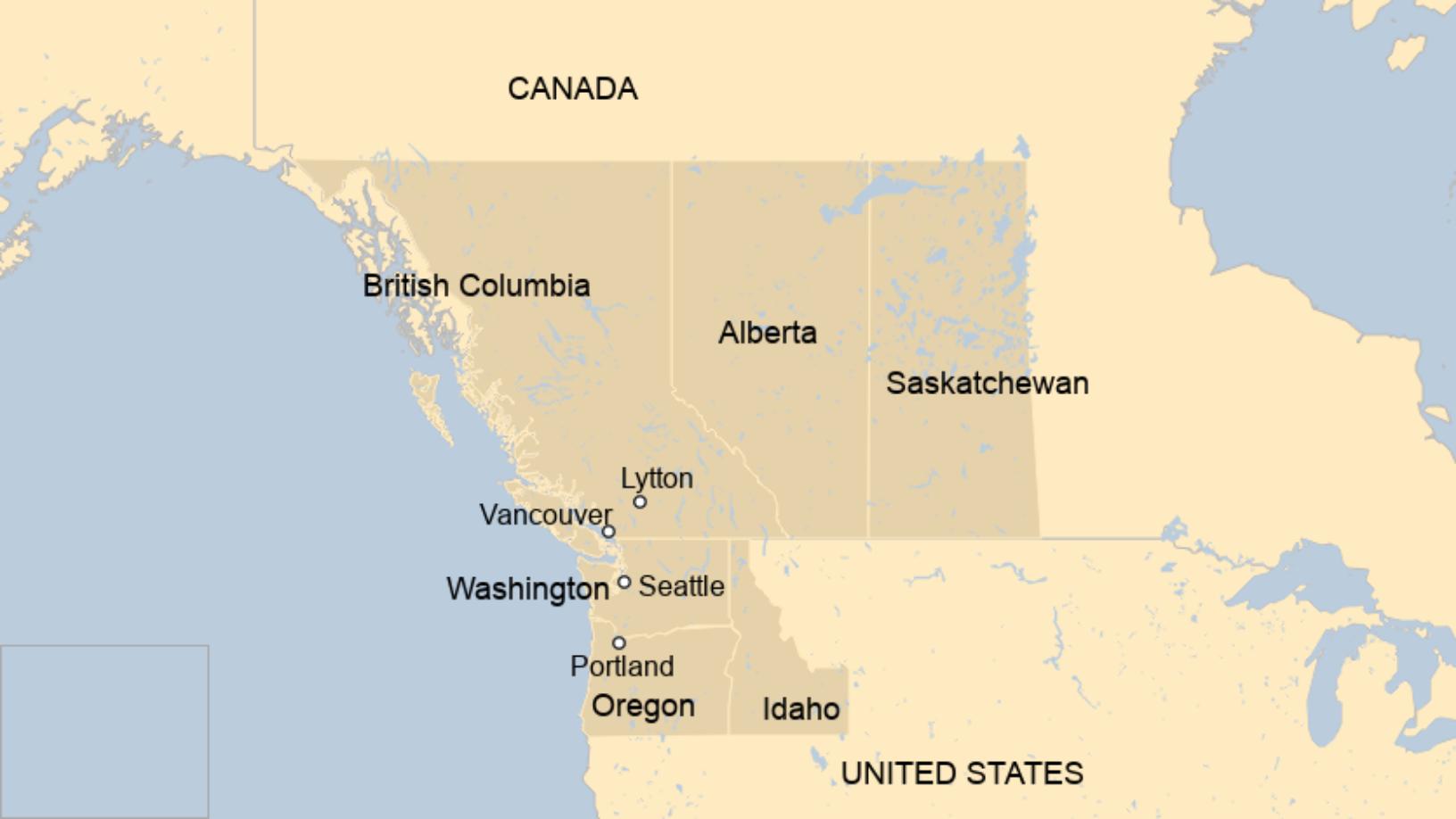
Canada broke its temperature record for a third straight day on Tuesday – 49.6C (121.3F) in Lytton, British Columbia.

The US north-west has also seen record highs – and a number of fatalities.

Experts say climate change is expected to increase the frequency of extreme weather events, such as heatwaves. However, linking any single event to global warming is complicated.

The heat over western parts of Canada and the US has been caused by a dome of static high-pressure hot air stretching from California to the Arctic territories. Temperatures have been easing in coastal areas but there is little immediate respite for inland regions.

Before Sunday, temperatures in Canada had never passed 45C.

British Columbia Premier John Horgan said the hottest week the province had ever experienced had led to “disastrous consequences for families and for communities”.

The number of heat-related fatalities is likely to rise as some areas say they have responded to sudden death incidents but have yet to collate the numbers.

In Vancouver alone, heat is believed to have been a contributing factor in the unexpected deaths of 65 people since Friday.

Map
1px transparent line

“I’ve been a police officer for 15 years and I’ve never experienced the volume of sudden deaths that have come in in such a short period of time,” police sergeant Steve Addison said. Three or four a day is the normal number.

He said people were arriving at relatives’ homes and “finding them deceased”.

Dozens of officers have been redeployed in the city, while the increased volume of emergency calls has created a backlog and depleted police resources.

British Columbia Chief Coroner Lisa Lapointe said 100 more deaths than normal had been reported in the period from Friday to Monday.

The BBC is not responsible for the content of external sites.View original tweet on Twitter
1px transparent line

The tiny village of Lytton, about 155 miles (250 km) east of Vancouver – and not much further south than London – has recorded all of Canada’s recent record highs.

Resident Meghan Fandrich said it had been “almost impossible” to go outside.

“It’s been intolerable,” she told the Globe & Mail newspaper. “We’re trying to stay indoors as much as possible. We’re used to the heat, and it’s a dry heat, but 30 [degrees] is a lot different from 47.”

Many homes in British Columbia do not have air conditioning as temperatures are usually far milder during the summer months. Temporary water fountains and cooling centres have been set up in the Vancouver area.

The country’s weather service, Environment Canada, has issued heat warnings for the provinces of British Columbia and Alberta, along with areas of Saskatchewan, the Northwest Territories and Manitoba.

Records fall in western US

In the US Pacific Northwest on Monday, temperatures hit 46.1C in Portland, Oregon, and 42.2C in Seattle, Washington, the highest levels since record-keeping began in the 1940s, the National Weather Service said.

At least a dozen deaths in Washington and Oregon are believed to be linked to the heatwave.

A doctor in a Seattle hospital told the Seattle Times the number of patients streaming in with heat stroke was comparable to the beginning of the Covid-19 pandemic.

Dr Jeremy Hess said some had kidney or heart problems, and one man had third-degree burns from walking on asphalt.

The heat has been intense enough to melt cables, shutting down the Portland Streetcar Service on Sunday.

The BBC is not responsible for the content of external sites.View original tweet on Twitter
1px transparent line

An electrical utility in Spokane, Washington, has also introduced rolling blackouts to cope with huge power demand as residents run air conditioners.

Agricultural workers are often now being given the option to start at dawn and finish at noon. But labour contractors say that some stay regardless of the heat.

One worker was found dead in a field at the end of his shift at a farm in Oregon.

One Seattle resident told the AFP news agency that the city felt like a desert: “Normally… 60, 70 degrees [farenheit] is a great day – everybody is outside in shorts and T-shirts – but this is… ridiculous”.

Amazon allowed members of the public into areas of its Seattle headquarters as a cooling-off location on Monday, while people in Portland also flocked to cooling centres.
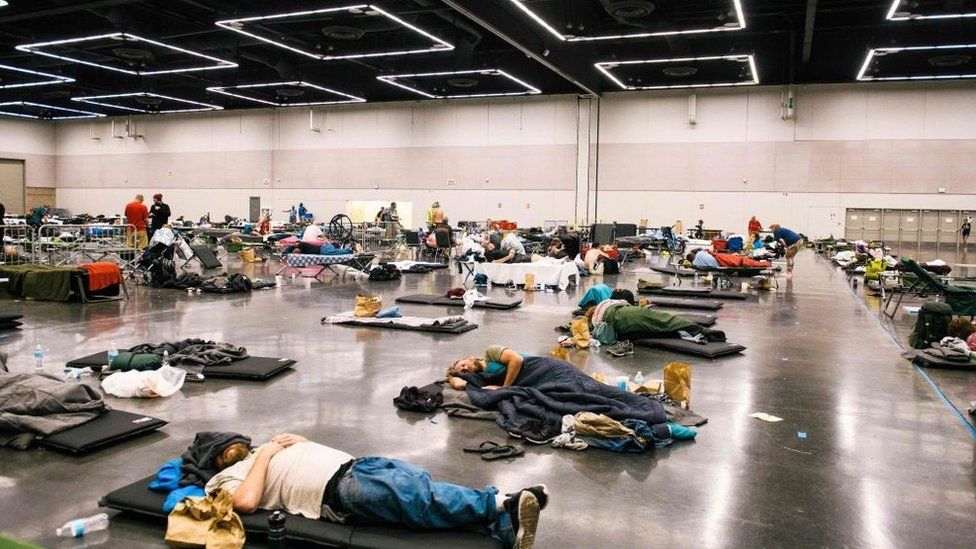

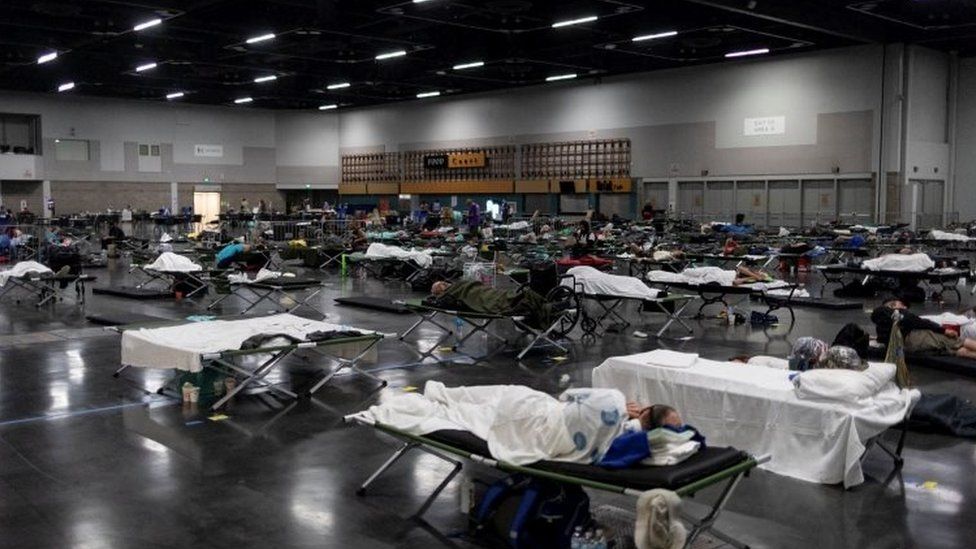
People rest at the Oregon Convention Centre cooling station in Oregon, Portland
Portland residents have flocked to cooling centres
line

The post Canada: Dozens Dead as 121 Degree Heatwave Shatters Records appeared first on The St Kitts Nevis Observer.

Canada: Heat Hits Record 116F, US North-West also Sizzles

Canada has recorded its highest ever temperature as the country’s west and the US Pacific north-west frazzle in an unprecedented heatwave.

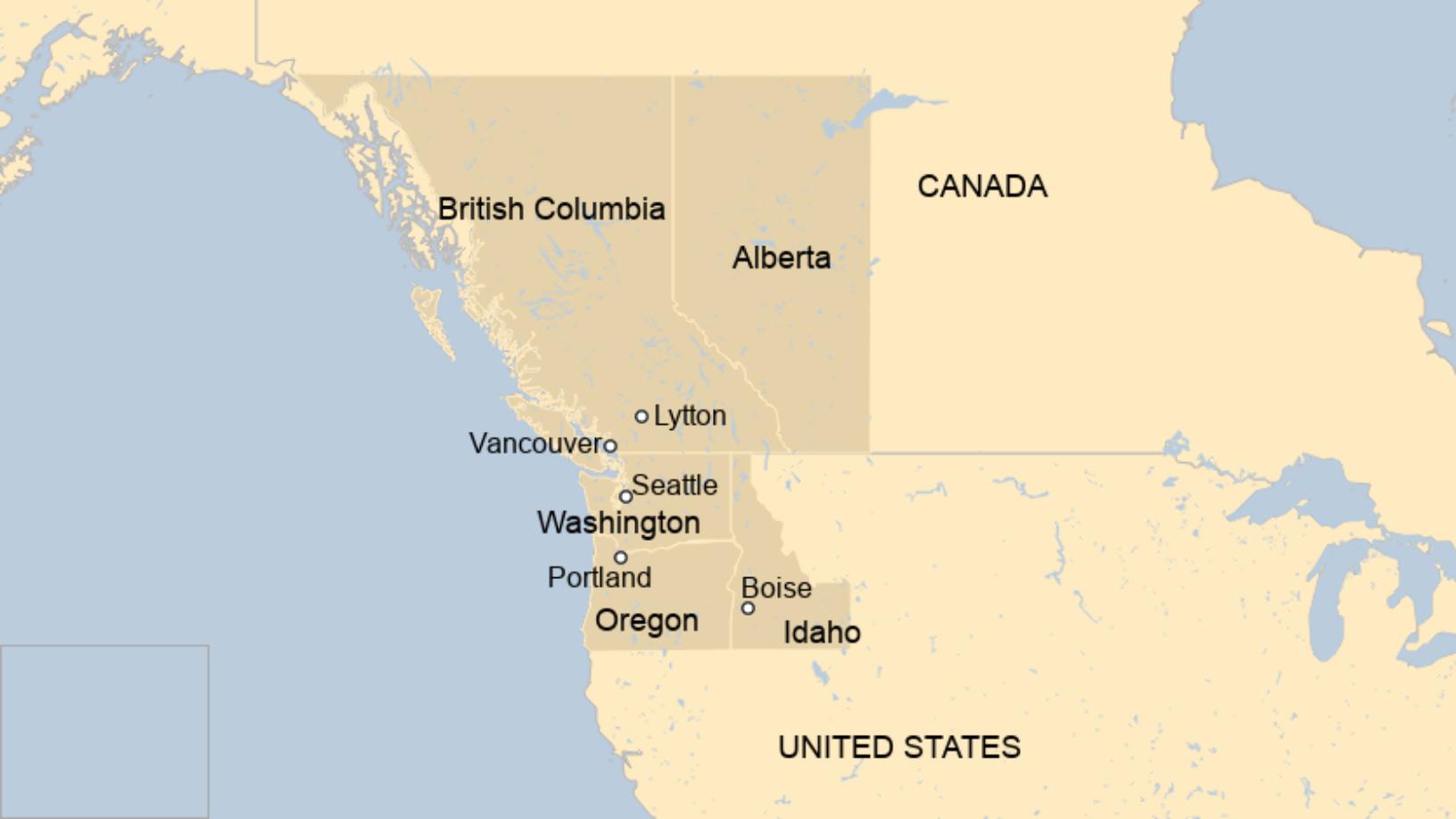
Lytton in British Columbia soared to 46.6C (116F) on Sunday, breaking an 84-year-old record, officials said.

A “heat dome” – static high pressure acting like a lid on a cooking pot – has set records in many other areas.

The US and Canada have both warned citizens of “dangerous” heat levels that could persist this week.

Experts say that climate change is expected to increase the frequency of extreme weather events, such as heatwaves. However, linking any single event to global warming is complicated.

BBC forecaster Nick Miller says that “heat dome” isn’t a strictly defined meteorological term but has become associated with describing large areas of high pressure, leading to clear skies and hot sunny days. The longer the high pressure pattern lasts, the longer the heatwave is and temperatures can build day by day.

This high pressure zone is huge, from California right up to Canada’s Arctic territories and stretching inland through Idaho.

Sales of air-conditioners and fans have surged, and cooling shelters have sprung up. Some bars and restaurants – and even a swimming pool – were deemed too hot to function.

Lytton, which is about 150 miles (250km) north-east of Vancouver, surged past the previous Canadian record.

That was set in two towns in Saskatchewan – Yellow Grass and Midale – back in July 1937 at a balmy 45C (113F).

Lytton was not alone. More than 40 other spots in British Columbia set new records.

Environment Canada senior climatologist David Phillips told CTV: “I like to break a record, but this is like shattering and pulverising them. It’s warmer in parts of western Canada than in Dubai.”

He said there was a chance of topping 47C somewhere, with Monday the likeliest day.

British Columbia’s power providers said there had been a surge in demand for electricity to keep air-conditioners running.

Environment Canada said Alberta, and parts of Saskatchewan, Yukon and the Northwest Territories, should also be on alert.

In its warning, it forecast a “prolonged, dangerous, and historic heatwave will persist through this week”, with temperatures 10C-15C above normal, at near 40C in many places.

Map
Presentational white space

‘Historic’ heat in US north-west

The Pacific north-west has also been breaking records, particularly in parts of Washington and Oregon states.

The US National Weather Service called the heatwave conditions “historic” and said they would persist through the week, “with numerous daily, monthly and even all-time records likely to be set”.

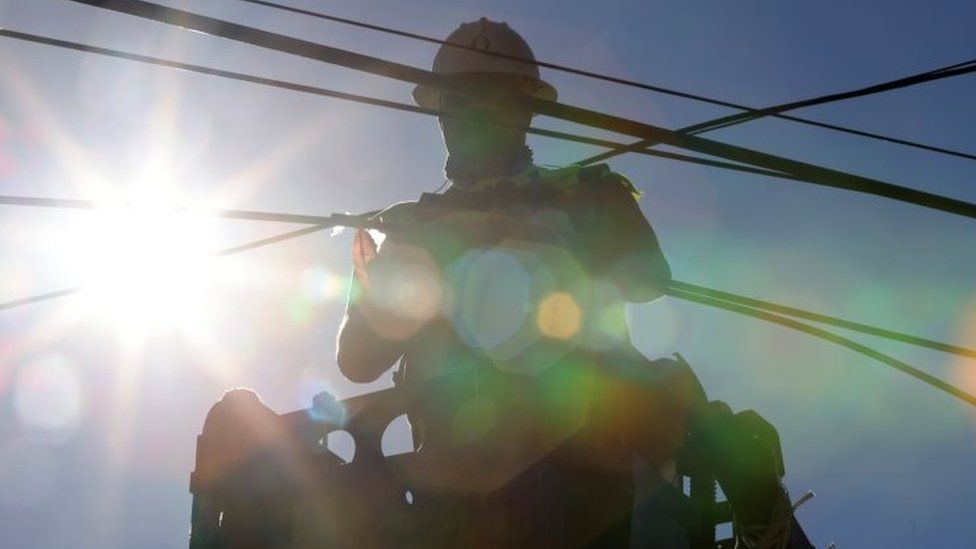
A worker tends to a fibre-optic line in Lake Forest Park, Washington, amid the scorching heatA worker tends to a fibre-optic line in Lake Forest Park, Washington, amid the scorching heat

Seattle and Portland, cities with famously rainy climates, both recorded their hottest temperatures ever on Sunday.

Portland shattered its prior record when temperatures reached 44C, according to the US National Weather Service. Seattle also passed a historic high as the mercury hit 40C.

Oregon eased Covid attendance restrictions to open up swimming pools and air-conditioned areas like shopping centres. But Seattle in Washington had to close one pool because of “unsafe, dangerous pool deck temperatures”.

Fruit growers have been rushing to pick crops, fearing the heat could shrivel cherries and other fruit. Pickers have been starting at dawn and stopping at lunchtime in the unbearable temperatures.

BJ Thurlby, president of the Northwest Cherry Growers, told the Seattle Times: “We are travelling in absolutely uncharted waters.”

People sleep at a cooling centre set up in Portland in the US state of OregonPeople sleep at a cooling centre set up in Portland in the US state of Oregon

The US track and field Olympic qualifying trials had to be halted in Eugene, Oregon, on Sunday, as the crowd was told to leave the stadium for safety reasons.

Some Covid vaccination centres also closed because of the heat.

Some areas along the coast could cool a little later in the week, but Boise, Idaho, could see a week of 40C+ temperatures. The National Weather Service said parts of the state could suffer “one of the most extreme and prolonged heatwaves in the recorded history of the Inland Northwest”.

The warnings for all were to stay hydrated, avoid strenuous activities, and check on vulnerable neighbours.

The post Canada: Heat Hits Record 116F, US North-West also Sizzles appeared first on The St Kitts Nevis Observer.
Antigua Announces Reduced Taxes for Intra-Regional Travel

Antigua and Barbuda has announced a 50 percent reduction in taxes on airline tickets for travel within several countries of the Caribbean Community (CARICOM).

The government says the measure will last for six months in the first instance.

“We think at this time where regional travel is relatively low, extremely flat that there is very little to lose and even though it may not be the best condition which to analyze the elasticity of ticket prices, it will give us some indicative indication as to how a reduction in pricing would impact on demand without creating a financial crisis, “Prime Minister Gaston Browne said.

“There is nothing to lose at this time, very little will oose as a result of cutting those taxes. So in the case of Antigua and Barbuda, we have taken a decision to cut our regional airport taxes by 50 percent, effective Monday (June 28) and we will do so for six months to see how it impacts revenue and then to make a final determination going forward as to what percentage is sustainable, if it is 25, 40 or even the 50 percent,” he added.

Browne said that the matter had also been discussed within the sub-regional Organisation of Eastern Caribbean States (OECS) “probably about three weeks ago.

Browne said that a reduction in taxes would assist the cash-strapped regional airline, LIAT, which has been placed under court-ordered administration.

“This will also help LIAT too especially if the OECS and Barbados could come together and agree on a travel bubble and to allow for fully vaccinated persons to move without quarantining. We think that will be a win-win for all of us.”

Last week, CARICOM leaders, who are members of the Prime Ministerial Sub-Committee on the CARICOM Single Market and Economy (CSME), met and among the agenda items were the proposal to cut taxes.

There has been no indication as to the position adopted at the meeting, but the CARICOM leaders are to meet early next month for their annual summit, where it is expected that Barbados Prime Minister Mia Mottley, who has lead responsibility for CARICOM Single Market and Economy (CSME), will report to her regional colleagues. The CSME allows for the free movement of goods, skills, labour and services within the region.

Browne said as a result of the high ticket prices, LIAT for example, for every country they fly into “they have to pay a tax, you have airport taxes for the passengers.

“In the case of Antigua and Barbuda, the airport taxes is US$97 and your ticket price would include the airport tax and if you are going into Barbados, there will be another airport tax.

“So technically speaking, your travel from Antigua to Barbados is US$600, half of your ticket cost is actually traveling taxes. So our proposal will be one in which we will ask the countries to move in lockstep with each other,” he said, hoping that a “travel bubble of low-risk countries” can be established as soon as possible.

CMC

The post Antigua Announces Reduced Taxes for Intra-Regional Travel appeared first on The St Kitts Nevis Observer.
Coronavirus: Harris Extends SOE for 6 Months

The St. Kitts-Nevis coalition government Monday extended the state of emergency (SOE) by a further six months, with Prime Minister Dr Timothy Harris telling Parliament it is a critical tool in the fight against the coronavirus (COVID019) pandemic.

The SOE was due to expire on July 7, but Harris said that it was being extended as part of his administration’s efforts to protect the lives and livelihoods and contain the spread of the COVID-19 disease that has now resulted in the deaths of three people in the twin-island Federation.

“Since the onset of the COVID-19 pandemic last March, we have utilized this tool to help us control the virus. Emergency powers were utilized in the first instance in March 2020, for a period of 21 days which is the limit placed on the time span for which the Governor-General can promulgate a state of emergency without the approval of the Parliament,” Harris said as he moved the resolution extending the SOE.

“Given the continuing community spread there is a need for the State of Emergency to be extended beyond July 06 as the COVID-19 pandemic still presents an existential threat to the lives and livelihoods in St Kitts and Nevis.

“Indeed, on Saturday last our Chief Medical Officer advised that a new variant which is more transmissible is present in our Federation. We have come today, ahead of the expiry date of the current state of emergency to seek an extension for a period of six months,” Prime Minister Harris said.

He told legislators that the SOE provides a sound legal anchor for the promulgation of curfews in St. Kitts and Nevis that prohibit the movement of persons that can help halt the spread of the disease.

“If persons stay in shelter the probability of a COVID-19 spread is significantly and dramatically reduced Mr Speaker, and this is what, in large measure, we are attempting to do now.

“I, therefore, want to reiterate my call for all persons in St. Kitts and Nevis to stay at home including their yard space and minimize contact with others outside of their household during the period of the lockdown.”

Harris said while his administration understands that the temporary measures being implemented in the fight against COVID-19 may inconvenience many “these measures are being brought for one reason and one reason only that is to save lives”.

The latest figures show that the twin-island Federation has recorded 429 cases of the virus since March last year with 127 having recovered. There have been three deaths.

Relatives of one of those who have died said she had been fully vaccinated and that they are now awaiting information from health authorities after a recent meeting.

Health officials have not publicly responded to the complaints and allegations now in the public domain.

The government has already announced a 24-hour lockdown as part of a slate of additional restrictive measures being taken to limit the movement of people, in an effort to stem the spread of the virus.

The post Coronavirus: Harris Extends SOE for 6 Months appeared first on The St Kitts Nevis Observer.

UK: Travel Sector Demands Reopening in Nationwide Protest

Travel agents, pilots, tour operators, aviation workers and cabin crew are among the thousands of people who will ‘speak up for travel’ today, as part of a day of action.

The sector is seeking to put pressure on the government to capitalise on the Covid-19 vaccine rollout by safely reopening travel for the summer season and provide tailored financial support to businesses.

The pandemic has been a catastrophe for the travel industry, closing borders, and even making most travel to and from the UK illegal for months on end.

Data from ABTA estimates that as many as 195,000 jobs have been lost or are at risk within the travel industry, with IATA research indicating that hundreds of thousands of aviation jobs are supported by the furlough scheme.

Although travel is no longer illegal, the industry says the government has failed to deliver a restart to international travel as promised, by undermining the risk-based system ministers established for a safe return to travel.

In contrast, other countries are forging ahead with pragmatic, risk-based schemes that allow safe travel including most recently Germany, France and Spain.

Tim Alderslade, chief executive of Airlines UK, said: “It is now or never for the government to reopen travel and save what is remaining of the summer season, not just for families desperate to get away but the tens of thousands of jobs which rely upon this once thriving sector.

“Airlines are at the absolute limit of what they can borrow and without a genuine reopening this summer they will require Government support to survive.

“The best way to save UK aviation is to enable a return to the skies – safely – by taking advantage of our vaccine dividend and allowing fully vaccinated passengers to travel without restrictions from amber and green countries.

“This is now happening across much of Europe and the UK is in grave danger of needlessly falling behind.”

Without a meaningful summer season – a crucial period of the year for travel businesses, airlines and airports – many thousands of livelihoods are at stake, as well as the ability of the travel sector to recover and reconnect the UK to the world.

As part of the day of action there are a range of events and activities happening across the UK – including 800 people attending an organised lobby outside parliament in London, 200 people at an event in Holyrood in Edinburgh and 100 gathering in Belfast.

There will be a virtual lobby in Cardiff, as well as activities at a range of UK airports and meetings with MPs locally and campaigning on social media.

The industry bodies behind the protest – including ABTA, Airlines UK, the Business Travel Association, Airport Operators Association, UKinbound, Advantage Travel Partnership and the Travel Network Group – also say the UK government’s support through the crisis has been inadequate.

While other sectors have received tailored support, such as grant schemes, the story is quite different for travel, with many travel businesses excluded from the general grant support available and others only able to access the bare minimum.

Airlines and airports, meanwhile, have taken on billions of pounds of debt – raised privately and through government loans schemes – that will have to be paid back.

As a result, many businesses are struggling to survive – 57 per cent of small- and medium-sized travel agents said they would not have the cash to survive more than three months based on current trading conditions and available government support.

The travel day of action has support from the major airlines and tour operators as well as hundreds of small independent travel agents and leisure and business travel agents.

Collectively they are calling on the UK government to:

  • Allow international travel to return safely and in a risk managed way by properly implementing the Global Travel Taskforce’s plan for a traffic-light system, by expanding the green list in line with the evidence and making restrictions more proportionate, while keeping a strong red list to guard against variants. Government should also capitalise on the success of the vaccine rollout by removing testing and quarantine requirements for fully vaccinated individuals travelling from green and amber countries.
  • Bring forward a package of tailored financial support, including extension of furlough support until April 2022, recognising that the travel sector’s ability to trade and generate income is much slower than first anticipated and more gradual than for businesses in the domestic economy.

The government is expected to provide an update on the traffic light list within the next week, and a review of the requirements for international travel is due on June 28th.

Despite international travel significantly being curtailed, meaning businesses still have little opportunity to generate income, companies will be subject to the ten per cent rise in furlough costs at the end of the month, and payments towards business rates for travel agents will also go up.

The post UK: Travel Sector Demands Reopening in Nationwide Protest appeared first on The St Kitts Nevis Observer.

Drought Hit Brazil Enacts Emergency Elec. Power Measures

RIO DE JANEIRO/BRASILIA, June 28 (Reuters) – Brazil’s government on Monday unveiled emergency hydroelectric measures in response to a drought that has emptied reservoirs and fanned inflation expectations.

Mines and Energy minister Bento Albuquerque in a speech urged consumers to be conscientious in their power and water use, but did not announce energy rationing. He said the government was working on a voluntary program to incentivize companies to use power outside of peak hours.

The news comes after President Jair Bolsonaro signed a temporary executive order that establishes an emergency body, known as the Chamber of Exceptional Rules for Hydro-energy Management.It is able to temporarily establish limits which “may result in a reduction in the flow of hydroelectric plants.” The order also paves the way for the government to buy electricity reserves from private companies.

Brazil – Latin America’s biggest country, with the world’s second highest COVID-19 death toll – is facing its worst drought in over 90 years, sparking fears of energy rationing and driving inflation fears. The lack of rain also poses a headache for the country’s giant agriculture sector.

Albuquerque has previously ruled out rationing, but said consumers should expect to pay more for their electricity, as power producers are forced to switch to more expensive sources.

On Friday, the National Electric Energy Agency (Aneel) recommended measures to control energy use and combat waste, asking consumers to take shorter showers and reduce the use of air conditioning, among other measures.

Writing by Gabriel Stargardter; Editing by Alistair Bell

The post Drought Hit Brazil Enacts Emergency Elec. Power Measures appeared first on The St Kitts Nevis Observer.

Haiti to Hold Constitutional Referendum Sept. 26

PORT-AU-PRINCE, June 28 (Reuters) – Haiti will hold a constitutional referendum on Sept. 26, the same date as presidential and legislative elections, authorities said, after postponing the date twice in part because of the pandemic, an official calendar showed Monday.

Political tensions in the Caribbean nation have been running high in recent months and Haitians have expressed fear of violence going to the polls. read more

Violence has spiked in the capital Port-au-Prince in recent weeks as rival groups battle with one another or the police for control of the streets, displacing thousands and worsening the country’s humanitarian crisis. read more

Elections were scheduled for Sept. 19. Postponing the referendum was done to give the health ministry time to deal with the COVID-19 crisis, Guylande Mesadieu, the president of the electoral board said in an interview.

The electoral council said in a statement that the country will implement health measures to curb the spread of the pandemic so that Haitians could cast their votes safely.

Municipal and local elections have been scheduled for Jan. 16, 2022, the calendar also showed.

It is not clear what the constitutional referendum will entail but Moise has previously said the powers of the president needed to be strengthened to break a “decades-long cycle of political crises”.

The presidency was weakened in Haiti’s 1987 Magna Carta.

Haitians mistrusted strong figureheads in the wake of the Duvalier family dictatorship notorious for human rights abuses and corruption.

Reporting by Andre Paultre in Port-au-Prince; Writing by Stefanie Eschenbacher; Editing by Stephen Coates

The post Haiti to Hold Constitutional Referendum Sept. 26 appeared first on The St Kitts Nevis Observer.

Copa: Messi in Historic in 4-1 Win Over Bolivia

Lionel Messi scored twice as he became Argentina’s most capped player in their 4-1 win Copa America win over Bolivia.

The Barcelona forward, 34, made his 148th international appearance, to take Javier Mascherano’s record.

Messi set up Papu Gomez’s sixth-minute opener, before scoring a penalty and adding a second just before half-time to extend his record goals tally to 75.

Elsewhere, Manchester United striker Edinson Cavani scored a 21st-minute penalty as Uruguay beat Paraguay 1-0.

Inter Milan’s Lautaro Martinez also scored in Argentina’s win and the team are now unbeaten in their last 17 games.

They take on Ecuador in the quarter-finals on Sunday, while Uruguay play Colombia on Saturday.

Hosts Brazil play Chile, while Paraguay face Peru.

Copa America quarter-finals

Peru v Paraguay (Friday 22:00 BST)

Brazil v Chile (Saturday 01:00 BST)

Uruguay v Colombia (Saturday 23:00 BST)

Argentina v Ecuador (Sunday 02:00 BST)

The post Copa: Messi in Historic in 4-1 Win Over Bolivia appeared first on The St Kitts Nevis Observer.

Mexico Marijuana: Top Court Says Private Recreational Use Okay

Mexico’s Supreme Court has decriminalised the private recreational use of cannabis by adults, calling the current prohibition unconstitutional.

In an 8-3 decision, the court ruled that adults would be able to apply for permits to cultivate and consume their own cannabis. Smoking in public and in front of children is banned.

The ruling does not mention the commercialisation of cannabis. The decision came after a legalisation bill stalled in Congress. “Today is a historic day for liberties,” Supreme Court president Arturo Zaldívar said.

But some groups said the ruling was unlikely to result in major immediate changes.

Mexico United Against Crime, a non-governmental organisation, said the decision “does not decriminalise the activities necessary to carry out consumption” such as possession and transportation.

Mexico’s lower house approved a bill legalising the recreational use of cannabis in March, but it still needs final approval by the Senate.

The legislation would let users with a permit carry up to 28g and grow as many as eight plants at home for personal use. At present, it is illegal to carry more than five grams.

Supporters of legalisation hope it could reduce some of the violence related to illegal drugs trade, which claims the lives of thousands of people in the country every year.


The post Mexico Marijuana: Top Court Says Private Recreational Use Okay appeared first on The St Kitts Nevis Observer.

Russia Sees COVID Surge Linked to Delta Variant, Slow Vaccine Drive


Grave diggers wearing personal protective equipment bury a person at a graveyard in Saint Petersburg

MOSCOW (Reuters) -Russia is facing a surge in COVID-19 cases that authorities blame on the highly infectious Delta variant and slow progress in vaccinating people, with deaths linked to the virus hitting a new record in Moscow on Friday.

Officials have scrambled to compel people to get inoculated amid tepid demand for the vaccine since cases spiked this month. Prime Minister Mikhail Mishustin on Friday said 21 million people had been vaccinated out of a population of 144 million.

The government coronavirus task force reported 20,393 new COVID-19 cases, the most confirmed in a single day since Jan. 24, including 7,916 in Moscow, taking the official national tally since the pandemic began to 5,409,088.

It said 601 people had died of coronavirus-linked causes in the past 24 hours, with 98 in the capital, pushing the national death toll to 132,064. St Petersburg also reported 98 deaths.

The federal statistics agency has kept a separate count and has said Russia recorded around 270,000 deaths related to COVID-19 from April 2020 to April 2021.

Moscow authorities have ordered bars and restaurants from Monday to serve people only if they can present a QR-code showing they have been vaccinated, had an infection indicating immunity or recently tested negative.

But one chain of private medical clinics, Invitro, said it was suspending antibody tests for 7 to 10 days due to a shortage of reagents, RIA reported.

Anna Popova, the head of consumer health watchdog Rospotrebnadzor, said eight Russian regions would make vaccination against COVID-19 compulsory some time next week, in addition to 10 regions where that is already the case.

The local health ministry in Russia’s far eastern Khabarovsk region on Friday said it had been forced to suspend vaccinations at some sites in two cities due to shortages.

The Kremlin said on Friday rising demand and storage difficulties were responsible for vaccine shortages, which would be resolved in the coming days.

Kremlin spokesman Dmitry Peskov said he was planning to be vaccinated with the one-dose Sputnik Light, Russia’s fourth registered vaccine against COVID-19, in the coming weeks.

(Reporting by Gleb Stolyarov, Alexander Marrow, Anton Kolodyazhnyy and Polina Ivanova; Writing by Alexander Marrow; Editing by Katya Golubkova, Alex Richardson and Giles Elgood

The post Russia Sees COVID Surge Linked to Delta Variant, Slow Vaccine Drive appeared first on The St Kitts Nevis Observer.