After his inauguration today (Jan20), President Joe Biden will take the reins of power amid huge challenges — and he will likely need some degree of cooperation from Republicans in order to address them.
The coronavirus pandemic is raging as badly as ever. The economy is beleaguered. And the nation itself is fractious and divided, as the Jan. 6 insurrectionary violence at the Capitol showed.
“There is no time to wait. We have to act and act now,” Biden said on Thursday, revealing his proposed $1.9 trillion plan for coronavirus relief.
ADVERTISEMENT
The Biden plan includes additional payments of up to $1,400 to many Americans as well as a total of $400 million aimed squarely at improving the vaccination process.
But those plans are being made at a time when up to 20,000 members of the National Guard are on their way to Washington to safeguard Biden’s inauguration, new COVID-19 cases are surging and new unemployment claims have risen about 25 percent within the past week alone.
Many in Biden’s party share his sense of urgency. Rep. Brendan Boyle (D-Pa.) said that the new president should be open to GOP cooperation — but should not hang around if it is not forthcoming.
“When push comes to shove, I think there will be several Republicans who will work with us in good faith,” Boyle said. “But the real lesson of President Obama’s first two years is: absolutely do not count on that or wait on it. If within a short period of time they are not interested, press ahead. Time is of the essence.”
Some Democrats are darkly wondering whether Biden faces an even more challenging landscape than Obama did when he took office in 2009.
At the start of Obama’s first term, the economy was imploding and the United States was enmeshed in two major wars.
ADVERTISEMENT
“Obviously, any incoming president faces challenges,” said Ohio-based Democratic strategist Jerry Austin. “But President Biden will be facing challenges nobody has ever faced before, whether it is the pandemic or succeeding Donald Trump or what happened” at the Capitol.
Yet even though the problems appeared monumental, Austin said one factor in their potential resolution lies in the relationship between two people: Biden and Senate Majority Leader Mitch McConnell (R-Ky.).
McConnell will lose his majority once the two new Democratic senators from Georgia are inaugurated. That will split the upper chamber 50-50. In the event of a tie, Vice President-elect Kamala Harris will be able to cast the deciding vote once she is inaugurated along with Biden on Wednesday.
The ability of Biden to address the nation’s problems will depend “maybe most of all on how he and Mitch McConnell either get along or don’t get along,” Austin said. “They know each other, they are not strangers, they have served together for a number of years.”
McConnell, a wily strategist, has not tipped his hand as to whether he hopes to work with Biden or provide staunch opposition to him. But his capacity to entirely thwart Biden, even if he wanted to do so, is limited.
There are at least a few GOP senators who are expected to show some openness to bipartisan action: Sens. Susan Collins (Maine), Lisa Murkowski (Alaska) and Mitt Romney (Utah). In addition, McConnell’s loss of an outright majority undercuts his ability to use procedural measures to stall Biden’s legislative agenda.
“McConnell no longer has the sole ability to stop things from coming to the floor,” said Democratic strategist Joe Trippi. “That alone is a big difference.”
Trippi also offered an optimistic take on Biden’s chances of breaking the Washington logjam.
The strategist asserted that “we haven’t had functional government for, like, 10 years,” citing McConnell’s oppositional approach to Obama after Republicans won the Senate majority in 2010 and then the tumult of President Trump’s tenure.
Trippi predicted it was likely that Biden’s COVID-19 package would pass because moderate Republicans would want to get on board. He also forecast that the left of the Democratic Party was unlikely to hold Biden’s feet to the fire in the early days of his first term, given the stakes involved — and the relief across the party about Trump’s ouster.
“The two issues that matter most are the health crisis and the economic crisis,” Trippi said. “You are going to see a very unified Democratic Party and real consequences for Republicans who are just saying no.”
Some Republicans express guarded optimism too. They see Biden as someone with whom they can do business — and as far more amenable to compromise than the left-wing rivals he defeated for his party’s presidential nomination, Sens. Bernie Sanders (I-Vt.) and Elizabeth Warren (D-Mass.).
“Clearly he is the best person the Democrats could have nominated and got elected, when it comes to working in a bipartisan way,” said Doug Heye, a former communications director for the Republican National Committee. “That is woven into his DNA.”
Still, Biden has one more complication to consider: his predecessor.
The timing of Trump’s Senate trial remains unclear after his second impeachment by the House last week. Biden has suggested the Senate may be able to “bifurcate” its business, so that it could spend half its working day on Trump’s trial and half on Biden’s nominees for office as well as other parts of his legislative agenda.
Even in that scenario, however, Trump will be able to seize at least some of the spotlight that a new president might otherwise expect to command.
Biden has chosen to largely avoid getting into high-profile tangles with Trump in recent weeks. Democrats know Trump is unlikely to fade off into the sunset — but they greet that prospect with a shrug of the shoulders.
“Trump will never make a voluntary exit. He will work like hell to stay out there and in the public eye in the most dramatic way he can,” said veteran Democratic ad-maker Bill Carrick. Senate trial or not, Carrick said, “I don’t think he was going to go away anyway.”
ADVERTISEMENT
Biden, who campaigned on the promise to restore “the soul of America,” is keeping up his hopeful demeanor.
“Out of all the peril of this moment, I want you to know I see all the promise as well,” he said as he introduced his COVID-19 plan last week. “I remain as optimistic about America as I have ever been.”
He will soon find out if his optimism is justified.
President Trump on Wednesday granted clemency to more than 100 people in one of his final acts as commander-in-chief, including his former chief strategist, Stephen Bannon.
Trump announced a wave of pardons and commutations shortly after midnight on Wednesday. Bannon, rapper Lil Wayne, GOP fundraiser Elliot Broidy and former Detroit Mayor Kwame Kilpatrick were among the notable figures to receive clemency, along with dozens of lower profile individuals whose cases were raised by criminal justice reform advocates.
Trump granted clemency to 143 individuals in total, just hours before leaving office: 73 received pardons, while 70 were granted commutations.
The Bannon pardon was perhaps the most surprising of the batch, given the former Breitbart News editor had a high-profile falling out with the Trump family after denigrating Donald Trump Jr. in Michael Wolff’s 2018 book, “Fire and Fury.”
“Mr. Bannon has been an important leader in the conservative movement and is known for his political acumen,” press secretary Kayleigh McEnany said in announcing Bannon’s pardon.
Bannon was a top adviser on Trump’s 2016 campaign and served as the chief White House strategist for roughly seven months. He was arrested and charged last August with defrauding hundreds of thousands of donors who contributed to a fundraising campaign for a private border wall.
The president reportedly went back and forth over whether to grant clemency to Bannon before deciding to do so.
Trump, who had branded Bannon as “sloppy Steve” upon the release of Wolff’s book, distanced himself from his former adviser upon news of the charges.
“I don’t like that project. I thought it was being done for showboating reasons,” Trump said at the time. “It was something that I very much felt was inappropriate to be doing.”
Trump also pardoned Broidy, a former top Republican National Committee (RNC) fundraiser, who was charged last year with conspiring to act as an unregistered foreign agent as part of a back channel effort to lobby the Justice Department.
Kilpatrick, the former Democratic mayor of Detroit, was convicted in 2008 of perjury and obstruction of justice.
And Lil Wayne faces prison time after pleading guilty to federal gun charges. The rapper, whose birth name is Dwayne Michael Carter Jr., met with Trump on the campaign trail in a meeting the campaign later touted as it courted Black voters.
Trump also commuted the sentence of Bill Kapri, better known as the rapper Kodak Black, who sentenced to 46 months in prison for making a false statement on a federal document. He had served less than half of his sentence.
The president issued pardons to several individuals who were charged with non-violent drug offenses, including Tena Logan, MaryAnne Locke and Caroline Yeats and. Alice Johnson, who Trump pardoned and who became a face of the White House’s criminal justice reform efforts, advocated for several of the individuals granted clemency on Wednesday.
Johnson was among those who advocated for clemency for Kilpatrick as well.
Trump has come under scrutiny for favoring political allies and well connected individuals in doling out pardons and commutations. Past recipients of clemency include ex-Trump campaign chairman Paul Manafort, longtime Trump associate Roger Stone and ex-Trump national security adviser Michael Flynn.
Following his election loss, Trump issued two sizable patches of pardons last month, including those for ex-Republican lawmakers Chris Collins and Duncan Hunter; his former campaign chairman Paul Manafort; longtime friend and adviser Roger Stone; and Charles Kushner, his son-in-law Jared Kushner’s father. He also pardoned Michael Flynn, his onetime national security adviser who pleaded guilty to lying to the FBI in connection with special counsel Robert Mueller’s investigation.
There had been much speculation leading up to Tuesday’s announcement about who Trump would ultimately choose to grant clemency in his waning hours as president. Some Republicans had pushed for Trump to pardon WikiLeaks founder Julian Assange or former National Security Agency official Edward Snowden, but neither was given clemency.
Presidents typically issue a flurry of pardons or commutations in their final day in office. There was speculation in recent weeks that Trump would move to preemptively pardon himself or his adult children to shield them from federal charges after leaving office. Trump opted against doing so, though he still faces a Senate impeachment trial in the coming weeks and the prospect of state investigations.
Trump is slated to leave Washington, D.C., Wednesday morning, foregoing the usual practice of attending the incoming president’s inauguration. Trump will be sent off with a ceremony at Joint Base Andrews outside the district. Meanwhile, Joe Biden will be sworn in as the 46th president of the United States around noon during a pared-down ceremony at the U.S. Capitol.
BRIDGETOWN, Barbados – Dr. Hyginius ‘Gene’ Leon has been elected president of the Caribbean Development Bank by the institution’s board of governors. He will take office on May 1.
Leon succeeds Dr. William Warren Smith, who has been at the helm of the regional financial institution for the last 10 years.
Dr. Leon has more than 30 years of experience in economic development and has directed macroeconomic and financial policy support to government authorities in Africa, the Middle East and Central Asia and the Caribbean. He has worked with the International Monetary Fund (IMF) for more than 24 years, serving as Mission Chief for the Gulf States of Oman, Qatar, and United Arab Emirates as well as The Bahamas, Nigeria, and Zimbabwe. He also served as the IMF’s Senior Resident Representative in Jamaica.
Prior to his engagement with the IMF, Dr. Leon was an Associate Professor at State University of New York at Old Westbury in the United States. He has also served as Director of Research at the Central Bank of Barbados and Country Economist at CDB.
Dr. Leon holds a Doctor of Philosophy (PhD) in Economics from the University of Southampton in the United Kingdom (UK) and a Bachelor of Science Degree (B.Sc.) in Economics from the University of London also in the U.K.
Commenting on his appointment, Dr. Leon said:
“I am deeply honoured by the trust that the Board of Governors has demonstrated in my experience and ability. The CDB remains an instrumental partner in regional development. I look forward to working with all Member States and a tremendous staff with zeal and unrelenting commitment.”
Hon. Alexis Jeffers, Minister of Agriculture, Cooperatives and Fisheries in the Nevis Island Administration delivering remarks at the Department of Agriculture’s Agro Agenda 2021.
CHARLESTOWN, NEVIS — Stakeholders in the agriculture sector have been called on to keep the momentum sparked by the impact of the COVID-19 pandemic in 2020 by Deputy Premier Hon. Alexis Jeffers, Minister of Agriculture, Cooperatives and Fisheries in the Nevis Island Administration (NIA).
“The theme of the annual event, revitalizing the passion and thrust as we ensure food and nutrition security, is extremely timely as farmers and government alike seeks to build on the gains made in the sector in response to the pandemic, said Hon. Jeffers, addressing the opening ceremony of the Ministry of Agriculture’s Agro Agenda 2021 forum on January 19.
“This activity is a means of looking forward,” said Jeffers. “Never before in our history, have we seen such a situation where we have had to change our whole attitude toward agriculture. In the past we had a lot of glowing talks about agriculture. It was on the lips of our people, but the action didn’t match our speech and our talk, our discourse but of course we have seen since 2020 that there is an urgency of now.
“Now is the time to plant more; now is the time to engage more; now is the time to ensure that we are providing the nutritious food that our people need, so as to ensure we are cultivating healthy communities,” he said. “Now is also the time for us to ensure that we are putting ourselves in a position to eliminate any difficulties and stress that may be caused if we were to have a similar situation or a more acute situation that could develop in the future.”
Hon. Jeffers pointed out that the NIA put plans in place for the agriculture sector in January 2020. Coupling that with the COVID-19 stimulus provided to farmers and fishers in March, over the past several months there had been a marked increase in food production on Nevis, and the time had come for the island to be in a position to feed itself.
“We want to ensure that if we are able to feed ourselves for a year or more, it means that we are moving to what we consider import substitution,” explained Jeffers. “We cannot go about our business depending on other countries to feed us anymore. We have to find our way to feed ourselves. That is why these activities are important, to engage our stakeholders, to engage the general public, and to ensure that all of us are on board in our effort to ensure that we are providing a strong and vibrant agricultural economy here in Nevis, and by extension the Federation of St. Kitts and Nevis.”
Jeffers encouraged stakeholders to continue the collaborative efforts exhibited during the crisis to strengthen the local agricultural economy going forward, so that the island’s food import bill could continue to trend downward.
“So all of the various sectors of the agricultural economy must be working cohesively; we must be working as partners to ensure that collectively we are building an agriculture infrastructure that would provide us with the security and sustainability that we seek to achieve now and in the future.
“We have the resources, we have the tools, let us put them to good use,” said Jeffers. “I want us to continue to build on those principles that we have been talking about. Let us grow what we eat and eat what we grow, and let our food be our medicine and let our medicine be our food,
he advised.
Agro Agenda 2021 provided stakeholders in the sector with data on the performance of the various areas in the sector from the previous year and outlined projections and plans for 2021.
In attendance were Hon. Mark Brantley, Premier of Nevis, other Cabinet Ministers from the NIA, officials from the Nevis Department of Agriculture and the federal Ministry of Agriculture, farmers, and representatives from allied agencies.
BASSETERRE, St. Kitts — Civil Society Organizations in St. Kitts and Nevis are invited to apply for grant funding of up to US$50,000 to implement or expand beekeeping under an Apiculture and Biodiversity project.
The funds are offered through the Global Environment Facility (GEF) Small Grant Programme (SGP) which falls under the United Nations Development Programme (UNDP) Country Programme.
Applicants are required to submit a Letter of Interest (LOI) to the GEF SGP UNDP National Coordinator via email il*******@***ps.org. Applications must be received on or before January 31, 2021.
Outgoing Senate Majority Leader Mitch McConnell (R-Ky.) on Tuesday accused President Trump of provoking the violent crowd that stormed the U.S. Capitol on Jan. 6.
“The last time the Senate convened, we had just reclaimed the Capitol from violent criminals who tried to stop Congress from doing our duty. The mob was fed lies. They were provoked by the president and other powerful people,” McConnell said on the Senate floor, marking the first convening of the full Senate since the attack.
McConnell’s statements carry significance ahead of an anticipated Senate impeachment trial. The GOP leader has told colleagues he hasn’t yet decided how he would vote on a House-passed article of impeachment against Trump.
ADVERTISEMENT
.@senatemajldr on the U.S. Capitol Attack: “The mob was fed lies. They were provoked by the president and other powerful people.” pic.twitter.com/QIeviyHkl3
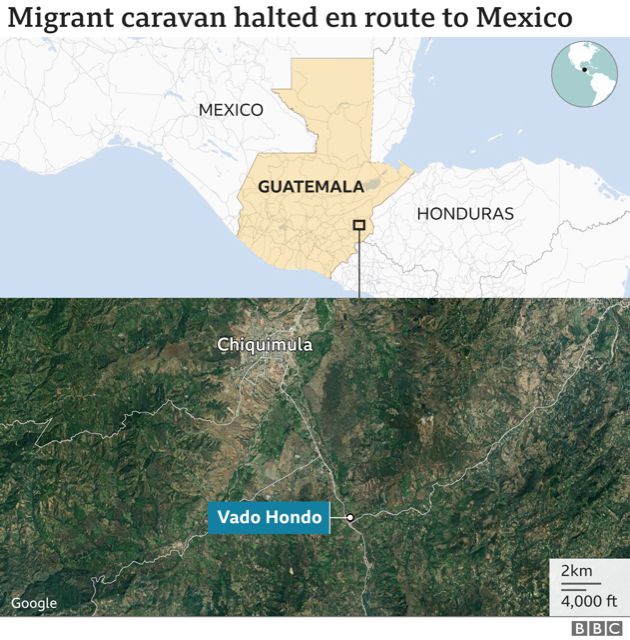
The caravan of migrants blocked a key road after being halted by police in Guatemala at the weekend
Mexican President Andres Manuel Lopez Obrador has urged the US to make major reforms to its immigration policy as thousands of migrants were blocked by police in neighbouring Guatemala.
Mr Lopez Obrador said he was hopeful that President-elect Joe Biden would agree to work with Mexico and other countries on the issue.
About 7,000 migrants, mostly from Honduras, have entered Guatemala.
They hope to travel on to Mexico and eventually reach the US border.
Every year, tens of thousands of Central American migrants try to reach the US, often on foot, in groups known as “caravans”.
They say they are fleeing persecution, violence and poverty in their home countries. Conditions have been made worse by the devastation wrought by two huge hurricanes that battered Central America last November.
In remarks on Monday, Mr Lopez Obrador urged the US to reform its policies on immigration.
“I think the time has come for the commitment [to immigration reform] to be fulfilled, and that is what we hope,” he said.
“In Joe Biden’s campaign, he offered to finalise immigration reform and I hope that he is able to achieve this. That is what I hope.”
He said his government would try to dissuade migrants from crossing into Mexico but added that the rights of all migrants must be respected.
In Guatemala on Monday, security forces broke up a caravan of about 4,000 mostly Honduran migrants who had been camped out near the village of Vado Hondo.
Witnesses said officers, beating their batons against their shields, tried to force the group back in the direction of the Honduran border, about 50km (31 miles) away.
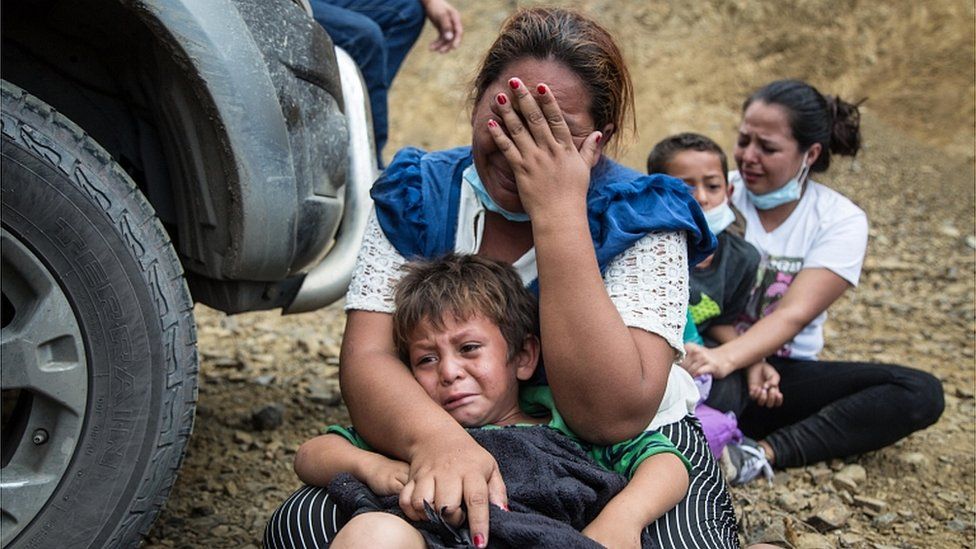
The migrants scattered but several threw stones at police who responded by firing tear gas.
image copyrightEPA
image captionWomen and small children were among those forced to scatter as police moved in
The caravan had been held back in the area since Saturday and was blocking a key road, causing a long tail-back of traffic. Clashes broke out on Sunday as some of the migrants tried to force their way past police lines.
Speaking to reporters, Guatemalan foreign minister Pedro Brolo urged the Honduran government to help ensure “an orderly and safe passage home for those in this caravan”.
President Donald Trump has taken a hard line against illegal immigration, especially along the southern US border with Mexico. He has also put pressure on Mexico, Guatemala, Honduras and El Salvador to crack down on northbound migrants.
Mr Biden has vowed to end the strict immigration policies of his predecessor but his administration, which will take office on Wednesday, has warned migrants not to make the journey because policies will not change overnight.
An administration official told NBC News that migrants trying to claim asylum in the US “need to understand they’re not going to be able to come into the United States immediately”.
The Biden administration will prioritise undocumented immigrants already living in the US, not those heading to the country now, the official said
Minister of Health Dr. Frank Anthony said the mobile hospital will be established in the compound of the West Demerara Regional Hospital and would accommodate 60 beds. It would also be fully equipped with the necessary equipment to treat critically ill patients.
“This hospital would have the beds required for COVID-19 patients and will also have things like ventilators and monitors so if it’s necessary to intubate someone that will be able to do that,” Dr. Anthony said, during Monday’s COVID-19 update.
“They will have all the necessary equipment to assist somebody who’s critically ill…This would increase our capacity to respond to spikes.”
The field hospital is part of the realization of a commitment made by Qatar to the Guyana Government last October. President Dr. Mohamed Irfaan Ali and Emir of Qatar, Sheikh Tamim bin Hamad Al Thani had held discussions on the countries’ bilateral relations.
Last year, the two leaders had discussed the fight against the Coronavirus Pandemic and critical areas of support for Guyana. The Emir committed to providing Guyana with much-needed equipment including portable military hospitals and ventilators.
Other areas identified for collaboration include support for the agriculture sector through investments in the halaal industry, expansion of the housing programme, the strengthening of diplomatic ties between the two countries, and support in other critical sectors including energy. Following the engagement, the teams also proceeded to design programmes and projects to access resources from the Qatar Fund for Development (QFFD).
Guyana has also benefited from COVID-19 support from other countries including, Mexico, China, India and Kuwait. The country has received donations of several ventilators, and quantities of medication and personal protective equipment to boost its capacity.
Guardian (UK) In a cold, sombre, damp Washington four years ago this Wednesday, Donald Trump took the oath of office as the 45th president of the United States and delivered an inaugural address now remembered for two words: American carnage.
He delivered, but not as he promised. Trump pledged to end the carnage of inner-city poverty, rusting factories, broken schools and the scourge of criminal gangs and drugs. Instead his presidency visited upon the nation the carnage of about 400,000 coronavirus deaths, the worst year for jobs since the second world war and the biggest stress test for American democracy since the civil war
“It’s not just physical carnage,” said Moe Vela, a former White House official. “There’s also mental carnage and there’s spiritual carnage and there’s emotional carnage. He has left a very wide swath of American carnage and that is the last way I would want to be remembered by history, but that is how he will be remembered.”
Trump campaigned for president as a change agent but millions came to regard him as an agent of chaos. His line-crossing, envelope-pushing, wrecking-ball reign at the White House crashed in a fireball of lies about his election defeat and deadly insurrection at the US Capitol. Future generations of schoolchildren will read about him in textbooks as a twice-impeached one-term president.
It all began in earnest in June 2015 when the property tycoon trundled down an escalator at Trump Tower in New York and announced a presidential run based on “America first” nationalism and building a border wall. Exploiting white grievance, economic dislocation and celebrity culture, he clinched the Republican nomination and promised: “I alone can fix it.” He lost the national popular vote to Hillary Clinton but lucked his way to victory in the electoral college.
The first person elected to the White House with no previous political or military experience, he represented a shock to the system and rebuke to the establishment.
Ian McEwan, the British novelist, observed in the Guardian: “Charles Darwin could not believe that a kindly God would create a parasitic wasp that injects its eggs into the body of a caterpillar so that the larva may consume the host alive … We may share his bewilderment as we contemplate the American body politic and what vile thing now squats within it, waiting to be hatched and begin its meal.”
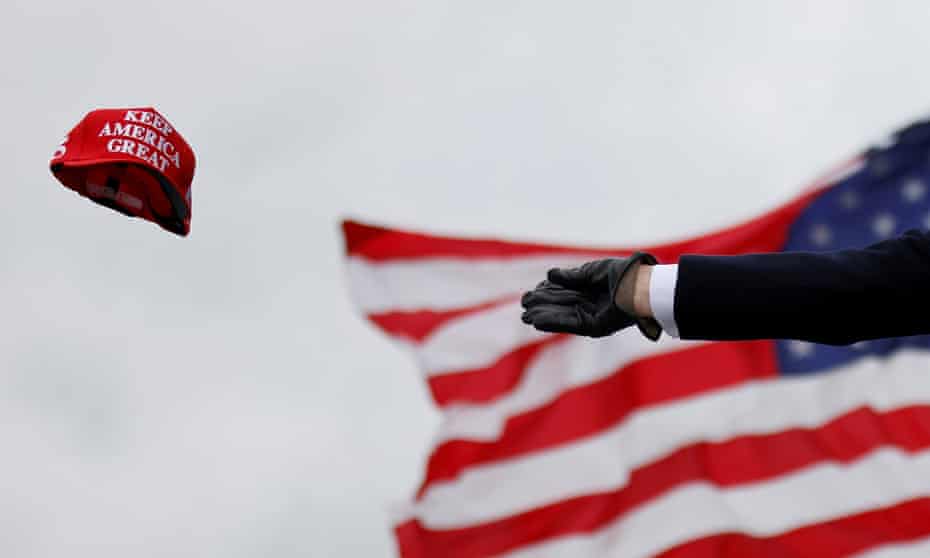
Trump tosses out ‘Keep America Great’ caps at a campaign rally at Oakland County international airport in Waterford Township, Michigan, in October 2020. Photograph: Carlos Barría/Reuters
Hopes that Trump would “pivot” and become “presidential” were dashed by that speech on 20 January 2017. A day later, the press secretary, Sean Spicer, tried to mislead the nation about the size of the inaugural crowd, and soon after the White House counsellor Kellyanne Conway was defending Spicer’s “alternative facts”. It was the outbreak of a disinformation pandemic.
Trump, by all accounts, tried to govern by gut instinct, refusing to read national security briefs but hanging on the words of hosts on the Fox News network. His Twitter feed gave an astonishing window on his thinking and frayed the nation’s nerves. He showed a narcissist’s craving for attention from the media and affirmation from West Wing staff, who came and went at a record rate.
He assailed government bureaucracy, sought to undo Barack Obama’s legacy and displayed the brashness and shamelessness that served his business career: hurl insults, never apologize, hit back harder and throw out constant distractions. He aped demagogues of the past by handing his family top jobs and deriding the media as “fake news” and “the enemy of the people”.
In his first year alone, Trump signed an executive order to prevent people from seven Muslim-majority countries from entering the US, fired the FBI director, James Comey, and other officials whose loyalty was less than absolute, announced America’s withdrawal from the Paris climate agreement and responded to deadly white nationalist violence in Charlottesville, Virginia, by insisting that there were “very fine people on both sides”.
As his term went on, Trump oversaw a “zero-tolerance” policy at the border that separated immigrant parents from children and stripped away environmental regulations. He encouraged the QAnon conspiracy movement, described as a domestic terror threat by the FBI. In language often laced with violent imagery, it was all about “owning the libs” and mesmerising the “Make America great again” base at cultish rallies.
Jim Mattis, a retired four-star Marine Corps general who served as his first defence secretary, said last year: “Donald Trump is the first president in my lifetime who does not try to unite the American people – does not even pretend to try. Instead he tries to divide us.”
Yet for three years, his beginner’s luck held and re-election seemed possible. An investigation into links between Russian meddling in the 2016 election and Trump’s campaign led to several criminal convictions but ultimately ended in anticlimax. He was impeached by the House of Representatives for pressuring Ukraine for political favours but was comfortably acquitted by the Senate.
Trump gratified Republicans by naming three supreme court justices and more than 220 federal judges, giving the judiciary an enduring conservative bent, and enacting the biggest tax cuts and reforms for a generation. He invested in the military and brought troops home, negotiated a new trade deal with Canada and Mexico and helped broker agreements between close ally Israel and three Arab states.
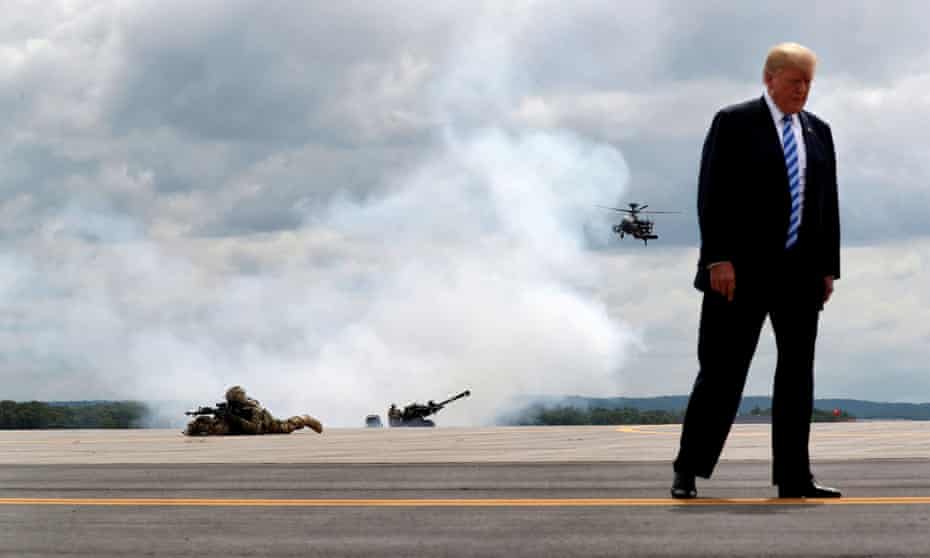
Trump observes a demonstration with the US army’s 10th Mountain Division troops, an attack helicopter and artillery, as he visits Fort Drum, New York, in August 2018. Photograph: Carlos Barría/Reuters
Newt Gingrich, a former Republican House speaker, said: “It was a remarkably effective populist disruption of the old order. It changed regulations, it rebuilt the American military, it recentred American foreign policy on American interests, it renegotiated trade policy around American jobs, it began to fundamentally shift the judiciary system back to a constitutional basis. And at the same time it was generating economic growth so you had the lowest Black and Latino unemployment in American history.”
Using a term that had led to widespread criticism of Trump for fuelling racism, Gingrich added: “Except for the enormous intrusion of the Chinese virus, it was an astonishingly successful period.”
But the coronavirus did change everything. From the start, Trump deliberately played down the threat and failed to build a national testing strategy. He sidelined public health officials by refusing to embrace mask-wearing and suggesting unproven treatments, including the injection of disinfectant, and was eventually hospitalised with the virus himself. Vaccines came at historic speed but their distribution lagged and was described by President-elect Joe Biden as a “dismal failure”.
The summer brought another crisis. Faced with mass protests against racial injustice, Trump responded with brute force, law-and-order rhetoric and a renewed culture war over statues and Confederate symbols. On 1 June, security forces chased away peaceful protesters with teargas outside the White House before the president staged a photo op, awkwardly clutching a Bible at a historic church.
But for every action, there is an equal and opposite reaction. The Trump era was also the era of #MeToo and Black Lives Matter. His inauguration was immediately followed by women’s marches including a record 4 million people in Washington. The “resistance” was maintained by activists, journalists, politicians, satirists, watchdogs, whistleblowers and voters, who delivered their verdict by handing Democrats the House, then the White House, then the Senate.
By tapping America’s id, the president inadvertently did it a favor by bringing all its internal tensions and tormented histories to the surface, making them far harder to deny. Arisha Hatch, vice-president of the activist group Color of Change, said: “Trump’s four years in office led to a huge degree of suffering but it will also be remembered as a time of racial reckoning, a time when racial justice finally became a majoritarian issue.
“Trump will be remembered for exposing the flaws in our democracy that have, for decades, kept us from achieving racial equity. Trump was a symptom of many problems, not the cause.”
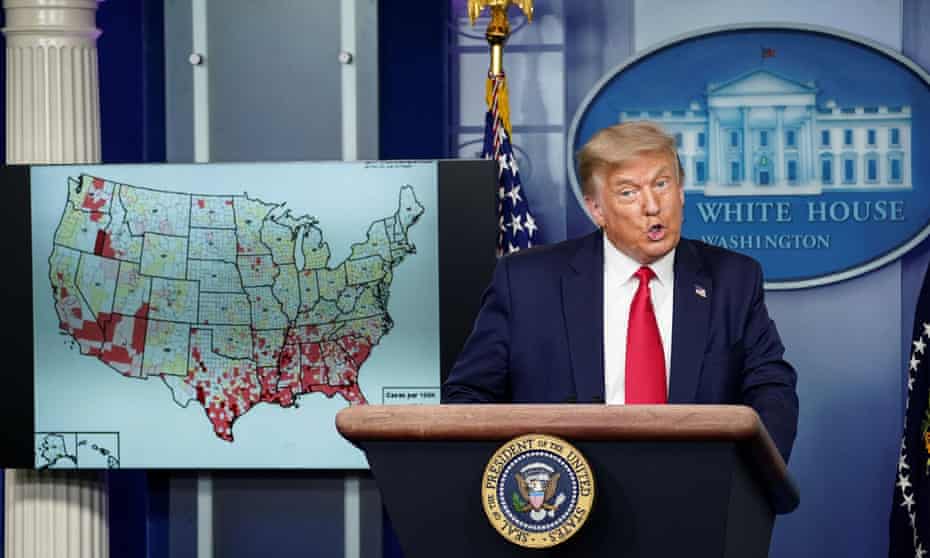
Trump hosts a coronavirus response task force briefing at the White House in July 2020. Photograph: Kevin Lamarque/Reuters
Trump once boasted that he could shoot somebody on New York’s Fifth Avenue and not lose any voters, an insight vindicated time and again, including when he grew his support from 63m votes in 2016 to 74m in 2020, more than any incumbent president in history. But his opponent, Biden, gained a record 81m votes and won 306-232 in the electoral college. Trump refused to concede and launched a scorched earth campaign of lawsuits, fantasies and propaganda to overturn the result.
But the officials, courts, civil society and media held firm. As Trump turned on his closest allies, including even Vice-President Mike Pence, weeks of election denialism and years of inflammatory rhetoric reached a fiery climax when a mob sacked the US Capitol, flaunting the Confederate flag and other far-right iconography. Five people died and members of Congress cowered in fear.
Gwenda Blair, a Trump biographer, said: “That was perhaps the first time I was truly shocked and truly, personally, physically frightened. I’ve been frightened on every other level before but that was the first time I thought, ‘It really could happen here’. It was the first time that all of the norms and all the notions of it being somewhere else were completely blown away.”
Blair was interviewed by the Guardian in a New York diner in July 2015 as Trump began his political ascent. Looking back on all that has happened since then, she reflected: “It’s a combination of exactly what I expected and worse than I could have imagined. It’s utterly consistent with his entire career but, even as someone who has been watching him for more than 30 years, it’s hard to wrap my mind around.”
From carnival barker to world’s most powerful man, Trump, 74, leaves a legacy of division, destruction and death. He accelerated Americans’ distrust in institutions and in each other, waging war on truth itself. He still has millions of acolytes whose divorce from the reality of a Biden’s presidency threatens further instability and violence from domestic terrorists. Overseas, Trump made America an object of ridicule, scorn or pity as he gravitated towards foreign autocrats and alienated longtime allies.
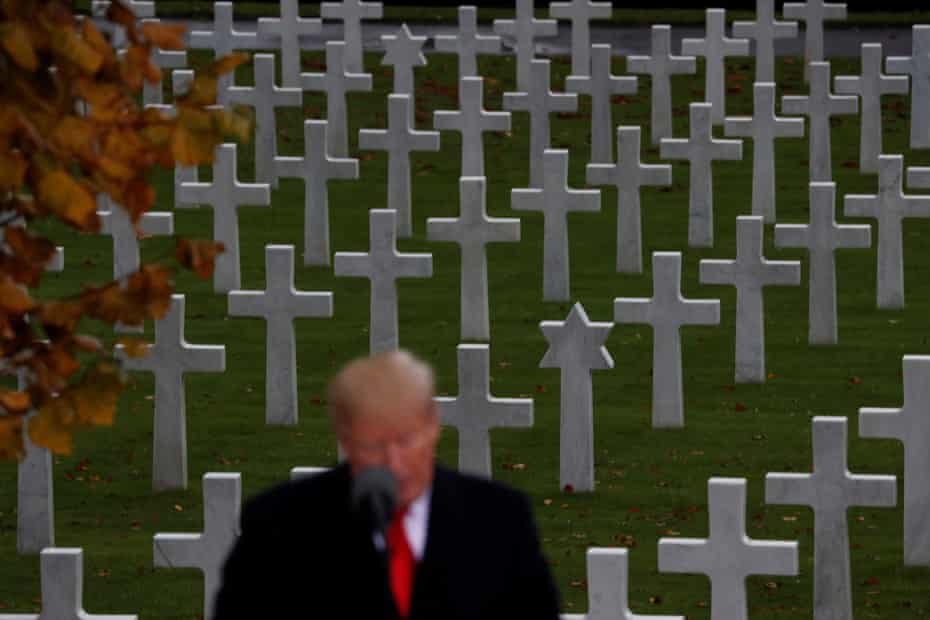
Trump speaks at the Suresnes American Cemetery and Memorial in Paris, France, on 11 November 2018. Photograph: Carlos Barría/Reuters
Advertisement
Leon Panetta, a former defence secretary and CIA director, said: “Future historians will say that it was perhaps the worst presidency the United States has had because of the person Trump is and because he had little respect for the values associated with the presidency, did not believe that there were any rules that constrained him and generally undermined the strength of the United States at a very critical time, both at home and abroad.”
But on Wednesday the lights will go out on the reality TV presidency as Trump exits the White House in defeat and disgrace, facing another impeachment trial in the Senate. A Pew Research Center poll found that his approval rating has collapsed to 29%, the lowest of his presidency. He has even been banned from social media, depriving him of the Twitter megaphone that gave diplomats and journalists sleepless nights.
Biden will be inaugurated in a city resembling a fortress and begin clearing up four years of carnage. Former president Gerald Ford’s proclamation after the departure of Richard Nixon – “our long national nightmare is over” – will be widely quoted. Many will hope that Trump was a mere heartbeat in historical terms, a blip as the baton passed from Obama to Biden, and a warning to the future: let’s not do that again.
Larry Sabato, director of the Center for Politics at the University of Virginia, said: “If history is honest, it will remember Donald Trump as by far the worst president ever. No one else even comes close. Not Warren Harding, not James Buchanan, not Richard Nixon. Nobody comes close.
“And beyond that he is, in my view, the most horrible human being who has ever sat in the Oval Office. In addition to being the worst president, he’s a terrible person. What a combination. I hope we’ve learned this lesson. This ought to remind all Americans what happens when you make a mistake with your vote.”
Jan. 19 (UPI) — Amid a global pandemic and the heaviest security of any inauguration in modern American history, President-elect Joe Biden is set to be sworn in Wednesday as the 46th president of the United States.
Biden is scheduled to arrive in Washington, D.C., on Tuesday evening from Delaware and will participate in an Inauguration Eve ceremony at the Lincoln Memorial to honor the 400,000 people in the United States who have died of COVID-19 to date.
At about 5:30 p.m. EST, Biden, Harris and their families will be near the reflecting pool at the memorial as about 400 lights are switched on, each representing 1,000 Americans who will have died of the pandemic.
Similar memorials will be held nationwide, including the Empire State Building in New York City and the Space Needle in Seattle and other landmarks.
On Wednesday, the ceremonies will begin at 11:15 a.m. EST with the National Anthem, sung by pop superstar Lady Gaga, and invocation by Father Leo J. O’Donovan. Those will be followed by a poetry reading and musical performance by Jennifer Lopez.
Then, Vice President-elect Kamala Harris will be sworn in by Supreme Court Justice Sonia Sotomayor and Biden at around noon EST by Supreme Court Chief Justice John Roberts on the western front of the U.S. Capitol.
After Biden repeats the presidential oath, he will deliver his inaugural address.
Due to heightened security at this year’s event, which will come exactly two weeks after radical supporters of President Donald Trump attacked the Capitol in a bid to interrupt Congress certifying Biden’s electoral victory, there will be only about 1,000 guests in attendance — not the usual tens of thousands in front of the complex.
Those in attendance will be limited mostly to members of Congress and their guests.
After his speech, Biden will move to the eastern side of the Capitol Building for what’s known as a Pass in Review, in which the new commander in chief will inspect military troops.
Finally, Biden will receive a military escort back across the Potomac River to the White House at about 3:30 p.m. EST.
The visit to Arlington is expected to last about 30 minutes to an hour.
The parade
One of the most visible traditions involved with every inauguration in recent memory, the physical parade from the Capitol to the White House along Pennsylvania Avenue, will not be a part of the events this year.
Instead, there will be a virtual parade — Parade Across America — which will include “diverse, dynamic performances” nationwide and honor Americans and front-line health workers, according to Biden’s transition team.
The National Mall, a long stretch of land between the Lincoln Memorial and U.S. Capitol complex, will be closed to the public and blocks surrounding the Capitol will be blocked off, due to threats of more violence from radical Trump supporters.
Barricades and security fencing have been put up along the grounds and Metro transit stations in the area have been closed until after the inauguration.
Evening program
Actor Tom Hanks will host a 90-minute program at 8:30 p.m. EST Wednesday titled Celebrating America, to honor the inauguration.
The program will be broadcast on ABC, CBS, NBC, CNN, MSNBC and PBS.
Presidential inaugurations through the years
President Dwight D. Eisenhower takes the oath of office during his inauguration at the U.S. Capitol in Washington, D.C., on January 20, 1953. Photo courtesy of Lemuel C. Shepherd, Jr. Collection at the Archives Branch/Marine Corps History Division/Wikimedia Commons