
Tag Archives: caribbean

Mexico: Amateur Sleuths Trace Stolen Cortés Papers to U.S. Auctions

Drazen Jorgic

In September, a New York auction house had a rare treasure up for sale: a five-centuries-old letter revealing political intrigue involving Hernán Cortés, the famed leader of the Spanish force that colonized what is modern-day Mexico.

Cortés papers seldom come to market. The 1521 document, offered by Swann Galleries, was expected to fetch $20,000 to $30,000. That is, until a plucky group of academics in Mexico and Spain helped thwart the sale.

Searching online catalogues of global auction houses and mining one of the researchers’ personal trove of photos of Spanish colonial documents, they traced its provenance to the National Archive of Mexico (AGN), the nation’s equivalent of the National Archives in Washington. An image of that 1521 letter captured by a Mormon genealogy project would play a supporting role.

What’s more, these amateur detectives unearthed nine additional Cortés-linked papers put on the block from 2017 to 2020 in New York and Los Angeles by auction houses – including the well-known British firms Bonhams and Christie’s – that are now confirmed to be missing from AGN, officials at the Mexico City-based archive told Reuters. They said some of those documents, once bound in weather-beaten books, had been surgically removed as if with a scalpel.

“It’s scandalous,” said one of the gumshoes, María Isabel Grañén Porrúa, a prominent Mexican cultural figure and a scholar of 16th-century Spanish colonial books. “We are very worried, not just by this theft, but also about all the other robberies and looting of national heritage.”

Names of the buyers and sellers of the Cortés documents were never disclosed publicly by the auction houses. Such anonymity is commonplace in an industry whose well-heeled patrons prize secrecy.

Swann Galleries, which handled a half-dozen Cortés papers, denied wrongdoing. London-based Christie’s, which put two out for bid, said it carefully vets the provenance of all items it puts up for auction. Bonhams, another London firm, auctioned one; it declined to comment. Los Angeles auction house Nate D. Sanders, which put one Cortés document on the block, did not respond to a request for comment.

The Cortés flap comes at a time of intensifying scrutiny of the global antiquities trade. Countries including Mexico are watching auction houses for potentially pilfered objects. Others are demanding repatriation of relics displayed in foreign museums.

The researchers’ sleuthing has sparked law enforcement investigations in Mexico as well as in the United States by U.S. Homeland Security Investigations (HSI), Reuters reporting has revealed.

A spokesperson for HSI declined to comment.

The news organization is also the first to reveal that Mexico’s Foreign Ministry has enlisted the help of the U.S. Department of Justice (DOJ) in repatriating the 10 missing manuscripts, according to Alejandro Celorio, the ministry’s legal advisor.

“We are already in cooperation with the federal prosecutor in the New York district,” Celorio said.

The DOJ declined to comment.

Separately, Reuters tracked down the Brazilian buyer of one of the allegedly purloined Cortés manuscripts handled by Swann Galleries who said he returned it to the auction house.

Manhattan-based Swan Galleries has emerged as a key player in the unfolding drama. It cancelled its scheduled Sept. 24 auction of the 1521 Cortés letter on Sept. 9, one day after Reuters contacted the firm about the researchers’ allegations.

Swann Galleries said it works diligently to ascertain the provenance of antiquities it auctions. It keeps extensive records and cooperates fully with law enforcement, said Alexandra Nelson, Swann Galleries’ chief marketing officer. “Knowingly moving stolen material through an auction house is just about the silliest thing a person can do,” Nelson said.

Robert Wittman, a former special agent who founded the Art Crime Team at the U.S. Federal Bureau of Investigation (FBI), said big auction houses aren’t doing enough to safeguard the world’s antiquities.

“They are not in the business of recovering stolen property or protecting cultural property,” Wittman said. “They’re in the business of buying and selling.”

Also under scrutiny is the AGN, Latin America’s largest archive. Mexican academics have long warned that the holdings of the cash-strapped institution are vulnerable to decay and theft.

“We are not ruling out any hypothesis,” about how the Cortés papers were stolen, Marco Palafox, legal counsel for the AGN, told Reuters. “We are not discounting the possibility that the person responsible for the thefts of these documents was a manager, a worker or a researcher.”

THE AMATEUR SLEUTHS

Key to the discovery of the alleged Cortés heists was a small group of Mexico-based academics. They included Grañén, the researcher of Spanish colonial books, and Michel Oudijk, a Dutch philologist at Mexico’s National Autonomous University of Mexico. They also recruited María del Carmen Martínez, a renowned Cortés scholar at the University of Valladolid in Spain.

They said their suspicions were first aroused when a handful of Cortés-signed letters suddenly appeared at auctions in 2017 after three decades of no public sales.

The mini-boom began in April that year at Swann Galleries, which touted a 1538 letter from Cortés to his property manager as the first such document sold publicly since 1984. “Cortés letters are quite scarce on the market,” the auction house said on its website.

The document fetched $32,500, according to the website. The name of the buyer was not published. But in 2018, the letter was displayed at The Morgan Library & Museum in New York. The institution said it did not own the letter and that it was part of an exhibition based on the private manuscript collection of Brazilian art historian Pedro Corrêa do Lago.

Reuters contacted Corrêa do Lago last month to inquire about the document.

“I have returned the letter, acquired in good faith, to Swann Galleries,” Corrêa do Lago said in an e-mail. He declined further comment on what he termed a “very rare and unfortunate occurrence”.

Swann Galleries declined to comment on Corrêa do Lago’s remarks.

Bonhams, Christie’s and Nate D. Sanders also auctioned one Cortés document each in 2017, according to the academics and information on Bonhams and Christie’s websites.

Nate D. Sanders did not respond to requests for comment. Bonhams declined requests for comment.

Christie’s said it devotes “considerable resources to investigating the provenance and authenticity” of auctioned objects and it “does not comment concerning ongoing investigations.”

The researchers said they alerted Mexican antiquities authorities in 2018 and 2019 about their suspicions as fresh Cortés manuscripts kept appearing at auction, including four in 2019. When two more surfaced in 2020, with still no action from the government, the academics launched their own investigation around mid-year.

MORMON CONNECTION

One of the group contacted Martínez, the Spanish scholar, for help. Not only was Martínez a leading Cortés expert, she had taken thousands of photographs of AGN manuscripts documenting his colonial administration during two trips to Mexico City in 2010 and 2014.

The academics quickly compiled a list of nine documents that had been put up for auction since 2017. A tenth was to be sold by Swann Galleries on Sept. 24, 2020: a 1521 missive to Cortés from some allies imploring him to avoid an emissary of the Spanish crown intent on stripping him of his powers.

It sounded familiar to Martínez. Poring over her photos, she found a match. The document shown on Swann Galleries’ website was identical to one she had photographed at AGN years earlier – down to the penman’s swooping cursive and a small triangle-shaped chunk of parchment missing from the left-hand margin.

In all, Martínez had photographed eight of the 10 manuscripts allegedly swiped from Mexico’s national archive.

“We really shouldn’t have situations like this in the 21st century,” Martínez told Reuters.

The researchers went public with their concerns in early September. Swann Galleries cancelled its Sept. 24 sale following inquiries from Reuters.

Palafox, the archive’s legal counsel, said AGN didn’t contact the U.S. auction house to stop the sale because it could not quickly establish – beyond Martínez’s photos – that the 1521 manuscript and others were, in fact, missing from its collection.

AGN houses hundreds of thousands of documents, but only about 40% have been catalogued, Palafox said. “The other 60% we don’t know what’s there,” he said.

For help, the archive staff turned to microfilm images recorded at AGN in 1993 by the Genealogical Society of Utah, an arm of The Church of Jesus Christ of Latter-Day Saints. The non-profit, now known as FamilySearch, has photographed archives worldwide to assist Mormons and others in tracing their ancestry.

Within that microfilm, Palafox said, AGN staff found images of nine of the 10 manuscripts that had come up for auction; a written description was found of the 10th. From there, AGN employees pinpointed where those papers should have been housed in its stacks. All were missing, Palafox said, some cut cleanly from their colonial-era bindings.

In October, Palafox said he hosted a video call with U.S. investigators. He displayed images of the Cortés documents from the websites of the auction houses alongside those of the 1993 microfilms and researcher Martínez’s photos to show the similarities.

“This was enough to get their attention,” Palafox said.

A senior source at Mexico’s Foreign Ministry told Reuters that the U.S. Department of Homeland Security, the U.S. State Department and one of the federal U.S. Attorney’s offices in New York state were working to retrieve the documents. The State Department said it could not comment on specific cases, but said the government was committed to combating the theft and trafficking of cultural heritage. The other U.S. authorities declined to comment.

Palafox said Mexican federal prosecutors have also launched a probe. The Mexican Attorney General’s office did not respond to requests for comment.

Wittman, the ex-FBI agent, said U.S. investigators would likely subpoena the auction houses to identify the sellers and consignors who handled transport of the documents. The strategy, he said, is to work down the chain until they reach the suspected thieves in Mexico.

Our Standards: The Thomson Reuters Trust Principles.

Read Next
  • Read NextMagnitude 6.6 quake strikes off coast of Indonesia’s Sumatra -GFZ
  • Read NextIndonesia police say Papuan separatist commander killed in shootout
  • Read NextLightning strike may have killed 18 wild elephants in India, officials say
  • Read NextTaking the call in Gaza before Israel takes out the building
Read Next
  • Read NextBig promises, few doses: why Russia’s struggling to make Sputnik V doses
  • Read NextCOVID-19 lab leak theory cannot be ruled out, leading scientists say

  • Read NextEgypt’s road building drive eases jams but leaves some unhappy

  • Read NextTurkey’s Karpowership shuts down power to Lebanon
Read Next
  • Read NextSingapore coronavirus cases could burst hopes for Hong Kong travel bubble
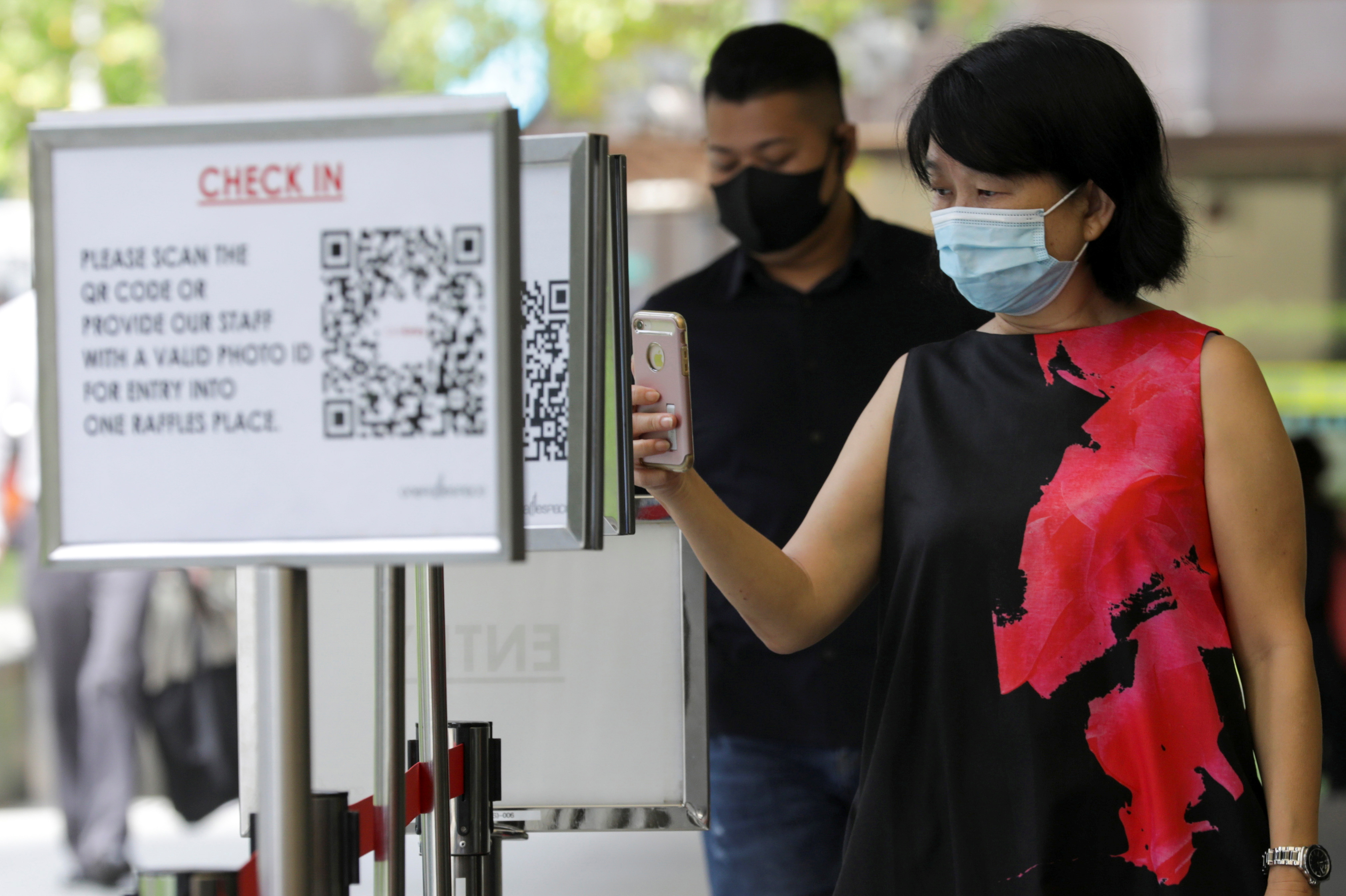
  • Read NextMarkets slump as Singapore brings in strictest COVID-19 curbs since lockdown
  • Read NextMyanmar junta declares martial law in town after attacks on bank, police
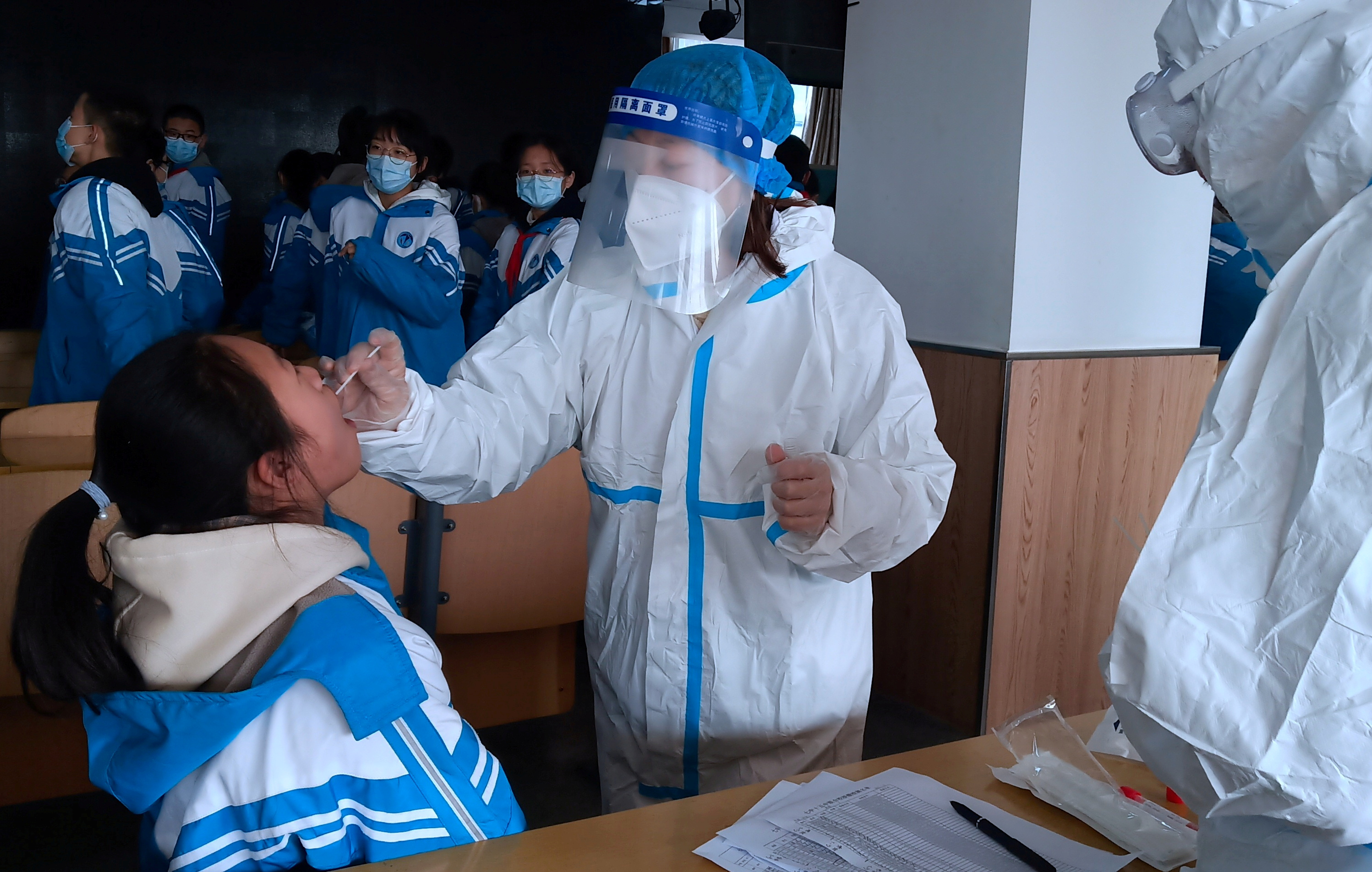
  • Read NextMainland China reports first local COVID-19 cases in more than 3 weeks
Read Next
  • Read NextPositive virus tests keep 75 Australians off flight home from India
  • Read NextChinese firm’s COVID-19 drug claims draw skepticism

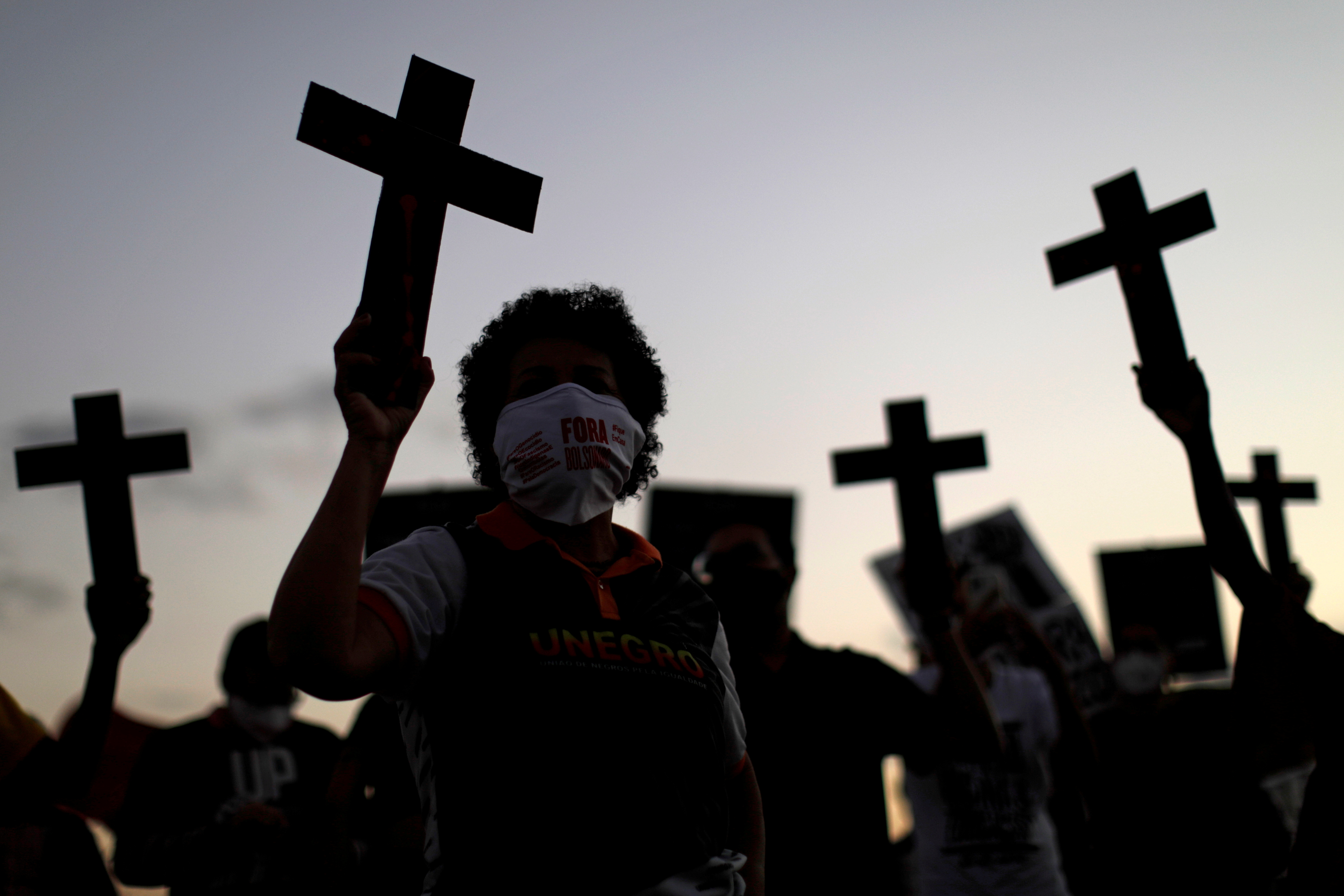
  • Read NextBlack Brazilians protest racism, police violence
Read NextIn surprise move, Japan adds 3 prefectures to virus state of emergency
Sign up for our newsletter

Subscribe for our daily curated newsletter to receive the latest exclusive Reuters coverage delivered to your inbox.

The post Mexico: Amateur Sleuths Trace Stolen Cortés Papers to U.S. Auctions appeared first on The St Kitts Nevis Observer.
Biden: US to Identify & Assist Vulnerable Migrants

(CNN) The Biden administration plans to coordinate with nongovernmental organizations to identify vulnerable migrant families in Mexico and allow them to enter the United States, instead of turning them away under a Trump-era border policy, according to a source familiar with discussions.

The administration has been facing fierce criticism for relying on a public health authority, known as Title 42, that was put in place under the Trump administration in early 2020 at the onset of the coronavirus pandemic.

The policy allows border officials to expel migrants encountered at the US-Mexico border. Immigrant advocates argue it has put migrants in harm’s way, leaving many, including those seeking asylum, in dangerous conditions in Mexico. In some cases, families have opted to separate from their children, since unaccompanied migrant children are not subject to the policy.

On Thursday, Democratic Sen. Jacky Rosen of Nevada told Homeland Security Secretary Alejandro Mayorkas, who’s defended the policy, that she remains “concerned about the continuation of Title 42, that policy that the Trump administration used to expel migrants across the board, including children and families desperately attempting to come here for our asylum process.”

The administration’s move appears designed to quell those concerns by addressing more families who are deemed exceptions to the policy. The latest plan is kicking off on a pilot basis, the source said, adding that families will be put in immigration proceedings.

“As the United States continue​s to enforce the CDC Order under its Title 42 public health authority, we are working to streamline a system for identifying and lawfully processing particularly vulnerable individuals who warrant humanitarian exceptions under the order,” said Sarah Peck, a Department of Homeland Security spokesperson.

“This humanitarian exception process involves close coordination with international and non-governmental organizations in Mexico and COVID-19 testing before those identified through this process are allowed to enter the country,” she added.

The public health order remains the subject of litigation. Since February, plaintiffs in a case concerning families being subject to the order have been in negotiations with the government.

An immigrant mother and son, 10, weep after completing their monthlong journey from Honduras to the US on April 14, 2021, in Roma, Texas.

Some exceptions have been made to the policy, including exempting 35 families daily who are referred by the American Civil Liberties Union to be admitted to the United States.

“The Title 42 order has always had an humanitarian exemption for especially vulnerable individuals and it is critical that the exemption process work efficiently through the ACLU process and the new consortium of global NGOs,” said Lee Gelernt, lead attorney in the litigation over the public health order.

The approach is similar to one taken by the administration earlier this year to process migrants who had been subject to the “remain in Mexico” policy. That Trump-era policy forced asylum seekers to stay in Mexico until their immigration court dates in the US.

The administration has similarly collaborated with international organizations to help identify and process thousands of migrants into the US with active cases under that policy. Migrants processed through that program are tested for the coronavirus before being allowed entry into the United States.

The post Biden: US to Identify & Assist Vulnerable Migrants appeared first on The St Kitts Nevis Observer.
Black Brazilians Protest Racism, Police Violence

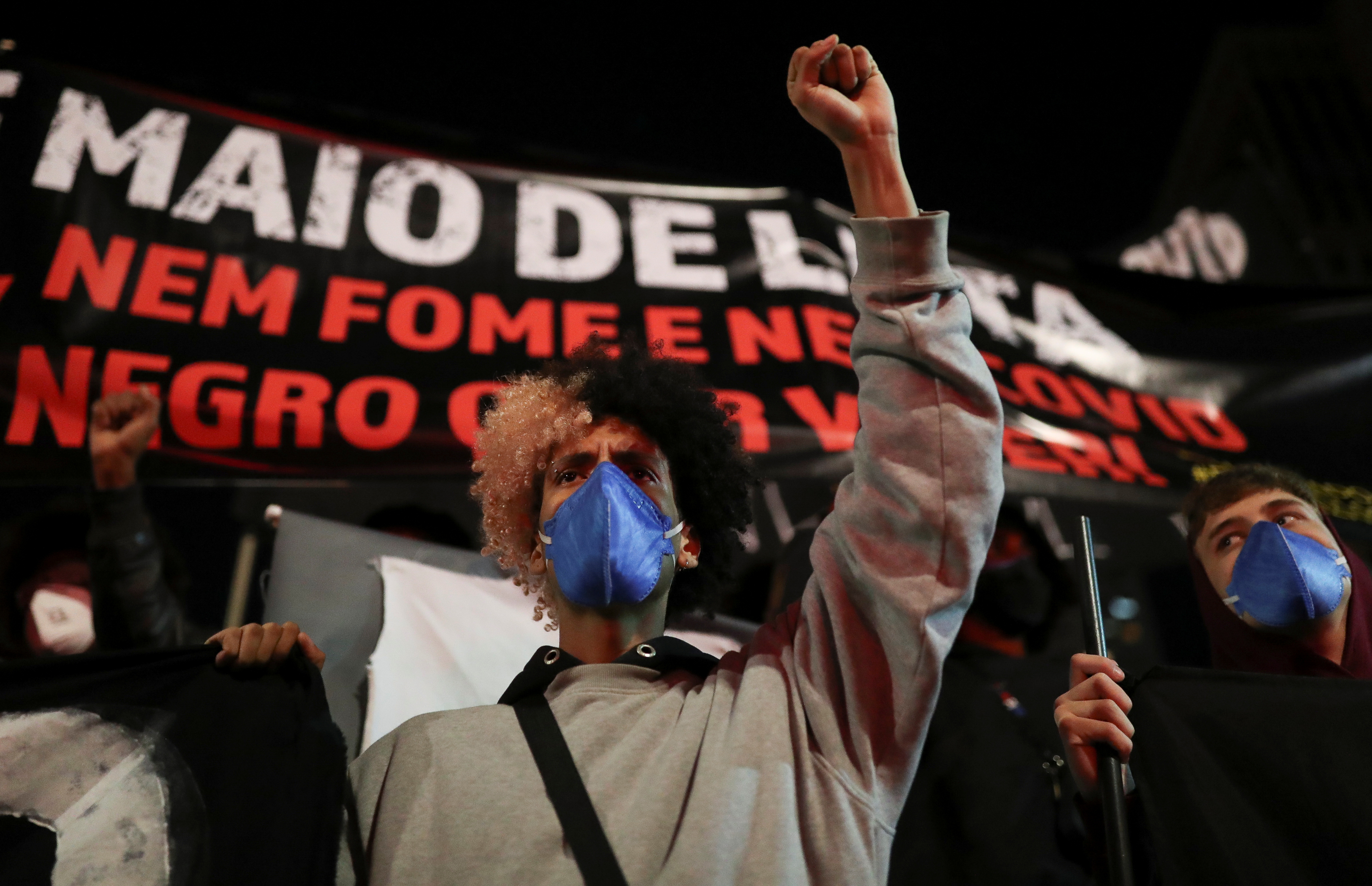
Reuters- Black Brazilians demonstrated in the country’s two largest cities on Thursday to protest against racism and police violence toward their communities in a local version of the Black Lives Matter movement in the United States, with some accusing the country’s president of genocide.

They were also protesting what they called the “false” anniversary of the abolition of slavery, officially marked for the day in 1888 when the Brazilian monarch’s daughter, Princess Isabel, signed the law freeing slaves.

Black Brazilians celebrate the end of slavery on Nov. 20, the anniversary of the killing of Zumbi, a figure of resistance against slavery and the last leader of a runaway slaves community called Palmares.

Around 1,000 people marched through downtown Rio de Janeiro in the evening holding candles and signs saying, “Don’t kill me, kill racism,” and accusing far-right President Jair Bolsonaro of genocide through police violence.

Other signs decried the shooting deaths of 28 people in a slum called Jacarezinho on the outskirts of Rio de Janeiro a week ago during an operation that police said targeted drug traffickers.

Human rights activists accused the police of “extrajudicial killings” saying many of the dead where not under investigation. A Supreme Court justice said he saw signs of “arbitrary execution” in the raid on Jacarezinho. read more

In São Paulo, a similar number of demonstrators crowded onto a main avenue to oppose racism and police violence.

“We are marking the date of the false abolition of slavery, and the tragedy in Jacarezinho where police ambushed 28 people to kill them in cold blood,” said João de Oliveira.

“President Bolsonaro and his vice president even applauded the slaughter. He committed genocide. We are here to protest

The post Black Brazilians Protest Racism, Police Violence appeared first on The St Kitts Nevis Observer.
Colombia Protesters: We’re Not Scared Anymore

By Manuel Rueda
Bogotá, Colombia

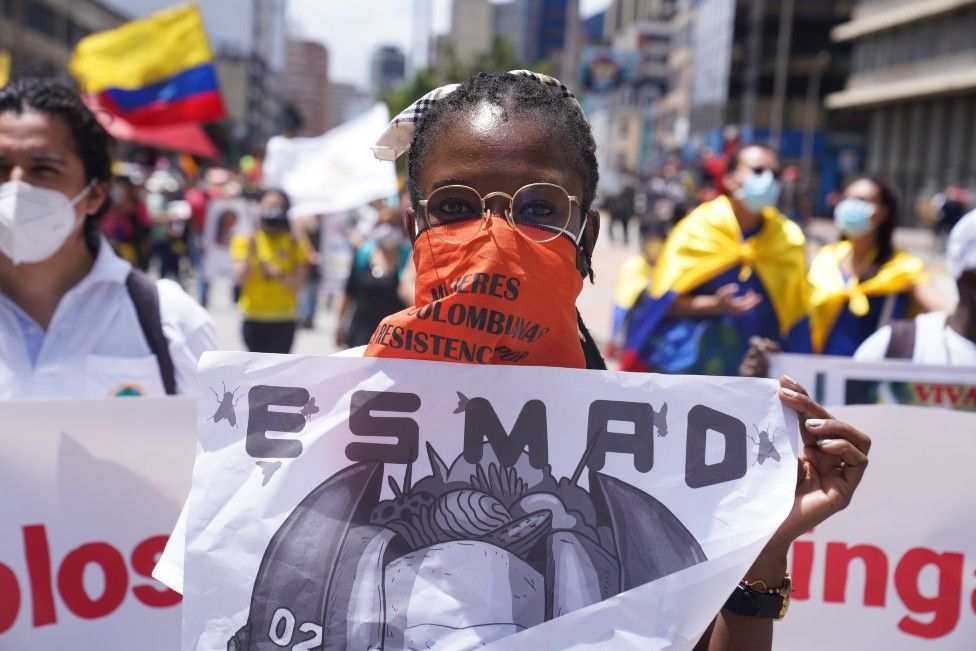
BBC- Anti-government protests in Colombia entered their third week on Wednesday. The demonstrations were sparked by a government proposal to increase taxes as millions of people have seen their incomes shrink due to Covid. But they have continued for days even after the government withdrew its proposed tax plan.

Protest leaders say their demands now go much further and include calls for a basic income scheme, free tuition at public universities and a reform of the police. Forty-two people have been killed during the protests, according to Colombia’s human rights ombudsman.

Protesters spoke to the BBC about their reasons for keeping up the demonstrations, which are the largest to sweep through Colombia in decades.

Yacila, political scientist

Yacila at a protest in Bogotá on 12 May 2021

There is a lot of discontent at the national level and it goes further than the issue of taxes. It’s caused by all the injustices that have been taking place during the [Iván] Duque government and during previous governments.

Hundreds of community leaders have been killed since the peace deal with the Farc (the Revolutionary Armed Forces of Colombia) was signed in 2016, including indigenous and black leaders.

We have a poster here with the names of almost 300 former Farc fighters who were killed after laying down their weapons. On top of that what we are seeing is that when people come out to protest there is repression, so that just makes us want to continue to mobilise.

I think that these protests should continue until people have satisfied their need to express their frustration with what is happening.

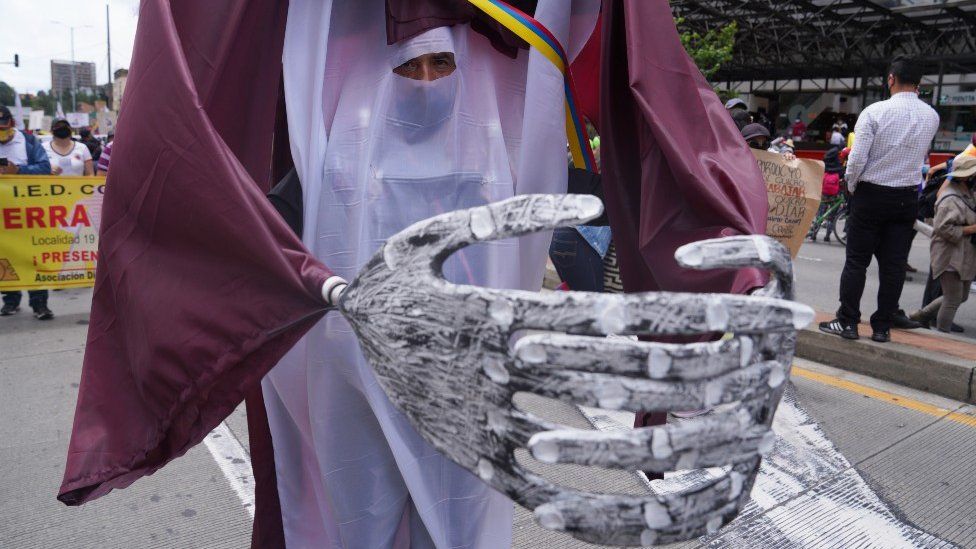
Ramiro Velasco, art teacher

Ramiro Velasco dressed in a costume at a protest in Bogota on 12 May 2021

I’m wearing a costume that represents death: it represents the massacres that have been occurring in Colombia under this government, the killings of community leaders in the countryside, deforestation, the growth of poverty and everything else related to death.

At this moment there is a very strong lack of government in this country. The government has no clear plans on how to improve healthcare, it has let the peace deal with the Farc wither. For all those reasons, I’m here. We have to demand that the government do its job because at this moment they are making us an unviable country.

They told us not to go out because we were going to get sick and we were going to die. But these demonstrations are proof that people are not scared anymore. We have to come out and express ourselves.

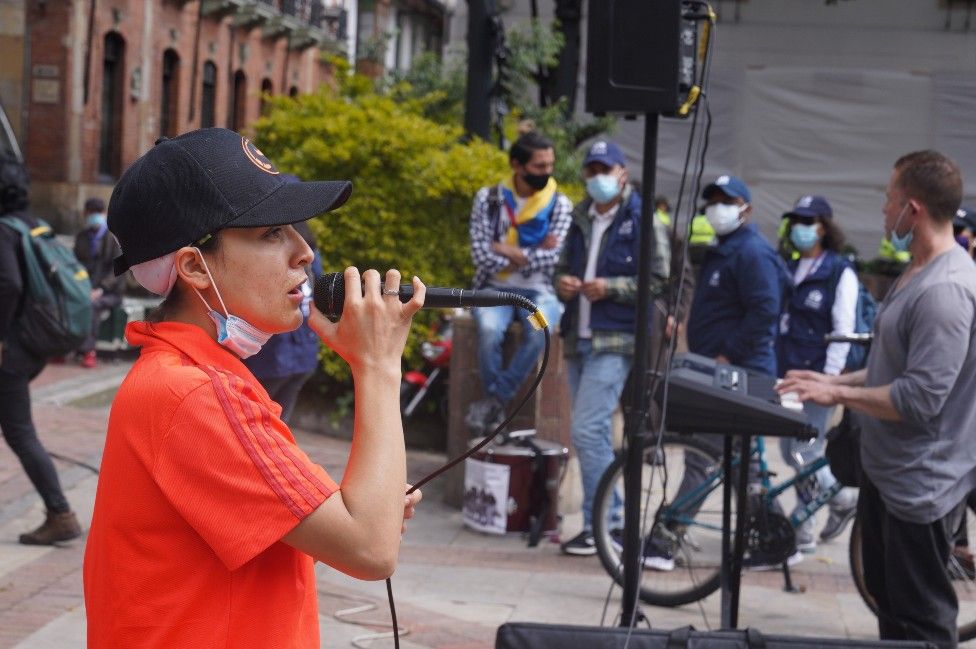
Liliana Rodríguez, classical singer

Liliana Rodriguez at a protest in Bogotá on 12 May 2021

I’m showing my support for the protests by coming out here to sing opera. What you see people expressing here is general discontent. It’s not just about a tax reform, or reform to the health system, and all the other laws. It’s people showing the discontent that they have been feeling for a long time.

Young people are especially frustrated because we study a lot, but we don’t have a place to continue our careers afterwards. I used to sing for the choir at the Bogotá Philharmonic but that’s just a youth choir. Now there is no choir where I can sing full-time, because in Colombia there are no choirs that pay professionals to sing.

There’s no work and things like food are more expensive now, there’s government corruption, that’s what makes people frustrated. The tax reform was just a fuse. But what is really going on is that we are tired of this bad governance we have.

Ernesto Herrera, leader of the Santa Fé Football Club fan group

Ernesto Herrera (right) at a protest in Bogotá on 12 May 2021

We support these protests because we are victims of the state. We’ve had members killed by the police.

Our youth have lots of needs that are not being met. There are drug addiction problems, economic problems, problems just not being recognised. But we want to get ahead and change things and have a different kind of government.

We don’t feel represented by politicians. But we want to sit down with them and show them that from our experience as football fans, we know what young people are going through. We have youth that need basic incomes, access to education, and need access to a decent healthcare system.

Daniela Sánchez, hospital worker

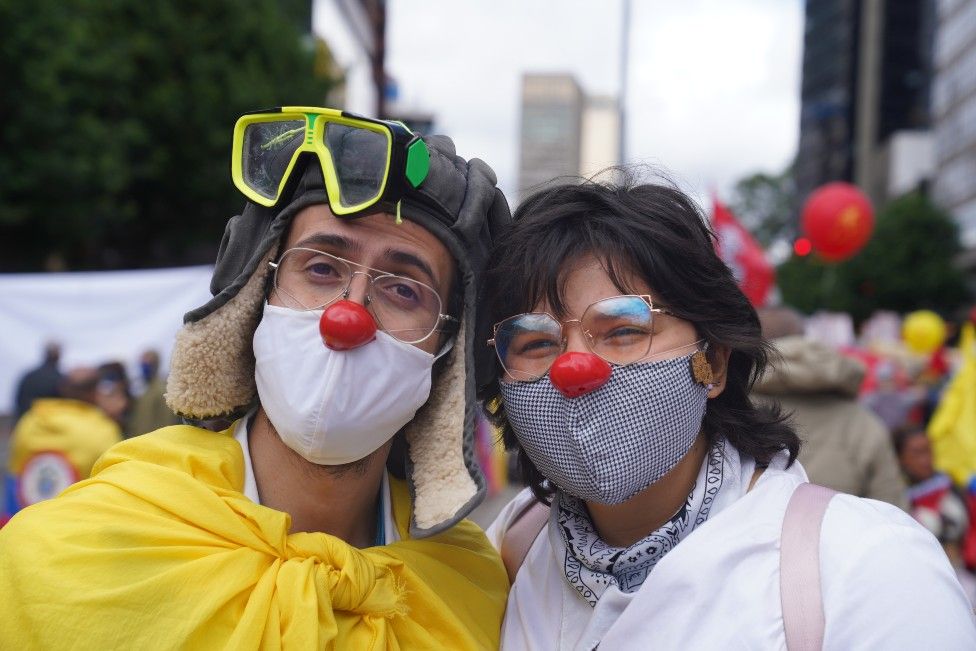
Daniela Sánchez (right) and a friend at a protest in Bogotá on 12 May 2021

I am a clown, and I do laughing therapy for children in hospital as well as for older people with terminal illnesses.

We decided to participate in these protests because we are fed up with inequality in this country. There are people in the countryside, and in cities, too, who can no longer afford three meals a day, people who have no access to education or to proper healthcare, we have seen that during our work as hospital clowns.

The pandemic exposed the big differences between the rich and the poor in Colombia. It showed how many people have no access to the internet, for example, or how many people lack savings and need to work on the streets to eat.

So I think this has to continue until the government shows remorse for its actions and hopefully it will show people that it is important to vote. We need to make good choices in next year’s election.

Miguel Morales, member of the Misak indigenous group

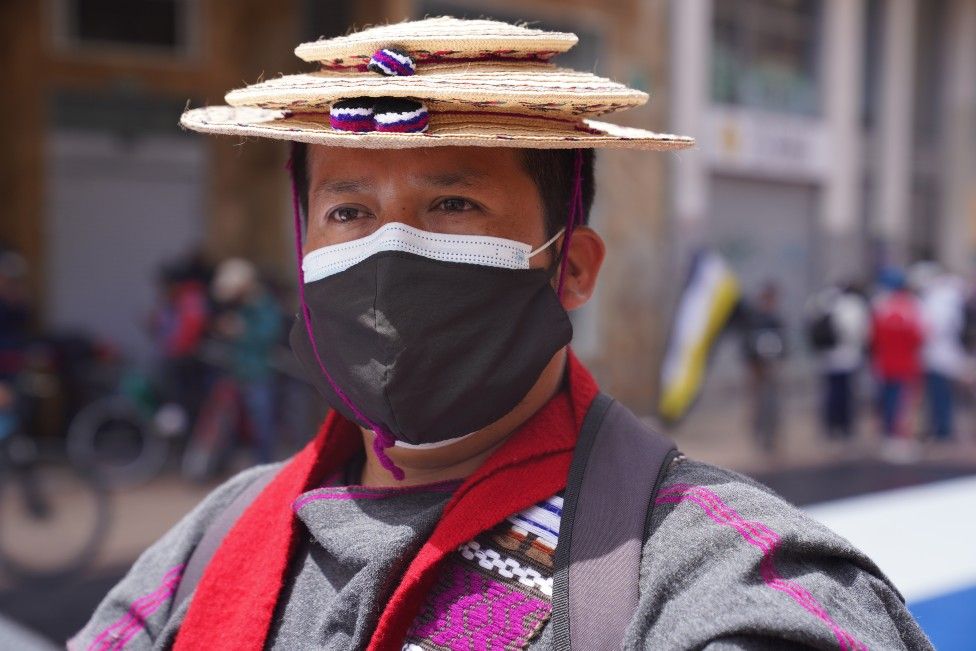
Miguel Morales at a protest in Bogotá on 12 May

This protest is not just about taxes. We are from the Cauca region, but we have about 200 families that have been here in Bogotá for 10 years because of the violence in our territories.

We think that these protests must continue because the president must realise that his job is not to do what his party wants, or what [his mentor] former President Álvaro Uribe wants, but to carry out the will of the people.

While he doesn’t hold real conversations with the people the protests will continue.

We have pulled down statues [of Spanish conquistadors] during the protests. These are symbolic acts of justice. In order for a country to live in peace, the histories of all its inhabitants must be heard.

Wendy Monroy, student at a public university

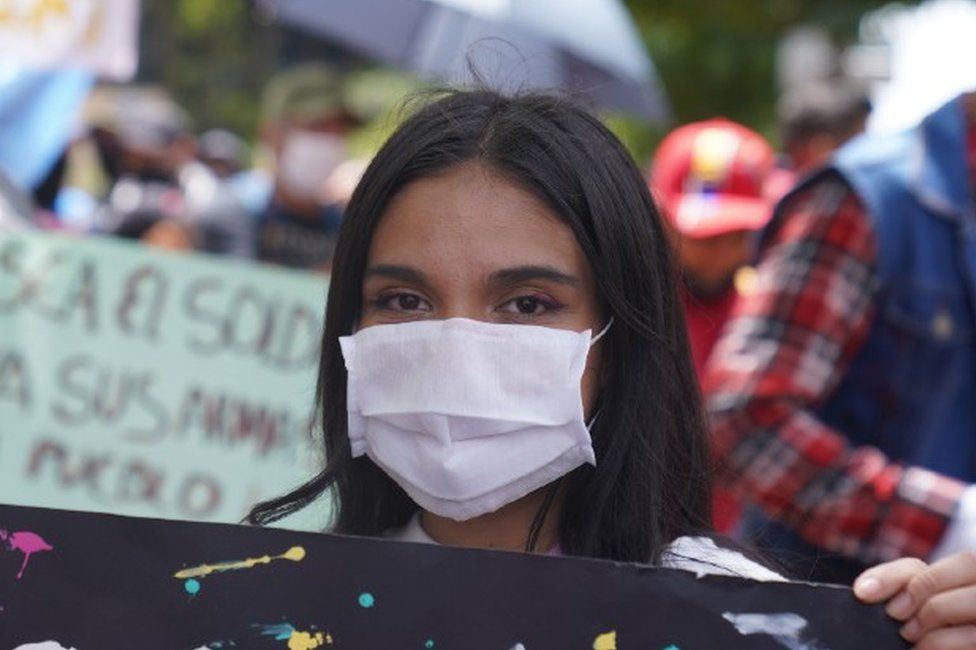
Wendy Monroy at a protest in Bogotá

I was in the second semester of my teaching degree when the pandemic broke out. Classes got suspended for some weeks and then they adjusted things so that we would continue our studies online.

I kept on studying but many of my fellow students dropped out. They dropped out because they had to work to support their families, because their parents didn’t have money any more.

So I’m here to ask for things like better healthcare but also to ask for better conditions for students.

At my university, we haven’t been able to go back to face-to-face classes yet. At private universities they’re already having regular classes again, but that’s because they have funds to take bio-security measures, simple things, like providing hand sanitizers, but at my university that hasn’t been done.

I believe that there are solutions for this country and we have to fight for that. These are the biggest protests I can remember. It shows that young people are willing to take control of this country and maybe in some years time, things can change.

The post Colombia Protesters: We’re Not Scared Anymore appeared first on The St Kitts Nevis Observer.

Trinidad & Tobago with 615 New COVID Cases

CMC- Trinidad and Tobago reported a record number of 615 positive cases of the coronavirus, as well as joining Jamaica in recording more deaths linked to the pandemic, with a 235 total to date.

The Ministry of Health in its latest bulletin said that the cases reflect a five day period and not for the last 24 hours.

“While the normal reporting timeframe covers samples taken within two to three days, the substantial increase in the positive cases and the resulting number of samples collected and processed at testing sites throughout the country, has affected the reporting timeline in this instance,” it said.

The Ministry said that the 99 cases reported on Monday “may have been as a result of the normal weekend closure of some of the testing sites and some of the health facilities where swabbing takes place”.

“This it should be underscored that the reported positive cases reflect a high percentage of infection within the population. The cases reflected a positivity rate in excess of 40 per cent, which is a cause for significant concern”.

According to the ministry, there are now 4, 588 active cases with 14, 417 positive cases since the first case was detected in March last year.

The authorities reported 11 more deaths pushing the total to 235. There are 439 people in state-sanctioned quarantine, while 3, 548 are in home isolation.

Epidemiologist Dr Avery Hinds told the Ministry of Health’s Covid-19 press conference Wednesday that the increased number of deaths is due to the increased number of cases.

So far this month, a total of 2,978 new cases have been registered for the month of May, with 66 deaths as compared to 27 last month.

“The increased number of deaths is really as a result of the increased number of cases and although we note that we’ve implemented several measures of increasing levels of stringency, we also want to remind the population that the more stringent of these are actually still only very recently implemented,” Hinds told reporters.

“The most stringent (lockdown) measures being less than a week old, those of moderate stringency being around just under or just around the two-week mark and we also have to bear in mind that each time one of these measures was implemented there was a little bit of a kickback, a rush to access whichever facility was being closed off at the time and those too would affect the figures. All of that has to work its way through the system before the numbers start to come down.

“Again this emphasizes the need for adherence to the public health measures, to recommendations we’ve been making to reduce mobility as much as possible, reduce contact as much as possible so that the measures that have been implemented have the braking effect that is desired. At this point, we still do expect that the numbers may get a little higher before they begin to decrease,” the epidemiologist said.

Meanwhile, Prime Minister Dr Keith Rowley confirmed that the United States has donated two field hospitals to Trinidad and Tobago.

Speaking on the state-owned television station, Rowley said the field hospitals are a response to rising numbers throughout the population, even as he indicated that “.it is not out of control.

“What we are doing is to expand this capacity to respond in the event that we require more beds,” he said, adding that the hospitals would be established in Couva, in central Trinidad and Diego Martin, west of here.

“It is one of the responses if we are getting more people infected and there is a demand for more bed space. A field hospital is what you use to increase your bed space in the short term. It is not out of control, it is a response to what is happening as we experience a higher level of infection,” Rowley said, urging citizens to comply with measures in place to protect the population.

“The pandemic is not a joke,” he said, adding “take it seriously, the things that have to be done, we told that to you over and over and over. Each one of us if we do those things, will not only protect ourselves but we will protect other people because those who are being infected by others.

“It is not a respecter of race, creed, class political suasion geography All over the country is exposed and all people are exposed. Now more than ever we have to be careful because we are seeing more and more young people falling to it,” said Rowley.

In Jamaica, the country recorded 101 new COVID-19 cases and six deaths over the last 24 hours, bringing the total number of confirmed cases to 46,922, with 23,121 active, and the death toll to 820.

The deaths included a 102-year-old woman and a 98-year-old man.

The new cases range in age from six months to 88 years, including 51 females.

A total of 1,380 tests were conducted. At the same time, there were 119 recoveries, for a total of 22,636.

The authorities said 175 patients are hospitalised, with 14 being critically ill.

In Guyana, there were 128 new COVID19 cases recorded Wednesday with 14 in the COVID19 ICU.

The authorities said there are 1,763 persons in isolation after testing positive for COVID19, with

1,657 isolating at home.

The country has so far recorded 331 since the first case was registered in March last year.No death has been recorded for Wednesday.

The post Trinidad & Tobago with 615 New COVID Cases appeared first on The St Kitts Nevis Observer.
Vaccination Incentive: A $1M Lottery, College Scholarships

COLUMBUS, Ohio (AP) — Ohio Gov. Mike DeWine unveiled a lottery system Wednesday to entice people to get COVID-19 shots, offering a weekly $1 million prize and full-ride college scholarships in a creative bid to overcome the vaccine hesitancy that remains a stubborn problem across the nation.

The move comes as governors, health officials and community leaders are coming up with creative incentives to get more shots in arms, including insider access to NFL locker rooms and an Indianapolis 500 garage, cash incentives, various other promotions.

With three weeks to go before most state restrictions lift, DeWine rolled out the big-ticket incentives during a prime-time address. Beginning May 26, adults who have received at least one vaccine dose may enter a lottery that will provide a $1 million prize each Wednesday for five weeks. In random drawings, the state will also provide five full four-year scholarships to an Ohio public university — including tuition, room-and-board, and books — to vaccinated Ohioans under 18.

The money will come from existing federal pandemic relief dollars, DeWine said, and the Ohio Lottery will conduct the drawings.

State Rep. Emilia Sykes, the top House Democrat, questioned the use of federal funds.

“Using millions of dollars in relief funds in a drawing is a grave misuse of money that could be going to respond to this ongoing crisis,” she said.

DeWine acknowledged the unusual nature of the financial incentives.

“I know that some may say, ‘DeWine, you’re crazy! This million-dollar drawing idea of yours is a waste of money,’” he said. But the real waste, when the vaccine is now readily available, “is a life lost to COVID-19,” the governor said.

All Ohio’s COVID-19 orders except those applying to nursing homes and other long-term care facilities will end June 2, the Republican also announced during the address. However, DeWine noted that stores and businesses still may require customers to be masked.

In announcing the mandates’ end, the governor cited the sharp drop in the numbers of COVID-19 cases and hospitalizations and the high vaccination rates among people 65 and older. He also said the vaccine is a “tested and proven weapon” that all Ohioans 12 and older can now avail themselves of.

“It’s time to end the health orders. It’s been a year. You’ve followed the protocols,” DeWine said. “You’ve done what we’ve asked. You’ve bravely fought this virus.”

The seven-day rolling average of daily new cases in Ohio did not increase over the past two weeks, going from about 1,522 new cases per day on April 26 to 1,207 new cases per day on May 10, according to data collected by the Johns Hopkins University Center for Systems Science and Engineering.

More than 4.2 million Ohioans — about 36% of the population — had completed the vaccination process as of Tuesday. But the number of people seeking vaccines has dropped in recent weeks, with an average of about 16,500 starting the process last week, down from figures above 80,000 in April. About 42% of Ohioans have received at least one dose.

“There comes a time when individual responsibility simply must take over,” DeWine said.

Business groups uniformly praised the decision. The news “is the logical next step in fully reopening our state for Ohio’s businesses and families,” said John Barker, president and CEO of the Ohio Restaurant Association.

“Removing these barriers comes at the right time and will assist the efforts of Ohio’s business community to restore Ohio’s economy,” said Andrew Doehrel, Ohio Chamber of Commerce CEO and president.

Dr Lisa Egbert, president of the Ohio State Medical Association, said the organization supported the announcement but urged all eligible Ohioans to be vaccinated as soon as possible.

DeWine made the announcement even though his previous goal for dropping the orders hadn’t been reached. In a March 4 primetime address, the governor had said he would lift remaining mandates once the state hit 50 coronavirus cases per 100,000 people for two weeks. At the time, the figure was 179 cases per 100,000 people; it had dropped to 123 cases as of this week.

Despite DeWine’s message, he had little choice in removing the mandates. His speech came only a few weeks before fellow GOP lawmakers could have voted to immediately remove all mandates, per a bill passed earlier this year over the governor’s veto. That legislation takes effect on June 23. House Republicans had signalled their intention to introduce a resolution Wednesday in preparation for a June 23 vote.

“There’s a strong sentiment that the health orders need to be dissolved,” House Speaker Bob Cupp, a Lima Republican, said earlier Wednesday.

Senate President Matt Huffman, another Lima Republican, also said Wednesday it was time for the end of mandates.

“Ohioans care about getting their businesses open and doing other things that will allow some freedom,” Huffman said.

Also Wednesday, DeWine spokesperson Dan Tierney confirmed that employees of executive branch agencies — who have been working almost exclusively from home — would return to their offices in stages, beginning July 6.

DeWine implemented the current mask mandate in July as case numbers rose. That followed a mandatory mask order in April 2020 that he rescinded just a day later under intense criticism that the directive was “one government mandate too far.”

In addition to his daily or weekly midday briefings, DeWine previously addressed Ohioans about the pandemic in primetime speeches on November 11 and July 15.

Also Wednesday, a federal judge denied Republican Attorney General Dave Yost’s request for a temporary order preventing U.S. Treasury Secretary Janet Yellen from enforcing a provision of the American Rescue Plan Act that says states can’t use their recovery dollars to offset tax cuts or credits.

Judge Douglas Cole said Ohio has a strong chance of proving the tax rule unconstitutionally ambiguous. But the judge also found that granting the order against Yellen wouldn’t provide Ohio with the relief it seeks, because Treasury’s rules for the money are still being worked out, the state hasn’t yet received its money and Yellen has not yet tried to recoup anything.


Written by Andrew Welsh-Huggins

The post Vaccination Incentive: A $1M Lottery, College Scholarships appeared first on The St Kitts Nevis Observer.
Police Capture Man Who Illegally Entered St. Kitts and Nevis


Police have captured the male who illegally entered St. Kitts on Tuesday was captured earlier this morning in the Buckleys Area.

Police have confirmed that the man is in quarantine and will be tested for COVID-19.

Yesterday, police said they were searching for a male who would have entered the Federation illegally with a stolen boat from Antigua.

This was confirmed by Divisional Commander for District ‘A’, Superintendent Cromwell Henry, who said the police were investigating the matter where an illegal entry into the federation occurred via one of the beaches.

“On Tuesday, May 11 police received information about a fishing vessel landing at Lime Kiln Bay, and an individual with a suitcase running off in the Lime Kiln area,” Henry disclosed.

He said the Coast Guard, Police and several Defence Force units responded, and found the abandoned vessel on the beach.

“The surrounding area was searched but no one was found. The vessel was taken into custody by St. Kitts and Nevis’ Coast Guard.”

Henry gave details of what law enforcement has discovered.

“Our investigations so far have revealed that the vessel was stolen in Antigua the night before. This has led us to believe the individual possibly came from Antigua.”

He said there is concern about the individual, because of the community spread in Antigua.

“We are well aware of the COVID-19 situation in Antigua with respect to community spread. This has raised concerns for us, as we do not know the COVID-19 status of this person who has now integrated into our society.

The post Police Capture Man Who Illegally Entered St. Kitts and Nevis appeared first on The St Kitts Nevis Observer.
July 4th Date: Palm Beach & Orlando Jerk Festival Now the Florida Jerk Festival

Palm Beach and Orlando Jerk Festival, two of Florida’s premier food events, has completed an extensive rebranding effort that will reflect a deep dedication to festival-goer’s experience online & offline. At the core of this rebranding are a change of the structures for each festival and the modification of the name to, Florida Jerk Festival.

Coinciding with the merge of both brands, and a new logo, Florida Jerk Festival will also launch a new website (www.floridajerkfestival.com) on May 15, 2021. Once launched, visitors will be able to view both festivals on one website with the convenience of separating Palm Beach and Orlando’s information on a user-friendly platform.

Florida Jerk Festival July 4th Edition

Along with the rebrand, organizers have announced that the Palm Beach edition will take place on Independence Day, Sunday, July 4th, 2021 at the South Florida Fairgrounds located at 9067 Southern Blvd, West Palm Beach, FL.

Early-Bird Tickets

Fans of the festival can purchase Early-bird tickets on Eventbrite ( https://bit.ly/3vPTIXc ) and visit www.floridajerkfestival.com to enter their email address for the upcoming performer’s announcement that is set to be released in the coming days.

“We’ve decided to rebrand as Florida Jerk Festival to bring our two events under one umbrella. We also want to launch Florida Jerk Festival as a food and lifestyle brand that is the number one space for all things relating to Caribbean food and culture,” says Damian Tater, the CEO of the Florida Jerk Festival.

Tater also says that for this year’s edition of the Palm Beach Jerk Festival, safe fun is the brand’s top priority. “We want our fans to come out and enjoy the festival, but we also have to ensure that they can do so safely. For this year’s event, we’re following guidelines by the CDC, requiring masks or facial coverings. We’ll also have over 100 sanitization stations at the venue.”

For over 17 years, the two events have been a staple in the Caribbean-American community allowing attendees to take a trip to the Caribbean without touching their passport.

From music to food and fun, Tater says Florida Jerk Festival aims to bring its audience a well-needed break and a relaxing moment. “Many of our attendees have Caribbean roots and they want a way to connect to their heritage right here in South Florida. Through music and food, which are universal languages, we’ve been able to provide an avenue for the Caribbean community and other locals in South Florida to be able to connect to Caribbean culture in an authentic way.”


The post July 4th Date: Palm Beach & Orlando Jerk Festival Now the Florida Jerk Festival appeared first on The St Kitts Nevis Observer.

World View: Israel-Hamas War, Floyd Cops Protest, Rich Nations Lag in Vaccinations, More

Alternate text

The Associated Press

The Rundown

I'm an image

GAZA CITY, Gaza Strip (AP) — Weary Palestinians on Thursday prepared for a somber feast marking the end of the Muslim holy month of Ramadan, as Gaza braced for more Israeli airstrikes and communal violence raged across Israel after weeks of protests…Read More

I'm an image

MINNEAPOLIS (AP) — Attorneys for three former Minneapolis officers awaiting trial in George Floyd’s death will be in court Thursday to argue pretrial motions, including a request that prosecutors be sanctioned after media reports that Read More

I'm an image

CHEYENNE, Wyo. (AP) — For pro-Trump Republicans, removing Rep. Liz Cheney from House GOP leadership was relatively easy. Booting her from office will be another matter. The rush to punish Cheney for her criticism of former President Donald Trump and…Read More

I'm an image

WELLINGTON, New Zealand (AP) — Some wealthy nations that were most praised last year for controlling the coronavirus are now lagging far behind in getting their people vaccinated — and some, especially in Asia, are seeing COVID-19 cases grow… …Read More

I'm an image

BRUNSWICK, Ga. (AP) — Attorneys for a white father and son charged with chasing and killing Ahmaud Arbery are asking a judge to allow evidence of the slain Black man’s past problems to be presented when their clients stand trial for murder… …Read More

OTHER TOP STORIES

Jaye Sanford, a 52-year-old mother of two, was driving home in suburban Atlanta on Nov. 21 when a man in a Dodge Challenger muscle car who was allegedly street racing crash…Read More

COLUMBUS, Ohio (AP) — Ohio Gov. Mike DeWine unveiled a lottery system Wednesday to entice people to get COVID-19 shots, offering a weekly $1 million prize and full-ride col…Read More

CLEMMONS, N.C. (AP) — A run on gas following a computer hack of the nation’s largest fuel pipeline had North Carolina tow-truck driver Jonathan King worried about whether h…Read More

NEW YORK (AP) — Ellen DeGeneres is calling time on her longtime-running talk show, according to reports. The daytime host, who has seen a ratings hit after allegations of r…Read More

The post World View: Israel-Hamas War, Floyd Cops Protest, Rich Nations Lag in Vaccinations, More appeared first on The St Kitts Nevis Observer.

12 Migrants Detained, One Dead on Florida Beach After Boat Intercepted

 
Florida – Legal authorities are investigating an attempted migrant landing involving a 28-foot boat in Jupiter Beach, Florida.

Authorities found 13 undocumented Haitian migrants connected to the suspected smuggling vessel. One of the migrants was found dead and floating in the water nearby, according to WPFB. It’s not yet clear how or when he died.

The vessel was first spotted on Wednesday near midnight. It appeared 40 yards offshore near the Jupiter Reef Club, an oceanfront property, WPTV reported.

Three Haitian men jumped overboard as U.S. Customs and Border Protection (CBP) officials approached the vessel. Though CPB apprehended all 12 living migrants, they reportedly questioned two of them for further information.

The boat remains on Jupiter Beach, according to WPEC. The beach is located 16 miles north of Palm Beach, a popular vacation destination. The Palm Beach County Sheriff’s Office, CBP, Jupiter police and the Department of Homeland Security are all investigating.

Newsweek contacted the Palm Beach County Sheriff’s Office for comment.

The incident marks the second time this month and the fifth time this year that authorities have discovered a vessel smuggling Haitian migrants in Florida.

On May 3, CBP officials arrested 29 Haitians whose vessel landed near Hallandale Beach, a beach 15 miles north of Miami Beach. That incident involved a 45-foot sport-fishing vessel that made a distress call to the U.S. Coast Guard as it ran aground. The vessel began leaking diesel fuel into the ocean. It was later removed from the beach and seized by authorities, according to The Palm Beach Post.

On March 25, police apprehended 25 migrants who came ashore near South Palm Beach just after midnight. The group had five children including two 9-year-old girls, an infant boy, a 17-year-old boy and a 2-year-old girl, the Post reported.

On March 3, authorities apprehended 25 Haitian migrants after their vessel began sinking 30 miles offshore. The group included nine men, nine women and seven children, the Post reported. The vessel used its onboard radio to call for help, but it lacked any other lifesaving equipment, authorities said.

On January 21, a group of 19 Haitians—including men, women and children—landed near the Boynton Beach waterfront park. The boat carrying the migrants departed soon after dropping its passengers on the beach. Authorities apprehended the migrants.

Haitians have increasingly migrated to the U.S. as well as other Caribbean and South and Central American countries, according to the Migration Policy Institute (MPI). Political instability, widespread poverty and natural disasters have prompted the migration.

The Haitian immigrant population in the U.S. has grown from 92,000 in 1980 to 687,000 in 2018, MPI reported.

The post 12 Migrants Detained, One Dead on Florida Beach After Boat Intercepted appeared first on The St Kitts Nevis Observer.