Tag Archives: caribbean

Nepal Chaos as Virus Forces PM to Resign

(CNN) Nepal has been thrown into political turmoil after the country’s Prime Minister was forced to step down following public anger over his response to a deadly second wave of Covid-19.

K. P. Sharma Oli — who touted unproven coronavirus remedies and attended crowded events even as cases rose — was removed from his position after losing a vote of confidence on Monday.

Just a month ago, the Himalayan nation of 31 million people was reporting about 100 Covid-19 cases a day. On Tuesday, it reported 9,483 new cases and 225 virus-related fatalities, according to its health ministry — the highest single-day death toll since the pandemic began.

Some have linked the country’s second wave to the outbreak in neighboring India, which began in mid-March. The two countries share a long, open land border that people easily travel back and forth across.

Scenes in India, of funeral pyres and people queuing outside hospitals, are being replicated in Nepal, where hospitals are running out of oxygen and turning away patients.

A worker cremates Covid-19 victims at Pashupatinath Temple crematorium in Kathmandu on May 9.

Critics say public complacency and government inaction likely worsened Nepal’s coronavirus outbreak. While it might not have been possible to prevent a second wave, experts say the government could have done more to control it.

As the crisis developed, the government’s key coalition partner, the Maoist Centre, withdrew its backing, prompting Oli to seek a parliamentary vote to prove he had enough support to remain in power.

Oli needed at least 136 votes in the 275-member House of Representatives to ensure a majority and save his government. But he only received 93 votes — 124 members voted against him.

Given Oli’s failure to secure a vote of confidence, Nepal’s President and ceremonial head of state Bidhya Devi Bhandari will now put out a call to form a new government.

Mixed messaging

Nepal’s coronavirus cases began rising in early April, but the government was slow to take action, allowing mass religious festivals, large weddings and other public gatherings to continue.

On April 8, when daily new cases had already tripled, Oli said Covid-19 could be treated by gargling with guava leaves — adding to his ridiculed comments last year that Nepalis had stronger immune systems due to their daily intake of spices.

It wasn’t until April 29, when daily cases had reached more than 4,800, that the government imposed a two-week lockdown on the capital, Kathmandu.

Beyond India, a growing number of Asian countries are being ravaged by fresh coronavirus waves

In May, authorities closed border crossings, ordered oxygen cylinders from overseas, built new health care facilities and banned all international flights. But by then it was too late.

The messaging from Oli and his administration has at times been unclear and contradictory.

On May 8, Oli told CNN the Covid-19 situation in Nepal was “under control,” insisting the government was taking appropriate action. “We are taking very serious measures to control the situation to supply oxygens, to supply beds, to supply ICU beds,” he said.

When asked about large events held in the country in recent weeks, he admitted “some mistakes” had been made, but said: “this should not be a political issue.”

His assertion the situation was under control drew anger from those struggling to survive.

“People are not getting beds, people are not getting oxygen, people crying out for help,” said Suraj Raj Pandey, a volunteer at Covid Connect Nepal, a volunteer-run website that connects patients with supplies and beds. “And the executive head of this country comes up and says to the international community, ‘Yeah, everything’s fine, Nepal is normal, everything’s under control,’ while people are dying out in the streets.”


Nepal’s former Prime Minister K.P. Sharma Oli inside parliament in Kathmandu on May 10.

Oli took a dramatically different tone two days later, in an opinion piece published in The Guardian newspaper on May 10, before the no confidence vote.

“Nepal’s history is one of hardship and struggle, yet this pandemic is pushing even us to our limits,” he wrote. “The number of infections is straining the healthcare system; it has become tough to provide patients with the hospital beds that they need.”

Despite government efforts, “due to the constraints of resources and infrastructure, the pandemic is turning out to be an overwhelming burden,” he wrote. “I have, therefore, appealed to the international community to help us with vaccines, diagnostic tools, oxygen kits, critical care medicines and equipment, to support our efforts to save lives. Our urgent goal is to stop preventable deaths occurring.”

Later that day, he was removed from his post.


Nepali Army personnel load the body of a Covid-19 victim into a van to be taken to a crematorium.

Covid crisis intensifies

All the while, as Oli and his administration fell into chaos, Nepal has continued to drown under Covid-19 cases.

Nepal’s cases skyrocket, prompting concern the country’s outbreak could mimic India’s

“It’s a humanitarian crisis at the moment,” said Eeda Rijal from volunteer group Covid Connect Nepal. “And we, working in the front line, we’ve seen that surge, and we don’t understand why the government has not been able to see this.”

Desperate families and Covid patients are pleading for supplies on social media. Surajan KC is among them. Both his parents are hospitalized with Covid-19; his father, whose oxygen levels have been unstable, is now in the ICU.

“We’re just waiting and watching whether he’s going to recover soon,” he said. “It is still pretty scary, especially when it comes to oxygen, because even if you find beds in the hospitals, I’ve heard that so many hospitals are telling patients that they have to find oxygen … by themselves.”

Doctors, too, say they have been pushed to their limits.

“It’s been sleepless nights for the last seven days … I’ve hardly slept for two hours,” said Saugat Poudyal, the medical director of Karuna Hospital in Kathmandu. “I think the global community needs to step forward from now on. It’s the lack of oxygen that’s going to bring about a huge catastrophe here.”

In an interim order on Tuesday, Nepal’s Supreme Court urged the government to set up a task force to direct the distribution of oxygen cylinders and other life-saving equipment. The court said no Nepali should be deprived of medical treatment due to oxygen shortages, and that it was the government’s responsibility to ensure supply and save lives.

A lockdown in the Kathmandu Valley — home to around 2.5 million people — has been extended until May 27, with residents advised not to go out unless necessary. Gatherings have been banned at party venues, and gatherings in private homes are capped at 10 people.

The ban on international flights has also been extended until May 31 — although two flights per week are allowed between Kathmandu and the Indian capital, New Delhi, under a “travel bubble” program, according to Nepal’s Civil Aviation Authority.

CNN’s Julia Hollingsworth, Nishant Khanal, Kosh Raj Koirala and Sugam Pokharel contributed to t

The post Nepal Chaos as Virus Forces PM to Resign appeared first on The St Kitts Nevis Observer.

Sham Marriages: A problem that needs addressing – Chief Immigration Officer

Sham Marriages: A problem that needs addressing – Chief Immigration Officer

Incidents of fake marriages are something that needs to be addressed, according to Chief Immigration Officer Merclyn Hughes, who said legislation would be necessary to effectively do so.

Hughes said the matter was something that there were no laws to properly police. “Marriages of convenience or sham marriages – some countries have the laws spelt out, and you can do your investigation and take the matter before the court.”

She said, however, that they were looking to amend the Immigration Act to ensure they have the legal footing when they investigate.

“These are one of the things that we are looking at, in terms of the Immigration Act to be reviewed, and for amendments. Those are some of the recommendations that we wish to make so that when these situations occur, we will have teeth, we will have the grounds to stand on to investigate.”

Hughes said that marriages of convenience are marital arrangements entered into without a real marital relationship.

“It is commonly done by persons seeking citizenship of another country.”

She said the new Enforcement Unit of the Immigration Department will help to investigate such incidents as soon as the laws are amended.

Hughes implored every citizen and resident to be watchful, and be the ears and eyes of law enforcement.

“The general public can expect to see immigration officers moving around the island in their newly acquired law enforcement uniforms.”

She said the new unit was activated to manage the large number of persons overstaying, and persons working without the relevant approval.

“We are therefore encouraging persons who fit these profiles to visit the Ministry of National Security and have their status regularized as soon as possible.”

The Immigration head also warned potential employers that it is an offence to employ any non-national without a work permit, which must be applied for while the prospective employee is outside the federation, and the employer fulfilled their local obligations outlined in the Immigration act.


The post Sham Marriages: A problem that needs addressing – Chief Immigration Officer appeared first on The St Kitts Nevis Observer.

Vaccinate or Suffocate – the stark choice

By Sir Ronald Sanders  

Sections of the population in many of the 14 independent CARICOM countries are in grave danger of undermining their own health and economic interests by their refusal to be inoculated against the coronavirus, COVID-19.

At the time of writing (May 13), 159.5 million persons have been infected with the virus worldwide.  Of this number, almost 3.4 million have died.  Shockingly, the countries of the Americas from Canada to Argentina, including the Caribbean, account for almost half of the global infections and deaths – 64.1 million infections and 1.5 million deaths.

While this persistent rate of infections and deaths continues, the entire Hemisphere, except for the wealthiest nations, will continue to experience a health and economic crisis.   All who yearn for a return to the pre-COVID period of unrestricted activity will not only endure an exceedingly long waiting period, but they will also experience increased numbers of infections and deaths.   The latter will overburden already fatigued medical capabilities and strain morgue and burial facilities.

Figures from Caribbean countries are worrying, despite the efforts of governments and their medical authorities, to prevent infections and deaths.   The Pan-American Health Organization (PAHO) records community spread in 8 of the 14 independent CARICOM countries – Barbados, Guyana, Haiti, Jamaica, St Lucia, St Vincent and the Grenadines, Suriname and Trinidad and Tobago.  Cluster cases are registered in two countries, namely Antigua and Barbuda and The Bahamas.  The other three countries – Dominica, Grenada and St Kitts-Nevis – report sporadic cases.

While it is not a magic bullet that will eliminate the coronavirus, the anti-COVID vaccine is the best solution for the people of CARICOM countries to save themselves, their families and their friends, and to place themselves in a position to recover from their present health and economic crises.  Those who refuse to be vaccinated or propagandize against it, are endangering themselves and all who live in their countries.  Indeed, they could be described as choosing to commit suicide and to take along with themselves many other people.  This not only lacks good judgement in personal terms, but it is also a clear and present danger to their entire societies.

When the COVID-19 pandemic started, all nations cried out for vaccines.  The wealthier nations invested billions of dollars in the big pharmaceutical companies to develop and test vaccines.  Four types were quickly developed and approved after extensive testing by AstraZeneca, Pfizer, Moderna and Johnson & Johnson.  On May 7  the World Health Organization also approved the Sinopharm COVID-19 vaccine from China.

Fear has been expressed about taking any of these vaccines based on the relatively rapid rate in which they were developed in comparison with vaccine development in the past.  This trepidation should take account of the fact, that unlike as in the past, science and technology have vastly improved, allowing for reliable results to be obtained faster. Further, at no previous time in human history has such large sums of money been devoted to the research and development of a vaccine.

Regarding those who take the simple view that they reject vaccines as unnecessary and harmful, Caribbean history reveals that what made Caribbean people survive and lead productive lives, were vaccines against mumps, measles, chicken pox, Hepatitis A and B, diphtheria, whooping cough, polio and tetanus (lockjaw). These vaccines were administered and accepted routinely because they saved lives.  What those vaccines have done in the past, and still do, anti-COVID-19 vaccines can do today.

But, vaccination rates in CARICOM countries are too low.  The anti-vaccination propaganda seems to have overtaken government information and education machinery – something governments must reverse swiftly, including by better use of social media platforms and by direct communication with influencers in communities.

Thus far in the vaccination success table, Antigua and Barbuda (31.74%), Barbados (26.9%), Dominica (26.2%), St Kitts-Nevis (24.3%), Guyana at 19.16%, and Grenada (11.1%) are the six leaders; all others are below 10% and four of them Jamaica, Trinidad and Tobago, St Lucia and St Vincent and the Grenadines are at less than 5%.

Where countries such as Antigua and Barbuda and Barbados have some vaccines, but people are falling prey to propaganda, endangering their own and other lives, as well as the recovery of their countries, they weaken considerably the argument that CARICOM governments have been advancing in the international community that we need access to more vaccines. Ten wealthy countries have secured 75 per cent of the 1.36 billion doses already administered to vaccinate 8.6 per cent of the world’s population.  Other countries are struggling.  There is a strong moral argument for equitable distribution.

But, if Caribbean countries have vaccines that are not being taken-up and which must be discarded because they have expired, the argument about being deprived of vaccines by rich countries will quickly be discounted.

A few politicians in some countries, such as Antigua and Barbuda, while publicly supporting vaccines, have joined the anti-vaccination propaganda behind the scenes with what appears to be an intent to promote circumstances to blame the governments for a lack of progress.  In Antigua and Barbuda, for instance, political focus has been placed on its Prime Minister Gaston Browne who was gifted with the Moderna vaccine which he took to try to allay fears.  Now, even with other safe and reliable vaccines available, some politicians are putting politics ahead of patriotism by promoting the idea that the only acceptable vaccine is Moderna.   From my own discussions with Moderna and Pfizer, I know that no new supplies will be available until January 2022 at the earliest.

None of this anti-vaccination propaganda is helping the Caribbean.  The region needs to reach herd immunity soon if economies are not to decline and wither, affecting everyone.

The fate or the future of the region is now in the hands of the region’s people themselves – rejecting vaccinations is a sure way of widening the path to misfortune.  The words of Dr Carissa Etienne, the Director of PAHO, should be the clarion call – “The best vaccine is the vaccine that is available”.

The alternative is a prolonged period of misery, including an increase in infections and deaths. None of this is exaggerated.

Responses and previous commentaries: www.sirronaldsanders.com  

(The writer is Antigua and Barbuda’s Ambassador to the United States and the Organization of American States.   He is also a Senior Fellow at the Institute of Commonwealth Studies at the University of London and Massey College in the University of Toronto.  The views expressed are entirely his own)  

The post Vaccinate or Suffocate – the stark choice appeared first on The St Kitts Nevis Observer.

Florida Declares Gas Shortage State of Emergency

TALLAHASSEE, Fla. (AP) — Florida Gov. Ron DeSantis declared a state of emergency Tuesday evening in response to gasoline shortages caused by the shutdown of a major pipeline by hackers.

The executive order signed by DeSantis activates the Florida National Guard, as needed, and directs state emergency management officials to work with federal and local officials.

The Colonial Pipeline, the biggest fuel pipeline in the U.S., delivering about 45% of what is consumed on the East Coast, was hit on Friday with a cyberattack by hackers who lock up computer systems and demand a ransom to release them. A large part of the pipeline resumed operations manually late Monday, and Colonial anticipates restarting most of its operations by the end of the week, U.S. Energy Secretary Jennifer Granholm said.

More than 1,000 gas stations in the Southeast reported running out of fuel, primarily because of what analysts say is unwarranted panic-buying among drivers.

The post Florida Declares Gas Shortage State of Emergency appeared first on The St Kitts Nevis Observer.

Toronto’s Caribbean Carnival COVID Cancelled

The city has confirmed that all major events in Toronto this summer, including the Caribbean Carnival and the Canadian National Exhibition, will once again be cancelled due to the COVID-19 pandemic.

In March, the city cancelled all events and permits through to June 30 and today’s announcement means events typically held in Toronto in July, August, and over the Labour Day weekend will also not proceed in person.

“To continue to slow the spread of COVID-19 and help provide predictability to major event organizers, the City of Toronto is extending the cancellation of in-person City-led and City-permitted outdoor events to September 6,” officials said in a news release issued Friday.

“The City understands the importance of these events to Toronto’s vitality, liveability and prosperity. City staff are working in close collaboration with event organizers, who in every instance possible have been consulted on this approach and given advance notice of this decision. The City is committed to working closely with event organizers to help them manage through 2021 and come back stronger in 2022.”

In a statement released on Friday morning, Mayor John Tory said he is working with the CNE to help the fair get “through this difficult year” and offer a bigger and better in-person event in 2022.

“The City supported The Ex when it had to be cancelled in 2020 due to the pandemic, and the City will once again step forward to support the CNE again this year,” he said.

“We are committed to working with the CNE as a partner, to support continued operations and to ensure that this historic event has a successful return in 2022 and I am confident that the other governments share that determination.”

In addition to the CNE and Caribbean Carnival, events impacted by the move include Taste of the Danforth, the Honda Indy, and The Beaches Jazz Festival.

Pride Toronto previously confirmed that once again this year, annual festivities for Pride Month, which runs from June 1 to June 30, will be virtual.

The post Toronto’s Caribbean Carnival COVID Cancelled appeared first on The St Kitts Nevis Observer.

Haiti: Criminal Deportees Become Part of Violent Society

Haiti’s ambassador to the US Brochit Edmond claimed Haitians deported to Haiti because of criminal convictions in the U.S. have become a big part of Haiti’s rampant violent crime problem today.

“Most of them are involved in gangs,” Edmond said. “And that’s why the battle against [Haiti’s] gangs [is] so difficult — because these are expert gangsters.”

Edmond did admit the Haitian government has few resources to aid those deportees once they arrive in Haiti. But his assertion that criminal deportees are a large contributor to Haiti’s violent crime crisis — including its terrifying wave of ransom kidnappings — is largely and often angrily refuted by the Haitian expat community.

“That’s a false narrative that’s been used by the Haitian government for decades,” said Haitian-American Michelle Karshan, executive director of Alternative Chance, a nonprofit that aids criminal deportees in Haiti.

“It’s a way to scapegoat all their problems and attribute them to criminal deportees — although there’s no proof. It’s also right now a way for the Haitian government to distance itself from recent human rights reports that connect massacres and criminal activity to the Haitian government,” she said.

Haitian President Jovenel Moïse’s government has in fact been rebuked by international human rights groups and the United Nations for condoning police brutality and criminality — and for ignoring widespread allegations of police involvement in the nation’s often deadly kidnapping surge.

A U.N. report accuses Haitian security forces of involvement in a 2018 gang massacre that killed at least 26 people in the Port-au-Prince neighborhood of La Saline.

Haiti has seen numerous street protests in recent years calling for Moïse to resign because of his government’s inability to stem the violent crime.

As for criminal deportees, Karshan concedes some do turn to crime after arriving in Haiti because they have no other support systems there.

But she points out they’ve often proven to be an asset there. After Haiti’s 2010 earthquake, she says, many criminal deportees were thanked by the government for helping the rescue and recovery effort as translators for international aid groups.

The post Haiti: Criminal Deportees Become Part of Violent Society appeared first on The St Kitts Nevis Observer.

World View: Israel-Gaza, Maskless US, UK To Reopen, More

Alternate text

The Associated Press

The Rundown

I'm an image

GAZA CITY, Gaza Strip (AP) — Israeli artillery pounded northern Gaza early Friday in an attempt to destroy a vast network of militant tunnels inside the territory, the military said, bringing the front lines closer to dense civilian areas and paving…Read More

I'm an image

WASHINGTON (AP) — In a major step toward returning to pre-pandemic life, the Centers for Disease Control and Prevention eased mask-wearing guidance for fully vaccinated people on Thursday, allowing them to stop wearing masks outdoors in crowds and i…Read More

I'm an image

WASHINGTON (AP) — What insurrection? Flouting all evidence and their own first-hand experience, a small but growing number of Republican lawmakers are propagating a false portrayal of the Jan. …Read More

I'm an image

LONDON (AP) — When London’s Science Museum reopens next week, it will have some new artifacts: empty vaccine vials, testing kits and other items collected during the pandemic, to be featured in a new COVID-19 exhibition. …Read More

I'm an image

NEW DELHI (AP) — The man in the WhatsApp video says he has seen it work himself: A few drops of lemon juice in the nose will cure COVID-19. “If you practice what I am about to say with faith, you will be free of corona in five seconds,” says the man…Read More

OTHER TOP STORIES

A graphic calling the East Coast fuel supply crunch “Biden’s Gas Crisis.” A tweet speculating that gas stations running dry was an “INSIDE JOB.” A meme depicting the p…Read More

JERUSALEM (AP) — In the 1980s, Rabbi Meir Kahane’s violent anti-Arab ideology was considered so repugnant that Israel banned him from parliament and the U.S. listed hi…Read More

PROVIDENCE, R.I. (AP) — Multiple people were wounded in a shooting Thursday evening in Rhode Island’s capital, police there said. Providence police Maj. David Lapatin …Read More

NORWALK, Calif. (AP) — The winner of a $26 million California Lottery prize may have literally washed the chance of a fortune down the drain. The winning SuperLotto Pl…Read More

The post World View: Israel-Gaza, Maskless US, UK To Reopen, More appeared first on The St Kitts Nevis Observer.

Corona Effect: India, Brazil, South Africa,UK on SKN Travel Ban List

St. Kitts & Nevis has extended the travel advisory for people arriving from the U.K., Brazil, South Africa and now India, as of May 4 to June 4, 2021.

Persons from the aforementioned destinations are advised not to travel to St. Kitts & Nevis at this time. Entry into the Federation will be denied. Citizens and Residents of St. Kitts & Nevis who are arriving from any of these countries must process their travel request through the online platform www.knatravelform.kn and will be required to quarantine for 14 days upon arrival, even if they have been fully vaccinated.

The decision to extend and expand the advisory is based on the advice of the Ministry of Health and enacted by the Government of St. Kitts & Nevis through the National COVID-19 Task Force in the interest of protecting its borders and the health of its citizens.

The Government is extending the advisory in response to Covid-19 variants that have originated in the UK, Brazil and South Africa and the widespread rates of COVID-19 currently being experienced in India. The Federation of St. Kitts & Nevis will continue to monitor the developing situation and will provide updates accordingly.

Travelers should regularly check the St. Kitts Tourism Authority (www.stkittstourism.kn) and Nevis Tourism Authority (www.nevisisland.com) websites for updates and information.

The post Corona Effect: India, Brazil, South Africa,UK on SKN Travel Ban List appeared first on The St Kitts Nevis Observer.

T&T’s Deadliest Day, US CDC: Vaccinated People Can Go Maskless, More

Thursday, May 13 marked the deadliest day for COVID-19 in Trinidad and Tobago since the pandemic began, with 21 deaths recorded.

The latest deaths, reported by the county’s Ministry of Health, took the toll to 256. With 87 of those occurring this month, May is now also the month in which the most deaths have been recorded.

The Ministry said the 21 latest deaths include six elderly females – five of them with comorbidities; six middle-aged women – half of them with comorbidities; five elderly men – four of them with comorbidities; three middle-aged males – one with comorbidities; and a young man without comorbidities.

The number of active cases is now 4,814. Since March 2020 when the first case of COVID-19 was recorded in twin-island republic, there have been 14,814 cases.

The Ministry also reported in its update on Thursday that 342 patients currently are hospitalized and being treated for COVID-19, while 103 persons are in step-down facilities, recovering from the virus.

CDC Says Fully Vax People Can Go Maskless

The Hill

People who are fully vaccinated against COVID-19 can safely resume life without any restrictions, according to long-awaited federal guidance released Thursday.

The Centers for Disease Control and Prevention (CDC) says if you are fully vaccinated — two weeks past the last required COVID-19 vaccine dose — you don’t need to wear masks indoors or outside, and you don’t need to maintain physical distance.

The change is a monumental shift in how the agency has communicated about the risks of the coronavirus and the benefits of vaccines, and is a major step towards reopening America in time for the July 4th holiday.

Essentially, for vaccinated people, life can begin to return to normal.

“Anyone who is fully vaccinated, can participate in indoor and outdoor activities, large or small, without wearing a mask or physical distancing,” CDC Director Rochelle Walensky said during a White House briefing. “If you are fully vaccinated, you can start doing the things that you had stopped doing because of the pandemic. We have all longed for this moment, when we can get back to some sense of normalcy.”

The new guidelines do not apply to health care settings, correctional facilities or homeless shelters, the agency said. People will also need to follow local business and workplace guidances, so masks are likely to continue to be required in private businesses.

In addition, CDC emphasized fully vaccinated people should still wear well-fitted masks where required by laws, rules and regulations, including on airplanes, trains and public transportation.

It also urged those who are immune-compromised to speak with their doctors before giving up their masks.

The update comes as the agency has been criticized for being too slow to react to changing science, overly cautious and even contradictory in its recommendations to the public.

More than 117 million Americans are now fully vaccinated, which is about 35 percent of the population. New cases are down by a third over the last two weeks, and daily deaths have dropped to the lowest point since April 2020.

But the announcement puts even more pressure on businesses and local governments. There is no way to know who is vaccinated and who is not, and the idea of some kind of “vaccine passport” or digital identifier has become a partisan flashpoint vehemently opposed by Republicans.

States across the country have been easing restrictions and reopening businesses as local vaccination rates increase, despite the CDC and federal health officials who continued to urge caution.

Health experts said they feared the agency’s overly conservative approach could result in fewer people getting shots, if they failed to show the benefits of being vaccinated.

The agency relaxed some of its rules for fully vaccinated people last month, but still advised wearing masks indoors in most public settings, and in many outdoor places.

That guidance included an elaborate color-coded chart for various activities that was widely mocked for being confusing and contradictory.

The agency’s recent guidance on summer camps was also panned as being overly restrictive.

The CDC had said masks should be worn at all times, even outdoors, by everyone, including vaccinated adults and children as young as 2 years old.

Walensky denied that the changes were being made because of the criticism, or as an incentive to get more people vaccinated.

“We follow the science here,” Walensky said. “While this may serve as an incentive for some people to get vaccinated, that is not the purpose.”

She said additional data in the past few weeks has shown the effectiveness of the vaccines in the real world, the vaccines work against variants, and vaccinated people are unlikely to transmit the virus.

But as recently as Wednesday evening, the message hadn’t changed.

During an interview with CNBC’s Shepard Smith, Walensky said that masks were still advised for people indoors, even if they were fully vaccinated because the science wasn’t clear if the vaccine worked against COVID-19 variants or whether vaccinated people could be asymptomatic carriers.

=================================================

Delay in giving second jabs of Pfizer vaccine improves immunity

Study finds antibodies against Sars-CoV-2 three-and-a-half times higher in people vaccinated again after 12 weeks rather than three

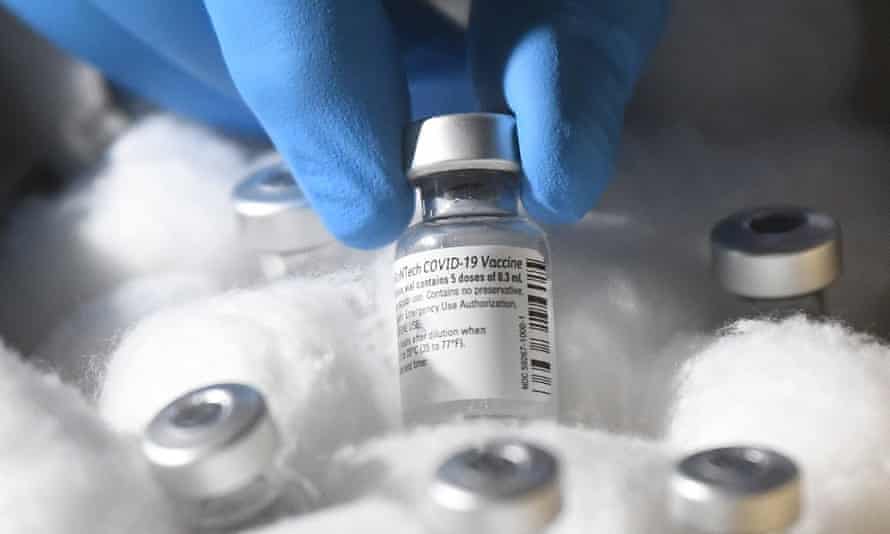
Pfizer-BioNTech vials at a British vaccination centre
Pfizer-BioNTech vials at a British vaccination centre, January. A Birmingham University blood analysis study of people over 80 found elevated antibodies when the booster was given after a three-month gap. Photograph: Neil Hall/EPA
Science editor
Guardian(UK)

The UK’s decision to delay second doses of coronavirus vaccines has received fresh support from research on the over-80s which found that giving the Pfizer/BioNTech booster after 12 weeks rather than three produced a much stronger antibody response.

A study led by the University of Birmingham in collaboration with Public Health England found that antibodies against the virus were three-and-a-half times higher in those who had the second shot after 12 weeks compared with those who had it after a three-week interval.

Most people who have both shots of the vaccine will be well protected regardless of the timing, but the stronger response from the extra delay might prolong protection because antibody levels naturally wane over time.

Dr Helen Parry, a senior author on the study at Birmingham, said: “We’ve shown that peak antibody responses after the second Pfizer vaccination are really strongly boosted in older people when this is delayed to 11 to 12 weeks. There is a marked difference between these two schedules in terms of antibody responses we see.”

In the first weeks of the vaccine programme the UK took the bold decision to delay administering booster shots so that more elderly and vulnerable people could more quickly receive their first shots.

The move was controversial because medicines regulators approved both the Pfizer/BioNTech and Oxford/AstraZeneca vaccines on the basis of clinical trials that spaced out the doses by only three or four weeks.

Researchers from Oxford University showed in February that antibody responses were more than twice as strong when boosters of their vaccine were delayed for 12 weeks. But the latest study is the first to compare immune responses after different timings with the Pfizer/BioNTech jab.

The scientists analysed blood samples from 175 over-80s after their first vaccine and again two to three weeks after the booster. Among the participants 99 had the second shot after three weeks, while 73 waited 12 weeks. After the second dose, all had antibodies against the virus’s spike protein, but the level was 3.5 times higher in the 12-week group.

The researchers then looked at another arm of the immune system, the T cells that destroy infected cells. They found that T cell responses were weaker when the booster was delayed, but settled down to similar levels when people were tested more than three months after the first shot. Details are published in pre-print form and have yet to be peer reviewed.

“This study further supports the growing body of evidence that the approach taken in the UK of delaying that second dose has really paid off,” said Dr Gayatri Amirthalingam, consultant epidemiologist at Public Health England.

“Individuals need to really complete their second dose when it’s offered to them because it not only provides additional protection but potentially longer lasting protection against Covid-19.”

The findings come as new data from Public Health England suggested that the vaccination programme had prevented 11,700 deaths by the end of April 2021 in those aged 60 and over, and at least 33,000 hospitalisations in those aged 65 and over in the same period.

“Overall, these data add considerable support to the policy of delaying the second dose of Covid-19 vaccine when vaccine availability is limited and the at-risk population is large,” said Eleanor Riley, professor of immunology and infectious disease at the University of Edinburgh.

“Longer term follow-up of this cohort will help us to understand which vaccine interval will be optimal in the future, once the immediate crisis is over.”

==================================================

Taiwan reports another record rise in domestic Covid-19 cases

Almost half the Australians booked on India repatriation flight barred after Covid tests

3h ago07:28

Updated at 7.37am BST

1 of 2

Newest

Older Oldest


The post T&T’s Deadliest Day, US CDC: Vaccinated People Can Go Maskless, More appeared first on The St Kitts Nevis Observer.