Director of Public Prosecutions (DPP) Valston Graham has thrown out the case of Bribery and treating against government Minister Eugene Hamilton, brought by his political opponent Dr Terrance Drew, noting there was no realistic prospect for success.
Graham said the evidence in support of the complaints, was disclosed to him by Counsel for Dr. Drew, and on receipt of the evidence, he sought opinions from two independent, senior criminal experts.
“One of those experts comes from within the Federation and the other from outside of the Federation. In written opinions provided to me, both independent criminal experts concluded that neither the charge of Bribery nor that of Treating had any realistic prospect of success.
“They further concluded that the prosecution instituted by Dr. Drew amounted to an abuse on the process of the court.”
The DPP said he sought the opinions of independent Counsel, although not required by law to do so.
“My decision to do so, was made in my own deliberate judgment in the interest of fairness and transparency, and Dr. Drew’s own Counsel instructed a written “respectful request” for me to engage independent counsel to conduct the matter on behalf of my office. Having received the opinions, I undertook my own examination of the evidence, considered the opinions, the law, and the Prosecution Policy to prosecute.”
SANTIAGO, April 29 (Xinhua) — Latin America’s post-pandemic economic recovery requires structural reforms to achieve sustainable development, the Santiago, Chile-based United Nations Economic Commission for Latin America and the Caribbean (ECLAC) said on Thursday.
The Latin American and Caribbean region has been hit the hardest by the novel coronavirus disease, and the most damaged in economic and social terms, ECLAC officials said in the latest edition of the United Nations agency’s Spanish-language online magazine, Revista CEPAL.
“This is due to long-standing structural factors that have foreshadowed its dysfunctional style of development. Therefore, economic recovery will have to undergo, at the same time, significant productive, fiscal and institutional structural reforms, to advance in the configuration of a new style of inclusive and sustainable development,” according to the authors.
The authors of the article, ECLAC Executive Secretary Alicia Barcena and the Deputy Executive Secretary Mario Cimoli, virtually presented the latest edition of the magazine.
In the article titled “Structural asymmetries and the health crisis: The imperative of a transformative recovery for sustainable development in Latin America and the Caribbean,” Barcena and Cimoli said the pandemic hit a region already suffering from three structural crises: a social crisis reflected in high levels of inequality; an economic crisis reflected in the region’s low growth; and technological lag compared to advanced countries and (increasingly) compared to some Asian economies.
“These three crises and the policies necessary to overcome them interact with each other. Changing the style of development in the region requires coordinated action on all three,” they said.
The authors called for a “transformative” recovery toward sustainable development that leaves behind the existing development style.
“Leadership is required that … promotes solidarity among nations, strengthens regional integration, fulfills international agendas, including the 2030 Agenda for Sustainable Development, and links the (health) emergency with the recovery,” they said
Two women were shot dead while a woman and a child were hospitalised after an attack on a bus on St John’s Road in St Catherine Thursday evening.
The Jamaica Observer was told that the bus was transporting people who had attended the burial of an alleged gangster who was killed in central Kingston recently.
On their way from the burial the bus was ambushed by armed men who opened fire indiscriminately.
When the shooting ended the three women and the child were found nursing gunshot wounds.
They were taken to hospital where the two women were pronounced dead and the other woman and the child rushed into surgery.
A stampede at a religious festival in Israel has killed dozens of people. AP is covering the latest developments in one of the country’s deadliest civilian disasters.
As India’s staggering virus numbers rise, scientists are urging Prime Minister Narendra Modi to release data on sequencing, testing and vaccines.
And in the U.S., resistance to making President Joe Biden’s proposed child tax credit permanent shows that even in a White House that embraces big government, there are some limits.
ALSO
Disneyland reopens in California after 13-month closure
JERUSALEM (AP) — An Israeli rescue service says a total of 44 people have been killed in a stampede at a religious festival in northern Israel. Motti Bukchin, spokesman for the Zaka ambulance service, confirmed the death toll in an interview on…Read More
WASHINGTON (AP) — President Joe Biden couldn’t get everything he wanted into his own $1.8 trillion families plan. His proposed child tax credit is set to expire after 2025. It would provide parents with $300 a month for each child under 6 and $…Read More
NEW DELHI (AP) — India’s coronavirus cases climbed again Friday, prompting the army to open up its hospitals in a desperate bid to control a massive humanitarian crisis created by an acute shortage of beds, medicines and oxygen. With 386,452 ne…Read More
ANAHEIM, Calif. (AP) — Four months ago, America’s most populous state was struggling to combat a surge in coronavirus hospitalizations that packed patients into outdoor tents and killed hundreds of people each day. On Friday, Disneyland, Califo…Read More
KABUL, Afghanistan (AP) — After 20 years, America is ending its “forever war” in Afghanistan. Announcing a firm withdrawal deadline, President Joe Biden cut through the long debate, even within the U.S. military, over whether the time was righ…Read More
No suspense at the top of this NFL draft: Quarterback, quarterback and, yep, quarterback. With fans in attendance, prospects on hand and Commissioner Roger Goodell dispensi…Read More
RIO DE JANEIRO (AP) — For most of this month, intensive care units across Brazil were at or near capacity amid a crush of COVID-19 patients, and sedatives needed to intubat…Read More
WASHINGTON (AP) — The family and representatives of Black men slain by the police met with senators and White House officials Thursday — and left optimistic that police ref…Read More
ELM GROVE, Wis. (AP) — Standing on the sidelines of her son’s soccer practice in this upscale suburb , Laura Hahn looked skyward for answers when asked how she would rate P…Read More
BBC- At least 44 people have been killed in a crush at a crowded religious festival in the north-east of Israel.
Dozens more were injured at the Lag B’Omer festival, which takes place annually at the foot of Mount Meron.
Prime Minister Benjamin Netanyahu described it as a “heavy disaster” and has travelled to the scene.
Tens of thousands of Orthodox Jews attended the festival, making it the largest event in Israel since the coronavirus pandemic began.
The country’s successful vaccination programme has allowed it to lift many restrictions, but health officials had still warned of the risk of Covid-19.
Early reports suggested a structure at the site had collapsed, but emergency officials later said a crush had occurred at around 01:00 local time (22:00 GMT Thursday).
Police sources told Haaretz newspaper that it started after some attendees slipped on steps, which caused dozens more to fall.
image copyrightGetty Images
image captionWitnesses said some people fell down a crowded set of steps
“It happened in a split second; people just fell, trampling each other. It was a disaster,” one witness told the newspaper.
Videos posted online show thousands of people struggling to flee through a narrow passageway.
Loudhailer messages urged the crowds to disperse, before police requested the full evacuation of the site.
“No-one imagined that this could happen here,” one pilgrim told Channel 12 TV. “Rejoicing became mourning, a great light became a deep darkness.”
Dozens of ambulances attended the scene as emergency services laid out bodies under foil covers on the ground. Helicopters took the injured to hospital, while the military said search-and-rescue troops had also been deployed.
A gunfight in an Ecuador prison has left five inmates dead and 15 injured, the latest deadly incident in the country’s overcrowded jails.
The violence in a prison in Guayaquil took place in a sector where members of the Los Choneros gang are held.
It happened shortly after a lawyer for the gang was shot dead in the capital.
In February, simultaneous fights at four prisons left 79 dead. The violence shocked the country and exposed the power of gangs operating in the jails.
Wednesday’s violence happened at 10:00 local time (15:00 GMT) at Penitenciaría del Litoral, and authorities are investigating whether it is linked to the killing of the lawyer in Quito.
The prison authority said 37 inmates were being investigated. Security was reinforced in prisons across the country.
The Penitenciaría del Litoral was one of the four jails where February’s violence took place, the deadliest incident in the country’s prisons in years. It is believed the fights were prompted by a battle for control of the jails after a gang leader was killed in December.
Ecuador’s prison system has capacity for 29,000 inmates but a prisoner population of 38,000, according to AFP news agency. There are 1,500 guards to oversee them, a shortfall of about 2,500, according to exper
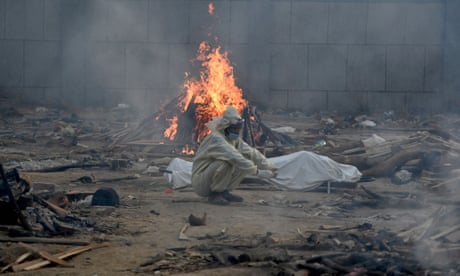
They will be remembered as India’s lost months: the stretch between September and February when Covid-19 cases in the country defied global trends, falling sharply throughout the coldest months of the year until they reached four-figure daily totals.
It was inexplicable. Was it the Indian climate? A protection conferred by childhood immunisations? Some speculated India may have naturally reached herd immunity. It was a tantalising idea that took hold in India’s highest circles of policymaking, media and science – even a government-commissioned study suggested herd immunity may indeed have been achieved. It would prove one of the most fatal miscalculations of the Covid-19 pandemic so far.
Now, with daily cases crossing 360,000, and recorded deaths beyond 3,200 per day, many see the lull between Covid-19 waves as a cruel illusion. “The elections, religious festivals and everything else opened up completely,” says Sujatha Rao, a former secretary of the Indian ministry of health and family welfare. “That was a very bad mistake and we have paid a very dear price, a heavy price for that oversight.”
‘We are witnessing a crime against humanity’: Arundhati Roy on India’s Covid catastrophe
An outbreak the size of India’s second wave, apparently fuelled by Covid-19 variants that appear to be more infectious than earlier strains, would have overwhelmed most public health systems – let alone one of the most chronically underfunded in the world, serving a vast, spread-out population.
But public health experts, including some involved in advising the government, say the scale of India’s current outbreak was also partly manmade, the result of a feeling of exceptionalism that emanated from the top of the Indian government and rippled across society, leading to countless administrative and personal decisions that, within a few months, would prove disastrous.
“There was a misreading of the situation in January that we had attained herd immunity and were unlikely to see a second wave,” says K Srinath Reddy, the president of the Public Health Foundation of India. “India went into full-blown celebratory mode. And we know the virus travels with people, and celebrates with crowds.”
Alongside warnings that people should maintain precautions, governments at all levels relaxed restrictions, allowed massive social events to resume and pressed ahead with raucous electioneering, confident the continued circulation of Covid-19 in states such as Kerala or Maharashtra were the dying embers of the virus, not evidence of the sparks that would ignite a second firestorm.
“There was a lot of mixed messaging coming through which made people very complacent,” Shahid Jameel, a virologist at Ashoka University, told a forum there on Tuesday. Some politicians and scientists boasted of low infection and death rates that gave Indians the impression “that somehow we are special”, Jameel added. “We are not special.”
Supermodels and herd immunity
Given India’s youthful population, Covid-19 death rates were expected to be smaller than elsewhere. But official numbers during the first wave were exceptionally low. In Karnataka, a state with a similar population to France, seroprevalence studies have suggested nearly half of people were infected by August. Yet the state’s Covid-19 death toll was about 12,000 last year, compared with the more than 60,000 people who died from the virus in France over the same period.
Studies are already beginning to understand the extent to which official Indian records of that time were unreliable. Ramanan Laxminarayan, the founder and director of the Centre for Disease Dynamics, Economics and Policy in Washington DC, told the Ashoka University panel that a forthcoming study of Indian mortality rates suggested the country had not escaped the first wave so unscathed.
“[The study shows] Indians are not exceptional at all,” he said. “In fact a lot of our mortality is in that 40-70 age group, where our mortality rates are higher than for other countries.”
The belief that India may have shaken off Covid-19 for good was bolstered by some scientists. Members of a committee established by the government to create a “supermodel” of Indian cases published a study in September claiming their model showed India may have already reached herd immunity. Others made a similar argument in newspaper columns.
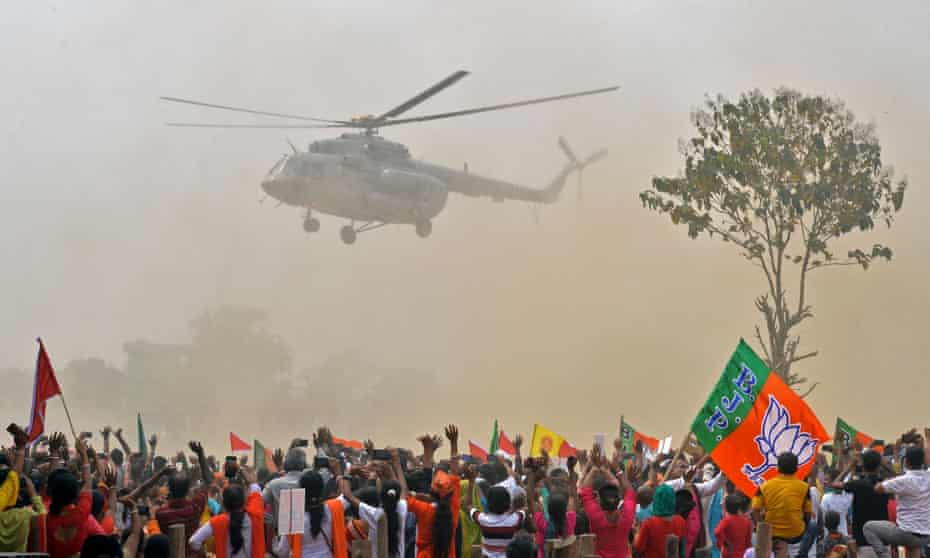
Supporters wave to a helicopter carrying the Indian prime minister, Narendra Modi, at a rally for West Bengal’s state legislative assembly elections, at Kawakhali on the outskirts of Siliguri, on 10 April. Photograph: Diptendu Dutta/AFP/Getty Images
“The idea that India had hit herd immunity, that we only needed to be careful and we could eradicate the virus by February, and the implicit assumption that Indians were ‘exceptional’ in some way – in that most of those infected would be asymptomatic as a result of genetics or prior exposure – all of this was wrong,” says Gautam Menon, an expert in disease modelling at the Institute of Mathematical Sciences in Chennai.
It was part of a stream of scientific advice flowing to the government, including more critical views warning there were still hundreds of millions of susceptible Indians, and that future strains of the virus could be more aggressive, as they had been in Europe and the US.
“But you must understand in which environment this advice landed,” Reddy said. “The Indian economy had gone into a slump before the pandemic. It had challenges during the pandemic, and it was just beginning to show some signs of recovery. There was some sense of urgency by the people in charge of the Indian economy, as well as industry leaders, to put it back on the rails.”
In that context, and with case numbers continuing to drop, “people heard what they wanted to hear”, says Reddy, who sits on the government’s national scientific Covid-19 taskforce.
“The politicians wanted to get back to their business, which is local elections and campaigning, the sportsmen wanted to get back to cricket tournaments,” he said. “There was a receptivity to any scenario predicting a full recovery with little possibility of a second wave.”
By late February, with official caseloads dwindling, life in India had been allowed to return to something close to normal. Malls in Delhi and Mumbai were busy. Crowds filed into cricket stadiums, including the largest in the world, named after the Indian prime minister, Narendra Modi.
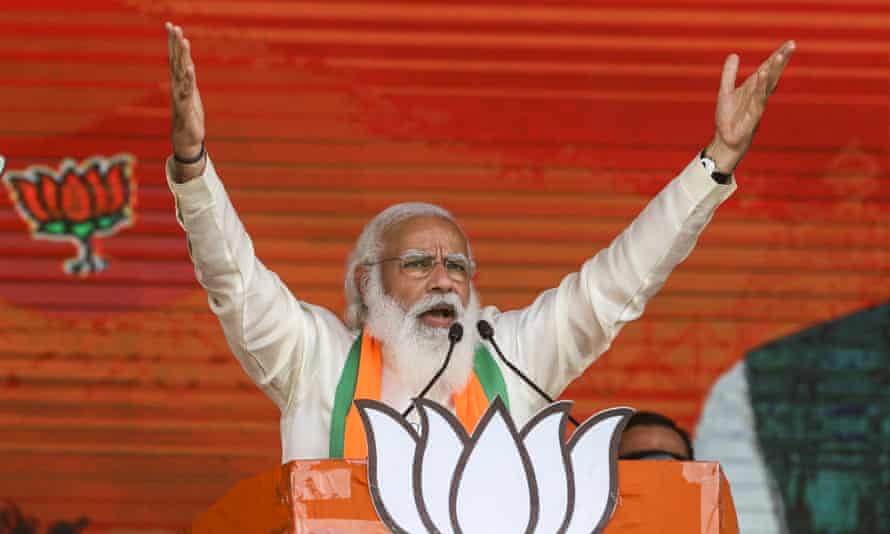
Narendra Modi boasted of the size of the crowds he would address on the campaign trail. Photograph: Bikas Das/AP
In spite of warnings in November by an Indian parliamentary committee that the numbers of beds in government hospitals was “abysmally small”, four temporary hospitals in the capital were dismantled, according to the Indian Express, along with an 800-bed hospital in Pune and a Covid-19 facility in Assam state.
“There was this huge window of opportunity to really set ourselves up,” Rao says. “The time could have been used on a very focused approach to scale up readiness for wave two. [But] we thought we were over the worst and had managed it.”
For a stretch between 11 January and 15 April, the country’s national scientific taskforce on Covid-19, which advised on quarantine policies and testing and treatment protocols, did not hold a single meeting, according a report in the Caravan, confirmed by the Guardian.
‘God will overcome the fear of the virus’
In West Bengal, a state considered a prize for Modi’s ruling Bharatiya Janata party (BJP), India’s election commission overruled opposition parties and gave permission for the country’s longest-ever regional election campaign, along with elections in four other states and territories. Modi himself boasted of the size of the crowds he would address in the weeks to come. By the beginning of this week, West Bengal had the fastest growing Covid-19 outbreak in India. On Thursday, voting went ahead anyway.
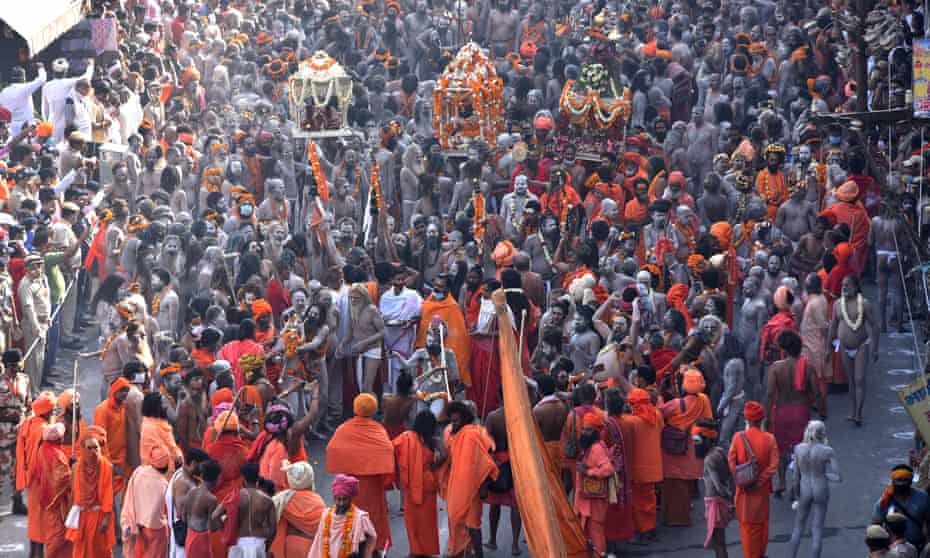
Approval was also given for the Kumbh Mela, a religious festival in a north Indian city on the banks of the River Ganges that would draw millions of Hindu pilgrims. For the BJP, a party that seeks to give primacy to India’s Hindu heritage, the go-ahead for the festival was highly symbolic. The event was advertised as clean and safe on the front page of national newspapers in advertisements that bore Modi’s face.
Tirath Singh Rawat, the chief minister of the state where the Mela was being held, encouraged as many as possible to come. “Nobody will be stopped in the name of Covid-19, as we are sure the faith in God will overcome the fear of the virus,” he said. Recorded infections in the state have jumped 1,800% over the past 25 days.
In its public statements, few groups were more certain in their conclusion that the pandemic was over than the ruling BJP. At a meeting of its national executive early in the year, with its eye on the upcoming elections, the party issued nothing less than a victory cry.
Indian holy men, or Naga Sadhu, make their way to take a holy dip in the Ganges River during the Kumbh Mela at Haridwar, Uttarakhand, India, on 14 April. Photograph: Idrees Mohammed/EPA
In the face of the world “speculating over how India with its vast population and limited healthcare infrastructure” would deal with the pandemic, according to a party resolution, it could be “said with pride that India [had] defeated Covid under the able, sensitive, committed and visionary leadership of Prime Minister Narendra Modi”.
The resolution was issued on 21 February, a day when 14,199 cases were recorded across India. Two months later, the figure would be 314,644.
01:23
India: tearful relatives beg for oxygen and hospital beds for Covid patients – video
The same feeling that the worst was over seemed to influence a lack of urgency in the country’s vaccination programme. Despite having almost a year to build vaccine infrastructure to reach Indian adults, the rollout started slowly. The government trumpeted vaccine giveaways to rival China’s influence in south Asia, while getting its hands on fewer than a hundredth of the doses required to vaccinate India, counting on securing the rest later as younger groups become eligible for shots.
There had been dissent to this triumphalism among the country’s top scientific advisers, according to several sources, but in public they strove to put the best face on the situation. Such an impulse was not unique to the Indian outbreak, but was so distinct there that the Lancet warned in a September editorial that persistent “false optimism” risked undermining the country’s response.
“We don’t know what they did behind closed doors, but in the weekly Covid briefings of the health ministry, [advisers] came out day after day giving us data about how cases per millions and deaths per million in India were the lowest in the world,” said Abantika Ghosh, the health editor of the Indian news website the Print.
“But they would give us numbers of testing and vaccinations in absolute numbers, because in a per-million setting, they don’t look impressive, they’re quite low. Questions were sidestepped. There was this compulsion, it seemed, to look away from science, from evidence the world over and just establish that India is different.”
=============================================
Costa Rica to close non-essential businesses next week over COVID-19
Reuters
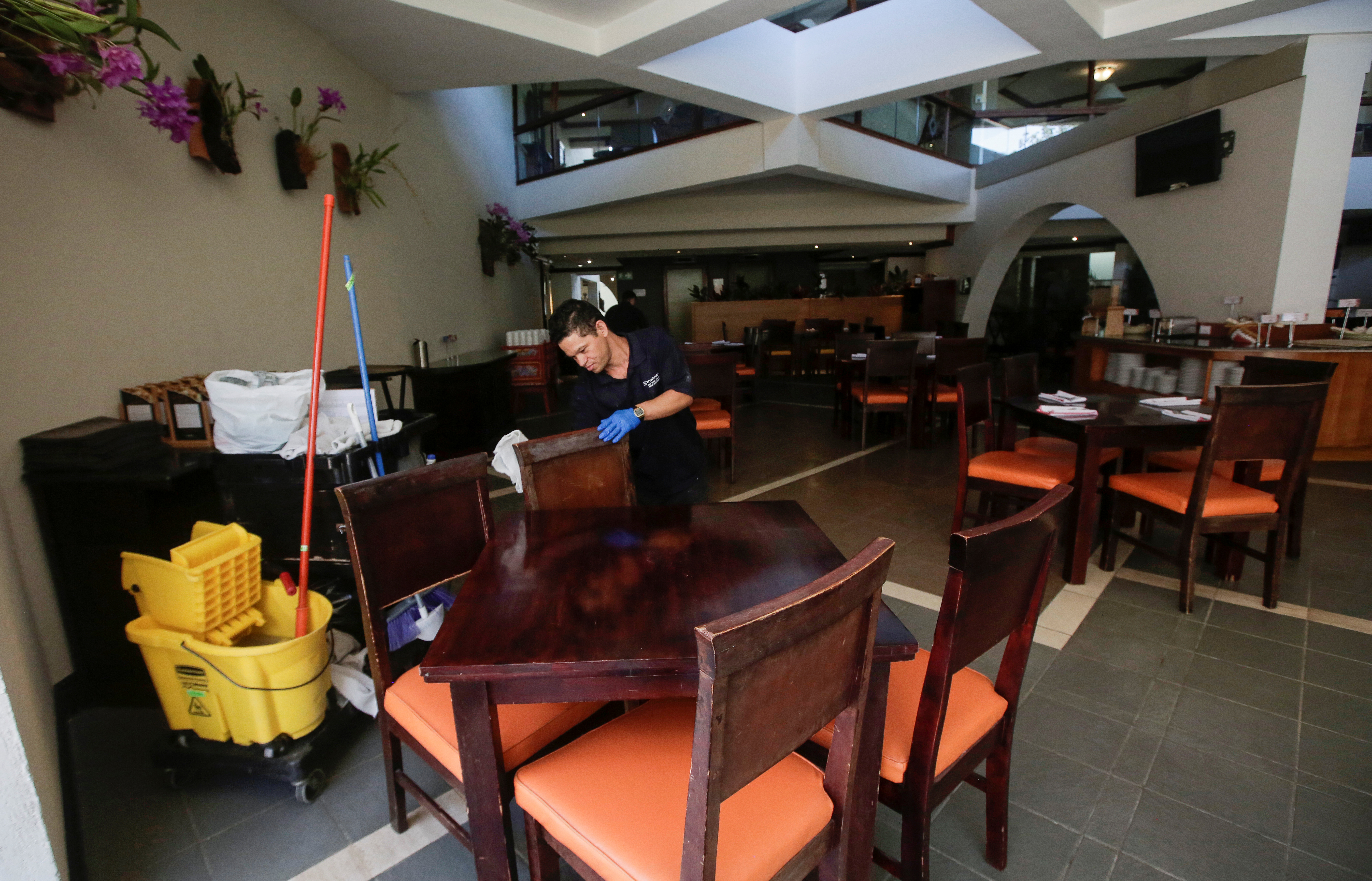
An employee cleans a restaurant chair in a hotel, as Costa Rica tourism industry braces for coronavirus disease (COVID-19) outbreak, in Heredia, Costa Rica March 18, 2020. Picture taken March 18,2020. REUTERS/Juan Carlos Ulate
Costa Rica will for the next week close non-essential businesses, including restaurants and bars, across the center of the country due to a sharp increase in new cases of COVID-19 and hospitalizations, the government said on Thursday.
From May 3-9, restaurants, bars, department stores, beauty salons, gyms and churches must close in 45 municipalities in central Costa Rica, where almost half the population lives and over two-thirds of new cases have been registered.
“We are in an unprecedented situation, and many people are going to die,” Health Minister Daniel Salas said after announcing 2,781 new daily infections, a record number. “There are already waiting lists to enter intensive care.”
The government will also impose travel restrictions during the week.
Costa Rica has so far reported almost 249,000 cases of COVID-19 and some 3,200 fatalities.
Some 10.5% of the population had been vaccinated as of Thursday, most of them over the age of 58, official data show.
LONDON (AP) — Novels that explore forgotten and neglected communities in Britain, the U.S. and the Caribbean were named finalists on Wednesday for the 30,000 pound ($42,000) Women’s Prize for fiction.
The six-book shortlist includes American author Brit Bennett’s tale of twins who take different paths, “The Vanishing Half,” U.S. writer Patricia Lockwood’s social media satire “No One is Talking About This” and “Transcendent Kingdom,” a story of African immigrants in Alabama by Ghanaian-American writer Yaa Gyasi.
Also in the running are Barbadian writer Cherie Jones’ story of gritty life on a beautiful island, “How the One-Armed Sister Sweeps Her House,” and two books by British writers: Susanna Clarke’s literary fantasy “Piranesi” and Claire Fuller’s rural family saga “Unsettled Ground.”
Booker Prize-winning novelist Bernardine Evaristo, who is chairing the judging panel, said several of the novels depicted “communities that aren’t really written about in fiction” and tough subjects such as domestic violence, addiction and depression.
“But they’re not miserable books,” she said. “They’re all really beautifully crafted stories. … They’re not lightweight, but they are a thrilling read.”
Founded in 1996, the prize is open to female English-language writers from around the world. Previous winners include Zadie Smith, Tayari Jones and Maggie O’Farrell.
Only one of this year’s finalists, Fuller, has published more than two books. Bennett, Clarke and Gyasi are nominated for their second published novels, while Lockwood and Jones are debut novelists.
Evaristo said the five judges “weren’t looking at whether they were debut novels. We weren’t even looking at the authors. It was the books, and whether the books spoke to us.”
“I think it might speak to the fact that perhaps there aren’t as many older women writers who have had long careers getting published,” said Evaristo, who won the Booker Prize in 2019 with her eighth novel, “Girl, Woman, Other.”
“There always seem to be lots of debuts around, but sustaining a long career is something that’s perhaps harder to do.”
The winner of the 2021 Women’s Prize will be announced July 7 at a ceremony
KINGSTOWN, St. Vincent (AP) — Heavy rains poured down on the island of St. Vincent and the Grenadines on Thursday, causing flooding and mudslides that damaged some homes and further battered areas already burdened by heavy ashfall from eruptions of La Soufriere volcano.
Authorities said there were no reports of deaths or injuries as the storm deluged the Caribbean nation for hours, with some areas receiving from 3 inches (7.5 centimeters) to 5 inches (12.5 centimeters) of rain. Forecasters warned that an additional 2 inches (5 centimeters) were possible over the next 24 hours.
There were reports of caved-in roofs and some structures wrecked by landslides and flooding in rural areas, and authorities said bridges also sustained damage. Problems in Kingstown, the capital, were confined to high water.
“I drove my vehicle into Kingstown this morning. However, if the flood doesn’t clear, I may have to leave it in the city,” said Darren Williams, a salesman.
The troubles follow a series of eruptions at La Soufriere that began April 9 and blanketed parts of St. Vincent island with heavy ash that has damaged buildings and ruined farm fields. Over 20,000 people have had to leave their homes and the water supply and electricity were disrupted.
Roderick Stewart, a volcano seismologist at the University of the West Indies Seismic Research Center, said on the state radio station that monitoring equipment had registered indications of lahars, dangerous slides of fast-moving volcanic ash turned into slurry by the rainstorm.
“Our seismometers have been picking up signals from lahars in several locations, so we suspect there are lahars in all the major drainages and it may have caused quite a lot of damage as it passed down from the volcano into the sea,” Stewart said.
He said the volcano itself had been relatively quiet recently.
“It does seem to be going back — I won’t say to sleep, cause that’s a bit hopeful — but it does seem to be quieting down,” Stewart said.
==========================================
UN Adopts Resolution of Solidarity
The United Nations General Assembly (UNGA) on Wednesday adopted a resolution in solidarity with and support for the Government and people of St Vincent and the Grenadines, as well as neighbouring countries affected by the impact of the eruptions of the La Soufriere volcano.
Guyana’s Permanent Representative to the UN and chair of the Caribbean Community (CARICOM) caucus, Carolyn Rodrigues-Birkett, introduced the resolution on behalf of the 14-member regional integration grouping.
The resolution received overwhelming support, with 174 of the 193 member states co-sponsoring the resolution, which was adopted by consensus.
In her statement, Ambassador Rodrigues-Birkett highlighted the “deep concern about the serious consequences of the explosive eruptions of the La Soufrière volcano …since April 9, 2021 which has resulted in the displacement of residents, loss of livelihoods, food security and nutrition, health security, and access to social infrastructure, and about the urgent need to restore normal conditions for the population.”



 *****@
 *****@
 *****@

 *****@
 *****@
 *****@

 *****@
 *****@
 *****@

 *****@
 *****@
 *****@